Complacency and American Girl Dolls 2

It’s time to revisit American Girl Dolls and the Saturn V rocket. The trending topic among millennials is the new “historical” American Girl doll who lives in the year 1999.

Previously, I blogged about the historical Courtney doll from 1986 in “Complacency and American Girl Dolls.” I used Courtney’s accessories to illustrate stagnation in the physical environment (within rich countries) of recent decades. Courtney has a Walkman for playing cassette tapes and she has an arcade-style Pac-Man game to entertain herself. I pointed out that ’80’s Courtney had to be given the World War II doll Molly just to keep life interesting.

What do Isabel and Nicki have a decade later in 1999?  

They have a personal CD player and floppy disks. It’s cute and the toys will sell. However, it does not seem like innovation has introduced many new capabilities. Isabel can listen to music through her headphones and be entertained on screens, just like Courtney could.

Isabel eats Pizza Hut and has dial-up internet access. There is no sense of sacrifice or expanding the frontier. The world was settled, and history had ended.  

What counts for adventure in 1999? Shopping vintage clothing. Just like Courtney, Isabel revisits the past to get a sense of purpose or excitement.

This is Isabel’s diary. Having nothing to do besides look at clothes from past decades, she obsesses over status. Presumably “Kat” complimented her hat in person. Facebook didn’t start until 2004, so Isabel is not worried about “Likes” in social media.

So, what did I do with my kids for their school break on Presidents’ Day?  We went to the U.S. Space and Rocket Center to see the Saturn V rocket.

Continue reading

The Economics of Brushing Teeth and the Tooth Fairy

There are many papers with titles in the style of “The Economics of X” with X covering a wide variety of topics, some deadly serious (“Economics of Suicide“) and others more trivial or unintentionally hilarious (“The Economics of Sleep and Boredom” comes to mind). There is a related genre of papers on “The Political Economy of Y,” once again with papers that are both serious and occasionally silly (or sometimes deadly serious papers with silly-sounding titles, such as “The Political Economy of Coffee, Dictatorship, and Genocide“).

But perhaps the best paper of this sort is a 1974 article on the Journal of Political Economy by Alan Blinder, titled “The Economics of Brushing Teeth.” It is, as you might guess, a paper that is somewhat tongue-in-cheek (tongue-in-teeth?), but the paper carefully follows the formal style you would expect from a JPE paper in 1974. I recommend reading the paper in full, and I can assure you that it is not at all like pulling teeth. But if you prefer not to look a gift horse in the mouth, here are a few favorite parts.

The paper is, of course, full of tooth-related puns, even in the footnotes, such as this acknowledgment: “I wish to thank my dentist for filling in some important gaps in the analysis.”

There are also plenty of jokes about human capital theory, jokes that only an economist could love, such as: “The basic assumption is common to all human capital theory: that individuals seek to maximize their incomes. It follows immediately that each individual does whatever amount of toothbrushing will maximize his income.”

Another section manages to poke fun at both sociologists and economists. In reference to a fake paper (no, there is no Journal of Dental Sociology), Blinder chastises the fake sociologist for misattributing a change in brushing patterns (assistant professors brush more) to advancing hygiene standards over time. No! It must be about maximizing income: “To a human capital theorist, of course, this pattern is exactly what would be expected from the higher wages received in the higher professorial ranks, and from the fact that younger professors, looking for promotions, cannot afford to have bad breath.”

And what good is a paper without a formal model of teeth brushing? This is the kind of model that many young economists cut their teeth on in graduate school.

Continue reading

Online Reading Onpaper

We have six weekly contributors here at EWED and I try to read every single post. I don’t always read them the same day that they are published. Being subscribed is convenient because I can let my count of unread emails accumulate as a reminder of what I’ve yet to read.

Shortly after my fourth child was born over the summer, I understandably got quite behind in my reading. I think that I had as many as twelve unread posts. I would try to catchup on the days that I stayed home with the children. After all, they don’t require constant monitoring and often go do their own thing. Then, without fail, every time that I pull out my phone to catch up on some choice econ content, the kids would get needy. They’d start whining, fighting, or otherwise suddenly start accosting me for one thing or another – even if they were fine just moments before. It’s as if my phone was the signal that I clearly had nothing to do and that I should be interacting with them. Don’t get me wrong, I like interacting with my kids. But, don’t they know that I’m a professional living in the 21st century? Don’t they know that there is a lot of good educational and intellectually stimulating content on my phone and that I am not merely zoning out and wasting my time?

No. They do not.

I began to realize that it didn’t matter what I was doing on my phone, the kids were not happy about it.

I have fond childhood memories of my dad smoking a pipe and reading the newspaper. I remember how he’d cross his legs and I remember how he’d lift me up and down with them. I less well remember my dad playing his Game Boy. That was entertaining for a while, but I remember feeling more socially disconnected from him at those times. Maybe my kids feel the same way. It doesn’t matter to them that I try to read news articles on my phone (the same content as a newspaper). They see me on a 1-player device.

So, one day I printed out about a dozen accumulated EWED blog posts as double-sided and stapled articles on real-life paper.

The kids were copacetic, going about their business. They were fed, watered, changed, and had toys and drawing accoutrement. I sat down with my stack of papers in a prominent rocking chair and started reading. You know what my kids did in response? Not a darn thing! I had found the secret. I couldn’t comment on the posts or share them digitally. But that’s a small price to pay for getting some peaceful reading time. My kids didn’t care that I wasn’t giving them attention. Reading is something they know about. They read or are read to every day. ‘Dad’s reading’ is a totally understandable and sympathetic activity. ‘Dad’s on his phone’ is not a sympathetic activity. After all, they don’t have phones.

They even had a role to play. As I’d finish reading the blog posts, I’d toss the stapled pages across the room. It was their job to throw those away in the garbage can. It became a game where there were these sheets of paper that I cared about, then examined , and then discarded… like yesterday’s news. They’d even argue some over who got to run the next consumed story across the house to the garbage can (sorry fellow bloggers).

If you’re waiting for the other shoe to drop, then I’ve got nothing for you. It turns out that this works for us. My working hypothesis is that kids often don’t want parents to give them attention in particular. Rather, they want to feel a sense of connection by being involved, or sharing experiences. Even if it’s not at the same time. Our kids want to do the things that we do. They love to mimic. My kids are almost never allowed to play games or do nearly anything on our phones. So, me being on my phone in their presence serves to create distance between us. Reading a book or some paper in their presence? That puts us on the same page.
College Major, Marriage, and Children Update

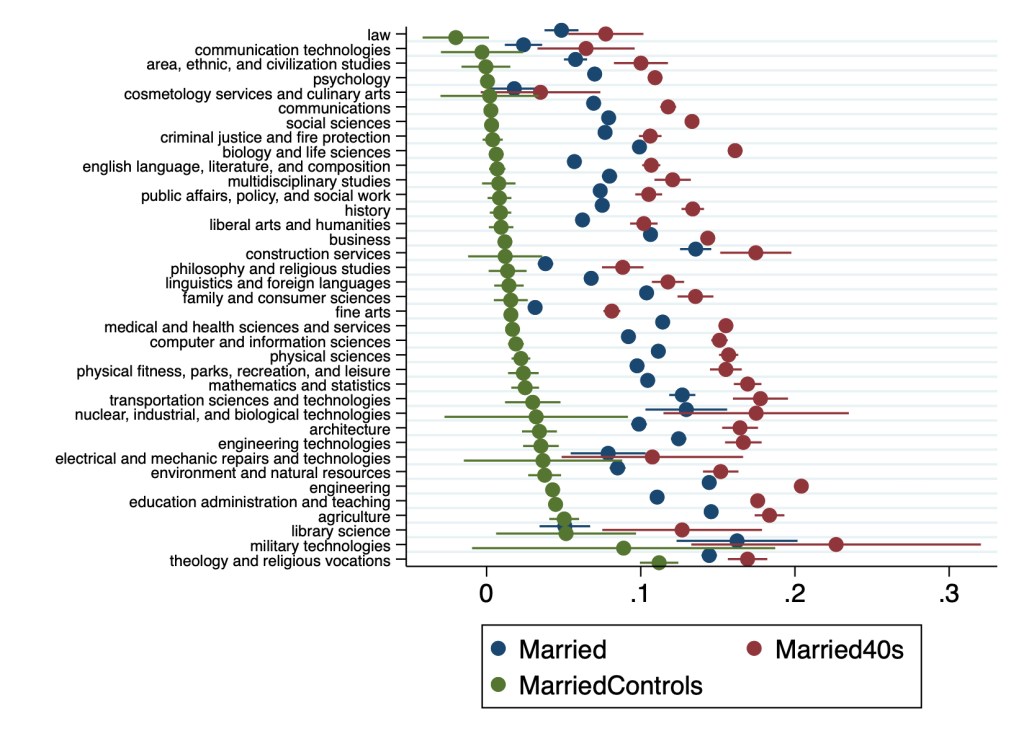
In a May post I described a paper my student my student had written on how college majors predict the likelihood of being married and having children later in life.

Since then I joined the paper as a coauthor and rewrote it to send to academic journals. I’m now revising it to resubmit to a journal after referee comments. The best referee suggestion was to move our huge tables to an appendix and replace them with figures. I just figured out how to do this in Stata using coefplot, and wanted to share some of the results:

Points represent marginal effects of coefficient estimates from Logit regressions estimating the effect of college major on marriage rates relative to non-college-graduates. All regressions control for sex, race, ethnicity, age, and state of residence. MarriedControls additionally controls for personal income, family income, employment status, and number of children. Married (blue points) includes all adults, others include only 40-49 year-olds. Lines through points represent 95% confidence intervals.
Points represent coefficient estimates from Poisson regressions estimating the effect of college major on the number of children in the household relative to non-college-graduates. All regressions control for sex, race, ethnicity, age, and state of residence. ChildrenControls additionally controls for personal income, family income, employment status, and number of children. Children (blue points) includes all adults, others include only 40-49 year-olds. Lines through points represent 95% confidence intervals.

Many details have changed since Hannah’s original version, and a lot depends on the exact specification used. But 3 big points from the original paper still stand:

  1. Almost all majors are more likely to be married than non-college-graduates
  2. The association of college education with childbearing is more mixed than its almost-uniformly-positive association with marriage
  3. College education is far from uniform; differences between some majors are larger than the average difference between college graduates and non-graduates

Farewell to the First Normal Semester in 3 Years

Today as I gave my last final and took my kids to a huge school party, it struck me that things are finally back to something like 2019 levels of normality.

2020 was a lost cause, of course. I had high hopes for 2021 that vaccines would immediately get us back to normal. They did get my school back to fully in-person by Fall 2021, but not really back to normal, partly thanks to the variants. My students were out sick more than normal, and I was out watching my sick kids more than normal, as every cold meant they would be home until the school was sure it wasn’t Covid. Toward the end of the Spring 2022 semester worries were subsiding, and my state was pretty much fully re-opened, but things still weren’t really back to normal. Student attendance and effort were still way below normal, partly from the lingering effects of Covid, and partly from celebrating its end- partying to make up for lost time (and cheering on a great basketball team).

Fall 2022 finally felt like a basically normal semester. I still see the occasional mask, still hear from the occasional student out with Covid, and still have one kid missing 2 school days with every cough (policies stricter than 2019, but much relaxed from the days when both kids were at schools that could have them miss 5+ days with every non-Covid cough). Overall though student attendance and effort are back to what seem like normal levels. Up to Spring 22 I’d have students just disappear for a few weeks, not in class, not answering e-mails about why they weren’t showing up or completing work, needing lots of help to get on track once they finally reappeared. This Fall that didn’t happen; in my Senior Capstone everyone turned in a quality paper basically on-time and without me having to chase anyone down for it. Also, everyone just seemed happier now that their stress levels are back down to the baseline for college students.

This semester was nothing special- and that was beautiful.

EWED Recommends Gifts 2022

Every year I request posts about stuff the writers actually use. My logic is that a great wave of stuff-buying is coming, so let’s try to highlight the good items and reduce holiday waste.

For Children

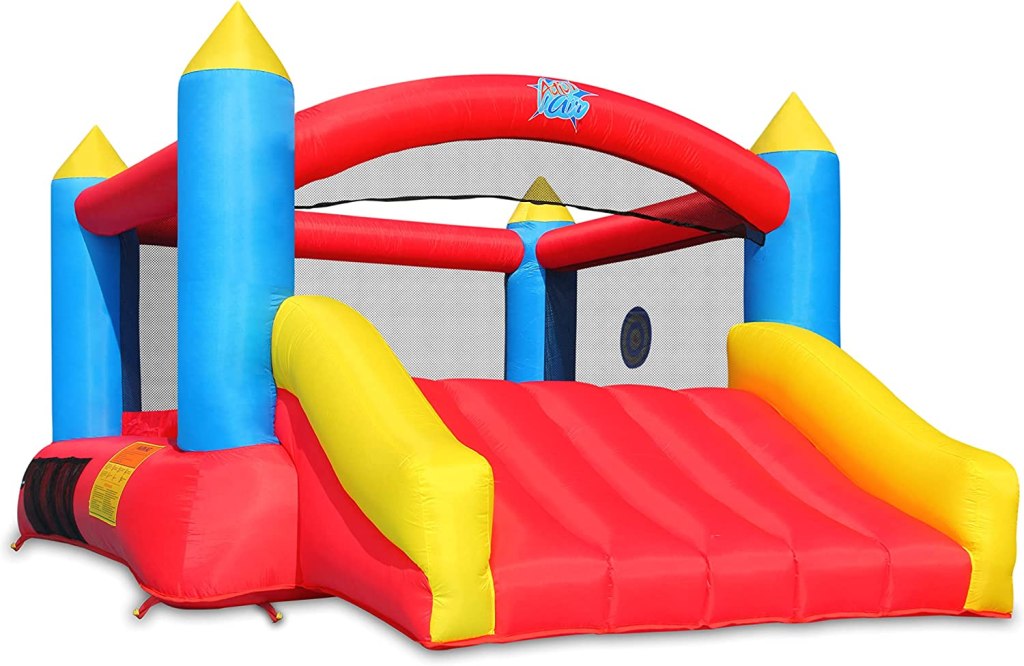
James recommends buying a whole bounce house. It might seem like something you could only afford to rent once a year, but the price of buying one you can use at home is now less than $300. In a big room, you can even do this indoors. Be the Christmas hero. Check on the space requirements.

I recommend two games that help kids learn to read. These are a great complement to Kindergarten or 1st-grade reading assignments. With enough confidence, you can convince kids that these games are toys and not “a book?”.

Sight Word Swat

Zingo sight words

SPOT IT is a card game that takes up almost zero space in the house or car. No reading or numeracy required and yet fun for adults!

Phantom Toll Booth A book for school-aged kids.

Little Tikes Easy Store Picnic Table with Umbrella, Scott says it’s worth the price if you have young kids around the house. Let them do messy food or activities there.

Food

Sounds like a good gift for adults who like to cook. Scott found a relatively affordable Black Rice.

Office to Garden

Compressed gas for computer maintenance. See Scott’s explanation on PC care.

Velcro Cut to Length – Zachary suggests: “Do you have a phone charger beside your bed that keeps falling on the ground? Just Velcro it to the nightstand lamp and it will stay exactly where you want it.”

Minute Soil is better than the dirt you have. This makes growing plants more fun and easier. Sounds like a great gift to wrap up for someone who likes gardening.

Set for Life

I agree with Zachary that cordless men’s hair clippers are a great investment.  

Barge All Purpose TF Cement Rubber – Praise from Scott: “Unlike most “superglues”, it will work on rough or porous surfaces, including situations like leather where flexibility is needed.”

Qwix Mix windshield – Windshield wiper fluid concentrate that is easy to store at home for when you need it.

Stoner Car Care 91154 10-Ounce Tarminator Tar, Sap, and Asphalt Remover Safe on Automotive Paint and Chrome on Cars, Trucks, RVs, Motorcycles, and Boats

Lastly, Mike has some correct life advice. Give yourself what your future self would want. For example, if you enjoy video games but don’t exercise enough, then try setting up an exercise bike right in front of your video games. That way you’ll get your cardio in and not have regrets the next week.

Bounce Houses are Surprisingly Cheap

Last year was the first time I saw a family that owned their own bounce house and just set it up in their living room. At the time I thought, what a lucky rich kid, that must cost at least a thousand dollars. But my wife looked into it and found out that bounce houses are surprisingly cheap these days. She got our kids this one last Christmas, its currently going for $234 on Amazon:

The kids love it and its still going strong ten months later, despite substantial use from kids and the presence of two sharp-clawed cats. It was certainly a bigger hit than the other major gift we tried last Christmas- telescopes are surprisingly hard to use.

Joy Recommends Stuff for Kids 2022

I recommend two games for teaching kids to read their “sight words”. In early school grades, learning sight words can mean doing boring homework or rote memorization of flash cards. Instead use

Zingo Sight Words

and

 Sight Word Swat 

These are both fun interactive games that will get kids reading and talking about sight words. Zingo Sight Words is easier, so I recommend starting there. It’s a lot like bingo with a fun plastic dispenser. Kids can do the matching task to win the game even if they are not yet confident with reading.

Sight Word Swat is a little more advanced but good for expanding vocabulary past the first 50 words. It’s fast paced and fun. Someone yells out a word and then two players compete to “swat” with a plastic mallet the correct “fly” that has the word. Also, if the kid isn’t competitive, they could swat the correct word without time pressure.

Next, I’ll recommend a game that will not remotely feel like an educational exercise. “Spot It” is a genius card game. The tin is small, so you can store it easily and travel with it. The game is easy to teach to new friends because it’s just matching visual patterns. Spot It requires zero reading – not even reading numbers. So, a kid as young as 4 could potentially jump in and start trying to get matches. One of the great things about Spot It is that you play a series of mini games. It’s not the nightmare of a Monopoly game that could take multiple days to finish. So, if you are a parent with limited time to spend on card games, you can parachute in and out quickly.

All of these items are under $20 and potentially all of them could make fun holiday gifts, although your mileage may vary for gifting books and getting smiles. Personally, I bought the sight word games when we needed them for learning instead of trying to make them Christmas gifts.

I had been looking forward to reading the Phantom Tollbooth with my kids for a long time. This is the kind of book that you should read as soon as they are ready to understand most of the action, but not before. If too much is going over their heads, then it isn’t fun. In my case, this book prompted a lot of questions and great conversations with the 7-year-old. The book will teach kids a lot, but if you keep your tone light it feels like just another adventure story.

6 Tips for Taming Your Inner Spock

The younger, high school and undergrad version of me was not the best person. My sense of humor was too dark and I didn’t much care about the experience of other people. When I went to grad school, I was so excited. I would finally be around other economists and I would be able to drop all of the niceties, empty social signals, and fuzziness that I thought non-economists employed. And I was oh so very wrong.

It turned out that economists are also human beings and that no amount of self-congratulatory Spock-praising would stop that from being the case. Indeed, with some candid feedback, I became convinced that I was in desperate need of the kind of prosocial norms that could help me to better produce social capital. In other words, I needed to figure out how to get along. Below is some advice that I’ve found pivotal. Maybe you can share it with another person who might be well-served by reading it too.

Below are six norms that are good to employ in order to improve social cohesion, agreeableness, and, frankly, better mental health. And these aren’t just for economists. I suspect that there are plenty of people (maybe young men) who can benefit from what took me too long to learn. So here we go!

Continue reading