What Counts As “In Shape”?

Given where we are starting from, the average American would probably be satisfied with a fairly low bar, like “not obese” or “can run a mile without stopping”. But the kind of person who writes about the topic a lot tends to be a fitness nut insisting on crazily high standards. So what makes for a reasonable middle-ground measure?

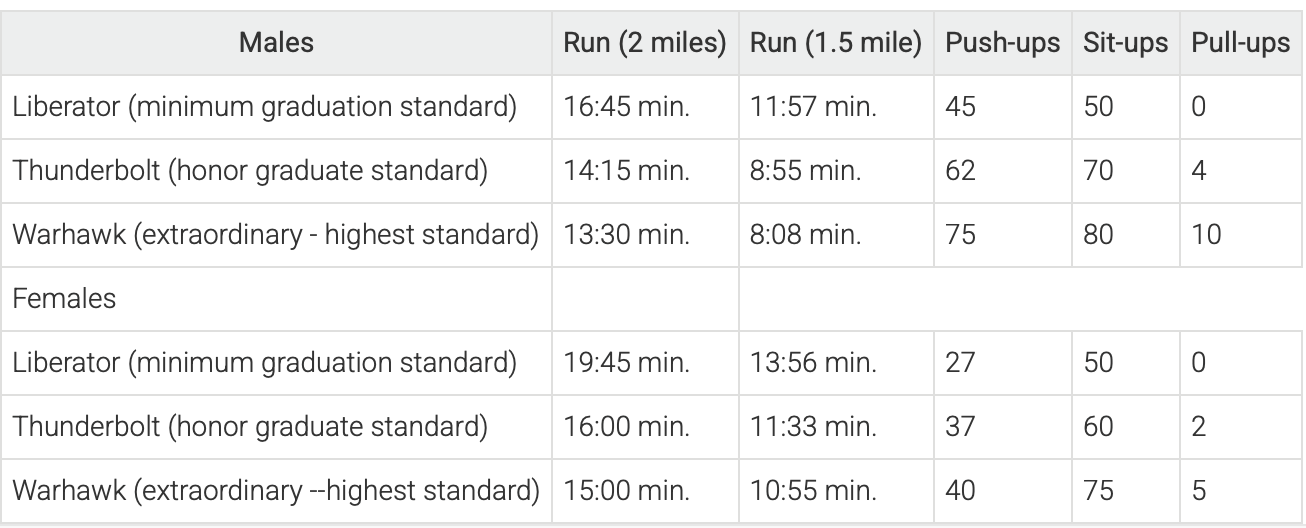
I think the US military’s standards do. They vary by branch and are changing, but here are some previous military fitness standards from the Air Force:

Pushups and sit-ups are how many can be done in one minute

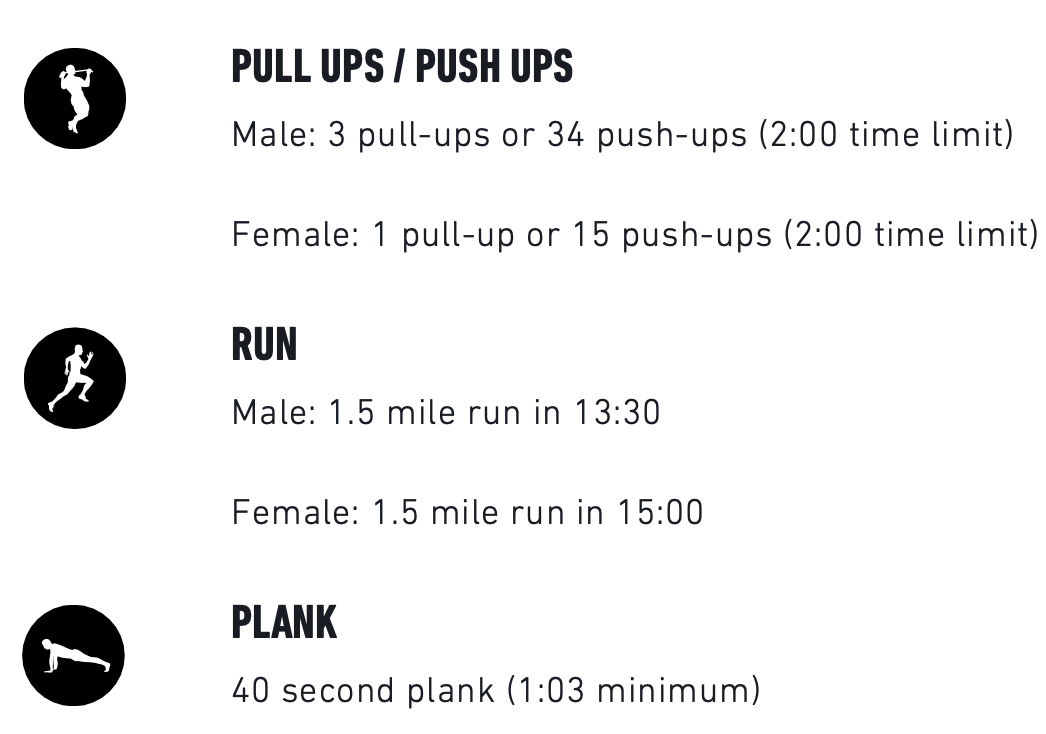
Here’s what the Marines expect from recruits before they show up for training:

The Army has a complex points system that varies by age and gender, but their minimum standards for a 20-year-old Male include: hex bar deadlift 150 lbs for 3 reps, 15 hand-release pushups within 2 minutes, plank for a minute 30, and a 2 mile run in 19:57 (plus their own sprint/drag/carry test in 2:28).

I like that the standards all involve a mix of strength and speed, and that they might take some work but should be achievable in a reasonable amount of time for a healthy person. I also like that they give stretch goals for the over-achievers in addition to their minimums.

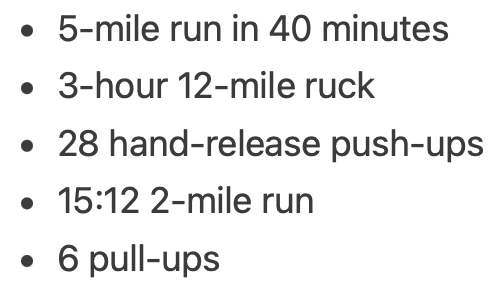
What about the real over-achievers, the ones who want to be not just “in shape” but “in great shape” or “in excellent shape”? For them, there are the special forces fitness tests. Here’s the Green Berets:

The Navy SEALs naturally add a swim:

I’m in no way an authority on any of this, but for what it’s worth, you have my permission to say you’re in shape if you can meet any branch’s minimum requirements.

$1 Million or I Quit: CTE Deaths in Football and Hockey

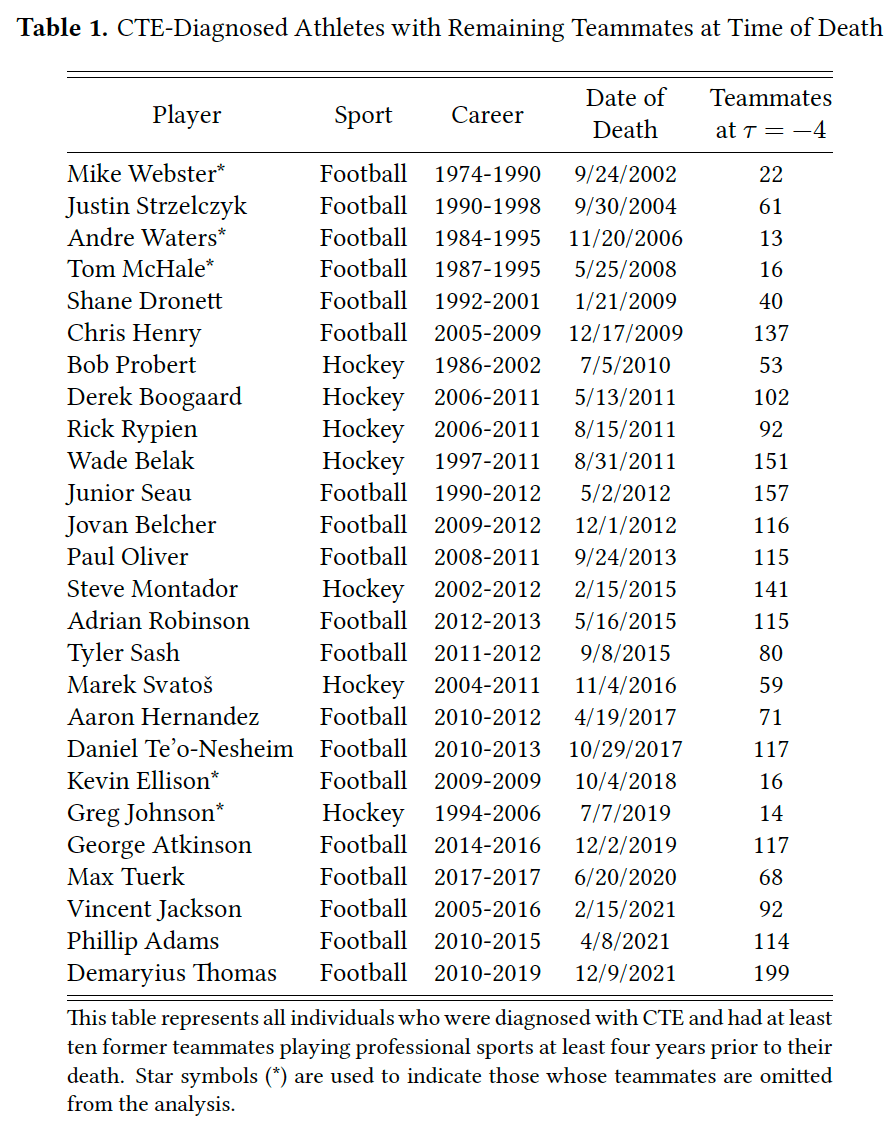
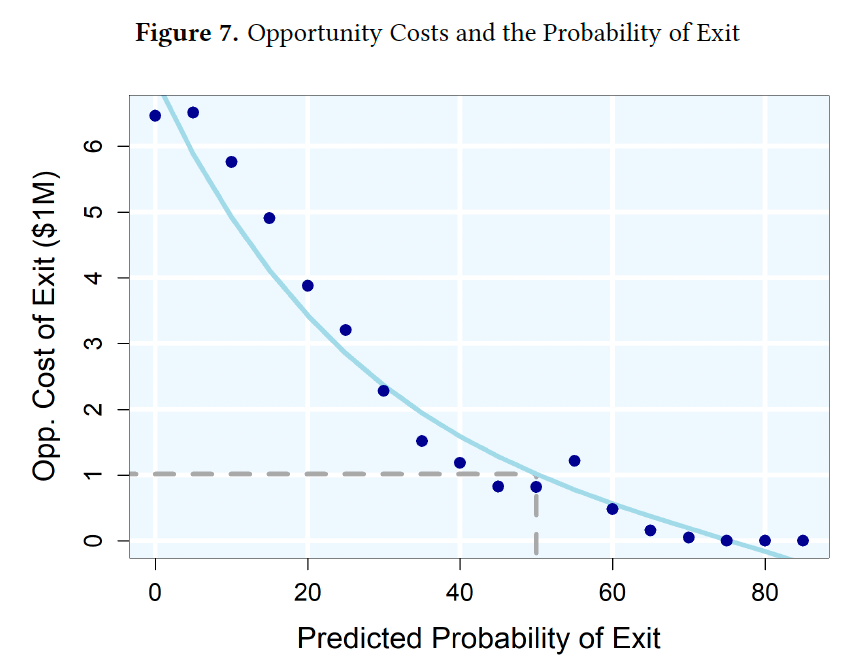
Former teammates of athletes who died of CTE would require $6 million to offset this disamenity and $1 million to be indifferent between exiting and staying in the profession.

So concludes a paper by Josh Martin. I thought this paper would be about a small group, since CTE deaths mostly happen among long-retired players with few or no former teammates still playing. But it turns out there were a fair number of early deaths, and each player had many teammates who can be affected, totaling 23% of NHL players and 14% of NFL players:

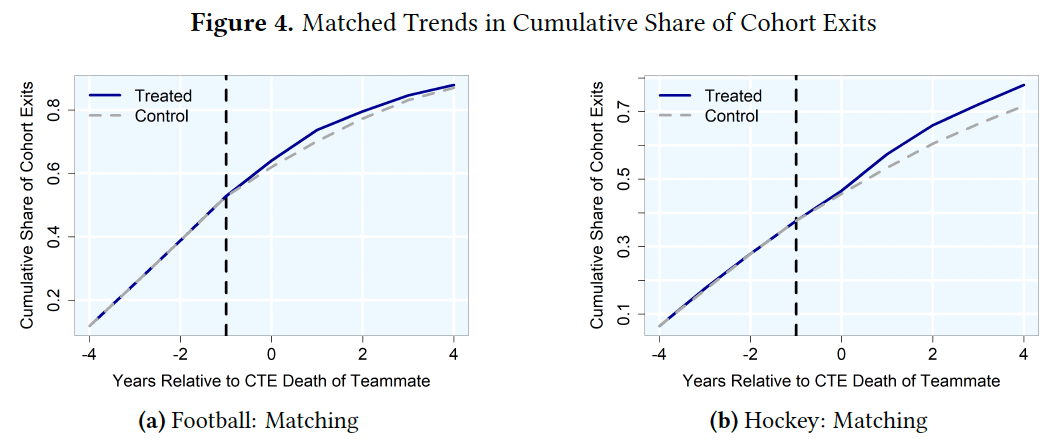
But teams mostly won’t pay worried players enough extra to stay, especially in hockey. So many of them retire early:

Athletes who were teammates with a former teammate who died with CTE for three or more years and played for a team with them at least two years before their death are 7.22 percentage points more likely to retire than characteristically similar non-treated players in the same years. Relative to the pre-treatment mean, this represents a 69% increase.

People still respond to incentives though, and if you do pay them enough they mostly take the risk and stay:

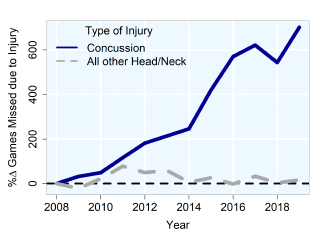
The remaining players will take measures to protect themselves, like skipping games to recover from concussions:

Michael previously pointed out here that these concerns matter more for certain positions, like running backs:

If you want millionaires to show up every week to willingly endure the equivalent of a half-dozen car accidents, you’re going to have to pay them.

This all makes for a good illustration of the theory of compensating differentials, which is sometimes surprisingly hard to observe in the labor market. But sports tend to have the sort of data we can only dream of elsewhere. Which other workers have millions of people observing, measuring, and debating their on-the-job productivity and performance?

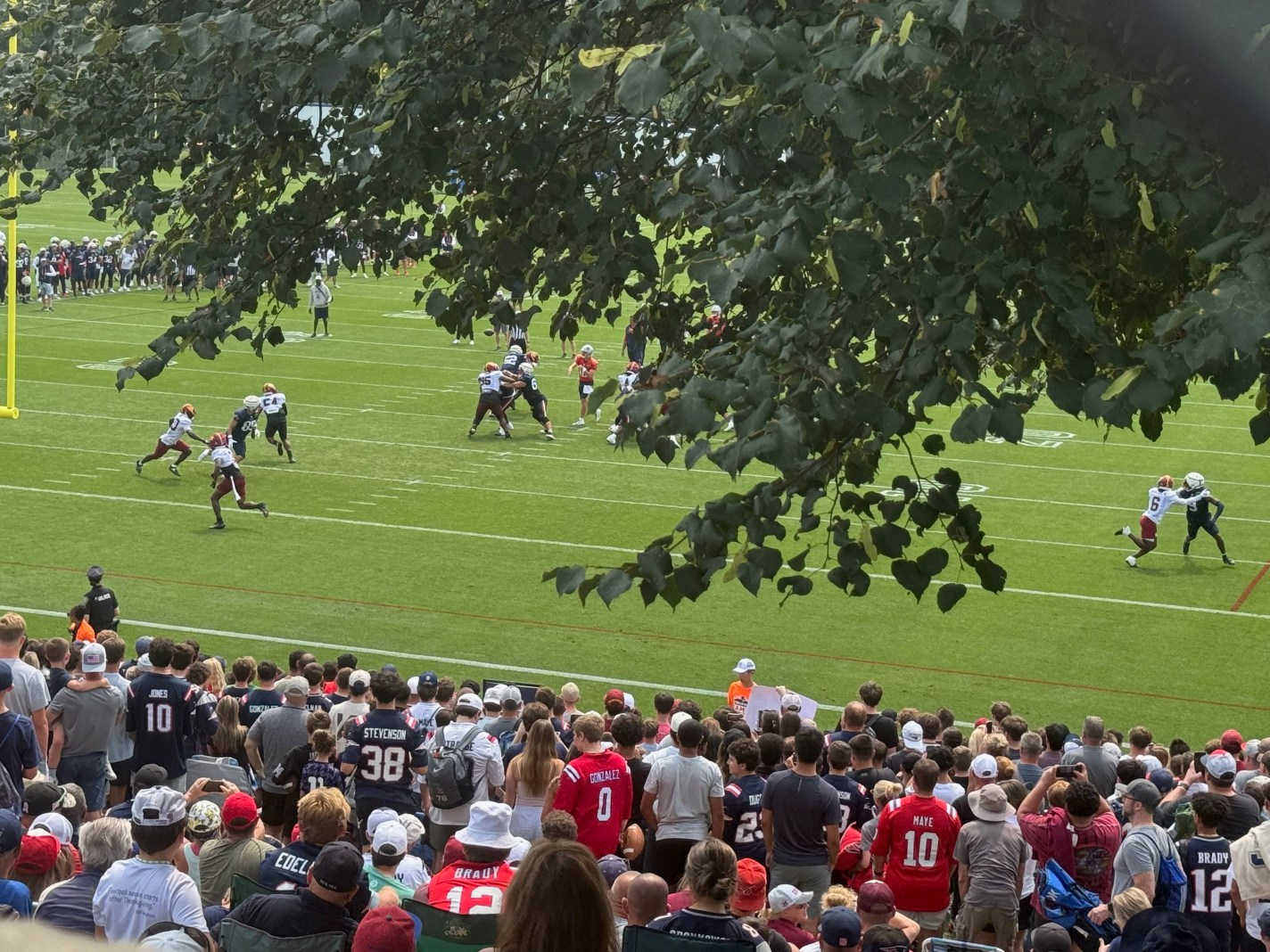
This summer I was one of thousands of people crowding into Foxborough just to watch them practice:

The NFL season kicks off today, and I say the players deserve the millions they are about to earn.

After the Fall: What Next for Nvidia and AI, In the Light of DeepSeek

Anyone not living under a rock the last two weeks has heard of DeepSeek, the cheap Chinese knock-off of ChatGPT that was supposedly trained using much lower resources that most American Artificial Intelligence efforts have been using. The bearish narrative flowing from this is that AI users will be able to get along with far fewer of Nvidia’s expensive, powerful chips, and so Nvidia sales and profit margins will sag.

The stock market seems to be agreeing with this story. The Nvidia share price crashed with a mighty crash last Monday, and it has continued to trend downward since then, with plenty of zig-zags.

I am not an expert in this area, but have done a bit of reading. There seems to be an emerging consensus that DeepSeek got to where it got to largely by using what was already developed by ChatGPT and similar prior models. For this and other reasons, the claim for fantastic savings in model training has been largely discounted. DeepSeek did do a nice job making use of limited chip resources, but those advances will be incorporated into everyone else’s models now.

Concerns remain regarding built-in bias and censorship to support the Chinese communist government’s point of view, and regarding the safety of user data kept on servers in China. Even apart from nefarious purposes for collecting user data, ChatGPT has apparently been very sloppy in protecting user information:

Wiz Research has identified a publicly accessible ClickHouse database belonging to DeepSeek, which allows full control over database operations, including the ability to access internal data. The exposure includes over a million lines of log streams containing chat history, secret keys, backend details, and other highly sensitive information.

Shifting focus to Nvidia – – my take is that DeepSeek will have little impact on its sales. The bullish narrative is that the more efficient algos developed by DeepSeek will enable more players to enter the AI arena.

The big power users like Meta and Amazon and Google have moved beyond limited chatbots like ChatGPT or DeepSeek. They are aiming beyond “AI” to “AGI” (Artificial General Intelligence), that matches or surpasses human cognitive capabilities across a wide range of cognitive tasks. Zuck plans to replace mid-level software engineers at Meta with code-bots before the year is out.

For AGI they will still need gobs of high-end chips, and these companies show no signs of throttling back their efforts. Nvidia remains sold out through the end of 2025. I suspect that when the company reports earnings on Feb 26, it will continue to demonstrate high profits and project high earnings growth.

Its price to earnings is higher than its peers, but that appears to be justified by its earnings growth. For a growth stock, a key metric is price/earnings-growth (PEG), and by that standard, Nvidia looks downright cheap:

Source: Marc Gerstein on Seeking Alpha

How the fickle market will react to these realities, I have no idea.

The high volatility in the stock makes for high options premiums. I have been selling puts and covered calls to capture roughly 20% yields, at the expense of missing out on any rise in share price from here.

Disclaimer: Nothing here should be considered as advice to buy or sell any security.

Pistol Squats Complete the Home Workout

A good strength workout includes a push, a pull, and legs. When I can get to the gym I like to alternate bench press and incline press for the push; rows and pulldowns for the pull; and squats and deadlifts for the legs. But with a baby to take care of at home, its been hard to find time for the gym. Between driving, waiting for equipment, and the actual lifts, the gym takes an hour. Doing a similar workout at home can take just 10 minutes, and has the advantage that you can watch a baby while doing it.

But the big challenge with home workouts was finding a good leg exercise. Pushes are easy: just do pushups. Pulls are pretty easy: just buy a $15 pullup bar to hang over a door. But how to do a good leg workout without costly barbells and plates that take up lots of space? Enter the pistol squat.

The idea is simply to start from a stand and lower yourself down almost to the ground on a single leg, then come back up on one leg, with the other leg out front for balance:

Source: Snapshot from this video, which shows how to do the standard pistol plus many variations

I find this to be about as difficult as doing a traditional two-legged barbell squat with 1x bodyweight on the bar. The traditional squat has two legs lifting 2x bodyweight (your body itself, plus 1x bodyweight on the bar); the pistol squat has one leg lifting 1x bodyweight (just your body itself), which is about equal. This was perfect for me because I was doing about 3 sets of 5 reps of squats with 1x bodyweight on the bar, so I just do the same number of pistol squats. But what if you’re not exactly at that weight?

Going lighter is easy– just put one hand on something sturdy nearby like a table and lean on it until it takes enough of your weight that you can do the squat. This helps with balance too if that is an issue. Going heavier is harder, but you could carry something heavy in your hands, turn the rise into more of an explosive jump, or just do more reps.

I’d still rather be at the gym, but the complete home workout seems like a good application of the Pareto Principle– you get most of the benefits of the gym while paying only a small fraction of its time and money costs.

The Greatest NBA Coach Is… Dan Issel?

Some economists love to write about sports because they love sports. Others love to write about sports because the data are so good compared to most other facets of the economy. What other industry constantly releases film of workers doing their jobs, and compiles and shares exhaustive statistics about worker performance?

This lets us fill the pages of the Journal of Sports Economics with articles on players’ performance and pay, and articles evaluating strategies that sometimes influence how sports are played in turn. But coaches always struck me as harder to evaluate than players or strategies. With players, the eye test often succeeds.

To take an extreme example, suppose an average high-school athlete got thrown into a professional football or basketball game; a fan asked to evaluate them could probably figure out that they don’t belong there within minutes, or perhaps even just by glancing at them and seeing they are severely undersized. But what if an average high school coach were called up to coach at the professional level? How long would it take for a casual observer to realize they don’t belong? You might be able to observe them mismanaging games within a few weeks, but people criticize professional coaches for this all the time too; I think you couldn’t be sure until you see their record after a season or two. Even then it is much less certain than for a player- was their bad record due to their coaching, or were they just handed a bad roster to work with?

The sports economics literature seems to confirm my intuition that coaches are difficult to evaluate. This is especially true in football, where teams generally play fewer than 20 games in a season; a general rule of thumb in statistics is that you need at least 20 to 25 observations for statistical tests to start to work. This accords with general practice in the NFL, where it is considered poor form to fire a coach without giving him at least one full season. One recent article evaluating NFL coaches only tries to evaluate those with at least 3 seasons. If the article is to be believed, it wasn’t until 2020 that anyone published a statistical evaluation of NFL defensive coordinators, despite this being considered a vital position that is often paid over a million dollars a year:

Continue reading

Don’t Look Back

On the Positivity Blog are no less than “67 Don’t Look Back Quotes to Help You Move on and Live Your Best Life”. Some of these sayings from notable folks include:

“Never look back unless you are planning to go that way.”
– Henry David Thoreau

“If you want to live your life in a creative way, as an artist, you have to not look back too much. You have to be willing to take whatever you’ve done and whoever you were and throw them away.”
– Steve Jobs

“There are far, far better things ahead than any we leave behind.”
– C.S. Lewis

“Don’t cry because it’s over, smile because it happened”  

– attributed to Dr. Seuss, though that attribution is heavily disputed

The Random Vibez offers another “60 Don’t Look Back Quotes To Inspire You To Move Forward”’ including “Don’t look back. You’ll miss what’s in front of you” and “I tend not to look back. It’s confusing”.   The Bible would add sayings such as, “Let your eyes look straight ahead; fix your gaze directly before you” (Proverbs 4:25); Paul wrote to the Philippians, “One thing I do: Forgetting what is behind and straining toward what is ahead, I press on toward the goal to win the prize for which God has called me”.

The Landy-Bannister Statue

What put me in mind of this whole theme of not looking back was seeing a bronze statue involving Roger Bannister. Sports buffs, and most educated people who are over 60, will know that he was the first man to break the four-minute mile. During many previous decades of trying, no human had been able to run that fast that long: that is a velocity of 15 miles per hour, sustained for a full four minutes. That is like a full sprint for most people, or a moderate bicycling speed. 

Bannister found that he was naturally a fast runner, and he employed scientific principles in his training. (He was a medical student at the time, and went on to become a noted research neurologist).  On May 6, 1954 Bannister finally cracked the four-minute mile, with a 3:59.4 time. As may be imagined, the crowd went wild.

Records, however, are made to be broken, and just 46 days later a rival runner, John Landy, ran the mile in just 3:57.9 to become the world’s fastest man. A few months after that Bannister and Landy ran head-to-head in the August, 1954 Commonwealth games in Vancouver. Landy was in the lead nearly the whole way, with a ten-yard lead by the end of the third lap. Bannister then started his signature kick and managed to catch up with Landy on the final bend. Landy must have heard footsteps, and at the end of the race glanced over his left shoulder to gauge Bannister’s position. That distraction slowed him just enough to allow Bannister to power past him on his right side. Landy’s time was still a respectable 3:59.6, but Bannister won with 3:58.8. Both runners later agreed that Landy would have won if he had not looked back. More on that race, including link to video of it, here.

This finish of this “Miracle Mile” race was immortalized by a larger-than-life bronze statue by Vancouver sculptor Jack Harman. Landy later quipped, “”While Lot’s wife was turned into a pillar of salt for looking back, I am probably the only one ever turned into bronze for looking back.”

Drone Racing is Poised to Grow

  1. Observations from the World Games

Drone racing was an event at the World Games in my city. Now I know it exists (as does canoe polo!).

The composition of contestants was interesting. One pilot was only 14 years old, the youngest person competing in the 2022 World Games. Another pilot was in a wheelchair. Drone racing is for sports like Work From Home is for professional jobs – the number of competitors is potentially enormous.

Spectators reported that it was hard to follow the actual drones with your eyes. People in the stadium for the race usually watched the jumbo screens that show the point of view of the pilots. This raises the question: why bother with the drones at all when we could just be doing e-sports? There is something special about the extra challenge of a physical race. The machinery adds a NASCAR-like element, and it gives people an excuse to gather together.

Videos, if you’d like to get a sense of how the sport works:

Championship Race: Xfinity CA Drone Speed Challenge, 2018

Maine drone racer heads to the World Games

2. Thoughts on the Future

Polaris published an industry report that predicts growth.

Drone racing will grow in the United States. This seems like a sport that will appeal to Generation Alpha and their parents.

As a parent, I would support it. It’s expensive, so that’s going to be prohibitive for a while, but millions of Americans bought drones at some point in the last decade. Drones get broken in races, but the cost of components is coming down. Part of the sport is being able to repair and build your own custom drones.

A handful of US high school already have drone racing clubs. Adults will be able to point to the value of learning technology that comes along with racing for fun.

Continue reading

Birmingham AL hosts The World Games

Have you heard of The World Games? It’s the Olympics for sports that are too random to be in the real Olympics. It is happening right now in Birmingham, AL. It’s not too late to get your tickets to see Canoe Polo.

For people interested in regional politics, this blog about the city successfully hosting a major event might be interesting. His references to people in “the suburbs” is something you won’t understand without some context and history. But you don’t have to be a local to learn that history, since everything is online.

Continue reading

College sports are better when they’re worse

It’s spring break and that means catching up on both research and my social network. It also means college basketball. I remain firmly in the camp that college athletes should be paid for their incredibly high-value labor and, in turn, recapture a huge share of the surplus currently enjoyed by schools and coaches. What I am beginning to rethink, however, is the way that “professionalization” can and will play out.

This rethinking began with the the realization that my enjoyment of the product is largely insensitive to the presence of great players. The gap between NBA and NCAA basketball, in terms of quality of play, is so great that I simply don’t watch the sports in the same way. I consume the NBA the way I do Denis Villeneuve films: enjoying an artform in its closest approximation to perfection at the bleeding edge of innovation. NCAA basketball, in contrast, is a soap opera for genre aficionados. It’s Battlestar Galactica for sports fans.

There is a floating, ever-changing cast of characters supporting a handful of recurring leads. Clans and sub-clans. Rises and falls. Tragic failures and heroic redemption arcs. And, much like the latest show about wizards or post-apocaplyptic alien invasion survivors on the SciFy channel, the enjoyment of this product doesn’t require high level precision or execution. Quite frankly, the show is more enjoyable when the actors aren’t famous or especially elite; it keeps me squarely focused on the shlocky fun, rather than getting distracted by any urge to pick apart the film composition, story logic, or actor subtext. College basketball, in much the same way, keeps me squarely focused on the drama of gifted athletes doing their best to help their team achieve success in a limited window before moving on to the rest of their lives. Trying to get a little slice of glory now, while their knees will allow for greatness, before getting on with the endless particulars of adult life later.

Which brings me back to the eventual professionalization of college sports with athlete compensation. Schools will find themselves faced with a decision of whether they should spend money on the very best athletes or try to compete with less expensive players. Athletes will have to decide where the best opportunities to develop their professional game are, and how much of their human capital investment portfolio they want to dedicate to sports. What might the equilibrium look like?

We can coarsely reduce the pool of athlete’s into three categories: all-in on athletics, those looking to purely subsidize secondary education, and those aiming for a mix of both. Currently schools capture the most rents from the pure athletics all-ins, who dedicate nothing but the bare minimum to schooling while maximizing their athletic preparation. The all-ins will often be the best players, who get the most media attention and contribute the most to winning glory, attracting applications from young fans and donations from nostalgic alumni. You might expect that compensation would shift the most suprlus to them. We have to consider, however, the possibility that a proper market for elite college athletic labor would provide the prices needed to accelerate the formation of pre-professional academies and player futures contracts. The very best 18-year old basketball players may find it far more lucrative to take a $120K in income and full-time coaching today in exchange for 2% of future professional earnings.

At the same time, college basketball may similarly learn the true nature of their collective good: that it is, in fact, a zero-sum competition where the total amount of talent isn’t nearly as important for earnings as they think. While a small number of schools absorbing all of the top talent might be exciting for covers of no longer existent sports magazines, in reality 120 teams competing for a less skewed distribution of talent more predominantly interested in subsidizing the full cost of college (i.e. tuition, lost wages, etc) may actually make for more drama, which means more ratings, which means more money. Why try to compete with the academies for 1 year of the next Lebron when those same resources, will get you 5 good players for 4 years? Combined with the fact that this bundle of athletes will place greater value on (nearly) marginally costless scholarships, teams looking to compete in the long-term with a maximimally effcient allocation of resources could shift the competitive equiibrium could actually shift away from the top talent.

Sports are fun when they are played at the highest level. They are also fun, however, when a little chaos is injected into the drama. It’s great when Steph Curry casually hits shots 40 feet from the basket, when Lebron James or Nikola Jokic make Matrix-esque passes through impossible angles. But it’s also great watching players struggle at the edge of far more human limitations to a find to win on the biggest stage of their lives while wearing the jersey of one of hundreds of colleges. The highest drama includes players making shots, but sometimes it needs players to dribble off their foot, too.

We don’t have to limit earnings to capture that glory. We don’t have to take money from young people whose particular talents put them in the sliver of the human population whose greatest earning potential might be age 20. We don’t need to appeal to platitudes or false nostalgia to explain why they’re being compensated with something better than money. We can just pay them. Some things will change, but I think you’ll be shocked to see how little the experience of college basketball will change. College sports will remain largely the same, but it will be a bit less shady, a bit less hypocritical. It will place greater value on, and care for, the players they have directly invested in.

Which, at least to me, would be a little more fun.

Word Golf is a new online game

If you like Scrabble or Family Feud, then you might enjoy playing Word Golf. You can get started for free immediately by going to word.golf

You play by thinking of word associations to click from one concept to another. The challenge will get you thinking. Every game only takes about one minute, and there are simple instructions on the website to get you going right away. Unlike chess, you can do this for fun even without any time commitment.

Like Mike and Jeremy before me this week, I am writing about something I saw at the Emergent Ventures conference. It was an inspiring type of event. I met the young creator of Word Golf and was inspired by his vision for a new intellectual sport.

The game is built from data on how often words appear together on the internet. That’s why I compare it to the TV guessing game show Family Feud. You are not just thinking of synonyms to jump from one word to another. The challenge is to think of what words other people typically use in the same online article.

Word Golf is probably a better use of time than Candy Crush or Solitaire. (I played a lot of computer FreeCell at one point in my life but not anymore.)