Scale and Online Learning

A simplistic view that I have heard about online learning is that it is of worse quality but cheaper than traditional classroom learning.

We should take the cheaper part seriously. Cheaper can mean new opportunities for many people. Delivering a lecture online can mean that, once the fixed cost of creating the video is incurred, the marginal cost of adding a student is nearly zero. The average cost of delivering instruction goes down with every student who joins the course. Economy of scale is a wonderful thing.

Now, let’s assume a family that has a quiet home and reliable internet service. Assume that a mom, m, signed up for a rock/geology class, r, for her school-aged son who cannot read. It’s me. I signed my son up for an online “rock camp”. I thought it would give me 45 minutes of time to get work done while my son was distracted in a Zoom room.

This week I got an email from the online school company about how to get ready for rock camp. I’m instructed to assemble a supply kit of about 30 items so that my kid can do a hands-on science experiment every day of the camp. This is not what I thought I was signing up for, and I no longer think rock camp is going to save me any time.  It gets me thinking about scale and online education for kids.

All the parents of rock campers will have to separately assemble a kit of supplies. The economies of scale would come from having the children in a physical school. Buy the supplies in bulk and hand out a pack to each kid all at the same time. It would be great to have a *classroom* where the students could *go*. Even though many classes do not involve vinegar and magnets, the point can generalize.

We should take scale seriously. I support experimenting with different kinds of education and giving students choices. Personally, I benefitted from getting to pilot an experimental program at my high school that allowed me to take microeconomics for college credit online. I also participate in online education sometimes as an educator.

However, it’s overly simplistic to say that the scale idea always points us in the direction of online education. Even at the university level, some products/services can be cheaper to deliver in a traditional class setting.

Steve Horwitz on “The Graduate Student Disease”

On Sunday the world lost a great teacher, economist, and all-around fantastic person in Steve Horwitz. If you don’t know about Steve, I recommend reading the tributes from Pete Boettke and Art Carden.

Pete and Art speak to Steve’s overall legacy and greatness. But I will tell you about a very specific piece of advice that Steve gave me about teaching undergrads.

Steve called it “the graduate student disease.” By this he meant the tendency of newly minted PhD economists to teach undergraduate courses as if they were mini versions of graduate courses. Steve insisted this was the wrong approach.

Continue reading

Thread on Programming Ability

Ethan Mollick brought this Nature article to my attention. One of the authors Chantel Prat, is also on the thread.

The sample size for this study is only 36, so we should think of it as preliminary work toward understanding how people learn to program.

Their abstract, with emphasis added by me:

This experiment employed an individual differences approach to test the hypothesis that learning modern programming languages resembles second “natural” language learning in adulthood. Behavioral and neural (resting-state EEG) indices of language aptitude were used along with numeracy and fluid cognitive measures (e.g., fluid reasoning, working memory, inhibitory control) as predictors. Rate of learning, programming accuracy, and post-test declarative knowledge were used as outcome measures in 36 individuals who participated in ten 45-minute Python training sessions. The resulting models explained 50–72% of the variance in learning outcomes, with language aptitude measures explaining significant variance in each outcome even when the other factors competed for variance. Across outcome variables, fluid reasoning and working-memory capacity explained 34% of the variance, followed by language aptitude (17%), resting-state EEG power in beta and low-gamma bands (10%), and numeracy (2%). These results provide a novel framework for understanding programming aptitude, suggesting that the importance of numeracy may be overestimated in modern programming education environments.

Learning Python, at least at first, is more like learning a foreign natural language than it is like doing arithmetic problems.

There are still many open questions in this area, so I see this paper as an important small step in the right direction. I have also done a study on this topic.

Should student debt be dischargeable in bankruptcy?

I’m not an economist who studies education or bankruptcy, and I’m not 100% confident I spelled dischargeable correctly. I am, however, above average at highlighting the difficulty of a question when dissuading a grad student from attempting an impossible thesis question, so let’s dig into this one, which sounds pretty hard to me.

First of all, it is very difficult to discharge student debt during Chapter 7 or 13 bankruptcy, but I think you still can do it if you convince a judge that continued attempts at repayment would create undue hardship i.e. put you in a state of poverty in the wake of previous good faith efforts.

That said, maybe you shouldn’t have to face literal starvation to discharge student loans. That’s a reasonable idea, but what would the broader consequences be? This is tricky question to untangle because there are both welfare consequences and knock-on effects where we are put down different forking paths of politics and policy.

If debt is dischargable, then lenders will expect lower rates of repayment. This increase in lender risk and decrease in return on capital would likely have immediate consequences in the form of:

  1. Higher interest rates
  2. Lower rates of loan approval
  3. Greater dependence on loan collateral
  4. Greater lender interest in what the loaned funds will be applied towards.

Before we tackle those, we also have to consider the different policy environment paths lenders may have to anticipate:

  1. The government stops subsidizing loans. This would lower tuition, but also lower access for low income students.
  2. A loan forgiveness program. Great for people with outstanding debt, but changes how expectations are formed forever going forward.
  3. The government launches a massive “free college” program that covers tuition at state colleges and universities. This would have all kinds of consequences potentially.

But where this really leaves us is with a billion dollar question: will dischargeable students loans lead to lower costs of higher education? I am confident that the answer is a definitive, unassailable maybe.

Higher interest rates is a pretty straightforward prediction, but the consequences are less clear. Higher interest rates could lead to less college matriculation, greater barriers for lower income individuals, and higher expected rates of bankruptcy, in part because decisions are being made by young people who don’t know the future, their future, or, really, anything. Related to this, lenders will become more discerning regarding who they lend to, giving more money on more favorable terms to matriculants from wealthier backgrounds, in no small part because wealthy parents are filled to the brim with collateral, making for excellent co-signers and providers of high school graduation gifts nicer than any car I ever hope to drive.

That is all boring and moderately obvious. It’s 4) that I’m most curious about. If you get into medical school, there is no shortage of institutions eager to dump several hundred thousand dollars in the foyer of your home. Part of the reason for this is the expected future income of physicians and their high graduation rates from medical school thanks to rigorous admission screening. But what is underappreciated is the 100% rate at which medical school students study medicine.

Not so with undergraduate education. You might study electrical engineering with a minor in computer science. You also might study something a senior tells you is the easiest major at your school. You might major in something that sounds fun or interesting. You might study Miscelleneous Studies, where Miscelleneous is a subject that is likely interesting and possibly extremely important, but within which you can choose classes that facilitate your avoiding learning anything useful or applicable in the labor market.

Herein lies the problem. Lenders treat loans for consumption very differently than loans for investment. Nursing and statistics degrees are investments. Art History classes (for most people) are consumption. What’s going to happen to higher education when the lender tells you you can have $200K at 3% to study any STEM field or $75K at 6% to study anything in the humanities? Will the demand for humanities degrees drop? Will the supply of humanities education recede? Are humanities and STEM education complements or substitutes?1

Let me phrase it a different way? Are wealthy fine arts majors cross-subsidizing STEM majors pursuing the first college degrees in their family? Or are they driving up the price of tuition because heavily subsidized credit is facilitating pre-career retirement lifestyles for 4 years?

All of this leaves me with the suspicion that dischargeable student loans will lower tuition for some while raising it for others. This heterogeneity would likely shift the electoral popularity of free tuition programs while also shifting the nature of those program. Maybe “free college” turns into a means-tested program. Maybe “free college” becomes “free STEM college”. Maybe both.

We could speculate what this means for loan forgiveness or subsidies, but this post is too long already and, as should be already clear, we’re not going to solve anything today. My elegant and succinct point is this:

When you massively subsidize a [knowledge, signal] bundled good for so long that it transforms into a [knowledge, signal, 4-year luxury cruise with your peers] bundle, and to accommodate that subsidy you protect your poorly constructed macro-investment in human capital by exempting it from bankruptcy proceedings, and as a result of this weird landscape a bizarre higher education industry emerges that is both one of the greatest achievements in US history but also a trap that 19-year-olds fall into because, really, is there any trap we don’t fall into when we’re 19, and from which thousands of people never financially recover, but if you just fix one part of it no one knows what will happen, and if you try to fix all of it at once in the back of your mind you’re afraid it could turn into the US healthcare industry part deux, well then what you have is a real and important problem that I don’t know how we will solve but I remain confident that other people will be very confident that they know how to solve it and they will get extremely cross with me for not sharing their confidence.2

So maybe don’t try to solve that in your dissertation.3 Might be safer to just definitively estimate the natural rate of interest that underlines all monetary transactions. That’ll be easier.

1The answer is “Yes”.

2 This is, to be extremely clear, not me picking on Ms. Reisenwitz’s tweet which was good and interesting and left me thinking about student loans for two days when I should have been working on the research topics I have actual expertise in.

3 Of course, if you do find a natural experiment where huge chunks of student debt were accidentally made dischargeable in a state for 2 years because of a legislative SNAFU, you should write that dissertation and put me in the acknowledgements.

Overfitting Celebrity Pitches

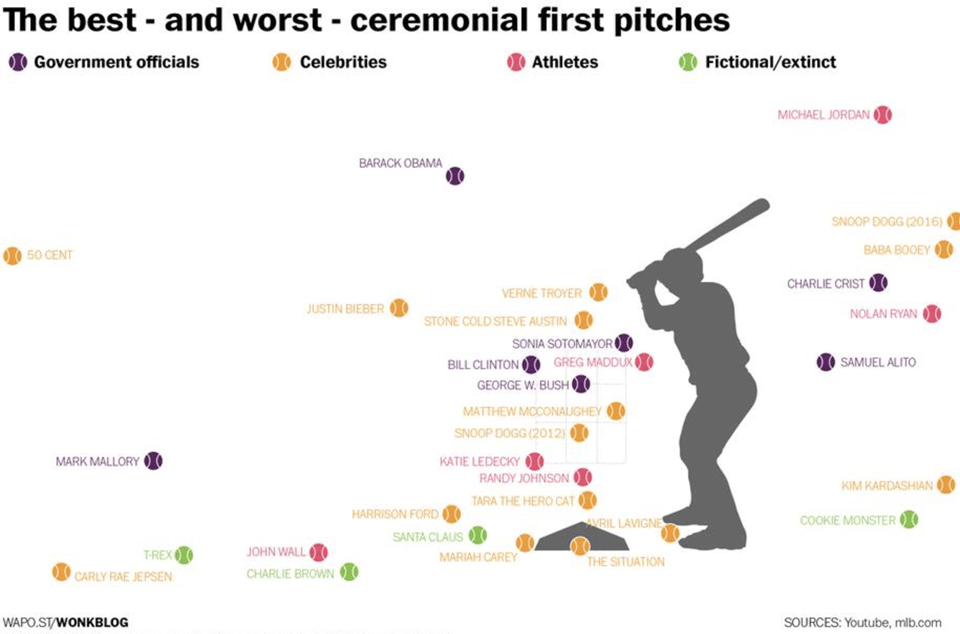
The Washington Post created a fun infographic of celebrity baseball pitches.

I use this graphic in my Data Analytics class. Students are tempted to draw inferences about individuals from this data set. John Wall and Michael Jordan are great athletes, but in this case they are underperforming Avril Lavigne and George W. Bush. Do we conclude that Sonia Sotomayor missed her calling as an MLB player?

The first lesson here is that we should not assume we can predict where Harrison Ford’s next pitch will go based on observing just one pitch. A single pitch should be considered a random draw from a distribution centered around Ford’s average ability. Any single pitch could be an outlier.

Snoop Dog features twice on this graph. In 2012 he got the ball in the strike zone. Had we only seen that, we would want to conclude that he is a great pitcher. However, in 2016 he was way off to the right. In either case, overconfidence that he is predictably near a single pitch would have been a mistake.

Lastly, I use this graph to illustrate the concept of overfitting (investopedia definition). I suggest a model that is obviously inappropriate. What if we conclude from these data that anyone with the last name of Bieber will not be able to throw the ball in the strike zone? That model surely will not generalize. The problem is that if we test that prediction on the same data we used to train the model, the misclassification rate will be zero. If possible, start with a large data set and set aside some portion of the data for validation, before training a model. Having validation data for assessment is a good way to check that you haven’t modeled the noise in your training set.

Publications as Positional Goods, and the Division of Labor in Academia

My co-blogger Mike Makowsky has a thoughtful post this week about the academic publishing process. I wanted to offer a slightly different perspective on the same topic. But my perspective comes from someone who is not at a research university, and someone who has recently survived the tenure process.

A little background for those not completely familiar with the academic world: schools are usually considered either teaching or research schools. At first this seems confusing: both Clemson (where Makowksy is) and the University of Central Arkansas (where I am) require that faculty engage in both research and teaching. The difference is subtle, but the big hint is that Clemson is considered an “R1” school (the highest research designation) and has a PhD program with many graduate students. At a school like Clemson, research is valued more than teaching. At UCA, teaching is valued more than research. (Much more could be said about the differences, perhaps in a future post.)

We both engage in both teaching and research (as well as service!), but the emphasis is different. For me at UCA, the expectations of which journals I will publish in and how frequently I will publish are lower than at a school like Clemson. At Clemson, some of your publications should be in the Top 5 (or at least Top 10) journals from time-to-time. At UCA, if you published in one of the top journals, the assumption would be that you are probably leaving soon to go to an R1 school

I’m glad both types of schools exist, and my point here is not to disparage either type of school. But the difference is important for thinking about the academic publishing process.

For someone at an R1 school, publications in top journals are positional goods. Makowsky doesn’t say this exactly, but that’s my takeaway from his post. There are only so many spots available in these journals, and they have value because there is only a fixed number available. And since there has been, over the years, a lot more economists doing a lot more research not all of the great papers will end up being published in one of the top journals.

Upshot: there are a lot of great papers being published in Top 50 or even Top 100 journals! Let me pick on myself. As I said, I recently successfully survived the tenure process. My publication record was good enough. You can inspect my publications over at Google Scholar. I’m proud of these publications. I think some of them are really great. But I’m fairly confident that I would never earn tenure at Clemson with these publications. Instead, you need a publication record like Makowsky.

What’s interesting here is that Mike and I occasionally publish in some of the same journals. Public Choice and Constitutional Political Economy jump out to me. These are, in my view, very fine journals. Lots of interesting research is published in these journals. I’m especially proud of this paper in Public Choice. But if someone published only in these two journals and journals like them, they wouldn’t get tenure at an R1 university.

So what do we do with this information?

Continue reading

Teaching through my R mistakes

I blogged earlier about a new textbook that I am adopting for an analytics course. The first few chapters are primarily an introduction to using the R coding language within RStudio. One of the resources I’m posting for students this week is screen capture videos of me manipulating data in RStudio.

Sometimes I make mistakes, shockingly. I’m a professional, and yet sometimes I still make careless typos in R. I found out that my version of R was outdated, right when I was in the middle of recording a lecture.

I could have deleted the footage of my mistakes. I could have re-recorded a clean smooth video in which I run command after command without saying “ok… I got an error”.

Continue reading

The Pappy Pricing Puzzle

If you drink bourbon whiskey (or even if you don’t) you’ve probably heard of Pappy Van Winkle. Bourbon has experienced something of a revival in the past two decades, after being in decline for much of the 20th century. As part of this revival, some bourbons have become very highly sought after by the nouveau bourbon enthusiasts. And the various offerings of Pappy Van Winkle are arguably the most highly sought after. Finding Pappy is almost impossible these days, though this was also true a decade ago so it’s not really a “new” phenomena.

So here’s the “puzzle” for economists: why aren’t Pappy and other rare whiskies sold at market prices? No one in the “legal” market seems willing to do so. I put “legal” in quotation marks because there is a robust secondary market for these bottles, and the legal status of these sales is entirely unclear to me as an economist (alcohol markets are, to say the least, highly regulated).

In these secondary markets, it is not unusual for a 20-year bottle of Pappy Van Winkle to sell for $2,000. The “manufacturer’s suggested retail price” is $199.99. But you will never find this bottle on the shelf for that price. The bottles are held by retailers, either to sell to friends, auction off for charity, or conduct a lottery for the right to purchase the bottle at well below market prices.

So why doesn’t the distillery raise the MSRP? Clearly, they do this from time to time. Ten years ago, if you were lucky enough to find this bottle it was around $100 (I was lucky enough, on occasion). Clearly, they recognize that prices can increase. And that’s not just “keeping up with inflation”: $100 in 2011 is about $120 in current dollars. By 2016, they had raised the MSRP to $169.99. But why doesn’t the distillery raise the price more, perhaps all the way up to the market clearing price? By doing so, they would, perhaps, be able to ramp up production so that in 2041 there might be a lot more Pappy on the shelf. At the very least, they could dramatically increase their profit.

Receipt for 1 bottle of 20-year Pappy and 2 bottles of 12-year Van Winkle “Special Reserve” from 2011.

Also, why don’t retailers just put bottles on the shelf at $2,000? Stores occasionally do this, but mostly because they are fed up with all of the customers calling about rare bottles. Sometimes they will price it even higher than secondary markets. But usually, they allocate the bottles by something other than the price mechanism. Why? Businesses don’t usually leave dollar bills, especially $1,000 dollar bills, on the table.

Continue reading

R.I.P. Borders

An analytics textbook is usually full of success stories (i.e. XYZ Corp. invested in a data warehouse and everything got better). I decided that my students needed to hear a downer for balance. What better example than Borders?

Borders was a fixture of suburban New Jersey in the 90’s. You could browse books or media and get coffee there. When I asked undergraduates in 2018 if they remember Borders, I learned how far south Borders had expanded (to Nashville, but not to Birmingham).

Never fear. All of my students knew the Kanye West song “All of the Lights”. The lyrics are:

Continue reading

Teaching Economics with COVID

In many of my blog posts I address either issues related to COVID or teaching economics. In this post, I want to combine the two. One thing economists of a certain age struggle to do is find examples to illustrate economic concepts which will actually connect with 18-22 year olds. The silver lining of the pandemic is that we now have an example that everyone is familiar with, and can be used to illustrate a host of economic concepts.

A great new book by Ryan Bourne, Economics in One Virus, really pushes this idea to the limit. He uses examples related to COVID to explain almost every single concept you would cover in a typical introductory economics course: cost-benefit analysis, thinking on the margin, the role of prices, market incentives, political incentives, externalities, moral hazard, public choice issues, and more.

Continue reading