Say that there is a labor market and that there is no income tax. If an income tax is introduced, then what should we expect to happen? Specifically, what will happen to employment, the size of the labor force, and the number of people unemployed? Will each rise? Fall? Remain unchanged? Change ambiguously? Take a moment and jot down a note to test yourself.
As it turns out, what your answer is depends on what your model of the labor market is. Graphically, they are all quantities of labor. The size of the labor force is the quantity of labor supplied contingent on some wage that workers receive. It’s the number of people who are willing to work. Employment is the quantity of laborers demanded by firms contingent on to wage that they pay. Finally, the quantity of people unemployed is the difference between the size of the labor force and the quantity of workers employed (Assuming that the labor force is greater than or equal to employment).
Jingi Qui, Tan Chen, Alain Cohn, and Alvin Roth ran a cool field experiment asking the question: does it matter if a prominent economist quote tweets your job market paper? Well, it turns out, yes, it does:
I’m not going to call anyone out, but there was definitely some significant pearl clutching about young careers, IRB, and did the job candidates in the control group give permission to not be retweeted by a prominent economist. I do not care about any of that. I’ll go on the record and say that a) I believe those concerns to be silly and b) if you don’t think they are silly, for your own mental health don’t start digging into how medical science is advanced at the stage of human trials.
What I do care about is the results and what they mean. All publicity is good publicity, doubly so when it implies a famous person has vouched for your paper. It’s the vouching that intrigues me because it’s so weak. It’s a retweeting. It should help you get out of a pile and into a slightly smaller pile. In a job market with a 500-1000 applicants for most positions and only 10-20 first interview slots that lead to 4-7 flyouts, the effect should be trivial. Twenty-five percent additional flyouts is not trivial. If anything it’s catastropic.
“Catastropic” is hyperbole, but this is a blog and that is the currency we deal in.
Twenty-five percent more flyouts are, to me, further evidence of the true source of most of the pathologies of academic economics: we’re overcommitted. We don’t have time to do things like reading papers. This is especially problematic for hiring committees tasked with sorted through 500 to 1000 applicants, each of whom has written a job paper. Careful, dear reader, because you might not like how far this logic can take you.
Why do journal reviews feel so capricious and random? Because the referees don’t have time to read anything or they won’t have time to work on their own submissions. Why does the NBER essentially operate as a club whose principal membership mechanism whether you are a student of a current member at a top 10 school? Because what else are they going to do, read 2000 applicant CVs every year? Why does a three-three teaching load feel utterly damning to those trying to start a research career? Because they marginal cost of additional teaching for someone without any research assistance leaves them a simple choice: no sleep or no research. Do I even have to get into the costs of having children early in careers?
So yeah, if I’m on a hiring committee and someone famous retweets your job market paper, I might just skim it there and then on my computer screen (it’s low marginal cost). It’s there in front of me, so I’ll probably more than read the abstract, I’ll skim the tables and figures too. And that’s all it takes. I’ve got a mandate to come up with a list of 10 candidates I think we should consider interviewing. Who am I to disagree with Famous Economist X when a moment’s humility will put me 10% closer to meeting my obligation?
I’m not saying we’re not star-f…..I’m not saying we’re not status seekers, it’s just that the obsession with status in academia is inframarginal in this context. What’s driving these results is stressed-out folks whose own imposter syndrome makes them incredibly vulnerable to any sort of low-cost information i.e. advertising that offers a new and easy way to economize on their time.
That’s it, that’s the post. I don’t have time to come up with a clever ending.
I recently did some business where I had a text file of names and email addresses that I wanted to send a group email to, in Gmail. Here I will share the steps I followed to import this info into a Google contact group.
The Big Picture
First, a couple of overall concepts. In Gmail (and Google), your contacts exist in a big list of all your contacts. To create a group of contacts for a mass email, you have to apply a label to those particular contacts. A given contact can have more than one label (i.e., can be member of more than one group).
To enter one new contact at a time into Gmail, you go to Contacts and Create Contact, and type in or copy/paste in data like name and email address for each person or organization. But to enter a list of many contacts all at once, you must have these contacts in the form of either a CSV or vCard file, which Google can import. So here, first I will describe the steps to create a CSV file, and then the steps to import that into Gmail.
Comma-separated values (CSV) is a text file format that uses commas to separate values. Each record (for us, this means each contact) is on a separate line of plain text. Each record consists of the same number of fields, and these are separated by commas in the CSV file.
A list of names and of email contacts (two fields) might look like this in CSV format:
We could have added additional data (more fields) for each contact, such as home phone numbers and cell numbers, again separated by commas.
For Gmail to import this as a contact list, this is not quite enough. Google demands a header line, to identify the meaning of these chunks of data (i.e., to tell Google that these are in fact contact names, followed by email addresses). This requires specific wording in the header. For a contact name and for one (out of a possible two) email address, the header entries would be “Name” and “E-mail 1 – Value”. If we had wanted to add, say, home phones and cell phones, we could have added four more fields to the header line, namely: ,Phone 1 - Type,Phone 1 - Value,Phone 2 - Type,Phone 2 – Value. For a complete list of possible header items, see the Appendix.
The Steps
Here are steps to create a CSV file of contacts, and then import that file to Gmail:
( 1 ) Start with a text file of the names and addresses, separated by commas. Add a header line at the top: Name, E-mail 1 – Value . If this is in Word, Save As a plain text file (.txt). For our little list, this text file would look like this:
( 2 ) Open this file in Excel: Start Excel, click Open, use Browse if necessary, select “All Files” (not just “Excel Files”) and find and select your text file. The Text Import Wizard will appear. Make sure the “Delimited” option is checked. Click Next.
In the next window, select “Comma” (not the default “Tab”) in the Delimiters section, then click “Next.” In the final window, you’ll need to specify the column data format. I suggest leaving it at “General,” and click “Finish.” If all has gone well, you should see an Excel sheet with your data in two columns.
( 3 ) Save the Excel sheet data as a CSV file: Under the File tab, choose Save As, and specify a folder into which the new file will be saved. A final window will appear where you specify the new file name (I’ll use “Close Friends List”), and the new file type. For “Save as type” there are several CSV options; on my PC I used “CSV (MS-DOS)”.
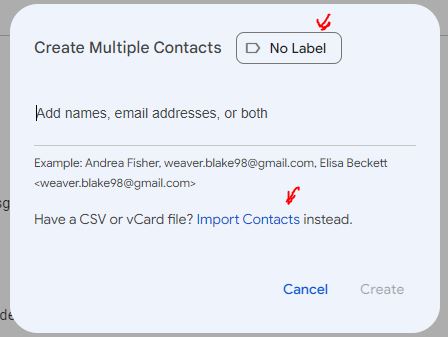
( 4 ) Go to Gmail or Google, and click on the nine-dots icon at the upper right, and select Contacts. At the upper left of the Contacts page, click Create Contact. You’ll have choice between Create a Contact (for single contact), or Create multiple contacts. Click on the latter.
( 5 ) Up pops a Create Multiple Contacts window. At the upper right of that window you can select what existing label (contact group name) you want to apply to this new list of names, or create a new label. For this example, I created (entered) a new label (in place of “No Label”), called Close Friends. Then, towards the bottom of this window, click on Import Contacts.
Then (in the new window that pops up) select the name of the incoming CSV file, and click Import. That’s it!
The new contacts will be in your overall contact list, with the group name label applied to them. There will also be a default group label “Imported on [today’s date]” created (also applied to this bunch of contacts). You can delete that label from the list of labels (bottom left of the Contacts page), using the “Keep the Contacts” option so the new contacts don’t get erased.
( 6 ) Now you can send out emails to this whole group of contacts. If this is a more professional or sensitive situation, or if the list of contacts is unwieldy (e.g. over ten or so), you might just send the email to yourself and bcc it to the labeled group.
APPENDIX: List of all Header Entries for CSV Files, for Importing Contacts to Gmail
I listed above several header entries which could be used to tell Google what the data is in your list of contact information. This Productivity Portfolio link has more detailed information. This includes tips for using VCard file format for transferring contact information (use app like Outlook to generate VCard or CSV file, then fix header info as needed, and then import that file into Google contacts).
There is also a complete list of header entries for a CSV file, which is available as an Excel file by clicking his “ My Google Contacts CSV Template “ button. The Excel spreadsheet format is convenient for lining things up for actual usage, but I have copied the long list of header items into a long text string to dump here, to give you the idea of what other header items might look like:
I bolded the two items I actually used in my example (Name and E-mail 1 – Value), as well as a pair of entries ( Phone 1 – Type and Phone 1 – Value) as header items which you might use for including, say, cell phone numbers in your CSV file of contact information.
I was watching the most recent episode of Welcome to Wrexam and was horrified to see another athlete with the wisdom to start planning for their future only for their time and money to be guided into a high risk, low payoff investment.
Stop!
If you are a professional athlete, actor, musician- if you are anyone in a career whose dollar rewards are front-loaded within careers that are short and hard to forecast – please, in the name of Shaquille O’Neal and all that is holy, do not take the money that needs to be the foundation of your family’s financial wellbeing and throw it into endeavors that are more likely to melt it down than grow and prosper.
Ok, Mr Know It All Economist, What should I do with myself and my money?
Great question, let’s start with what you shouldn’t do.
Don’t invest your money in anything cool. Your peak income earning years are likely behind you. You can’t afford to be paid in cool. Everything balances out in the wash. If something is cool to invest in (art, music, memorabilia, fashion, film, etc) then it pays out that much less monetarily.
Don’t invest your time or money in anything that priortizes the economic outcomes of everyone but you. You’re heavily specialized, which means you may have managers, agents, publicists, etc. You’re a gravy train for others and that train is going to slow down one day. Your job is to ensure your future, not theirs.
Don’t insist on maintaining the same economic trajectory. Trying to match or beat your peak athletic earnings is going lead you to taking on too much risk. Look for skills and opportunities that accessible that offer a career you can imagine doing for 20 years. Leverage your connections, skills, public awareness, and interests.
Try to tame your instincts towards overconfidence. You were in the top 0.01% of the population for your previous athletic endeavor. You are highly unlikely to be at the same level of elite excellence at your next profession. Look for something you are likely to be good at. Good can and may turn into great, but don’t assume it from the start.
Ok, but what does that add up to? What should I actually do?
Fine, here you go.
Invest most of your money in S&P 500 index funds.
Buy a house in a place you want to live long term. However much house you think you should buy, get 25% less.
Look for a job. Don’t overconcern yourself with the salary, focus on skill acquisition. If need by, take an internship or two.
If there is a field you want to work in, yes, even a cool one, and someone gives you an opportunity to work and learn, by all means go for it. But if they ask you for money, run away as fast as you can.
Take risks with your time and your feelings (it’s been a long time since you were bad at something!), not with your money.
It’s ok to make less money and in less exciting ways. Ninety-nine percent of people can’t be wrong.
I’m going to be in Montana later this summer and I’d like to solicit our readers for travel suggestions. Three days in Helena, two and a half in Bozeman. I will have a car, but Glacier and Yellowstone National Parks are likely going to be too difficult to squeeze in given the brevity. Where should I go? Should food be a consideration beyond basic caloric needs? I know 5 days is shockingly brief for big sky country, but that’s why I’m coming to you!
I’m in the process of writing a review of Jon Haidt’s book The Anxious Generation. I wrote some preliminary thoughts a few weeks ago, but I’m diving a lot deeper now, so watch for that review soon. But one of the main startling pieces of data in the book is the dramatic rise in suicides among young girls. Haidt isn’t the first to point this out, but in large part his book is an attempt to explain this rise (as well as the rise among boys and slightly older girls).
This got me thinking a bit more broadly about not just suicides, but all causes of mortality among young Americans. So in the style of my 2022 post about the leading causes of death among men ages 18-39, let’s look at the historical trends for deaths among girls 10-14 in the US.
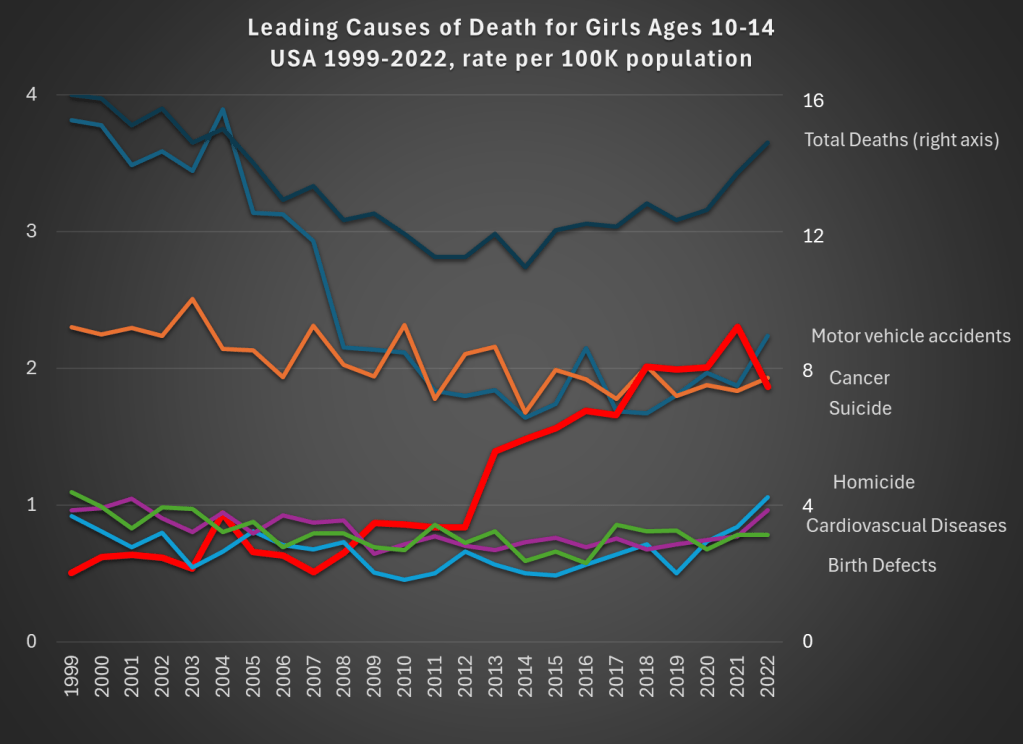
Data comes from CDC WONDER. The top dark line shows total deaths, and the scale for total deaths is the right-axis. Notice that for total deaths, there is a U-shaped pattern. From 1999 to about 2012, deaths for girls aged 10-14 are falling. Then, the bottom out and start to rise again. While the end point in 2022 is lower than 1999 (by about 9 percent), there is a 22 percent increase from 2010 to 2022.
What’s driving those trends? A fall in motor vehicle accidents (blue line, the leading cause of death in both 1999 and 2022) is driving the decline. This category fell 41 percent over the entire time period: a big drop for the leading cause of death!
But the rise in suicides (thick red line) starting in 2013 is the clear driver of the reversal of the overall trend. Suicides for this demographic in 2022 were 268 percent higher than 1999, and 116 percent higher than 2010. Haidt and others are right to investigate the causes of this trend (I’m not convinced they have the complete answer, but more on that in my forthcoming book review).
There has been no clear trend in cancer deaths over this time period, and the combination of all the three of these trends means that roughly equal number of girls ages 10-14 die from car accidents, suicide, and cancer.
What can we learn from this data? First, we should acknowledge just how rare death is for girls ages 10-14. At 14.8 deaths per 100,000 population, it is the lowest 5-year age-gender cohort, other than the ages just below it (ages 5-9, for both boys and girls). But just because it is small doesn’t mean we should ignore it. The big increase, especially in suicides, in the past decade is worrying and could be indicative of broader worrying social trends (and suicides have risen for almost every age group too, see my linked post above).
If a concern, though, is that we are over-protecting our kids and this is leading them to retreat into a world of social media, we might want to see if there are any benefits of this overprotection in addition to the costs. The decline in motor vehicle accidents is one candidate. Is this decline just a result of the overall increase in car safety? Or is there something specific going on that is leading to fewer deaths among young teens and pre-teens?
As we know from other data, a lot fewer young people are getting driver’s licenses these days, especially compared to 1999 (and engaging in fewer risky behaviors across the board). Of course, 10-14 year-olds themselves usually weren’t the ones getting licenses — they are too young in most states — but their 15 and 16 year-old siblings might be the ones driving them around. Is fewer teens driving around their pre-teen siblings a cause of the decline in motor vehicle deaths? We can’t tell from this data, but it is worth investigating further (note: best I can tell, only about 23 percent of the decline is from fewer pedestrian deaths, though in the long-run this is a bigger factor).
Social tradeoffs are hard. If there really is a tradeoff between fewer car accident deaths and more suicides, how should we think about that tradeoff? Or is the tradeoff illusory, and we could actually have fewer deaths of both kinds? I don’t think I know the answer, but I do think that many others are being way too confident that they have the answer based on what data we have so far.
One final note on suicides. For all suicides in the US, the most common method is suicide by firearm: about 55% of suicides in the US were committed with guns in 2022, with suffocations a distant second at about 25%. For girls ages 10-14, this is not the case, with suffocation being by far the leading method: 62% versus just 17% with firearms. I only mention this because some might think the increasing availability of firearms is the reason for the rise in suicides. It could be true overall, but it’s not the case for young girls.
Twice in the past year, I have received robo notices from doctors’ offices, blandly informing me that their systems have been penetrated, and that the bad guys have absconded with my name, phone number, address, social security number, medical records, and anything else needed to stalk me or steal my ID. As compensation for their failure to keep my information safe, they offer me – – – a year of ID theft monitoring. Thanks, guys.
And we hear about other data thefts, often on gigantic scales. For instance, this headline from a couple of months ago: “Substantial proportion” of Americans may have had health and personal data stolen in Change Healthcare breach”. By “substantial proportion” they mean about a third of the entire U.S. population (Change Healthcare, a subsidiary of UnitedHealth, processes nearly half of all medical claims in the nation). The House Energy and Commerce Committee last week called UnitedHealth CEO Sir Andrew Witty to testify on how this happened. As it turned out:
The attack occurred because UnitedHealth wasn’t using multifactor authentication [MFA], which is an industry standard practice, to secure one of their most critical systems.
UnitedHealth acquired Change Healthcare in 2022, and for the next two years did not bother to verify whether their new little cash cow was following standard protection practices on the sensitive information of around a hundred million customers. Sir Andrew could not give a coherent explanation for this lapse, merely repeating, “For some reason, which we continue to investigate, this particular server did not have MFA on it.”
But I can tell you exactly why this particular server did not have MFA on it: It was because Sir Andrew did not have enough personal liability for such a failure. If he knew that such an easily preventable failure would result in men in blue hauling him off to the slammer, I guarantee you that he would have made it his business within the first month of purchasing Change Healthcare to be all over the data security processes.
Humans do respond to carrots and sticks. The behaviorist school of psychology has quantified this tendency: establish a consistent system to reward behavior X and punish behavior not-X, and behaviors will change. As one example, Iin one corporate lab I worked in, a team of auditors from headquarters came one year for a routine, scheduled audit of the division’s operations. If the audit got less than the highest result, the career of the manager of the lab would be deeply crimped. Our young, ambitious lab manager made it crystal clear to the whole staff that for the next six months, the ONLY thing that really mattered was a spotless presentation on the audit. It didn’t matter (to this manager) how much productivity suffered on all the substantive projects in progress, as long as he was made to look good on the audit.
Let me move to another observation from my career in industry, working for a Certain Unnamed Large Firm, let’s called it BigCo. BigCo had very deep pockets. Lawyers loved to sue BigCo, and regulators loved to fine BigCo, big-time. And it would be a feather in the cap of said regulators, or other government prosecutors, to throw an executive of BigCo in the slammer.
Collusion among private companies to fix prices does do harm to consumers, by stifling competition and thereby raising prices. So, back in the day when regulators fiercely regulated, statutes were enacted making it a criminal act for company agents to engage in collusion, and authorizing severe financial penalties. American authorities were fairly aggressive about following up potential evidence, and over in Europe, police forces would engage in psychological warfare using their “dawn raid” tactic: just as everyone had sat down at their desks in the morning in would burst a SWAT team armed with submachine guns and lock the place down so no one could leave. I don’t know if the guns were actually loaded, but it was most unpleasant for the employees. BigCo’s main concern was avoiding multimillion dollar fines and restrictions on business that might result from a collusion conviction, so they devoted significant resources to training and motivating staff to avoid collusion.
Every year or two we researchers had to troop into a lecture hall (attendance was taken) and listen to the same talk by the same company lawyer, reminding us that corporations don’t go to jail, people (i.e. employees) go to jail, by way of motivating us to at all costs avoid even the appearance of colluding with other companies to fix prices or production or divide up markets or whatever. This was a live issue for us researchers, since some of us did participate in legitimate technical trade associations where matters were discussed like standardizing analytical tests. If memory serves, the lawyer advised us that if anyone in a trade association meeting, even in jest, made a remark bordering on a suggestion for collusion, we were to stand up, make a tasteful scene to make it memorable, and insist that the record show that the BigCo representative objected to that remark and left the meeting, and then stride out of the room. And maybe report that remark to a government regulator. That maybe sounds over the top, but I was told that just such a forceful response in a meeting actually saved BigCo from being subjected to a massive fine imposed on some other firms who did engage in collusion
My point is that if the penalties (on the corporate or managerial level) for carelessness are severe enough, the company WILL devote more substantial resources to preventing fails. It seems to me that the harm to we the people is far greater from having our personal data sucked out of health care and other company databases, than the harm from corporate collusion which might raise the price of copier paper or candle wax. Thus, I submit that if someone in the C-suite, like the chief information officer or the CEO, were liable to say 90 days in jail, management would indeed apply sufficient resources to data integrity to thwart the current routine data theft.
If I were king, this would be the policy in my realm. I recognize that in the current U.S. legal framework, the corporate structure shields management from much in the way of personal liability, and there are good reasons for that. I suppose another way to get at this is to have automatic fines structured to strip away nearly all shareholder value or management compensation, whilst still allowing the company to operate its business. This would be another route to put pressure on management to prioritize protection for their customers. Sir Andrew’s total compensation package has been running about $20 million/year. To my knowledge, the impact of the recent gigantic data breach on him has been fairly minimal in the big picture. Sure, it was aggravating for him to have to tell the U.S. Congress that he had no idea why his corporate division screwed up so badly, and to have to devote a good deal of effort to damage control, but I am guessing that his golf game (if he is a golfer) was not unduly impacted. He is still CEO, and collecting a princely compensation. But what if the laws were such that a major data hack would automatically result in a claw-back of say 95% of his past two years of compensation, and dismissal from any further management role in that company? I submit that such a policy would have motivated the good Sir Andrew to have devoted proper diligence and company resources to data integrity, such that this data breach would not have happened.
I don’t mean to pick on Andrew Witty as being uniquely negligent. By all accounts he is a nice guy, but his behavior is paradigmatic of ubiquitous benign management neglect, which has consequences for us little people.
These are just some personal musings; I’m sure readers can improve on these proposals.
I just back from the Society of Labor Economics Meetings in Portland. A couple thoughts in no particular order
Conferences are about both luxuriating and reinvesting in our geographically dispersed social networks. Everything else is a secondary. Its not just that I like seeing these people who speak our language and share our jokes, I genuinely miss them when it’s been too long.
Post sessions are fantastic for applied work. I enjoyed multiple 2 to 4 person discussions with an actively engaged author who had a perfect prop to lean on. Great stuff.
If you’re going to give a keynote, don’t try to impress people, try to educate them on something you specialize it. We all miss being students. Give us a crash course to distract us from the hotel catering.
Portland, and the Pacific Northwest in general, is just beautiful. Go to the Japanese Gardens next time you are there.
If you want an economist to support a government intervention, then there are two major sets of logic that they generally find attractive.
The first concerns rate of return and attracts narrower support. If the government can invest in a project in a way that the private sector couldn’t/wouldn’t and the payoff is bigger than the investment by enough, then the project should be built.
The second set of logic is more accepted more broadly. If there is an externality, and the administration costs are small relative to the change in the externality, then the project should be pursued in order to increase total welfare.
I’m going to criticize and refine the second argument. I was inspired by a student who wrote about education creating positive externalities for “all”. They kept using the word “all”. And I notated each time “not *all*”. While we might refer to something called ‘social’ cost and value, the existence of externalities does not imply that everyone is affected by the them identically. That’s a representative agent fallacy. The externalized costs and benefits are often irregularly distributed among 3rd parties. This is important because government intervention can impose its own externalities depending on how the administrative costs funded.
I’ll elaborate with two examples that illustrate when an irregular distribution of externalities is a problem and when it isn’t a problem.
Electric Plant Pollution
The first example illustrates how resolving an irregular distribution of externalities can be resolved without issue. Consider a coal-powered electric plant that serves a metropolitan area and creates pollution. That pollution drifts east and passively harms residents in the form of asthma exacerbation and long-term ill health. The residents to the west are unaffected by the pollution, thanks to favorable weather patterns. Obviously, one would rather live on the west side, all else constant (importantly, all else it not always constant and there is a case to be made that there is no externality here).
To resolve the externality, the government imposes a tax per particle on the power plant at a low administrative cost. That’s nice and efficient – we won’t waste our time with means-oriented regulations. In turn, the cost of electricity increases for all metropolitan residents, both those in the east and in the west. Why is this appropriate? Prior to the intervention, the electricity users in the west were enjoying electricity at a low price, failing to pay for the harm done by their consumption. For that matter, the residents to the east are also paying the higher rates, but now they enjoy better health.
In the end, the externality is resolved by imposing a cost on all consumers of the good – which happens to be everyone. This circumstance is not pareto efficient, but it is Kaldor-Hicks efficient. Everyone now considers the costs that they were previously able to impose on others and ignore.
David Neumark has an excellent article reviewing the extensive literature examining the effects of the minimum wage on, well, a little bit of everything. Sometimes we see improved outcomes, sometimes worse outcomes, often not much of anything. I’m not demeaning this literature to which I’ve myself helped make a modest contribution, but there does arise the concern that perhaps the fruit has begun to hang a bit too low. Which is to say that in a world of modern computing, where regressions can be run at approaching zero cost and policy changes are characterized by an at least a minimally sufficient level of exogeneity, there’s nothing stopping anyone from regressing any measurable outcome on the minimum wage. We’re still arguing about the minimum wage, but what exactly is it that we are learning?
I’m going to head this post off at the pass befores it veers into “back in my day economics used to be about the theory” territory. Yes, the ascendance of empirically-driven applied economics has led to theory to taking something of a backseat, at least in terms of the sheer volume of published research, but I don’t think that is what is going on with the minimum wage literature. Rather, I think its a story of supply and demand.
The minimum wage is an almost perfect issue for people to argue over. It’s not life or death, which keeps the temperature below “brick throwing” levels. The status quo always bears the possibility of change, making arguments policy salient. The absence of action is a meaningful option, particularly in a world with non-trivial inflation. It’s a quantifiable policy that affects incomes and employment directly, which means it’s sufficiently concrete for anyone to have an opinion on. Last, but certainly not least, it lends itself to binary opinion-affiliation in that you either think the minimum wage should be higher or you don’t.
From the point of view of researchers, this adds up to a policy for which there will be near endless research demand. To satisfy that demand your research should, preferably, give consumers a new reason to belief the minimum wage should or should not be higher. To do that a researcher need either i) give new and useful evidence as to how and how much the minimum wage affects earnings and employment, or ii) new and useful evidence that the minimum wage makes some other measurable outcome better or worse. When you consider that the cost of consuming new research is both low and constant, it’s fair to consider the demand to be perfectly elastic. Coupled with the increase in the supply of empirical research generated by reduced cost of computing noted earlier, we shouldn’t be surprised by an equilibrium where an ever-growing number of outcomes have been regressed on the minimum wage.
I don’t think this is anything to get worked up over, don’t see any first-order negative externalities. Most complaints about low-cost empirical research usually sound like academics pining for a time with higher barriers to entry, when you had to be “really good” to produce economic research. The assumption that the complainer is themselves, of course, “really good” always seems to remain unstated. Back to my earlier question, though: what are we learning?
If you’re genuinely curious about the minmum wage, read Neumark’s review. It’s characteristically excellent. Rather than recap, let me come out and say what I think I’ve learned from the reading a lot, but certainly not all, of the minimum wage literature. The minimum wage matters, it’s salient to people earnings, but not nearly as much as the volume of research or argument would suggest. The effects observed tend to be moderate, but labor markets are sufficiently local, heterogenous, and complex that the there remains the possibility of observing different results with different (but largely honest) analyses. This goes doubly so for observing any second-order effects beyond wages and employment, such as health, education, or crime. You are more likely to observed improved outcomes when changes are small, deleterious effects when changes are large.
Those are easy, largely riskless conclusions to share, so let me go a bit farther. The fact that we observe anything but trivial outcomes, positive or negative, is a stark reminder of the margins on which so many people are making decisions. Whether it’s earning a dollar more an hour or losing half a shift a week, it is telling that we see more criminal recidivism, more smoking, less teen-pregnancy, more maternal time with children, and a dozen other effects. It just doesn’t take that much to move the needle.
There is a constant cultural bombardment to value income and material goods less. Perhaps the lesson of a thousand and one minimum wage regressions is that many people aren’t experiencing the diminishing returns to income that popular advice would have you believe. For the young, less-educated, recently immigrated, or those burdened with the stigma of a criminal record, the income elasticity of human behavior remains very much intact. Labor policies matter, even if the minimum wage shouldn’t be quite so close to the top of the list.



 Economist Writing Every Day