Everyone’s an Expert: Easy Data Maps in Excel

I love data, I love maps, and I love data visualizations.

While we tend not to remember entire data sets, we often remember some patterns related to rank. Speaking for myself anyway, I usually remember a handful of values that are pertinent to me. If I have a list of data by state, then I might take special note of the relative ranking of Florida (where I live), the populous states, Kentucky (where my parents’ families live), and Virginia (where my wife’s family lives). I might also take special note of the top rank and the bottom rank. See the below table of liquor taxes by State. You can easily find any state that you care about because the states are listed alphabetically.

A ranking is useful. It helps the reader to organize the data in their mind. But rankings are ordinal. It’s cool that Florida has a lower liquor tax than Virginia and Kentucky, but I really care about the actual tax rates. Is the difference big or small? Like, should I be buying my liquor in one of the other states in the southeast instead of Florida? Without knowing the tax rates, I can’t make the economic calculation of whether the extra stop in Georgia is worth the time and hassle. So, the most useful small data sets will have both the ranking and the raw data. Maybe we’re more interested in the rankings, such as in the below table.

But, tables take time to consume. A reader might immediately take note of the bottom and top values. And given that the data is not in alphabetical order, they might be able to quickly pick out the state that they’re accustomed to seeing in print. But otherwise, it will be difficult to scan the list for particular values of interest.  

Continue reading

The story of social media isn’t over

Saturday I opened twitter and was immediately confronted with bad news that threatened to turn tragic.

This was horrible. “That’s horrible” I said. I spent a moment’s thought reflecting on what might have happened and then continued down my feed.

Within seconds of continued scrolling, I was confronted with this:

My mentality changed immediately. This was no longer a tragic event happening to an anonymous person in a context I had no capacity, nor obligation, to offer assistance. This was a problem and time was a factor. I started thinking about who I knew in Florida. Did I have any friends holding a position through which they could offer assistance? Was there a social cluster I was connected to I could reach out to through social media? Hospitals, law enforcement, travel. Who did I know? I became despondent when it became clear I had nothing to offer but a retweet.

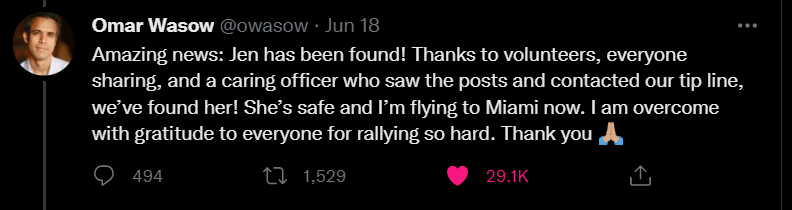
After a few seconds I returned to reading what I realized was a thread of tweets only to be given the relief of wonderful news, a happy ending that was directly a product of sharing on twitter:

The arc of drama (from the privilege of my physical and personal distance from actual events) was over in less than 30 seconds. What I was left with was a simple truth: I was sympathetic, but comfortably detached from a tragic event actively unfolding. It wasn’t my problem nor was it something I could do anything about until I found out I knew someone involved.

Barely knew. I had exchanged a couple messages with Omar about a year ago. A handful of polite thoughts about something Omar tweeted that was of mutual interest. That’s it. That’s the totality of our interactions. But with it came a completely different framing, a level of connection that elevated an evocation of standard sympathy to a potential call to action.

Twitter, that engine of animosity and toothless rage, had made me care more about a stranger through the simplest of social connections.


Comedians and other entertainment professions often tell the same simple story about online trolls that goes something like this:

  1. Someone writes something mean about the entertainer on twitter
  2. The entertainer responds to the troll in a polite and controlled manner that invites them to more civil engagement or simply reveals that the trolls comments are hurtful.
  3. The troll evaporates, replaced by a person excited to re-acknowledge the basic humanity and worth of their previous target.

A moment of direct interaction transforms, in the eyes of the troll, a previously two-dimensional narrative prop into a flesh and bone person worthy of dignity. We’re awash in the denigration of targeted individuals by detached opportunists seeking status and approbation through targeted cruelty. What is underappreciated is the opportunity in this moment for the target to reach back and give the troll what they actual want: to be seen.


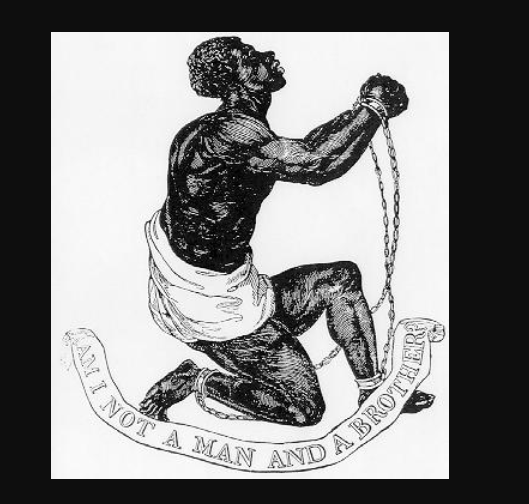
This next part is probably not the leap you are expecting, but there is a long history of media radically changing how we acknowledge and internalize the humanity of others. In this vein, there is arguably no more famous and impactful image than the seal of the The Society for the Abolition of the Slave Trade (1787), asking “Am I not a man and a brother?”

Not to be glib about such an important and horrifying part of our history, but this image blew people’s minds. In David Levy’s amazing history of how economics came to be referred to as “The Dismal Science”, he relates the efforts of Thomas Carlyle, Charles Dickens, John Ruskin, and other figures in English literature to deny the basic humanity of non-White men and women, particularly those from Africa and Ireland. Key to their efforts were stories, particularly those coupled with drawings, that explicitly portrayed the targets of their denigration as something far removed from humanity as a species. It was to their chagrin that the “Man and Brother?” image went the 18th century equivalent of viral.

It not only shocked households all over England to learn that the victims of the slave trade were clearly human in every sense of the word, it sparked an undeniable chain of logic. If these are men and women, then they can learn to read. If they can read, then they can come to know the Bible and their souls can be saved. If they can be saved then we have an obligation to teach them to read, offer them a Bible, and welcome them as brothers and sisters.

This image forced the reconsidered worth of others and with that reconsideration a calling for their liberation and salvation. This image, and others like it, changed who was human.


Social media is currently how many of us stay on the bleeding edge of news. It’s a way for us to promote ourselves and our work. It’s also a hellscape of acrimony, bad faith arguments, bullying mobs, and malicious propaganda. That’s what it is today. But that doesn’t mean that’s all it can ever be. Film and television changed the world as entirely passive, one-directional media. Most of the downsides of social media are born of interactions that, by little more than the inertia of the mob, often behave as if it were a one-directional media, carrying the masses along in the tidal wave of an irresistible narrative. There remains the possibility, the hope, that the capacity to interact meaningfully will eventually reclaim it as a multi-directional discourse, where the people we interact with become more real. More human. Where calls to serve can overwhelm and displace calls to destroy.

The story of social media isn’t over. There is still time for it to become something more. Where the people on the other side of claims and jokes and accusations become more human, not less. Where we broaden the ranks of who we offer our best to and shrink those whom we condemn with our worst.

It’s nice going to the movies again

Everything Everywhere All at Once is one of those truly great movies that manages to be high and low art at the same time. It is beautiful, absurd, timeless, and inspiring. It is without question my favorite expression of positive nihilism in popular art I’ve ever come across. There is no intrinsic meaning to life, but in that absence there is the opportunity to fill that empty vessel with meaning of your own design. As the characters ponder their own designs on how to impose meaning on the shifting and chaotic ocean of the multiverse, they present theories of strength, weakness, destiny, and fashion. I loved this film.

I also saw the new Top Gun film. I consumed a heroic amount of popcorn and diet pepsi. I learned absolutely nothing. I’m not sure I ever had a serious thought during it’s entire run time. I thoroughly enjoyed every second of it. I’m just so terribly happy to be going to the movies again.

Thoughts for the week on podcasts and the Constitution

  1. Jamal Greene was the most recent guest on Conversations with Tyler. This is how Greene describes his work habits as an academic with children:

GREENE: … my most effective work habit is to use the entire day to work. I get a lot of work done late at night. Most of my time during the day is spent teaching classes or meeting with students, and all writing and reading and preparation and everything is much later. That means I don’t watch television shows. It’s a really extended workday.

I work during soccer practices. I work sitting in the car while my kids are doing something or other. I don’t segregate times of the day where I can’t work.

One thing I find personally is that if I’m doing empirical work then I really need to be inside with at least one external monitor. As much as I like the idea of working from the pool (referencing the viral video of the week) being at my office is the best set up.

2. Currently I am teaching an online asynchronous class. Considering that my students are on the move in different places right now, I decided to create a podcast assignment. This seems to have gone over well. One student had a criticism for the episode that she chose: it was not entertaining. Another student complained that his episode had too much fluff about the personal lives of the speakers. This raises the interesting question of how the experts manage to make podcasts informative without being boring. It’s an art. Talking about your personal life to break up the subject matter can work but it can also feel like a waste of time.

3. For a discussion group, I read The Essential Federalist and Anti-Federalist Papers.

Something that stood out to me was the sheer intensity of these guys. Liberty is a serious topic, but I’ll just share something that is funny from the book.

In the middle of a long fiery speech of Patrick Henry, the book inserts a line in brackets:

What will then become of you and your rights? Will not absolute despotism ensue? {Here Mr. Henry strongly and pathetically expatiated on the probability of the President’s enslaving Americans, and the horrible consequences that must result.}

A footnote explains that stenographer had difficulty keeping up with Mr. Henry and was occasionally reduced to recording a mere summary of his words. It’s impressive that a stenographer could have gotten as much as they did.

I came away from the book thinking that people should talk more about this moment in history, and then I started noticing when people do talk about it. In fact, Tyler was interviewing a constitutional scholar this week and explicitly addressed the idea of “federalism.”

4. The debate does rage on 200+ years later.

Continue reading

The Political Economy of Crazy

The Ohio State House of Representative has passed an absolutely insane law granting adults the option to challenge the gender of children participating in youth sports. This thread has the details, read at your own emotional peril:

Now, let’s keep a few things in mind. First, it hasn’t passed the Senate yet, which won’t make a decision until November. Second, there is no guarantee the governor would sign it into law if it passes the Senate. Third, the likelihood that such a law would hold up in court seems slim, though I’m certainly not a legal expert. Fourth, it strikes me as extremely unlikely the Republican party has any interest in having the legally prescribed violation of children as something they have to defend in subsequent elections.

So then what the hell just happened? Why have state houses of representatives become places where the lunatic fringe not only can get an institutional toehold, but actually push legislation through?

Let me answer my own question with a different question.

Can you name your state house representative? Name you name any representative from your state house? Can you name anyone who has been a representative in your state house that didn’t subsequently gain fame in national politics?

I can’t either.

The simple fact seems to be that voters don’t pay much attention to state representatives. Voter turnout is dependent on the draw of elections for national offices, and subsequent voter decisions largely leverage party brand. But that doesn’t mean candidates don’t have options. There are, of course, brands within parties (progressive Democrats, Trumpist Republicans, etc), which are particularly important in primaries. There are campaign platform choices that may resonate with informed voters, as well. The notion that informed voters can swing an election depends depends on the Miracle of Aggregation and the Law of Large Numbers. Simply put, if the voter errors are random, then completely ignorant voters should cancel out, leaving the outcome to be determined by the minority of informed voters.

What happens with a vanishingly thing number of people are informed, though? Candidates could inform them, but this is a state house election. Candidates don’t have any campaign money to inform them with. What they need is free campaign advertising. What they need is attention.

You know what gets attention? Crazy. Crazy gets attention.

Proposing and passing legislation to allow strangers to demand that children be physically inspected to determine their gender, that will get attention. That the “legitimacy” of a childs physical appearance be publicly brought into doubt, in front of peers and a crowd of peers. The shock, the tears, they chumming of the waters for the angriest parents and the most unhinged theories, that gets people to write articles and tweets. Articles and tweets that might include a candidate’s name. And if people know a candidate’s name, they might check their box come election time.

Social media gives the impression that everyone is paying attention to everything, but I suspect it is exactly the oppositve. We’ve never bored anymore, which means that the price of grabbing our attenion is higher than ever. For shoestring campaigns, the only way to get over the top is to offer somethings so irresistible that voters will be compelled to grant them a moment’s thought. Which isn’t to say that all of this insanity is pure pantomime. Sure, there are incentives to acting crazy. But causality can go the other way as well. The less we pay attenion to state politics, the more that elections will select for crazy.

This is all a long way of saying that I don’t see any reason it won’t keep getting even dumber.

What Moved My Priors: Homicide in London

I’ll write about violence and gun control at a later date, but I thought I’d share the moment that levered my position on gun control. It was about 5-6 years ago when I looked up crime statistics in London out of little more than curiousity.

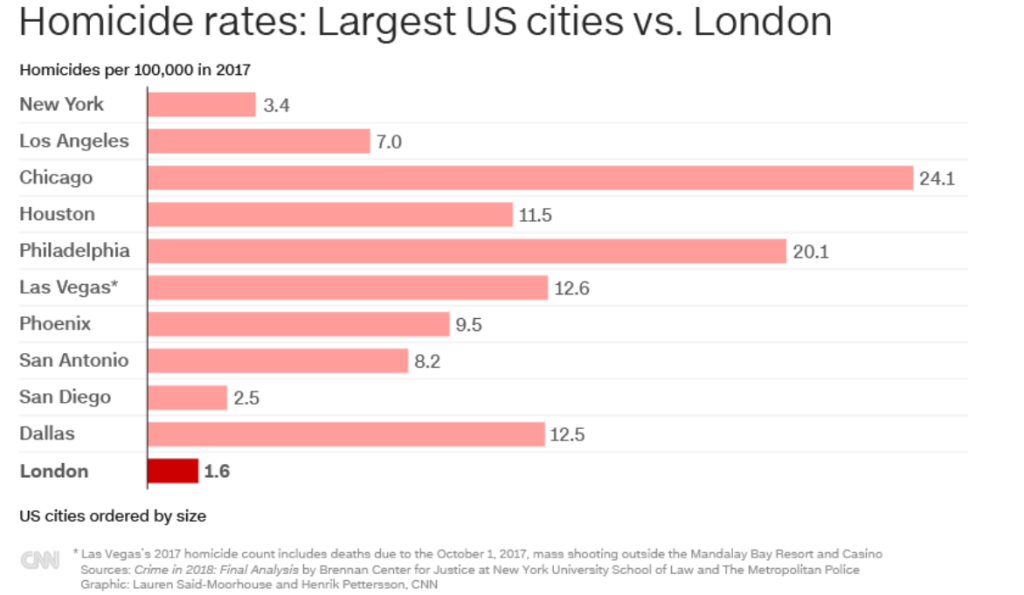
London is a city of 9 million people, larger than any US city. It is an economically, religiously, and racially diverse city. Londoners struggle with soaring rents like people in most major cities. You will not be shocked to learn that London has crime rates commensurate with any other major city, including violent crime.

Except for homicide.

I spent the day looking up statistics trying to see if London had “solved” crime, but it certainly had not. It’s a crowded city full of people who are occasionally desperate and exhausted. Of course there is crime. Just not homicide. It’s one city, but it’s more than an anecdote. As far as comparisons go, it’s like someone made a synthetic control for US cities, but will strict gun control laws. And I don’t want to give the impression that I was staunchly laissez faire with regard to firearms only to have a few London statistics lift the scales from my eyes. But it was certainly a moment when a single set of sylized facts created a chain reaction in my mind, when things fell into place. It’s a complicated issue that I have deeper thoughts on, but there remains the fact that the citizens of London do not live in fear of their government or their neighbors for want of firearms, but they appear to be a lot safer for it.

Whether or not you personally want to own firearms is a different question. But limits on firearms does appear to have significant postive effects. London homicide is a fraction of the safest US city. The country as a whole has (I believe) not had a mass shooting since the tragedy that lead to nationwide gun restrictions 26 years ago. The US has had more mass shooting events in the last month than the UK has had in 26 years. And it’s not just mass shoootings. There’s a potentially coincidental, but nonetheless pronounced, drop in London violent crime since gun restrictions went into effect.

London violent crime since 1981

US citizens increasingly live under the watchful eye of armed professionals in our schools and places of business, with little or no positive effect save the knowledge that we are surrounded by firearms. I see little reason we are safer or more independent of government supervision for it. Conversely, places with less armed supervision, but also fewer firearms, are experiencing better outcomes. There are arguments to be had about what constitutes optimal firearm policy. But “firearms restrictions don’t work” simply doesn’t appear to be true.

7 Quick Takes of Undeniable Insight, Absent Evidence or Significant Explanation

  1. Over-fraternization within a line of work leads to all kinds of pathologies as social networks become too insular. If you’re a police officer and you spend your days constantly interacting with civilians having the worst day of their life, it’s really important you spend your free time with people who are having a perfectly normal and safe week. Same goes for politics, academia, entertainment, etc. This is not a “pop your bubble to improve the quality of your opinions” take. This is purely advice for your own personal mental health. Academics and entertainers need people in their life that they are rightfully embarrassed to complain in front of, to keep perspective on what the stakes of their decisions actually are. Cops and soldiers need reminders that the world is not constantly coming apart at the seams. Most of us will call the cops maybe once in our lives, and it probably won’t be because something good happened. Not a week goes by in a beat cop’s life where they don’t interact with someone who had to call the cops. They need to fill their set of observed experiences with stories uncorrelated with events where someone had to call the cops.
  2. The distribution of people’s opinions of Elon Musk needs to be compressed. Everyone with an above 75th percentile opinion needs to downgrade their estimation of him as a thoughtleader or agent of positive chaos/liberty. Everyone with a below 75th percentile opinion needs to upgrade their appreciation of him as an engineering genius committed to building tangible infrastructure innovations.
  3. The current political era we are living through isn’t defined by extremism, it’s defined by gambles on different sides of the “median voter vs institutional inertia” coin. The Democratic Party is struggling to hold together a coalition of progressives and moderates with nothing but bubble gum and reproductive rights because they believe the median voter remains an irresistible force. The Republican party, on the other hand, continues to bet the entire franchise on an activated base of extremists and gerrymandering. This bet is not ignorant, or in denial, of the median voter. It’s a bet that institutional inertia combined with potentially two decades of control of the Supreme Court will yield benefits greater than the costs of eventually losing control of all three branches across multiple elections.
  4. The best super hero movies are the ones where they take an auteur with at least 5 movies under their belt and say “make the most ‘you’ movie possible, but with our characters in our universe”. Why is “Doctor Strange and the Multiverse of Madness” so good? Because they hired Sam Raimi and gave him the greenlight to make “Evil Dead 4”.
  5. Even the people who *know* that crypto and blockchain technology will create enormous value – even those people aren’t sure if the coins that currently exist will have significant commodity value down the road.
  6. There are lots of right wing political positions that I view as wrong or costly, but most of them I view as “deviations from an uncertain optimal state of the world” which is to say I don’t worry about them in the slightest. The embrace of White replacement theory and increased framing of their opposition as enabling of sexual predation of children, on the other hand, scares me a lot because there is no action or option that is taken off the table for the people who believe them. Say what you will about corporate conspiracy theories and other intellectual pathologies of the current progressive left, they consistently keep terrorism and violence of the table. It can be hard to pin down the intellectual center of a political party or coalition, but the moral center is always composed of the voices that keep violence out of the choice set. I’m don’t know who those voices currently are in the Republican political and media coalition.
  7. The key to popular support for capitalism is the continued to expansion of mint-chocolate flavored options in our choice sets.

Inviting the whole class to a birthday

I am preparing to host my son’s first grade class at our house for a birthday party. Even leading up to today (Friday), it has been a lot of work. Now I’m in the home stretch and will not have time to write a real blog. I have no problem blogging while I’m “on vacation” (in quotes because I’m an academic and I never go a day without fielding emails), but this is another level.

  1. Mental load on women – it’s real!
  2. There is a sweet convention in elementary school here that the entire class gets invited to a birthday party. My son is not “the popular kid” in his class, but he still gets chances to enter into homes and social life through these occasional birthday parties. This is weird and speculative… but there are some adults who would benefit from somehow getting integrated into one of these birthday rings. (my previous post on loneliness)
  3. Scott posted this on stablecoins last month. He had said, “…The potentially problematic aspect of this type of stablecoins is the change in value of the collateral and the reliance on supplementary instruments. …” …which is relevant because a major algorithmic stablecoin, TerraCoin, collapsed this week, leading to its de-listing by major crypto exchanges.

The propaganda premium puzzle

Beliefs I currently hold:

  1. In the past we have been surprised by the capacity of blatantly false information to persuade large groups of people.
  2. In the future we will continue to be surprised by the ability of blatantly false information to persuade large groups of people.

From the point of view of classic economic theory, this is almost a two-way paradox. First, why aren’t people rationally updating their beliefs to be more skeptical of the information presented to them by state and private media with fairly transparent agendas? If we accept the premise of the first, though, it invites a second question: why is anyone surprised by the efficacy of propaganda and the credulity of large swaths of the public? Shouldn’t we, the meta-observers, also be updating our beliefs?

My preferred explanations, as they stand, are:

  1. Preference Falsification i.e. people are not fooled, they just happen to believe that at the moment it is safer and more rewarding to appear as though they believe the lies.
  2. Social coordination i.e. narrowly held false beliefs make more better coordination mechanisms for solving collective action problems than broadly held truths

The first is a classic theory that originated with Timur Kuran’s seminal work. Whenever the median voter, or median would-be voter in an autocracy or failed democracy, seems to be held in sway by particularly transparent propaganda, I usually start from the default assumption of preference falsification. These people know the media regime they live within is a menagerie of lies that exist solely to flatter leadership and disrupt any opposition, but they also know that their short run futures remain more secure if they not only publicly accept, but actively parrot the lies.

For now at least. Preference falsification is an inherently fragile equilibria. As effective and impenetrable as propaganda can appear at a given moment, public support for those lies can collapse in the blink of an eye, a dynamic only intensified by modern communication technology.

The ability of false beliefs to solve coordination problems is more subtle, but no less salient to the propaganda premium puzzle, particularly when a regime is dependent on a small subset of a society to hold on to power (a “selectorate“) or the support of a political “base” who would otherwise have difficulty signaling their identity to one another. The reality is that obvious or widely shared truths have almost no value when trying to signal mutual affinity and trustworthiness to individuals trying to solve collective action problems. Patently ridiculous beliefs, on the other hand, work precisely because the only people who would publicly commit to holding such beliefs are those who are committed to the collectively produced club good.

So why does propaganda continue to work better than we think it should? Because we’re using the wrong metrics. Or, more precisely, because the right metrics aren’t available to us. We can ask people what they believe, but we can’t make them tell us the truth. And even if we could make them tell us the truth, we can’t measure the benefits motivating their reasoning, the value of the club goods they are gaining access to because they’ve performed the mental gymnastics necessary to hold those beliefs. Sure, it was cognitively costly to convince yourself the earth is likely flat, but those costs are trivial in the face falling out of the tightest network of friends you’ve ever been a part of.

All of this armchair theorizing is really just a long-winded way of suggesting that fighting propaganda is decidedly not about curing people of their false beliefs. If you want to unravel preference falsification, people don’t need the truth. They already know the truth. What they need are safe channels to express it to one another. If subgroups are forming around false beliefs, the answer is not to shame them for their beliefs. That will only strengthen their group and members’ committment to one another. Rather, the answer is to provide superior substitutes for the club goods they are currently receiving. When in doubt, if you want to break a social equilibrium, you’re better off giving people what they need rather than demeaning what they have.

Come to think of it, that’s probably pretty good life advice in general.