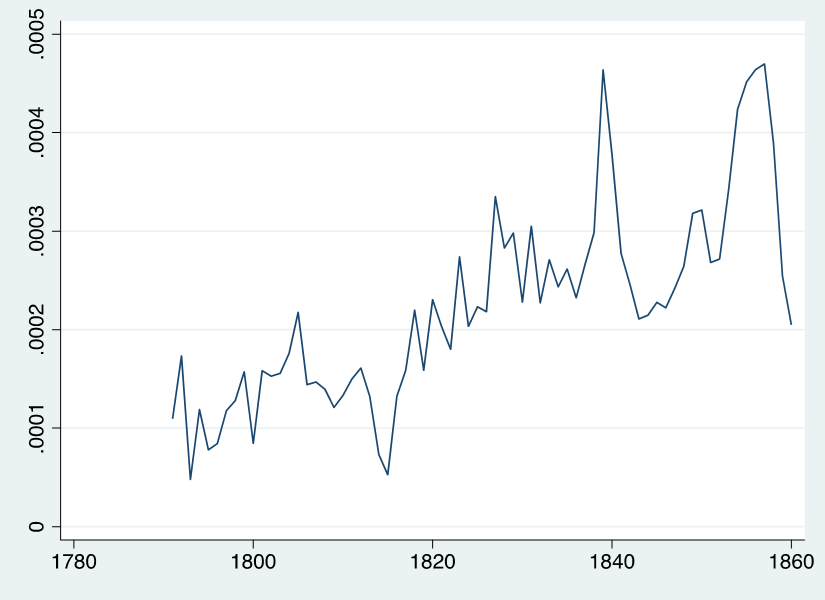
Dating Recessions: 19th Century Edition

Last week my post was on the definition of a recession and argued against using the “two quarters of declining GDP standard.” Little did I know that the White House’s Council of Economic Advisors would write a blog post on this topic the very next day (essentially taking the same position as I did). The CEA post set off a long discussion on Twitter, which even spilled over into the national media.

I don’t want to get into that debate here today. Instead, let’s look at the history of dating business cycles, specifically in the 19th century. Forget waiting a few months or even a year for an official NBER announcement: the first attempt to date business cycles was going back over 100 years! In going over this history, perhaps we can learn something about our current debates over recessions, but I think the history is interesting in its own right (it’s also a great example of how we can get better data and use it to answer important questions).

I’ll give a brief history here, but read this Romer and Romer conference paper to get an excellent, full history of the NBER’s business cycle dating. The NBER was essentially founded as an institution to study business cycles. One of the first major publications was Willard Thorp’s Business Annals, published in 1926. It was groundbreaking study, which not only provided annual business cycle dates for the entire history of the US, it also did so for 16 other countries for roughly the same time period!

While such an undertaking was impressive, the methods used were pretty unsophisticated from the hindsight of almost 100 years later. First, these are annual estimates, not monthly or even quarterly. Monthly estimates would come later, first appearing in Burns and Mitchell’s 1946 volume Measuring Business Cycles. Those monthly estimates began in 1854, and these are the same ones you will find on the NBER website today, essentially unmodified by even a single month for the late 19th century.

But what of the first half of the 19th century? How did Thorp date recessions?

Continue reading

How many of our problems come from captured land value?

I can’t shake the idea that captured land value serves as the origin, or at least accelerant, of a great deal of the problems in the United States. What if the YIMBY vs NIMBY fight is just the most visable element of the core economic disease in America? A heads up, if you’re expected a deeply researched 5,000 word post that will YIMBY “pill” your most skeptical colleague, make your peace with disappointment now. But if you’re into policy failures and run-on sentences, you’re in for a good time.

I just can’t get over how often the examination of seemingly every subpar economic context (not immediately attributable to a pandemic or war) comes down to people X are geographically constrained, they need to be proximate to a specific physical location to produce or consume Y, and a huge amount of the economic surplus that would be created from any sort of exchange is captured by land/property owners because legal constraints on development have made the physical place in which an exchange happens THE short side of nearly every market that is pointed to as a failing institution.

Seriously, go through the list of everything that leaves critics of markets ready to burn capitalism (and its fostering society) to the ground. Wages are too low relative to rent. Rent is too high in the places that are near the jobs I want. Public schools aren’t good enough unless you’re willing to carry a mortage that would account for 70% of your take-home pay. Healthcare…eh, maybe not healthcare. Healthcare is crappy for its own bespoke and byzantine set of reasons.

I am a person with no shortage of bodily ailments because I chose to play lots of sports despite never being especially good at them. As a result, I am an avid consumer of physical therapy and therapeutic massage. I have had many conversations about the economics of these fields, and I am now 100% certain that the key to making a career at either, given a minimal level of competence, is not how good you are at your job, but your capacity and good fortune in solving your real estate problem. The entire Massage Envy empire appears to exist not based on greater competence in technique, training, or personnel. It exists solely to extract rents from employees because scale lets them solve the real estate problem (and probably pool liability risk, too). The single biggest thing an individual professional can do to increase their yearly income is not win an award for Therapist of the Year or get 5 stars on Yelp. It’s buying a house with a room they can use as a home office, where they can pay “rent” to themselves and take a tax deduction for the office.

I was once told a likely apocryphal story (that I can’t find on the internet, so it’s probably not true) that the then CEO of Starbucks declared “We make coffee, but we’re in the real estate business.” That their business had matured to the point where revenues could be projected with sufficient accuracy that the profitability had been reduced to identifying opportunities in the real estate market. I don’t know if that ever happened, but that still seems about right to me.

Housing costs hold a special place in how we view our own economic status and security going forward, in part because food costs have been reliably low for so long (knocks on all of the wood). When the rent goes up we feel worse off, not just because we have less disposable income today, but because it increases our expectations for future rent increases as well. We have lots of words for economic insecurity and desperation, but nothing quite makes your blood run cold like the prospect of being homeless, even for the briefest moment.

The phrase “paying your nut” is a lot less common these days. You usually only hear it from self-employed people who live off of a la carte incomes, either in entertainment, freelance, or contracting work. It refers to the minimum amount you have to earn in a month to avoid significant consequences, usually the aggregate of rent/mortgage, utilities, and debt payments. Economists talk about “nominal” and “real” incomes to account for the changes in prices people face. Sometimes there is discussion of “money illusion” where people living under inflation are fooled by higher take-home pay into thinking they’ve become richer. I’ve never been persuaded that nearly anyone suffers from money illusion, nor do I think folks track national price indices and growth statistics.

I think people just know whether it’s easier or harder to pay their nut, and the simplest version of that is the ratio of their take home pay to their rent. Paycheck divided by rent, full stop. If you follow this blog or Jeremy on twitter, you’ll know that one of the puzzles frequently revisited is why Americans are so pessimistic about the economic dynamics of the last 20 to 30 years, and why younger people seem terribly aggrieved about their relative economic status.

So if generational income is fairly consistent and median home mortages account for a slightly declining fraction of median income, what gives? Well, it could all be one big economic mass hysteria, but I’ve got a simpler explanation: the ratio of rent to income to has skyrocketed in the places that young people want to live. Maybe I’m overprojecting my own lived experience, but when I was 25 I did not want to live in a rural area, the suburbs of a major city, or even the downtown of a minor city. I wanted to live in a proper big city. And for a young person, that means living in a small apartment, possibly with roommates, which is exactly the kind of housing places like California stopped building.

Why do so many young people seem pessimistic? Putting aside the absolute failure of politics to produce meaningful climate policy, the simplest explanation is that they have an unpleasant choice. They can live in the same places young people have always lived, only absent any possibility of savings and economic security. Or they can be dispersed from the cultural and economic capitals of our country, and try to build social networks without the benefits of the generational density, plethora of events, and dating markets that have been the hallmark of being a young person in the city since World War I (if not longer).

What will solve this? Policy? California has showed some glimmers of hope. Young people voting with their feet, moving to the shining middle-sized cities that are allowing for growth and affordable rents? Could be, but critical mass is real and growing into a proper metropolis takes decades. Work from home?

That’s interesting enough that I’ll write about it next week. I have thoughts and policy prescriptions, in case any major city is looking for a czar of housing policy (NB: I’m not qualified, but available).

A Logarithmic Map of the Entire Universe, from Earth to Edge

Pablo Budassi has created a logarithmic map of the entire known universe, that shows the distances and relative sizes of objects above the earth’s surface. I think you will find it a worthwhile use of your 30 seconds of attention to click on the link below, scroll to the bottom to start down at the earth’s surface (the image quality at the link is much better than I can convey in these snips here):

And  then scroll your way up and up, through planets and stars to galaxies (not every star and every galaxy is shown, of course) and galaxy clusters:

And out through galaxy superclusters, to the very edge of the observable universe:

The scale of distances and sizes keeps getting larger and larger by factors of ten (i.e.,  logarithmically) as you go up. Here is the link: https://www.visualcapitalist.com/cp/map-of-the-entire-known-universe/

I am awed by the sheer sizes of things compared to familiar earth-scale objects. We know that our observable universe has not existed forever; presumably whatever caused this vast universe is incomprehensibly vaster. [1]

I am also impressed that humans are able to figure all this out; it is not obvious to the naked eye. An enormous amount of collective brainpower over the years  has gone into making instruments (including space-based telescopes) to collect data at many electromagnetic frequencies and to figure out what it all means.

Bonus: In case you haven’t seen them already, here is a link to compelling infrared images from the newly-deployed $10 billion Webb space telescope (your tax dollars at work):

https://www.cnet.com/science/space/features/webb-space-telescope-mechanics-how-nasa-unlocked-astronomys-next-great-era/

[1] I don’t want to distract from the sheer visual enjoyment of this graphic with a controversial discussion of what is responsible for bringing our universe into existence. All I will say here is that it did not come from “nothing”, as a certain dishonest physicist is fond of claiming. See the “Thinking About the Existence and Attributes of God” section of Christian Apologetics Insights from David Geisler, Ray Ciervo, and Prem Isaac [2020 NCCA, 9], including footnotes 1 and 2, for a brief discussion of these issues, and implications for a nonmaterial sustainer of physical reality.

Severance and the Disutility of Work

For those who were unaware, we are apparently a Severance blog now, a trend made all the better since nobody else is talking about the show anymore. Like all high concept fiction, the show can be consumed as a metaphor, in this case usually as a metaphor for modern office work. While I consume more than my share of metaphors, I usually find speculating about the “true” underlying metaphor driving a piece of storytelling to be more fun than useful. Instead, let’s talk about what the central conceit of the show actually is, namely a return to explicit slavery. Not almost slavery. Not wage slavery. Not “I’d rather be playing Minecraft on Twitch than making pivot tables in Excel ” slavery.

Actual slavery. The hook, through a clever bit of science fiction, is that it is slavery through a channel that allows a person to enslave the only person that we can imagine the world allowing to pass as anything but grossly criminal: themselves. The person you are enslaving to toil on your behalf happens to be a partitioned-off portion of your own consciousness (known as an “innie”) who continues to operate within a now shared bodily meat sack while your “outie” consciousness goes into a apparent blacked-out stasis. The innie does all the work, while the outie reaps (nearly all) all of the material rewards.

One take away is that there are people so desperate to not have to go to their jobs that they will carve off 8 hours a day out of their own claim to existence, a full third of their life, grant independent sentience to that third, and then enslave it. Putting aside the moral repugnance of such a decision for a second, one can’t help but ponder the preferences being revealed by an individual paying such a price.


Never trust a “unified theory” of damn near anything. It’s usually bullshit from the first moment, a cheap trick for gaining attention while grotesquely overreaching for importance in what is either a relatively mundane insight or a bit of intellectual sleight of hand designed to misdirect the reader from a deep underlying fallacy.

Anyway..


The price we’re willing to pay to not do something we don’t like often reveals more about ourselves than the prices we pay for the things we do like. The cost we’re willing to inflict on others reveals it all the more.

One of my little mental tricks when trying to understand human behavior that I can’t quite grok is to swap out a “utiliity maximizing” model for a “disutility minimizing” model. Trying to understand why a person would enslave a portion of themselves within the framework of “what are they maximizing?” lends itself to complex speculation on dimensions of their lives we can’t observe. Flipping it around, however, and asking what they are minimizing is immediately more intuitive. Without getting too deep into spoilers, there’s clearly a motive to minimize the disutility of work itself. Of toil, tedium, and drudgery. Of being told what to do and doing what you are told.

The hypothesis of Severance is that people will create an enslaved conscious person and explicitly deny the humanity of that person if, in doing so, they can minimize their own disutility of work. The corporation that creates these institutions in this fictional world will probably turn out to be either decadently evil in pursuit of pure profit or banally evil in pursuing some sort of yet unseen greater good. Even if they have rich and tragic back stories, the middle management that keep the plantation functioning are morally wretched individuals who have chosen to enable slavery to preserve their own status quo. The corporation, the managers, these are the bad guys. The heavys. The bullys who gain from the suffering of others.

But they’re not the monsters. The only monsters in the world of Severance are the individuals who made a choice to create and enslave another person solely so they themselves might enjoy a life without toil or tedium.

The cost that you are willing inflict on another in an effort to minimize your own discomfort reveals a lot about you. Whether you’re a socialist preaching “solidarity”, an economist who knows that Smithian “sympathy” is the glue of modern society, or just someone who thinks that it all comes down to coping with the prisoner’s dilemma, how a person values the suffering of others is a defining attribute.

Which brings me to a question I think only the creaters of Severance can answer. Is the conceit of their show to show that people will enslave a portion of themselves because they deny the humanity of their creation? Or is it that an office job is so abhorrent that opportunity to offload that burden to another while keeping the rewards for themselves overcomes any sympathy they might have for the other?

This show isn’t a metaphor. It’s a model. In this sense, Severance may be the most misanthropic hypothesis of humanity in the economically developed world I’ve ever observed. That humans, freed of the disutility of possible starvation or annihilation, will take any opportunity to minimize their own discomfort, even at the cost of a third of their lives and moral rot that comes with the enslavement and denied humanity of another. Somewhere, in the deep dark noughaty core of this piece of fiction is the consideration that, freed from our need for one another, our antipathy for discomfort will birth an idle, half-drunk decadence that will lead us to literally eat away at ourselves.

Or maybe the creators just all had office jobs while they were trying to make it in hollywood, and they really, really hated them.

Be Like Pete

Pete Buttigieg is the Secretary of Transportation in the Biden administration. He has made an interesting habit of going on Fox News and willingly submitting himself to what his interlocutors clearly anticipate to be difficult “gotcha” questions that will leave their liberal target squirming on camera. Secretary Buttigieg seems to always come out the clear winner and I think there is something to be learned from it.

The easy answer is that Buttigieg is smarter and more polished than the Fox News interviewers, which he is, but I think that’s easy to overrate. There is no shortage of smart people who wouldn’t fair half as well as the Secretary does. Part of it is his calm and poise, but credit should also go to just being nice. That niceness really puts people on the back foot. The secret sauce, in my estimation, is that he never for a second sounds like he is arguing. There’s no sense that he is interested in a back in forth. He never gives anyone an opening to raise their voice, to seem attacked.

But it’s not just being nice. The interviewer in the first clip quickly realizes that his question has failed to get the desired reaction, and subsequently tries to interrupt him at multiple points. The Secretrary simply ignores him and proceeds with his answer without missing a beat or raising his voice. He’s the G-d— Secretary of Transportation. He doesn’t have to be deferential to some teleprompter anchorman trying to raise points of political decorum and social norms with a member of the opposition party that has been given no quarter on their network for 20 years.

So how do you be like Pete?

  1. Be nice.
  2. Know your stuff.
  3. Never defer to anyone who isn’t nice and doesn’t know their stuff.

Being nice is inclusive of being polite, but there is more to it. It means being generous in the motives you assume in others, including those who are questioning or arguing with you. It means using tones of voice and choices of language that don’t imply you are dealing with an enemy or a fool, even when dealing with a foolish enemy.

Knowing your stuff means that you can explain choices and positions clearly and concisely in a manner than allows the people listening to you to actually learn something. Knowing you stuff, however, also confers on you the right to finish your thoughts. If others prefer your conversation be more akin to a verbal brawl, that’s their prerogative, but that doesn’t mean they get to dictate where your thoughts begin and end just because they’ve lost control of the outcome. Knowledge should confer some privleges, be them however limited.

And finally, being like Pete means never deferring to people who don’t want to play by the rules of basic civility and have nothing to contribute to the conversation. You’ve got a job to do and being nice will help you do it all the better. So be nice, until it’s time to not be nice.

On Vacation, Does the Law of Demand Apply?

I’m on vacation this week. But no, I’m not just saying this to get out of posting this week, or to brag. Americans really have started going back to the normal routine of vacations after a long break during the pandemic.

You might think that the high price of gasoline will slow down summer travel. Not so, according to estimates from AAA. While the total number of estimated travelers for Independence Day weekend is still slightly below Summer 2019 (by about 1 million travelers), travel by car is predicted to be just above 2019 levels (by about 0.5 million travelers), with 42 million Americans traveling by car. Air travel has been a mess lately and quite expensive (even compared to pre-pandemic levels), and is predicated to be about 0.5 million below 2019. Bus/train/cruise travel is still the big loser, well above the past two summers, but still 1 million travelers below 2019. (These are all estimates, of course, but AAA is in the business of knowing this data well.)

What gives? Basic economic theory would tell us that if the price of something increases, people should buy less of it. And traveling by car is much more expensive than in Summer 2019. We should also think about substitutes, and airline travel is certainly a substitute for car travel. But if we look at what has happened to both airfares and gasoline prices since July 2019, we can see that gasoline prices have increased much more (about 60% vs. 25% for airfares).

So, do we just throw up our hands and say: “it’s just too complicated, lots of factors at play”?

Continue reading

The Third Act of American Prohibition

As you know, the Supreme Court overturned Roe v Wade, effectively giving states the ability to legislate the conditions, if any, under which abortion is legal. Many states had trigger laws in place, meaning that abortion became partially, mostly, or entirely illegal immediately. While some states already had laws in place protecting the right to an abortion, others are expected to pass new legislation restricting abortion access in the near term.

So, to summarize, there is a medical service for which there is significant demand. That demand, at the micro level of an individual consumer, comes with time pressure in a heightened emotional context. The supply of the service will vary geographically. Given the clustering of states that are prohibiting abortion in the south and midwest, there will be considerable heterogeneity in legal abortion access based almost entirely on physical distance and access to transportation.

Advocates for the banning of abortion are aware of this and have responded in some states by adding heavy punishments for aiding and abetting abortion access, some going as far as granting access to civil lawsuits or offering rewards for third-parties who tip off authorities to those who have received an abortion.

Prohibition of a good with strong demand, heterogeneous legal supply, and heavy punishments for those seeking to enable arbitrage across state lines. This is not a new story. First alcohol, then narcotics, now abortion. This might feel different because abortion is a service good, but it’s not. Why?

Because of mifepristone and misoprostol, often referred to as “The abortion pill”:

As it stands, a state cannot ban a drug with FDA approval, but access is nonetheless thin. There will also be, with similarly little doubt, efforts to quickly ban mifepristone and misoprostol, with accompanying heavy punishments. Eleven weeks is a long enough window that it will cover the majority of abortions. It’s small and portable, which means it will be easily transported and resold. It will also remain perfectly legal in a number of states bordering those prohibiting abortion. There will be, with nearly zero doubt, a booming black market in mifepristone and misoprostol within a matter of months.

But this isn’t a medical procedure provided in a fixed building with identifiable practitioners. These will be pills that will be exchanged in school bathrooms and college dorms, purchased by professional women who drove 300 miles in a Lexus and came back with enough to give to their professional friends who want to be proactive and prepared for daughters who may be sexually active. Further, these aren’t addictive products: there won’t be weekly customers whose symptoms will create patterns of consumption and the kinds of collateral damage that attract attention. Passive enforcement of these laws will be highly ineffective.

In some places, enforcement on pill restrictions will simply be weak, meaning anyone whose pregnancy can be terminated in the short run will retain some meaningful access. The price will be elevated like any good where suppliers incur legal risk, which means access to abortion will correlate heavily with income, resources, and social privilege. This will also shift the effective burden of abortion restrictions towards the later term “abortions” that only account for 1.3% of terminated pregnancies, but are more heavily associated with medical emergencies, incomplete miscarriages, and the kinds of pregnancy events associated with trauma and shame (e.g. rape or incest) where a women is not necessarily in a position to take decisive early action. Given that the majority of Americans averse to abortion are principally concerned with late term abortions, but also believe abortion should always be an option when the health of the mother is in jeopardy, it is expecially vexxing that laws that reduce access to early term abortions will increase the previously miniscule demand for late term abortions.


I expect some states will attempt to enforce prohibitions or limitations on mifepristone and misoprostol with a war-on-drugs like zeal. How do you heavily enforce a ban on a small pill that is easily hidden, not regularly used, legally manufactured in other states, and has a viable market with high income individuals? Experience tells us the answer is to dedicate lots of resources while carrying little regard for individual rights or public safety.

Marijuana legalization has spread rapidly across the country. District attorneys are increasingly uninterested in prosecuting minor possession charges of nearly any drug. In 1993 state and local governments spent $15.9 billion on the criminal justice of drug enforcement, $26 billion by 2003. Now it’s probably closer to $40 billion (I couldn’t easily find a good current estimate). That’s a lot of money. That’s a lot of jobs. That’s a lot of government jobs, with government job security, many of whom might be wondering what their job is actually going to be in five years. They needn’t worry. When one prohibition closes a door, a new one opens a window.

Local governments have been seizing property, charging fines and fees, and generally subsidizing their local tax bases on the back of the drug war for decades now. Cracking down on a new banned substance might not work for a variety of reasons already listed, but that doesn’t mean they won’t try, particularly if trying means getting a lot of political attention while hosting photo ops with seized contraband next to local police and publicly shaming perpetrators as unforgivable monsters.


Prohibition of alcohol failed in large part because it made nearly everyone a criminal. Alcohol appealed across every strata of American life. Most Americans had a hidden liquor cabinet, a favored speakeasy, or even a backyard still. That breadth and depth of demand brought tremendous profits to those who could supply it outside of the law and, eventually, tremendous violence from those eager to capture those profits.

Demand for abortion access, whether for discretionary reasons or medical necessity, appears randomly in lives, but those rolls of the dice are inclusive of nearly every woman and every family. With that breadth and depth of demand will come a black market. Possibly even a highly profitable market. Materially profitable for suppliers. Politically profitable for those legislating to suppress it. Budgetarily profitable for those working every day to destroy it. These prohibition rents will appear, they will be fought for, and they will sustain themselves through a process that will destroy lives. Mostly women.

The third act of American Prohibition is here and it will hurt us all. Mostly women.

Labor market tournaments and the cost of almost making it

Two weeks ago Tyler Cowen observed the increasing presence of family lineages in the NBA. The post is without much commentary, so I won’t impute any theory on Tyler’s behalf, but I suspect most people would observe this as the a product of genetics combined with the increased ability of NBA teams to precisely identify the attributes and aptitudes they want. There could also be a component of nepotism i.e. 2nd generation players are given greater leeway and time to develop, but given the revenues on the line in professional sports and the dependence on labor to compete, those effects are likely to be weak.

I’d like to offer an alternative theory to genetics that I refer to as “Better last than second”. There are certain lines of work, such as athletics, acting, music, or twitch streaming that are best thought of as winners-take-all labor tournaments. Any occupation where the concept of “making it” is well understood by its participants as an elusive but desirable goal can be considered a labor tournament.

There are lots of labor tournaments (academia for instance), but in most of them 2nd, 3rd, or Nth place are reasonably tolerable outcomes because the rewards correlate fairly linearly with any success level beyond abject failure. Nobody worries about being the 27,342nd ranked accountant in the world – that person likely makes a good living. Even if they can’t get a job as an accountant, they have skills that readily translate to a variety of other well-paid occupations. Winning is merely a (highly remunerative) cherry on top of an already pretty good oucome.

Basketball players worry a great deal about being the 474th best in the world.


The NBA at any given moment has 450 employees on their rosters. A couple dozen more float in and out on short term contracts to fill in for injuries and other player absences. The league minimum salary is $925k per season. The NBA developmental league (the G League) pays about 37k per season. That already makes it sound like the earnings dropoff from being the 449th best player to the 474th player is enormous, but it’s actually much, much worse.

It’s worse because basketball skills translate to the tiniest sliver of other jobs. Television acting, DJing house music, colorfully live streaming a Castlevania speed run: these are all skills that can pay large sums of money if you cross some imaginary threshold and “make it.” The catch that distinguishes “better last than second” markets from other winner-take-all labor tournaments is that participation requires the dedication of tens of thousands of hours building human capital whose rewards are skewed almost entirely towards a selected few. Those thousands of hours play out over the course of a survival game where, month by month, year by year a new round of “losers” is selected out.

The irony being that losing first is better than than getting the silver medal. Losing first means rebooting your life early and building up your human capital in something else (hopefully in something more forgiving of merely being very, very good). The silver medalist is, in fact, the biggest loser. The opportunity cost of time and energy they will never get back and never be rewarded for. I don’t worry about players that don’t get NCAA scholarships or drafted for the NBA. I worry about the guys hanging around in the G league until they’re 34 only to get released from their contract over a text message. I worry about the actors who’ve spoken 15 lines across 24 television guest spots and 3 commercials in 11 years based mostly on aesthetics, only to wake up at 34 and find themselves in the uncastable valley of normalcy. I worry about the members of all the bands I like but none of my friends have ever heard of.

Which brings us back to NBA lineages and why they seem to be becoming more common. If your father was in the NBA in the 80s or 90s, you probably come from upper-middle class or better means and, in turn, have the backing to tolerate the financial risk of not making it. Second, almost making it is likely to be less costly for you because you are part of a basketball family. Your name will grant you far greater access to the small number of basketball-adjacent jobs that will value your skills (i.e. coaching, scouting, recruiting, commentary, etc). Being part of a lineage makes that silver medal a lot more valuable. Maybe just as importantly, your family is likely to be a lot more supportive and tolerant of the risk you are taking. If your one of your parents had a six year run on Dynasty or made a living on the LPGA tour, they’re that much more likely to see a path to success for you.

As athletics become more lucrative, they become better understood. As they become better understood, the body of highly specific tacit knowledge grows as well. Lineage players will have access to this tacit knowledge through their parents. Dell Curry knew his son wasn’t going to particularly tall (Steph Curry is listed as 6′2", and official NBA heights are notoriously generous). This lead him to entirely reinvent his son’s shooting form in a manner that rendered him unable to shoot from any distance at all for months, entirely based on his understanding as a former NBA player that his son’s lack of genetic predisposition to play in the NBA required a motion that would catapult shots over much taller players. Even if lineage players do have genetic advantages in the high school and college stages of the tournament, the value of these advantages pale in comparison to the advantages of tacit knowledge precisely because of the stage of the game at which they are leveraged.

One could even argue that any genetic advantages that correlate to success at the early stages of a “better last than second” tournament (i.e. being 6’8″) are akin to a resource curse, giving the false impression of a non-trivial probability of “making it.” Conversely, a lack of genetic gifts (i.e. being 6’2″) while having access to the tacit knowledge valued at the last stage of the tournament truly are a blessing. If you survive the tournament until the last round without the obvious endowments other players have, you probably have a rich portfolio of other skills which, combined with the previously mentioned late-stage tacit knowledge, means you’ve been playing the game with less risk and greater expected value than others.


“Better last than second” labor tournaments are common in high prestige entertainment fields, but they aren’t limited to them. Any academic field that produces PhDs with little to no demand in the private market shuttle thousands of students through exactly such a tournament. The only difference is that the gold medal is a $87k a year job with the job security of tenure and “almost making it” often includes crippling student loans. It shouldn’t be much of a surpise that academia is full of lineages, too. And with those academic parents will come the knowledge of how decisions made in high school, college, grad school, and beyond will determine they win their respective labor tournaments. Or lose and have to settle for saving the world.

Everyone’s an Expert: Easy Data Maps in Excel

I love data, I love maps, and I love data visualizations.

While we tend not to remember entire data sets, we often remember some patterns related to rank. Speaking for myself anyway, I usually remember a handful of values that are pertinent to me. If I have a list of data by state, then I might take special note of the relative ranking of Florida (where I live), the populous states, Kentucky (where my parents’ families live), and Virginia (where my wife’s family lives). I might also take special note of the top rank and the bottom rank. See the below table of liquor taxes by State. You can easily find any state that you care about because the states are listed alphabetically.

A ranking is useful. It helps the reader to organize the data in their mind. But rankings are ordinal. It’s cool that Florida has a lower liquor tax than Virginia and Kentucky, but I really care about the actual tax rates. Is the difference big or small? Like, should I be buying my liquor in one of the other states in the southeast instead of Florida? Without knowing the tax rates, I can’t make the economic calculation of whether the extra stop in Georgia is worth the time and hassle. So, the most useful small data sets will have both the ranking and the raw data. Maybe we’re more interested in the rankings, such as in the below table.

But, tables take time to consume. A reader might immediately take note of the bottom and top values. And given that the data is not in alphabetical order, they might be able to quickly pick out the state that they’re accustomed to seeing in print. But otherwise, it will be difficult to scan the list for particular values of interest.  

Continue reading

The story of social media isn’t over

Saturday I opened twitter and was immediately confronted with bad news that threatened to turn tragic.

This was horrible. “That’s horrible” I said. I spent a moment’s thought reflecting on what might have happened and then continued down my feed.

Within seconds of continued scrolling, I was confronted with this:

My mentality changed immediately. This was no longer a tragic event happening to an anonymous person in a context I had no capacity, nor obligation, to offer assistance. This was a problem and time was a factor. I started thinking about who I knew in Florida. Did I have any friends holding a position through which they could offer assistance? Was there a social cluster I was connected to I could reach out to through social media? Hospitals, law enforcement, travel. Who did I know? I became despondent when it became clear I had nothing to offer but a retweet.

After a few seconds I returned to reading what I realized was a thread of tweets only to be given the relief of wonderful news, a happy ending that was directly a product of sharing on twitter:

The arc of drama (from the privilege of my physical and personal distance from actual events) was over in less than 30 seconds. What I was left with was a simple truth: I was sympathetic, but comfortably detached from a tragic event actively unfolding. It wasn’t my problem nor was it something I could do anything about until I found out I knew someone involved.

Barely knew. I had exchanged a couple messages with Omar about a year ago. A handful of polite thoughts about something Omar tweeted that was of mutual interest. That’s it. That’s the totality of our interactions. But with it came a completely different framing, a level of connection that elevated an evocation of standard sympathy to a potential call to action.

Twitter, that engine of animosity and toothless rage, had made me care more about a stranger through the simplest of social connections.


Comedians and other entertainment professions often tell the same simple story about online trolls that goes something like this:

  1. Someone writes something mean about the entertainer on twitter
  2. The entertainer responds to the troll in a polite and controlled manner that invites them to more civil engagement or simply reveals that the trolls comments are hurtful.
  3. The troll evaporates, replaced by a person excited to re-acknowledge the basic humanity and worth of their previous target.

A moment of direct interaction transforms, in the eyes of the troll, a previously two-dimensional narrative prop into a flesh and bone person worthy of dignity. We’re awash in the denigration of targeted individuals by detached opportunists seeking status and approbation through targeted cruelty. What is underappreciated is the opportunity in this moment for the target to reach back and give the troll what they actual want: to be seen.


This next part is probably not the leap you are expecting, but there is a long history of media radically changing how we acknowledge and internalize the humanity of others. In this vein, there is arguably no more famous and impactful image than the seal of the The Society for the Abolition of the Slave Trade (1787), asking “Am I not a man and a brother?”

Not to be glib about such an important and horrifying part of our history, but this image blew people’s minds. In David Levy’s amazing history of how economics came to be referred to as “The Dismal Science”, he relates the efforts of Thomas Carlyle, Charles Dickens, John Ruskin, and other figures in English literature to deny the basic humanity of non-White men and women, particularly those from Africa and Ireland. Key to their efforts were stories, particularly those coupled with drawings, that explicitly portrayed the targets of their denigration as something far removed from humanity as a species. It was to their chagrin that the “Man and Brother?” image went the 18th century equivalent of viral.

It not only shocked households all over England to learn that the victims of the slave trade were clearly human in every sense of the word, it sparked an undeniable chain of logic. If these are men and women, then they can learn to read. If they can read, then they can come to know the Bible and their souls can be saved. If they can be saved then we have an obligation to teach them to read, offer them a Bible, and welcome them as brothers and sisters.

This image forced the reconsidered worth of others and with that reconsideration a calling for their liberation and salvation. This image, and others like it, changed who was human.


Social media is currently how many of us stay on the bleeding edge of news. It’s a way for us to promote ourselves and our work. It’s also a hellscape of acrimony, bad faith arguments, bullying mobs, and malicious propaganda. That’s what it is today. But that doesn’t mean that’s all it can ever be. Film and television changed the world as entirely passive, one-directional media. Most of the downsides of social media are born of interactions that, by little more than the inertia of the mob, often behave as if it were a one-directional media, carrying the masses along in the tidal wave of an irresistible narrative. There remains the possibility, the hope, that the capacity to interact meaningfully will eventually reclaim it as a multi-directional discourse, where the people we interact with become more real. More human. Where calls to serve can overwhelm and displace calls to destroy.

The story of social media isn’t over. There is still time for it to become something more. Where the people on the other side of claims and jokes and accusations become more human, not less. Where we broaden the ranks of who we offer our best to and shrink those whom we condemn with our worst.