The future is always uncertain, but the short term returns on Luka Doncic to the Los Angeles Lakers already look better than some would have forecast. While he isn’t up to his highest previous standard of play yet, the reduced burden and additional space being enjoyed by Lebron James is already evident in his play. You’ll find no predictions regarding the rest of the season here, but it is a healthy reminder that complementarities are harder to anticipate than substitutes. The possibility of substitution between inputs is more than anything else revealed by their sameness, an attribute that alllows revelation by comparions. Complementarity, on the other hand, is far more complex and often obfuscated by the near infinite ways two or more inputs can be different. Substitutes can be predicted with information and attention to detail, and is therefore more easily reduced to a repeatably applied formula. Predicting complementarities demands more bespoke creativity, an art that is far harder to differentiate from luck.
Uncategorized
There’s nothing creative about DOGE
Institutional vandalism is neither privatization nor creative destruction. It’s just cruelty masquerading as genius that plans to simply plead the necessary risk of endeavor when exposed as gratuitous incompetence. We may, within 10 years, see a newer, better NIH (or, preferably, cluster of baby NIHs) rise from the ashes. We may see a revitalized NSF and a whole slew of new institutions funding educaton research domestically and supporting the broader world through American aid programs. Maybe, maybe not.
But make no mistake: this is not a controlled burn. There is no plan, other than perhaps the wholly articulated belief that destruction wrought from chaos is a plan. This is a series of forest fires set by gleefull children with matches, wholly unable to even comprehend the risks they are taking on behalf of everyone else. We’ll probably get through to the other side, but for those of us who have been thinking about tail risk for a decade of Trump, the number of standard deviations between us and the unthinkable keeps getting smaller.
Relevant indicators for evaluating the prospect of democratic collapse
How bad are things? You know, in terms of our democracy and economy crumbling under the great wheel of history as the current administration tries to waddle us into fascist kakistrocracy. Are they bad? Maybe! Or maybe things are mostly fine and all we have to cope with is fear-peddling journalists and neurotic academics hyperventilating through what promises to be a four-year panic attack.
Well, Tyler is looking for market indicators. Signs that the market is internalizing the possibility of deteriorating government and political institutions into prices. That’s a really tall order, even more so than what it might seem to those of us who tend to rely on prices to reveal collective wisdom and the best underlying forecast. Prices reflect the expected benefits and the opportunity cost of an asset or choice in question. Opportunity cost can be explained in a number of ways, but they all boil down to the best outside option. It’s always going to be trickier to expect convenient and obvious price indicators for risk that is inescapable, where there is little in the way of an outside option. If you want a good forecast for avian flu, poultry and egg prices work pretty well, reflecting culled supply, reduced demand from a fearful public that thinks carnitas is sufficiently tasty, and the moves made by speculators who think that things are (or are not) going to get worse. So what are the analogous prices for those speculating that the center will or will not continue to hold in the Great American Project?
If you believe that the Trump administration is, in fact, trying to backdoor in an authoritarian revolution while walling off the largest economy from the rest of the world into a protectionist backwater, all while undermining the global reserve currency, what exactly is the outside option? Where can the money go? The people? The ideas? There are no doubt answers to those questions, but while most of the developed world is struggling with protectionist and authoritarian fevers, all while many entertain the prospect of a Russian invader who is already actively attacking a democratic nation, a host of obvious answers don’t rush to mind.
But let’s not punt entirely. Let’s get a little more micro. Is the market internalizing a more protectionist future for the US market and the global economy? Here’s the S&P 500 index for the “Materials” sector vs the entire S&P 500 over the last year:
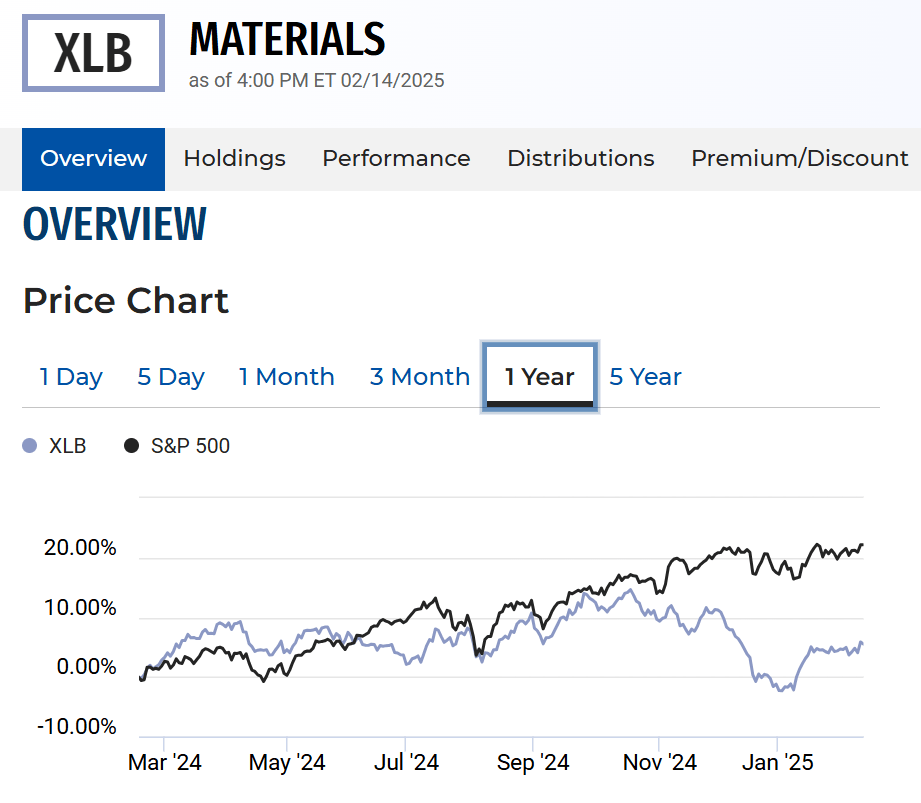
Correlation is not causation, but the rapid drop off in the value of “chemicals, construction materials, containers and packaging, metals and mining, and paper and forest products” since what was effectively a coin-flip election is certainly convenient to the hypothesis that the market thinks materials previously circulating the global economy are not as likely to find their most valued uses under the Trump administration. If the market thinks we should take the threats of protectionism seriously, why shouldn’t we treat the administration’s threats to default on the debt similarly? Of weaponizing the DOJ against political opponents or ignoring court decisions? There’s not going to be a silver bullet composite price, but for each individual threat we should be looking for a relevant price.
If we are going to accept the hypothesis that any one single price indicator is going to be hard to identify, how about a forecasting index? The folks beind the Policy Uncertainty Index have a measure that reflects the language used in a large variety of publications combined with professional forecasters to reveal not what the future of policy is likely to be, but how much disagreement there is about it. Again quite the increase in the aftermath of a coin-flip election, which is odd because you would expect their to be more uncertainty before a coin-flip election, not afterwards. Shouldn’t we know what we are getting to a greater degree now what we know who is holding the office? I mean, assuming we actually know who is wielding power and influence within the office…
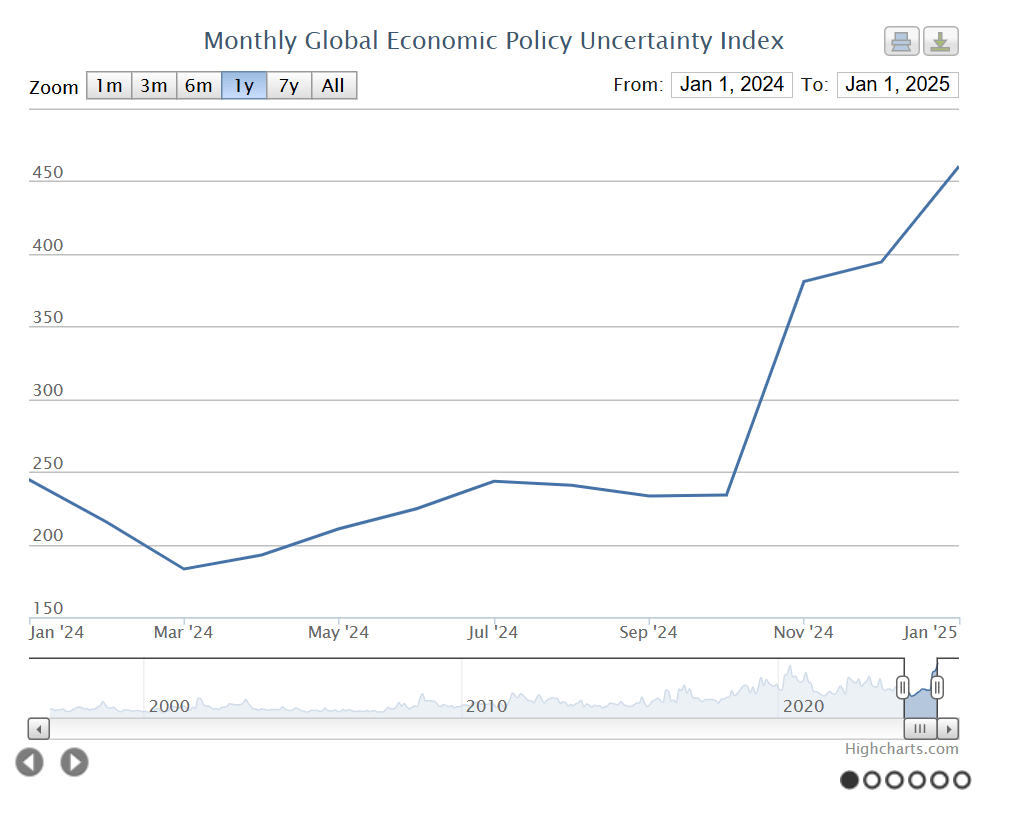
So there are some metrics that point towards a more isolationist future characterized by less predictable government institutions. That’s not nothing. We should be careful not to expect the markets to hand us a forecast on a silver platter, however. In both 1962 and 1983, it’s entirely possibe that nuclear war was averted by Stanislav Petrov and Vasily Arkhipov, who respectively refused to launch missiles and report (erroneously indicated) US missile launches, as dictated by Soviet protocol. As chaos is injected into the US government, including those tasked with overseeing the nuclear arsenal, we should perhaps look to the past. What were the prices that revealed how close we were to history-forking events? Did any price reflect the ebbs and flows in that underlying risk, the changing cultures within the Soviet military and the growing and shrinking prospects of nuclear war? Or did prices instead remain largely untouched by such tides of history? Not to get melodramatically apocalyptic, but perhaps prices cannot accurately reflect the prospect of a world without connection to the markets of today. So it goes. There’s some risk you simply can’t diversify, insure, or reallocate against.
Which prices will reflect those risks?
Is there a competitive threat to the NBA?
On its merits, the dumbest trade in the history of the NBA, if not modern professional sports, occurred last week. There is no shortage of content explaining why the trading of Luka Doncic for Anthony Davis was a poorly exectuted trade in which the Dallas Mavericks got pennies on the dollar from the Los Angeles Lakers. Even if you subscribe to the theory that there is a signficant unobserved defect in Doncic motivating Dallas to avoid what would have been a new $350m contract, the fact remains they could have traded him for a host of draft assets far in excess of the value of Anthony Davis.
This has unsurprisingly spawned a cottage industry of conspiracy theories. The most popular is that the new Dallas owners are maneuvering for a casino license, but my favoirte is that the owners have inside information that a new Saudi Arabian, LIV Golf-style, rival league is in the works (I can’t find a post where such a thing was suggested. If you have a link, please put it in the comments). I have observed **ZERO** evidence for such a thing…but that doesn’t mean it doesn’t make for an excellent thought experiment, particularly since I think Saudi “sport washing” is largely motivated by a desire to diversify out of the oil business. A couple actual facts:
- LIV Golf
- The conceit of LIV golf was that the PGA Tour had a global monopoly based on nothing but i) high start up costs, ii) historical capital including brand recognition, and iii) the network effects born of having every top player in the world currently participating. The Saudi Arabia’s Public Investment Fund (PIF) made the audacious move to commit no less than $2 billion in winnings and up front fees to players to switch to their rival event series. The PGA and PIF are multiple years deep into trying to negotiate a merger with the LIV tour.
- The Saudi Pro League (Soccer/Football)
- The PIF took a 75% ownership stake in the league and immediately went plundering for talent around the world, signing late career-stage (but still very good) Christiano Ronaldo and a host of other excellent players, often tripling their salaries
- They didn’t fully ignore existing contract rights, probably because of a hope to eventually integrate into the broader international soccer structure.
- The basketball labor pool is no longer American-dominated
- The best player in the world is Serbian.
- 36% of NBA players were born outside the United States.
- The ABA was cooler than the NBA
- The last time the NBA faced competitiion from a rival league, they absorbed it in 1976.
- The WHA was in many ways cooler than the NHL as well. The NHL similarly merged with them.
- NBA players are paid far less than their market value
- The owners and players union have a collectively bargained team salary cap of $140.6 million per season. The highest single player salary is $56 million.
- Young players are so underpaid relative to their value their contracts are some of the most valuable assets because they give you a competitive advantage under the salary cap. No one ever seems to bring up how much the NBA Players Unions allows owners to underpay incoming players.
So, let’s put it this way. Why *wouldn’t* the Saudi Arabian PIF invest $5 billion in creating a rival basketball league? Remember, the Saudi soccer league successfully acquired some of the best players in the world from a sport that a) has nearly zero restrictions on salary (“financial fair play” rules not withstanding) and b) is, quite frankly, miserable to play with players that are below your level. What sort of havoc could they wreak on the NBA?
They could at least double the salaries of every single non-American player in a league that, in many cases, would be a shorter flight to their home countries. For comparative pennies they could fill out the rosters tripling the salaries of all of the best players in the Spanish and Italian leagues. As the PGA learned, there are no doubt a couple dozen top American players that would be happy to play abroad for 200% salary bumps. Would a single season of Lebron be worth a half billion dollars to a nascent league? Victor Wembanyama is currently the single most valuable player asset in the NBA and is getting paid $12.77million a year. A Saudi league could start him at $60m a year today and not bat an eye. What is the career arc of a sport-altering talent worth from beginning to end for a global entertainment product?
How is this relevant to the Doncic-Davis trade?
What exactly are the incentives for players, especially non-American players, and the PIF to honor existing contracts? Having a top 5 player under contract has exactly zero value if they don’t intend to honor the deal. Let’s go further – what exactly is the value of a draft pick if the cartel enforcing your “right” to be the sole employment option for player if that draft right isn’t honored by a rival league offering higher wages? The entire market value of NBA assets is predicated on the pre-existing property rights surrounding contracts and draft status. The calculus underlying those values is made astonishingly complex by the byzantine rules of the NBA salary cap. It’s all very confusing, but also taken entirely for granted in the ecosystem of analysts inside and pundits outside the system.
What happens if a rival shows up with no regard for the pre-existing institutions of the NBA cartel?

Every NBA institution would be up for grabs. The salary cap? It threatens the ability to retain the top talent. The draft? Why would rookies accept pennies on the dollar and a single possible employer? Why would someone who grew up in Sao Paulo want to take an 80% paycut for the privlege of playing in a town they’ve never heard of? I’m sure people who grew up in Los Angeles would prefer San Antonio to Riyadh, but *how much* would they prefer it? Is it a $100 million preference?
There is no shortage of irony in European sports existing in largely unbridled market competition while American sports leagues putter on as little socialist cartels. The thing about cartels is that all the antitrust exemptions in the world won’t protect you from competition if you’re too profitable. And the NBA is very profitable.
Again, I don’t think there is reason yet to believe that the Dallas Mavericks made anything other than a foolish, no good, very bad business decision. But that doesn’t mean that it isn’t also the first sign that NBA owners aren’t 100% sure how to value their current assets going forward. This deal wasn’t just foolish, it was weird. When market prices get weird, big changes aren’t usually far off.
After the Fall: What Next for Nvidia and AI, In the Light of DeepSeek
Anyone not living under a rock the last two weeks has heard of DeepSeek, the cheap Chinese knock-off of ChatGPT that was supposedly trained using much lower resources that most American Artificial Intelligence efforts have been using. The bearish narrative flowing from this is that AI users will be able to get along with far fewer of Nvidia’s expensive, powerful chips, and so Nvidia sales and profit margins will sag.
The stock market seems to be agreeing with this story. The Nvidia share price crashed with a mighty crash last Monday, and it has continued to trend downward since then, with plenty of zig-zags.
I am not an expert in this area, but have done a bit of reading. There seems to be an emerging consensus that DeepSeek got to where it got to largely by using what was already developed by ChatGPT and similar prior models. For this and other reasons, the claim for fantastic savings in model training has been largely discounted. DeepSeek did do a nice job making use of limited chip resources, but those advances will be incorporated into everyone else’s models now.
Concerns remain regarding built-in bias and censorship to support the Chinese communist government’s point of view, and regarding the safety of user data kept on servers in China. Even apart from nefarious purposes for collecting user data, ChatGPT has apparently been very sloppy in protecting user information:
Wiz Research has identified a publicly accessible ClickHouse database belonging to DeepSeek, which allows full control over database operations, including the ability to access internal data. The exposure includes over a million lines of log streams containing chat history, secret keys, backend details, and other highly sensitive information.
Shifting focus to Nvidia – – my take is that DeepSeek will have little impact on its sales. The bullish narrative is that the more efficient algos developed by DeepSeek will enable more players to enter the AI arena.
The big power users like Meta and Amazon and Google have moved beyond limited chatbots like ChatGPT or DeepSeek. They are aiming beyond “AI” to “AGI” (Artificial General Intelligence), that matches or surpasses human cognitive capabilities across a wide range of cognitive tasks. Zuck plans to replace mid-level software engineers at Meta with code-bots before the year is out.
For AGI they will still need gobs of high-end chips, and these companies show no signs of throttling back their efforts. Nvidia remains sold out through the end of 2025. I suspect that when the company reports earnings on Feb 26, it will continue to demonstrate high profits and project high earnings growth.
Its price to earnings is higher than its peers, but that appears to be justified by its earnings growth. For a growth stock, a key metric is price/earnings-growth (PEG), and by that standard, Nvidia looks downright cheap:

Source: Marc Gerstein on Seeking Alpha
How the fickle market will react to these realities, I have no idea.
The high volatility in the stock makes for high options premiums. I have been selling puts and covered calls to capture roughly 20% yields, at the expense of missing out on any rise in share price from here.
Disclaimer: Nothing here should be considered as advice to buy or sell any security.
Shocked
Two weeks in and it’s safe to say the United States federal government has been shocked out of it’s previous equilibrium (whether that shock is “exogenous” is honestly besides the point). Some thoughts, in no particular order
The federal talent drain is going to get even worse
At some point in the last 100 years the equilibrium strategy for the government has been to pay employees in the non-pecuniary benefits of a) job security, b) status, c) retirement d) pro-social civic pride, and e) still more job security. Almost none of that remains wholly intact. The previous bundle of non-pecuniaries resulted in a federal labor force where, glibly estimated, 20% of the employees did 80% of the work. The federal government functioned off the talent and committment of employees whose non-pecuniary preferences led them to forego considerable amounts of income in the private sector. Not sure who’s going to stick around or start a career in the federal government at this point, but I expect the selection effects to be sometimes darkly tragicomic, but mostly just tragic. People have already been hurt. More people will continue to be hurt.
The shrill cranks were right
It’s time for a lot of people to start publicly accepting the fact that the new administration is actually running an authoritarian playbook. Words like “fascism” are neither shrill nor overwrought. Is it unfortunate that people have being making accusations of fascist intent everyday for the last 30 years? Yes, but just because they were wrong then doesn’t mean it’s inappropriate now. The stopped clock is in fact right twice a day. Guess what time it is?
On raptors and resistance
If you’re looking for metaphor instead of adjectives, the new administration are raptors testing their cages for weakpoints, seeing what they can get away with. The bad news is that they are finding no shortage of potential weaknesses to advance their agenda. The good news is that finding and exploiting weaknesses takes time. If we are willing to accept that tariffs are going to impose a lot of price-related pain on consumers and, as the previous round of elections around the world has evidenced, voters do in fact punish incumbents for consumer pain, then the optimal strategy is to merely survive the next 206 weeks with as little damage as possible. So how do we do that?
Put simply, waste time. The entire opposition strategy should be to force the administration to use as much time as possible at every step. Procedural, judicial, and legislative moves are all available. Aspiring fascists they may be, but they are not particularly competent fascists. These people are not grinding out 16 hour work days to write air tight executive orders. They are not career bureacrats who know exactly what buttons to push. They are carnival barkers, reality tv producers, third-rate social media influencers, and niche celebrities. Every time they make a misstep, design something poorly, and have to rescind it 44 hours later? That’s a win. It’s wasted time on a ticking clock that they will never get back. It doesn’t feel like a win because it imposed a lot of pain on a lot of people, but that pain fell well short of the administration’s ambitions.
This works for the tariffs as well. This is not the 18th century where you would simply put someone with a coin purse on the docks to inspect and collect tariffs from every ship that came to port. Modern supply chains are outrageously complex. Collecting tariffs effectively requires institutional infrastructure closer to a VAT tax. Do you really they think these people are going to design it in a manner impervious to bureaucratic and market resistance on the first or second try? Resistance means tying things up in courts on one side while publicly broadcasting the loopholes for the marketplace on the other. Resistance means not just smiling when Canada designs retaliatory tariffs that target “red state” produced goods, but actively broadcasting and supporting that targeting (he wrote while living in a red state and knows he should probably stock up on maple syrup).
Complaining in Stereo
Incumbents lost around the world because nothing pierces rational voter ignorance quite like inflation. Unemployment is salient, but until you hit ~8% or more it might not be sufficiently pervasive to move enough votes. The converse is even more true – it’s almost impossible to get credit for high employment because all you really know is that you have a job which you would have had anyway because you are good and smart and deserve to have a job. Higher prices though, those are always someone else’s fault. The current adminstration blamed Democrats and foreigners. Now it’s the new opposition’s turn to blame Republicans and incompetent public figures in the bureacracy. When consumers take it on the chin, the opposition needs to amplify, amplify, amplify. If there is one thing that seems to be universally true in the modern social media age, it’s that few things are as welcomed by the audience as anxiety and anger. People love to complain. I see no reason not to feed that complaining.
Reblog: One acceptable truth or a million fantasies
I’m in Houston to give a talk on “Ability to Pay” reforms for how fines and fees are assigned in the criminal justice system, so I’m taking the opportunity to economize on my scarce time i.e. be lazy.
This post received renewed interest in the last week thanks to a vastly superior stating of the hypothesis by Zach Weinersmith. I think it holds up pretty well, title aside, whose connection to the actual material is, at best, unnecessarily oblique and high-handed.
One acceptable truth or a million fantasies (12/28/20)
Humans are soft, slow, and (to the best of my knowledge) make for fairly nutritious meals. Brains for tool-making, and the opposable thumbs for using them, are significant evolutionary adaptations, but it is our capacity to act collectively that placed us at the top of the food chain.
By the end of a standard undergraduate economics curriculum, one couldn’t be blamed for coming to the conclusion that the failures of collective action are the greatest obstacle to mankind – Oh what we could have accomplished if only we had ever found a way to just cooperate. Alas, all those externalities, Prisoners’ Dilemmas, free riders, easy riders, market failures, government failures, they just stopped us at every turn…
I’m not doubting the pedagogical value of teaching any of these obstacles, I teach them myself, but I believe we spend insufficient time reminding students that humans have been solving collective action problems with great success for thousands of years. Every national government, book club, homeowners association, and sorority has managed to produce public goods. So has every military coup and angry mob (if only sometimes for fleeting moments), but collective action is collective action, regardless of how we may feel about the outcome.
More often than not the most interesting question to me isn’t can a collective action problem be solved, but rather i) how has it already been solved and ii) how is that solution going to be threatened or hijacked? When I look to the current political landscape and the only mildly-exaggerated state of political and social polarization, I see not just rival ideologies, but alternative strategies for engendering and ensuring cooperation. On the left, I observe greater recent emphasis on purity – there is a narrow band of acceptable truth and any deviation from that, be it however accidental or benign in intent, can lead to significant punishments, including purges colloquially referred to as cancellations. On the right, I see required public professing of incorrect, often seemingly absurd, beliefs. I might talk about purity tests and purges on the left another times. What I’m interested in at the moment are the public untruths of current right wing identities (broadly conceived) and how they fit into the sacrifice and stigma theory, or club theory, of religion.**
I’ve written a lot about sacrifice and stigma theory. It has become the hammer than has left me forever searching for nails. Originally put forth by Laurence Iannaccone in 1992, it is nothing short of brilliant to my mind. A tool for solving collective problems so profound that when it shows up we barely notice it, and where it shows up tends to be the most powerful clubs shaping our societies: the religious, martial, and extremist political groups that bend the arc of history.
Groups produce what we call “club goods” i.e. public goods only accessible to members of the group. What Iannaccone demonstrated was that a group could actually increase their production of club goods by burdening its members with completely unproductive costs. Why do religious groups require clothing, behavior, or language that could stigmatize their members in broader society? Why are members required to sacrifice their resources at the literal or figurative altar of the group? Because if you impair members’ private productivity, or if the fruits of that private production are skimmed away, they will invest more of their resources into the group. If all group members face these same altered incentives, guess what, you’ve solved the collective action problem!
When I see educated women and men declaring the earth is 5,000 years old, that evolution isn’t real, that climate change is a hoax, or that Donald Trump is a brilliant human being, what I see is public profession of beliefs that might limit social or even occupational opportunities and, in turn, further commit them to a specific subset of affiliations. In the constellation of beliefs that might end up as political shibboleths, of course, there stand to be some more costly than others. In fact, there might even be beliefs that impose negative externalities on others, such antipathy towards vaccines or mask-wearing during a pandemic. Excessive burden might hurt the group, of course – remember, club membership must to be a net gain to persist. In a polarized society, however, vitriol created in rival factions by the externality-generating belief could actually intensify the commitment of group members. The liberals hate real-Americans like me so much now, they’d never accept me as anything but a dumb redneck, so the rational thing to do is double down on my commitment to the only group that will have me. Beliefs that reduce private productivity, increase group productivity, and create long-run antipathy in rival groups can serve to create something incredibly valuable to the group: a captured membership. If there is one thing that is evolutionarily hard-wired into human beings it is the knowledge that isolation is death. A member so stigmatized by past public behavior that rival groups would never accept them stands to be very committed to the group going forward.
The vulnerability of sacrifice and stigma born of public adherence to false beliefs, however, is the capacity of leaders to incept preferred false beliefs into the dogma. This is one way that minority groups can become scapegoated, the carbon costs of fossil fuels denied, quack remedies pedaled, or the reliability of electoral institutions undermined. Religious texts exist (mostly) unedited for long periods of time for a very important reason: core rules of behavior, methods of tithing, and sets of beliefs must be inoculated against opportunistic actors who would hijack the club goods they produce.
Sacrifice and stigma through club-specific false beliefs is a dangerous strategy for political parties for the simple reason that without the constraints of fact or scripture, leaders will feel the pull of their own preferences. Far more dangerous however, is the megalomaniacal conman that any political party institutionally designed to demand cognitive dissonance of its members will eventually attract. Political parties need to solve collective action problems, yes, but they also need immune systems. One might point to social norms, both within and outside the group, as key means of protection. Recent years, however, would seem to suggest that norms are not sufficiently robust in the long run. The US court system has held up well, and has in many ways served as the nations constitutional immune system. Perhaps the major political parties should consider updating and reinforcing their own constitutions, and put in place mechanisms to protect themselves from the next inevitable invasion.
American political parties need to update and upgrade their immune systems.
Inspiring research:
Iannaccone, Laurence R. “Sacrifice and stigma: Reducing free-riding in cults, communes, and other collectives.” Journal of political economy 100.2 (1992): 271-291.
Aimone, Jason A., Laurence R. Iannaccone, Michael D. Makowsky, and Jared Rubin. “Endogenous group formation via unproductive costs.” Review of Economic Studies 80, no. 4 (2013): 1215-1236.
**Note: this is not to suggest that left-wing identity affiliations don’t utilize sacrifice and stigma mechanisms. There is no shortage of what I suspect are completely ineffective, but highly visible, ostensibly pro-environment behaviors that are demanded. But the “headline” mechanisms of herding left-of-center identities under the progressive banner look more like threats of exile than sacrifice and stigma.
What we hear at the campfire
A recent scout campout got me thinking about who gets an audience. A small group was sitting around a campfire silently. Eventually the person who piped up and sapped our attention was 9 years old, with all the maturity expected thereof. Who is to blame for the low quality of discourse that night? I didn’t expend any energy to make good use of that time. I could have taught those kids something, if I had told an engaging story or introduced a clever joke. It would have taken energy to communicate something important in a way that they would want to listen to it.
We have a limited number of minutes to pay attention to the world and we use few of them productively. There is a metaphorical campfire every night, after the work of subsistence is over. Who speaks up? Who gets an audience? When a journalist is doing their best to cover an important issue or sound an alarm, how many people bother to click or get a paid subscription?
I regularly see people complain that journalists or the media are doing it wrong. “Why didn’t the NYT cover X?” Jeremy regularly points out that the NYT did cover X, but not many people clicked.

Ship hijackings on the other side of the world aren’t very fun to read about. What really got clicks this past week was Melania’s hat.
Most of the handwringing over what the media should do is deflecting blame from what we should be doing, which is paying for good journalism and engaging in the boring/important news.
Even before LLMs, for decades, there has been no shortage of great serious writers and text could be shared at very low cost online. The bottleneck is the audience. Good readers are more scarce than writers.
Paying people not to work can save a lot of money
Failure to elucidate (or the intended obscuring) of unseen policy costs and benefits is the kind of stuff that sends economists to an early retirement. The most common example is the unrealized gains from potential trade that haunt any and all forms of protectionism, but I often find more “micro” examples easier to convince an audience of because it allows them to delve into their own lived experience for supporting evidence.
I’m a big fan of this conversation with co-founder Reed Hastings about severance package generosity at Netflix. The interviewer is absolutely baffled that they offer a minimum of 4 months severance for all employees, with 100% pay and benefits, immediately after hiring, and it grows with length of tenure after that. How could a company afford such a costly line item, particularly one that yields no benefits at all? It’s exactly the kind of policy a central casting stereotype of an MBA would never consider or, perhaps more telling, would be the first on the chopping block when cutting costs to pump up quarterly earning numbers.
What Hastings lays out, besides just the warm-glow benefits of a more “compassionate” severance policy, is the subtle efficiency at the margin. The people making the decision to lay off an employee are sympathetic, pro-social, perfectly normal human beings. They don’t want to hurt someone else which means, perhaps even selfishly, they will take a series of costly intermediate steps to delay the prospective firing of a poorly matched or unproductive employee. The manager will incur costs that perhaps signal to the employee that they are inherently valued, that they, the manager and the company, want the employee to succeed, that any eventually possible firing is only an action of last resort. These actions, as anyone who’s ever had a job will know, rarely if ever succeed in reorienting the employee to a new and fruitful line of productivity. Rather, they simply delay their eventual firing, leaving them in the lurch to find new employment. The costs incurred to soften the impact of the inevitable firing are internalized as benefits by neither the employee nor the firm.
The more efficient policy, to the benefit of everyone involved, is to make the employment separation as early as possible, rolling over as much of those saved costs into a (nearly) pure cash severance that will soften their landing and subsidize their search for their next job. In anything less than the weakest job market four months is enough time to not just find a job, but to be selective in that search. Extended severance strengthens the bargaining power of the former employee in their job search because they don’t have to say yes to the first offer.
From the employer side, they can rest easy knowing that because their managers will not have to incur the emotional cost of wrecking their employees lives with cold calculating decisions to leave in employees in the lurch with 2 weeks pay and a “good luck” out the door, managers will, in turn, make employment decisions faster and more decisively. Generous severance pay is a perfect example of an excellent policy that only looks inefficient to those naive to the actual decisions being made on the ground. Conversely, a more draconian policy carries the pretense of a colder efficiency, when the reality is a flailing hodgepodge of spinning wheels and sundry transaction costs.
What other policies, micro or macro, might see their efficiency aspirations and denunciations wholly inverted if we were to consider not just their line item magnitudes on a spreadsheet, but the whole of their of interconnected costs and benefits?
Is there a fiduciary obligation to be extorted?
All the big companies are suddenly finding themselves compelled to donate to Trump’s inauguration. That a bunch of large businesses with significant regulatory exposure would want to lobby the President isn’t terribly surprising. Such things are endemic, if not inherent, to any democracy. Perhaps heightened by the media, but I can’t help but think that the prospect of targeted tariffs, elimination of key visa programs, and the general animus projected towards seemingly anyone and everyone by the administration have changed the tone of this particular round of contributions. In short, it feels less like traditional lobbying and more like extortion.
“Nice business you have there. It’d be a shame if something undermined its market integrity. You know, for a few million dollars we could help you out. Pennies, really, when you think about the billions of dollars at stake.”
Which brings me to my absolutely genuine, I actually don’t the answer, question. Does a company have a fiduciary obligation to its shareholders to be a rent seeker? Is there a fiduciary obligation to give in to political extortion?
There is legal precedent that a company does not have an obligation to give in to ransom or criminal extortion. Common law duty of care (Meinhard v. Salmon, 164 N.E. 545 [N.Y. 1928]) does not extend to unlawful acts. 18 U.S.C. § 873 prohibits the receipt of funds in response to extortion. 18 U.S.C. § 1201 imposes criminal penalties for aiding or abetting kidnappers. 18 U.S.C. § 2339B may indirectly criminalize paying ransoms to terrorists. The Foreign Corrupt Practices Act (FCPA) dictates that paying bribes or ransoms may violate anti-corruption statutes.
But what if the extortion isn’t explicitly illegal? As some have suggested, certain activities are not in fact illegal if the President does it, a sentiment that has only gained legal standing. Which brings up the next point: could shareholders sue Amazon, Google, or Meta if they in fact chose not to donate to the inauguration? What if they released a joint statement that they had been approached by the administration but refused to donate? Could a civil case be launched against them on behalf of shareholders? I don’t think so, but we’re in a wild enough world where such a action could be profitable if only as a threat.
Maybe this is just another case where politicians are increasingly willing to “say the quiet part out loud”. Yes, it’s extortion, but it’s also always been extortion; the new administration is simply more willing to make political extortion more explicit. It’s just rent seeking as usual, only louder. Which, fine, it’s business as usual, but the volume does matter. Explicitness is a signal of voraciousness and intensity, that they are unlikely to be constrained by shame or the costs of overplaying a hand in the repeated game of lobbying and favorable policy outcomes that is replayed between industries and political parties across decades.
These things can and do come to a head eventually. These businesses are smart, they know how to discount repeated costs and figure out when it’s time to say no. A million here and milllion there, pretty soon you’re talking about real money. Everyone’s always asking when someone is going to stand up to a bully. The answer is straightforward, if easier said than done: when the benefits outweigh the costs. Eventually the administration is going to make promises that yield big donations. Either those donations will serve to stabilize policy, at least in the interest of the donors (which will hopefully extend to vast swaths of the US marketplace), or they will renege on those promises and then things get…interesting. The word will get out and then it will all cascade down in a hilarious carnival of vicious public statements and political threats. The collateral damage could be minimized as an administration finds its impact limited and hands tied. Or the collateral damage is maximized as influence is sought to be reestablished through chaotic political writhings of a cornered animal.
I guess we have to root for stability? I’m not excited about it, but maybe the best thing for the US is for politicla extortion to be significantly remunerative that the administrative decides the most profitable choice is to in fact release the hostage that is the US economy.
I guess I’m just hoping the lessons of Speed have been rightly lost to time.
 Economist Writing Every Day