Seven Reasons Why Americans Pay So Much for Health Care

Ken Alltucker at USA Today recently published a piece titled Seven reasons why Americans pay more for health care than any other nation. It starts off:

Americans spend far more on health care than anywhere else in the world but we have the lowest life expectancy among large, wealthy countries.

A lot of that can be explained by the unique aspects of our health care system. Among other things, we reward doctors more for medical procedures than for keeping people healthy, keep costs hidden from customers and spend money on tasks that have nothing to do making patients feel better.

“We spend more on administrative costs than we do on caring for heart disease and caring for cancer,” said Harvard University economist David Cutler. “It’s just an absurd amount.”

The article notes that the whole system is skewed towards high costs. It is not just profiteering insurance companies. Seven factors are listed. I will excerpt them in italics below, and close with a few of my comments.

Reason 1: Lack of price limits

U.S. hospitals have more specialists than do medical facilities in other nations. Having access to 24/7 specialty care, particularly for hospitals in major metro areas, drives up costs… Patients have more elbow room and privacy here. U.S. hospitals typically have either one or two patients per room, unlike facilities abroad that tend to have open wards with rows of beds, Chernew said. He said differences in labor markets and regulatory requirements also can pack on costs.

Of the $4.5 trillion spent on U.S. health care in 2022, hospitals collected 30% of that total health spending, according to data from the Centers for Medicare & Medicaid Services. Doctors rank second at 20%. Prescription drugs accounted for 9% and health insurance − both private health insurance and government programs such as Medicare and Medicaid − collect 7% in administrative costs.

Reason 2: Hospitals and doctors get paid for services, not outcomes

Doctors, hospitals and other providers are paid based on the number of tests and procedures they order, not necessarily whether patients get better.  The insurer pays the doctor, hospital or lab based on negotiated, in-network rates between the two parties.

Critics of this fee-for-service payment method says it rewards quantity over quality. Health providers who order more tests or procedures get more lucrative payments whether the patients improve or not.

Reason 3: Specialists get paid much more ‒ and want to keep it that way

Doctors who provide specialty care such as cardiologists or cancer doctors get much higher payments from Medicare and private insurers than primary care doctors.

Some see that as a system that rewards doctors who specialize in caring for patients with complex medical conditions while skimping on pay for primary care doctors who try to prevent or limit disease.

[My comment: There is a saying in management science that your system is perfectly designed for the results you are getting. In other nations with a fixed pot of money, doled out by the government, to mainly non-profit health providers, there is (in theory, at least) an incentive system that would work towards minimizing overall health expenses. In the U.S., though, we have a mainly for-profit system, that collects more moolah the more health problems we have, and the more expensive are the treatments. Most healthcare providers try to be noble-minded and work for the good of their patients, but still the overall financial incentives are what they are.  The health insurance companies are one of the few forces working against endless upward spiraling of healthcare costs. ]

Under the current system, doctors are chosen or approved by the American Medical Association to a 32-member committee which recommends values for medical services that Medicare then considers when deciding how much to pay doctors. Some have compared the idea of doctors setting their own payscale to the proverbial fox guarding the henhouse.

Reason 4: Administrative costs inflate health spending

One of the biggest sources of wasted medical spending is on administrative costsseveral experts told USA TODAY….Harvard’s Cutler estimates that up to 25% of medical spending is due to administrative costs.

Health insurers often require doctors and hospitals to get authorization before performing procedures or operations. Or they mandate “step therapy,” which makes patients try comparable lower-cost prescription drugs before coverage for a doctor-recommended drug kicks in.  These mandates trigger a flurry of communication and tasks for both health insurers and doctors.

Reason 5: Health care pricing is a mystery

Patients often have no idea how much a test or a procedure will cost before they go to a clinic or a hospital. Health care prices are hidden from the public. …An MRI can cost $300 or $3,000, depending on where you get it. A colonoscopy can run you $1,000 to $10,000.

Economists cited these examples of wide-ranging health care prices in a request that Congress pass the Health Care Price Transparency Act 2.0, which would require hospitals and health providers to disclose their prices.

Reason 6: Americans pay far more for prescription drugs than people in other wealthy nations

There are no price limits on prescription drugs, and Americans pay more for these life-saving medications than residents of other wealthy nations.

U.S prescription drug prices run more than 2.5 times those in 32 comparable countries, according to a 2023 HHS report…. Novo Nordisk charged $969 a month for Ozempic in the U.S. ‒ while the same drug costs $155 in Canada, $122 in Denmark, and $59 in Germany, according to a document submitted by Sanders.

[My comment: Yes, this disparity irks me greatly].

Reason 7: Private Equity

Wall Street investors who control private equity firms have taken over hospitals and large doctors practices, with the primary goal of making a profit. The role of these private equity investors has drawn increased scrutiny from government regulators and elected officials.

One example is the high-profile bankruptcy of Steward Health Care, which formed in 2010 when a private equity firm, acquired a financially struggling nonprofit hospital chain from the Archdiocese of Boston.

Private equity investors also have targeted specialty practices in certain states and metro regions.

Last year, the Federal Trade Commission sued U.S. Anesthesia Partners over its serial acquisition of practices in Texas, alleging these deals violated antitrust laws and inflated prices for patients. …FTC Chair Lina Khan has argued such rapid acquisitions allowed the doctors and private equity investors to raise prices for anesthesia services and collect “tens of millions of extra dollars for these executives at the expense of Texas patients and businesses.”

[ This also concerns me. That anesthesia monopoly should never have been allowed, in my opinion. The reason the PE firm paid to acquire all those individual practices was so that they could raise prices while minimizing services. Duh. That is the PE gamebook. When they do a corporate takeover, they nearly always fire employees and raise prices on products, to goose profits. This would not be a problem if the business were, say, selling pet rocks, but healthcare is different.

In many metro areas now, nearly all healthcare providers (even if they seem to retain their private practices) have become part of one or two mega conglomerates that cover the area. I feel fortunate because at least on of the mega conglomerates in my area is a high-quality non-profit, but I pity those whose only choice is between two for-profits.]

Final comments: I think another factor here is in our private enterprise system, it is so costly to become a doctor that they have to charge relatively high fees to compensate. This leads to a system where there are layers and layers of admins and nurses to shield you from actually seeing the doctor. As an example, I sliced my finger a couple of years ago, and went to an urgent care facility. There was an admin at the desk who took down my insurance info and relayed my condition to the back. Some time later, an aide took me back and weighed me and took my blood pressure. I think a nurse swung by as well. Finally, The Doctor Himself sailed in, to actually patch me up. And of course there were layers of administrative paperwork between me, the care facility, and my insurance company, to settle all the charges.

In contrast, a friend told me that when he broke his arm in the UK, he went to the local clinic, which was staffed by a doctor, and no one else. The doc set his arm, charged him some nominal fee, and sent him on his way.

There are other factors, I’m sure, such as the unhealthy lifestyle choices of many Americans. Think: obesity and opioids, among others.  I suspect that is to blame for the poorer health outcomes in this country, more than the healthcare system.

In favor of the current U.S. system, although we pay much more, I think we do get something in return. It seems that with a good health plan, the availability of procedures is better in the U.S. than in many other countries, though I am open to correction on that.

Tradeoffs: Bluesky edition

The reply culture on Bluesky is starting to get nasty. I know this is either ironic or churlish coming from someone who wanted more tension on Bluesky (I swear I just wanted people arguing about research and papers in a fruitful manner). Maybe I am in fact just getting what I asked for (oops). So what exactly can we do about said reaping of cursed sowing?

I don’t have any genious suggestions in the face of a very difficult exercise in tradeoffs. On the one hand we have the status quo of an open forum where we incur the cost of jerks and interlopers poisoning the conversation. On the other hand we could set up barriers to entry around the conversation, turning Bluesky into a very large #EconSky slack channel with hundreds (thousands?) of economists, policy professionals, and journalists engaging in a conversation. This sounds great at first blush, but the idea of finding new and innovative ways to make economics an even more insular club of insiders does not appeal to me. The costs go beyond that, though, because once you decide to wall something off, mechanisms have to be put in place to admit new members (and kick out misbehavers). Those mechanisms come with their own set of problems, including the costs borne by those who must see to the administering and oversight of those mechanisms.

So what’s the answer? I don’t have a silver bullet, but I am a big fan of trivial costs of entry that will only affect those attempting to enter “at scale” i.e. troll farms. Some sort of third party registration using .edu, .gov, and other profession email addresses. Maybe a google scholar or RePec connection. Basically, anything that will take 5 minutes for professionals to accomplish. Just enough that registering 100 accounts becomes costly for troll farms and repeatedly registering banned accounts becomes too much of a hassle for independent anonymous jerks. Such a thing could work for a professionally accredited jerks as well. If getting blocked by 3 people removes you from the register, then you have to go back and do the 5 minute registration over again. A tiny cost, sure, but I suspect a lot of jerks, after being removed 3 times, will simply take the hint or decide they can’t be bothered.

Yes, I know this means that the laws of ironic comeuppance will strike me down on Bluesky at some point, but if it protects the network from turning into Twitter I’ll take the hit.

Humans are struggling to understand LLM Progress

Ajeya Cotra writes the following in “Language models surprised us” (recommended, with more details on benchmarks)

In 2021, most people were systematically and severely underestimating progress in language models. After a big leap forward in 2022, it looks like ML experts improved in their predictions of benchmarks like MMLU and MATH — but many still failed to anticipate the qualitative milestones achieved by ChatGPT and then GPT-4, especially in reasoning and programming.

Joy’s thoughts: A possible reason for underestimating the rate of progress is not just a misunderstanding of the technology but a missed estimate on how much money would get poured in. When Americans want to buy progress, they can (see also SpaceX).

I compare this to the Manhattan project. People said it couldn’t be done, not because it was physically impossible but because it would be too expensive.

After a briefing regarding the Manhattan Project, Nobel Laureate Niels Bohr said to physicist Edward Teller, “I told you it couldn’t be done without turning the whole country into a factory.” (https://www.energy.gov/lm/articles/ohio-and-manhattan-project)

We are doing it again. We are turning the country into a factory for AI. Without all that investment, the progress wouldn’t be so fast.

The Mythology of Rice and Beans

I’ve written about proteins twice before. Once concerning protein content generally and then another concerning amino acid content of animal proteins. The reason that I stuck to animal proteins initially was because I held a common and false belief: Singular vegetarian foods aren’t complete proteins. The meat-eaters gotchya claim is that meats contain complete proteins. After all, we’ve heard a million times that beans and grains are often eaten together because they form a complete protein. The native North Americans? Corn and beans. Subcontinent Indians? Rice and Lentils or chickpeas. Japan? Rice and soy. Choose your poor or vegetarian population in the world, and they combine beans and grains. We’ve always been told that it’s because the combination constitutes a ‘complete protein’.

But you know what else constitutes a complete protein? Any of those foods all by themselves. What the heck. I haven’t been lied to. But I’ve certainly been misled. Let me briefly tell you my research journey. My recommended daily intake (RDI) are from the World Health Organization and the amino acid data is from the US Department of Agriculture. Prices are harder to pin down in a representative way, but I cite those too.  

Continue reading

Predicting College Closures: Now with Machine Learning

Small, rural, private schools stand out to me as the most likely to show up on lists of closed colleges. This summer I discussed a 2020 paper by Robert Kelchen that identified additional predictors using traditional regression:

sharp declines in enrollment and total revenue, that were reasonably strong predictors of closure. Poor performances on federal accountability measures, such as the cohort default rate, financial responsibility metric, and being placed on the most stringent level of Heightened Cash Monitoring

Kelchen just released a Philly Fed working paper (joint with Dubravka Ritter and Doug Webber) that uses machine learning and new data sources to identify more predictors of college closures:

The current monitoring solution to predicting the financial distress and closure of institutions — at least at the federal level — is to provide straightforward and intuitive financial performance metrics that are correlated with closure. These federal performance metrics represent helpful but suboptimal measures for purposes of predicting closures for two reasons: data availability and predictive accuracy. We document a high degree of missing data among colleges that eventually close, show that this is a key impediment to identifying institutions at risk of closure, and also show how modern machine learning algorithms can provide a concrete solution to this problem.

The paper also provides a great overview of the state of higher ed. The sector is currently quite large:

The American postsecondary education system today consists of approximately 6,000 colleges and universities that receive federal financial aid under Title IV of the federal Higher Education Act…. American higher education directly produces approximately $700 billion in expenditures, enrolls nearly 25 million students, and has approximately 3 million employees

Falling demand from the demographic cliff is causing prices to fall, in addition to closures:

Between the early 1970s and mid-2010s, listed real tuition and fee rates more than tripled at public and private nonprofit colleges, as strong demand for higher education allowed colleges to continue increasing their prices. But since 2018, tuition increases have consistently been below the rate of inflation

Most college revenue comes from tuition or from state support of public schools; gifts and grants are highly concentrated:

Research funding is distributed across a larger group of institutions, although the vast majority of dollars flows to the 146 institutions that are designated as Research I universities in the Carnegie classifications…. Just 136 colleges or university systems in the United States had endowments of more than $1 billion in fiscal year 2023, but they account for more than 80 percent of all endowment assets in American higher education. Going further, five institutions held 25 percent of all endowment assets, and 25 institutions held half of all assets

Now lets get to closures. As I thought, size matters:

most institutions that close are somewhat smaller than average, with the median closed school enrolling a student body of about 1,389 full-time equivalent students several years prior to closure

As does being private, especially private for-profit (states won’t bail you out when you lose money):

As do trends:

variables measuring ratios of financial metrics and those measuring changes in covariates are generally more important than those measuring the level of those covariates

When they throw hundreds of variables into a machine learning model, it can predict most closures with relatively few false positives, though no one variable stands out much (FRC is Financial Responsibility Composite):

My impression is that the easiest red flag to check for regular people who don’t want to dig into financials is “is total enrollment under 2000 and falling at a private school”.

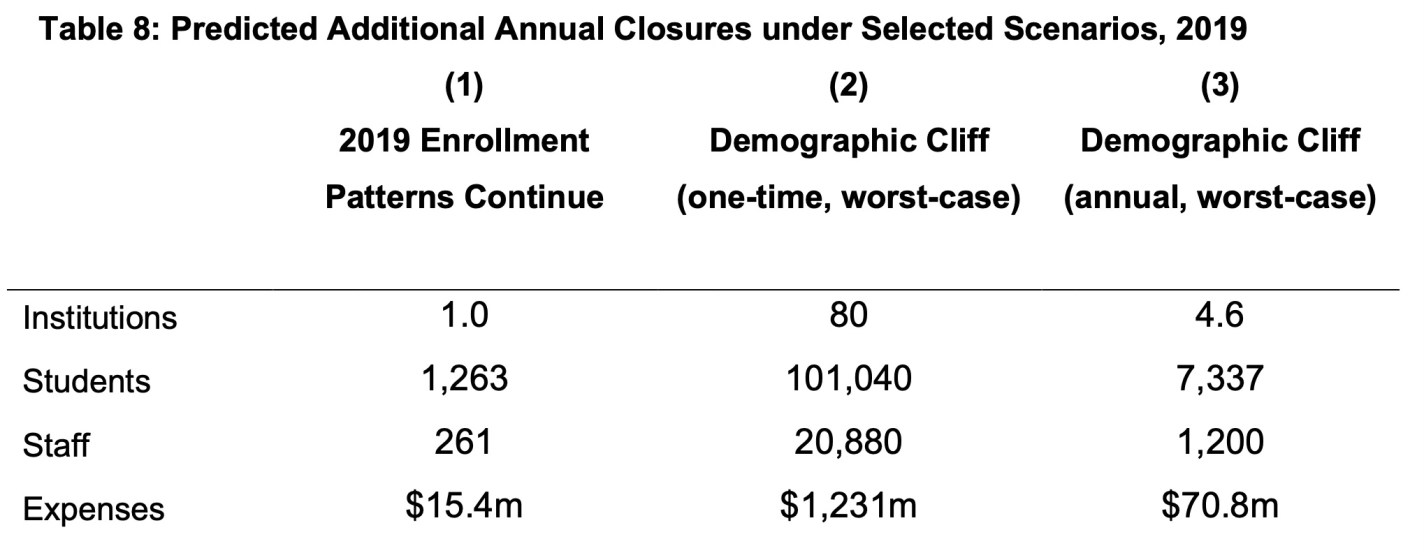
They predict that the coming Demographic Cliff (the falling number of new 18-year-olds each year) will lead to many more closures, though nothing like the “half of all colleges” you sometimes hear:

The full paper is available ungated here. I’ll close by reiterating my advice from the last post: would-be students, staff, and faculty should do some basic research to protect themselves as they consider enrolling or accepting a job at a college. College employees would also do well to save money and keep their resumes ready; some of these closures are so sudden that employees find out they are out of a job effective immediately and no paycheck is coming next month.

House Prices and Quality: 1971 vs 2023

Last week I did a comparison of “time prices” for several goods and services in 1971 compared with 2024. For almost all goods and services, it took fewer hours of work in 2023 to purchase them. In some cases, huge increases in affordability; air travel is 79% cheaper and milk is 59% cheaper, in terms of how much time an average worker needs to labor to pay for them.

There was one major exception though: housing. Especially the cost of buying a new home. Just using the median sale price of a home, the cost (in terms of hours of work) roughly doubled between 1971 and 2024. That’s not good!

Many who commented on the post mentioned that houses are much bigger today, and I noted that in the post but still claimed this is a worrying trend: “since 1971 you can’t really argue the quality improvements make up for the increase. Yes, houses are much bigger (about double in size), but that’s not clearly driven by consumer demand (more so by zoning and other laws). The 1971 house also had indoor plumbing (but maybe not air conditioning).”

Furthermore, housing is the largest expense for most families, both today and in 1971. In the early 1970s it was 30.8% of consumer spending, and in 2023 it was slightly higher at 32.9%. Given all this, it is worth investigating further.

First, let’s consider the size of a typical house. For most of the 1971 data, I will use this HUD report on new single-family homes. And I will use the similar Characteristics of New Housing report for 2023 (the latest year available) to compare.

Are houses bigger today? Yes, but not nearly enough to account for the decreasing affordability I showed in the previous post. In 1971, the median new home had 1,400 square feet of floor space. In 2023, it was 2,286. That’s a big increase (over 60%), but let’s now do the time-price affordability calculation, which I show in the table below.

Continue reading

My New Favorite Mass Cookie Recipe: Sally’s Chewy Oatmeal Chocolate Chip

For decades, our family favorite holiday cookie recipe has been a hearty ginger cookie containing, among other things, wheat germ. The original recipe author claimed that these cookies “got my family through Alaskan winters”. That’s hard core.

With my family’s help, I made big batches for decades to hand out among colleagues at work. This always included my boss and boss’s boss, and their admins. (Cynics may think what they wish of my motives there.)  Also, we like to hand out small, decorated bags of cookies to all our neighbors for several houses in all directions. We like to try to build community as we can, and this is often the only time we get to exchange words with some neighbors.

However, there are two downsides to that ginger cookie. First, it is very labor-intensive. The final mixing with a stiff dough takes a lot of muscle, and forming the cookies takes an assembly line with multiple steps: with the help of a spoon, form the sticky dough into a ball, then roll the ball in sugar, then place on baking tray, then press a blanched almond (can only find these in specialty vendors these days) into the top of the ball.    Second, this ginger cookie is a bit on the dry side – – I would usually recommend consuming them with coffee or milk as I handed them out.

Two years ago, however, an esteemed family member pointed me to a radically different recipe, for an oatmeal chocolate chip cookie. That seemed kind of decadent compared to my old favorite, but worth a try. It solved the two drawbacks for the ginger cookies. Making it is easy, just scoop into the dough and plop onto the cookie sheet. (I did buy a cookie scoop for this). And there was no need to apologize for dryness. These babies are just plain delicious. So now I make large batches of these cookies to hand out to neighbors at Christmas.

Without further ado, here is a link to the recipe for Chewy Oatmeal Chocolate Chip Cookies, by Sally McKenney of Sally’s Baking Addition. You do have to follow the directions, including the step of creaming the butter (see links in recipe for what “room temperature” means) and sugar, and using old-fashioned (not instant) oatmeal.

Here are some of my tweaks to this recipe:

Make two double batches, in two separate large bowls. Chill in fridge several hours. Set aside several hours to bake them all.

Don’t bother creaming butter alone. Just add sugars to butter and stir in with wood spoon, then beaters. Add flour, using spoon and then beaters. For adding oats, chips, etc., just use spoon.

I backed out some of the chocolate chips, and added chopped walnuts: so, in each double batch I have total 3 c choc chips (e.g. 2.25 c regular chips, ¾ c mini chips), plus 1 c chopped walnuts. It’s worth getting good chocolate chips. Ghirardelli seems to be the best chocolate chip. Guittard also gets raves.

The recipe calls for big cookies (a full, large scoop, about 3 Tbsp), but those may spread too much, and I want more cookies, so I use about ¾ full large scoop.

Bake at 355 F instead of 350 F, to speed it up a bit. (My oven is wimpy, electric). Parchment paper works well to keep cookies from sticking.

Enjoy!

New evidence on the effects of legal financial obligations

Newly published research from Finlay et al takes the deepest dive yet on how the costs of the criminal justice system impact people’s lives going forward. Leveraging the new (and phenonomenal) integrated data from CJARS, the authors look at 9 (!) separate discontinuous increases in the fines and fees associated with misdemeanor and felony convictions. The paper is exceptionally well executed, connecting criminal and earnings records to estimate a pooled seemingly unrelated regression of those 9 separate treatments. They observe null effects on future convictions, earnings, and living conditions. So does this mean we can soak those convicted for every penny in their pockets without consequence? No, I don’t think so (and I strongly doubt the authors do either). Does it mean that people, such as myself, need to soften their calls to stem the growing tide of law enforcement as local regressive taxation scheme? Maybe in some cases, but I do think additional context matters here. A couple quick comments, in no particular order:

  1. Of the 9 increased fine and fee treatments, 4 are small (≤$65), 5 are large (≥$200). Four of the large increases are explicitly raising the fines and fees of traffic offenses (DUIs). It’s not unfair to summarize the legislated treatments here as mild for those more likely to be in a state of poverty since you have to have access to a car to receive the larger treatments.
  2. There’s always a little bit of a Rorschach test with RD designs, even when the differences are or are not statistically significant. In this case we observe null effects, but it sure seems like something happens with convictions in the first 100 days after reform and then it returns to trend (see below in Panel A). That feels like a system updated the de facto rules to accomodate the new de jure. As for earnings, it’s always tough when slopes change sign (Panels B and C), but the differences aren’t significant.
  3. In the subgroup analysis there are two significant increases in recidivism, most notably a 4.7% increase in recidivism for those in the lowest predicted income quartile. This isn’t an enormous effect, but when it comes to what I consider to be a regressive tax, then focusing on the lowest income quartile isn’t an exercise in p-hacking, it’s to some degree the point of the endeavor. Combine that with the fact that the overweighting of the high magnitude treatments on driving offense can be expected to attenuate the potential effect on treated individuals with low incomes, a 4.7% increase in recidivism doesn’t seem that small anymore.

This is good research, but like most contributions it isn’t the last word. The growing use of fines and fees as revenue sources is a complex and, in many ways, adaptive system that exists to generate revenue for local governments whose revenue apparatuses hamstrung in countless ways, frequently struggling to keep the lights on (whether those lights should necessarily be on is a whole separate question). When they’re looking for that revenue, many (but not all) will arrive at the conclusion that they can only get so much much from poor people. Sometimes, such as with traffic offenses, the poorest individuals that do get caught in this system aren’t necessarily the intended targets, but rather the collateral damage. When we’re looking for that collateral damage, it’s important to know both where that damage is occuring and where it is being mitigated by local adaptation, particularly that which exists outside of the laws as written.

Handmade Sweaters Cost $500

If you spend any time on Twitter/X, you must know the suit guy, Derek. Given my interest in the economics of fast fashion, I read his new thread about expensive craft sweaters.

He explains that some clothes on this earth are still made by hand. Artisan sweaters cost a lot because of the labor. Supporting that art or tradition is fine, if you have $500 on hand.

The comments on the thread are interesting as well. (Caveat, a good number of anonymous accounts are trolls bent on your destruction – read accordingly always.)

One comment, presumably by an amateur knitter in a rich country: “As a knitter, I know how much work would go into hand making sweaters like these. That’s not even taking into account the cost of a good wool yarn. If anything, they are underpriced.”

Not a lot of people want to spend $500 on a sweater. I really loved this reply about thrift stores. We don’t all have to buy the sweater new.

Someone who has been thinking about how goods change hands in the modern economy is Mike Munger who wrote Tomorrow 3.0: Transaction Costs and the Sharing Economy.

My related posts on fast fashion (a.k.a. factory-made sweaters cost $5):

Cato Globalization book out in paperback – my most optimistic take on this is that AI will facilitate the sharing part of the sharing economy, which will help justify the cost of high-quality new garments.

Is the repair revolution coming? – in my opinion, probably not, although I still think AI could help with this

(Tweet HT: Tyler)

The Price of a Complete [Animal] Protein

I wrote about the protein content of different foods previously. I summarized how much beef versus pea and wheat flour one would need to eat in order to consume the recommended daily intake (RDI) of ‘complete proteins’ – foods that contain all of the essential amino acids that compose protein. These amino acids are called ‘essential’ because, unlike the conditionally essential or non-essential amino acids, your body can’t produce them from other inputs. Here, I want to expand more on complete proteins when eating on a budget.

Step 1: What We Need

To start, there are nine essential amino acids with hard to remember names for non-specialists, so I’ll just use the abbreviations (H, I, L, K, M, F, T, W, V). The presence of all nine essential amino acids is what makes a protein complete. But, having some of each protein is not the same as having enough of each protein. Here, I’ll use the World Health Organization’s (WHO) guidelines for essential amino acid RDI for a 70kg person. See the table below.

Step 2: What We Need to Eat

What foods are considered ‘complete proteins’? There are many, but I will focus on a few animal sources: Eggs, Pork Chops, Ground Beef, Chicken, & Tuna. Non-animal proteins will have to wait for another time. Below are the essential amino acid content per 100 grams expressed as a percent of the RDI for each amino acid. What does that mean? That means, for example, that eating 100 grams of egg provides 85% of the RDI for M, but only 37% of the RDI for H.

Continue reading