Is the Silver Bubble Bursting?

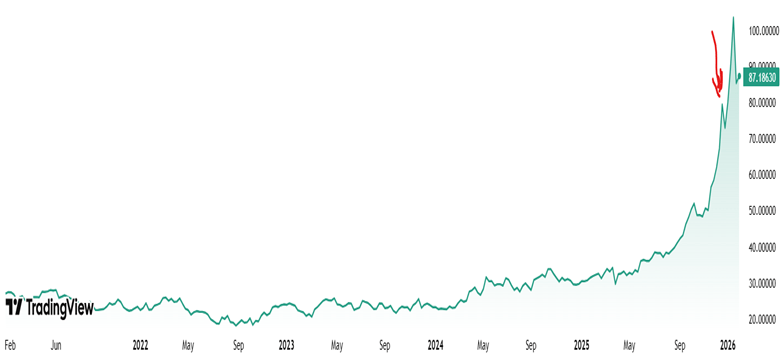
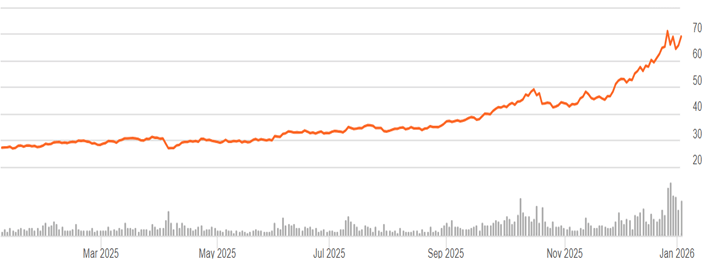
This is a five-year chart of the silver ETF SLV:

By most standards, this pattern looks like we entered a bubble a few months ago: speculative froth, unjustified by fundamentals. Economic history is replete with such madness of crowds. It is accepted wisdom on The Street that these parabolic price rises seldom end well. I lost a few pesos buying into the great gold bubble of 2011. All sorts of justifications were given at the time by the gold bugs on why gold prices ought to just keep on rising, or at least reach a “permanently high plateau” (in the famous words of Irving Fisher, just before the 1929 crash). Well, gold then proceeded to go down and down and down, losing some 60% of its value, until the price in 2015 matched the price in 2009, before the great bubble of 2010-2011.

Today, similar justifications are proffered as to why silver is going to the moon. There is a long-standing deficit in supply vs. demand; it takes ten years for a new silver mine to get productive; China has started restricting exports; Samsung announced a breakthrough lithium battery that can charge in six minutes, but requires a kilogram of silver; AI infrastructure is eating all the silver. These narratives seem to feed on each other. As the silver price moved higher in the past month, out came yet wilder stories that ricochet around the internet at high speeds: the commodities exchanges have run out of physical silver to back the paper trades; and the persistent claim that “they” (shadowy paper traders, central banks, commodity exchanges, the deep state, etc.) are “suppressing” silver and gold prices by means of shorting (which makes no sense). Given this popular shorting myth, it was with great glee that the blogosphere breathlessly spread the bogus story that some “systematically important bank” was in the process of being liquidated because it got squeezed on its silver short position.

The extreme price action at the very end of December (discussed below) was like rocket fuel for these rumors. Having bought a little SLV myself so as to not feel like a fool if the silver rally did have legs, I spent a number of hours as 2025 turned to 2026 trying to sort all this out. Here are some findings.

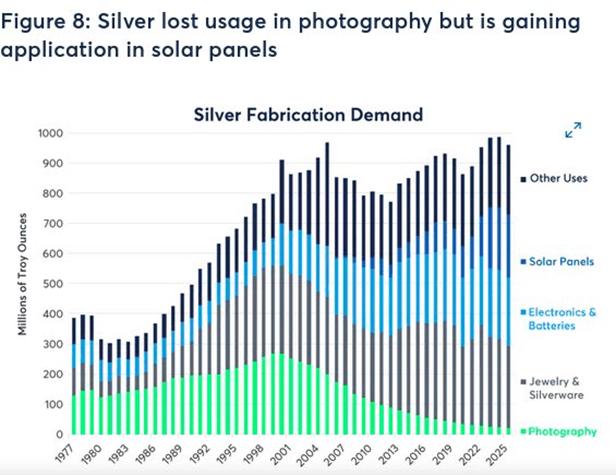
First, as to  the medium term supply/demand issues, I refer the reader to a recent article on Seeking Alpha by James Foord. He shows a chart showing that silver demand is increasing, but slowly:

He also notes that as silver price increases, there is motivation for more recycling and substitution, to compensate. He concludes that the current price surge is not driven by fundamentals, but by paper speculation.

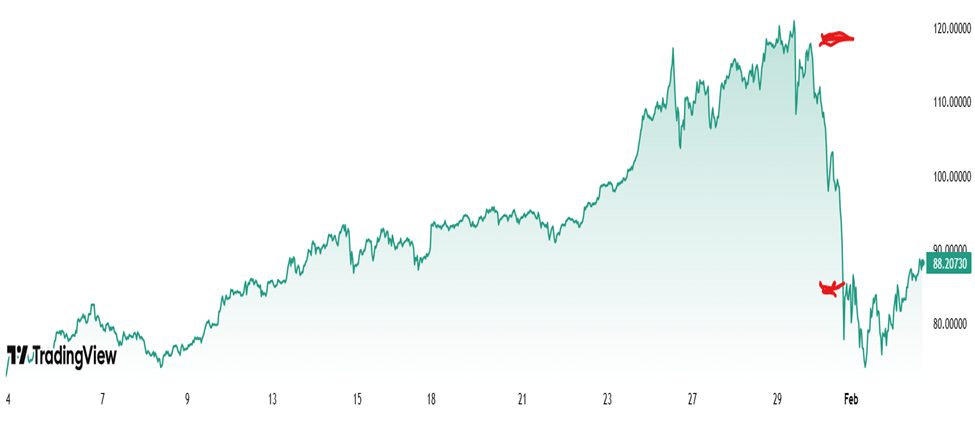
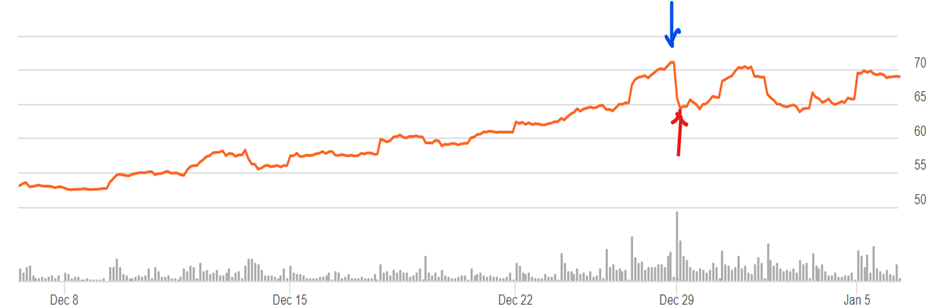
The last ten days or so have been a wild ride, which merits some explanation. Here is the last 30 days of SLV price action:

Silver prices were rising rapidly throughout the month, but then really popped during Christmas week, reaching a crescendo on Friday, Dec 26 (blue arrow), amid rumors of physical shortages on the Shanghai exchange. To cool the speculative mania, the COMEX abruptly raised the margin requirements on silver contracts by some 30%,  from $25,000 to $32,500, effective Monday, Dec 29. I think the exchange was trying to ensure that speculators could make good on their commitment, and the raise in margin requirement would help do that. (Note, the exchange is liable if some market participant fails to deliver as promised and goes BK).

Anyway, this move forced long speculators to either post more collatoral or to liquidate their positions, on short notice. Blam, the price of silver dropped a near record amount in one day (red arrow). For me, a little minnow caught in the middle of all this shark tank action, the key part is what came after this forced decline. Was the bubble punctured for good? Should I hold or fold?

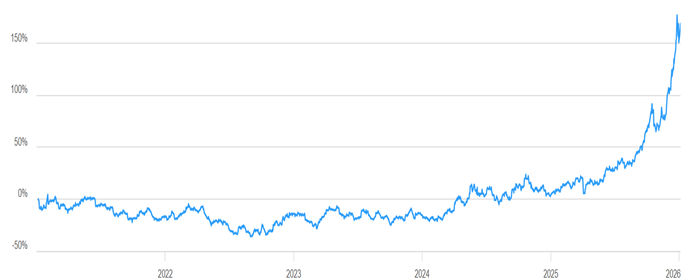
As shown above, the price has traded in a range for the past week, with violent daily moves. Zooming out to the a one-year view, it looks like the upward momentum has been halted for the moment, but it is unclear to me whether the bubble will deflate or continue for a while:

I sold about a quarter of my (small) SLV holding, hoping to buy back cheaper sometime in the coming year. Time will tell if that was a good move.

Usual disclaimer: Nothing here is advice to buy or sell any security.
P.S. Tuesday, Jan 6, 2025, after market close: I wrote this last night (Monday, Jan. 5) when silver was still rangebound. SLV was about $69, and spot silver about $76/oz. But silver ripped higher overnight, and kept going during the day, up nearly 7% at the close to new all time high. It looks like the bubble is alive and well, for now. Congrats to silver longs…

Housing & The Fed’s Reputation

I am not worried about inflation and I’m not worried about the total spending in the economy. As I’ve said previously, total spending is on track with the pre-pandemic trend and, I think, that helped us experience the briefest recession in US history. When output growth declines below trend, we face higher prices or lower incomes. The former causes inflation, the latter causes large-scale defaults. Looking at the historical record, I’m for more concerned about the latter.

I do, however, want to call special attention to the composition of the Fed’s balance sheets. Specifically, its Mortgage Backed Security (MBS) assets. Having learned from the 2008 recession, the Fed was very intent on maintaining a stable and liquid housing market. Purchasing MBS is one way that it maintained that stability. Its total MBS holdings almost doubled from March of 2020 to December of 2021 to $2.6 trillion. Should we be concerned?

At first, a doubling sounds scary. And, anything with the word ‘trillion’ is also scary. Even the graph below looks a little scary. MBS holdings by the Fed jumped and have continued to increase at about a constant rate. Is the housing market just being supported by government financing? What happens when the Fed decides to exit the market?

Luckily for us, there is precedent for Fed MBS tapering. The graph below is in log units and reflects that a similar acceleration in MBS purchases occurred in 2013. Fed net purchases were practically zero by 2015 and total MBS assets owned by the Fed were even falling by 2018. Do you remember the recession that we had in 2013 when the Fed stopped buying more MBS’s? Wasn’t 2018-2019 a rough time for the economy when the Fed started reducing its MBS holdings? No. We experienced a recession in neither 2013 nor 2018. Financial stress was low and RGDP growth was unexceptional.

Although there was no macroeconomic disruption, what about the residential sector performance during those times? Here is a worrisome proposed chain of causation:

  1. Relative to a heavier MBS balance sheet, the Fed reducing its holdings increases supply on the MBS market.
  2. This means that the return on creating new MBS’s falls (the price rises).
  3. A lower return on MBS’s means that there is less demand from the financial sector for new loans from loan originators.
  4. A tighter secondary market for mortgages decreases the eagerness with which banks lend to individuals.
  5. Fewer loans to individuals puts downward pressure on the demand for houses and on the price of the associated construction materials.

The data fits this story, but without major disruption.

Less eager lenders went hand-in-hand with higher mortgage rates and less residential construction spending. The substitution effect pushed more real-estate lending and spending to the commercial side. Whereas residential spending was almost the same in late 2019 as it was in early 2018, commercial real-estate spending rose 13% over the same time period.

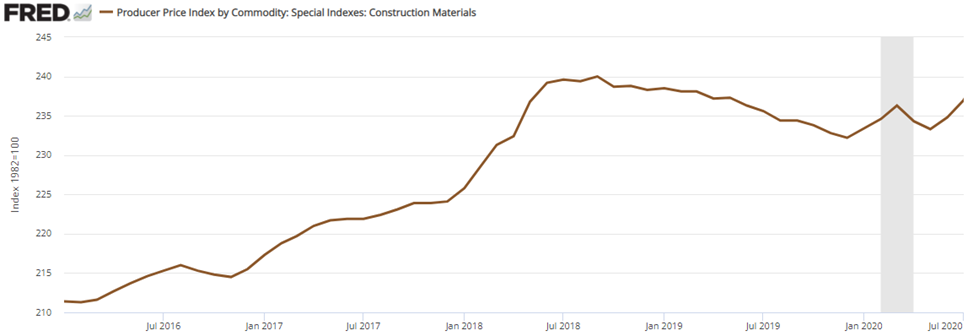
But, importantly in the story, the income effect of a Fed disruption should have been negative, resulting in less total spending and lower construction material prices. And that’s not what happened. Total Construction spending rose and so did construction material prices. Both of these are the opposite of what we would expect if the Fed had caused disruption in the housing construction sector due to its MBS holding changes.   Spending on residential construction fell understandably. But spending on commercial construction and the price of construction materials rose.

My point is that you should not listen to the hysteria.

The Fed has a variety of assets on its balance sheet and it pays special attention to the residential construction sector. Do you think that there is a residential asset bubble? Ok. Now you have to address whether the high prices are due to demand or supply. Do you suspect that the Fed unloading its MBS’s will result a popped bubble and maybe even contagion? It’s ok – you’re allowed to think that. But the most recent example of the Fed doing that didn’t result in either a macroeconomic crisis or substantial disruption in the construction markets.

The Fed has a track record and it has a reputation that serves as valuable information concerning its current and prospective activities. The next time that someone gets hysterical about Fed involvement in the housing sector, ask them what happened last time? Odds are that they don’t know. Maybe that information doesn’t matter for their opinion. You should value their opinion accordingly.