Did Federal Government Spending Shrink in 2025?

One of the major goals of the new Trump administration, particularly the DOGE unit, was to shrink the size of the federal government’s budget. Did they achieve this goal?

Last spring both my co-blogger Zachary and I pointed to a tool from the Brookings Institution to track federal spending, pulling in data directly from the US Treasury in a convenient format. Back in March I said “this will be a useful tool to follow going forward.” Now we have a full year of spending data for 2025.

When we look at total spending for Calendar Year 2025, it was about $318 billion higher than 2024, or about 4 percent higher. So, it seems that by that measure, the cuts that the Trump administration made were too small to overcome the other areas that grew.

But…

It may be more useful to remove some spending from the equation. In particular, entitlement programs and interest spending are very large spending categories that aren’t subject to the annual budgeting process. Of course, any program is ultimately under the control of Congress, so it’s a little bit of a cheat to remove Social Security and Medicare, but those programs are on autopilot with respect to the annual federal budget process. They are worth talking about, but they are probably worth talking about separately (especially because they have their own funding mechanisms). And interest on the debt isn’t something a President can control directly: it can only be reduced in future years by closing the budget gap today.

Removing those programs — which constitute about $4.8 trillion of the $7.9 trillion in 2025 spending (so a lot!) — gives you this chart (note: figures have been slightly updated with more complete data since I originally posted this chart):
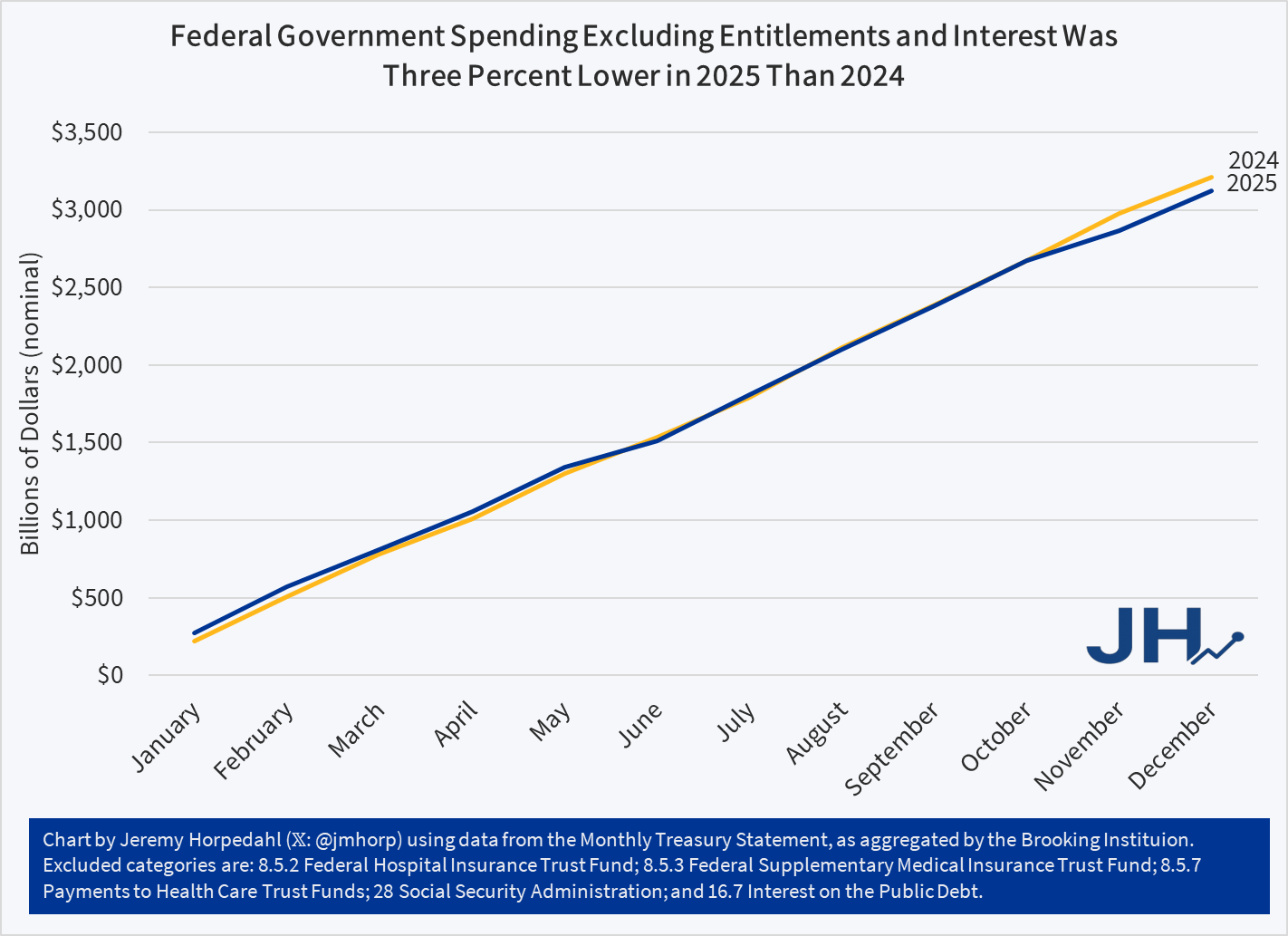
Federal spending by this measure was about $85 Billion lower in 2025 than the prior year, or about 5 percent. And that’s in nominal terms: it is an even bigger cut if we adjust for inflation. Notice too that the pattern fits what we might expect: spending was slightly higher in the first half of the year (before any Trump changes could have had much of an effect), almost exactly equal for most of the second half, and then slightly below once we get to November and December (after the Deferred Resignation Program layoffs in October). If we ignore the first two months of the year (when it would have been really hard for Trump to have an effect), the drop in spending is about 8 percent.

What were the biggest cuts that led to the $85 billion drop? Keep in mind that some programs increased spending, such as military spending, so there are more than $85 billion in cuts. Using the Daily Treasury Statement categories, here are the big ones:

  • Federal Financing Bank (Treasury): $59 billion
  • Department of Education: $46.8 billion
  • USAID: $30.2 billion
  • EPA: $17 billion (though EPA seems to have gone on a spending binge at the end of 2024. Compared with 2023, the first Trump year was 50% higher!)
  • Federal Employee Insurance Payment (OPM): $16.3 billion
  • Pension Benefit Guarantee Corporation: $11.3 billion
  • Department of State: $8.6 billion
  • Food Stamps (USDA SNAP): $4 billion
  • CDC: $3.7 billion
  • Crop Insurance Fund (USDA): $3.1 billion
  • USDA Loan Payments: $2.7 billion
  • Independent Agencies: $2.6 billion
  • FCC: $1.8 billion
  • NIH: $1.2 billion
  • US Postal Service: $1.1 billion

Those are all the programs I could find that declined by at least $1 billion, totaling a little over $200 billion. There were some other highly salient cuts that were under a billion dollars (such as the Corporation for Public Broadcasting, which was completely eliminated). Looking at that list I don’t think there is an easy way to sum up a “theme,” but I think the real theme is that if the Trump administration wants 2026 discretionary spending to be even lower than 2025, they will really need some major action from Congress. These cuts are mostly low-hanging fruit, and some are long-running goals of the GOP (such as Dept. of Education, foreign aid, and public television).

Of course, to really get federal spending under control, Congress will have to tackle entitlement reform and shrink the budget deficit to lower interest costs. Social Security, Medicare, and interest payments — the bulk of federal spending, over 60% of the total — increase by 9% in 2025. Again, it was probably unreasonable to expect Trump and Congress to have done anything major with them in a single year, but something must be done soon: the Social Security Old Age trust fund will be depleted in about 8 years, and the Medicare Part A trust fund will be depleted in about 10 years.

US Federal Government Spending Hasn’t Decreased (Yet)

Despite DOGE and the President partially stopping some payments for some federal agencies, the changes so far aren’t visible at all in federal payments data. The Brookings Institution has put together a new tool that tracks daily spending data from the US Treasury. (My co-blogger Zach wrote about this tool last week too.) Here’s a chart from that tool showing total federal outlays by calendar year. Notice that 2025 is right on track with the past two years, or just slightly above (dollars are in nominal terms):

Of course, given the massive amount of US federal spending and the large number of agencies, we might expect it to take more than a few months to get spending under control or significantly alter its course. But this way of tracking the data is definitely picking up any changes made so far. For example, notice the flat lining of USAID funding after Trump comes into office at the end of January:

So while we don’t see any big changes yet in the aggregate spending, the few small agencies that DOGE has frozen are showing up in this data. That tells this will be a useful tool to follow going forward.

Federal Spending in 2024 was $2.3 Trillion More Than 2019

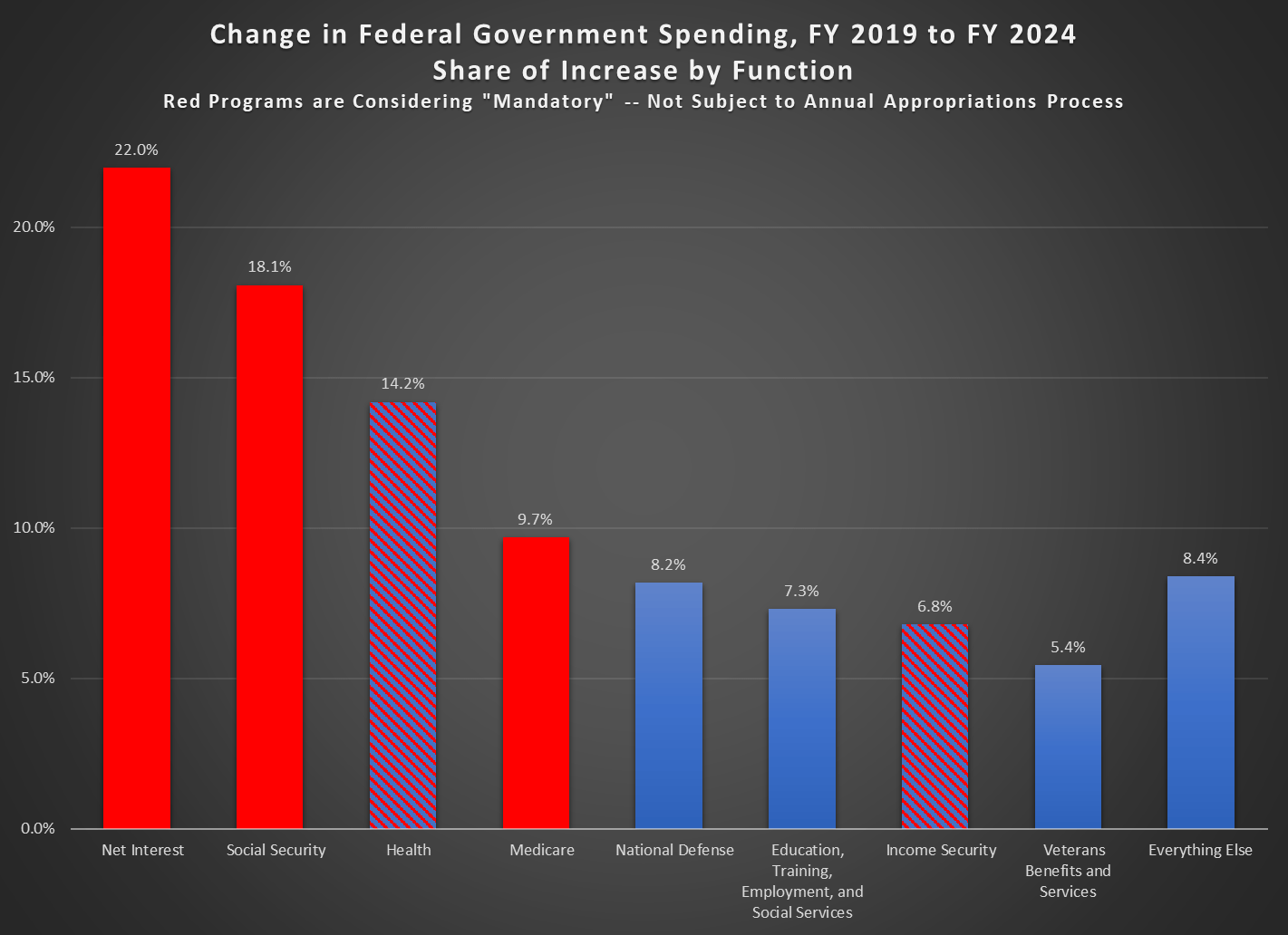
In Fiscal Year 2019, the US federal government spent $4.45 trillion dollars. In Fiscal Year 2024, spending was $6.75 trillion, or an increase of $2.3 trillion dollars. If you adjusted the 2019 number for inflation with the CPI, it would only be about $1 trillion more. Where did that additional $2.3 trillion go?

It will probably not surprise you that most of the increase in spending went to the largest categories of spending. Historically these have been health, Social Security, and defense, but now we must also include interest spending (roughly equal in size to defense and Medicaid in 2024). Indeed, with these areas of spending, 72 percent of the increase is accounted for. Add in the next three functions, and we’ve already accounted for over 90 percent of the increase.

Importantly, most of these categories are outside of the annual federal budget process, meaning that Congress does not need to approve new spending each year (Congress could change them, just as it could change any law, but it’s not part of the annual budgeting process). The “mandatory” categories, as they are called in federal law, are shaded red. I’ve striped with red and blue the health and income security functions, because some of this is subject to the annual budget process, but most of it is not. For example, Medicaid is not subject to the budget process (biggest part of the “health” function) and SNAP is not subject to the budget process (a big part of income security — it is set by the Farm Bill, usually on a five-year cycle).

So, when we talk about the $2 trillion increase since 2019, or the roughly $2 trillion cuts that would be needed to balance the budget, keep in mind that most of this is not subject to the annual budget process. It would require Congress to consider them specifically to enact cuts — though some big categories, such as Social Security, would be automatically cut under current law once their trust funds are exhausted (coming up on about a decade for the Social Security Old-Age Trust Fund).

A Cornucopia of Financial Data from J. P. Morgan, Relevant to Investors

I just ran across the 1Q2023 “Guide to Markets” issued by J. P. Morgan Asset Management. This compendium of financial data is issued by a large team of their Global Market Insights Strategy Team. It consists of some seventy pages of data-packed charts, covering through December 2022. This information is selected to be of use to investors, both individual and institutional.

I was like a kid in a candy store, scrolling from one page of eye candy to the next. Without further ado, I will paste in some charts with minimal commentary.

One thing that caught my attention here was the persistence overestimation of earnings by Wall Street analysts. “Why do they keep doing that?” I wondered. A brief search led me to a 2017 article on Seeking Alpha by Lance Roberts titled “The Truth About Wall Street Analysis”.  

Continue reading

The Justice Dividend

While I was listening to The New Bazaar and enjoying an episode with Tim Harford, I was reminded that economists don’t just have the job of understanding the world. We have a responsibility to our fellow man of keeping fallacy and economic misunderstanding at bay (a Sisyphean task).  That doesn’t mean that we just teach economic theory. We can and should advocate for good economic policy ideas and try to think up some policy alternatives that fit our political climate.

Here I was sitting, being grumpy at the US Federal deficit, when an idea came to me. I am full of ideas. Especially unpopular ones. So, I especially like ideas that make political sense to me given that the political parties care about their policy values and re-election. Asserting that people in congress actually care about policy apart from re-election is kind of a pie-in-the-sky assertion. But, here we go none the less.

Mancur Olson liked to emphasize the role of concentrated benefits and diffused costs in political decision making. Economists point to it and explain the billion-dollar federal subsidies that go to interest groups. A favorite example is Sugar subsidies. As of 2018 there were $4 billion in subsidies and sugar growers earned $200k on average. The typical family of four pays about $50 more in subsidies each year as a result. The additional tax burden of higher sugar prices is also relatively small. Therefore, says the economist, the few sugar beet and sugar cane farmers have a large incentive to ensure the subsidy’s survival while others pay a relatively small cost to maintain it. That small cost means that there is little money saved and little gain for any individual who might try to fight the applicable legislation.

That’s the standard story. But it’s so much worse than a story of concentrated benefits and diffused costs. The laity don’t know how the world works in two important ways. First, many people will simply say that they are happy to protect American producers for an additional $50 per year. That’s a small price to pay for ensuring the employment and production of our fellow Americans, they say. An economist might reply, in a manner that so automatic that it appears smug, that that $50 would instead go to producers of other goods and that our economy would be more productive if the sugar-producing resources were diverted elsewhere. This is Bastiat’s seen and unseen. Honestly, I suspect that neither economists nor non-economists can adopt the idea without a little bit of faith.

Secondly, people don’t know what causes a particular price to change. Hayek painted this characteristic as a feature of the price system. We are able to communicate information about value and scarcity without evaluating the values of others or the actual quantity of an available resource. However, lacking causal knowledge of prices makes for some bad policies. Say that the subsidies and protections subsided and the price of US sugar declined. The consumer would likely not know anything about the subsidies in the first place, much less that they were rescinded. Further, the world is a complicated place and people are apt to thank/blame irrelevant causes otherwise (corporate greed, anyone?).

When economists blame concentrated benefits and diffused costs, they often assume that there is perfect information. THERE ISN’T. People don’t know how the world works well enough to predict with confidence what will happen in an alternate version of reality without subsidies. Nor do they understand the particular determinants of prices in our current world. Half the battle is a lack of knowledge about the functioning of the world – not just that the costs and benefits fail to provide a strong enough incentive for legislative change.

Continue reading