Summary of You Wouldn’t Steal a Car

I have a new working paper with Bart Wilson titled: “You Wouldn’t Steal a Car: Moral Intuition for Intellectual Property” 

This quote from the introduction explains the title:

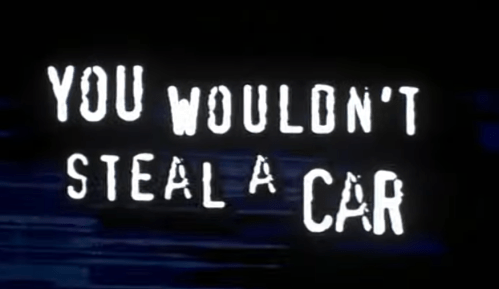
… in the early 2000s… the Motion Picture Association of America (MPAA) released an anti-piracy trailer shown before films that argued: (1) “You wouldn’t steal a car,” (2) pirating movies constitutes “stealing,” and (3) piracy is a crime. The very need for this campaign, and the ridicule it attracted, signals persistent disagreement over whether digital copying constitutes a moral violation.
The main idea:

In contemporary economies, “idea goods” comprise a substantial share of value. Our paper examines how norms evolve when individuals evaluate harm after the taking of nonrivalous resources such as digital files.

We report experimental evidence on moral evaluations of unauthorized appropriation, contingent on whether the good is rivalrous or nonrivalrous. In a virtual environment, participants produce and exchange two types of resources: nonrivalrous “discs,” replicable at zero marginal cost, and rivalrous “seeds,” which entail positive marginal cost and cannot be simultaneously possessed or consumed by multiple individuals. Certain treatments allow unauthorized taking, which permits observation of whether participants classify such actions as moral transgressions.

Participants consistently label the taking of rivalrous goods as “stealing,” whereas they do not apply the same term to the taking of nonrivalrous goods.

To test the moral intuition for taking ideas, we create an environment where people can take from each other and we study their freeform chat. The people in the game each control a round avatar in a virtual environment, as you can see in this screenshot below.

In the experiment, “seeds” represent a rivalrous resource, meaning they operate like most physical goods. If the playerin the picture (Almond) takes a seed from the Blue player, then Blue will be deprived of the seed, functionally the equivalent of one’s car being stolen.

Thus, it is natural for the players to call the taking of seeds “stealing,” Our research question is whether similar claims will emerge after the taking of non-rivalrous goods that we call “discs.”

The following quote from our paper indicates that the subjects do not label or conceptualize the taking of digital goods (discs) as “stealing.”

Participants discuss discs often enough to reveal how they conceptualize the resource. In many instances, they articulate the positive-sum logic of zero-marginal-cost copying. For example, … farmer Almond reasons, “ok so disks cant be stolen so everyone take copies,” explicitly rejecting the application of “stolen” to discs.

Participants never instruct one another to stop taking disc copies, yet they frequently urge others to stop taking seeds. The objection targets the taking away of rivalrous goods, not the act of copying per se. As farmer Almond explains in noSeedPR2, “cuz if u give a disc u still keep it,” emphasizing that artists can replicate discs at zero marginal cost.

We encourage you to read the manuscript if you are interested in the details of how we set up the environment. The conclusion is that it is not intuitive for people to view piracy as a crime.

This has implications for how the modern information economy will be structured. Consider “the subscription economy.” Increasingly, consumers pay recurring fees for ongoing access to products/services (like Netflix, Adobe software) instead of one-time purchases. Gen Z has been complaining on TikTok that they feel trapped with so many recurring payments and lack a sense of ownership.

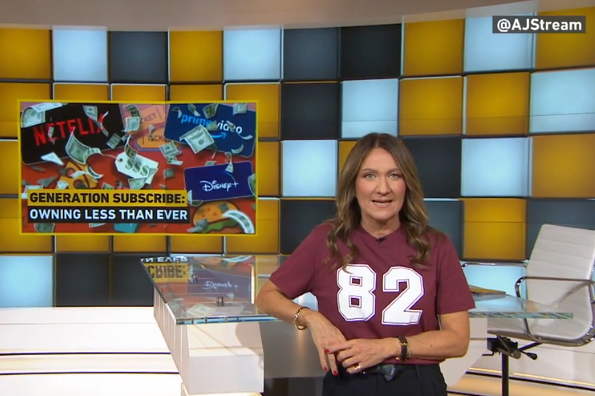
In a recent interview on a talk show called The Stream, I speculated that part of the reason companies are moving to the subscription model is that they do not trust consumers with “ownership” of digital goods. People will share copies of songs and software, if given the opportunity, to the point where creators cannot monetize their work by selling the full rights to digital goods anymore.

A feature of our experimental design is that creators of discs get credit as the author of their creation even when it is being passed around without their explicit permission. Future work could explore what would happen if that were altered.

Related Reading

An Experiment on Protecting Intellectual Property” (2014) with Bart Wilson. Experimental Economics, 17:4, 691-716.

You Wouldn’t Steal a Car: Moral Intuition for Intellectual Property,” with Bart Wilson (SSRN)

Joy on The Subscription Economy (EWED)

The Anthropic Settlement: A $1.5 Billion Precedent for AI and Copyright (EconLog)
Joy on The Subscription Economy

An Al Jazeera talk show called The Stream had me back again for

Why subscriptions are taking over our lives

along with journalist guest Sanya Dosani.

Our episode began with some clips from TikTok of young people expressing anger over feeling trapped in “the subscription economy.” Watch our show at the link above to see.

The subscription economy is a business model shift where consumers pay recurring fees for ongoing access to products/services (like Netflix, SaaS) instead of one-time purchases, focusing on “access over ownership” for predictable revenue. Gen Z feels upset that they are getting charged for subscriptions, some of which they simply forgot to cancel. They have nostalgia for the days of toting a zipper case of CDs onto the yellow school bus in 2004.

My commentary starts around minute 5:30 in the show. The first thing I point out is that, by and large, we have more entertainment available to us at a lower price than people did in that bygone era of mostly cable TV and physical discs. (This is a bit like the point I made on The Stream in March 2025 about how fast fashion represents more stuff for consumers at lower prices, which is good.)

In the episode, we discussed how people can still buy CDs today. Sanya Dosani made the point that, “there’s a place for buying and a place for renting.” Everyone should be aware of how cheap DVDs, books, and CDs are at rummage sales in the United States in 2025. You can get a music album for 50 cents. Some youths have (re)discovered that DVD players are cheaper than a year of streaming subscription costs.  

Around minute 17, I got to bring up my research about intellectual property, digital goods, and morality.

I have two papers with Bart Wilson about taking and digital goods. In 2014, we published “An Experiment on Protecting Intellectual Property”.

And now we have a new working paper titled “You Wouldn’t Steal a Car: Moral Intuition for Intellectual Property” that makes a clean comparisons between the taking of rivalrous physical goods versus nonrival digital goods.

We find that people do not feel bad about taking the digital goods, or “pirating.” We even find that, in a controlled experiment with no previous context for what we might call intellectual property protection, the creators of these digital goods do not call such taking stealing either. It seems to be understood that folks will take and share if they can.

The proposed reason for artificially restricting the taking and resale of intellectual property is that creators need a way to profit from providing a public good. (Intellectual property rights in the U.S. Constitution are covered by Article I, Section 8.)

I said in the interview, “If you were able to just give a song to all of your friends, you probably would, and then that artist might not be able to make songs the next year.”

Thus, I suggested, “The subscription economy is a reaction to the fact that most people don’t view it as wrong to take things they can take and not necessarily pay for them. Companies had to find a new way to be able to make money and stay in business.”

I’ll clarify that I have not done quantitative research to prove that subscription models emerged causally because of pirating. I’m speculating. Another side to this is that people simply want to stream and companies are providing exactly what people want (despite the complaints circulating on TikTok). People reminisce about the “golden days” of early Netflix, but most people forget that the company was losing money at that time.  Media production and distribution companies have to make money to stay in business.

At the end, the host asked me, “… what does it mean for who we are as humans, more of an existential question, where we are going with this age?”

That’s a deeper question than you might expect for a conversation about CD-ROMs. However, people do care about having some tangible form of art about them. Think of the ancients buried alongside beads and dolls. Netflix will never be the only thing that people want. As for Gen Z being upset about convenient Spotify, “what does it mean for who we are” has got to be part of it.

References:

An Experiment on Protecting Intellectual Property” (2014) with Bart Wilson. Experimental Economics, 17:4, 691-716.

You Wouldn’t Steal a Car: Moral Intuition for Intellectual Property,” with Bart Wilson 

As an aside, furthermore, I’ll say here on the blog that Gen Z is by some measures the most entertained generation in history. For spiritual, not financial, reasons, I encourage them to cancel their subscriptions, take out their AirPods, and feel the silence and dread for a week.

Joy on the Anthropic Copyright Settlement

I’m at Econlog this week with:

The Anthropic Settlement: A $1.5 Billion Precedent for AI and Copyright

There are two main questions. Will AI companies need to pay compensation to authors they are currently training off of? Secondly, how important is it for human writing to be a paying career in the future, if AI continues to need good new material to train from?

There is more at the link but here are some quotes:

If human writing ceases to be a viable career due to inadequate compensation, will LLMs lose access to fresh, high-quality training data? Could this create a feedback loop where AI models, trained on degraded outputs, stagnate?

This case also blurs the traditional divide between copyright and patents. Copyrighted material, once seen as static, now drives “follow-on” innovation derived from the original work. That is, the copyright protection in this case affects AI-content influenced by the copyrighted material in a way that previously applied to new technology that built on patented technical inventions. Thus, “access versus incentives” theory applies to copyright as much as it used to apply to patents. The Anthropic settlement signals that intellectual property law, lagging behind AI’s rapid evolution, must adapt.

A Wartime Natural Experiment About Copyright

One of the hardest questions in copyright policy is: “What would have happened otherwise?” When Disney lobbies for longer copyright terms or academic publishers defend high subscription fees, we struggle to evaluate their claims because we can’t observe the counterfactual. What would happen to creativity and innovation if we shortened copyright terms or lowered prices?

This is what makes Biasi and Moser’s 2021 study in the American Economic Journal: Microeconomics valuable. They examine a rare “natural experiment” from World War II – the Book Republication Program (BRP) – which provides insights into how copyright affects the spread and use of knowledge.

In 1942, the U.S. government allowed American publishers to reprint German scientific books without seeking permission from German copyright holders (though royalties were still paid to the U.S. government). This created a test case: German books suddenly became cheaper, while similar Swiss scientific books (Switzerland being neutral in the war) maintained their original copyright protection and prices.

This setup lets us answer the counterfactual question. What happens when you maintain basic royalty payments but prevent monopoly pricing? The researchers compared the same book before and after the policy change, German books versus Swiss books, areas near libraries with these books versus those without, and usage by English-speaking scientists versus others. Such comprehensive comparison groups are rarely available in copyright research.

The authors report that when book prices fell by 10%, new research citing these books increased by 40%. The benefits spread beyond elite institutions, with new research clusters emerging wherever scientists gained access to these books. This does not appear to just be shifting citations from one source to another – there was genuine new knowledge creation, evidenced by increased patents and PhD production.

Such clean natural experiments in copyright policy are rare (there are a few laboratory experiments). Most changes come from lobbying (like the “Mickey Mouse Protection Act”) or technological disruption (like music streaming), making it hard to isolate the effects of copyright itself. The BRP provides uniquely clear evidence that moderate copyright protection – rather than maximum protection – might better serve innovation.

As we debate copyright terms and academic paywalls today, this historical accident of war gives us something valuable: empirical evidence about what happens when you find a middle ground between total copyright protection and unrestricted access.

Biasi, Barbara and Petra Moser. 2021. “Effects of Copyrights on Science: Evidence from the WWII Book Republication Program.” American Economic Journal: Microeconomics, 13 (4): 218–60.

The current alliance to counter digital piracy

U.S. Immigration and Customs Enforcement’s (ICE) Homeland Security Investigations (HSI) has joined forces with the Motion Picture Association (MPA) to launch a new initiative aimed at countering digital piracy and protecting a vital sector of the U.S economy.

The initiative is called Operation Intangibles.

Digital streaming services provide quick and easy access to creative works, such as music, television, movies. However, the growth of digital streaming services has presented new challenges when it comes to law enforcement’s ability to ensure vital copyright protection for the industry. This technology that has provided millions of people access to their favorite shows, has also enabled criminals to turn piracy into a crime that is no longer restricted to the hand-to-hand sale of illegally pirated media.

Digital piracy negatively impacts millions of jobs, results in less taxes being paid, and threatens innovation and creativity. Its effects are felt across multiple industries and includes the cost of corollary crimes on consumers such as the potential damage caused by hidden or embedded malware, as well as identity theft and financial crimes, such as credit card fraud.

There exists a National Intellectual Property Rights Coordination Center.

Recall, Napster was shut down in 2001. Limewire was shut down in 2010. Illicit downloading is happening through other channels.

According to this graph, people spent almost as much on vinyl records as they did on CDs in 2018. The Economist provided a nice chart (last updated in 2019) on the rise of streaming revenue and the collapse of traditional records sales.