Is Tesla Stock Grossly Overpriced?

One of the more polarizing topics in investing is the valuation of Tesla stock. Its peers among the Magnificent 7 big tech leaders sport price/earnings ratios mainly in the 30s. Those are high numbers, but growth stocks deserve high P/Es. A way to normalize for expected growth of earnings is to look at the Price/Earnings/Growth (PEG) ratio. This number is usually 1.5-2.0 for a well-regarded company. Anything much over 2 is considered overvalued.

Tesla’s forward P/E of about 270 is nearly ten times higher than peers. Its anticipated growth rate does not seem to justify this astronomical valuation, since its PEG of around 4-10 (depending on assumptions) is way higher than normal. This seems to be a case of the CEO’s personal charisma dazzling shareholders. There is always a new “story” coming out to keep the momentum going.

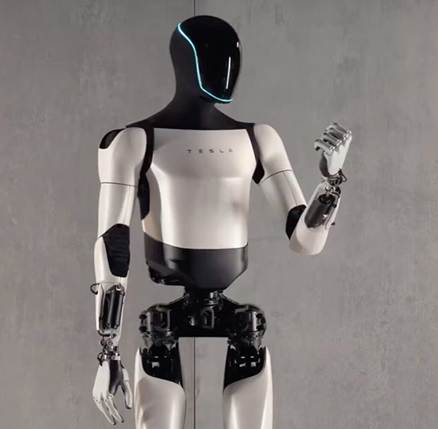
Tesla’s main actual business is selling cars, electric cars. It has done a pretty good job at this over the past decade, supported by massive government subsidies. With the phasing out of these subsidies by the U.S. and some other governments, and increasing competition from other electric carmakers, it seems unlikely that this business will grow exponentially. Ditto for its smallish ($10 billion revenue) business line of supplying large batteries for electric power storage. But to Tesla fans, that doesn’t really matter. Tesla is valued, not as a car company, but as an AI startup venture. Just over the horizon are driverless robo-taxis (whose full deployment keeps getting pushed back), and humanoid Optimus robots. The total addressable market numbers being bandied about for the robots are in the trillions of dollars.
Source: Wikipedia

From Musk’s latest conference call:

Optimus is Tesla’s bipedal humanoid robot that’s in development but not yet commercially deployed. Musk has previously said the robots will be so sophisticated that they can serve as factory workers or babysitters….“Optimus will be an incredible surgeon,” Musk said on Wednesday. He said that with Optimus and self driving, “you can actually create a world where there is no poverty, where everyone has access to the finest medical care.”

Given the state of Artificial General Intelligence, I remain skeptical that such a robot will be deployed in large numbers within the next five years. It is of course a mind-bending exercise to imagine a world where $50,000 robots could do anything humans can do. Would that be a world where there is “no poverty”, or a world where there is no wealth (apart from the robot owners)? Would there be a populist groundswell to nationalize the robots in order to socialize the android bounty? But I digress.

On the Seeking Alpha website, one can find various bearish articles with the self-explanatory titles of, for instance, Tesla: The Dream Factory On Wall Street, Tesla: Rallying On Robotaxi Hopium, and Tesla: Paying Software Multiples For A Car Business – Strong Sell . There are also bullish pieces, e.g. herehere, and here.

Musk’s personal interaction with shares has propped up their value. He purchased about $1 billion in TSLA shares in September. This is chicken feed relative to its market cap and his net worth, but it apparently wowed TSLA fans, and popped the share price. What seems even more inexplicable is the favorable response to a proposed $1 trillion (!!) pay package for Elon. For him to be awarded this amount, Tesla under his watch would have to achieve hefty boosts both in physical production and in stock market capitalization. But… said package would be highly dilutive (like 12%) to existing shareholders, so, rationally they should give it thumbs down. However, it seems likely that said shareholders are so convinced of Musk’s value that they will approve this pay package on Nov 6, since he has hinted he might leave if he doesn’t get it.

Such is the Musk mystique that shareholders seem to feel that giving him an even greater stake in Tesla than he already has  will cause hundreds of billions of dollars of earnings appear from thin air. From the chatter I read from Wall Street professionals, they view all this as ridiculous magical thinking, yet they do not dare place bets against the Musk fanbase: the short interest in TSLA stock is only a modest 2.2%. Tesla is grossly overvalued, but it will likely remain that way as long as Elon remains and keeps spinning grand visions of the future.

Musk, Twitter, and Poison Pills

It has been all over the financial news that Elon Musk made an offer last week to buy out Twitter for $54.20 per share, which is well above its recent stock price. And also, that the board quickly stiff-armed Musk by adopting a “poison pill” provision. What are poison pills, are they a good thing, and how does this particular one work?

Major decisions for a corporation are made by its board of directors. In theory, they are supposed to direct operations for the benefit of the company’s shareholders, who are considered the actual owners of the corporation. The members of the board are elected by the shareholders in annual meetings.

In practice, the board largely does what it wants, and has an outsized influence on who gets elected. The board sets the agenda of the annual meetings, and proposes successor directors. In theory, shareholders can propose resolutions and alternative board candidates at an annual meeting, but it usually takes a determined effort by some activist shareholder group to actually push through some measure that is not approved by the existing board. The outside board members are often executives of other companies, and so are naturally attuned to the interests of the managerial class.  Thus, the members of this Old Boys (and Girls) Club tend to vote each other generous pay:  board members are typically paid very handsomely for what is often a fairly undemanding, part-time job.

Big corporate mergers and takeovers became a thing in the 1980’s. Some outside investor would make an offer to buy up company shares for more than the current market price. Often,  management would resist this offer, since it might entail them losing their cushy jobs. The delicate matter for management in such cases was to convince shareholders that rejecting the buyout offer was in their best long-term interest.

As in so many matters, “where you stand depends on where you sit.” Management would argue that “short-termism” is bad for the company and for the nation as a whole; the “corporate raiders” would just fire people, break up the company, and sell off the pieces, and generally create misery. The outside investors would reply that their new management would “unlock value” better than the current management was doing, by making operations more efficient and competitive and innovative.

A variety of measures might be implemented by the board to make it less attractive or less feasible for a change in control. The terms of the board of directors might be staggered, so that it would be impossible for the existing board to be totally changed out in less than say 3 years, even if someone controlled 100% of the shares. A company I was associated with in the 1990’s implemented a policy that provided for generous severance packages for upper employees in the event of change of control. (Again, management looking out for themselves).

The term “poison pill” typically refers to some measure that  targets share prices, in a way to discourage a hostile takeover. The most common form is the “flip-in” approach: 

A flip-in poison pill strategy involves allowing the shareholders, except for the acquirer, to purchase additional shares at a discount. Though purchasing additional shares provides shareholders with instantaneous profits, the practice dilutes the value of the limited number of shares already purchased by the acquiring company. This right to purchase is given to the shareholders before the takeover is finalized and is often triggered when the acquirer amasses a certain threshold percentage of shares of the target company.

This is what the Twitter board has pulled on Musk. If he acquires more than 15% of Twitter shares without board approval, the company will allow any shareholder (except Musk) to purchase additional shares at a 50% discount. Yes, this dilution would tend to lower the value of the shares, but if a lot of shareholders bought into this offer, his share of control would shrink. If he tried to buy yet more shares to get back to more than 15% ownership, the company would issue yet more discounted shares to everyone except him.

Is the Twitter board acting in their own interests, or the interests of the shareholders? Investment adviser Larry Black noted, “Let me point out something obvious: If Elon Musk takes Twitter private, the Twitter board members don’t have jobs any more, which pays them $250K-$300K per year for what is a nice part-time job. That could explain a lot.”

Musk hinted at a “Plan B”, and tweeted provocatively, “Love Me Tender”. He might be considering trying to bypass the board altogether and make a “tender offer” to the shareholders at large to sell their shares to him, at some attractive price. Typical conditions for such an offer would be that he only has to make good on his purchase offer if some large plurality of the shareholders take him up on it. It turns out that in practice this approach can be messy and complicated and delayed, probably not something the fast-moving Musk might have patience with. Also, even if he captured 100% of the shares, he could not replace all the existing board members for something like three years, so they could remain sitting there,  making anti-Musk decisions all along.

Musk’s offer has now put Twitter “in play” as a takeover target. You know that lots of wealthy people and entities are consulting their investment bankers about becoming a white (or black) knight here. Anyway, it makes for great theater. Popcorn, anyone?

The Rise and Fall (?) of Bitcoin Price

Well, it has been a fun party. Here is a chart of Bitcoin prices over the last year or so. Folks that bought in before December were up X4 or more by April. Woo-hoo! But prices have dropped by half in the past two months. Many articles were published over the winter justifying ever greater heights for Bitcoin. It was to be the digital equivalent of gold as a store of value. Also, it is touted as being decentralized and free of government manipulation – – a global, privatized people’s currency. What happened?

Source: Seeking Alpha
Continue reading

“Rapid Uncontrolled Disassembly”: Musk’s Positive Take on Rocket Explosion

If you haven’t been living under a rock, you probably saw at least one image of Elon Musk’s “Starship” rocket blowing up last week. This is a really big rocket, some 165 ft high, which Musk intends to use to ferry humans to Mars, as early as 2026. And before that, paying passengers like you and I are to climb aboard for brief tourist excursions to outer space.

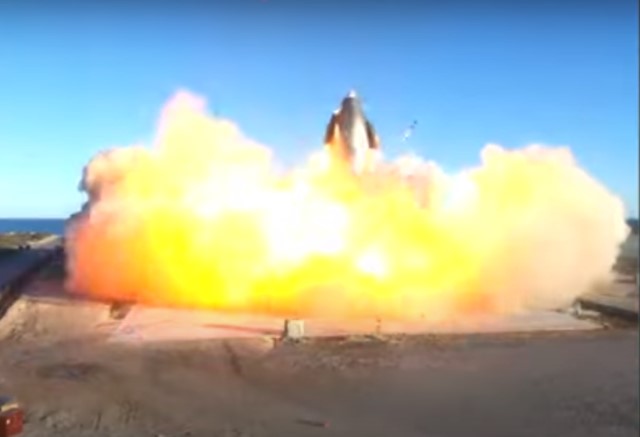
The rocket is designed to land back on its launchpad, to be ready for its next flight. That part is what went wrong last Wednesday. I snagged three screenshots from the live-streamed SpaceX video on YouTube to show what happened. The first image shows the vessel descending on its rocket jets, obviously dropping way too fast as it neared the ground.

This is what happened upon impact:

Ouch.  It turns out that not enough fuel was getting to the rocket engines to slow the vessel’s descent.

Here are the smoking ruins:

Another man may have been chagrined over this outcome, but not the indomitable Musk. He had given this flight only one in three odds of landing intact, and he was ecstatic over the vast majority of things that went right, and the useful data collected. After all, the rocket did successfully take off, ascend to 40,000 ft (12 km), and mainly descend in the desired horizontal orientation to minimize overheating. Right after the blast he tweeted:

“Fuel header tank pressure was low during landing burn, causing touchdown velocity to be high & RUD, but we got all the data we needed! Congrats SpaceX team hell yeah!!”

 When you are Elon Musk, a little RUD (Rapid Uncontrolled Disassembly) is all in a day’s work. Which may be partly why he accomplishes so much more than most of us.