Rate Cuts Looking Dubious for 2024

Fellow blogger James Bailey and I have noted earlier this year that with inflation having  plateaued well above the target 2% level, and with the ongoing strength in the U.S. economy, the three (initially six) rate cuts that pundits predicted for 2024 may not materialize. In fact, we may get no rate cuts at all. This has implications for many things, including housing markets and investing. Also, high interest on the federal debt, layered on top of insane peacetime budget deficits (neither party is willing to tell we the people that we cannot have big spending and low taxes), means the debt will balloon. Sorry about that, grandkids.

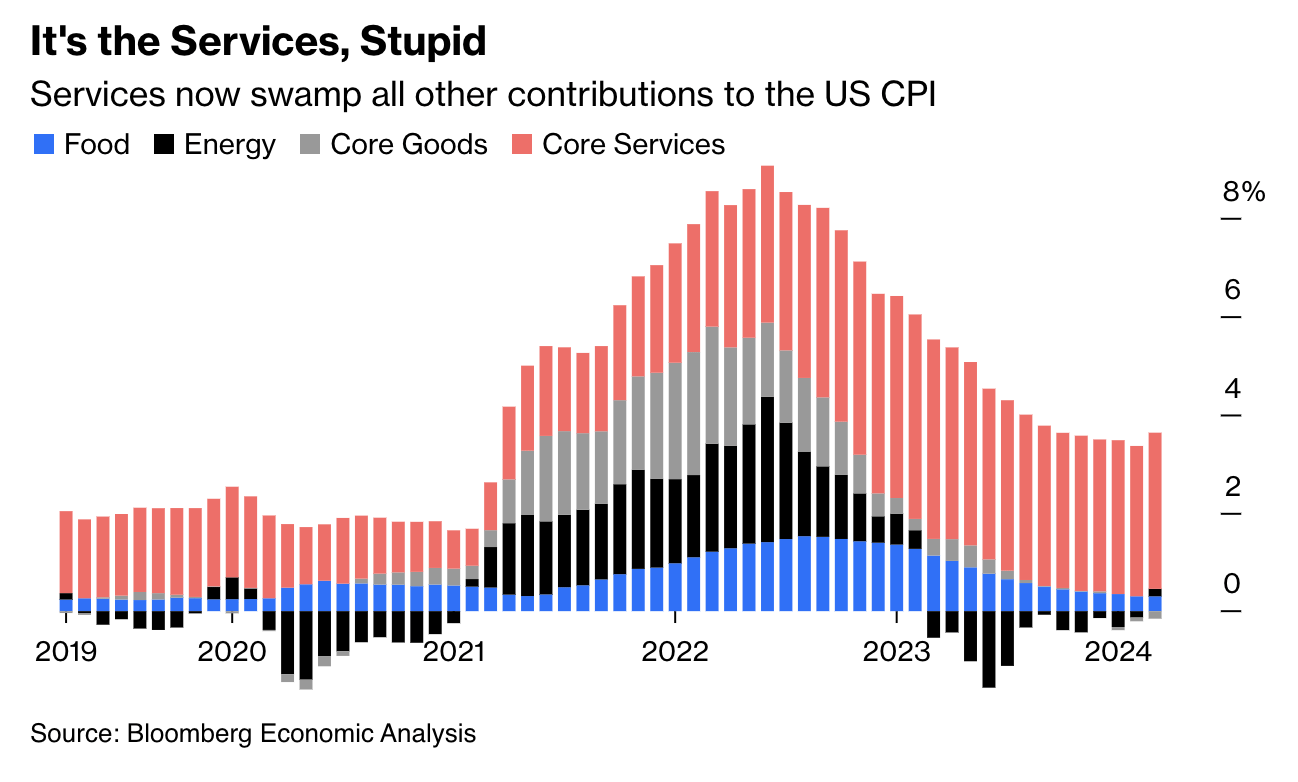
Here is a graphic which illustrates the course of inflation as measured by the Consumer Price Index:

It seems that inflationary expectations are now firmly embedded into wage growth (which is the driver for the increase in Service costs). This mindset way be tough to break. Such is the fruit of the Fed’s head in the sand, inactive approach to raging inflation back in 2021. Instead of nipping it in the bud, they blandly assured us, “It’s just a transitory response to supply shocks”.

One very recent (yesterday) data point is the Census Bureau’s Advance Report on Monthly Sales for Retail & Food Services. This report provides initial data on consumer spending at U.S. retail establishments for March 2024; this is a valuable, timely indicator of current economic activity. According to the Census, Retail Sales expanded by +0.72%, surprising to the upside by +0.32%. This economy just isn’t slowing down.

Slow Landing versus No Landing

The dominant expectation among economists as 2023 drew to a close was that the economy would slow down significantly, gradually enough to justify Fed rate cuts, but it would not crater so fast as to bring on a recession. Now there is more and more talk of a “No Landing” scenario, where GDP keeps chugging along and rates stay high, as the new normal.

Yahoo Finance summarized the recent thinking of Wells Fargo:

The Wells Fargo Investment Institute piled on to that narrative in a note Monday upgrading its outlook for the U.S. economy. While the bank didn’t specifically predict a “no landing” outcome, researchers lifted their gross domestic product growth forecast from just 1.3% for 2024 to 2.5%—the same as last year’s rate of 2.5%.

Wells also said the U.S. unemployment rate will sit at 4.1% instead of 4.7% by the end of 2024. The tradeoff will be slightly higher inflation. The bank now sees U.S. CPI inflation of 3%, instead of its previous 2.8% estimate.

Several factors have been named to account for the unexpected strength of the U.S. economy over the past few years, including record fiscal spending, particularly on infrastructure and semiconductors; the housing market’s resilience to higher rates owing to post–Global Financial Crisis policy changes and supply issues; and even “greedflation.”

But Wells Fargo said the economy has outperformed expectations because financial conditions—a measure of the availability and cost of borrowing, as well as risk and leverage in financial markets—are actually accommodative, despite the Fed’s rate-hiking campaign.

To that point, the Chicago Federal Reserve’s National Financial Conditions Index has been in accommodative territory throughout the Fed’s hiking cycle, and decreased to –0.53 in the week ended April 5—its lowest level since February 2022.

Unless there is a sudden change, it looks unlikely to me that the Fed can cut in May or June or July. If they do not cut by August, the thinking goes, it becomes likely that they will not cut at all this year, because of the optics around the fall election.
A Contrarian View from Apollo: No Rate Cuts in 2024

The mainstream view for the last 18 months has been that Fed rates cuts are always right around the corner. Markets are acting like the cutting cycle has already begun.

Apollo Global Management is a well-regarded alternative investment firm. (Disclosure: I own some APO stock). Their Chief Economist, Torsten Sløk, recently published his outlook, which differs sharply from the mainstream view. He notes that by various measures, the economy is heating up (or at least staying hot), and inflation has started to creep back up, not down. In his words:

The market came into 2023 expecting a recession.

The market went into 2024 expecting six Fed cuts.

The reality is that the US economy is simply not slowing down, and the Fed pivot has provided a strong tailwind to growth since December.

As a result, the Fed will not cut rates this year, and rates are going to stay higher for longer.

How do we come to this conclusion?

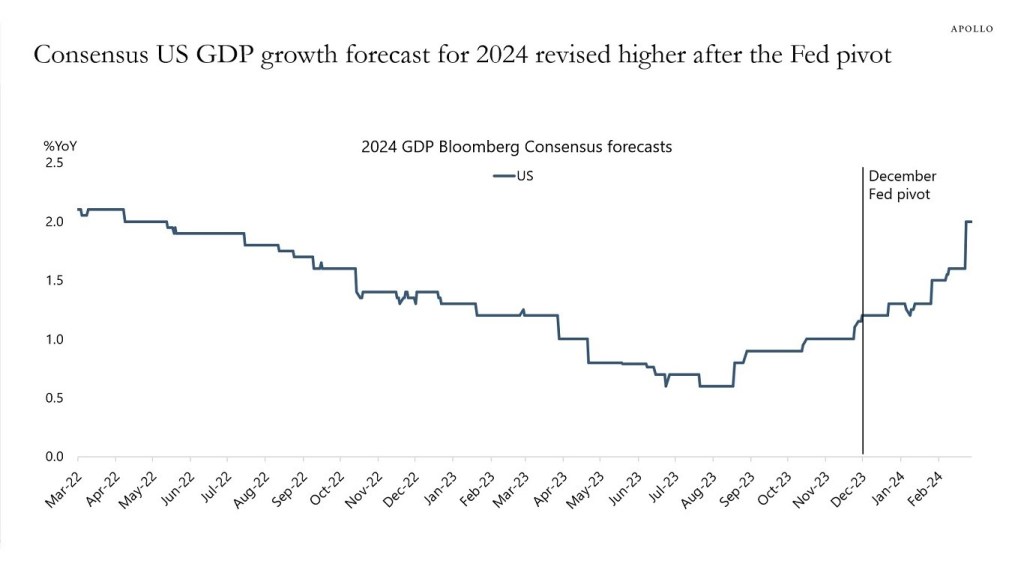
1) The economy is not slowing down, it is reaccelerating. Growth expectations for 2024 saw a big jump following the Fed pivot in December and the associated easing in financial conditions. Growth expectations for the US continue to be revised higher, see the first chart below.

2) Underlying measures of trend inflation are moving higher, see the second chart.

3) Supercore inflation, a measure of inflation preferred by Fed Chair Powell, is trending higher, see the third chart.

4) Following the Fed pivot in December, the labor market remains tight, jobless claims are very low, and wage inflation is sticky between 4% and 5%, see the fourth chart.

5) Surveys of small businesses show that more small businesses are planning to raise selling prices, see the fifth chart.

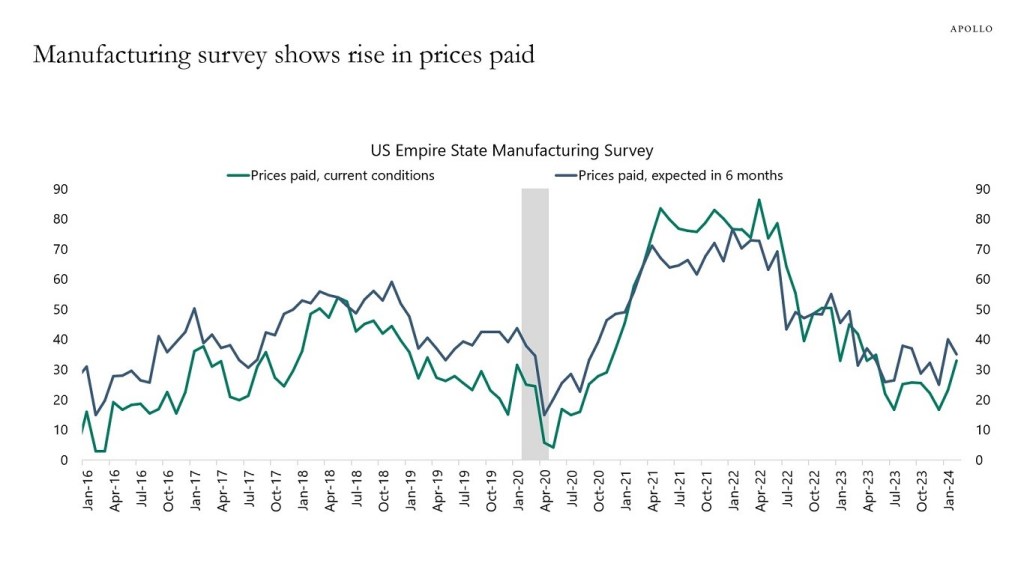
6) Manufacturing surveys show a higher trend in prices paid, another leading indicator of inflation, see the sixth chart.

7) ISM services prices paid is also trending higher, see the seventh chart.

8) Surveys of small businesses show that more small businesses are planning to raise worker compensation, see the eighth chart.

9) Asking rents are rising, and more cities are seeing rising rents, and home prices are rising, see the ninth, tenth, and eleventh charts.

10) Financial conditions continue to ease following the Fed pivot in December with record-high IG issuance, high HY issuance, IPO activity rising, M&A activity rising, and tight credit spreads and the stock market reaching new all-time highs. With financial conditions easing significantly, it is not surprising that we saw strong nonfarm payrolls and inflation in January, and we should expect the strength to continue, see the twelfth chart.

The bottom line is that the Fed will spend most of 2024 fighting inflation. As a result, yield levels in fixed income will stay high.

[END OF EXCERPT]

The big question, of course, is whether these recent signs of increased inflation are just blips of  noise, or the start of a new trend. Time will tell if Sløk’s contrarian view is correct, but I have to respect his intestinal fortitude in putting it right  out there, without any weaselly qualifications. He refers to many charts which are in his original article. I will reproduce four of these charts below:

Raging Inflation, Spiking Rates, Plunging Stocks, Oh, My!

It has been such a volatile couple of days in the markets that you hardly know where to focus.  Friday’s inflation print was 8.6% (year/year), higher than expected and the highest in forty years, showing (yet again) that the Fed’s “transitory inflation” line was always just fantasy. Despite its glacial, foot-dragging pace of response to date, the Fed will need to raise short-rates (which they directly control) faster and farther than earlier planned. The Fed does not directly control long-term rates, but they influence them by buying and selling bonds on the open markets. For years, they have been buying bonds (driving interest rates lower), but they will have to stop that and maybe go the other way, being net sellers of bonds.  This will make financing government deficits much more difficult.

Anyway, both short and long term rates have gone vertical in the past few days as markets price in all this, reaching levels not seen since the aftermath of the 2008 Global Financial Crisis:

Rates of U. S. 1-Year Bills. From Wolf Richter.

Rates of U. S. 10-Year Notes. From Wolf Richter.

https://seekingalpha.com/article/4518160-treasury-bonds-plunge-yields-spike-stock-crypto-mess

Mortgage rates will likely march even further upward, increasing the monthly payments for most homeowners. At some point, this will deflate the housing market. Some of today’s eager new homebuyers who paid over asking price, assuming that housing only goes up, may be in for a rude awakening.

It seems like the only way to tamp down inflation is old-fashioned demand destruction. Stock market participants are starting to price in the dreaded R-word (recession). The plunging stock market has been in the news the last few days. Yes, it has dropped a lot, but shown on a five-year chart below it may not be so apocalyptic. It is dropping from ridiculously over-optimistic market highs at the end of 2021.  We are still slightly above the pre-COVID peak:

S&P 500 Index. From Seeking Alpha.

If you are young and working, you should see lower prices as a buying opportunity. If you are making regular contributions to a savings plan in stocks (dollar cost averaging), your dollars are buying you more stocks. If you feel you must DO something, you could always rebalance your portfolio, shifting some funds into stocks from something else, to maintain a say 70/30 stock/bond portfolio. Peace…