WSJ: Nothing Important Happened in China, India, or AI This Year

I normally like the Wall Street Journal; it is the only news page I check directly on a regular basis, rather than just following links from social media. But their “Biggest News Stories of 2024” roundup makes me wonder if they are overly parochial. When I try to zoom out and think of the very biggest stories of the past five to ten years, three of the absolute top would be the rapid rise of China and India, together with the astonishing growth in artificial intelligence capabilities.

All three of those major stories continued to play out this year, along with all sorts of other things happening in the two most populous countries in the world, and all the ways existing AI capabilities are beginning to be integrated into our businesses, research, and lives. But the Wall Street Journal thinks that none of this is important enough to be mentioned in their 100+ “Biggest Stories”.

To be fair, China and AI do show up indirectly. AI is driving the 4 (!) stories on NVIDIA’s soaring stock price, and China shows up in stories about spying on the US, hacking the US, and the US potentially forcing a sale of TikTok. But there are zero stories regarding anything that happened within the borders of China, and zero that let you know that AI is good for anything besides NVIDIA’s stock price.

Plus of course, zero stories that let you know that India- now the world’s most populous country, where over one out of every six people alive resides- even exists.

AI’s take on India’s Prime Minister using AI

This isn’t just an America-centric bias on WSJ’s part, since there is lots of foreign coverage in their roundup; indeed the Middle East probably gets more than its fair share thanks to “if it bleeds, it leads”. For some reason they just missed the biggest countries. They also seem to have a blind spot for science and technology; they don’t mention a single scientific discovery, and only had two technology stories, on SpaceX catching a rocket and doing the first private spacewalk.

The SpaceX stories at least are genuinely important- the sort of thing that might show up in a history book in 50+ years, along with some of the stories on U.S. politics and the Russia-Ukraine war, but unlike most of the trivialities reported.

I welcome your pointers to better takes on what was important in 2024, or on what you consider to be the best news source today.
Starship: Quantity has a Quality of its own

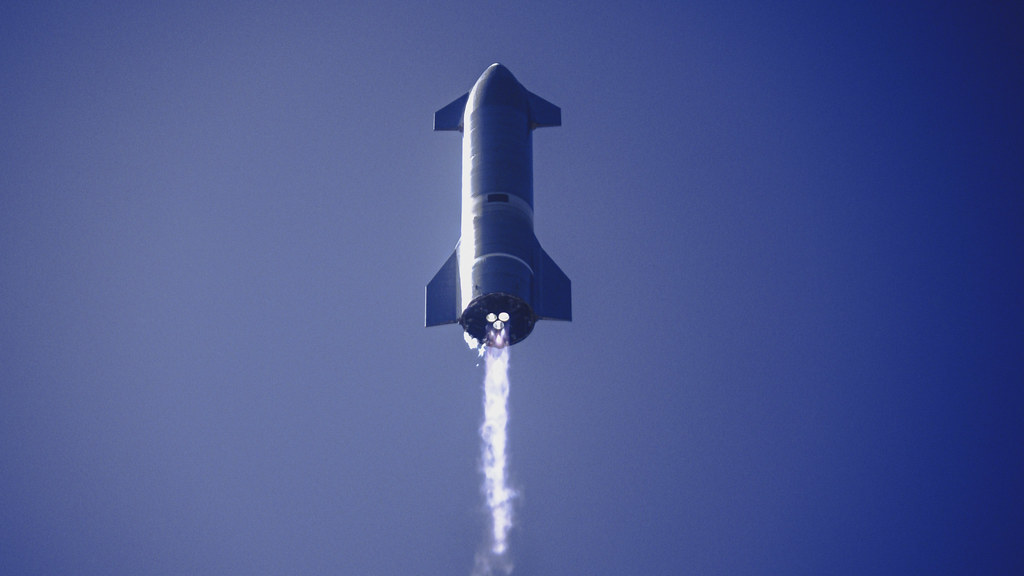
If the SpaceX Starship ends up working as planned, it will do the same things our rockets do now, but at one one-hundredth the price. In an inspiring blog post, Casey Handmer argues that even people within the industry have yet to appreciate the qualitatively different opportunities that this price drop would enable:

By refilling in LEO, a fully loaded deep space Starship can transport >100 T of bulk cargo anywhere in the solar system, including the surface of the Moon or Mars, for <$100m per Starship. Starship is intended to be able to transport a million tonnes of cargo to the surface of Mars in just ten launch windows, in addition to serving other incidental destinations, such as maintaining the Starlink constellation or building a big base at the Lunar south pole.

Second, and more importantly, shoehorning Cassini 2.0 or Mars Direct into Starship fails to adequately exploit the capabilities of the launch system. Not to pick on Cassini or Mars Direct, but both of these missions were designed with inherent constraints that are not relevant to Starship. In fact, all space missions whether robotic or crewed, historical or planned, have been designed with constraints that are not relevant to Starship. 

What does this mean? Historically, mission/system design has been grievously afflicted by absurdly harsh mass constraints, since launch costs to LEO are as high as $10,000/kg and single launches cost hundreds of millions. This in turn affects schedule, cost structure, volume, material choices, labor, power, thermal, guidance/navigation/control, and every other aspect of the mission. Entire design languages and heuristics are reinforced, at the generational level, in service of avoiding negative consequences of excess mass. As a result, spacecraft built before Starship are a bit like steel weapons made before the industrial revolution. Enormously expensive as a result of embodying a lot of meticulous labor, but ultimately severely limited compared to post-industrial possibilities. 

Starship obliterates the mass constraint and every last vestige of cultural baggage that constraint has gouged into the minds of spacecraft designers. There are still constraints, as always, but their design consequences are, at present, completely unexplored. We need a team of economists to rederive the relative elasticities of various design choices and boil them down to a new set of design heuristics for space system production oriented towards maximizing volume of production.

As they say, read they whole thing, especially the part about space tractors. I leave you with one final quote:

It is time to raise the scope of our ambition and think much bigger

“Rapid Uncontrolled Disassembly”: Musk’s Positive Take on Rocket Explosion

If you haven’t been living under a rock, you probably saw at least one image of Elon Musk’s “Starship” rocket blowing up last week. This is a really big rocket, some 165 ft high, which Musk intends to use to ferry humans to Mars, as early as 2026. And before that, paying passengers like you and I are to climb aboard for brief tourist excursions to outer space.

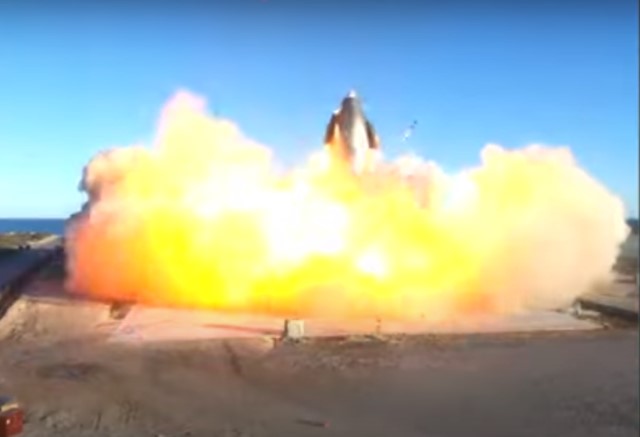
The rocket is designed to land back on its launchpad, to be ready for its next flight. That part is what went wrong last Wednesday. I snagged three screenshots from the live-streamed SpaceX video on YouTube to show what happened. The first image shows the vessel descending on its rocket jets, obviously dropping way too fast as it neared the ground.

This is what happened upon impact:

Ouch.  It turns out that not enough fuel was getting to the rocket engines to slow the vessel’s descent.

Here are the smoking ruins:

Another man may have been chagrined over this outcome, but not the indomitable Musk. He had given this flight only one in three odds of landing intact, and he was ecstatic over the vast majority of things that went right, and the useful data collected. After all, the rocket did successfully take off, ascend to 40,000 ft (12 km), and mainly descend in the desired horizontal orientation to minimize overheating. Right after the blast he tweeted:

“Fuel header tank pressure was low during landing burn, causing touchdown velocity to be high & RUD, but we got all the data we needed! Congrats SpaceX team hell yeah!!”

 When you are Elon Musk, a little RUD (Rapid Uncontrolled Disassembly) is all in a day’s work. Which may be partly why he accomplishes so much more than most of us.