What’s Wrong with Sales Tax Holidays?

Tax holidays are when some set of goods are tax-free for a period of time. These might be back-to-school supplies for a week or a weekend, or hurricane supplies for several months. These policies tend to be popular among non-economists.

There are practical reasons for anyone to decry tax holidays. Usually, there is a particular type of good that qualify for tax-free status. These are often selected politically rather than by an informed and reasoned way with tradeoffs in mind. Sometimes, there is a subpopulation that is intended to benefit. However, the entire population gets the tax holiday and those with the most resources, who often have higher incomes, are best able to adjust their consumption allocations and enjoy the biggest benefits. A tax holiday weekend is no good to a single-mom who can’t get off work during that time.

Getting more economic logic, these holidays also concentrate shopping on the tax-free days, causing traffic and long lines that eat away at people’s valuable time – even if they aren’t purchasing the tax-free items. Furthermore, retailers must comply with the law. This means ensuring that all items are taxed correctly, making neither mistakes in over-taxing or under-taxing. Given the variety of goods and services out there, this is a large cost for individual firms.

Finally, as economists know, there is a deadweight loss anytime that there is a tax. As a consequence, you might think that economists would love anytime that taxes are low. But, holding total tax revenue constant, a tax break on a tax holiday implies that there must be greater tax revenues on the other non-holidays. In particular, economists also know that losses in welfare increase quadratically with changes in tax rates. Therefore, higher tax rates on some days and lower rates on other days causes more welfare loss than if the tax rate had been uniform the entire time. In the current context, such welfare loss manifests as forgone beneficial transactions. These non-transactions are hard for non-economists to understand because we can’t see purchases that don’t happen, but would have happened in the absence of poor policy.

Let’s look at some graphs.

Continue reading
Salty SALT in the OBBB

The Republicans hold a majority in both chambers of congress and they are the party of the president. They want to use that opportunity to pass substantial legislation that addresses their priorities. Hence, the One, Big, Beautiful Bill (OBBB). But, just like the Democratic party, Republican congressmen are a coalition with various and sometimes divergent policy agendas. There are ‘Trump’ Republicans, who want tariffs, executive orders, and deportations. There are more liberal members who want more free markets. You can also find the odd ‘crypto bro’, blue-state representatives, and deficit hawks. Given the slim majority in the House of Representatives, they all have to get something out of the legislation. Put them together, and what have you got?* You get a signature piece of legislation that no one is happy about but everyone touts.

One example of such compromise is the State and Local Tax federal income tax deduction, or SALT deduction. The idea behind it is that income shouldn’t be taxed twice. If you pay a part of your income to your state government in the form of taxes, then the argument goes that you shouldn’t be taxed on that part of your income because you never actually saw it in your bank account. The state took it and effectively lowered your income. The state and local taxes get deducted from the taxable income that you report to the federal government.  The reasoning is that you shouldn’t need to pay taxes on your taxes.

Paying taxes on your taxes sounds bad. And plenty of people don’t like one tax, much less two. The Tax Foundation has done a lot of good work to cut through the chaff and has published many pieces on the SALT deduction over the years.**

Cut and Dry SALT Deduction Facts:

  • It’s a tax cut
  • It reduces federal tax revenue
  • It adds tax code complication
  • It is used by people who itemize rather than take the standard income tax deduction
  • Prior to the 2017 Tax & Jobs Act, there was no limit on the SALT deduction. After, the limit was $10k.
  • The current OBBB increases the SALT deduction.

Those are the basics. Everything else is analysis. The Grover Norquist Republicans never see a tax cut that looks bad, so they’d like to see the SALT limit raised or disappear. Tax think tanks that like simplicity don’t like the SALT deduction because it adds complication. Plenty of others say they don’t like complication, but often change their mind when it comes to the details (much like cutting government waste). Think tanks tend to be a bit lonely on this point.

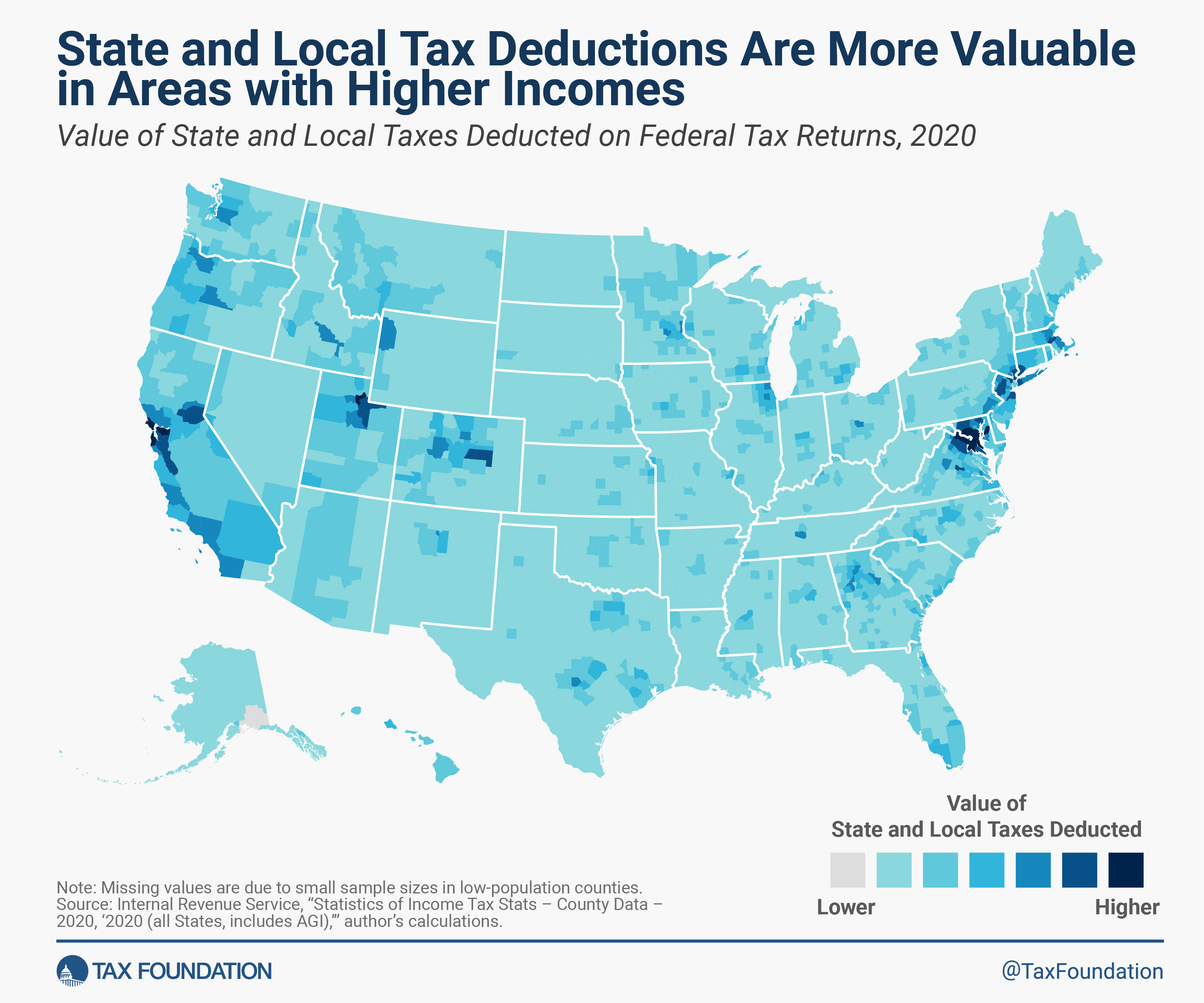
People mostly care about the SALT deduction due to the distributional effects. Who ends up benefiting from the deduction? The short answer is people who 1) itemize & 2) have heavy state and local tax bills. Who is that? Rich people of course! They have high incomes and lots of wealth and real estate – on which they pay taxes. But not all rich people pay loads of state taxes. So the SALT deduction is a tax cut that primarily benefits rich people who live in high tax districts. Where’s that? See the below.

Continue reading

Are You A Business, Man? The Surprising Benefits Of A Sole Prop and IRA

I never thought of myself as a businessman- until 2015 when the IRS told me I was, and that I therefore needed to pay them more money to cover the self-employment tax. Naturally I was confused and angry about this at first, but in the long run it turns out they were doing me a favor.

If you make a tiny amount of 1099-MISC or 1099-NEC income on occasion, the IRS is probably* fine with characterizing this as ordinary income from a hobby. But if you earn 1099 income at all regularly, they will likely want to characterize you as a business, and want you to pay a self-employment tax similar to the payroll tax that W2 employees pay (though it will look higher to you, since you will pay both the employee and employer halves of the tax). If you make an intermediate amount of 1099 income, you might have the choice of whether to call this hobby income or business income; I had thought it would be better to avoid the complications and extra taxes of being a business, but it turns out that being a business unlocks new opportunities for deductions than can far outweigh the self-employment tax.

For example, a home office, business-related travel expenses, and advertising expenses can be deductible. For a writer, this could cover conferences, website expenses, computers, and much more. It also means you can start a SEP IRAin addition to a personal IRA if you like. This alone could allow you to deduct thousands of dollars in income per year (technically up to $69k if you make at least $276,000 per year in business income, though if you make that much, you’re the one who should be giving me advice). The SEP IRA has the advantage over a personal IRA of a much higher income limit and, potentially a higher contribution limit, though again the beauty is that you don’t have to choose- you can just do both.

While this post is mainly about business, I also think regular IRAs might still be underrated. I didn’t start one until 2022, but I should have done it much earlier. First I thought I was too poor (low income, then higher income but with student loans to pay off first), then I thought I was too rich (above the income limits). It turns out though that you can still start a personal IRA even when you are above the income limits- it just means you only get one tax benefit instead of two, but that one tax benefit is still pretty good.

Every IRA has the benefit of investments growing tax-free; if you meet the income limits then IRAs get the additional benefit of avoiding income taxes either when you put the money in (for traditional) or when you pull it out (for Roth). But even if you “only” get the benefit of tax free growth, that can still be a huge monetary benefit depending on your investment strategy. It is also a big time benefit- every taxable brokerage account means at least one** extra tax form to deal with every year, while an IRA account avoids this.

Another great benefit to IRAs (SEP or regular) is that you can still start one now and make contributions for the 2024 tax year. I was just doing my taxes and kicking myself for not doing some things differently back in 2024 when it would have helped; but IRAs are like a form of time travel where you can still go back and fix things, at least until April 15th.

*Disclaimer- Not official tax advice, I’m not an accountant, I’m just a 37 year old guy with lifetime 1-1-1 record against the IRS. Three times they have told me I owed them more than I paid on a tax return. Once I won (I told them I owed nothing and explained why, and they agreed). Once I lost (I told them oh shit, you’re right and paid them). For the story I started this post with, I call it a draw (they told me I owed them X, I told them I owed nothing and explained why, then they told me I actually owed them 1/3X and I just paid it).

**More than one if like me you accidentally invest in a partnership and as a result get a K-1 on top of the usual 1099-DIV for that overall brokerage account

HT: Trinette McGoon

Tariffs: Bad for Revenue

Economists are pretty united against tariffs. There are lots of complicated arguments. Keeping things simple, one reason is that they are bad for welfare. President-elect Trump seems to imply that tariffs can raise a lot of government revenue. But in lieu of what? The Tax Foundation estimates that there is absolutely no way that tariffs can replace all revenue from income taxes. The primary reason that they cite is that imports compose a tiny portion of the potential tax base. There are plenty of goods and services produced domestically that wouldn’t be subject to the tariffs. Any time we add a tax exemption, we’re adding complication, higher compliance costs, and distorting consumption patterns, etc.

For this post I singularly focus on the tax revenue.  In fact, let’s demonstrate what *maximizing* tax revenue looks like under three cases: 1) Closed economy with a tax, 2) Open economy with a tax, & 3) Open economy with a tariff. I’ll use some simple math to demonstrate my point. None of the particulars affect the logic. You’ll reach the same general results with different intercepts, slopes, etc. Let’s start with a domestic demand and domestic supply.

Closed Economy with a Tax

Whenever tax revenue is raised, there is a difference between the price paid by demanders and the price received by suppliers. In a closed economy a tax might be imposed on all goods. In these examples, I treat the tax as some dollar per-unit of output tax. But it’s a short jump to percent of spending taxes, and then another short jump to percent of income taxes. With this in mind, demanders pay more than the suppliers receive by the amount of the tax. Tax revenue is the tax rate times the number of units of output that are subject to the tax. That’s the thing we want to maximize.

Continue reading

Lump Sum Taxes: Never by Popular Demand

The tax code is complex. That’s not news. The US federal tax code is also very progressive. Apart from that, the tax code pushes social or other policy goals. The Earned Income Tax Credit, for example, acts as a negative income tax and increases after-tax wages for those who can claim it. The idea is to incentivize earnings.

Economists tend to really like lump-sum taxes (in theory). But, despite the profession’s influence, almost nobody supports them. First, what is a lump-sum tax? It’s a tax that ignores any activities of the target. A per capita lump-sum tax would target the young, the old, the indigent, the working, the rich, the disabled… everyone. The idea is that no behaviors, aside from breathing, incur or disqualify a person from owing the tax.

Economists like them because they don’t change the relative price of labor and leisure. Whereas a marginal tax rate reduces a worker’s effective wage, a lump sum tax leaves it unaffected. People aren’t disincentivized from working/earning. Using jargon, we say that a lump-sum tax is non-distortionary.

In the simple two-good model of consumption and leisure, marginal tax rates reduce the amount of consumption that one can afford with each hour of work, making leisure relatively more attractive. Lump-sum taxes reduce the affordable amount of both leisure and consumption. Affording less leisure is the same as saying that people work more hours. It happens for two reasons. 1) Poorer people must work enough to pay the inevitable tax bill and also reach an income level of sustenance. However much work sustenance entails, it’s surely more when there is a tax. 2) Since working and earning itself is not taxed, people at all levels of income decide to work more because their after-tax wage is higher relative to the case of a marginal income tax.

At this point someone gets what I call the “French” idea. The French idea is that if we provide a lump-sum subsidy, then we can all leisure more and consume less – the opposite of a lump sum tax. What a life! We can avoid the prisoner dilemma problem where we can’t credibly commit to shirking together or actually taking a lunch. By forcing a lump-sum subsidy on everyone, we’d work a little less and do it voluntarily. We can sit outside a cafe, enjoying our coffee, baguette, and cigarette without having to worry about our neighbor with their “go get’em” attitude making us look bad.

Continue reading

What Are the Effects of TCJA? It’s A Little Hard to Say

The Tax Cuts and Jobs Act was passed in late 2017 and went into effect in 2018. For academic research to analyze the effects, that’s still a very recent change, which can make analyzing the effects challenging. In this case the challenge is especially important because major portions of the Act will expire at the end of next year, and there will be a major political debate about renewing portions of it in 2025.

Despite these challenges, a recent Journal of Economic Perspectives article does an excellent job of summarizing what we know about the effects so far. In “Sweeping Changes and an Uncertain Legacy: The Tax Cuts and Jobs Act of 2017,” the authors Gale, Hoopes, and Pomerleau first point out some of the obvious effects:

  1. TCJA increased budget deficits (i.e., it did not “pay for itself”)
  2. Most Americans got a tax cut (around 80%), which explains #1 — and only about 5% of Americans saw a tax increase (~15% weren’t affected either way)
  3. Following from #2, every quintile of income saw their after-tax income increase, though the benefits were heavily skewed towards the top of the distribution ($1,600 average increase, but $7,600 for the top quintile, and almost $200,000 for the top 0.1%)

Beyond these headline effects, it seems that most of the other effects were modest or difficult to estimate — especially given the economic disruptions of 2020 related to the pandemic.

For example, what about business investment? Through both lowering tax rates for corporations and changing some rules about deductions of expenses, we might have expected a boom in business investment (it was also stated goal of some proponents of the law). Many studies have tried to examine the potential impact, and the authors group these studies into three buckets: macro-simulations, comparisons of aggregate data, and using micro-data across industries (to better get at causation).

In general, the authors of this paper don’t find much convincing evidence that there was a boom in business investment. The investment share of GDP didn’t grow much compared to before the law, and other countries saw more growth in investment as a share of GDP. Could that be because GDP is larger, even though the share of investment hasn’t grown? Probably not, as GDP in the US is perhaps 1 percent larger than without the law — that’s not nothing, but it’s not a huge boom (and that’s not 1 percent per year higher growth, it’s just 1 percent).

Ultimately though, it is hard to say what the correct counterfactual would be for business investment, even with synthetic control analyses (the authors discuss a few synthetic control studies on pages 21-22, but they aren’t convinced).

What’s important about some of the main effects is that these were largely predictable, at least by economists. The authors point to a 2017 Clark Center poll of leading economists. Almost no economists thought GDP would be “substantially higher” from the tax changes, and economists were extremely certain that it would increase the level of federal debt (no one disagreed and only a few were uncertain).

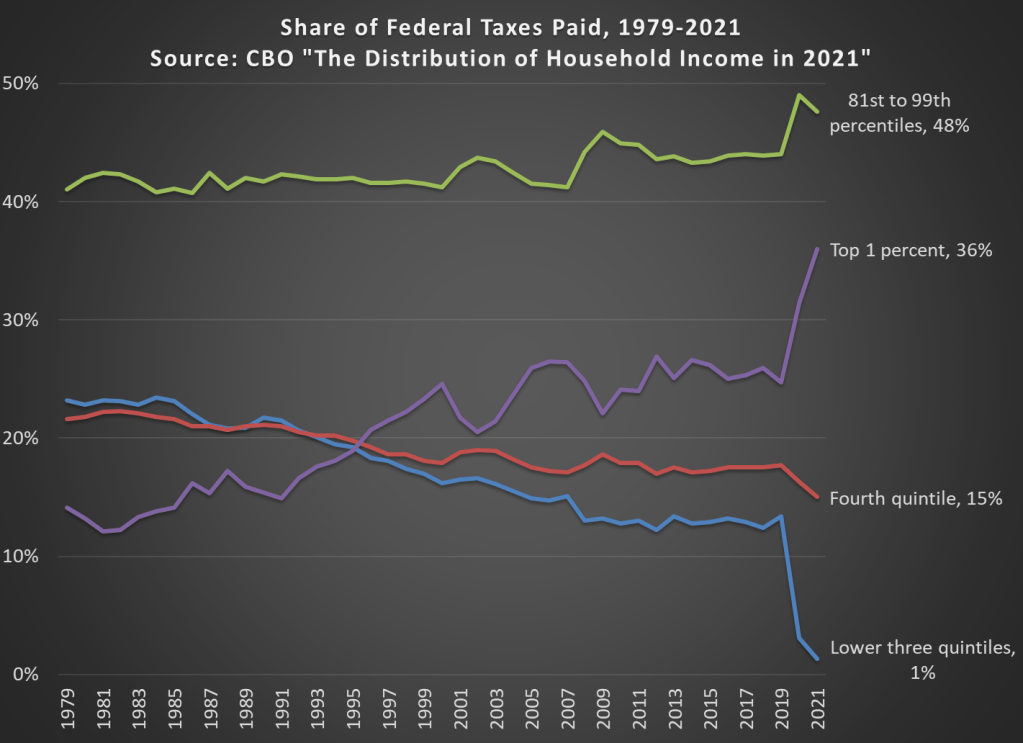
The Top 1 Percent Paid a Lot of Taxes in 2021

In 2021 the top 1 percent of taxpayers in the United States paid 36 percent of all federal taxes (they have 21.1 percent of income). This figure had been below 20 percent until the mid-1990s, and as recently as 2019 it was just 24.7 percent (they had 15.9 percent of the income that year).

The data comes from the latest CBO report on “The Distribution of Household Income in 2021.”

The increase is primarily due to a large number of high-income households realizing capital gains in 2021. With all the talk lately of potentially taxing unrealized capital gains, it’s important to note that we do tax realized gains, and these change a lot from year to year. Another contributing factor is that the share of the bottom 60 percent of households only paid 1 percent of federal taxes in 2021, a big drop from 2019 due to a big increase in temporary refundable tax credits.

Fiscal Illusion: It’s Real (People Underestimate How Much They Pay in Taxes)

The concept of “fiscal illusion” has long existed in public finance, but it is difficult to test. The basic theory is that people will underestimate how much they pay in taxes, as well as underestimate government expenditures. A forthcoming paper in Public Choice by Kaetana Numa uses survey data from the United Kingdom to test the theory, and finds support. From the abstract of “Fiscal illusion at the individual level“:

“providing personalized fiscal information reduces support for higher taxes and spending and increases support for lower taxes and spending. These findings indicate that taxpayers underestimate both their tax liabilities and the costs of public services.”

The paper uses a “novel personalized fiscal calculator” to estimate how much tax an individual would actually owe. It then randomizes which taxpayers get this information, and finds that “the treated respondents… were less supportive of raising taxes and more supportive of cutting taxes than the respondents in the control condition.”

And the results are large. For all taxes, in the treated group that saw their personalized fiscal calculator, 61 percent support cutting taxes, versus just 50 percent in the control group. The differences show up across the major taxes that individuals pay in the UK, including the income tax, national insurance contributions (both employer and employee sides), and the VAT. There is no tax category where the treatment group is more likely to want to increase the tax, though the VAT and the smaller Fuel duty and Council tax are about equal on the percent wanting an increase (but the median response for these last two is to decrease the tax — in both the control and treatment groups).

Do these results from the UK hold up in other developed nations? Possibly. In a 2014 Eurobarometer survey, the percent of EU citizens that could correctly identify their nation’s VAT rate varied widely. The high was 89 percent in Germany correctly identifying the rate, down to 31 percent in Ireland. The average was 65 percent — though the UK was at the low end with only about 47 percent correctly identifying the VAT rate.

Fiscal illusion appears to be a real issue, and probably an important one in the UK.

Taxes & Unemployment – Know Your Bias?

Say that there is a labor market and that there is no income tax. If an income tax is introduced, then what should we expect to happen? Specifically, what will happen to employment, the size of the labor force, and the number of people unemployed? Will each rise? Fall? Remain unchanged? Change ambiguously? Take a moment and jot down a note to test yourself.

As it turns out, what your answer is depends on what your model of the labor market is. Graphically, they are all quantities of labor. The size of the labor force is the quantity of labor supplied contingent on some wage that workers receive. It’s the number of people who are willing to work. Employment is the quantity of laborers demanded by firms contingent on to wage that they pay. Finally, the quantity of people unemployed is the difference between the size of the labor force and the quantity of workers employed (Assuming that the labor force is greater than or equal to employment).

Continue reading

Hotel Taxes and Quality: Why Georgia Sucks (Value)

Every year my family travels from SW Florida to the mid Atlantic area. Without stops it takes 16-17 hours. With small children, it’s definitely a two day trip. We find that they handle it better if we leave super early, take a longer leg on the first day, then stop at a hotel midway and get the kids in the pool to help burn off some energy. We also rent a suite whenever possible.

We’ve made this trip many times. I use the Bonvoy app which is for Marriott hotels. We even have a particular hotel that we prefer: The Fairfield Inn in Santee, SC. It’s clean, spacious, the employees are welcoming and kind, the breakfast includes cooked items that aren’t bad, it’s within walking distance of a grocery store, and the price isn’t bad at all. Fairfield Inns are generally a great price per quality…. But not in Georgia.

I’ve stopped at several Fairfield Inns in GA: near Atlanta, near Savannah, and we’ve been disappointed. Every. Single. Time. All the margins on which the Fairfield in Santee is great are the same margins on which Georgia ones are poor. I’m sure that there is not just one reason. Maybe there is a bad regional manager or bad assistant to the regional manager. That’s not my primary hypothesis though.

Continue reading