Housing is More Expensive Today, But Not Because the US Left the Gold Standard

Housing is certainly more expensive than in the past. I have written about this several times, including a post from last year showing that between about 2017 and 2022 housing started to get really expensive almost everywhere in the US, not just on the West Coast and Northeast (as had previously been the case). I don’t think the housing affordability crisis is in serious doubt anymore, and it can’t be explained over the past few years by increasing size and amenities, since those haven’t changed much since 2017 (though it is relevant when comparing housing prices to the 1970s).

But why did this happen? Knowing why is crucial, not merely to blame the causes, but because the policy solution is almost certainly related to the causes. I and many others have argued that supply-side restrictions, such as zoning laws, are the primary culprit. The policy solution is to reduce those restrictions. But a recent op-ed titled “Why your parents could afford a house on one salary – but you can’t on two,” the authors place the blame for housing prices (as well as the stagnation of living standards generally) on a different factor: Nixon’s 1971 “severing the dollar’s link to gold.” The authors have a book on this topic too, which I have not yet read, but they provide most of the relevant data in this short op-ed.

Does their explanation make sense? I am skeptical. Here’s why.

Continue reading
Queens 2060: Where Upzoning Matters Most

Most US cities make it hard for housing supply to meet demand because of rules that prevent large apartment buildings. Usually cities do this with zoning rules that limit the number of homes per parcel, often to as low as 1. New York City relies more on rules about Floor Area Ratio (the ratio of the floor area to the area of the parcel). But how binding are these rules? If we relaxed or repealed them, how much new construction would we see, and where would we see it?

MIT PhD student Vincent Rollet has calculated this for New York City:

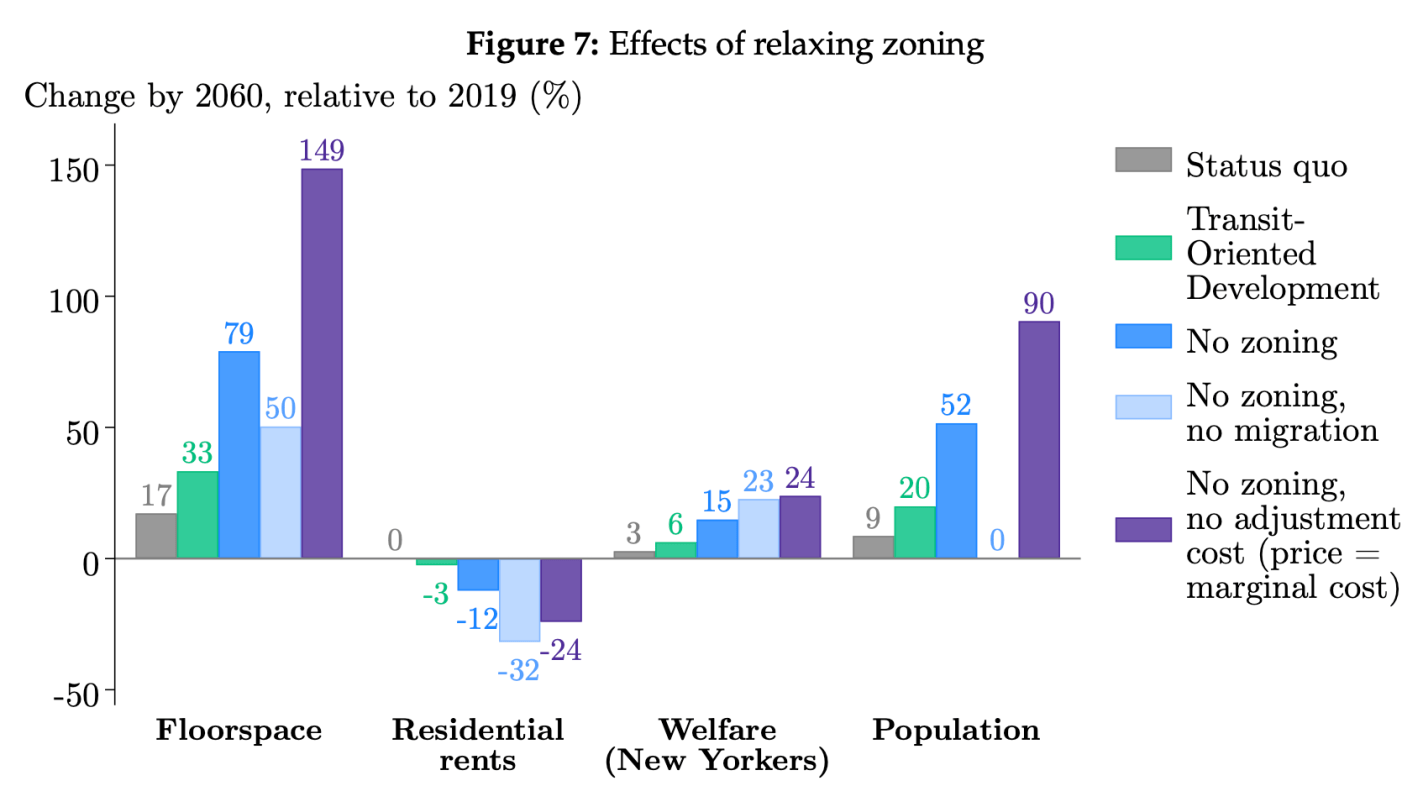
I build a dynamic general equilibrium model of the supply and demand of floorspace in a city , which I estimate using a novel parcel-level panel dataset of land use and zoning in New York City. I validate the model using quasi-experimental variation from recent zoning reforms and use it to simulate the effects of zoning changes on construction and prices.

He finds that eliminating these rules in NYC would lead to a construction boom, with a 79% increase in the amount of floor space available by 2060. This would allow many more people to live in New York, with a 52% increase in population; but many of the benefits would go to existing NYC residents, with more floor space per person and modestly lower rents leading to higher wellbeing:

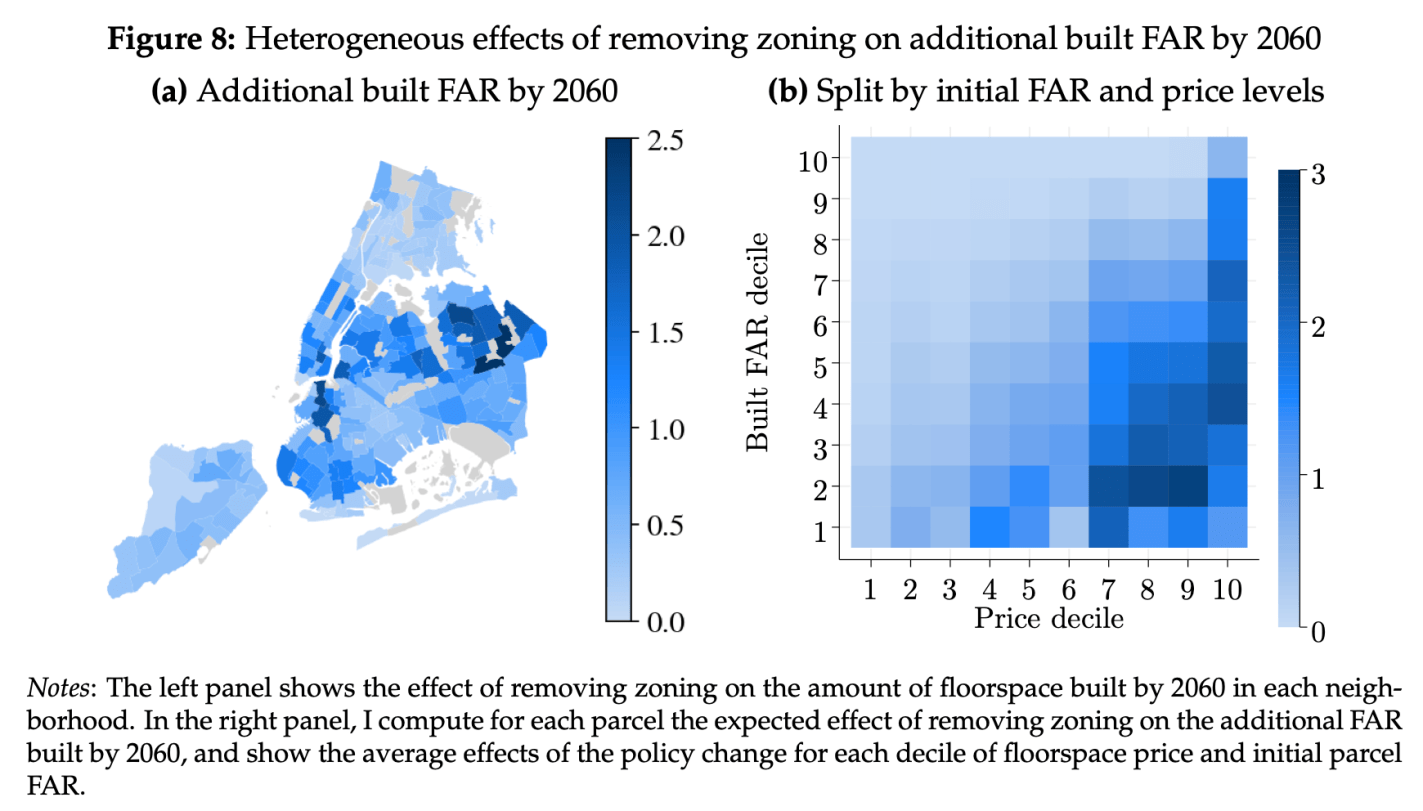
Where exactly would we see the building boom? Not Manhattan, but Brooklyn and Queens. The intuition is that zoning is most binding in places where housing prices are currently high but where the buildings are currently small; this is where there is the biggest incentive to tear down existing buildings and build taller if you are allowed to.

Zoning Matters for Rising Housing Costs, Especially After 1980

From a new working paper “The Price of Housing in the United States, 1890-2006” by Ronan C. Lyons, Allison Shertzer, Rowena Gray & David N. Agorastos (emphasis added):

“Zoning was adopted by almost every city in our sample during the 1920s. We see a slightly steeper gradient over the next two periods (coefficients of .48 and .29, respectively). In these periods it is possible both that the existing zoning regimes were causing higher price growth and that home price appreciation was incentivizing cities to adopt even more restrictive measures, particularly by the 1970s (Fischel, 2015; Molloy et al., 2020). The gradient in the final period (1980-2006) is even steeper, however (coefficient of .67), suggesting a closer relationship between zoning and home price appreciation towards the end of the 20th century.”

The authors acknowledge that they cannot establish causality with their data, but this is consistent with existing research, such as a paper by Gyourko and Krimmel that I previously discussed.

Mortgage Affordability Since 1971

Mortgage interest rates are climbing quickly, while housing prices are still mostly high. These factors combined means that it is much more expensive to buy a home than in the recent past. But how much more expensive? And how does this compare with the past 50 years of history?

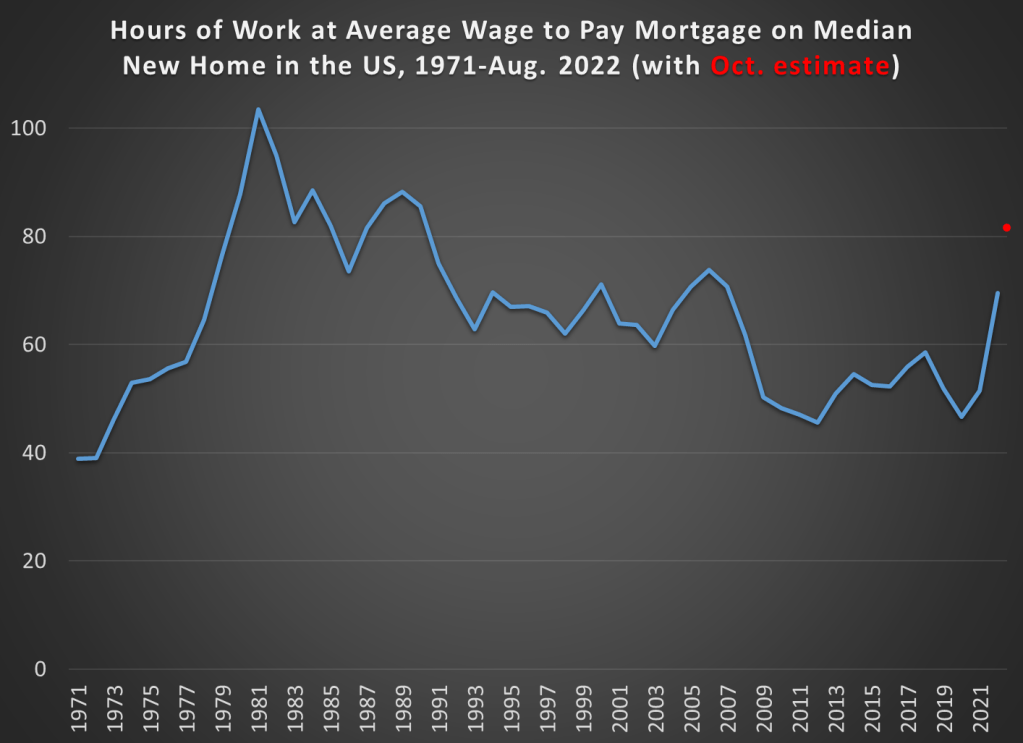
The chart below is my attempt to answer those questions. It shows the number of hours you would need to work at the average wage to make a mortgage payment (principal and interest) on the median new home in the US.

My goal here was to provide the most up-to-date estimate of this number consistent with the historical data. Thus, I had to use average wage data rather than median wage data, since the median hourly wage data is not available for 2022 yet. But as I’ve discussed before, while median and average wages are different, their rate of increase is roughly the same year-to-year, so it would show the same trends.

The final point plotted on the blue line in the chart is for August 2022, the last month for which we have median home price data, average wage data, and 30-year mortgage rates. Mortgage rates are the yearly average (or monthly average in the case of August 2022).

You’ll also notice a red dot at the very end of the series. This is my guess of where the line will be in October 2022, once we have complete data for these three variables (right now only mortgage rates are available in October for the three series I am using). I’m doing my best here to provide as much of a real-time picture as possible, given that rates are rising very sharply right now, while still providing consistent historical comparisons. If that estimate is roughly correct, mortgage costs on new homes are now less affordable than any year since 1990.

What do you notice in the chart?

Continue reading

How Zoning Affects Your Home, Your City, and Your Life (a book review)

As you drive, walk, or bike around your city, what do you think about as you see the various buildings and other structures? Perhaps you think about the lives of the people in them, or the architecture of the buildings themselves, or the products and services that the businesses offer for sale. For me, lately I’ve been thinking about one thing as I make my way around town: zoning. It’s not something I had thought about before very much, but after reading Nolan Gray’s new book Arbitrary Lines: How Zoning Broke the American City and How to Fix It, I’ve been thinking about zoning a lot more.

(Disclosure: I know the author of the book, but I paid for my own copy and got it in advance through the luck of the Amazon-pre-order draw.)

The book does a wonderful job of explaining what zoning is (and importantly, also what it is not), where zoning comes from historically (it’s a development of the early 20th century), and how zoning affects our cities. I really like the way that the book encourages the reader to be a part of the story of zoning. In Chapter 2, Gray encourages you to put down the book and locate your city’s zoning map to learn more about how zoning impacts your life.

I immediately did so and had no trouble finding zoning maps for the city I live in, Conway, Arkansas. Conveniently, my city provides both a simple PDF map and an interactive map, which provides a lot more detail. The interactive map even has embedded links with historical information on different pieces of property. For example, I found the ordinance for when my college, the University of Central Arkansas (previously Arkansas State Teachers College), was annexed by the City in 1958. Pretty cool!

Looking over the map, it’s pretty clear that most of the city that I live in is covered by R-1 and R-2 zoning. But what exactly do these designations mean? You can probably guess that “R” designates residential, but what does it proscribe about land use?

For that, you must dig into the zoning ordinances. And as Gray cautions in the book (somewhat tongue-in-cheek), you might not want to get in too deep with your zoning ordinances, since they can run hundreds or thousands of pages. But I was brave enough to do so, and located my zoning code online (the PDF runs a modest 253 pages).

What did I learn about the zoning that covers my city?

Continue reading