Gari Melchers

Who’s your favorite artist? Warhol? Picasso? Van Gogh? Maybe someone much earlier, such as Michelangelo or Titian? Of course, there is something about the style or subjects that you enjoy. But something about the artist’s personal life might also matter to you. Personally, I’m a fan of Hieronymus Bosch, about whom we know little, and William Blake, who had some social and political opinions that would still be considered liberal even today.

Picasso, Dalle, and Warhol were all eccentric. Picasso had multiple girlfriends who didn’t get along, Dalle enjoyed exemplifying surrealism in his dress and behavior, and Warhol was a reclusive hoarder. Their eccentricity increases their allure and fosters an aura of mystique that they are privy to some unknown truths.

Continue reading

Mortgage Fraud Is Surprisingly Common Among Real Estate Investors

That is the conclusion of a recent Philadelphia Fed working paper by Ronel Elul, Aaron Payne, and Sebastian Tilson. The fraud is that investors are buying properties to flip or rent out, but claim they are buying them to live there in order to get cheaper mortgages:

We identify occupancy fraud — borrowers who misrepresent their occupancy status as owner-occupants rather than investors — in residential mortgage originations. Unlike previous work, we show that fraud was prevalent in originations not just during the housing bubble, but also persists through more recent times. We also demonstrate that fraud is broad-based and appears in government-sponsored enterprise and bank portfolio loans, not just in private securitization; these fraudulent borrowers make up one-third of the effective investor population. Occupancy fraud allows riskier borrowers to obtain credit at lower interest rates. 

One third of all investors is a lot of fraud! The flip side of this is that real estate investors are much more prevalent than the official data says:

We argue that the fraudulent purchasers that we identify are very likely to be investors and that accounting for fraud increases the size of the effective investor population by nearly 50 percent.

Many people blame investors for making housing unaffordable for regular people. Economists tend to disagree, and one of our arguments has been to point out that investors are still a small fraction of home buyers. However, official statistics recently showed the investor share over 25% (though dropping fast), and apparently that may still be an understatement. If investors are a problem, there are enough of them to be a big problem.

Of course, there are other reasons economists aren’t so concerned about real estate investors. One is that they can provide the valuable service of renting out homes to people who couldn’t qualify for a mortgage themselves (especially after 2010, when Dodd Frank made it difficult for people without great credit to qualify). Another is that many investors seem to be surprisingly bad at flipping homes for higher prices. The panic over “ibuyers” that would buy houses sight unseen based on algorithms abated when it turned out those those companies lost a ton of money, saw their stock prices plunge, and gave up.

The mortgage fraud paper also provides evidence of investors losing money. In particular, rather than fraudulent investors crowding out the good ones, they are actually more likely to end up defaulting on their purchases:

These fraudulent borrowers perform substantially worse than similar declared investors, defaulting at a 75 percent higher rate.

Still, such widespread fraud is concerning, and I hope lenders (especially the subsidized GSEs) find a way to crack down on it. Based on things I see people bragging about on social media, I’m guessing that tax fraud is also widespread in real estate investing, though I haven’t looked into the literature on it.

This mortgage fraud paper seems like a bombshell to me and I’m surprised it seems to have received no media attention; journalists take note. For everyone else, I suppose you read obscure econ blogs precisely to find out about the things that haven’t yet made the papers.

Updated GDP and Inflation Data for G7 Countries

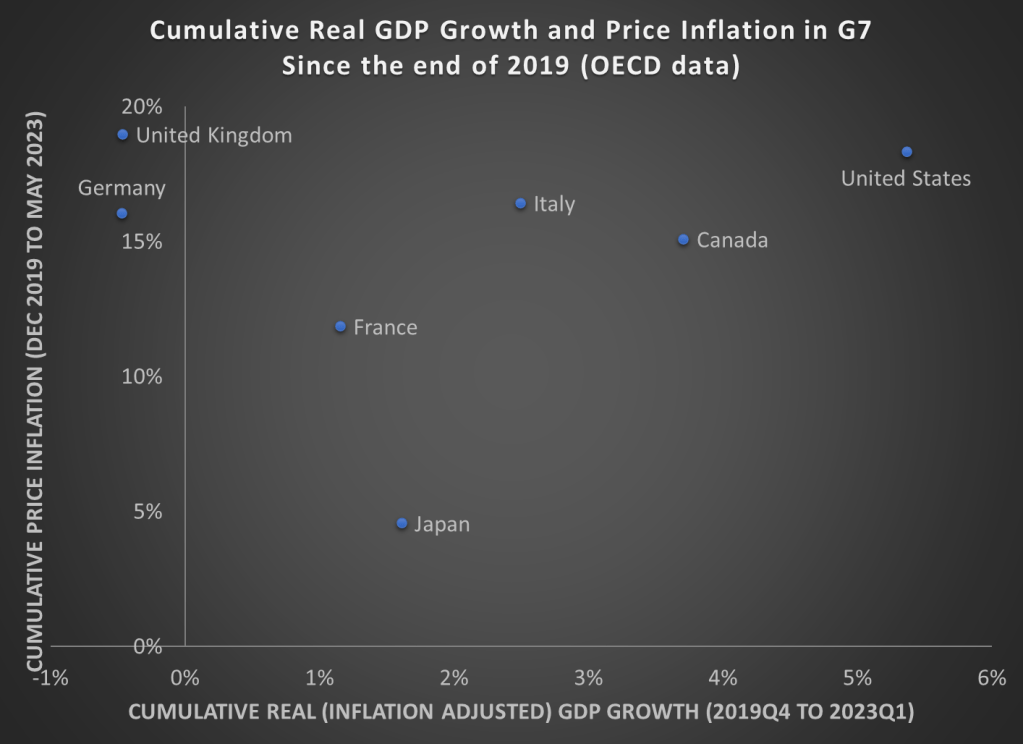
As we prepare for the release of second quarter GDP data over the next few weeks, here is a chart showing cumulative GDP growth (inflation adjusted) and Price inflation for G7 countries. While inflation has been high everywhere (except for Japan), the US comes out looking very well relatively on GDP growth. That’s especially true compared to the UK and Germany, which have also had high price inflation, but have actually had negative economic growth since the end of 2019.

Malwarebytes Poll: Public Fascination with ChapGPT Has Turned to Suspicion

ChatGPT and related AI have been all the rage these past few months. Among other things, “AI” became the shiny object that companies have dangled before investors, rocketing upward the shares of the “Magnificent Seven” large tech stocks.

However, a recent poll by computer security firm Malwarebytes notes a marked turn in the public’s attitude towards these products:

It seems the lustre of the chatbot-that’s-going-to-change-everything is starting to fade….

When people explored its capabilities in the days and weeks after its launch, it seemed almost miraculous—a wonder tool that could do everything from creating computer programs and replacing search engines, to writing students’ essays and penning punk rock songs. Its release kick-started a race to disrupt everything with AI, and integrate ChatGPT-like interfaces into every conceivable tech product.

But those that know the hype cycle know that the Peak of Inflated Expectations is quickly followed by the Trough of Disillusionment. Predictably, ChatGPT’s rapid ascent was met by an equally rapid backlash as its shortcomings became apparent….

A new survey by Malwarebytes exposes deep reservations about ChatGPT, with optimism in startlingly short supply. Of the respondents familiar with ChatGPT:

  • 81% were concerned about possible security and safety risks.
  • 63% don’t trust the information it produces.
  • 51% would like to see work on it paused so regulations can catch up.

The concerns expressed in the survey mirror the trajectory of the news about ChatGPT since its introduction in November 2022.

As EWED’s own Joy Buchanan has been pointing out specifically with regard to citations for research papers (here, here, and in the Wall Street Journal), ChatGPT tends to “hallucinate”, i.e., to report things that are not simply true. In the recent working paper “GPT-3.5 Hallucinates Nonexistent Citations: Evidence from Economics” , she warns of the possibility of a vicious spiral of burgeoning falsehoods, where AI-generated errors which are introduced into internet content such as research papers are then picked up as “learning” input into the next generation of AI training.

Real-world consequences of ChatGPT’s hallucinations are starting to crop up. A lawyer has found himself in deep trouble after filing an error-ridden submission in an active court case. Evidently his assistant, also an attorney, relied on ChatGPT which came up with a raft of “citations to non-existent cases.” Oops.

And now we have what is believed to be “the first defamation lawsuit against artificial intelligence.” Talk show host Mark Walters filed a complaint in Georgia which is:

…asking for a jury trial to assess damages after ChatGPT produced a false complaint to a journalist about the radio host.  The faux lawsuit claimed that Mr. Walters, the CEO of CCW Broadcast Media, worked for a gun rights group as treasurer and embezzled funds.

…Legal scholars have split on whether the bots should be sued for defamation or under product liability, given it’s a machine — not a person — spreading the false, hurtful information about people.

The issue arose when an Australian mayor threatened to sue the AI company this year over providing false news reports that he was guilty of a foreign bribery scandal.

Wow.

Thousands of AI experts and others have signed an open letter asking: “Should we let machines flood our information channels with propaganda and untruth? Should we automate away all the jobs, including the fulfilling ones? Should we develop nonhuman minds that might eventually outnumber, outsmart, obsolete and replace us? Should we risk loss of control of our civilization?”.    The letter states that “Such decisions must not be delegated to unelected tech leaders. Powerful AI systems should be developed only once we are confident that their effects will be positive and their risks will be manageable.”    It therefore urges  “all AI labs to immediately pause for at least 6 months the training of AI systems more powerful than GPT-4…If such a pause cannot be enacted quickly, governments should step in and institute a moratorium…AI labs and independent experts should use this pause to jointly develop and implement a set of shared safety protocols for advanced AI design and development that are rigorously audited and overseen by independent outside experts.”

Oh, the irony. There is reason to believe that our Stone Age ancestors were creating unreal images like this:

whilst stoned on peyote, shrooms, or oxygen deprivation. And here we are in 2023, with the cutting edge in information technology, running on the fastest specially-fabricated computing devices, and we get…hallucinations.

Policies are an uncoordinated bundle

There is much to admire in the bundle of Canadian policy, but housing and construction regulation remains a largely unmitigated disaster.

I note this only as a reminder that

  1. It’s safer to admire individual policies rather than national bundles. There isn’t a nation on earth that gets anywhere close to everything right.
  2. What you gain from an optimal policy is often just slack that softens the impact of getting something else completely wrong.
  3. Often you only really feel the true cost of bad policy when political tides undermine what was previously buttressing your entire system. Case in point: the NHS and Brexit.

What happens to the Canadian economy when the housing market is still strangling disposable income and an anti-immigrant political movement rises to power on the false but persuasive accusation that immigrants, and not bad housing policy, is to blame? Leveraging all my gifts of analysis and foresight, I predict bad things. Bad things will happen.

EconTwitter Platforms and Threads

There is a community called #EconTwitter. This agglomeration of not-anonymous accounts links together professional economists, academics, and independent intellectuals. Twitter.com is the home base and origin of #EconTwitter. Mike wrote about turmoil in EconTwitter in December 2022. Find me on Twitter at @aboutJoy

The #EconTwitter group has experimented with leaving Twitter to join new networks. For some people, getting away from the billionaire owner is the explicit goal. Others join the new platform to be where the people are.

Mastodon launched in 2016 but it was not until recently that #EconTwitter made a go at that.

Mastodon is also part of the Fediverse ensemble of computer servers, which use shared protocols allowing users to interact with other users on computers running compatible software packages such as PeerTube and Friendica. Mastodon is crowdfunded and does not contain ads.

https://en.wikipedia.org/wiki/Mastodon_(social_network)

Fediverse? Protocols? The average Twitter user does not want to be bothered with “computer servers”. That’s part of the problem. On Mastodon I am @JoyBuchanan@econtwitter.net

When I joined, I was not confident that it would build on the initial momentum. The reason that the move to Mastodon was large and sudden is that Paul Goldsmith-Pinkham volunteered to set up econtwitter.net It’s paid for out of his research budget and he serves as the monitor. He can ban anyone who violates his speech/civility rules. So there is a moderator but not one paid by Mastodon.

I wrote about “Content Moderation Strategy” back in April 2022 when Elon at Twitter was big news.

Elon Musk buying Twitter is the big news this week. He wants to enhance free speech on the site and, according to him, make it more open and fun. Some fans are hoping that he will make the content moderation and ban policy more transparent. 

me in April 2022

Some people thought Twitter would crash – as in go offline – because of Elon. That has not happened, but users and brands have been irked by his management and personal style.

EconTwitter at Mastodon is still going. As far as I can tell, most people have reverted to Twitter for their main feed because the audience is larger and writers want engagement. The level of engagement at Mastodon probably peaked about a month after Paul started the server for economists. One reason I think it never overtook real EconTwitter is that economists like having a big audience that includes journalists and sociologists. Silo-ing on an EconTwitter-dedicated server was less fun. People say they don’t want to have to deal with weird strangers online, but revealed preference indicates otherwise.

Another notable development was the launch of Bluesky. I’m there as @joybuchanan.bsky.social

Making a good handle at the beginning is easy and there is some upside if it turns out to attract a large community. A few “Twitter famous” people will join these new apps and commit to posting just in an attempt to unseat Twitter. This sort of works in the sense that both networks are still operating, however neither ever got close to the Twitter scale.

Threads, launched this week, might be different.

Mark Zuckerberg opened up Threads for anyone with an Instagram account, which most of us already have. Millions of people joined in just two days. If you already have an Insta, then you can download the free Threads app on your phone and port over your Insta account.

I’m @_Joy_Buchanan_ on Threads. The underscores might look awkward, but there is no “early adopter” phenomenon here, unless you were an early adopter of Instagram.

Brands and celebrities are comfortable on Threads, so it will be able to make money without asking users to pay for a Blue Check. I have no problem with Elon asking Twitter users to pay. Someone who is worried about free speech should want to be able to pay for service.

The Silicon Valley phrase is: “If you’re not paying for the product, you are the product.

That’s going to be true on Threads, since I’m not paying for the product.

Threads will not kill Twitter, but it is going to make a bigger dent than Bluesky and Mastodon did. Nothing is free and nothing is perfect. I know a lot of people are upset about Twitter. However, there are some people who got a voice through it. People stuck inside authoritarian countries had a way to send messages out to a global audience.

Here is my most bullish case for Threads: it might unite the “TikTok generation” that never joined Facebook or Twitter but had Instagram with the older people from Twitter who never joined TikTok. The Twitterers will stay if they get enough attention.

Thus, Threads might put a dent in TikTok, too. Zuckerberg is probably sophisticated enough to make a “TikTok person” feel engaged by sending them more food videos and less BLS update charts.

Continue reading

Awards for young talent are antinatalist

Another announcement just went out in my field to apply for an award for research support. This one is for early-career people. There are parameters about who can apply.

I know one of the men on the committee, and it would never occur to him in a thousand years that the structure of this prize discriminates against mothers. He probably thinks he’ll give equal consideration to everyone, which might be true in a sense, but there are a lot of people who are not allowed to put themselves in the pool. For this specific research prize, they don’t actually list an age limit, but they care about how fast you have progressed through the PhD->job track.

Let’s just say that this blog post is about every “under 30” or “under 40” prize that you can think of. Any prize that is age-limited sends the message that you had better accomplish whatever you are going to accomplish professionally first. Having kids needs to be the afterthought, chronologically.

Biologically, for men and especially women, having a kid before you turn 30 makes sense, if you ever want to have one. Professionally, there are a lot of implicit barriers to doing this. One of the few remaining explicit barriers that I can think of is these age-stage-specific prizes.

In case someone out there is thinking that IVF solves this, I’d like to point out that it’s really miserable and of course does not always work. In case someone out there is thinking “Bryan Caplan already showed that parenting is easy, so why does this matter?” I have a whole rant about that from last year.

Basic Immigration Logic

Economists overwhelmingly favor looser immigration controls. Allowing people to immigrate would improve the allocation of scarce labor and capital and it is a far cheaper way to aid poorer families than sending direct payments or trying to develop an entire country. Let’s cover some static analysis basics for migrating workers and their dependents.

Workers, Labor Markets, & Output Markets

There are two markets to consider: The new home country and the old home country. If workers leave the old country in search of the higher wages in the new country, then world employment remains unchanged. Employment obviously rises in the new country and falls in the old country. With identical laborers (a terrible assumption that’s the least charitable to immigration), wages in the new country fall and wages in the old country rise. This logic illustrates the cheap aid of which economists are fond.

Continue reading

A Dangerous Year For Economists

I’m not sure exactly how many notable economists I expect to die in a year, but as of early July I feel like 2023 has already seen a year’s worth:

Robert Lucas, helped re-found macroeconomics with micro-foundations and a focus on growth, influential even as Nobel Prizewinners go

Paul David, economic historian and economics of technology

Stanley Engerman, economic historian, author of the much debated Time on the Cross

Herbert Gintis, game theorist and big picture thinker

Bennet McCallum, macroeconomist and pioneer of nominal GDP targeting and monetary rules

Barkley Rosser, eclectic thinker on chaos, complexity, catastrophe

Luigi Pasinetti, post-Keynesian

Victoria Chick, post-Keynesian

Li Yining, Chinese reformer, helped re-establish the Chinese stock market

Padma Desai, Indian reformer and scholar of planning

Rebecca Blank, labor economist, UW chancellor, acting US Secretary of Commerce

Harry Markowitz, won Nobel for “pioneering work in the theory of financial economics” (finding the risk-return optimal frontier for a portfolio)

Not all the biggest names, but all important enough that I knew of them despite not working in their subfields and, unfortunately, not having met them personally.

Let me know if I’m currently missing anyone, though let’s hope the list doesn’t get much longer by the end of 2023.

Economic Growth in the United States

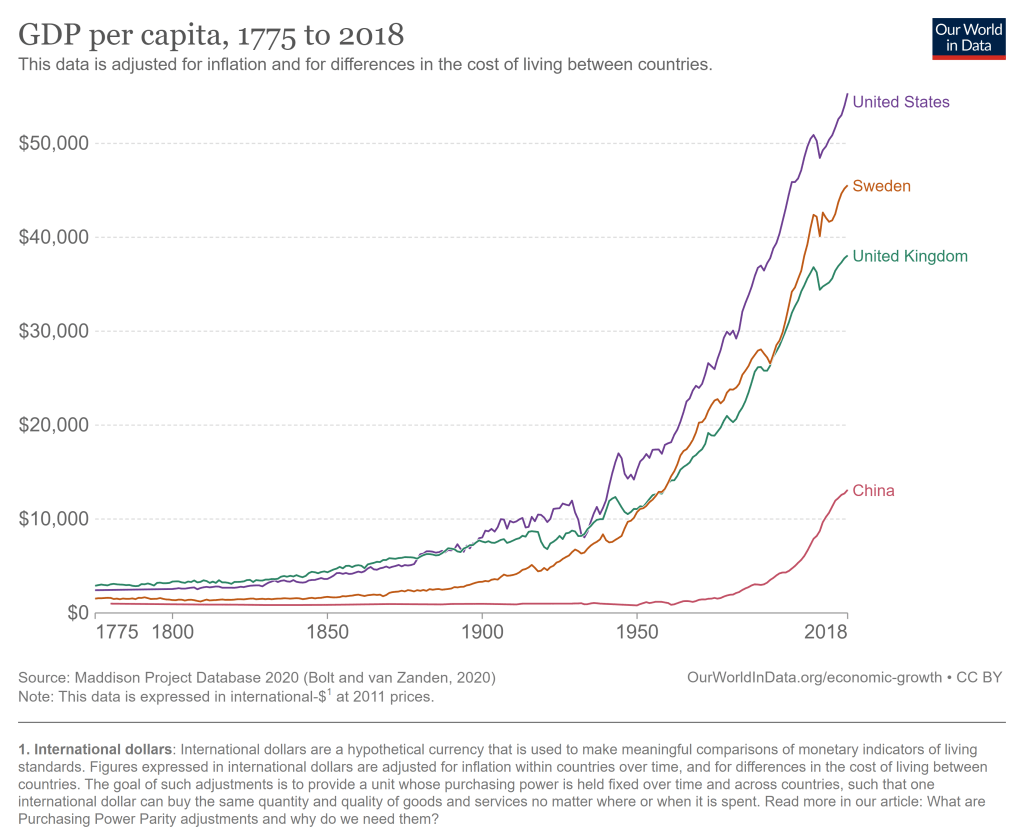
The United States has problems and always had. But the historical record of the United States as an economic powerhouse is unrivaled. The US had a bit of a head start on economic growth, being a direct descendant of the country that really kicked of the Industrial Revolution. But we took that head start and really ran with it, now being by far the highest income large country, and the highest income country that does not derive a significant part of its GDP from fossil fuels or being a tax haven.

The average American has, as best as we are able to measure it, a standard of living that is at least 20 times greater than Americans when this country began.

Source: the indispensable Our World in Data