Bespoke misinformation as solution to targeted disinformation

[Author’s note: I almost used the word “radical” in the title, but stepped back from the abyss. Being wrong is always more forgivable than being sweaty and clichéd.]

The principal objective of disinformation campaigns is to lower the value of publicly available knowledge so the purveyor’s preferred narrative can compete in the market for ideas. This is particularly attractive to authortarian regimes who have control of large media outlets. If the integrity of public information is sufficiently low, then wholesale fabrications can dominate based on reach and volume.

But what if you are a benevolent democratic regime without a state media outlet trying to compete with targeted disinformation campaigns? Your enemies have flooded the zone with so many conspiracy theories and falsehoods that your ability to steer the public discourse is significantly hindered. How do you recover control of the narratives driving elections and, in turn, policy?

The classic power solution would be to eliminate the disinformation. Constraints on production and dissemination of information, bans on outlets, criminal prosecution for promoting foreign propaganda. Standard command and control governance. But what if the genie is already out of the bottle? Maybe you can limit access to foreign-owned outlets (i.e. TikTok), but eventually everything is going to leak through via other outlets. Half of Instagram Reels is essentially TikTok on a two week delay after all. And that doesn’t solve the problem of domestic disinformation/misinformation. If disinformation has reduced the price of lying to zero, then we should expect news and campaigns to indulge whenever it serves their bottom lines, which means lies will find every crack in the media regulatory firewall, like water on concrete.

(Brief aside: maybe you don’t believe in the horseshoe theory of political politics as it relates to authoritarianism and identity, but it sure does seem to accurately describe affinities for conspiracy theories.)

If you are a benevolent democratic regime seeking to retain office for yourself or your political party, how do you communicate with a public unable to distinguish truth from opposition deception? How do you produce something with signal value when the world is being purposefully and strategically filled with so much noise?


What if you didn’t focus on communicating with the public, per se, at least in the short run? What if you gave up on communicating broadly, for a moment, and focused entirely on the subset who could independently extract signal from noise? You’d lose elections, right? There’s not enough “signal extracters” to compete with “noise voters”, are there?

This is going to sound mathy and, at first, elitist, but hear me out. Maybe there are enough signal extractors simply because noise voters cancel each other out. This is not a new theory. This is classic statistics and political economy. If we assume that noise voters are purely random in who they vote for, then the Law of Large Numbers kicks in and you essentially get an even split of noise voters across all candidates, allowing the election-within-the-election “signal extractors” to determine the final winner.

If that all sounds just a little too cute and too convenient, its because it probably is. Assuming that noise voters are randomly distributed across parties and platform is a pipe dream. At this moment in the US and abroad, authoritarians and social conservatives are far more invested in pursuing noise voters, to varying degrees of success, by serving them up bespoke misinformation at every turn. Not that we should expect this to stay constant. As we speak a Kennedy (!) is running for the Democratic nomination on what is essentially a platform of disinformation, conspiracy theories, and pure hokum.

At the end of the day, we have to increase the value of signal campaigns relative to noise. How do we do that? Education! Public service! A recommitment to civic duty! A recommitment to God! A blogging revival! Ha. You wish. Sorry, those are certainly aspirational, if not inspirational, solutions. But I think those whither and die in the face of unrepent bullshit and lies. I have a different answer.

What if the solution to disinformation is more misinformation? But first, an aside.


There is a classic story in game theory that professors still put in front of their students to this day: if you had to meet someone in New York City tomorrow, but couldn’t communicate with them, where would you go and when would you go there? When posited to New Yorkers, specifically, and East Coasters broadly, it’s amazing how many people give the same answer: the clock in Grand Central Station at noon.

This is known as a focal point (or Schelling Point). It allows for coordination without communication. Focal points show up in culture and social norms on fairly regular basis simply because they are so useful. They emerge, over time, from thousands of repeated interactions, with certain norms taking hold when they create advantages for their adherents. The seeds of these focal points are when enough people find something useful that it becomes duplicated. Like meeting a friend arriving in town at the train station.

The truth can be a natural focal point, not because it is necessarily pretty or inviting, but because it is actually there.


So, again, what if the solution to disinformation is more misinformation? Not debunking the lies and bullshit, but heaping more out the window until it covers every surface? The reason that targeted disinformation works is that it reduces the advantage of telling the truth, allowing your preferred narrative to compete. The weakness of disinformation and lies, though, is that they are nearly costless to supply. Noise voters aren’t shopping for the best answer, they’re shopping for the answer that they would prefer to be true. So give it to them! Give them exactly the answer they want. Give everyone the exact answer they want. Flood the zone to the point of total saturation.

If everyone can find their own truth, then the Law of Large Numbers can actually dominate the outcome. If everyone can be fed exactly the story they need to hear to vote for Candidate A and exactly the story they need to hear to vote for Candidate B, then their vote will be effectively a coin flip. They only votes remaining to be determined outside of our probabilistic system? The signal voters. But it gets better, because the truth has an advantage in this landscape: it’s a superior focal point. If beliefs are blades of grass in a lawn fertilized with pure and utter bullshit, the truth will look like all the others, but it will be just a little taller. As people observe signal voters collecting around it, it will grow and grow until people decide, absent communication, to meet at the tall blade of grass.


How do you create such an infinite system of bespoke false narratives for the tiniest slices of the electorate? Targeted large language models. Artificial intelligence. The exact thing that some people fear will destroy democracy and enable authoritarians everywhere. If everyone is receiving their perfect cocktail of flattering, angering, entertaining disinformation, the only people that will determine elections will be those with an abnormal resistance to bullshit. Narratives flooding the internet, produced by a million AIs at a million typewriters, will ensure that each of us will stumble upon the exact sonnet you most want to hear, telling you which aliens caused which problems, which conspiracy cost people jobs, and which reason the world is worse than when you were sixteen.

No one will be fully, purely resistant, but we, each of us, have dimensions on which we actually know what we are talking about. Our own experiences, tacit knowledge, and expertise what will dominate our decision making process and tilt the balance of our vote towards the best outcome. A lot, if not most, of us, have a signal voter within. If our lesser proclivities are nullified in the aggregate by the power of statisics and perfectly curated bullshit, then the political carnival might just leave us governed by the better angels of our nature. A curious, counter-intuitive distillate, to be sure. But maybe also a functioning, more resilient democracy.

Just don’t read the comments ever again.

Canadian Wildfires Will Burn All Summer; Ways to Filter the Air in Your Home

This past week, smoke from wildfires in Canada once again drifted southward and gave very unhealthy air in parts of the U.S.  Several sources I checked indicated that it is unrealistic to expect human effort to extinguish these fires (see here , here, and here). The Canadian forests are just too huge in relation to the fire-fighting resources. What usually happens, even during a normal fire season, is that summer fires just keep burning until they are dampened down by winter rain, snow, and cold. Most of the fire-fighting efforts are devoted to saving communities that are in the path of the flames.

Thus, we may expect periodic episodes of unhealthy air for the next several months. The most hazardous smoke particles are those less than 2.5 microns in size. Particles this small make it past your body’s defenses and penetrate deep into your lungs, promoting a number of serious medical conditions. These smoke particles are made of toxic chemicals like polycyclic aromatic hydrocarbons.

What to do to protect yourself? A first line of defense is to don an effective mask, even indoors. We all probably have Chinese KN95 or Korean KM94 masks left over from pandemic days, and (properly fitted around the nose) these should filter out most of the smoke, including the particles that are less than 2.5 microns. (I prefer the more-comfortable KM94 masks, as discussed here.)  These masks are supposedly about as effective as the more-rigid N95 masks that are the U.S. standard.

Air Filters in Your Furnace

See here for some general tips on dealing with smoke in the home, e.g. damp-mop non carpet floors rather than vacuuming, to avoid shooting settled particles into the air. However, what is really needed is some means to filter the smoke out of the air in your home, otherwise over time the air inside may be as polluted as the air outside. All furnace/central air conditioning systems have a filter in the circuit. A simple solution would be to use an air filter which can catch the smoke particles. The problem here is that the better the filter is at catching small particles, the more restrictive of air flow it is.

Most air filters are rated according to MERV values. MERV 13 filters can remove most smoke particles in a single pass. Unfortunately, most home heating/cooling systems cannot handle that much restriction in air flow; the fan motor would get overloaded and perhaps burn out. One solution here is to install a parallel air filter, with its own booster fan, using a MERV 13 filter. Here, only part of the home air circulation goes through the MERV 13 filter on each pass, but with time most of the home air gets cleaned.

Another approach is to install a MERV 11 or (if your furnace is newer) MERV 12 filter in the furnace. A MERV 11 filter might only capture around 25% of smoke particles per pass, but in the course of a day your whole house air volume should pass through the filter several times. If you have a common size air filter, you can probably get a MERV 11 that would fit on Amazon or at a local big box store. For uncommon sizes, try here.

Make Your Own High-Capacity Filter Box

In addition to working with your furnace/air conditioning filter, you can buy a compact stand-alone air purifier for your home. This Shark HP202 model will provide a continuous read-out of air quality.

For even more air-cleaning muscle, you can make a box-style air purifier by duct-taping together four MERV 13 furnace air filters (four sides of a cube), and adding a box fan on top. Instructions (including YouTube links) for doing this are here, with further details here. These diagrams give the general picture:

An example of a finished product is below; note the red tape covering the outer part of the fan outlet. Blocking that outer area, giving a smaller diameter opening for the air to blow out, increases the net air flow significantly. (It prevents back-eddies of air around the edges).

 It turns out that the air flow through one of these home-made air filters is so high that, even though the per-pass capture efficiency is lower than a HEPA filter, the home-made filter box can remove more particulates from a room than a store-bought HEPA filter.

I have made two of these filter boxes so far, using premium and regular filters. They have worked quite well in clearing the smoke from our rooms: the benefit is well worth the cost of parts and labor. See here for more on my experiences and construction tips.

Some on-line resources:

Accuweather  seems to have straightforward reporting of air quality, including specifically the less than 2.5 micron particles. (Search on your location, then find Air Quality and click Details).

NOAA provides a real time satellite map of smoke patterns (click on “Surface Smoke”), but don’t rely on their color coding to decide whether your local condition is orange or red.

This web site from Natural Resources Canada shows locations of current wildfires in Canada. See Overlays for the meaning of the symbols; red denotes fires that are out of control. You can click Fire Perimeter Estimate to see the enormous extents of some of these fires.

The Part I Remember from Eat, Pray, Love

Elizabeth Gilbert of Eat, Pray, Love delivered an insight, second-hand from “Deborah the psychologist”.

I remember a story my friend Deborah the psychologist told me once. Back in the 1980s, she was asked by the city of Philadelphia if she could volunteer to offer psychological counseling to a group of Cambodian refugees—boat people—who had recently arrived in the city. Deborah is an exceptional psychologist, but she was terribly daunted by this task. These Cambodians suffered the worst of what humans can inflict on each other—genocide, rape, torture, starvation, the murder of their relatives before their eyes, then long years in refugee camps and dangerous boat trips to the West where people died and corpses were fed to sharks—what could Deborah offer these people in terms of help? How could she possibly relate to their suffering?

“But don’t you know,“ Deborah reported to me, “what all these people wanted to talk about, once they could see a counselor?“

It was all: I met this guy when I was living in the refugee camp, and we fell in love. I thought he really loved me, but then we were separated on different boats, and he took up with my cousin. Now he’s married to her, but he says he really loves me, and he keeps calling me, and I know I should tell him to go away, but I still love him and I can’t stop thinking about him. And I don’t know what to do…

This is what we are like.

Continue reading

Competition and Racial Exclusion

There is a narrative about US history that goes like this: “Historical racism was really bad and limited opportunities for blacks. Blacks were not allowed to participate in a set of occupations and other civic life. The absence of blacks from typically higher income occupations reduced the number of competitors in those sectors. Not only did blacks have fewereconomic opportunities, the whites who were insulated from competition earned monopoly rents. Therefore, if blacks were excluded, the whites who were in exclusive sectors earned profits at the expense of blacks.”

The logic is neat. Are there any holes in it?Let’s see.

Continue reading

Replicating Research with Restricted Data

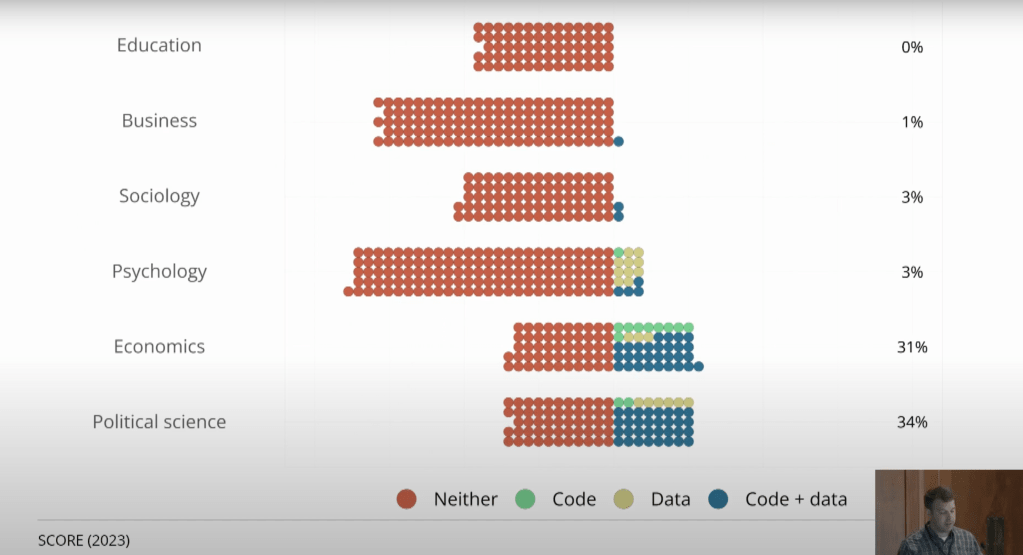
If a scientific finding is really true and important, we should be able to reproduce it- different researchers can investigate and confirm it, rather than just taking one researcher at their word.

Economics has not traditionally been very good at this, but we’re moving in the right direction. It is becoming increasingly common for researchers to voluntarily post their data and code, as well as for journals (like the AEA journals) to require them to:

Source: This talk by Tim Errington

This has certainly been the trend with my own research; if you look at my first 10 papers (all published prior to 2018) I don’t currently share data for any of them, though I hope to go back and add it some day. But of my most recent 10 empirical papers, half share data.

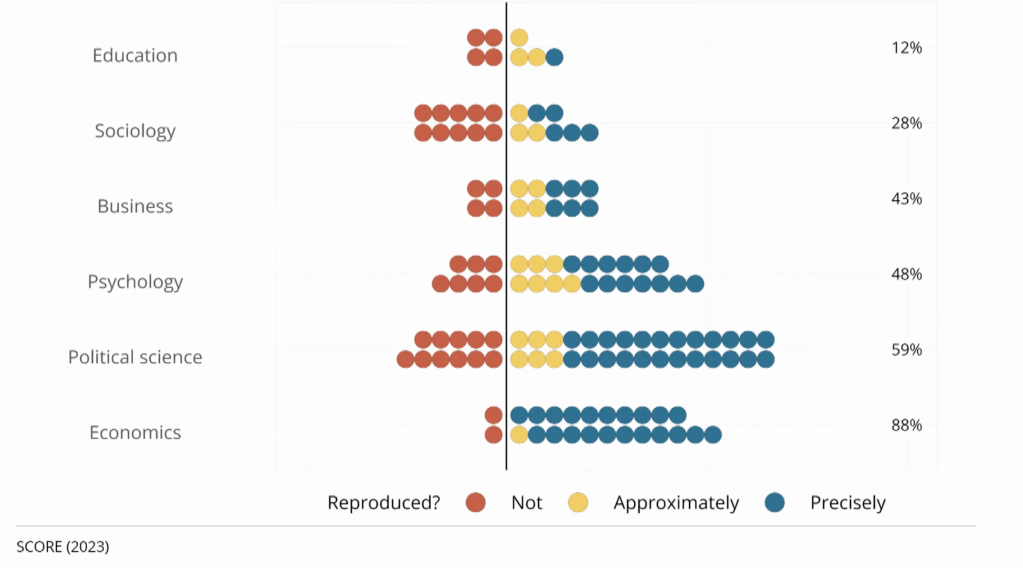
This sharing allows other researchers to easily go back and check that the work is accurate. This could mean simply checking that it is “reproducable”, i.e., that running the original code on the original data produces the results that the authors said. Or it could mean the more ambitious “replicability”, i.e., you could tackle the same question with different data and still find basically the same answer. Economics does generally does well at reproducability when code is shared, but just ok at replication.

Of course, even when data and code are shared, you still need people to actually do the double-checking research; this is still relatively rare because it is harder to publish replications than original research. But more replication journals are opening, and there are now several projects funding replications. The trends are all in the right direction to establish real, robust findings, with one exception- the rise of restricted data.

Traditionally most economics research has been done using publicly available datasets like the Current Population Survey. But an increasing proportion, perhaps a majority of research at top journals, is now done using restricted datasets (there’s a great graph on this I can’t find but see section 3.3 here). These datasets legally can’t be shared publicly, either due to privacy concerns,licensing agreements, or both. But journals almost always still publish these articles and give them an exemption to the data sharing requirement. One the one hand it makes sense not to ignore this potentially valuable research when there are solid legal reasons the data can’t be shared. But it does mean we can’t be as confident that the data has been analyzed correctly, or that it even really exists.

One potential solution is to find people who have access to the same restricted dataset and have them do a replication study. This is what the Institute for Replication just started doing. They posted a list of 100+ papers that use restricted data that they would like to replicate. They are offering $5000 for replications of most of the papers, so I think it is worthwhile for academics to look and see if you already have access to relevant datasets, or if you study similar enough things that it is worth jumping through the hoops to get data access.

For everyone else, this is just one more reason not put too much trust in any one paper you read now, but to recognize that the field as a whole is getting better and more trustworthy over time. We will be more likely to catch the mistakes, purge the frauds, and put forward more robust results that at least bear a passing resemblance to what science can and should be.

The Cost of Raising a Child, Revisited

Last week my post was about a new article I have with Scott Winship on the “cost of thriving” today versus 1985. That paper has gotten quite a bit of coverage, including in the Wall Street Journal, which is great but also means you are going to get some pushback. Much of it comes in the form of “it just doesn’t feel like the numbers are right” (see Alex Tabarrok on this point), and that was the conclusion to the WSJ piece too.

Here’s a response of that nature from Mish Talk: “There’s no way a single person is better off today, especially a single parent with two kids based on child tax credits that will not come close to meeting daycare needs.”

He mentions daycare costs, but never comes back to it in the post (it’s mostly about housing costs). Daycare costs are undoubtedly an important cost for families with young children (though since Cass’ COTI is about married couples with one earner, they may not be as relevant). And in the CPI-U, daycare and preschool costs only getting a weight of 0.5%. Surely that’s not reality for the families that actually do pay daycare costs! If only there was an index that applied to the costs of raising children.

In fact, there already is. Since 1960, the USDA has been keeping track of the cost of raising a child. Daycare costs are definitely given much more weight: 16% of the expenditures on children got to child care and education. And much of that USDA index (recently updated by Brookings) looks similar to what COTI includes: housing, food, transportation, health care, education, but also clothing and daycare. I wrote about it in a post last year and compared that cost to various measures of income (including single-earner families and median weekly earnings). But what if we compared it to Oren Cass’ preferred measure of income, males 25 and older working full-time? Here’s the chart.

Continue reading

My $109 Raspberry Plant: Growing “Raspberry Shortcake” in a Container

One of Warren Buffet’s most famous quotes (channeling the venerable Benjamin Graham) is: “Price is what you pay; value is what you get.”  He thus rationalizes buying top-quality companies or stocks, even if their price is not beaten down. So, allow me to explain why I put over $100 into a single, not-very-large raspberry plant.

In various earlier homes I have lived in, I have grown raspberries. To my way of thinking, this is an ideal crop for a home gardener. You can get maybe five bare-root dormant plants from a gardening supply house like Burpee in the early spring, plant them in the ground, and by that fall have a crop of sweet, flavorful berries you can eat right off the bush. And then you have a perennial bed that will fill in with even more canes each year. The “everbearing” (“fall-bearing” or primocane) varieties like Heritage or Caroline can produce from June through early October, depending on your climate zone. Not many pests attack raspberries, and the only maintenance needed is pruning, fertilizing, and watering during droughts. They do need nearly full sun, and well-drained soil.

I now live in a townhouse, However, I did want to grow raspberries, partly for the fun of growing my own food, partly out of nostalgia, and partly to give my grandson the experience of picking food from a plant instead of from a grocery store shelf.

The townhouse I live in now only gets nearly-full sunlight at one corner of the house. There is no appropriate garden bed there, so I need to use a container. Raspberries normally grow 3-4 feet tall, with roots that go down maybe two feet. I did not really have the space for a two-foot high/two-foot diameter container, and such a large container would be hard to move around. So last year I tried to grow a regular raspberry (Glencoe variety) in maybe a 14-inch x 14-inch pot. It was a total fail. The root space was just too small for this large a plant, I think.

So this year I regrouped, dug deep in my wallet, and bought a special dwarf raspberry called “Raspberry Shortcake.” This variety is bred to grow in small spaces. This plant is mostly supplied in a #1 size pot (nominally 1 quart, but actually smaller). I was impatient and wanted a larger plant that would bear fruit this year, so I spent more and bought a larger (# 2 pot) plant from Plant Addicts. It arrived in late April, and I transplanted it to a 16” x 16” (40 cm x 40 cm) plastic pot from Better Homes and Gardens. This pot is white, which I hope will reflect some of the sun’s heat during the summer.

This is a summer-bearing (floricane) raspberry, so it will only bear fruit for a few weeks in June-July. However, there is a new Asian fly pest spreading in the U.S. that attacks raspberries later in the season, so it may be best to avoid the fall-bearing varieties now anyway.

The plant had been pruned back to several slender, woody stems about ten inches high. Each of these stems has since put out several side shoots, most of which have now borne clusters of berries at their tips. I have enjoyed several dozen berries, and they are still coming. Also, I have had the pleasure of seeing my grandson pick and eat berries off the bush. I am a satisfied customer. Photos:

And close-up on the berries:

This plant cost me $72 ($57 plus $15 shipping). We got lucky with the pot, paying only about $22, when you can easily pay twice that for this sized pot. Potting soil was another $15. So about $109 all-in.

Obviously, I could have bought many little cartons of raspberries in the store instead for $109. I paid a high price for my plant, but got a value that I am satisfied with.

POSTSCRIPT: Just for completeness, to inform other would-be buyers of this plant – – it’s berry production peaked in mid-June here in U.S. growing zone 7a. It continued to produce a few berries a day till the end of the month. Since about July 1, it still produces perhaps an average of one berry a day, with 6-7 visible on the bush at any one time, but they are not ripening properly. Sometimes they just fall off before they are ripe, but most often they ripen very unevenly: some of the little “drupes” turn dark red (and then sometimes fall off) while the rest are still whitish. This may be a reaction to the heat, it is sunny and has hit 90 degrees F nearly every day, so the soil around the roots in the pot is way hotter than it would be for an in-ground planting . Anyway, none of this takes away from the satisfactory performance in June.

Post-PostScript: After watering the plant more frequently to let it transpire like crazy in the heat, and also after I loosely wrapped a 14-inch high strip of aluminum flashing around the pot to deflect some of the sun’s rays, the berries seem to be ripening better…getting 1-2 berries a day, though July 15, though they really are petering out now.

Begging for legislation is the last refuge of the dying cartel

While the FTC is trying to break up a monopoly that, in my current but open to revision opinion, isn’t a monopoly, the most efficiently labor-extractive cartel in US history is literally sitting inside the Capitol begging Congress to give them back their (near) zero wage labor.

I’m not going to make the case against Lina Khan’s FTC lawsuit against Amazon (and by all accounts I’ve come across, it is very much her lawsuit). I’ll leave that to people who know a lot more about monopoly and antitrust than me. What I would like to humbly suggest, however, is that there is something kafkaesque about dedicating significant resources and political capital to pursue a case that is at least not unreasonable to say is wrong-headed while an obvious cartel that spent decades enforcing a zero-wage policy on labor in physically dangerous occupations is at this very moment actively lobbying for legislation to create a legal firewall ensuring that billions of dollars never suffer the ignomius fate of falling into the hands of their employees.

Yes, I know, I just wrote the same paragraph twice, but it’s just that flabbergasting, a “too-on-the-nose” political cartoon come to life. I’m not even sure that else to write.

I could talk about the pure powers of rationalization and cognitive dissonance. Nothing will lead to a more clear-eyed, full-hearted, open-throated defense of the purity of amateur sports and the inevitable destructive powers of wages than the $1.14 billion cut in rents the NCAA receives each year. And that’s just the NCAA, the governing body that oversees the cartel. The chief participants earned $3.3 billion in revenue from sports. You don’t have to be a sociopath sincerely spouting bald-faced lies with those kinds of incentives. The human capacity for narrative internalization and rationalization will do the trick for you, no sweat.

I could delve into classic the capture theory of regulation, how monopolies and cartels are often the only people sufficiently informed and motivated on niche issues to tilt the balance of democratic forces in their favor. I could reference the classic prisoner’s dilemma/collective action problems that plague even the most successful cartels. The network-structure of competitive sports leagues allowed the NCAA to successfully monitor and enforce the rules of their cartel (no compensation for players other than in-kind tuition, room, and board), but even such a successful cartel was still on borrowed time against the incentives facing top programs combined with the march of innovation and the rival collective of players.

No, what disappoints me is our regulatory institutions ignoring low-hanging fruit. I get it, political appointees are political animals, as well as just standard humans trying to make a secure living. Any FTC chair that sues Amazon, successful or not, will never want for law school appointments for the rest of their career. More than 70% of US adults are in households subscribed to Amazon Prime, which is affects a lot of voters and will lead to a lot of thinkpieces. For a $139 a year they get a bundle of goods and services, including the rough equivalent of Netflix. Is that too high? Is exit from the service too costly? Even if the answer is yes, what is the preferred outcome? A $7 lower price? Three-clicks fewer to unsubscribe? Even spread across the entirety of the US adult population, the costs seem fairly trivial, and added up in aggregate that’s not that much either. If it’s suppression of competition, well that’s a far tougher argument to win, which is why they aren’t making it.

The NCAA, on the other hand, has extracted a) enormous rents, likely > 50% of the marginal product of labor, b) from employees in physically dangerous and demanding jobs, many of whom c) are engaged in the task for which they have the peak marginal revenue product of their entire career. That last part is often under-appreciated. Very few of us, myself included, will ever have a marginal revenue product from our labor that compares to a starter on a Division I sports team that is regularly televised. They’re literally being denied earnings in what should be the highest 1 to 4 years of their career earning power. Maybe that doesn’t add up to as much in the aggregate of shaving $7 off of Amazon Prime, but the the number of households for whom Prime fees are salient to the trajectories of their lives is absolutely trivial compared to the NCAA cartel.

One of the big questions in governance is what do we want out of our regulatory agencies? A not unreasonable school of thought is to say we want a counterbalance to scale. Government forces with enough heft that they can bring the mightiest companies to heel. A reasonable person might say we want to maximize welfare, which could mean targeting cartels and monopolies of any size, looking strictly at the bottom line for consumers. A third might say the world is noisy and constantly changing. Cases are confusing and take years to adjudicate. What we should pursue are the most obvious transgressions, where we can operate with a high degree of confidence that government action will lead to better outcomes in contexts that matter.

If you count yourself in that third camp, as I do, then let me suggest there is no easier antitrust case to make than when a multi-billion dollar entity comes to you hat in hand begging for an antitrust exemption. Legal rhetoric and economic evidence are great, but nothing beats an old-fashioned confession.

Practical Sewing, Washing, and Drying Tips

I don’t agree with Elizabeth L. Cline on everything, but she’s written a reasonable book for Americans today. The Conscious Closet has some good advice for everyone.

A decade ago, Cline wrote Overdressed: The Shockingly High Cost of Cheap Fashion which investigated the environmental toll of clothes and the labor controversies. Since then, she has been working on what consumers can do differently.

Not every American household has practical knowledge of laundry and sewing anymore. Cline offers suggestions on how to economically maintain clothes longer by making sensible home repairs or washing them less. (Don’t wash a pair of jeans after just one wear. I don’t.) The Conscious Closet came out in 2019, so it’s up-to-date concerning chemicals and certifications and websites that operate today.

The way we wash and dry our clothes uses a lot of water and energy. If a person was looking for a way to lower their environmental footprint, then a marginal reduction of laundry loads might be a relatively easy way to do it. Since almost every American has an electric dryer, we have lost the tacit knowledge of how to air dry clothes. She gives the practical reminder, for example, that dark color clothes will fade if exposed to extended sunlight.

I feel like Cline could be even more conscious about the opportunity cost of time. She does explicitly acknowledge that in her chapter about re-selling your unwanted clothes.

Chapman University Economic Forecast Update 2023

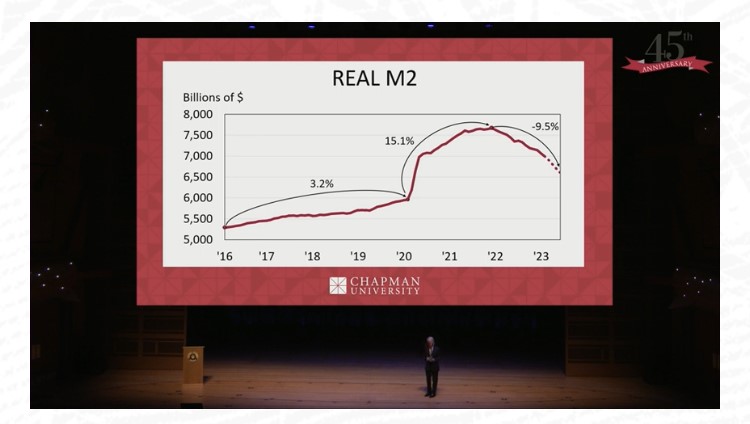
I watched the Chapman Economic Forecast Update for 2023 live on June 22 (you can watch the whole thing free here). Go to their website for free videos and links. They have an excellent track record for being correct.

This time, Dr. Jim Doti believes we are headed for a recession by the third quarter of 2023 or at least what he conservatively calls a “slowdown”. He hates to make dramatic predictions or deliver bad news, but he saw the inflation brewing back in 2021, and I remember him correctly predicting what was to come.

For one thing, the dramatic growth in the money supply at the beginning of the pandemic has been corrected into a sharp contraction of the money supply.

People have been joking about how the recession isn’t happening.

We’ll see who’s laughing in 2024.

The middle segment of the forecast, which I recommend watching, is about investing. Fadel Lawandy cautions that stocks are not a good bet right now, with a likely recession looming.

The third segment is focused on the economy of California. I didn’t finish that part, since I don’t live there anymore.