The Greatest NBA Coach Is… Dan Issel?

Some economists love to write about sports because they love sports. Others love to write about sports because the data are so good compared to most other facets of the economy. What other industry constantly releases film of workers doing their jobs, and compiles and shares exhaustive statistics about worker performance?

This lets us fill the pages of the Journal of Sports Economics with articles on players’ performance and pay, and articles evaluating strategies that sometimes influence how sports are played in turn. But coaches always struck me as harder to evaluate than players or strategies. With players, the eye test often succeeds.

To take an extreme example, suppose an average high-school athlete got thrown into a professional football or basketball game; a fan asked to evaluate them could probably figure out that they don’t belong there within minutes, or perhaps even just by glancing at them and seeing they are severely undersized. But what if an average high school coach were called up to coach at the professional level? How long would it take for a casual observer to realize they don’t belong? You might be able to observe them mismanaging games within a few weeks, but people criticize professional coaches for this all the time too; I think you couldn’t be sure until you see their record after a season or two. Even then it is much less certain than for a player- was their bad record due to their coaching, or were they just handed a bad roster to work with?

The sports economics literature seems to confirm my intuition that coaches are difficult to evaluate. This is especially true in football, where teams generally play fewer than 20 games in a season; a general rule of thumb in statistics is that you need at least 20 to 25 observations for statistical tests to start to work. This accords with general practice in the NFL, where it is considered poor form to fire a coach without giving him at least one full season. One recent article evaluating NFL coaches only tries to evaluate those with at least 3 seasons. If the article is to be believed, it wasn’t until 2020 that anyone published a statistical evaluation of NFL defensive coordinators, despite this being considered a vital position that is often paid over a million dollars a year:

Continue reading

Where Can You Still Buy an Affordable Home in the US?

A few months ago I looked at the richest and poorest MSAs in the US, including adjusting for the cost of living in each MSA. One big thing I found was that the list doesn’t change that much when you adjust for the cost of living: San Jose, San Francisco, Bridgeport (CT), Boston, and Seattle are still the highest income MSAs even after accounting for the fact that they are also high-cost-of-living places to live. The gap shrinks, but they are still in the lead.

But that was adjusting for all the factors in the cost of living. But what if we just looked at one important aspect of the cost of living: housing. And since the cost-of-living adjustments (BEA’s RPP) that I was using are from 2021, what if we tried to bring the data up as close to the present as possible? We know that housing prices have increased a lot since 2021, but also that the cost of borrowing has risen dramatically too. What would this show us about the cost of living for different MSAs?

A tool from the Harvard Joint Center for Housing Studies allows us to make some pretty up-to-date comparisons. Their interactive map shows data for the 179 largest MSAs (about half of the total MSAs in the US) on the median price of each home for the second quarter of 2023 and uses interest rates from that quarter to show the rough principal and interest cost (assuming a 3.5% down payment). Taxes and insurance costs for each MSA are also estimated.

Based on those assumptions, their tool provides the minimum income you would need to purchase a home in that area, assuming a 31% debt-to-income ratio for the mortgage. And the income levels needed vary quite widely across MSAs, from a low of $44,000 in Cumberland, Maryland, to a high of over $500,000 in San Jose, CA. That’s a huge difference.

Of course, we know that incomes also vary across MSAs. But they don’t vary that much. The JCHS tool doesn’t provide this data (though a JCHS map from 2017 did compare house prices to incomes), but we can look up median family income for each MSA from Census. Doing so we see that San Jose is indeed unaffordable based on the current (2022) median income, which is “only” about $170,000. A nice income compared to the national median, but only about 1/3 of the $500,000 you would need to afford a home in San Jose. Cumberland looks much better though: median family income is over $77,000 there, about 76% more than you would need to buy a home!

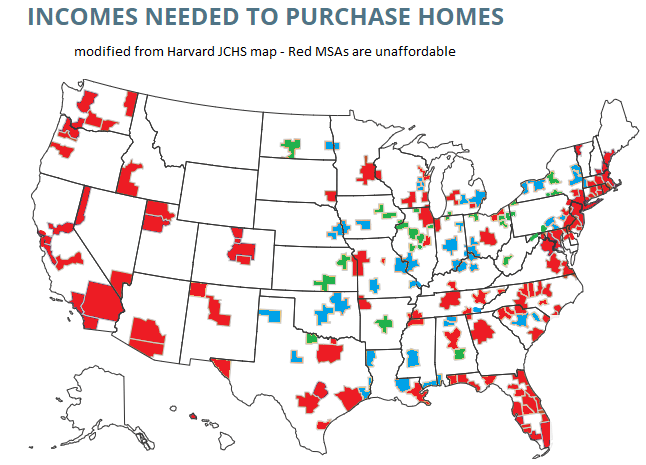
What if we did a similar calculation for all MSAs in the JCHS data? The following map is my attempt to do so. Sorry, but my graphics skills are not the best, so this map isn’t as pretty as it could be (I started with the JCHS map, and just shaded in the colors I wanted to use). But I think it conveys the general idea.

Green-shaded MSAs are the most affordable: places like Cumberland, Maryland, where median family income is well above (at least 20% above, my arbitrary threshold) the amount JCHS says you need to buy a home. There are 27 Green-shaded MSAs. Blue-shaded MSAs are affordable too, and median income is between 100% and 120% of the amount needed to afford a home on the JCHS standard. There are 41 of these, making 68 total MSAs out of these 179 that are affordable. Red-shaded MSAs are less than 100%, and thus unaffordable (though as I will discuss below, some are much closer to affordable than others).

Continue reading

Charlie Munger’s Rule for a Happy Life

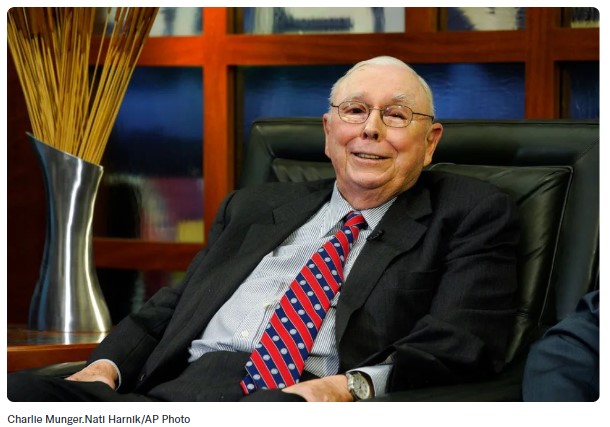
A big piece of news in the investment world has been the passing of Charlie Munger on Nov 28 at age 99. He was vice chair of Berkshire Hathaway, and Warren Buffett’s right-hand man there.

Munger grew up in Omaha, Nebraska, which is Warren Buffett’s hometown as well. They met at a dinner party there in 1959, and hit it off with one another personally.  Munger was a really smart guy. After joining the US Army Air Corps in1943, he scored highly on an intelligence test and was sent to study meteorology at Caltech. After the war he was accepted into Harvard Law School despite lacking a formal undergraduate degree, and graduated summa cum laude.

In his 50s, Munger lost his left eye after cataract surgery failed. A doctor warned he could lose his right eye too, so he began learning braille, but the condition improved.

He entered law practice, and eventually started his own firm, but he became more interested in investing. He racked up 19.8% annual returns investing on his own, between 1962 and 1975. Buffett convince Munger to give up law and join him as vice-chairman of Berkshire Hathaway in 1978.

Perhaps Buffett’s most famous investing saying is “It’s far better to buy a wonderful company at a fair price than a fair company at a wonderful price”. He credits this approach to Munger: “Charlie understood this early – I was a slow learner.”  Before being influenced here by Munger, Buffett had been more inclined to buy very low-priced shares in mediocre companies.  

Munger was heavily involved with Buffett’s decisions. “Berkshire Hathaway could not have been built to its present status without Charlie’s inspiration, wisdom and participation,” Buffett said following Munger’s death. That tribute is no overstatement: from the time Munger joined Berkshire Hathaway in 1978 till now, shares of the company soared 396,182% (i.e.,  $100 invested in Berkshire Hathaway in 1978 is worth $396,282 today). This performance dwarfs the 16,427% appreciation of the S&P 500 over the same time period. When he died, Munger was personally worth $2.6 billion.

(See more on Berkshire Hathaway’s formula for success at: Warren Buffett’s Secret Sauce: Investing the Insurance “Float” )

Quotations From Vice-Chairman Charlie

The internet is rife with sites displaying memorable or useful quotes from Charlie Munger. For example, “I never allow myself to have an opinion on anything that I don’t know the other side’s argument better than they do”;   and three rules for a career: “1) Don’t sell anything [to others] you wouldn’t buy yourself; 2) Don’t work for anyone you don’t respect and admire; and 3) Work only with people you enjoy.”

Some of these quote lists focus on sayings which provide guidance to individual investors, such as this from CNBC:

“I think you would understand any presentation using the word EBITDA, if every time you saw that word you just substituted the phrase,  ‘bull—- earnings.’ ″

The 2003 Berkshire shareholder meeting was one of the many occasions Munger called out what he saw as shady accounting practices, in this case EBITDA — a measure of corporate profitability short for earnings before interest, taxes, depreciation and amortization.

In short, Munger felt that companies often highlighted convoluted profitability metrics to obscure the fact that they were severely indebted or producing very little cash.

“There are two kinds of businesses: The first earns 12%, and you can take it out at the end of the year. The second earns 12%, but all the excess cash must be reinvested — there’s never any cash,” Munger said at the same meeting. “It reminds me of the guy who looks at all of his equipment and says, ‘There’s all of my profit.’ We hate that kind of business.”

To invest like Munger and Buffett, don’t fall for the flashiest numbers in the firms’ investor presentations. Instead, dig into a company’s fundamentals in their totality. The more a company or an investment advisor tries to win you over with esoteric terms, the more skeptical you should likely be.

As Buffett put it in his 2008 letter to shareholders: “Beware of geeks bearing formulas.”

Munger’s Secret to Happiness

Out of all these witty and helpful quotes, I’ll conclude by zeroing in on what Charlie Munger thought was the single most important factor in achieving personal happiness. He said it a number of different ways:

The secret to happiness is to lower your expectations. …that is what you compare your experience with. If your expectations and standards are very high and only allow yourself to be happy when things are exquisite, you’ll never be happy and grateful. There will always be some flaw. But compare your experience with lower expectations, especially something not as good, and you’ll find much in your experience of the world to love, cherish and enjoy, every single moment.

and

The world is not going to give you extra return just because you want it. You have to be very shrewd and hard working to get a little extra. It’s so much easier to reduce your wants. There are a lot of smart people and a lot of them cheat, so it’s not easy to win.

and finally:

A happy life is very simple. The first rule of a happy life is low expectations. That’s one you can easily arrange. And if you have unrealistic expectations, you’re going to be miserable all your life. I was good at having low expectations and that helped me. And also, when you [experience] reversals, if you just suck it in and cope, that helps if you don’t just stew yourself into a lot of misery.

Why I think we’ve hit peak pessimism

The key to successful public forecasting is to choose a subject that is too costly for your critics to formally measure. In keeping with such a spirit of low risk public posturing, I am hereby calling it: peak pessimism is now behind us. Which is not to say that people think things are fine, but rather that the gap between how things actually are (pretty good!) and how people think they are (kinda bad) is much smaller than the gap was six months ago (historically bad, even though they were pretty good then too!). The gloom of sunny days benighted by the goth-tinted glasses of an anxiety-serving media amplified by the terminally online is finally breaking.

For me, the real bellweather was the general non-response to a NYT article and Siena poll that said Biden was likely to lose to Trump head-to-head next November. Six months ago this would have received breathless coverage, with non-stop amplification on social media. What I observed instead was a lot of hand-waving and dismissal of an attempt for political panic clickbait.

So what’s my reasoning? In a nutshell, rational pessimism.

I’m a big believer in ecological rationality i.e. a lot of our seemingly irrational biases are actually relatively optimal behaviors when viewed in the long term for individual survival or cultural/group selection. Pessimism is an expressed preference for fewer negative surprises. From a households perspective, being surprised by a negative shock is far more dangerous to economic survival than being surprised by or even missing out on positive shocks. Choosing to rent intstead of buying a house in 2000 was, in hindsight, problematic, but not nearly so dangerous to your economic survival as buying a house in December of 2007. Not to get too Lamarckian on you, but it’s not crazy to say that the pandemic was such a (Knightian/Black Swan) shock to a lot of people that they updated their entire model of the economy to include the possibility of an entirely new kind of negative economic shock and, as a result, their new strategy is far more pessimistic. They very badly don’t want to be surprised again.

But that doesn’t mean they are done updating. At some point the good news is just too good to ignore. Employment is too good, wages are too good. New vaccines are too good. Climate data is…well that’s still pretty bad, but hey look, solar is happening! Good news, however, is an erosive force running against a freshly built wall of pessimism designed for the express purpose of protecting a household from the next negative shock. We shouldn’t be surprised if it takes a lot of good news a long time to break it down.

But it will break down. I’m not saying when it will break down, but the cracks are finally starting to show. Pessimism may be ecologically rational, but optimism always has an irresistible allure for those who don’t want to miss out. We’re starting to get the good news because people are starting to want it, even if only just a little bit. And media customers always get what they want.*


* Which is not to say that Fox News and similar outlets won’t remain consistently negative. Political and age-demographic demands for “everything is going to hell” aren’t going to change any time soon. They will also keep getting what they want.

Joy’s Fashion Globalization Article with Cato

I am published by Cato this week:

Fast Fashion, Global Trade, and Sustainable Abundance

This is part of a 10-part series called “Defending Globalization: Society and Culture

Imagine trying to explain the world today to a person who time traveled forward from 300 years ago. How could someone who lived in France in the year 1600 understand our modern problems?

Person from the Past: So, how is it with 8 billion people?

Me Today: It’s bad. We have too many clothes.

PftP: Right. With 8 billion you wouldn’t have enough clothes for everyone.

MT: Too many.

PftP: Not enough?

MT: I said we have TOO MANY clothes. Not even the poorest people in the world want them. Shirts pile up on the beaches and pollute the ocean.

PftP: …

My article highlights the fact that we live in an era of unprecedented clothing abundance. First, that was not always true.

Most of human history has been characterized by privation and low‐​productivity toil. As one American sharecropper exclaimed in John Steinbeck’s Depression‐​era novel The Grapes of Wrath, “We got no clothes, torn an’ ragged. If all the neighbors weren’t the same, we’d be ashamed to go to meeting.”

https://www.cato.org/publications/globalization-fashion

Secondly, not everyone is celebrating.

The United Nations Economic Commission for Europe called the fashion industry an “environmental and social emergency” because clothing production has roughly doubled since the year 2000. Their main concerns are fast fashion’s environmental impact and working conditions. 

Some of my article is a response to the critics of modern low-cost mass production.

Thirdly, I explain how we could keep most of the benefits of cheap clothes with less litter in the environment. The item I am most optimistic about is using our new artificial intelligence tools to re-sort the world’s junk. We would produce and throw away fewer clothes if we had a better system for rearranging the stock of goods that we already have. The problem I see today is that I have “perfectly good” clothes in my house that I don’t really want; however, attention and time are so scarce that no one will pay me for them. Even if I donate them, I worry that half will end up in the trash. Someone on this earth could use them but identifying that someone and making the trade still has high prohibitively high transaction costs. Very smart AI could come to my house and scan my stuff and pay me for it because very smart AI could get it to someone with a positive value for it.

If you’d like to see a trail of blogs that I wrote while in the research phase for this article, use https://economistwritingeveryday.com/?s=fashion

Lastly, we thank Tyler for the Marginal Revolution link.

House Rich, House Richer

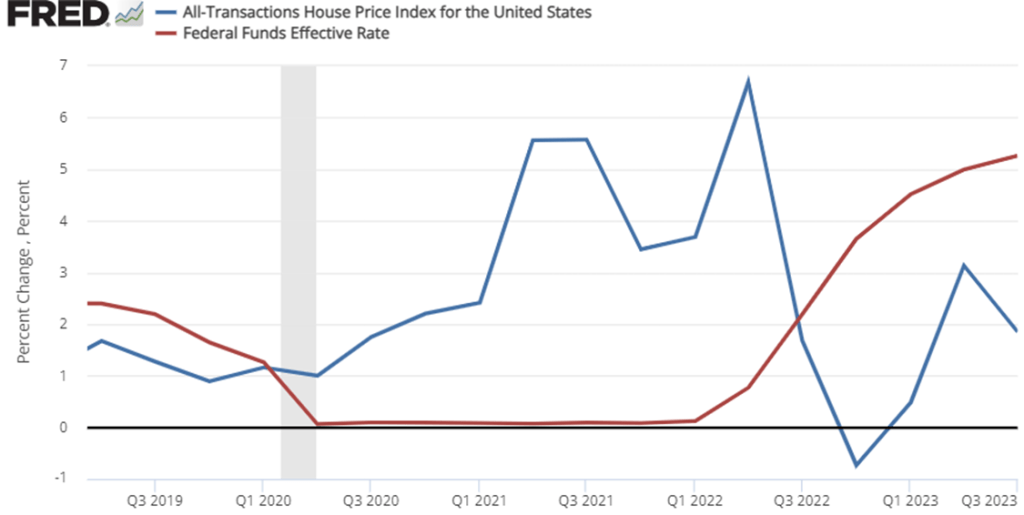
The third quarter ‘All Transaction’ housing price data was just released this week. These numbers are interesting for a few of reasons. One reason is that home prices are a big component of our cost of living. Higher home prices are relevant to housing affordability. This week’s release is especially interesting because it’s starting to look like the Fed might be pausing its year 18-month streak of interest rates hikes. In case you don’t know, higher interest rates increase the cost of borrowing and decrease the price that buyers are willing to pay for a home. Nationally, we only had one quarter of falling home prices in late 2022, but the recent national growth rate in home prices is much slower than it was in 2021 through mid-2022.

Do you remember when there were a bunch of stories about remote workers and early retirees fleeing urban centers in the wake of Covid? We stopped hearing that story so much once interest rates started rising. The inflection point in the data was in Q2 of 2022. After that, price growth started slowing with the national average home price up 6.5%. But the national average masks some geographic diversity.  

Continue reading

OpenAI, IZA, and The Limits of Formal Power

Companies and non-profit organizations tend to be managed day-to-day by a CEO, but are officially run by a board with the legal power to replace the CEO and make all manner of changes to the company. But last week saw two striking demonstrations that corporate boards’ actual power can be much weaker than it is on paper.

The big headlines, as well as our coverage, focused on the bizarre episode where OpenAI, the one of the hottest companies (technically, non-profits) of the year, fired their CEO Sam Altman. They said it was because he was not “consistently candid with the board”, but refused to elaborate on what they meant by this; they said a few things it was not but still not what really motivated them.

Technically it is their call and they don’t have to convince anyone else, but in practice their workers and other partners can all walk away if they dislike the board’s decisions enough, leaving the board in charge of an empty shell. This was starting to happen, with the vast majority of workers threatening to walk out if the board didn’t reverse their decision, and their partner Microsoft ready to poach Sam Altman and anyone else who left.

After burning through two interim CEOs who lasted two days each, the board brought back ousted CEO Sam Altman. Formally, the big change was board member Ilya Sutskever switching sides, but the blowback was enough to get several board members to resign and agree to being replaced by new members more favored by the workers (including, oddly, economist Larry Summers).

A similar story played out at IZA last week, though it mostly went under the radar outside of economics circles. IZA (aka the Institute for Labor Economics) is a German non-profit that runs the world’s largest organization of labor economists. While they have a few dozen direct employees, what makes them stand out is their network of affiliated researchers around the world, which I had hoped to join someday:

Our global research network ist the largest in labor economics. It consists of more than 2,000 experienced Research Fellows und young Research Affiliates from more than 450 research institutions in the field.

But as with OpenAI, the IZA board decided to get rid of their well-liked CEO. Here at least some of their reasons were clear: they lost their major funding source and so decided to merge IZA with another German research institute, briq. Their big misstep was choosing for the combined entity to be run by the the much-disliked head of the smaller, newer merger partner briq (Armin Falk), instead of the well-liked head of the larger partner IZA (Simon Jaeger). Like with OpenAI, hundreds of members of the organization (though in this case external affiliates not employees, and not a majority) threatened to quit if the board went through with their decision. Like with OpenAI, this informal power won out as Armin Falk backed off of his plan to become IZA CEO.

Each story has many important details I won’t go into, and many potential lessons. But I see three common lessons between them. First is the limits to formal power; the board rules the company, but a company is nothing without its people, and they can leave if they dislike the board enough. Second, and following directly from this, is that having a good board is important. Finally, workers can organize very rapidly in the internet age. At OpenAI nearly all its employees signed onto the resignation threat within two days, because the organizers could simply email everyone a Google Doc with the letter. Organizers of the IZA letter were able to get hundreds of affiliates to sign on the same way despite the affiliates being scattered all across the world. In both cases there was no formal union threatening a strike; it was the simple but powerful use of informal power: the voice and threatened exit of the people, organized and amplified through the internet.

Are You Better Off Than You Were Four Years Ago?

In the October 1980 Presidential debate, Ronald Reagan famously asked that question to the American voters. His next sentence made it clear he was talking about the relationship between prices and wages, or what economists call real wages: “is it easier for you to go and buy things in the stores than it was four years ago?”

Reagan was a master of political rhetoric, so it’s not surprising that many have tried to copy his question in the years since 1980. For example, Romney and Ryan tried to use this phrase in their 2012 campaign against Obama. But it’s a good question to ask! While the President may have less control over the economy than some observers think, the economy does seem to be a key factor in how voters decide (for example, Ray Fair has done a pretty good job of predicting election outcomes with a few major economic variables).

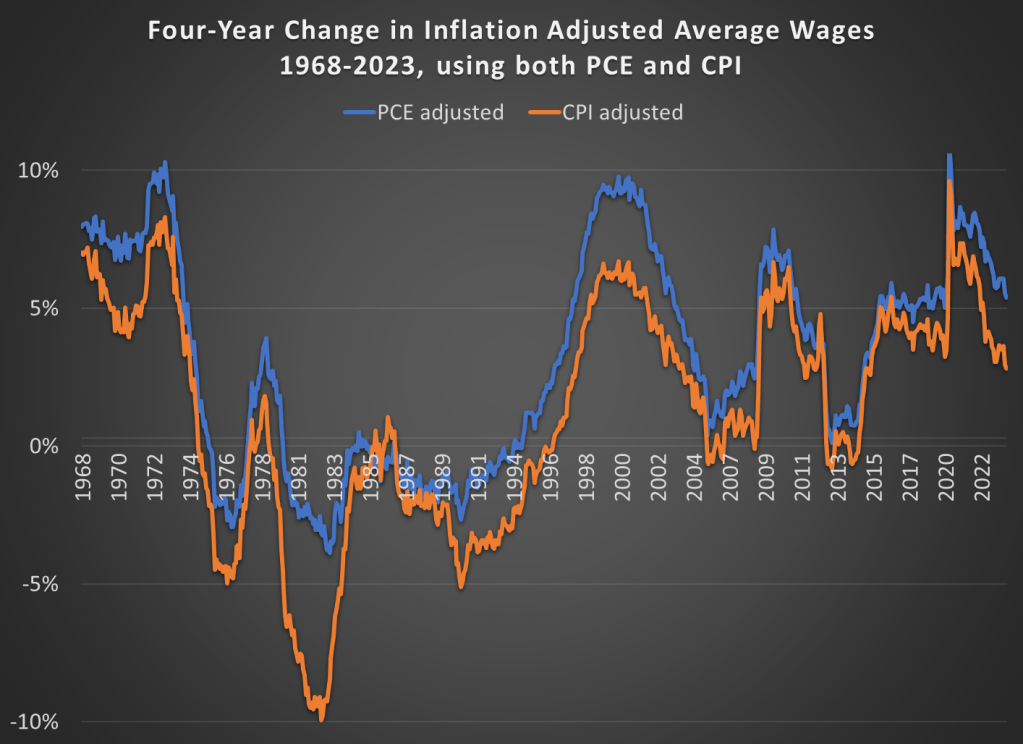
Voters in 2024 will probably be asking themselves a similar question, and both parties (at least for now) seem to be actively encouraging voters to make such a comparison. We still have 12 months of economic data to see before we can really ask the “4 years” question, but how would we answer that question right now? Here’s probably the best approach to see if people are “better off” in terms of being able to “go and buy things at the stores”: inflation-adjusted wages. This chart presents average wages for nonsupervisory workers, with two different inflation adjustments, showing the change over a 4-year time period.

Continue reading

Stock Options Tutorial 1. Options Fundamentals

Put simply, a stock option is a contract to buy (if it is a call option) or to sell (if it is a put option) a given stock at some particular price (“strike price”), by some particular expiration date.

Example: Buying Apple Call Option Instead of the Stock


In a little more detail: if you buy a call option on a stock, that gives you the right to buy that stock at the strike price (“call” the stock away from some current stockholder).
For most American stocks the option holder can exercise this right at any time, up till the end of the expiration day. (For so-called European options, you can only exercise the option on the expiration date itself.)
Let’s jump into an example. As of late morning 11/27/2023 when I am writing this, the price of Apple stock is $190 per share.  Suppose I have a strong conviction that within the next month or so, Apple will go up by 10 dollars (5%) to $200/share.

One thing I can do is plunk down 100 x $190= $19,000 to buy 100 shares of Apple, and wait. If Apple does indeed reach my target price of $200 in some reasonable timeframe, and I sell it there, I will make a profit of 100 shares x $10 / share = $1000 on my initial investment of $19,000. That represents a 5.3% return on my investment.


But suppose because of some unexpected factor (Taiwan invasion?), that the price of Apple plunges by say 30% to $133/share, and remains there for the indefinite future. If I want to get my money out of this affair and move on, I would face a huge loss of 100 shares x (190-133)= $5,700 dollars on my large $19,000 investment.

Instead of buying the stock outright, I could buy a call option. There are a number of specific strategies and choices here, but to keep it simple, I could buy an Apple call option with a strike price of 190 (the current price of Apple) and an expiration date of say December 29, 2023. At the moment, that call option would cost me $3.80 per share, or $380 dollars for a standard options contract that involves 100 shares.


If Apple stock hits my price target of $200 sometime in the next month, I could exercise this option and purchase 100 Apple shares for $19,000 dollars, (100 x $ 190 strike price) and immediately sell them into the market 100 x $200/share = $20,000 dollars. That would give me a net profit of: (profit on stock buy & sell) minus (cost of call option) =  100 x ( ($200 – $190 ) – $3.80 ) = $620. That is a return of 163% on my $380 investment. Woo hoo!
(If I did not want to actually exercise the call, I could have sold it back into the options marketplace; the value of the call would have risen by somewhat less than $10 dollars since the time I bought it, so I could take my profit that way, without going through the cycle of actually buying the shares and immediately selling them.)

If Apple stock fails to rise by more than the $3.80 dollars a share that I paid for the call option, I will lose money on this trade. If Apple stays at or below 190, this call option expires valueless, and I will have lost 100% of my option purchase price. (If say two weeks goes by and the share price is hovering just below 190, this call option might still be worth something like $1.90/share, and I might choose to sell it and bail on this trade, to recover half of my $3.80 instead of risking the loss of all of it; there are many, many ways to trade options).

Now, in the event that Apple shares plunge by 30% and stay low indefinitely, I would only lose the $380 that the options cost me, instead of the $5,700 dollars I would lose if I had bought the stock outright.

This example demonstrates some of the benefits of buying stock options: You can make a huge return on your invested/risked capital if your stock price thesis plays out, and you can be shielded from any losses other than the cost of the option. The big weakness of this approach is that your hoped-for stock move must occur within a limited timeframe, before the expiration date, or else you can lose 100% of your investment. Folks who trade options for a living make lots and lots of small trades, knowing that they will lose on a significant percentage of these trades, hoping that their wins will outweigh their losses.

Buying Put Options for Hedging and Speculation

This has been a somewhat long-winded explanation of one way of utilizing options, namely, buying calls. Buying a put option, on the other hand, gives you the right to require that someone will buy a stock from you at the strike price (here, you are “putting” the stock to the person who sold you the option).

Puts are often used as for protective hedging. Suppose I own 100 shares of Apple stock that is currently valued at 190 dollars a share, and I want to protect against the effects of a possible plunging share price. As an example, I might buy a March 15, 2024 put with a strike price of 175, for $2.80. If Apple price falls, I would absorb the first 15 dollars per share of the losses, from 190 to the strike price of 175. However, that put would protect me against any further losses, since no matter how low the share price goes, I could sell my shares at $175. (Again, instead of actually selling my shares, I might sell the puts back into the market, since their value would have increased as Apple share price fell).
Buying puts in this manner is like buying insurance on your portfolio: it costs you a little bit per month, but prevents catastrophic losses.

Buying puts can also be used for speculative trading. Suppose I was convinced that Apple stock might fall well below $175 in the next three months. Without owning Apple shares, I might buy that March 2024 175 put for $2.80 per share, or $280 for a 100-share contract. If Apple share price went anywhere below (175 – 2.80 = 172.20), I would make money on this trade. If the price went back down to its recent low of 167, my net profit would be around 100 x (172.2 – 167) = $520. This would be nearly doubling the $280 I put into buying the puts. But again, if Apple price failed to fall as hoped, I might lose all of my $280 option purchase price.

Where to Find Options Prices

There are lots of YouTube tutorials on trading stock options. Here is quick ten-minute intro: Stock Options Explained, by The Plain Bagel. If you want to check out the prices of options, they are shown on websites like Yahoo Finance, Seeking Alpha (need to give email to sign in; you can ignore all the ads to make you purchase premium), and your own broker’s software.

I usually prefer to sell options, rather than buy them, but that is another post for another time. As usual, this discussion does not constitute advice to buy or sell any security.
I’m not going to write a post this week

I’ve thought it over and decided not to write a post this week. It’s not that I have writer’s block. I am writing plenty in the dimensions of my profession that dominate my time (and actually pay me). And I have a back catalog of “bigger” pieces I might write later. But there is nothing I am compelled to write today. Which is what I want to write about.

We all share editorials and thinkpieces with each other, whizzing around social media and email, getting discussed over meals and beverages. This content is produced in mass and at breakneck speed. Some people are very good at it. Others less so. Some people, over time, rise to a level of recognition that they are offered plum spots at major outlets, lavished with salaries greater than I will certainly ever enjoy. Their names acquire significant fame, their opinions serving as the substrate for millions of conversations.

And then we savage them.

Sometimes we savage their works because they are signaling the wrong politics and identities. That’s just life. Sometimes we savage their writing because they’re rich and famous, which is annoying, but that’s just the tax a person pays for being eminent (see Swift, Jonathan). But often, more often than they would likely want to admit, we savage their writing as poor and ill-conceived because it is poor and ill-conceived.

Let’s be clear: these people are largely critical thinkers and phenomenonal writers. But they are also on a deadline. Opinions, unlike news, do not appear in our minds fully formed and their subsequent development does not always adhere to a regular schedule. My writings here are essentially an unpaid hobby. I haven’t missed many weeks this last 3 years, but I’ve missed a few. Some weeks I totally mail it in and just write a few paragraphs about a research paper I read that I thought was cool. The New York Times editorial page does not indulge such academic capriciousness.

Would I invest a lot more time in these posts if the NYT was paying me a hefty salary? Of course. I would have stockpiles of evergreen columns, folders of half-written ideas, a corkboard littered with post-its cataloging my every idea that might support a column. But even then I can’t help but suspect that I might occasionally find myself staring down a deadline with nothing I want to say, or with a drafted piece that I know isn’t very good.

And that’s why I think we get the so many big-name editorials that social media descends on like gleeful hyenas, merrily yanking and ripping until the every vacuous subject and failed predicate has yielded it’s final LOL. Why do columnists collectively produce so much dreck? Because they write too much. Scratch that. Because they publish too much.

Which is why I’m not writing a post this week.

(To be clear out of an abundance of caution, this observation does not pertain to those glorious blogs and substacks that mostly produce data-driven analysis and subject-matter deep dives, rather than bloated opinions designed to foment clicks. You are god’s perfect children, never change.)