Chipmaker Stock Prices Explode: The Latest Bubble?

The share prices of many semiconductor chip companies have gone nearly vertical in the past month. Here are five-year charts for Micron (MU) and AMD, as of the close Monday:
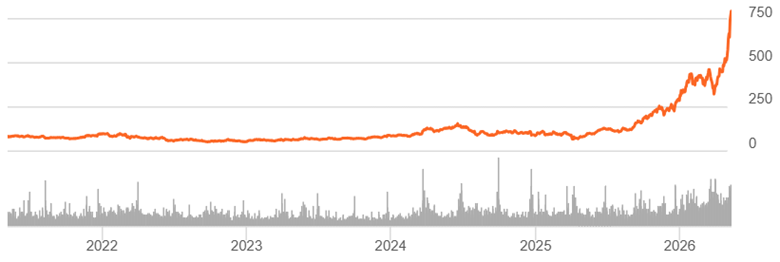
Micron (MU) 5-Year Stock Chart
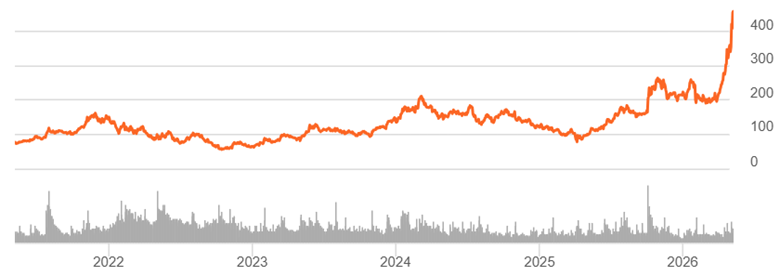
Advanced Micro Devices (AMD) 5-Year Stock Chart

Many analysts have been taken by surprise by the magnitude of the recent surge and prices. There has been no sudden, truly new news to drive this shift. It has been known for over a year that there is a huge shortage of memory chips, allowing Micron to charge high prices for its products.  But apparently the official quarterly announcement of earnings and projections substantiated that narrative. The bears have been claiming that memory chips are a cyclic business, where chip shortages are followed by building more manufacturing capacity, which inevitably leads to overcapacity and a crash in memory chip prices. It has happened repeatedly, and therefore the current Micron stock party would end in tears after a couple of years. But the bears have been beaten back to their caves for now. Micron was up another full 7% yesterday.

AMD, which specializes in central processing units (CPUs), also released good earnings and strong projections. But the real share price driver there seems to be the new narrative that the shift from the shift to agentic AI will require a higher ratio of CPUs to GPUs.  GPUs (graphic processing units) are the engines that do the core large language model (LLM) AI calculations. But apparently an increasing number of CPUs will be required to coordinate the activities of the GPUs:

AI agents—or the Agentic Era, as called by analysts—need more CPUs per GPU because they are responsible for the orchestration of AI workloads and the required data processing in order for the agent to accomplish its task, or, more simply, CPUs organize the steps of the workflow for the agent.    Traditional LLM models—not agents—required a CPU:GPU ratio of 1:4 to 1:8, but analysts anticipate this ratio to shift toward 1:2 or even 1:1 in the coming years.

All that to say demand for AMD‘s chips is projected to increase.

So far, so good. But apparently being swept up in the whirlwind of exhilaration is the share price for lowly Intel (INTC). Intel was the leading manufacturer of processor chips back in the day, but it missed the boat on GPUs and just cannot seem to execute at global standards. In recent years, Intel has mainly been famous for ever-slipping deadlines on producing high performing chips. Its earnings have been approximately zero for some time. The good news is it now has a foundry business. The bad news is that the foundry business loses around $2 billion a year. The foundry has pulled in a few large customers, and after their experience there, they all run screaming for the exits. But wait, there’s been an announcement that Apple may contract with Intel to produce some low-end chips. Whoopee!
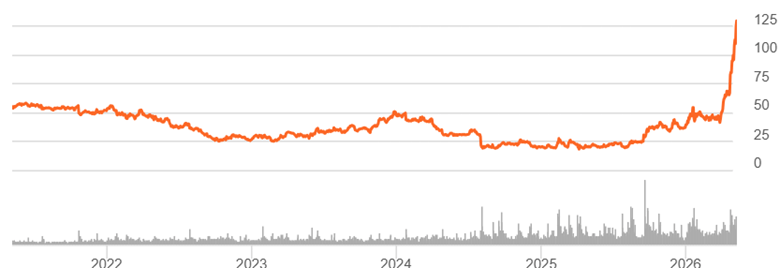
Intel (INTC)  Five-year stock chart


Folks who look at technical behavior of stocks rather than the fundamentals of the business seem somewhat skeptical about the current surge. Terms like overbought are thrown around. I read an article claiming that hedging activities in the options market is creating an artificial, temporary demand for these high-flying stocks:

It is also fairly clear what has been driving these overbought conditions at the index level: aggressive call buying is creating a gamma squeeze across several stocks, such as Micron (MU). This occurs when aggressive call buying forces dealer hedging flows, resulting in purchases of the underlying stock. The more the stock rises, the more call buying tends to increase, and the cycle builds on itself.


My take on this spectacle

I can get the fundamental bull case in general for Micron stock. I bought into it about six months ago. Even that far back, it was clear that the demand for memory chips far outstripped the supply, so Micron could not help minting money for the next year or two. It was one of my fairly rare successes in stock picking. Sadly, I only bought a little bit, because I was influenced by many negative articles claiming that memory chips are a cyclic business, so this boom would end like all the previous Micron booms, with a glut and a crash.

There seems to be a solid bull case for AMD as well. For pitiful Intel, however, I see its price chart as a sign of market FOMO.

Where these stock prices go from here, I have no idea. My observation over the years is that this level of enthusiasm is usually followed eventually by, “What was I thinking?”, and a return to earth. However, in the meantime, tech stock prices often run up longer and further than I would have thought possible.

Usual disclaimer: Nothing here should be taken as advice to buy or sell any security.

Did Apple’s Recent “Illusion of Thinking” Study Expose Fatal Shortcomings in Using LLM’s for Artificial General Intelligence?

Researchers at Apple last week published with the provocative title, “The Illusion of Thinking: Understanding the Strengths and Limitations of Reasoning Models via the Lens of Problem Complexity.”  This paper has generated uproar in the AI world. Having “The Illusion of Thinking” right there in the title is pretty in-your-face.

Traditional Large Language Model (LLM) artificial intelligence programs like ChatGPT train on massive amounts of human-generated text to be able to mimic human outputs when given prompts. A recent trend (mainly starting in 2024) has been the incorporation of more formal reasoning capabilities into these models. The enhanced models are termed Large Reasoning Models (LRMs). Now some leading LLMs like Open AI’s GPT, Claude, and the Chinese DeepSeek exist both in regular LLM form and also as LRM versions.

The authors applied both the regular (LLM) and “thinking” LRM versions of Claude 3.7 Sonnet and DeepSeek to a number of mathematical type puzzles. Open AI’s o-series were used to a lesser extent. An advantage of these puzzles is that researchers can, while keeping the basic form of the puzzle, dial in more or less complexity.

They found, among other things, that the LRMs did well up to a certain point, then suffered “complete collapse” as complexity was increased. Also, at low complexities, LLMs actually outperform LRMs. And (perhaps the most vivid evidence of lack of actual understanding on the part of these programs), when they were explicitly offered an efficient direct solution algorithm in the prompt, the programs did not take advantage of it, but instead just kept grinding away in their usual fashion.

As might be expected, AI skeptics were all over the blogosphere, saying, I told you so, LLMs are just massive exercises in pattern matching, and cannot extrapolate outside of their training set. This has massive implications for what we can expect in the near or intermediate future. Among other things, the optimism about AI progress is largely what is fueling the stock market, and also capital investment in this area: Companies like Meta and Google are spending ginormous sums trying to develop artificial “general” intelligence, paying for ginormous amounts of compute power, with those dollars flowing to firms like Microsoft and Amazon building out data centers and buying chips from Nvidia. If the AGI emperor has no clothes, all this spending might come to a screeching crashing halt.

Ars Technica published a fairly balanced account of the controversy, concluding that, “Even elaborate pattern-matching machines can be useful in performing labor-saving tasks for the people that use them… especially for coding and brainstorming and writing.”

Comments on this article included one like:

LLMs do not even know what the task is, all it knows is statistical relationships between words.   I feel like I am going insane. An entire industry’s worth of engineers and scientists are desperate to convince themselves a fancy Markov chain trained on all known human texts is actually thinking through problems and not just rolling the dice on what words it can link together.

And

if we equate combinatorial play and pattern matching with genuinely “generative/general” intelligence, then we’re missing a key fact here. What’s missing from all the LLM hubris and enthusiasm is a reflexive consciousness of the limits of language, of the aspects of experience that exceed its reach and are also, paradoxically, the source of its actual innovations. [This is profound, he means that mere words, even billions of them, cannot capture some key aspects of human experience]

However, the AI bulls have mounted various come-backs to the Apple paper. The most effective I know of so far was published by Alex Lawsen, a researcher at LLM firm Open Philanthropy. Lawsen’s rebuttal, titled “The Illusion of the Illusion of Thinking,  was summarized by Marcus Mendes. To summarize the summary, Lawsen claimed that the models did not in general “collapse” in some crazy way. Rather, the models in many cases recognized that they would not be able to solve the puzzles given the constraints input by the Apple researchers. Therefore, they (rather intelligently) did not try to waste compute power by grinding away to a necessarily incomplete solution, but just stopped. Lawsen further showed that the ways Apple ran the LRM models did not allow them to perform as well as they could. When he made a modest, reasonable change in the operation of the LRMs,

Models like Claude, Gemini, and OpenAI’s o3 had no trouble producing algorithmically correct solutions for 15-disk Hanoi problems, far beyond the complexity where Apple reported zero success.

Lawsen’s conclusion: When you remove artificial output constraints, LRMs seem perfectly capable of reasoning about high-complexity tasks. At least in terms of algorithm generation.

And so, the great debate over the prospects of artificial general intelligence will continue.

Stock Options Tutorial 1. Options Fundamentals

Put simply, a stock option is a contract to buy (if it is a call option) or to sell (if it is a put option) a given stock at some particular price (“strike price”), by some particular expiration date.

Example: Buying Apple Call Option Instead of the Stock


In a little more detail: if you buy a call option on a stock, that gives you the right to buy that stock at the strike price (“call” the stock away from some current stockholder).
For most American stocks the option holder can exercise this right at any time, up till the end of the expiration day. (For so-called European options, you can only exercise the option on the expiration date itself.)
Let’s jump into an example. As of late morning 11/27/2023 when I am writing this, the price of Apple stock is $190 per share.  Suppose I have a strong conviction that within the next month or so, Apple will go up by 10 dollars (5%) to $200/share.

One thing I can do is plunk down 100 x $190= $19,000 to buy 100 shares of Apple, and wait. If Apple does indeed reach my target price of $200 in some reasonable timeframe, and I sell it there, I will make a profit of 100 shares x $10 / share = $1000 on my initial investment of $19,000. That represents a 5.3% return on my investment.


But suppose because of some unexpected factor (Taiwan invasion?), that the price of Apple plunges by say 30% to $133/share, and remains there for the indefinite future. If I want to get my money out of this affair and move on, I would face a huge loss of 100 shares x (190-133)= $5,700 dollars on my large $19,000 investment.

Instead of buying the stock outright, I could buy a call option. There are a number of specific strategies and choices here, but to keep it simple, I could buy an Apple call option with a strike price of 190 (the current price of Apple) and an expiration date of say December 29, 2023. At the moment, that call option would cost me $3.80 per share, or $380 dollars for a standard options contract that involves 100 shares.


If Apple stock hits my price target of $200 sometime in the next month, I could exercise this option and purchase 100 Apple shares for $19,000 dollars, (100 x $ 190 strike price) and immediately sell them into the market 100 x $200/share = $20,000 dollars. That would give me a net profit of: (profit on stock buy & sell) minus (cost of call option) =  100 x ( ($200 – $190 ) – $3.80 ) = $620. That is a return of 163% on my $380 investment. Woo hoo!
(If I did not want to actually exercise the call, I could have sold it back into the options marketplace; the value of the call would have risen by somewhat less than $10 dollars since the time I bought it, so I could take my profit that way, without going through the cycle of actually buying the shares and immediately selling them.)

If Apple stock fails to rise by more than the $3.80 dollars a share that I paid for the call option, I will lose money on this trade. If Apple stays at or below 190, this call option expires valueless, and I will have lost 100% of my option purchase price. (If say two weeks goes by and the share price is hovering just below 190, this call option might still be worth something like $1.90/share, and I might choose to sell it and bail on this trade, to recover half of my $3.80 instead of risking the loss of all of it; there are many, many ways to trade options).

Now, in the event that Apple shares plunge by 30% and stay low indefinitely, I would only lose the $380 that the options cost me, instead of the $5,700 dollars I would lose if I had bought the stock outright.

This example demonstrates some of the benefits of buying stock options: You can make a huge return on your invested/risked capital if your stock price thesis plays out, and you can be shielded from any losses other than the cost of the option. The big weakness of this approach is that your hoped-for stock move must occur within a limited timeframe, before the expiration date, or else you can lose 100% of your investment. Folks who trade options for a living make lots and lots of small trades, knowing that they will lose on a significant percentage of these trades, hoping that their wins will outweigh their losses.

Buying Put Options for Hedging and Speculation

This has been a somewhat long-winded explanation of one way of utilizing options, namely, buying calls. Buying a put option, on the other hand, gives you the right to require that someone will buy a stock from you at the strike price (here, you are “putting” the stock to the person who sold you the option).

Puts are often used as for protective hedging. Suppose I own 100 shares of Apple stock that is currently valued at 190 dollars a share, and I want to protect against the effects of a possible plunging share price. As an example, I might buy a March 15, 2024 put with a strike price of 175, for $2.80. If Apple price falls, I would absorb the first 15 dollars per share of the losses, from 190 to the strike price of 175. However, that put would protect me against any further losses, since no matter how low the share price goes, I could sell my shares at $175. (Again, instead of actually selling my shares, I might sell the puts back into the market, since their value would have increased as Apple share price fell).
Buying puts in this manner is like buying insurance on your portfolio: it costs you a little bit per month, but prevents catastrophic losses.

Buying puts can also be used for speculative trading. Suppose I was convinced that Apple stock might fall well below $175 in the next three months. Without owning Apple shares, I might buy that March 2024 175 put for $2.80 per share, or $280 for a 100-share contract. If Apple share price went anywhere below (175 – 2.80 = 172.20), I would make money on this trade. If the price went back down to its recent low of 167, my net profit would be around 100 x (172.2 – 167) = $520. This would be nearly doubling the $280 I put into buying the puts. But again, if Apple price failed to fall as hoped, I might lose all of my $280 option purchase price.

Where to Find Options Prices

There are lots of YouTube tutorials on trading stock options. Here is quick ten-minute intro: Stock Options Explained, by The Plain Bagel. If you want to check out the prices of options, they are shown on websites like Yahoo Finance, Seeking Alpha (need to give email to sign in; you can ignore all the ads to make you purchase premium), and your own broker’s software.

I usually prefer to sell options, rather than buy them, but that is another post for another time. As usual, this discussion does not constitute advice to buy or sell any security.