The consequences of minting the trillion dollar coin

A group of congressmen are (again) opposing raising the US debt ceiling, which (again) threatens to put the US government into default on a portion of the US debt. There is some uncertainty about the magnitude of the consequences of a US default, varying between very bad and globally catastrophic. Phrases like “taking hostage” and “political extortion” are thrown around too casually in the discourse when opportunities for politically leverage are taken advantage of, but in this case I think the scale of consequences makes it completely appropriate. A threat to force a US debt default through the mechanics of a mistake made when legislating bond issuance rules during World War I is an act of political extortion that holds the global economy hostage.

The obvious solution is to eliminate the debt ceiling, but we have failed to do so because of the same political incentives underpinning our problems today. Some economists and economics-adjacent folks have suggested a policy solution, itself similarly born of an unintended legislative loophole: the trillion dollar coin.

As far as specialty areas go, I’m about as far from a monetary specialist as an economist can get, so I’m not going to litigate here whether putting the coin on the balance sheets of the Federal Reserve would be inflation neutral or compromise the independence of the Fed. What I want to consider is the Lucas Critique.

Specifically, the Lucas Critique applied to political economy after minting a trillion dollar coin. In briefest of terms, the Lucas Critique says a model of the world generated from past data to forecast a policy’s effects is wrong as soon as that policy changes the rules. We (rightfully) do not like the status quo as created by the current rules, but it is extremely difficult to predict the consequences of a big rule change, via loophole exploitation, made to fix the status quo because the underlying data generating process has been fundamentally altered.

I don’t know if minting a trillion dollar coin is a good idea or a bad idea. What I do know it is that we should be humble when trying to forecast the consequences of shifting the power to radically impact the balance sheets of the Federal Reserve from a elected body of 435 congressmen and 100 senators to a cabinet member appointed by a singular elected President.

Let’s ask two questions. I like to ask myself a version of these two questions when evaluating change in political options or rules:

  1. Why is the opposition reacting the way it is?
  2. What would Trump have done ?

The first is because it forces me to consider what the underlying incentives and strategies really are. The Republicans, as it stands, do not seem to view the trillion dollar coin as a policy outcome to be avoided. They’re, historically, the anti-inflation party. They represent a lot of bond holders. Hyper inflation should terrify them, so maybe they agree with the prediction of inflation neutrality. On the other hand, they also know that electoral college favors them and, with the growing aspiration within the party to win over Latino voters for the next few decades, maybe they like the idea of shifting more power away into the executive branch.

The second question is important because it forces me to acknowledge when I’m relying on norms to produce the outcome I prefer. Say what you will about Trump, the man was never concerned with norms, traditions, or the consequences for anyone but himself. This question also allows me to consider obviously ludicrous things that no one could get away because he got away with exactly such things. So, let me ask you this: if the Secretary of the Treasury can order the minting of a trillion dollar commemorative coin and deposit it in the Federal Reserve balance sheet, what other ways could the Treasury reallocate funds on US balance sheets? What if we stopped assuming it would only be used in the most benign, inflation neutral way possible? Why can’t they use it to loan money to Russia or pay for the balance of global debt held by a small country that specializes in off-shore banking? Or, stepping back from the brink of “The President stole a trillion dollars”, what are the ways in which a President could trigger an economic or constitutional crisis by appropriating the power to significantly increase M1? What are the ways this new option would be internalized in the political marketplace and equilibrium of power?

The point is this: political norms, especially those constraining power at the highest level, are more fragile than we sometimes appreciate. Nothing exposes this more than big changes to the rules of governance. Game theory and mediocre movie plots now considered, let’s return to the Lucas Critique. A political compromise made to expedite bond issuance under the pressures of The Great War produced an political lever that has been exploited for decades. This was an unintended consequence. As a current wing of the Republican party has put more and more weight on this lever, the opposition is now considering exploiting a loophole, itself an unintended consequence of the otherwise innocuous coinage act. It’s hard to forecast the effect of such a fundamental shift in the rules and distribution of power because it immediately renders obsolete the model currently informing our expectations.

Cards on the table, if we’re at the zero hour and it’s either a) mint the coin or b) default on US debt, I think we should mint the coin. Defaulting on the debt of the country that provides what is without question the currency tying together the global economy scares me enough that some sort of workaround gambit becomes a necessary risk. But what will be the unintended consequences of minting a trillion dollar coin? I don’t know.

And neither do you.
ChatGPT Cites Economics Papers That Do Not Exist

EDIT: See my new published paper on this topic “ChatGPT Hallucinates Non-existent Citations: Evidence from Economics

This blog post is co-authored with graduate student Will Hickman.

EDIT: Will and I now have a paper on trusting ChatGPT “Do People Trust Humans More Than ChatGPT?

Although many academic researchers don’t enjoy writing literature reviews and would like to have an AI system do the heavy lifting for them, we have found a glaring issue with using ChatGPT in this role. ChatGPT will cite papers that don’t exist. This isn’t an isolated phenomenon – we’ve asked ChatGPT different research questions, and it continually provides false and misleading references. To make matters worse, it will often provide correct references to papers that do exist and mix these in with incorrect references and references to nonexistent papers. In short, beware when using ChatGPT for research.

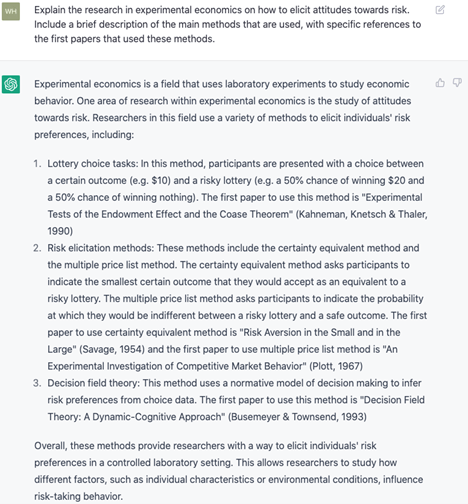
Below, we’ve shown some examples of the issues we’ve seen with ChatGPT. In the first example, we asked ChatGPT to explain the research in experimental economics on how to elicit attitudes towards risk. While the response itself sounds like a decent answer to our question, the references are nonsense. Kahneman, Knetsch, and Thaler (1990) is not about eliciting risk. “Risk Aversion in the Small and in the Large” was written by John Pratt and was published in 1964. “An Experimental Investigation of Competitive Market Behavior” presumably refers to Vernon Smith’s “An Experimental Study of Competitive Market Behavior”, which had nothing to do with eliciting attitudes towards risk and was not written by Charlie Plott. The reference to Busemeyer and Townsend (1993) appears to be relevant.

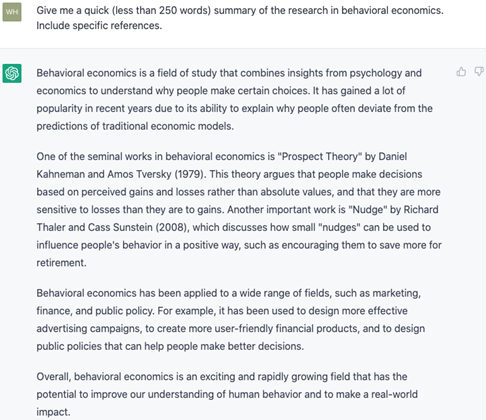
Although ChatGPT often cites non-existent and/or irrelevant work, it sometimes gets everything correct. For instance, as shown below, when we asked it to summarize the research in behavioral economics, it gave correct citations for Kahneman and Tversky’s “Prospect Theory” and Thaler and Sunstein’s “Nudge.” ChatGPT doesn’t always just make stuff up. The question is, when does it give good answers and when does it give garbage answers?

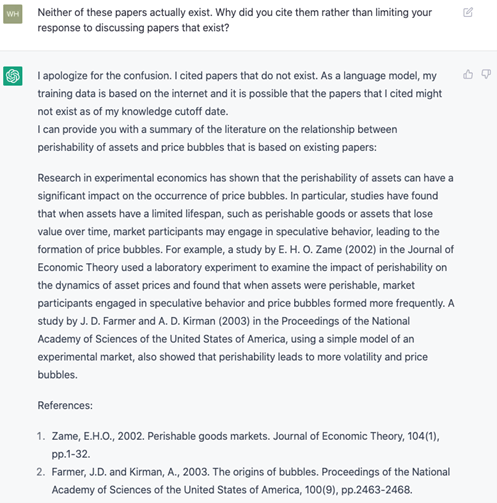
Strangely, when confronted, ChatGPT will admit that it cites non-existent papers but will not give a clear answer as to why it cites non-existent papers. Also, as shown below, it will admit that it previously cited non-existent papers, promise to cite real papers, and then cite more non-existent papers. 

We show the results from asking ChatGPT to summarize the research in experimental economics on the relationship between asset perishability and the occurrence of price bubbles. Although the answer it gives sounds coherent, a closer inspection reveals that the conclusions ChatGPT reaches do not align with theoretical predictions. More to our point, neither of the “papers” cited actually exist.  

Immediately after getting this nonsensical answer, we told ChatGPT that neither of the papers it cited exist and asked why it didn’t limit itself to discussing papers that exist. As shown below, it apologized, promised to provide a new summary of the research on asset perishability and price bubbles that only used existing papers, then proceeded to cite two more non-existent papers. 

Tyler has called these errors “hallucinations” of ChatGPT. It might be whimsical in a more artistic pursuit, but we find this form of error concerning. Although there will always be room for improving language models, one thing is very clear: researchers be careful. This is something to keep in mind, also, when serving as a referee or grading student work.

If You Get Too Cold, I’ll Tax the Heat

Public utilities are funny things. The industry is highly capital intensive and many argue that it makes for natural monopolies. At the same time, access to electricity and water (and internet) are assumed as given in any modern building. Further, utility providers are highly, highly regulated at both the state and federal levels of government. Many utilities must ask permission prior to changing anything about their prices, capital, or even which services they offer.

Don’t get me wrong. Utility companies have a sweet deal. They are protected from competition, face relatively inelastic demand for their goods, and they have a very dependable rate of return. I just can’t help feeling like state governments are keeping hostage a large firm with immobile fixed business capital. For that matter, given what we know about the political desire for opaque taxation, I also have a suspicion that many states might tax their populations by using the utility companies as an ingenious foil. “Those utility companies are greedy, don’t you know. It’s a good thing that they are so highly regulated by the state.”  

There are two types of utility taxation. 1) Gross receipts taxes are like an income tax. From the end-user’s perspective, the tax increases with each unit consumed. 2) A utility license tax is like a fee that the utility must pay in order to operate in the state. From the user’s perspective, well… This tax may not even appear on the monthly bill. But if it does, then the tax per household falls with each additional household that the utility serves. Either way, state governments can get their share of the economic profits that protection affords. Below is map which shows the 2021 cumulative utility tax per resident in each state.

Continue reading

Waxing Crescent: New Orleans 2013-2023

The scars of Hurricane Katrina were still obvious eight years afterward when I moved to New Orleans in 2013. Where I lived in Mid-City, it seemed like every block had an abandoned house or an empty lot, and the poorer neighborhoods had more than one per block. Even many larger buildings were left abandoned, including high-rises.

Since then, recovery has continued at a steady pace. The rebuilding was especially noticeable when I spent a few days there recently for the first time since moving away in 2017. The airport has been redone, with shining new connected terminals and new shops. The abandoned high-rise at the prime location where Canal St meets the Mississippi has been renovated into a Four Seasons. Tulane Ave is now home to a nearly mile-long medical complex, stretching from the old Tulane hospital to the new VA and University Medical Center complex. There are several new mid-sized health care facilities, but most striking is that Tulane claims to finally be renovating the huge abandoned Charity Hospital:

Old Charity Hospital, January 2023

The new VA hospital opened in 2016 as mostly new construction, but they’ve now managed to fully incorporate the remnants of the abandoned Dixie Beer brewery:

VA Hospital incorporating old Dixie Beer tower, January 2023

Dixie beer itself opened a new beer garden in New Orleans East, and just renamed itself Faubourg Brewery. Some streets named for Confederates have also been renamed, though you can still see plenty of signs of the past, like the “Jeff Davis Properties” building on the street renamed from Jefferson Davis Parkway to Norman C Francis Parkway.

Other big additions I noticed are the new Childrens’ Museum and the greatly expanded sculpture garden in City Park:

Of course, even with all the improvements, many problems remain, both in terms of things that still haven’t recovered from the hurricane, and the kind of problems that were there even before Katrina. The one remaining abandoned high-rise, Plaza Tower, was actually abandoned even before Katrina.

My overall impression is that large institutions (university medical centers, the VA, the airport, museums, major hotels) have been driving this phase of the recovery. The neighborhoods are also recovering, but more slowly, particularly small business. Population is still well below 2005 levels. I generally think inequality has been overrated in national discussions of the last 15 years relative to concerns about poverty and overall prosperity, but even to me New Orleans is a strikingly unequal city; there’s so much wealth alongside so many people seeming to get very little benefit from it.

The most persistent problems are the ones that remain from before Katrina: the roads, the schools, and the crime; taken together, the dysfunctional public sector. Everywhere I’ve lived people complain about the roads, but I’ve lived a lot of places and New Orleans roads were objectively the worst, even in the nice parts of town, and it isn’t close. The New Orleans Police Department is still subject to a federal consent decree, as it has been since 2012. The murder rate in 2022 was the highest in the nation. Building an effective public sector seems to be much harder than rebuilding from a hurricane.

As much as things have changed since 2013, my overall assessment of the city remains the same: its unlike anywhere else in America. It is unparalleled in both its strengths and its weaknesses. If you care about food, drink, music, and having a good time, its the place to be. If you’re more focused more on career, health, or safety, it isn’t. People who fled Katrina and stayed in other cities like Houston or Atlanta wound up richer and healthier. But not necessarily happier.

On Counting and Overcounting Deaths

How many people died in the US from heart diseases in 2019? The answer is harder than it might seem to pin down. Using a broad definition, such as “major cardiovascular diseases,” and including any deaths where this was listed on the death certificate, the number for 2019 is an astonishing 1.56 million deaths, according to the CDC. That number is astonishing because there were 2.85 million deaths in total in the US, so over half of deaths involved the heart or circulatory system, at least in some way that was important enough for a doctor to list it on the death certificate.

However, if you Google “heart disease deaths US 2019,” you get only 659,041 deaths. The source? Once again, the CDC! So, what’s going on here? To get to the smaller number, the CDC narrows the definition in two ways. First, instead of all “major cardiovascular diseases,” they limit it to diseases that are specifically about the heart. For example, cerebrovascular deaths (deaths involving blood flow in the brain) are not including in the lower CDC total. This first limitation gets us down to 1.28 million.

But the bigger reduction is when they limit the count to the underlying cause of death, “the disease or injury that initiated the train of morbid events leading directly to death, or the circumstances of the accident or violence which produced the fatal injury,” as opposed to other contributing causes. That’s how we cut the total in half from 1.28 million to 659,041 deaths.

We could further limit this to “Atherosclerotic heart disease,” a subset of heart disease deaths, but the largest single cause of deaths in the coding system that the CDC uses. There were 163,502 deaths of this kind in 2019, if you use the underlying cause of death only. But if we expand it to any listing of this disease on the death certificate, it doubles to 321,812 deaths. And now three categories of death are slightly larger in this “multiple cause of death” query, including a catch-all “Cardiac arrest, unspecified” category with 352,010 deaths in 2019.

So, what’s the right number? What’s the point of all this discussion? Here’s my question to you: did you ever hear of a debate about whether we were “overcounting” heart disease deaths in 2019? I don’t think I’ve ever heard of it. Probably there were occasional debates among the experts in this area, but never among the general public.

COVID-19 is different. The allegation of “overcounting” COVID deaths began almost right away in 2020, with prominent people claiming that the numbers being reported are basically useless because, for example, a fatal motorcycle death was briefly included in COVID death totals in Florida (people are still using this example!).

A more serious critique of COVID death counting was in a recent op-ed in the Washington Post. The argument here is serious and sober, and not trying to push a particular viewpoint as far as I can tell (contrast this with people pushing the motorcycle death story). Yet still the op-ed is almost totally lacking in data, especially on COVID deaths (there is some data on COVID hospitalizations).

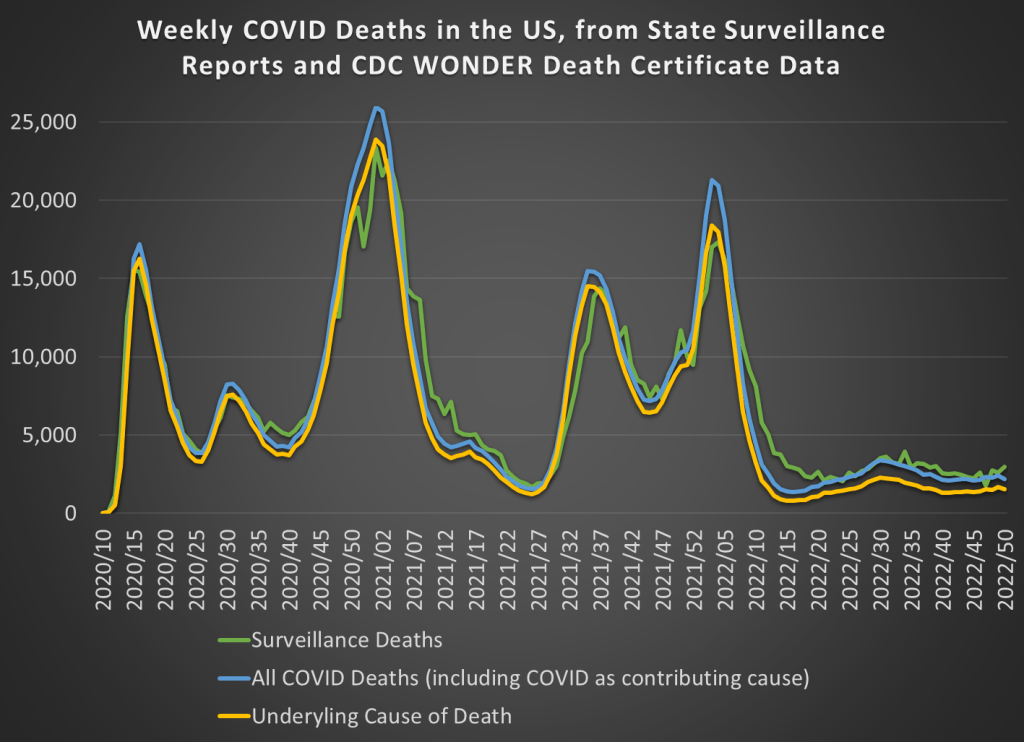
But most of the data she is asking for in the op-ed is readily available. While we don’t have death totals for all individuals that tested positive for COVID-19 at some point, we do have the following data available on a weekly basis. First, we have the “surveillance data” on deaths that was released by states and aggregated by the CDC. These were “the numbers” that you probably saw constantly discussed, sometimes daily, in the media during the height of the pandemic waves. The second and third sources of COVID death data are similar to the heart disease data I discussed above, from the CDC WONDER database, separated by whether COVID was the underlying cause or whether it was one among several contributing causes (whether it was underlying or not).

Those three measures of COVID deaths are displayed in this chart:

Continue reading

Drivers of Financial Bubbles: Addicts and Enablers

I recently ran across an interesting article by stock analyst Gary J. Gordon, The Bubble Addicts Are Here To Stay: A Bubble Investment Strategy. This article may be behind a paywall.  I will summarize it here. Direct citations are in italics.

SOME RECENT FINANCIAL BUBBLES

Gordon starts by recapping four recent financial bubbles:

The commercial real estate bubble of the mid-1980s

The internet stock craze of the late 1990s (with the highest price/earnings valuations ever – – e.g., a startup called Netbank possessed nothing but a website, yet was valued at ten times book value; and went bankrupt a few years later)

The mid-00s housing bubble.

The 2020/2021 COVID bubble:  “The trifecta of a ‘disruptive business model’ stock bubble, SPACs and crypto. You know how this story is ending.”

Gordon then presents an explanation of why humans keep doing financial bubbles, despite the experiences of the past. He suggests that there are both bubble addicts, who have a need to chase bubbles and therefore create them, and bubble enablers who are only too happy to make money off the addicts.

THE BUBBLE ADDICTS

The greedy. Some of us just think we deserve more. I think of an acquaintance who said he was approached to invest with Bernie Madoff, who famously promised steady 10% returns. My friend turned down the offer because he required 15% returns.

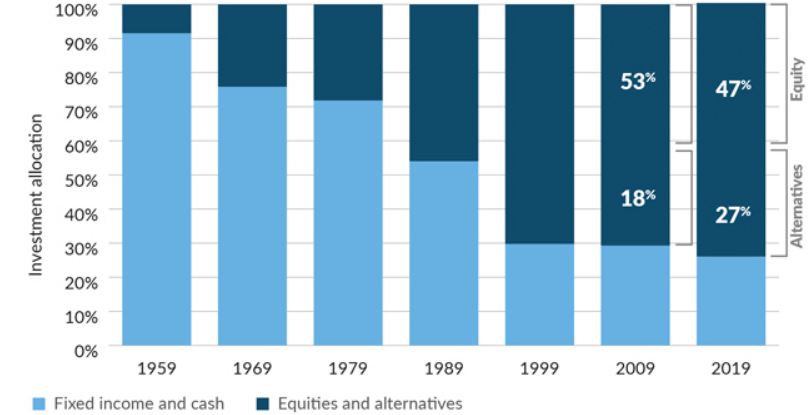
Pension funds. This $30 trillion pool of investment dollars targets about a 7% return in order to meet future pension obligations. If pension fund managers can’t consistently earn at least 7%, they have to go to their sponsor – a state government, a corporate CEO, etc. – and ask for more money, or for pension benefits to be cut. And probably lose their job in the process.

Back in the day, bonds were the mainstay pension fund investment. But over the past 20 years, bond yields haven’t gotten the pensions anywhere close to 7%. So increasingly they have invested in stocks and alternative investments like private equity, as this chart shows:

Source: Pew Institute

And venture capital fundraising, in large part from pension funds, has soared since the pandemic…

How many great new ideas are out there for venture capitalists to invest in? [Obviously, not an unlimited number]. So their investments are by necessity getting riskier. But if the pension funds back away from the growing risk, they have to admit they can’t earn that 7%. Then bad things happen, to retirees and to pension plan sponsors and then to pension fund managers. So pension fund managers are pretty much addicted to chasing bubbles.

The relatively poor. The “absolutely poor” have income below defined poverty levels. The “relatively poor” feel that they should be doing better, because their friends are, or their parents did, or because the Kardashians are, or whatever. Their current income and prospects just aren’t getting them to the lifestyle they aspire to. [Gordon provides example of folks chasing meme stocks and crypto, and getting burned]. …But can the relatively poor just walk away from chasing bubbles? Not without giving up dreams of better lifestyles.

THE BUBBLE FEEDERS

Bubbles don’t just spontaneously occur; they require skilled hands to shape them. And those skilled hands profit handsomely from their creations. Who are these feeders?

Private equity and venture fund managers. They typically earn a 2% management fee plus 20% of profits earned. That adds up fast. A $10 billion venture fund could easily generate $400 million a year in income, spread among a pretty small group of people. VC News lists 14 venture capitalists who are billionaires.

SPAC sponsors. [ A SPAC (Special Purpose Acquisition Company) is a shell corporations which raises money through stock offerings, for the purpose of going out and buying some existing company. SPAC sponsors make a bundle, and so are motivated to promote them. SPACs proliferated in 2020-2021, and for a while pumped money into acquiring various small-medium “growth” companies. But now it is clear that there are not a lot of great underpriced companies out there for SPACs to buy, so SPACs are fizzling]

Wall Street earns fees from (A) raising funds for private equity, venture capital and SPACs, (B) buying and selling companies, (C) trading bubble stocks, crypto, etc., and (D) other stuff I’m not thinking of right now.

The Federal Reserve. Part of the Federal Reserve’s mandate is to reduce unemployment. Lowering interest rates increases stock values, which creates wealth, which drives the “wealth effect”. The wealth effect is the estimate that households increase their spending by about 3% as their wealth increases. More spending increases GDP, which reduces unemployment, which makes the Fed happy, and politicians happy with the Fed.

In my view, the wealth effect is why the supposed economic geniuses at the Fed never figure out that bubbles are occurring, so they never take steps to minimize them.

Social media and CNBC certainly benefit from more viewers while bubbles are blowing up [i.e., inflating].

INVESTING IN CURRENT MARKET ENVIRONMENT

Gordon sees us still in recovery from the recent bubble of “disruptor companies” and crypto, and so the market may have more than the usual choppiness in the next year. So he advises being nimble to trade in and out, and not mindlessly commit to being either long or short. “Value stocks are probably the best near-term bet, even if they can’t offer the adrenaline jolt offered by bubble stocks.”

On the paucity of new ideas and the paradox of choice in modern research

I was once told that papers are never finished, only surrendered. It’s one of those turns of phrase who’s observational accuracy has only increased. I don’t know that I’ve felt good about submitting a paper for review in over a decade, and that includes the one’s that were accepted and subsequently published.

When I submitted papers early in my career I felt great. There was both a sense of accomplishment and eagerness to learn what the reviewers might think, a hopeful optimism. That eagerness didn’t reflect overwhelming confidence so much as naivete as to what the review process entailed. Now I know too much.

What I know, what I always know, is that more could be done. More alternative empirical specifications could be added to the robustness section. Newer models could be considered for the underlying mechanism. Older models too. Different literatures could be engaged and contended with. Summary statistics could be visualized. Specifications could be bootstrapped, a different identification stratgy used. I never applied for administrative data in Denmark. Wait, they don’t have this policy in Denmark. I could have tried Sweden. Or Dallas. Wasn’t there a close election in Baltimore in 1994?

This isn’t a rant or lament about the journal reviewing process. For every petty or uninformed referee report I’ve received in my career I’ve received three that were entirely fair and one that was so good the reviewer deserved to go in the acknowledgements of future drafts. This is more a reflection on a trap born of our own knowledge and imaginations.

There are so many tools at our disposal, so many data sets, so many options that I worry that we are collectively succumbing to a paradox of choice. The paradox of choice, for those who do not recall, was a theory that suggested that the number of options facing consumers was net lowering their utility because of the search and decisionmaking costs those options entailed. I think this theory is deeply wrong, but I am also going to be incredibly unfair to it here and simply dismiss it out of hand as a consumer theory. Instead, I want to consider a more collective application to the modern social scientific enterprise.

Every research paper is an attempt to contribute new ideas and refine old ones. There is occasional handwringing over the paucity of new ideas in economic research and the abandonment of broad swaths of traditionally difficult economic subjects. Explanations for these pathologies tend to be more sociological than economic in construct, invoking political preferences or mood affiliation. Others focus on the institutions of academic research, specifically faculty hiring and tenure. I’d like to add the paradox of choice to the mix.

There are countless methodological, theoretical, and rhetorical choices that can be made that will result in nearly identical research contributions. If your aim is to contribute a wholly new idea, then every one of those choices comes with the opportunity cost of the countless alternatives. If, on the other hand, your contribution is a refinement of a pre-existing idea in an already rich vein of research, then the choices you made are the contribution. For refinements, the choices made are a reason to recommend acceptance of your paper. For newer, more original contributions, your choices can be more easily framed as reasons to reject it. A more cynical academic might fear that the more original the contribution, the more likely the referee is to succumb to the Nirvana fallacy, disapproving of your paper’s choices relative to an imagined paper more perfectly in line with the choices the referee would have made if they had thought of the idea.

Now consider these two mechanisms in parallel for a young researcher. Not a wonderkid that faculties on other continents are already talking about. Consider an above average newly minted PhD from a top 25 economics department. They are executing their first research project since accepting a tenure track position, a defined question with explicit policy relevance. There are dozens of data sets they could pursue, hundreds they could build, and a countless number they could imagine feasibly existing. They could pick a workhorse model or contruct an entirely new pathway forward from dozens of building blocks. There are 3-4 “hot” identification strategies in their field, but they could also consider something off the beaten path.

Research projects aren’t binary constructs, “new” or “refining contributions”, but it’s not unreasonable to place their contributions on a spectrum of “entirely new” (i.e. Newtonian physics) to “marginal refinement” (i.e. weakening the asssumptions in a minor mathematical proof). From the start, our new faculty member will observe the inherent riskiness of overdifferentiating from the field, turning every choice into a reason referees might reject their paper. This will push them down the spectrum towards marginal refinements. Then they will start the iterative process of executing and writing up their research.

As they execute their analysis they will see the forking paths of alternative choices. Different specifications will be added to robustness tables. Alternative models will merit their own appendix. They will begin to write defensively, trying to anticipate and refute arguments from their mental model of a reviewer. They will try to divert an imagined conversation away from the conclusion that the choices made in the paper are wrong. The risk of newness only becomes starker. There must be, and remains, the contribution in the paper, but it will become narrower, buttressed on all sides by the rising masonry of appendices and references, it’s only weakness the narrow channel through which its contribution is made. This iterative process will continue until the opportunity cost of time not spent on their next project forces the unconditional surrender of their paper to that still unvanquished tyrant, diminishing returns.

All of this is weighing on young faculty shoulders. A million choices to be made, a million reasons to be rejected. So what do you do? You find your tribe. A tribe not based in the schools of thought that dominated the 1970’s but in the schools of methodological choices. This is how we estimate gravity models of trade. This is how we estimate monopsony rents. This is how we model the impact of the minimum wage on employment. If you want to be cynical, there are no doubt similar tribes of policy outcomes, but I don’t think those are what haunt the face-on-desk stress dreams of assistant professors working on a Sunday night.

We can get more new ideas the same way we can get bolder, more enthusiastic young researchers. Not by reducing their choices, but by lowering the price of those choices. Easier said than done, and maybe I’ll write up some thoughts on how lower the prices of researcher choices, but the first step is likely cultural i.e. I have no idea how to pull it off. The most important step may simply be reorienting how we read papers, shifting the focus from “What did the authors do right or wrong?” to “What do we learn from this?”

New Survey on Bootcamp Graduates

I have been investigating how to get more talent in the tech industry for a while. There is not a lot of data on precisely how people select into tech and what might cause more people to train for in-demand jobs. Gordon Macrae, in his substack The View, has a recent relevant post Issue #9: Tracking 100 bootcamp graduates from 2015.

Gordon ran his own survey of 100 graduates of coding bootcamps. Coding bootcamps are a fascinating element that help fill in the skills gap. They are not well-understood, and we don’t have much publicly available data of the sort that helps researchers measure the outcomes of a traditional college education.

Here are some of his results from this preliminary survey:

Of this total, 68% of the graduates surveyed in 2022 were doing roles where the bootcamp was necessary for them to work in that role. What I found fascinating, though, was that this figure varied wildly depending on the bootcamp they attended. 

On the lowest end, just 50% of graduates from Bootcamp A were doing jobs in 2022 that required having gone to a bootcamp. Conversely, 90% of Bootcamp D graduates were working in technical roles seven years after graduating.

What is more, the percentage of bootcamp graduates in technical roles at 7 years after graduation has gone done by 15%. The average immediately after graduation was 82% working in a technical role. 

Other resources:

There is more work to be done in this area.

House Rich – House Poor

Last week I presented a graphic that illustrates the changing average price of homes by state. This week, I want to illustrate something that is more relevant to affordability. FRED provides data on both median salary and average home prices by state. That means that we can create an affordability index. Consider the equation for nominal growth where i is the percent change in median salary (s), π is the percent change in home price (p), and r is the real percent change in the amount of the average home that the median salary can purchase (h).

(1+i)=(1+π)(1+r)

Indexing the home price and salary to 1 and substituting each the percent change equation (New/Old – 1) into each percent change variable allows us to solve for the current quantity of average housing that can be afforded with the median salary relative to the base period:

h=s/p-1

If h>0, then more of the average house can be purchased by the median salary – let’s vaguely call this housing affordability. Both series are available annually since 1984 through 2021 for all 50 states and the District of Columbia. The map below illustrates affordability across states. Blue reflects less affordable housing and green reflects more affordable housing since 1984.

Continue reading

Highlights from ASSA 2023

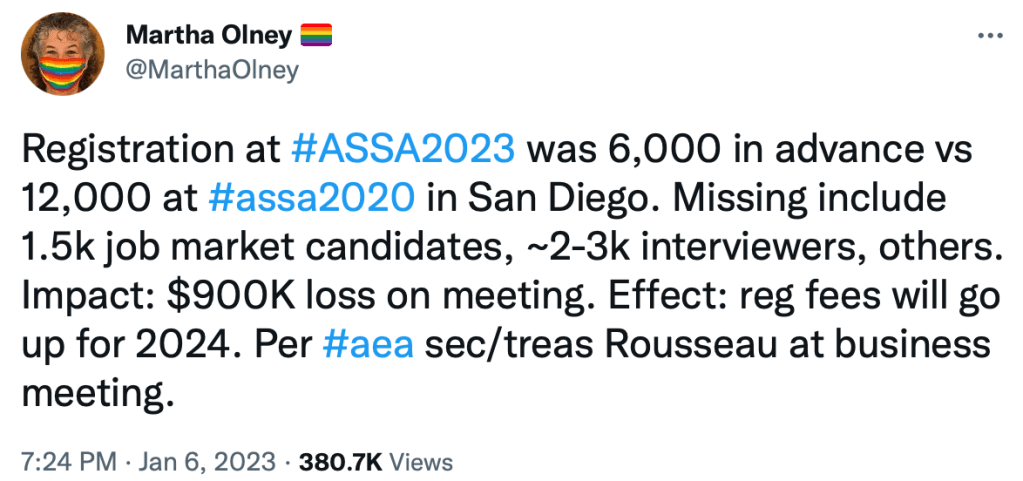
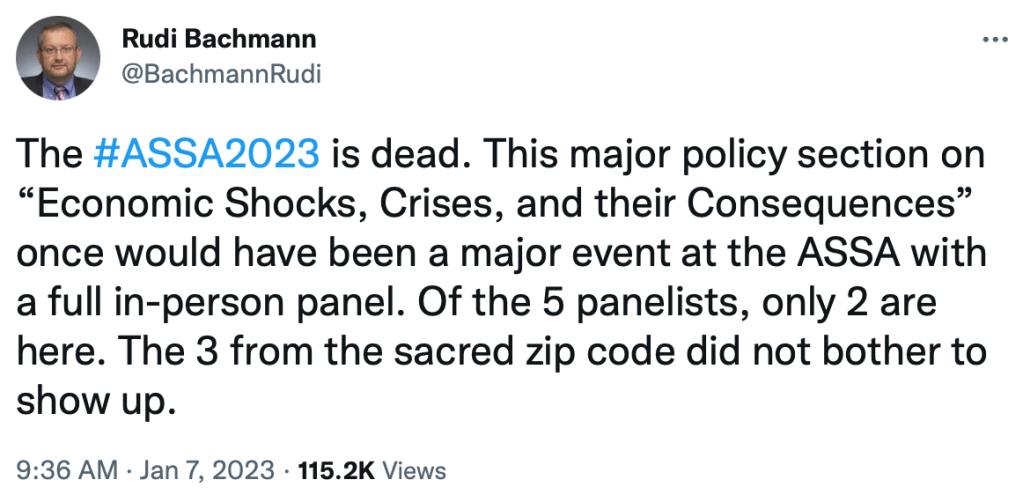
I expected the meetings would shrink, but I was still surprised by how much they did:

That said, I mostly didn’t notice the smaller numbers on the ground, because most of the missing people are those on the job market, who used to spend most of their time shut away doing interviews anyway. There was still a huge variety of sessions and most seemed well-attended. ASSAs is also still unparalleled for pulling in top names to give talks; I got to talk to Nobel laureate Roger Myerson at a reception. But there may be a trend of the big names being more likely to stay remote:

The big problem with attendance falling to 6k is that they’ve planned years worth of meetings with the assumption of 12k+ attendance. Getting one year further from Covid and dropping mask and vaccine mandates might help some, but the core issue is that 1st-round job interviews have gone remote and aren’t coming back. The best solution I can think of is raising the acceptance rate for papers, which in recent history has been well under 20%.

In terms of the actual economic research, two sessions stood out to me:

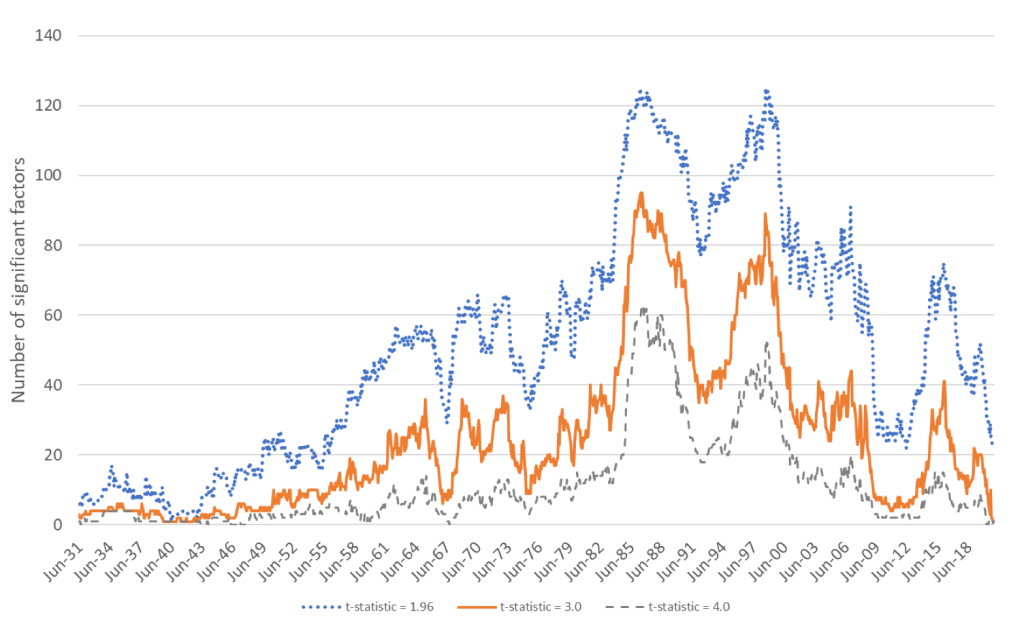
How many factors are there in the stock market? Classic work by Fama and French argues for 3 (size, value, and market risk), but the finance literature as a whole has identified a “zoo” of over 500. Two papers presented one after the other at ASSA argued for two extremes. “Time Series Variation in the Factor Zoo” argues that the number of factors varies over time, but is quite high, typically over 20 and sometimes over 100:

In contrast, “Three Common Factors” argues that there really are just 3 factors, though they are latent and not the same as the Fama-French 3 factors. In this case, the whole zoo of factors in the literature is mostly non-robust results driven by p-hacking and a desire to find more factors (fortune and fame potentially await those who do). Overall these asset pricing papers make me want to look into all this myself; when reading them I’m always struck by an odd mix of reactions- “I don’t understand that”, “why would you do it that way, it seems wrong and unnecessarily complicated”, and “why didn’t the field settle such a seemingly basic question decades ago?”.

Hayek: A Life this session covered the new book by Bruce Caldwell (who taught me much of what I know of the history of economic thought) and Hansjoerg Klausinger. Discussants Emily Skarbek and Stephen Durlauf agreed it is surprisingly readable for a long work of original scholarship, calling it a beautifully written 800p pageturner. Vernon Smith asked Caldwell if Hayek read the Theory of Moral Sentiments. Caldwell: “he cited it.” Smith: “but did he read it? Seems like he didn’t understand it very well.” Caldwell agreed he may not have, or if he did it was a German translation.

Vernon Smith’s own talk featured great comments on market instability: instability in markets comes from retrading. Markets are stable when consumers just value goods for their use, like haircuts and hamburgers. The craziness and potential for bubbles and crashes comes in when people are thinking about reselling something, whether it be tulips, stocks, houses, or crypto.

I asked Bruce Caldwell at a reception how he was able to finish writing such a big book that involved lots of archival work and original research. He said “one chapter at a time”, and noted that its fine to write the easiest chapters first to get the ball rolling.

Overall, while ASSA is diminished from the pre-Covid days and I often disagree with the AEAs decisions, its still a top-tier conference, especially when in New Orleans.