Today I will write about something I care deeply about: the wellbeing of the moms of young children.
I can remember having a child enrolled in preschool. It was expensive but it was worth it, for us. What follows will be most relevant to readers who are working full-time and have children enrolled in full-time daycare/preschool. That is not the right choice for every family. If it’s the choice you made, then read on.
Do less for preschool. Save your energy and money for the years when your child will actually remember.
I’m going to explore a passage from The Dawn of Everything about whether humans reject Western civilization.
The introductory chapter of The Dawn of Everything is called “Farewell to Humanity’s Childhood.” The authors are idealists wrestling with big questions.
We can take [Steven] Pinker as our quintessential Hobbesian. (page 13)
For instance, if Pinker is correct, then any sane person who had to choose between (a) the violent chaos and abject poverty of the ‘tribal’ stage in human development and (b) the relative security and prosperity of Western civilization would not hesitate to leap for safety. (page 18)
Over the last several centuries, there have been numerous occasions when individuals found themselves in a position to make precisely this choice – and they almost never go the way Pinker would have predicted.
For a current research project on institutions, I skimmed The Dawn of Everything (2021).
I liked this passage about an archaeological site in Syria. The following items were found in a destroyed village where people are estimated to have lived 8,000 years ago:
These devices included economic archives, which were miniature precursors to the temple archives at Uruk and other later Mesopotamian cities.
These were not written archives: writing, as such, would not appear for another 3,000 years. What did exist were geometric tokens made of clay, of a sort that appear to have been used in many similar Neolithic villages, most likely to keep track of the allocation of particular resources.
In chunks, the book has fascinating stuff like the quote above. However, D-o-E is the second book I have read this year that tries to do too much. A book on “everything” sounds incredibly fun to write, and I’m the type who would try, so I take these as a warning.
What is more intriguing than history? Emily Wilson said it well, concerning some of the oldest records we have of human words:
I think we should stop selling classics as, “These are the societies that formed modern America, or that formed the Western canon” — which is a really bogus kind of argument — and instead start saying, “We should learn about ancient societies because they’re different from modern societies.” That means that we can learn things by learning about alterity. We can learn about what would it be to be just as human as we are, and yet be living in a very, very different society.
Why do Americans eat a lot of junk food? Because it’s the easy way out.
Unhappy? Open a candy bar. You’ll feel happy again in seconds. Kid crying? Hand them a fun-sized candy bar. They will be quiet.
If you are struggling with paying bills or health (I know, the health one is ironic here), then you’ll tend to reach for anything that is fast and easy to deal with immediate problems.
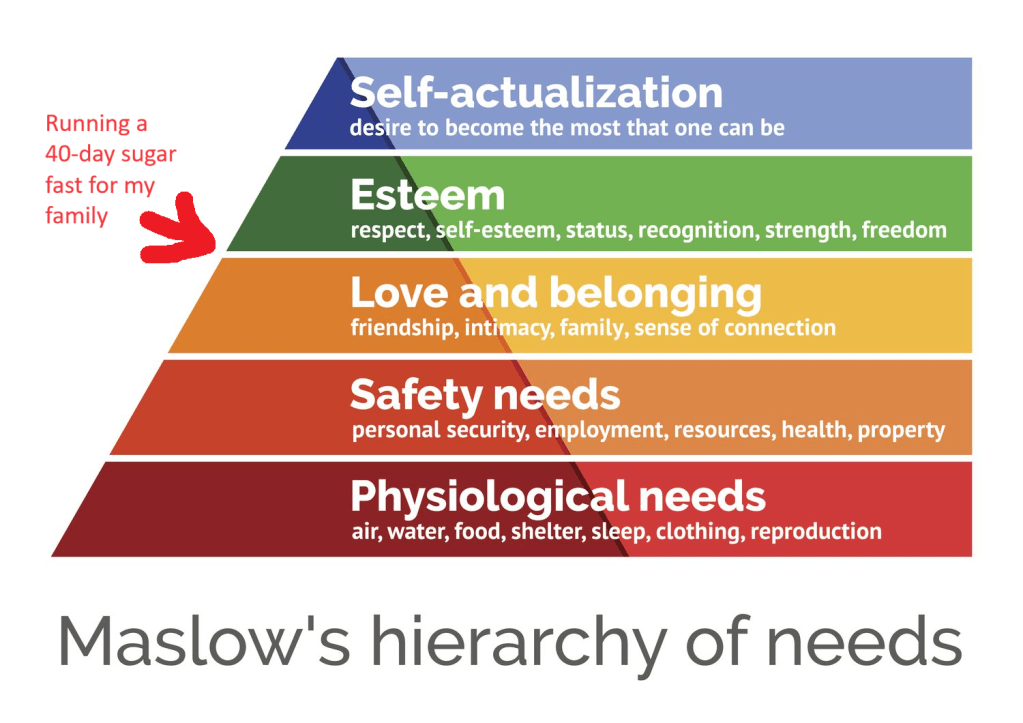
For me, I decided to wait until my semester is over, so I won’t be attempting this while teaching or traveling. A 40-day sugar fast for the whole family technically began on May 1, but the grocery shopping changed earlier. The idea was to eat down junk and not buy new for over a week.
Forty days isn’t much in the big scheme. The idea is to make a deposit on health. Possibly, I’ll break a mild sugar addiction to the point where the body doesn’t expect it so much. Maybe something that we end up doing to meet this artifactual goal will end up getting into the routine on a regular part of the year when there is more travel and work. Part of the problem I identify is that there are points throughout the day where people feel unhappy. If sugar is on hand, then there is a tendency to reach for it. Part of what I’m going to do is insert more healthy food and activities, but of course that is a lot more work. If it’s just not there, people barely miss it.
I’m already so much happier at home. There is barely any sugary junk food left in the house. Now if the kids circulate the kitchen, I don’t have to stress out and yell at them to not eat cookies before dinner or whatnot.
Internet: So, you’re going to meal plan and not eat dessert for a month? This was worth telling everyone?
Me: I’ve been thinking about it constantly since Christmas.
Internet: Wasn’t this the site where we get more optimistic about the world?
Me: There are some things I read about and decided against. I will not worry about sugar in sauces (e.g. Chicken teriyaki bowl). I will not cut out bread or pasta. There is a sliding scale of how healthy you can be and how much time you are willing to put in. I have decided on a level of effort and a fixed amount of time. I’m not even going to turn down cookies if they are offered to us for free. The most important thing is to stop buying junk from the grocery store. It’s financially very cheap, but actually very costly.
P.S. It’s a small step toward getting my personal chef, but I saw an ad for Walmart “emeals” which is more intelligent grocery delivery plus recipes. I haven’t tried it myself, but it seemed like an update on What the Superintelligence Can Do For Us. When I have the equivalent of “former restaurateur, Frances,” in my house, then I just won’t need anything else and innovation can stop there, thanks.
Why does Mark Zuckerberg want to solve general intelligence? Well, for one thing, if he doesn’t, one of his competitors will have a better chatbot. Zuckerberg wants to be the best (and good for him). At his core, he wants to build the best stuff (even the world’s best cattle on his ranch).
If AGI is possible, it will get built. I’m not the first person to point out that this is a new space race. If America takes a pause, then someone else will get there first. However, I thought the Zuck interview was an interesting microcosm for why AGI, if possible, will get made.
… We started FAIR about 10 years ago. The idea was that, along the way to general intelligence or whatever you wanna call it, there are going to be all these different innovations and that’s going to just improve everything that we do. So we didn’t conceive of it as a product. It was more of a research group. Over the last 10 years it has created a lot of different things that have improved all of our products. … There’s obviously a big change in the last few years with ChatGPT and the diffusion models around image creation coming out. This is some pretty wild stuff that is pretty clearly going to affect how people interact with every app that’s out there. At that point we started a second group, the gen AI group, with the goal of bringing that stuff into our products and building leading foundation models that would power all these different products. … There’s also basic assistant functionality, whether it’s for our apps or the smart glasses or VR. So it wasn’t completely clear at first that you were going to need full AGI to be able to support those use cases. But in all these subtle ways, through working on them, I think it’s actually become clear that you do. … Reasoning is another example. Maybe you want to chat with a creator or you’re a business and you’re trying to interact with a customer. That interaction is not just like “okay, the person sends you a message and you just reply.” It’s a multi-step interaction where you’re trying to think through “how do I accomplish the person’s goals?” A lot of times when a customer comes, they don’t necessarily know exactly what they’re looking for or how to ask their questions. So it’s not really the job of the AI to just respond to the question. You need to kind of think about it more holistically. It really becomes a reasoning problem. So if someone else solves reasoning, or makes good advances on reasoning, and we’re sitting here with a basic chat bot, then our product is lame compared to what other people are building. At the end of the day, we basically realized we’ve got to solve general intelligence… (emphasis mine)
Credit to Dwarkesh Patel for this excellent interview. Credit to M.Z. for sharing his thoughts on topics that affect the world.
“we’ve got to solve general intelligence” If a competitor solves AGI first, then you are left behind. No one would not want general intelligence on their team, on the assumption that it can be controlled.
I would like the AGI to do my chores for me, please. Unfortunately, it’s more likely to be able to write my blog posts first.
You know what the biggest problem with pushing all-things-AI is? Wrong direction. I want AI to do my laundry and dishes so that I can do art and writing, not for AI to do my art and writing so that I can do my laundry and dishes.
— Joanna Maciejewska—Myth-Touched is here! (@AuthorJMac) March 29, 2024
I got to be a guest of Vignesh Swaminathan who is based in Mumbai. It’s fun to have a deep conversation with someone on the other side of the world and share it with the whole internet (and the AI’s).
The first 10 minutes are about Tyler’s GOAT book. Vignesh asked me to name some influential economists who did not make Tyler’s list.
Around minute 12 we talk about the experimental economics methodology.
The middle (minute 15-42) is a discussion of the pipeline into tech and my Willingness to be Paid paper. He adds his perspective on tech jobs in India.
Around minute 42, Vignesh makes a switch over to the Barbie movie and then Oppenheimer. He observes that Oppenheimer is a “brand.” I speculate on careers in Barbieland. We recorded this before Christmas of ’23, right after everyone had seen these summer movies. Both movies ended up in the 2024 Oscars awards ceremony.
I predicted that people will eventually be able to create a custom movie from a verbal prompt, because of the AI content revolution. Here in Spring of ’24 that has already come true. Sora is shocking everyone and even caused Tyler Perry to halt a physical film studio expansion.
Around minute 55, we pivot to Hayek and competition, which leads to a postmortem on Google Plus (RIP).
Skimming back through this conversation has me thinking about tech work. The market for IT workers and programmers has evolved since I first started the project that became “Willingness to be Paid: Who Trains for Tech Jobs?”
I like pointing people all the way back to this report on jobs from 1958. Learn to Code has been good advice for a long time, for the people who can tolerate the work. That does not mean it will be true forever, but I would argue that it is still true today.
Silicon Valley as a career might have peaked around 2021. It’s not going away, but it might not be growing anymore in terms of the number of talented people who can be absorbed there. (Might I suggest Huntsville instead?)
The rise of artificial intelligence is affecting job seekers in tech who, accustomed to high paychecks and robust demand for their skills, are facing a new reality: Learn AI and don’t expect the same pay packages you were getting a few years ago.
Jobs in areas like telecommunications, corporate systems management and entry-level IT have declined in recent months, while roles in cybersecurity, AI and data science continue to rise, according to Janco’s data. The average total compensation for IT workers is about $100,000, making the position a target for continued cost-cutting.
One reason tech jobs are less attractive than some other professional paths is that the skillset changes. We mentioned this as a drawback in our policy paper. Computers are constantly changing. Vignesh and I discuss the issue of risk. I suggested that companies could pay less for talent if they were willing to offer packages that carry less risk of getting fired.
Nevertheless, tech still has decent job prospects. An unemployment rate of about 5% is about normal for work, even though tech had seen lower rates at the peak of demand. I do not know what programming as a career will look like in 10 years, but I’d say the same about screenwriting and live sports commentary. The LLMs are coming for everything or nothing or something in between.
I’ve been on tour (regionally) with our ChatGPT paper and getting opportunities to query different audiences about their LLM use. Last week I talked to a young man in our business school who is using ChatGPT to write SQL code at his job. I said in the podcast that I would still advise young people in Alabama to learn to code, even if they are not going to move to Silicon Valley. I think coding is more fun in the LLM-age or at least less miserable.
There were not a lot of successful female writers and academics in the 1970’s. Maybe I underestimate how many there were, but obviously they would have been in the minority. I’m reading a chapter on the anthropologist Mary Douglas who somehow combined raising three children with remaining active in academia. I read a few pages while helping at the Cub Scout camping trip.
In one of her books, Douglas added an apology for professional duties eclipsing domestic ones: ‘All our things have fallen into neglect while I have been writing, floors unpolished, curtains falling off hooks. I am grateful to my family for their patience.’
page 130 of The Slain God by Timothy Larsen
It is irksome to hear this woman apologizing for working what is essentially two jobs and performing so well at each one. (I wouldn’t want to put anyone off reading Larsen, who admires her very much.)
I had planned to do this a year ago, but then I ended up writing papers on artificial intelligence and doing a bunch of related speaking engagements. (I love it – anyone who wants a speaker on ChatGPT should invite me out.) Anyway, I’m going to try to do the equivalent of fixing the “curtains falling off hooks.” The curtains really do fall down. You could have a well-functioning household and drawers full of clothes that fit your children… and then if someone is not engaged in constant warfare… it will all fall apart in about 6 months.
To be on Cowen’s short list is a compliment. Of all the thinkers and writers in recorded history, Adam Smith is one of only six writers that Cowen gives serious consideration to. Next, readers will ask, “Did our guy win?”
Tyler’s book will make no one happy because he does not take anyone’s side unequivocally. A huge fan of Adam Smith (and I know several) might have wanted a book about why Adam Smith is designated as the GOAT. I don’t want to ruin the book for anyone who hasn’t read it. What you will get is very interesting and thoughtful, so I hope you’ll read the manuscript* sometime, even if your guy doesn’t win.
*completely free – can get it on your Kindle somehow I heard
What We Are Learning about Paper Books – I did write the AdamSmithWorks post in collaboration with the GPT version of the book, as a first step, along with my own memory of having read the book. And then, secondly, I consulted the book manuscript. The GPT performed fairly well… considering that it’s a GPT. I suppose I thought that interrogating the GPT would save me time. However, I can now say authoritatively that Tyler’s actual writing is so much better than what you will get from the GPT. Among other things, the GPT is much more boring than Tyler’s actual manuscript.
I’m not using all of it, but it’s very helpful to see what other instructors have come up with to make teaching monetary policy more fun and more effective. You have to sign up to access it, using your official instructor email address.
It can feel relatively easy to talk to students about their role in the economy as consumers. It is relatively hard to lecture about central banking, because it is less relatable to everyday life. These exercises help us get into the “mind” of a bank.
Thank you to Econiful and Marginal Revolution University for making these resources available. There will probably be an equivalent for fiscal policy produced in the future.
This is a transcript of Lex Fridman Podcast #419 with Sam Altman 2. Sam Altman is (once again) the CEO of OpenAI and a leading figure in artificial intelligence. Two parts of the conversation stood out to me, and I don’t mean the gossip or the AGI predictions. The links in the transcript will take you to a YouTube video of the interview.
(00:53:22) You mentioned this collaboration. I’m not sure where the magic is, if it’s in here or if it’s in there or if it’s somewhere in between. I’m not sure. But one of the things that concerns me for knowledge task when I start with GPT is I’ll usually have to do fact checking after, like check that it didn’t come up with fake stuff. How do you figure that out that GPT can come up with fake stuff that sounds really convincing? So how do you ground it in truth?
Sam Altman(00:53:55) That’s obviously an area of intense interest for us. I think it’s going to get a lot better with upcoming versions, but we’ll have to continue to work on it and we’re not going to have it all solved this year.
Lex Fridman(00:54:07) Well the scary thing is, as it gets better, you’ll start not doing the fact checking more and more, right?
Sam Altman(00:54:15) I’m of two minds about that. I think people are much more sophisticated users of technology than we often give them credit for.
Sam Altman(00:54:21) And people seem to really understand that GPT, any of these models hallucinate some of the time. And if it’s mission-critical, you got to check it.
Lex Fridman(00:54:27) Except journalists don’t seem to understand that. I’ve seen journalists half-assedly just using GPT-4. It’s-
Sam Altman(00:54:34) Of the long list of things I’d like to dunk on journalists for, this is not my top criticism of them.
As EWED readers know, I have a paper about ChatGPT hallucinations and a paper about ChatGPT fact-checking. Lex is concerned that fact-checking will stop if the quality of ChatGPT goes up, even though no one really expects the hallucination rate to go to zero. Sam takes the optimistic view that humans will use the tool well. I suppose that Altman generally holds the view that his creation is going to be used for good, on net. Or maybe he is just being a salesman who does not want to publicly dwell on the negative aspects of ChatGPT.
I also have written about the tech pipeline and what makes people shy away from computer programming.
Lex Fridman(01:29:53) That’s a weird feeling. Even with a programming, when you’re programming and you say something, or just the completion that GPT might do, it’s just such a good feeling when it got you, what you’re thinking about. And I look forward to getting you even better. On the programming front, looking out into the future, how much programming do you think humans will be doing 5, 10 years from now?
Sam Altman(01:30:19) I mean, a lot, but I think it’ll be in a very different shape. Maybe some people will program entirely in natural language.
Someday, the skills of a computer programmer might morph to be closer to the skills of a manager of humans, since LLMs were trained on human writing.
In my 2023 talk, I suggested that programming will get more fun because LLMs will do the tedious parts. I also suggest that parents should teach their kids to read instead of “code.”
The tedious coding tasks previously done by humans did “create jobs.” I am not worried about mass unemployment yet. We have so many problems to solve (see my growing to-do list for intelligence). There are big transitions coming up. Sama says GPT-5 will be a major step up. He claimed that one reason OpenAI keeps releasing intermediate models is to give humanity a heads up on what is coming down the line.
 Economist Writing Every Day