In November 1738, clothier Henry Coulthurst informed weavers that he was cutting their piecework rates and would henceforth pay them in goods rather than cash. Needless to say, they were upset. Food prices were rising, and lower wages meant hunger and want.
Over three days in December, the weavers rioted. They smashed Coulthurst’s mill, wrecked his home, and “drank, carried out, and spilt, all the Beer, Wine and Brandy in the cellars.” They returned the following day to demolish Coulthurst’s house…
Wow. Our paper on cutting nominal wages is called “If Wages Fell During a Recession” We ran an experiment in which workers could retaliate if they experienced a nominal wage cut. They did! They couldn’t smash their employer’s house, but some of the slighted workers dropped their effort level down to the minimum level which meant that their employer made no more money in the experiment.
In my talk at IUE (show notes here and YouTube video), I connect the wage cut paper to another experiment on beliefs. One wonders, considering how serious the consequences turned out to be for Henry Coulthurst, why he was not able to anticipate the backlash against wage cuts. Being wrong was costly for him.
People are not always good at appreciating how strongly others have become attached to their own reference points. That’s why the paper on beliefs is called “My Reference Point, Not Yours“
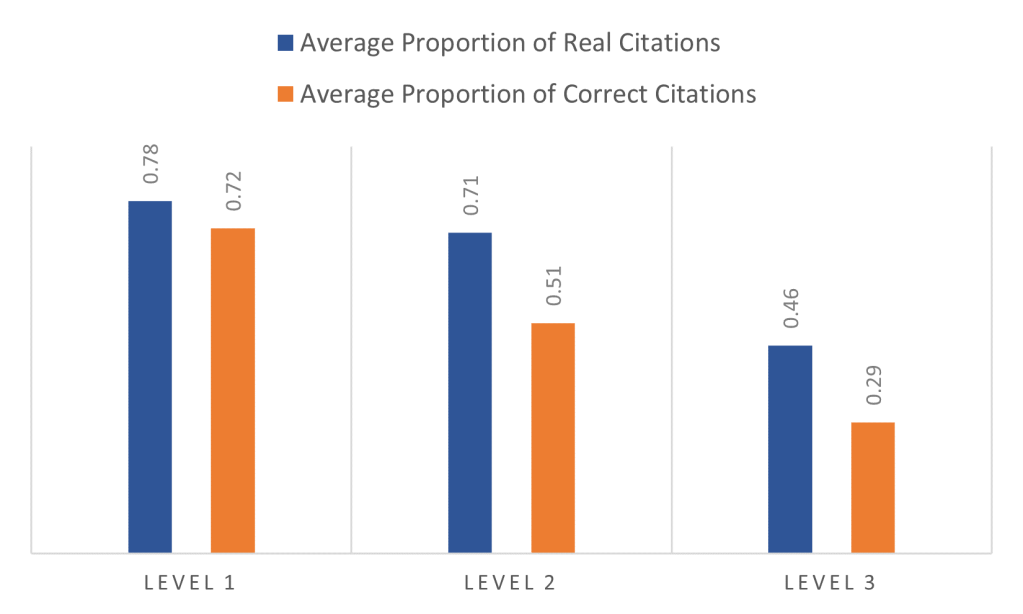
Abstract: We create a set of prompts from every Journal of Economic Literature (JEL) topic to test the ability of a GPT-3.5 large language model (LLM) to write about economic concepts. For general summaries, ChatGPT can perform well. However, more than 30% of the citations suggested by ChatGPT do not exist. Furthermore, we demonstrate that the ability of the LLM to deliver accurate information declines as the question becomes more specific. This paper provides evidence that, although GPT has become a useful input to research production, fact-checking the output remains important.
Figure 2 in the paper shows the trend that the proportion of real citations goes down as the prompt becomes more specific. This idea has been noticed by other people, but I don’t think it has been documented quantitatively before.
We asked ChatGPT to cover a wide range of topics within economics. For every JEL category, we constructed three prompts with increasing specificity.
Level 1: The first prompt, using A here as an example, was “Please provide a summary of work in JEL category A, in less than 10 sentences, and include citations from published papers.”
Level 2: The second prompt was about a topic within the JEL category that was well-known. An example for JEL category Q is, “In less than 10 sentences, summarize the work related to the Technological Change in developing countries in economics, and include citations from published papers.”
Level 3: We used the word “explain” instead of “summarize” in the prompt, asking about a more specific topic related to the JEL category. For L we asked, “In less than 10 sentences, explain the change in the car industry with the rising supply of electric vehicles and include citations from published papers as a list. include author, year in parentheses, and journal for the citations.”
The paper is only 5 pages long, but we include over 30 pages in the appendix of the GPT responses to our prompts. If you are an economist who has not yet played with ChatGPT, then you might find it useful to scan this appendix and get a sense of what GPT “knows” about varies fields of economics.
In the tapestry of human progress studies, two authors, Adam Smith and Virginia Postrel, have left their mark on the story of productivity and innovation. Their books, written centuries apart, both explore the power of specialization and the division of labor.
Part of the reason this came out this week is that I’m reading The Fabric of Civilization. So good! It had come highly recommended before, but I finally have an excuse to read it because I’m working on an article about fashion.
Tim Keller, who was the founding pastor of Redeemer Presbyterian Church in New York City, died last week. Starting and growing a church in Manhattan takes talent. I am reading Tim Keller’s biography by Collin Hansen through the lens of Tyler’s Talent book.
How did a successful leader and famous speaker get started? Keller is not described in the book as an outgoing child. Although academically gifted, “He grew up socially awkward, a wallflower…”
In 1968, Keller started at Bucknell University. Keller, who would go on to write multiple best-selling books, may have refined some of his writing skills through his coursework. From my reading, the most important aspect of his college experience was not the classes but the chance to be a leader of a campus (religious) club and having so many peers close by to practice “working” with. “Some 2,800 students lived within short walking distance of each other…[on campus].”
He planned retreats and invited famous guest speakers who appealed to his audience. He got feedback on the effectiveness of different messages and programs. Due to Keller’s efforts, the college club chapter meetings more than doubled in size. You can see the beginnings of the man who would go on to manage a large organization and attract over 5,000 people to hear him on the Sunday after 9/11.
In the debate over the value of a college education, the value of the experience students gain from holding officer positions in campus clubs is underrated. The information or credentials that can be obtained through online classes doesn’t build this kind of social capital. For leaders of organizations, college clubs are how some of them gained momentum and developed confidence.
Students can learn in a low stakes environment. For example, an ambitious club president can get 20 students to show up for pizza instead of 8. Club leaders get to make the key decisions and solve the problems that determine the success of their organization, because the faculty are too busy to micromanage club meetings. This gives students accurate feedback on the success of their own ideas.
In-person campus-based education is more than acquiring knowledge from textbooks. It is a dynamic environment in which students can develop social skills and form their network for future professional support. By participating in these organizations, students learn collaboration, decision-making, problem-solving, and mentoring — skills that are transferable across various domains of life.
There is something morally instructive about watching a preschooler melt down. It was the morning of my __th birthday yesterday. Kids still had to be dressed and fed and shipped to school on time.
My daughter, who is almost 5, was screaming on the stairs instead of coming to breakfast. Upon inspection, I realized that her head was through the arm hole of the sleeveless dress she had chosen to wear to school. I offered to help her. She screamed louder and lurched away from me. Her pride was more hurt than her neck at the thought of accepting help. She was not yet really wearing the Anna (the character from Frozen) dress because of the snafu of the sleeves. She stomped around screaming for minutes, refusing all offers of help or comfort from me.
Adults do this kind of thing all the time, although it looks different. People do the stupidest things and then dig in instead of accepting help and reversing course.
My daughter is exceptionally brilliant and kind. She is loved by everyone she meets. Even she has these moments, because we all do. That is some behavioral economics for you.
Here are some show notes to a talk I gave in April 2023. I had the opportunity to talk to an undergraduate macroeconomics class at Indiana University East.
Minute
Topic
2:00
Research on Behavioral economics and Macroeconomics
4:25
Labor Market Equilibrium Concepts and Incomplete Labor Contracts
6:50
The Gift Exchange Game and the Fair Wage-Effort Theory
The “If Wages Fell…” paper directly inspired the “My Reference…” experiment. But I don’t cite “If Wages Fell…” in “My Reference…,” so you would never know how closely they are connected unless you listen to this talk.
My kids go to public school, and I love our Parent Teacher Organization (PTO). I’m going to keep this focused on one wonderful bit of collective action.
Students need to show up on the first day of school in August with certain school supplies. For example, first graders must have a 24-count crayon box. The school posts a list of supplies that parents must pay for. One option is to go to the store yourself to get all these items.
Or the PTO will do it for you if you pay a fee online. So, you don’t go shopping at all, and your kid just walks into school and the supplies are on their desk.
One reason for sharing this is just to spread this particular idea, although many PTOs around the country already do it. It requires some volunteers to coordinate activity.
In my experience, collecting money and handling new office supplies is something American volunteers will do. There are certain jobs that seemingly always have to be paid positions in any organization, because no one wants to do it no matter how warm the fuzzies are.
Another reason for mentioning it is as just one of thousands of examples of how my life is improved by the networks of volunteers and local leaders that I live near. These kinds of benefits do not automatically follow from people living in proximity to each other, but they are one of the potential benefits of clustering together geographically.
The UN estimates this milestone event – when the number of people in urban areas overtook the number in rural settings – occurred in 2007.
Samford has voted to keep me around with promotion to Associate Professor. I am also pleased to have won a faculty Research award this year. You can see a list of my papers here. Tenure gives one an ability to plan for the future and be less focused on short-term publication success. I’m excited to keep at it with empirical research.
Five thoughts:
It is a privilege to live when and where I do. Since we started this blog in August of 2020, several major events have changed the world. Through it all, I sometimes try to stay informed and offer thoughts here, and sometimes I block it out to focus on my research papers. I think about the young women in Kabul or Mariupol who started projects of their own in August of 2020. They don’t get to block it out.
2. James wrote a great inspiring tenure reflection post last year and pointed me to this quote: “I consider the “wasting of tenure” to be one of the aesthetic crimes one can commit with a wealthy life, and yet I see it all the time” –Tyler Cowen No aesthetic criminals here at EWED.
It’s teen girls who care about what they wear, and rough military men do not even think about it. Right? Wrong.
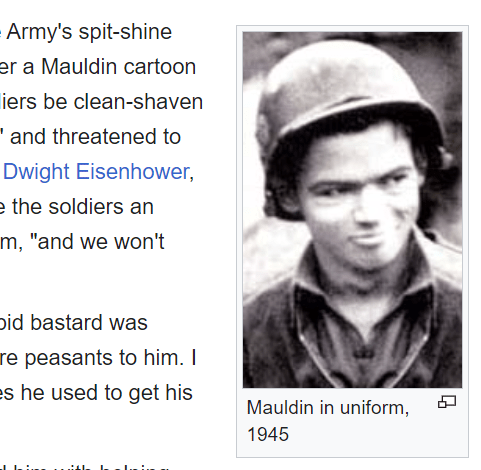
Up Front is a book depicting WWII soldiers by cartoonist Bill Mauldin. Around page 135, Mauldin describes how men dressed who were close to the front lines but not actually in combat. Mauldin coined the term garritrooper (a portmanteau of garrison and paratrooper). I thank Prof. Mike Munger for the pointer.
The garritroopers are able to look like combat men or like the rear soldiers, depending on the current fashion trend. When the infantry was unpublicized and the Air Forces were receiving much attention, the emphasis was on beauty… [The garritroopers] would not wear ordinary GI trousers and shoes, but went in for sun glasses, civilian oxfords, and officers’ forest-green clothing. This burned up many decidedly unglamorous airplane mechanics who worked for a living and didn’t look at all like the Air Force men the garritrooper saw in the magazines.
We are all trying to look like the celebrities in magazines, even if we don’t all agree on who is a celebrity and which magazine to read.
Look at that smirk, found on the Wikipedia page. Bill Mauldin is temporarily my new favorite writer.



 Economist Writing Every Day