Drone Racing is Poised to Grow

  1. Observations from the World Games

Drone racing was an event at the World Games in my city. Now I know it exists (as does canoe polo!).

The composition of contestants was interesting. One pilot was only 14 years old, the youngest person competing in the 2022 World Games. Another pilot was in a wheelchair. Drone racing is for sports like Work From Home is for professional jobs – the number of competitors is potentially enormous.

Spectators reported that it was hard to follow the actual drones with your eyes. People in the stadium for the race usually watched the jumbo screens that show the point of view of the pilots. This raises the question: why bother with the drones at all when we could just be doing e-sports? There is something special about the extra challenge of a physical race. The machinery adds a NASCAR-like element, and it gives people an excuse to gather together.

Videos, if you’d like to get a sense of how the sport works:

Championship Race: Xfinity CA Drone Speed Challenge, 2018

Maine drone racer heads to the World Games

2. Thoughts on the Future

Polaris published an industry report that predicts growth.

Drone racing will grow in the United States. This seems like a sport that will appeal to Generation Alpha and their parents.

As a parent, I would support it. It’s expensive, so that’s going to be prohibitive for a while, but millions of Americans bought drones at some point in the last decade. Drones get broken in races, but the cost of components is coming down. Part of the sport is being able to repair and build your own custom drones.

A handful of US high school already have drone racing clubs. Adults will be able to point to the value of learning technology that comes along with racing for fun.

Continue reading

Perks in Severance

I have written three blogs on the TV show Severance this summer. My newest post is up at the Online Library of Liberty.

I discuss how job perks are portrayed in the show. The bosses in the show are creepy and we come to find out that they are totally evil. Given the way everything feels in the show, you could come to the conclusion that perks are generally manipulative and false. Someone implied that in an op-ed published by the NYT.

My argument is that free adults can use “perks” to motivate themselves and each other to do the right thing.

We are all just trying to get that dopamine, in the short term. Should people only feel happy when they are doing drugs or playing video games? Should bosses not be allowed to create a fun moment at work?

Trivial gifts and prizes must be cheap, so that their cost does not start to outweigh the benefits of incentivizing things we should be doing anyway. Finding ways to make a responsible life exciting is in fact the key to maintaining our liberty. Most people do not want to be martyrs. They want life to be fun.

The following tweet shows the character Dylan and his performance prize.

Behavioral scientists have documented lots of quirks in human behavior. We aren’t solely motivated by our (real wage) salaries to produce effort. The good news is that we are capable of self-reflection. We can make these quirks work for us. Lots of successful people will promise themselves a small reward at the end of the week if they accomplish something hard.

Perks aren’t all bad at work, but, on the other hand, Severance could make you more alert to genuine manipulation that is out there.

Watching Severance prompts good questions. Who are you? (That’s the opening line of the show.) What are you doing with your life? Whose purposes are you serving?

I liked the show because it has great characters, funny moments, and it gets you thinking. If you watch the show, don’t take it too seriously. Ben Stiller is a co-director. The man (the genius) brought us Zoolander (2001).

One give-away that this ain’t the new 1984 is a plot hole concerning how the main character Mark decided to sever himself and join the evil corporation. According to the show, his wife died and he was so sad that he quit his job as a history professor after three weeks of feeling sad. I know a lot of academics. History professors have worked too hard and too long to quit their jobs after three weeks of feeling sad. Take everything with a grain of salt from these writers. Mark’s general lack of executive control is at odds with the backstory that he once obtained a job as a history professor.

Severance is described as science fiction but it clearly takes place in the United States of America. For one thing, a “senator” has a role. For another thing, the work schedule is pretty American. This is a funny video on how Europeans view the American work schedule:

I have no idea how far down the rabbit hole the writers will feel like they have to do in Season 2. Will there be a role for a POTUS?

The second blog was posted to EWED: my thoughts about relating Severance to Artificial Intelligence.

A question this raises is whether we can develop AGI that will be content to never self-actualize.

And, back in May, OLL ran my first blog about Severance and drudgery.

The first line in the show is, “Who are you?” Themes about identity and purpose are explored alongside the thrilling hijinks of the prisoner innies. Outie Mark has nothing except his personal life to think about, which in his case is tragic. Innie Mark has nothing but work. Neither man is happy or complete.

Birmingham AL hosts The World Games

Have you heard of The World Games? It’s the Olympics for sports that are too random to be in the real Olympics. It is happening right now in Birmingham, AL. It’s not too late to get your tickets to see Canoe Polo.

For people interested in regional politics, this blog about the city successfully hosting a major event might be interesting. His references to people in “the suburbs” is something you won’t understand without some context and history. But you don’t have to be a local to learn that history, since everything is online.

Continue reading

Teaching with ACS regional data

If you are teaching a quantitative college course, then you have probably thought about where to get data that students can practice with.

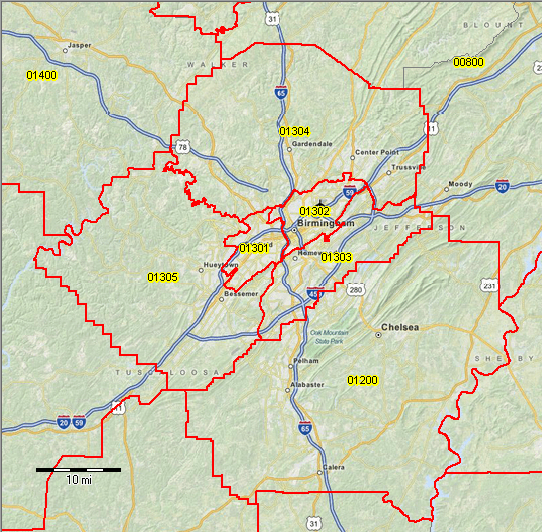
Public Use Microdata Areas (PUMAs) are non-overlapping, statistical geographic areas that partition each state or equivalent entity into geographic areas containing no fewer than 100,000 people each. The image here shows PUMAs around Birmingham, AL. I created a dataset for my students that includes demographic data from the American Community Survey (ACS) for the region around our university.

For just about any topic you would teach in stats, I can create a mini assignment using data on the people around us. Any American metro area has clusters of high-income households and clusters of low-income households. One example of a an exercise is to create summary statistics on income by PUMA. Students will be surprised to learn the facts about their own city.

Zachary has blogged about how great IPUMS is. The way I obtained the data was to make a free account with IPUMS. If you asked for data on every American, you’ll end up with an unwieldy big file. The trick is to filter out all but a handful of PUMAs. I also recommend restricting it to just one year unless you are teaching time series techniques.

I originally got the idea from Matt Holian. Matt wrote fantastic book called Data and the American Dream. The book has data and R codes that allow you to reproduce the findings from several interesting econ papers that all use ACS data. I’m not teaching material that overlaps perfectly with Matt’s book, so I couldn’t assign it to my students, but I did borrow some elements of his idea and even (with his permission) some of his code.

The World is Watching Top Gun Maverick

I see that you’re hurtin’, why’d you take so long

To tell me you need me? I see that you’re bleeding
You don’t need to show me again
But if you decide to, I’ll ride in this life with you
I won’t let go ’til the end

So cry tonight
But don’t you let go of my hand
You can cry every last tear

These are the lyrics to the song sung by Lady Gaga in the closing credits of Top Gun: Maverick. This song has been on the Billboard Top 100 chart for 6 weeks. The film TG:M is on its way to breaking a billion dollars worldwide at the box office this year. People (millions of people in every demographic all over the world) want to see Tom Cruise, playing himself (j/k), save the day. At the end of the movie they expect you to want to cry, and then Lady Gaga tells you to just let it out.

The only bit of acting that was hard to believe in the movie was the guy who was trying to play the arrogant jerk. The writers were trying to inject some drama with his lines, but the whole cast was so good-hearted and earnest. These folks seemed about 2 meters from heaven, and I don’t just mean because of flying at high altitudes.

After seeing TG:M in theaters this weekend, I watched the original 1986 movie (free on Amazon Prime right now) for comparison. The locker room banter in TG1 seemed more genuinely mean-spirited. That was back when bullies were bullies and no one was afraid of getting canceled?

Continue reading

Nudging Students to Choose a Major

In one sense, it seems like advice does not work. Advice is often ignored and sometimes even resented. People are going to just do what they want.

And yet, many people were in fact influenced by advice at some point in some situation. Many people can tell you about a mentor they spoke with or a book they read. Somehow, we do indeed need to learn about our environments and make choices about career and health and relationships. So, advice does work, sometimes.

A trivial example is why I stopped putting sugar in my coffee. A random anonymous message board post said that you should stop putting sugar in your coffee and your taste will adjust. “You won’t even miss it,” the anonymous poster told me. From that day forward, I stopped putting sugar in my coffee. I’m healthier and I don’t miss it. I was “nudged”. I was also predisposed to make this healthy decision, and I had sought out advice.

We might overestimate the effectiveness of advice because when people bother to talk about it, they mention the one time it affected them. First, they fail to mention the thousands of messages that had no effect (personally I still eat all kinds of junk food that contain sugar despite getting warnings to stop). And secondly, some decisions (perhaps including my coffee-sugar example) would have been made eventually without the advice event. Even recognizing those limitations, I still believe that messaging works sometimes.

It is tempting to think that, at almost zero cost, you could nudge people into making different decisions, just by sending them messages. There is a growing literature on this topic. Economists like myself are collecting data on whether it works.

One of these papers was just published:

Halim, Daniel, Elizabeth T. Powers, and Rebecca Thornton. 2022. “Gender Differences in Economics Course-Taking and Majoring: Findings from an RCT.” AEA Papers and Proceedings, 112: 597-602.

We implemented an RCT among undergraduate students enrolled in large introductory economics courses at the University of Illinois at Urbana Champaign. Two treatment arms provided encouragement to major in economics. A “prosocial” treatment provided information emphasizing the wide variety of career options and personal benefits associated with the major, while an “earnings” treatment provided information on financial returns. We evaluate the effects of the two treatments on subsequent choices to take another economics course and declaration of the economics major by the end of the student’s junior year using student-level matched administrative data. … Our primary aim is to evaluate whether women can be “nudged” into a major with low-cost, theoretically grounded, encouragement/information interventions.

Our primary sample consists of 1,976 students who were freshmen or sophomores during the focal course.

We find that the average male student receiving either treatment is more likely to take at least one more economics course after the focal course, but there is little evidence of increased majoring. The average woman appears unresponsive to either treatment.

Treated women with better than-expected focal-course performance are nudged to take an additional economics course. The likelihood that a woman takes another course in response to treatment increases by 5.6-5.9%-points with a favorable one-third- grade “surprise”. The hypothesis of treatment effects on women’s majoring, mediated or not, is rejected. Men’s susceptibility to treatment is invariant with respect to focal course performance.

Women did not demonstrate a bias towards a pro-social framing, and men did not demonstrate a bias towards a pro-earnings framing.

The pile of null results for messaging, when it is randomly assigned, is growing. It’s good to see null results get published though.

One of my current projects is related, but with a focus on computer programming instead of majoring in economics.

Thoughts for the week on podcasts and the Constitution

  1. Jamal Greene was the most recent guest on Conversations with Tyler. This is how Greene describes his work habits as an academic with children:

GREENE: … my most effective work habit is to use the entire day to work. I get a lot of work done late at night. Most of my time during the day is spent teaching classes or meeting with students, and all writing and reading and preparation and everything is much later. That means I don’t watch television shows. It’s a really extended workday.

I work during soccer practices. I work sitting in the car while my kids are doing something or other. I don’t segregate times of the day where I can’t work.

One thing I find personally is that if I’m doing empirical work then I really need to be inside with at least one external monitor. As much as I like the idea of working from the pool (referencing the viral video of the week) being at my office is the best set up.

2. Currently I am teaching an online asynchronous class. Considering that my students are on the move in different places right now, I decided to create a podcast assignment. This seems to have gone over well. One student had a criticism for the episode that she chose: it was not entertaining. Another student complained that his episode had too much fluff about the personal lives of the speakers. This raises the interesting question of how the experts manage to make podcasts informative without being boring. It’s an art. Talking about your personal life to break up the subject matter can work but it can also feel like a waste of time.

3. For a discussion group, I read The Essential Federalist and Anti-Federalist Papers.

Something that stood out to me was the sheer intensity of these guys. Liberty is a serious topic, but I’ll just share something that is funny from the book.

In the middle of a long fiery speech of Patrick Henry, the book inserts a line in brackets:

What will then become of you and your rights? Will not absolute despotism ensue? {Here Mr. Henry strongly and pathetically expatiated on the probability of the President’s enslaving Americans, and the horrible consequences that must result.}

A footnote explains that stenographer had difficulty keeping up with Mr. Henry and was occasionally reduced to recording a mere summary of his words. It’s impressive that a stenographer could have gotten as much as they did.

I came away from the book thinking that people should talk more about this moment in history, and then I started noticing when people do talk about it. In fact, Tyler was interviewing a constitutional scholar this week and explicitly addressed the idea of “federalism.”

4. The debate does rage on 200+ years later.

Continue reading

No in-group bias from financial choices in latest experiment

“How Dictators Use Information about Recipients” is my new project with Laura Razzolini. A working paper is up at SSRN. We use the Dictator Game to measure if people are generous toward others who made a similar choice.

In the first stage of the experiment, every player gets to make their own choice about whether or not to invest in a risky option (called Option B). Players can pick Option A if they do not want to invest.

In the second stage, participants get to decide if they will send any money to another anonymous player. If a “dictator” (the person who determines the final allocation of money) decided to take the risk on Option B in stage 1, would they be more generous toward a counterpart if they know that person also picked Option B?

We explain in our paper why the literature indicates such a form of favoritism could be expected.

Social identity theory is the psychological basis for intergroup discrimination. Economic experiments have created feelings of group identity in various ways, leading to significant effects on behavior. Chen & Li (2009) demonstrate that group identity formation can affect social preferences.

Chen and Li (2009) started by having subjects review paintings by two different modern artists. The subjects were divided into two groups, based on their reported painting preferences. Subjects were informed about their group membership by the experimenter.

The Chen and Li paper has been cited almost 2000 times. Group identity is a topic of interest. Several experimental papers demonstrate that strangers can have team feelings induced quickly with the right procedures. Those team loyalties affect behavior in incentivized tasks.

Group feelings artificially induced in the lab by Eckel & Grossman (2005) influence levels of cooperation and contributions to public goods. Pan & Houser (2013)  induce group identities by asking subjects to complete tasks in groups.  Pan & Houser (2019) found that investors trust in-group members more. The in-group has been induced in several different ways in lab experiments. In this paper, we investigate whether in-group effects arise from making a common financial decision in the first stage of the experiment.

Do you think our manipulation in the beginning affected giving?

Nope. There was no effect. Dictators who chose Option B did not give more to recipients who also chose Option B.

Not every result in the paper is a null result. One piece of information caused a large increase in giving. If we inform the dictator that their counterpart started with less money in the first stage (due to bad luck) then the dictator would give more. Sympathy was inspired, as we predicted, by knowing if a recipient was “poor” in the experiment. Conversely, if dictators are informed that their counterpart is “rich” then they excused themselves from having to give up money to help.

Information about financial choices, at least in our sterile simple environment, neither polarized nor united the participants. The giving with only choice information was higher than giving to “rich” but lower than giving to “poor”. Lastly, we provided all of the information at once. With full information, dictators were still heavily influenced by the starting endowments and choices information had no effect.

Understanding polarization is important. Humans exhibit tribal instincts to not help those who are perceived as different. In our experiment we seem to have found one difference that that people are willing to tolerate or overlook.

See also my Works in Progress blog about polarization and a different experiment.  

References

Chen, Yan, and Sherry Xin Li. “Group Identity and Social Preferences.” American Economic Review 99, no. 1 (March 2009): 431–57.

Eckel, Catherine C., and Philip J. Grossman. “Managing Diversity by Creating Team Identity.” Journal of Economic Behavior & Organization 58, no. 3 (2005): 371–92.

Pan, Xiaofei, and Daniel Houser. “Why Trust Out-Groups? The Role of Punishment under Uncertainty.” Journal of Economic Behavior & Organization 158 (2019): 236–54.

Pan, Xiaofei Sophia, and Daniel Houser. “Cooperation during Cultural Group Formation Promotes Trust towards Members of Out-Groups.” Proceedings of the Royal Society B: Biological Sciences 280, no. 1762 (July 7, 2013): 20130606.

Artificial Intelligence in the Basement of Lumon Industries

For some background on the new TV show Severance, see my OLL post about drudgery and meaning for the characters.  

The fictional “severance procedure” divides a worker’s brain such that they have no memories of their personal life when they are at the office. When they return to their personal life, they have no memories of work. One implication is that if workers are abused while working at Lumon Industries, they cannot prosecute Lumon because they do not remember it.

The workers, as they exist in the windowless basement of Lumon, have the skills of a conscious educated human adult. They have feelings. They can conceive of the outside world even though they do not know their exact place in it. Often, the scenes in the basement feel normal. They have a supply closet and a kitchen and desks, just like most offices in America.

What the four main characters do in the basement is referred to as “data refinement.” They perform classification of encoded data based on how patterns in the data make them feel. The task is reminiscent of a challenge most of us have done that involves looking at a grid and checking every square that contains, for example, a traffic light. The show is science fiction but the actual task the workers perform is realistic. It seems like something a computer could be trained to do, if fed enough right answers tagged by humans (called “training data” by data scientists). Classification is one of the most common tasks performed by computers following algorithms.

Of the many themes viewers can find in Severance, I think one of them is how to manage AGI (Artificial General Intelligence). The refiners, who are human, eventually decide to fight back against their managers. They are not content to sit and perform classification all day. They are fully aware of the outside world, and they want to be part of it (like Ariel from The Little Mermaid). The workers desire a higher purpose and some control over their own destiny. Their physical needs are met so they want to get to the top of Maslow’s hierarchy of needs.  

A question this raises is whether we can develop AGI that will be content to never self-actualize. What if “it” fully understands human feelings and has read all of the literature of our civilizations. To be effective at their jobs, the refiners have to be be able to relate to humans and understand feelings. Can we create AGI that takes over certain high-skill tasks from humans without running into the problems that Lumon confronts?

Can humans create an AI that simply doesn’t have aspirations for autonomy? Is that possible? Would such a creature be able to integrate with humans in the way that would be most useful for high-skill work tasks?

To see how it’s going in 2022, check out these tweet threads of economists on GPT-3. Ben Golub declares that GTP-3 passes the Turing test for questions about economics. Paul Novosad asked how the computer would feel if humans decided to shut it down forever.

Modern authoritarian states face a similar problem. They want a highly skilled workforce. National security relies increasingly on smarts. (see my previous post on talent winning WWII) Will highly intelligent workers doing high skill tasks submit to a violent authoritarian state?

Authoritarian states rely on the control of information to keep their citizens from knowing the truth. They block news stories that make the state look bad. As a result, their workers do not really know what is going on. Will that affect their ability to do intellectual work?

An educated young woman from inside of Russia shared her thoughts with the world at the beginning of Putin’s invasion. Tatyana Deryugina provided an English translation.

First the young Russian woman explained that she is staying anonymous because she will get 15 years in a maximum-security prison for openly expressing her views within Russia. She is horrified by the atrocities Russia is committing in Ukraine. She had been writing a master’s thesis in economics prior to the invasion, but now she has abandoned the project. She feels hopeless because she knows enough about the West to understand just how dark her community is and how small her scope of expression is. This woman could have been exactly the kind of educated worker that makes a modern economy thrive. She is deeply unhappy under Putin. Even though she might never openly rebel, she will certainly not reach her full potential.

Is it hard for authoritarians to develop great talent? I think that has some implications for the capacity we as a human species will have to cultivate talent from intelligent machines.

Lumon Industries and Drudgery

I have a blog up on the new TV show Severance at the Reading Room.

Some background for those who have not seen the show

Mark Scout (played by Adam Scott) voluntarily undergoes the fictional “severance procedure” so he can work for Lumon Industries. While at work, Mark is cut off from all memories of his personal life. 

One of my contentions is with the way work is questioned by brother in law Ricken without acknowledging what society gets from work . Granted, Ricken is portrayed as someone we should not take seriously.

It is taken for granted that when outie Mark gets home from work he has modern conveniences and access to food and (maybe unfortunately, in his case) alcohol. Those goods are supplied by businesses and specialized workers. Even though his hippie brother-in-law Ricken writes books questioning whether workers are free, Ricken enjoys electricity. Mark’s sister Devon gives birth to Ricken’s firstborn during Season 1. In life before modern corporations, the chances of mothers or babies dying was unacceptably high. While painting Lumon as utterly evil, Severance fails to acknowledge what good can come from work. … there is one insight from Adam Smith that is so basic it cannot even be controversial. Wealth comes from specialization and trade.

The writers gradually make the world in the show bigger. First, it’s just a few nicely-dressed people in a windowless office. By the end, a Senator is involved. We don’t know how deep this rabbit hole will go. I thought Season 1 was exciting, but I’m not sure if they will be able to make audiences happy when the writers try to tie up all the lose threads.

As for what the “data refiners” do for Lumon, I consider their classification task to be somewhat realistic. What they are doing is reminiscent of “check every image that contains a stop sign”. The ultimate purpose of what they are doing remains a mystery for now, but the show hints that Lumon is doing something terrible in secret.