Willingness to be Paid Treatments

This is the second of two blog posts on my paper “Willingness to be Paid: Who Trains for Tech Jobs”. Follow this link to download the paper from Labour Economics (free until November 27, 2022).

Last week I focused on the main results from the paper:

  • Women did not reject a short-term computer programming job at a higher rate than men.
  • For the incentivized portions of the experiment, women had the same reservation wage to program. Women also seemed equally confident in their ability after a belief elicitation.
  • The main gender-related outcomes were, surprisingly, null results. I ran the experiment three times with slightly different subject pools.
  • However, I did find that women might be less likely to pursue programming outside of the experiment based on their self-reported survey answers. Women are more likely to say they are “not confident” and more likely to say that they expect harassment in a tech career.
  • In all three experiments, the attribute that best predicted whether someone would program is if they say they enjoy programming. This subjective attitude appears more important even than having taken classes previously.
  • Along with “enjoy programming” or “like math”, subjects who have a high opportunity cost of time were less willing to return to the experiment to do programming at a given wage level.

I wrote this paper partly written to understand why more people are not attracted to the tech sector where wages are high. This recent tweet indicates that, although perhaps more young people are training for tech than ever before, the market price for labor is still quite high.

The neat thing about controlled experiments is that you can randomly assign treatment conditions to subjects. This post is about what happened after adding either extra information or providing encouragement to some subjects.

Informed by reading the policy literature, I assumed that a lack of confidence was a barrier to pursuing tech. A large study done by Google in 2013 suggested that women who major in computer science were influenced by encouragement.

I provided an encouraging message to two treatment groups. The long version of this encouraging message was:

If you have never done computer programming before, don’t worry. Other students with no experience have been able to complete the training and pass the quiz.

Not only did this not have a significant positive effect on willingness to program, but there is some indication that it made subjects less confident and less willing to program. For example, in the “High Stakes” experiment, the reservation wage for subjects who had seen the encouraging message was $13 more than for the control subjects.

My experiment does not prove that encouragement never matters, of course. Most people think that a certain type of encouragement nudges behavior. My results could serve as a cautionary tale for policy makers who would like to scale up encouragement. John List’s latest book The Voltage Effect discusses the difficulty of delivering effective interventions at scale.

The other randomly assigned intervention was extra information, called INFO. Subjects in the INFO treatment saw a sample programming quiz question. Instead of just knowing that they would be doing “computer programming,” they saw some chunks of R code with an explanation. In theory, someone who is not familiar with computer programming could be reassured by this excerpt. My results show that INFO did not affect behavior. Today, most people know what programming is already. About half of subjects said that they had already taken a class that taught programming. Perhaps, if there are opportunities for educating young adults, it would be in career paths rather than just the technical basics.

Since the differences between treatments turned out to be negligible, I pooled all of my data (686 subjects total) for certain types of analysis. In the graph below, I group every subject as either someone who accepted the programming follow-up job or as someone who refused to return to program at any wage. Recall that the highest wage level I offered was considerably higher on a per-hour basis than what I expect their outside earning option to be.
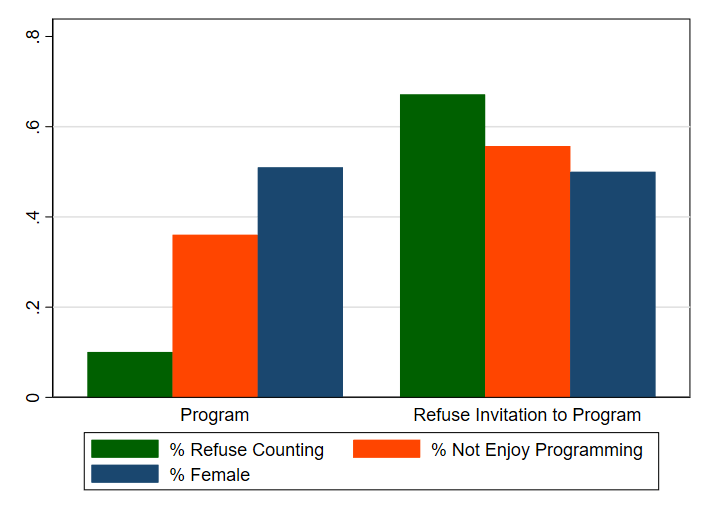
Fig. 5. Characteristics of subjects who do not ask for a follow-up invitation, pooling all treatments and sample

I’ll discuss the three features in this graph in what appear to be the order of importance for predicting whether someone wants to program. There was an enormous difference in the percent of people who were willing to return for an easy tedious task that I call Counting. By inviting all of these subjects to return to count at the same hourly rate as the programming job, I got a rough measure of their opportunity cost of time. Someone with a high opportunity cost of time is less likely to take me up on the programming job. This might seem very predictable, but this is a large part of the reason why more Americans are not going into tech.

Considering the first batch of 310 subjects, I have a very clean comparison between the programming reservation wage and the reservation wage for counting. People who do not enjoy programming require a higher payment to program than they do to return for the counting job. Self-reported enjoyment is a very significant factor. The orange bar in the graph shows that the majority of people who accepted the programming job say that they enjoy programming.

Lastly, the blue bar shows the percent of female subjects in each group. The gender split is nearly the same. As I show several ways in the paper, there is a surprising lack of a gender gap for incentivized decisions.

I hope that my experiment will inspire more work in this area. Experiments are neat because this is something that someone could try to replicate with a different group of subjects or with a change to the design. Interesting gaps could open up between subject types under new circumstances.

The topic of skill problems in the US represents something reasonably new for labor market and public policy discussions. It is difficult to think of a labor market issue where academic research or even research using standard academic techniques has played such a small role, where parties with a material interest in the outcomes have so dominated the discussion, where the quality of evidence and discussion has been so poor, and where the stakes are potentially so large.

Cappelli, PH, 2015. Skill gaps, skill shortages, and skill mismatches: evidence and arguments for the United States. ILR Rev. 68 (2), 251–290.
Postmodernism to Poastmodernism

Authors of the kinds of books I read present themselves as a voice of reason against our declining society that no longer can evaluate arguments or define moral principles. (I’m fun at parties.) “Postmodernism” has been attacked all my life.

For a while, I have been looking for a successor of postmodernism. To simply define our age as the one that came after modernism seems unsatisfactory. How many more decades can we coast along on this antithesis idea?

One reason I don’t like the term postmodernism is that it gives a sense of progress where we might be losing ground. If you aren’t modern, then you are pre-modern. If you aren’t a verbal culture, then you have regressed to pictographs. If you aren’t engaging arguments, then you have degenerated to tribalism. So, postmodern might be dressing up a decline with a word that is too respectable sounding.

Calling people who use smartphones premodern does not seem right. But, what information are they consuming on those screens? Is it mostly low-quality videos and quick poasts? That doesn’t seem like what someone in 1900 would expect of a modern person.

Here’s an idea for the new century. We are in an age of poastmodernism, beginning with the founding of Twitter. This is different from the kind of skepticism or moral relativism that defined postmodernism. The poasters and their followers can be earnest. They retweet like evangelists. (A “poast” is a message posted in an internet forum.)

Poasts are short. This does not allow for nuance or traditional rational forms of argumentation. A poast could be referencing a rich history or body of literature, but if this generation has not evaluated those original sources then they are really just getting the meme. The poast does not provide its own context. Tyler Cowen says that people who think “modern art” is absurd have no context. Context for modern art would be the classical art and realistic landscape paintings that came before. Most Americans including myself are pretty ignorant about classical art. Similarly, how much value would teenagers get from Lord of the Rings internet memes if they have never seen the movies or read the books?

I’m on Twitter. The pace of discourse is more fun than reading a 50-page econ journal article. I get the appeal of poasting. It’s easy. Our first pediatrician told us not to let our baby use touchscreen games. She told us that it is good for a child to struggle to touch a ball that is two feet away across the floor. Better that they cry over the ball than get the dopamine too easily on a tablet game. Tapping on a screen trains kids for instant rewards. Something that concerns me about a generation that was not raised on books is that they will actually enjoy poasting less than I do, because they will be used to the rapid pace of reward. Twitter as a company benefits from the current generation of people who did not grow up with Twitter.

Poasting affects politics. This week two US Senate candidates had a debate. What would someone who gets most of their news from social media learn about the debate? Some top poasts about the debate have almost zero positive policy substance. Campaigners use the internet medium to dunk on their opponents instead of offer solutions to problems. What attracts engagement is the fire emoji.

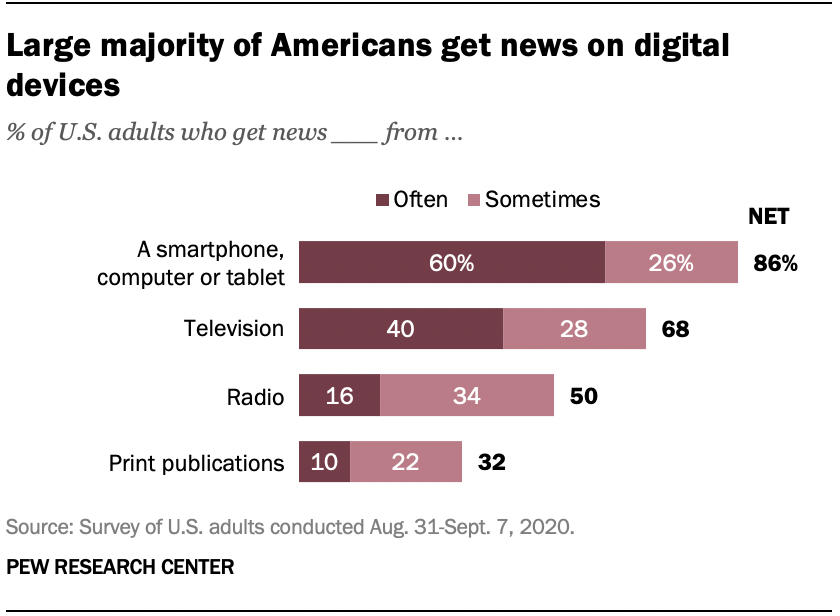
This is not meant as a comment on either men as candidates. I share these jabs because lots of Americans are consuming their “news” in this form (see Pew Research chart). In postmodernism a successful political candidate has to appeal to feelings as much as reason. In poastmodernism, they only have 280 characters to work with. (Donald Trump was a skilled poaster.)

Getting elected today might require great poasting, but that has little to do with being good at governing. Most people think the details of government are dull. Ten minutes into a city council meeting, I’m bored and ready to check the notifications on my phone. And yet, we cannot just poast about poasting. It’s the physical political world and the classic books that make the best subjects of conversation. So, I’m not sure if the era of poastmodernism will last for a long time, or simply to the end of my lifetime. Millennials are not going to give up the dog fire meme.

You’ll have to pry it from our hands after our large generation has passed on. But will it inspire people in the future? I have already been informed that teenagers are calling our gifs “cringe”. They seem to prefer 90 second videos of their peers dancing to pop music. Don’t ask me what comes next after that.

I’ll end on a positive note by saying that sometimes shorter is better. Get to the point quickly, if you can. Some of the novels produced in the modern era were too long. Adam Smith’s books would be more widely read if they were shorter. Long-winded speeches are not necessarily good and I’m glad I am not forced to listen to them. (I get the tl;dr the next day.)

A lot of bad ideas were dressed up in pages of smart-sounding language and then passed off for wisdom in the modern era. It might be harder to pull that off today. Authoritarian regimes in the past relied on being able to lie about conditions on the ground. Today, we know what is happening because of individuals on the ground sharing to Twitter (although social media can also be used for disinformation). American elites believed lies about what was going on inside the Soviet Union for years. That would be more difficult today.

Willingness to be Paid Paper Accepted

I am pleased to announce that my paper “Willingness to be Paid: Who Trains for Tech Jobs?” has been accepted at Labour Economics.

Having a larger high-skill workforce increases productivity, so it is useful to understand how workers self-select into high-paying technology (tech) jobs. This study examines how workers decide whether or not to pursue tech, through an experiment in which subjects are offered a short programming job. I will highlight some results on gender and preferences in this post.

Most of the subjects in the experiment are college students. They started by filling out a survey that took less than 15 minutes. They could indicate whether or not they would like an invitation for returning again to do computer programming.

Subjects indicate whether they would like an invitation to return to do a one-hour computer programming job for $15, $25, $35, …, or $85.[1]This is presented as 9 discrete options, such as:

“I would like an invitation to do the programming task if I will be paid $15, $25, $35, $45, $55, $65, $75 or $85.”,

or,

“I would like an invitation to do the programming task if I will be paid $85. If I draw a $15, $25, $35, $45, $55, $65 or $75 then I will not receive an invitation.”,

and the last choice is

“I would not like to receive an invitation for the programming task.”

Ex-ante, would you expect a gender gap in the results? In 2021, there was only 1 female employee working in a tech role at Google for every 3 male tech employees. Many technical or IT roles exhibit a gender gap.

To find a gender gap in this experiment would mean female subjects reject the programming follow-up job or at least they would have a different reservation wage. In economics, the reservation wage is the lowest wage an employee would accept to continue doing their job. I might have observed that women were willing to program but would reject the low wage levels. If that had occurred, then the implication would be that there are more men available to do the programming job for any given wage level.

However, the male and female participants behaved in very similar ways. There was no significant difference in reservation wages or in the choice to reject the follow-up invitation to program. The average reservation wage for the initial experiment was very close to $25 for both males and females. A small number of male subjects said they did not want to be invited back at even the highest wage level. In the initial experiment, 5% of males and 6% of females refused the programming job.

The experiment was run in 3 different ways, partly to test the robustness of this (lack of) gender effect. About 100 more subjects were recruited online through Prolific to observe a non-traditional subject pool. Details are in the paper.

Ex-ante, given the obvious gender gap in tech companies, there were several reasons to expect a gender gap in the experiment, even on a college campus. Ex-post, readers might decide that I left something out of the design that would have generated a gender gap. This experiment involves a short-term individual task. Maybe the team culture or the length of the commitment is what deters women from tech jobs. I hope that my experiment is a template that researchers can build on. Maybe even a small change in the format would cause us to observe a gender gap. If that can be established, then that would be a major contribution to an important puzzle.

For the decisions that involved financial incentives, I observed no significant gender gaps in the study. However, subjects answered other questions and there are gender gaps for some of the self-reported answers. It was much more likely that women would answer “Yes” to the question

If you were to take a job in a tech field, do you expect that you would face discrimination or harassment?

I observed that women said they were less confident if you just asked them if they are “confident”. However, when I did an incentivized belief elicitation about performance on a programming quiz, women appear quite similar to men.

Since wages are high for tech jobs, why aren’t more people pursing them? The answer to that question is complex. It does not all boil down to subjective preferences for technical tasks, however in my results enjoyment is one of the few variables that was significant.

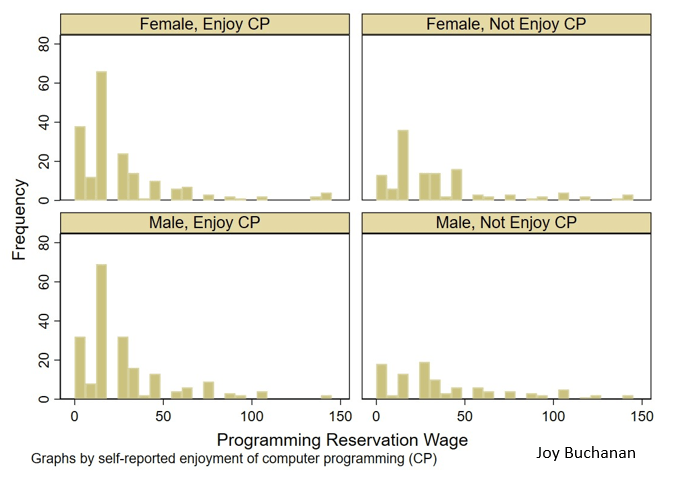
People who say they enjoy programming are significantly more likely to do it at any given wage level, in this experiment.

Fig. 3 Histogram of reservation wage for programming job, by reported enjoyment of computer programming (CP) and gender, pooling all treatments and samples

Figure 3 from the paper shows the reservation wage of participates from all three waves. Subjects who say that they enjoy programming usually pick a reservation wage at or near the lowest possible level. This pattern is quite similar whether you are considering males or females.

Interestingly, enjoyment mattered more than some of the other factors that I though would predict willingness to participate. About half of subjects said they had taken a class that taught them some coding, but that factor did not predict their behavior in the experiment. Enjoyment or subjective preferences seemed to matter more than training. To my knowledge, policy makers talk a lot about training and very little about these subjective factors. I hope my experiment helps us understand what is happening when people self-select into tech. Later, I will write another blog about the treatment manipulation and results, and perhaps I will have the official link to the article by then.

Buchanan, Joy. “Willingness to be Paid: Who Trains for Tech Jobs.” Labour Economics.


[1] We use a quasi-BDM to obtain a view of the labor supply curve at many different wages. The data is not as granulated as that which a traditional Becker-DeGroot-Marschak (BDM) mechanism obtains, but it is easy for subjects to understand. The BDM, while being theoretically appropriate for this purpose, has come under suspicion for being difficult for inexperienced subjects to understand (Cason and Plott, 2014). We follow Bartling et al. (2015) and use a discrete version.

Recent Podcasts about Data Analytics

My students recently assembled a list of podcasts about data analytics that are a click away if this is a topic of interest.

The show they pulled from the most was In Machines We Trust produced by the MIT Technology Review.

“Attention Shoppers, You’re Being Tracked“

“Hired by an Algorithm” (“I would recommend this podcast to anyone who will be applying for a job in the near future.”)

“Encore: When an Algorithm Gets It Wrong”

“Can AI Keep Guns out of Schools“

“How retail is using AI to prevent fraud“

Other episodes, not from In Machines We Trust:

More or Less Behind the Statistics: Can we use maths to beat the robots?  (Might be of interest to the folks who like to debate “new math” in schools.)

“How Data Science Enables Better Decisions at Merck“

Data Science at Home: State of Artificial Intelligence 2022

Emoji as a Predictor – Data skeptic

Data Skeptic: Data Science Hiring Process 

“True Machine Intelligence just like the human brain” (Ep. 155)

“How to Thrive as an Early-Career Data Scientist” – Super Data Science

No matter how you feel about intelligent machines, you’ll be talking to them soon.

They are delivering food already.

Patrick Henry Blog

I wrote about Patrick Henry for OLL this week.

“Can [the President] not at the head of his army beat down every opposition? Away with your President, we shall have a King: The army will salute him Monarch; your militia will leave you and assist in making him King, and fight against you: And what have you to oppose this force? What will then become of you and your rights? Will not absolute despotism ensue?” It is noted in the manuscript that the stenographer could not keep up with the torrent of terrible possible consequences that Henry was shouting about concerning a chief executive.

Most of his apocalyptic scenarios have not happened … yet. What inspired me in his speech was his energy more than his arguments. As much as he praised the American spirit of the past that ousted British rule, he was not complacent. He models a kind of patriotism that embraces an American project without holding to any fantasies about the morality of particular American leaders or soundness of American institutions. He would not have been disillusioned by the scandals and crimes of the American political class. He anticipated it. 

Read the rest at The Reading Room.

Dog Cartoon Information Warfare for the 21st Century

Russia’s attack on Ukraine has generated a lot of attention. Many people care deeply about this unfolding crisis. I wondered back in March 2022 where all this energy would end up getting channeled?

What I had in mind was not an army of “cartoon dogs”, and yet here we are. Official coverage of the #NAFO dog memes this week has come from the Economist and Politico.

The North Atlantic Fella Organisation (spellings vary) is a tongue-in-cheek label adopted by a virtual army that champions Ukraine’s cause and harangues its foes on social media. Its members don the avatar of a cartoon shiba inu dog…

When your enemy is as humorless as Putin, there is an advantage to being funny. After circulating in internet backwaters for weeks, official Ukrainian accounts have acknowledged the help offered by the movement.

The effects of #NAFO are 1) to influence the flow of information/opinions and 2) raise money for Ukraine defense.

For example, you can buy a “ticket” to a “beach party” in Crimea: https://www.saintjavelin.com/products/crimea-beach-party-early-bird-ticket-sale-1-entry

Mike posted earlier about donating to the Kyiv department of Economics.

And this is a just an aid organization that is not very funny but helps refugees in Lviv.

An explainer of a different Very Online thing is https://www.slowboring.com/p/dark-brandon-explained. Dark Brandon and #NAFO are similar in the sense that supporters are made to feel like they are part of a brotherhood of winners who share fun jokes.

Balaji Srinivasan recently released a book called The Network State suggesting that online communities of likeminded people are so powerful that they could supplant what we have known as “countries” for a few centuries. From what I can tell, families want to live in a real place that has tangible services and security. The interesting thing about #NAFO is that it’s purpose is to support an old-fashioned country defending its physical borders.

Meanwhile, in the country of Russia, as reported by the WSJ, “The chairman of Russia’s second-largest oil-and-gas giant, Lukoil PJSC, died Thursday after falling from a hospital window in Moscow, according to Russian state media agency TASS.”

Economics in Wedding Season

You watch a romantic comedy to feel good. I was tired at the end of last week, so “Wedding Season” Netflix looked like it might be funny. I was not expecting that the protagonist would be an economist.

First, how was the movie? The first half was somewhat entertaining. The second half is too sappy and long for me.

This movie is one of the few movies I know that is just unironically set in New Jersey. There were no jokes about Jersey or Shore folk. New Jersey is where immigrant families from India are making dreams come true. The dialogue about immigrant Indian culture, including arranged marriages, was interesting.

You know the trope about a character becoming rich because they inherited money from an estranged uncle? In Wedding Season, the guy becomes unexpectedly rich from Facebook stock.

Second, how was economics portrayed?

Here is the plot summarized by Wikipedia

Asha is an economist working in microfinance who has recently broken off her engagement and left a Wall Street banking career behind to work for a microfinance startup in New Jersey. Asha’s mother Suneeta, concerned for her future and against the advice of her husband Vijay, sets up a dating profile through which Asha meets Ravi.

In the beginning of the movie, Asha pitches microfinance to investors from Singapore. Asha tries to convince them using graphs and statistics. The investors turn her project down.

Microfinance was hyped in the 2000’s. I believed, so I became a Campus Kiva Representative as an undergraduate. I convinced teens in my dorm to pool our dollars to sponsor a loan for a woman in a poor country. Since then, economists have done empirical work to show that microfinance is not as effective as we hoped (see work by 2019 Nobel Prize Winners Esther Duflo and Abhijit Banerjee). The filmmakers either do not know the latest research or they don’t care. The pitch is still as emotionally appealing as it was when I heard it for the first time 15 years ago, so it makes for good movie scenes.

The irony in Wedding Season is not only that Asha succeeds in getting bankers from Singapore to invest in microfinance but also how she goes about it.

Continue reading →

Ambitious Parenting

Things go by online about moms and kids that bother me. Here I will Be Like Pete and try to articulate a positive vision. We could talk more about parenting small children.

Ambitious people, both men and women, might want to be parents. Time spent on parenting takes away from other projects, so the earlier you start planning the better. Hearing about the experiences of other parents is both instructive and inspiring.

Parenting, like modern creative careers, is an unpredictable enterprise. Maybe one reason people are not encouraged more to plan is because the disappointments can be so devastating in this arena. There is a risk that I will sound insensitive if I am too positive. That said, I feel like discussions I see in public miss the point too often and fail to use the “billboard space” we have effectively. There is an ocean of thoughtful honest free content for How to Achieve Your Writing Goals, but there is very little on how to achieve your parenting goals that resonates with ambitious young people. The writing advice can be ignored by those who don’t want to write; parenting advice can be ignored by those who don’t want kids.

Economists talk a lot about parents and children, especially now that the US is near population decline. One particular point I have heard is: “Data shows that piano lessons do not have a causal impact on lifetime earnings, so your problems are solved. Everyone sit back and enjoy your kids.”

This message may be helpful to some people, but it seems like primarily a lie to me. “Enjoy your kids” assumes a lot. I’d prefer an honest approach about the sacrifice involved, or the “opportunity cost”. I think that the benefits of parenting outweigh the cost, but it’s not inspirational to say “selfish lazy people will enjoy parenting.” Raising kids who you enjoy being around is not easy, but there are tricks and proven methods to help.

The economist who gets it is Emily Oster. Her books go more like this: “You probably aspire to having family meals that you can enjoy. Sit down with your co-parent 6 months ahead of time and plan out how you are going to achieve such a wonderful ambitious goal while also being able to schedule other events and pursuits.”

Emily Oster books/newsletter is a great place to start. She’s not for everyone, but if you are reading an econ blog then she might be for you. The good news for ambitious parents is that many books have been written that explain how to achieve certain results. Ambitious smart people can figure out good techniques, although as I said earlier be prepared for things not to go as planned. It helps to start on the learning process before you have kid to care for. Once you become a primary caregiver, you will have less time to read, so read widely and often whenever you can.  We have a /Parenting category in this blog, to curate some of the good stuff.

This boy’s ambition was to dig a trench from a tidal pool all the way to the ocean.

Kids could come up in conversation about ambition more, as a possible complement not just as a substitute.

This Elon tweet has layers: “Being a Mom is just as important as any career” What do you think the subtext is? How would a college student understand this?

Why use this hackneyed phrase when he could say something to actually inspire both his male and female Gen Z fans to become parents? If Elon is a good parent, then teach us how he combines it with an ambitious life. And if he’s a bad parent, he should say less about it. If he’s trying to elevate mothers, then retweet a mother.

Similarly, a male economist who writes books about how easy parenting is should explain how he got through the first 5 years. Either someone else raised his children or he worked hard to maintain a routine and boundaries. Did he create his own routine from scratch or did he borrow from someone else’s model? Were his children in daycare 40 hours a week?

It can be hard to write about these topics honestly, because of privacy issues. So, we are back to Emily Oster, because she has been willing to tell the world what really goes on in her own family. Elon should just tweet out her newsletter every week if he’s such an advocate for mothers.

Dr. Oster is not the only one. There are millions of mothers creating content who would value the exposure. What if Elon (or some other ambitious person with a large platform) retweeted a trick for getting children to try carrots. “Wow, genius technique. Follow this Mom for more…” Or, Elon could highlight a man who being a great parent.

Ambitious people just talking about their kids and their own honest personal experiences is a good way to achieve Elon’s stated goal of getting more people to have kids. If Elon wants to tell us that he loves his kids, then that’s inspirational, and I don’t think it’s a lie.

I will engage in some introspection here, not because I think I’m so interesting, but because I see pro-natalist men talking past everyone else on how to raise the birth rate. I had a parenting win this past week. I solved a behavioral problem in a creative way and I’d love to talk about it. I’d like to feel like I’m part of a community conversation. I’d like to be recognized for my expertise. That’s what most people want, right? More resources in the attention economy devoted to parents is a form of compensation that I have not heard discussed before.

I have heard advice to female professors to not put up pictures of their children at the office. If colleagues know you care about your children, then you might be ostracized from the intellectual community that you have spent your whole life trying to join. In my own small way, I have pushed back against this norm by occasionally talking about kids and babies, so that other people who want families can feel part of a bigger community online and in academia. My broader point in this post is that there is a kind of rhetoric about family life and parenting strategies that would make young ambitious people think that having kids will not prevent them from pursuing other goals.

It’s not bad to talk about a 14-hour workday or an organizational strategies for achieving professional goals. I wouldn’t want to censor anyone or stop them from sharing how they accomplished something valuable. On the margin, more conversations could also include a discussion of how life changes if you become a parent, so that ambitious young people can build mental categories for this.

The Freakonomics podcast provides examples:

Stephen Dubner brought the teen children of famous economists on his show to talk about what it was like to grow up with those weirdos. It’s funny. Listeners will not feel like they are being told what to do or judged. Dubner is simply lending his platform to parents and children. He’s using the billboard space. There is parenting content on the internet already, but if it’s all siloed over at parents.com then it may not make it to the young person who is trying to figure out what “the Good” is.

Birmingham AL Coffee Shop Crawl

There are lots of fun coffee shops in Birmingham. I’m going to limit this list geographically to make it a “crawl” that you could potentially bike around. I’ll list the cute places I know that are between Railroad Park downtown and Samford University south of Birmingham.

Starting at the North end, coffee shops that border Railroad Park:

Red Cat: Website | Instagram | Facebook

Honorable mention to Hero Doughnuts that operates two locations within the Crawl Area and serves great coffee.

Starbucks does operate here, although I assume that’s of less interest in terms of local color.

Moving South to Five Points:

Domestique (operates in multiple locations on the Crawl)

Filter Coffee Parlor: Website | Facebook | Instagram

Moving South, crossing into Homewood:

Caveat: Website | Facebook | Instagram

O’Henry’s (multiple locations)

Santos: Website | Instagram | Facebook

Chocolate America is not a coffee shop but the caffeine levels are high enough to make the Crawl.

It’s just slightly out of the crawl zone to the West, but I can’t leave out:

Seeds: Website | Instagram | Facebook

From the Seeds Instagram

Business Analytics Textbook plus Discussion Book

Many undergraduates take at least one business analytics course at the 200 course level. A book that I and other professors at our business school have selected to teach business statistics is by Albright and Winston

Business Analytics: Data Analytics and Decision Making (Amazon link)

This book provides three essential ingredients to a successful course:

  1. Covering core concepts like descriptive statistics and optimization
  2. Providing relevant examples in a business context (e.g. how much inventory should a retail store order)
  3. Showing step-by-step instructions for how to do applications in a specific software which in this case is Excel

Microsoft Excel is essential for business school graduates (arguably all college graduates). No one is born knowing how to select cells or enter formulas. The book does not assume anything, so the professor does not have to require supplementary material on how to use Excel. There are lots of exercise and examples that teach proficiency in the tool while demonstrating the concepts. Analytics courses should be hands-on.

Sometimes statistics courses do not feel like they allow for critical thinking or discussions. There is only one correct formula for an average, and it is merely and exactly what the formula determines it to be. Therefore, an interesting addition to a technical class is the book by Muller

The Tyranny of Metrics (Amazon link)

Muller spends most of the book pointing out cases where measuring results backfired. He is not so much against “analytics” as he is skeptical of pay-for-performance management schemes. Many of these schemes were sold to the public as incredible technocratic improvements, such as No Child Left Behind. I do not always agree with Muller, but he gives students something to debate. Note that only select chapters should be assigned so that it does not take up too much time from the other course material.