School workbooks recommendation

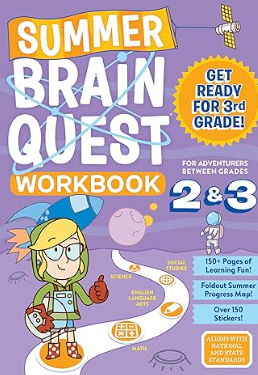
I’m on my second book in a series of age-appropriate Brain Quest academic workbooks. Here’s a link to the summer book for 2nd to 3rd grade.

These workbooks are well designed. I’m not promising that your kids will not see it as a chore, but I think these books make practicing math and writing about as fun as it can be.

We found Brain Quest in a bookstore while we were looking for things to do in my son’s summer after kindergarten. The K-to- 1 summer workbook was fun and helped maintain what he had learned in kindergarten. He loved adding a new sticker to the adventure path after finishing each activity. You can finish it in one summer by doing about 5 pages per day, which only takes about 10 minutes.

We really love the summer map books but they also have schoolyear books. The First Grade school-year book is huge (320 pages). There aren’t as many stickers as the K-to-1, but they still have a way of marking off accomplishments that my son finds satisfying. It’s a kind of gamification, but it’s not more screen time.

These pages can be done after school on weekdays. What I like best is that it gives us some structure to leaning on weekends and holidays. It’s cheaper than tutoring.

Amazon link to K-to-1 summer workbook (160 pages)

Amazon link to First Grade book (320 pages)

The series goes up to Sixth Grade.

The War on Ukraine

1. Read this letter from a young woman inside of Russia. Her despair is not sadder than the Kindergarten getting bombed, but it helps explain why people are resisting Russian rule. Ukrainians’ lives would be like hers except worse.

2. ‘My city’s being shelled, but mum won’t believe me’ With loyalty like this, I don’t understand why Russian state TV is bothering to cover up the shelling. Mum’s personal loyalty to Putin already transcends her love of her own daughter. Is lying itself a flex and a form of psychological warfare against the opposition within Russia?

3. Read on the End of History, and my blog about circular history.

4. Social media changes sieges.

5. President Putin speaks his truth, embraces his identity, and blocks his haters. With a trifecta like that, I have no doubt that he practices self-care. And now people are upset that they can’t get through to rattle him. Now people wonder: why can’t we reason together anymore? Yet, this is what Americans are encouraging each other to do. We are out of practice when it comes to discovering and debating The truth.

Previously I wrote about Americans blocking each other on social media. Now when we want to get through to someone on the other side, we have less channels of communication open. Americans don’t get enough practice seeing the world through someone else’s eyes. We have gotten into a bad habit of curating our sources of information to insulate ourselves from the facts and opinions that would force us to learn or argue with someone who holds a different point of view.

Also, we are seeing many people cut ties with Russians. I understand, initially, why there was a blitz on all Russian people, as we tried to get through the news of what was happening with urgency. However, this next week might be an opportunity to reach out to an economist on the inside of Russia, if you know one. Should they be protesting on the street, instead of checking emails? At this point they have already made their decision. You could start a research project with them about some banal uncontroversial topic. They are going to suffer, regardless of whether they have a foreigner to talk to or not. This opens a channel.

(The faculty at Kyiv School of Economics is probably getting behind on their research. They would probably love it if you would look up their previously published papers. )

The percent of Russians who don’t agree with the war should be a concern to the Kremlin. Most of them will not openly say what they think within the borders of Russia, so it creates uncertainty. On paper, Russia is favored to be able to inflict more casualties, but this aspect of Russian society makes the future hard to model. Any young men who are sent to the front lines will learn what is actually happening from the Russian speakers in Ukraine. How will that affect them?

How to Set Working Directory in R for Replication Packages

The AEA Data Editor kicked it all off with this tweet:

“Please stop using “cd” (in Stata) or “setwd()” (in R) all over the place. Once (maybe, not really), that’s enough.”

Replies proliferated on #EconTwitter this week. In this blog post I am collecting solutions for R.   These days you might share the code used to generate your results for an empirical paper. That code would ideally be easy for other people to run on their own computers. File paths are hard (as I blogged previously).

A project for a single paper might have multiple code files. The code interacts with data stored somewhere. Part of the task of the code is to point the statistical program to the data set. It is frustrating if an outsider is trying to replicate a result and must alter the code in multiple places to point to their own location of the data.

Here is a concise summary of good practice, for any code language: “cd and setwd() specify the directory. When you share code and run on a different computer, they don’t work. Therefore, good practice to only specify once, at the beginning”

Continue reading

Context and age and soft skills

It is hard to know when oneself does not have enough context to appreciate a piece of art. When someone else lacks context, it is easier to see.

Consider my children watching last week’s Super Bowl halftime show. Snoop Dogg was performing on a stylized urban-themed stage. My kids could see the same thing I could see. They did not, remotely, “get it”.

You better lose yourself in the music…

“Lose Yourself” performed by Eminem

Children have little context for anything. But this half time show was a cultural moment. Millennials and Gen X experienced an awakening, or perhaps a collective crisis.

The following tweet got 60 thousand likes about how old the performers are. Everyone was calculating how many years had gone by since this hip hop and rap music was new. Decades have passed and now we who have the context to understand this music are feeling old.

In some nursing home in the year 2070, school children will trudge in and sing “Lose Yourself” because it makes the old people happy. The kids will not understand the appeal.

Matt and Ben are tweeting about music in code, but it happens to be a code I know. There are many codes that I do not know. I think that is part of what Tyler means in his latest posts about how “context is scarce”.

The real reason for writing about context this week is not the Super Bowl. I was reading yet more articles about tech skills and labor demand.* Once again, I came across the issue of soft skills. Could we say, “Soft skills are that which is scarce”?

When workers lack hard skills, it seems straight-forward to pack them off to a bootcamp. Teach them, for example, some functions in a programming language. The solution to a lack of soft skills is less clear, although maybe that is what decades of modern education is for. Corporate workers today need to know when to apply their skills and what tone to use in their email communication. They must not embarrass the company.

If a manager tells a worker to do “X task,” they cannot explain every detail. The worker needs to have the context to carry out the work on their own. Workers need to know the code.**

Could that be why so many employers desire a bachelor’s degree? Tyler wrote:

9. So much of education is teaching people context.  That is why it is hard, and also why it often does not seem like real learning.

Does this explain why there is simultaneously age discrimination and the ubiquitous “5 years of experience” hurdle for good jobs? Managers are looking for the sweet spot of current technical savvy and institutional context.

* I was reading a report by Quinn Burke. Here’s a published paper on soft skills and STEM. Here’s a blog of mine in which I wrote, “Trust falls and Tolkien is the prescription for this workforce.”

**funny Elf clip on The Code and dating

Did we repeat the Christmas Covid Wave?

The year is 2021

Around January of 2021, hospital staff and other select personnel received the first vaccines meant for the public. As a classroom teacher, I was designated important enough in the state of Alabama to get a Pfizer vaccine as early as February 2021.

Imagine what could have happened next

Americans grew antsy in May of 2021, because less than half of the population had been able to get a vaccine. It was frustrating to see the vaccine winners carrying on with life without fear of the virus while supply constraints made it impossible for everyone to join them at once.

An unintended consequence of the gradual vaccine rollout was that Americans who were initially concerned about vaccine safety had months to observe their family members and neighbors who got in line first. By July of 2021, most Americans personally knew of someone who died from Covid, and almost no one had witnessed a bad vaccine outcome.

By the end of the summer of 2021, over 90% of the American public was fully vaccinated. The economy roared back to life and working parents did not have to worry about school closures anymore.  

Americans felt proud to have invented and implemented the world’s best Covid vaccine. Considering that Trump has started the research and Biden had overseen the distribution, it was one thing that red and blue Americans could unite over.

The internet as a concept was vindicated because anyone who wanted to understand vaccines could do their own research. Scientific knowledge is no longer the domain of a select elite. Anyone can see the Covid death rates for vaccinated versus unvaccinated people. Amateurs can create data visualizations to share. Information on mRNA technology is free to all.

Speech remained free with regard to vaccine dialogue, but those who tried to discourage Americans from getting Covid vaccines were shouted down in all forums or accused of being foreign trolls.

The first Covid wave in April of 2020 was terrible and the second big event around Christmas of 2020 resulted in thousands of deaths per day lasting for months. No one wanted to repeat that.

Of course, that is not what happened.

Now I have the answer to the question I asked two months ago when I wrote https://economistwritingeveryday.com/2021/12/18/will-we-repeat-the-christmas-covid-wave/

The number of Americans who died from Covid in January 2022 is available from the CDC website.

Number of Covid deaths in January 2022, CDC 59367
Number of Covid deaths in January 2021, CDC 97866

We came fairly close (60%) to repeating the tragedy after the Christmas of 2020. The exponential rise and fall of a new Covid variant and the ensuing pattern of deaths is something we have been through several times. We knew this would happen.

Would every one of those deaths have been prevented by higher vaccine take-up? No. But the death rates among vaccinated people are much lower. Charles Gaba, a data analyst, estimates that about 143,000 Americans have died since the summer of 2021 who would have lived if we had a higher vaccine uptake rate.

Ezra Klein also engaged in some wishful thinking this week, so I’m not the only one.

My best explanation for this is that people want to feel like they are in control of their own lives. Due to a variety of factors, a large number of adults have a different concept of being in control than I do.* Something that shaped my personal attitude toward the vaccine was reading about the research and development process in real time, which I largely did by keeping up with Marginal Revolution.

Unrelatedly, Jeffrey Clemens has given our blog a label this week that I’m happy with: “speculative but engaging”

* According to Andrew Sullivan, “There’s something about masking … and vaccines themselves, that some men seem to find feminizing.”

Day care and new pre-K findings

There was a buzz over a new study showing that pre-K is not necessarily good for children. It’s amazing how experts can be completely surprised by the results of a major study on an issue like pre-K education.* Noah Smith summarized the literature and thought through some policy implications. Emily Oster also just summarized the paper and points out that it provides almost no help for parents making decisions. **

I’ll offer some “amateur astronomer” observations about preschool and childcare.

What to call the daycare I patronize, since it offers all of the pre-K functions? I’ll call it Day-K. My kid comes home from Day-K with worksheets difficult enough for a kindergartener, but it was handed to a 3-year-old and the kid just scrawled a few lines of crayon across it. Most little kids aren’t going to retain material that is beyond their developmental level. Why bother printing these nice worksheets at all instead of just letting them color a bear?

Something that surprised me was how early kids can learn the alphabet and yet how disconnected that is from anything useful such as being able to read words. If a 2-year-old can do it (e.g. recognize “A”) then a 4-year-old can probably pick it up easily anyway.

Good private daycares in desirable urban areas are expensive but have unbelievable waitlists. Donald Shoup advocates that cities should charge more for parking. He reasoned that every city block should have an open parking space. Instead of spending valuable time circling like a vulture, you should just pay a lot of convenient parking or else know you will have to go somewhere else. Would the same logic apply to the good daycares? Should they not charge so much that there is always an open slot for the next parent who can pay? One issue with this from the daycare owner’s perspective is that they don’t want new kids cycling through constantly. A brand-new kid who does not trust the staff and has not learned the routine is a temporary disaster. I believe that the waitlists work because the owners want a predictable flow of great committed customers. By keeping fees low enough to have a long waitlist, they get good families to stay and they can easily fill any holes left by departures or dismissals.

If the program was free, I suspect that would change the dynamic inside compared to high-fee Day-K. Daycare kids are on a regimented schedule. Everyone thrives on the routine. The staff are happy when the kids know the rules. If people were coming and going unpredictably, that might make it harder for kids to learn.

Even under optimal conditions, there are scuffles at daycare. Being pushed down on the playground is often the only thing a kid will remember from a full day of “instruction”. How could pre-K actually negatively affect some kids, as the new study shows? One way I can think of is that the experience a good teacher tries to provide could be ruined by one kid who is loud or violent. If half of the classes are functioning as day care and having no impact at all on future outcomes and half of the classes have a kid hitting, then the average effect for all pre-K classes could be negative. The social environment of pre-K is probably highly variable. Sometimes you could get a great social atmosphere in which kids learn to share and sing. Sometimes the chaos level could make things difficult, I imagine. This is speculative. But I think it’s ok to speculate in the brainstorming period that should follow a surprising result.

Daycare centers have a fantastic physical environment. When I think of the returns to scale, the low table and chairs that fits the 3-year-olds perfectly comes to mind. A preschool classroom has a perfect bathroom with low toilets and sturdy step stools at the sinks. There is no heirloom China or nice upholstery in the room to worry about. There are dozens of age-appropriate toys and craft supplies can be bought in bulk. This physical environment allows kids to be creative and have fun. Adults don’t have to hover over them, afraid that they’ll hurt themselves or break something at any moment. By contrast, having a 2-year-old child roam my house was terrible. I kick myself for not making more up-front investments in kid-proofing and creating safe play areas. But it’s expensive and difficult for a parent to outfit their own home perfectly for each stage of development. The great thing about a daycare classroom for 3-year-olds is that it is perfectly fitted for 3-year-olds, because 3-year-olds will be cycling through it for the next decade. The physical scale factor makes me a daycare optimist for urban areas. However, as I wrote earlier, things could be trickier for low-density population areas.

The study has given us a lot to think about. I hope the research community can be helpful in continuing to figure out the puzzle.

One thing we can conclude, as Noah says in his blog, is that a compulsory university pre-K would be bad. Forcing families to send 4-year-olds to an institutional program (the way 5-16 kids are regulated) would be an expensive “own goal” policy. I don’t know of anyone seriously considering that, which hopefully means that nobody is.

* As a lab experimentalist, I’m used to being surprised by data. Check out this podcast just recorded with John List. He talks about surprising findings from field experiments. You never know until you run the experiment. Hence, my post in September about a rant about behavioral economics.

** Yesterday, Emily Oster announced that she is leaving Twitter because it had become a toxic place for her. You can still find her at substack, instagram, and other traditional publishing outlets (e.g. her books).

Modern loneliness in Toy Story 4 and Taylor Swift

I just saw Toy Story 4 (2019) because I’m a parent (don’t keep up with new releases – watch Pixar movies). The depiction of utter loneliness of the Gabby Gabby doll is one of the memorable parts of the movie. She knows that other people are experiencing human interaction, but she has none. Not a single human person notices her or needs her. Can you imagine that being the main plot of a movie made in 1940?

Loneliness is not completely new for humans. In the past, a lonely person might have had extra time to focus on nature, God, or books, or just immediate survival. Today, lonely people can be inundated with images of faces while also knowing that they have no real local friends. The Toy Story toys are like modern rich people in the sense that material survival is far from their minds. The toys can sit on a shelf for decades, awake and alone. No physical needs drive them out to a grocery store or into a service sector job. They have time to obsess over their social status, and the result can be tragic. (The fate of sitting on a museum shelf for years was discussed at length in Toy Story 2.)

Gabby Gabby reminded me of a bleak 2014 song by Taylor Swift called “Wildest Dream”. Swift sings as a female protagonist who sleeps with a handsome stranger knowing that he will leave her right afterwards. Here’s what she is hoping for:

I can see the end as it begins

My one condition is

Say you’ll remember me

Taylor Swift, 2014

She’s concerned that the man won’t remember the encounter at all. That is some malaise, yes? She has no hope at all for a lasting relationship. That is an illustration of one way that loneliness looks in the modern world.

From a male perspective, also in 2014, a similar sentiment is expressed in “Stay with Me” by Sam Smith.

I don’t want you to leave, will you hold my hand?

Again, the singer is asking for someone from a one-night stand to help fill a void of human connection instead of immediately leaving. Swift and Smith wonder aloud if there is some way to at least temporarily feel like they are close to another person.

These forms of loneliness in pop culture resonate with the public. Toy Story 4 yielded over $1B at the box office globally. “Wildest Dreams” was on music charts around the world. These forms are somewhat new, due to new technology and changing social customs. I’m not trying to write the next Bowling Alone (2000) in this blog post, but merely noting some current illustrations, inspired by Toy Story.

I bet a proper classicist could find us some illustrations of old-style loneliness. When I think of ancient loneliness, I think of to-be-King David hiding in desert caves trying to avoid being stabbed by a Bronze Age(?) sword. He chronicled some of those feelings as follows

Turn to me and be gracious to me, for I am lonely and afflicted. Relieve the troubles of my heart and free me from my anguish. … See how numerous are my enemies and how fiercely they hate me!

Psalm 25

David is lonely, but he’s also hiding from numerous nearby fierce enemies. So, it’s not exactly like Gabby Gabby who is sad that no one notices her at all. (In fact, maybe it puts our problems into some perspective.)

There is a recent 2020 New Yorker article, inspired by Covid lockdowns, on the history of loneliness. They consider the idea that this really is new. Maybe there would not have been a Gabby Gabby doll in ancient poems. As usual, economics is part of the story.

In “A Biography of Loneliness: The History of an Emotion” (Oxford), the British historian Fay Bound Alberti defines loneliness as “a conscious, cognitive feeling of estrangement or social separation from meaningful others,” and she objects to the idea that it’s universal, transhistorical, and the source of all that ails us. She argues that the condition really didn’t exist before the nineteenth century, at least not in a chronic form. It’s not that people—widows and widowers, in particular, and the very poor, the sick, and the outcast—weren’t lonely; it’s that, since it wasn’t possible to survive without living among other people, and without being bonded to other people, by ties of affection and loyalty and obligation, loneliness was a passing experience. …  to be chronically or desperately lonely was to be dying. The word “loneliness” very seldom appears in English before about 1800. 

The New Yorker, 2020

Lastly, Mike wrote a great piece on loneliness in art last year. He even introduced a formal economic model!
Pledging for effective altruism

I attended an administrative board meeting for a large local nonprofit organization this week. The report from the finance committee included a comment that our “giving” is up while “pledging” is trending down. People are giving money when they feel like it or when they have extra money.*

However, the finance committee wishes that more people would pledge their giving at the beginning of the year, so that the organization can plan ahead. They are trying to make an operating budget and want to make promises to the staff. It’s nerve-wracking to plunge into the year with no idea how the whims of thousands of people will affect the final revenue a year from now.

I don’t have any sources for this, outside of the representative’s report this week. They said that nonprofits all over the country are seeing a decline in pledges and an increase in (impulse) giving.

I am looped into niche online chatter about Effective Altruism. “You should give money for malaria instead of re-painting a lobby in America.” Fair enough. Most Americans don’t subscribe, and I’m not trying to make a case for the malaria pills right now.

What about giving to the same causes you already give to, in a new way? Make a pledge. If you lose your job or cannot pay, then there is no consequence. It’s not a legal contract. It’s just an indication of your intentions that helps leaders plan.

Millennials just recently outnumbered Boomers as the nation’s largest living adult generation. Trends in anything adults do are likely to be “generational shifts” for the next few years. I suggest to my fellow Millennials that your money can be spent more effectively by the nonprofit sector if you commit proactively instead of reacting to crises. See if the groups you give to allow for pledging.

Lastly, I’d like to brag about my group for pivoting this January to provide for new Afghan refugees in Birmingham. Having extra money on hand from record 2021 revenue helped make that possible.

… and finally, pledging could be a good topic for economists to look at.

*New papers on giving after windfall income bumps are here (published) and here (working).

What we pay for the thing that some workers do that most people do not

In middle school, I broke my leg in a soccer tournament game. I needed to go to the hospital and get extra support for the next month. Some of the workers who helped me were not highly paid, but my value of their services was very high.

Why bring this up? There has been conversation about the label “low skill” work this week. Brian Albrecht summarized the debate. Brian tangentially mentioned the “diamond-water paradox,” but I think it is worth talking more about that. Economists have a few models and stories that change the way you think about the world.

When I teach Labor Economics, we read an excerpt from Average is Over and then I explain the diamond-water paradox in class. I ask the students why diamonds cost more than water, even though water is more important. The answer can help us understand how wages get set for human workers (I say “human” because by that time we are deep in the topic of robot workers as substitutes).

I tell my students that some of the low-pay work performed by humans is extremely important. I’m still looking for the perfect illustration here. The one I use goes something like this, which is related to my broken leg anecdote… imagine if you tripped on train tracks and couldn’t get yourself out of the way of an oncoming train. How much would you pay a human to haul you to safety? Almost any human could perform the task. That service would be as valuable as a glass of water if you are about to die from thirst, which is to say that your value for it is almost infinite.

The key to understanding the market price of cleaners as opposed to the high wages for repairing Facebook code is marginal thinking. There is a lot of water, so the next glass is going to be cheap.

In writing Average is Over, Tyler Cowen is trying to understand why wages for the-less-highly-paid-skills have stagnated recently, while wages for the-highly-paid-skills are increasing along with GDP. He brings computers and technology into the conversation, as one culprit for recent changes. There is a limited supply of humans who can show up to a tech job and contribute reliably. “Programmers” are not the only highly paid class of workers, but it’s easy to see that the supply of people who are proficient with Python is limited.

I see two opposing forces in the tech world, which I have been following for a few years. First, we have boot camps, code clubs and all kinds of resources to both equip and encourage people to go into tech. I volunteer to advise a club that provides resources for female college students taking a technical route. On the other hand, lots of people who do get a foot into the door of a tech company become upset and quit.

Here is a quitter (a twitter quitter?):

You can read about this specific situation at this woman’s website. It seems like she made the right choice for herself. She is actually on a mission to change tech for women. I’ll reproduce the text here, in case someone can’t see the tweet: “first day at my new job! i am now a ceramicist because it lets me have no commute, make my own hours, decide the value of my work, and bring people joy. make no mistake, i wanted to code, but tech fulfilled none of that. so i hand off the baton. please fix tech while i make pots!”

The point is that she is one of many people who have dropped out of the tech workforce. Those employees who remain are pushed up toward the “diamond market price” and away from the “water market price”. Here is a blog about “burnout” survey data from 2018.

Populations in rich countries are not growing and labor force participation is down. Could the market wage for lower-skill-requirement jobs in the US rise dramatically in the next century, or at least keep pace with the wage increases that were recently enjoyed by those-with-the-capabilities-that-are-highly-valued? Marginal utility still apply, but prices will change if supply shifts.

See my old blog about Andrew Weaver who is researching skills that are in demand.

Remittances Eye-tracking Experiment: Meet the authors and paper

I am pleased to have been asked to discuss a paper in an ASHE (American Society of Hispanic Economists) session at the 2022 AEA meeting. Our session is “Hispanics and Finance” on Sunday January 9 at 12:15pm Eastern Time.

The paper is “Neuroeconomics for Development: Eye-Tracking to Understand Migrant Remittances”. Here is a bit about each author. Meeting in person is a benefit that I miss this time, since the meeting is virtual.

Eduardo Nakasone of Michigan State University has several papers on information and communication technologies and agricultural markets. I pondered this sentence from one of his abstracts, “Under certain situations, ICTs can improve rural households’ agricultural production, farm profitability, job opportunities, adoption of healthier practices, and risk management. All these effects have the potential to increase wellbeing and food security in rural areas of developing countries. Several challenges to effectively scaling up the use of ICTs for development remain, however.” His prior work on ICTs is relevant to the paper at hand, which is about how migrants utilize information about remittance tools.

Máximo Torero is the Chief Economist of the Food and Agriculture Organization (FAO). He has worked on development and poverty in many capacities including at the World Bank.

Angelino Viceisza, an associate professor at Spelman College, is doing interesting work at the intersection of Development and Experimental Economics. Here is his 2022 paper (Happy New Year!) published in the Journal of Development Economics.  

I am discussing their paper on how migrants choose financial services. The pre-analysis plan is public. Remittance sending is important for migrants and for the entire world economy. The authors remind us that a significant chunk of what migrants earn is “lost” to service fees. The authors are examining how migrants incorporate new information about competitive alternative services.

Some neat aspects of their work:

  • Their subject pool is migrants who send remittances, recruited in the DC area.
  • Like most experiments I am used to, the stakes are real and significant.
  • Not only can they observe which service is selected, but by using eye-tracking they can get a sense of what information was salient or persuasive.

It is potentially a big deal for migrants to compare services more rigorously and switch providers more readily. The internet, as least in theory, makes it easy to find information on transaction fees. Policy makers have even proposed subsidizing websites that compare the fees of money transfer operators (MTOs). The authors are trying to understand how such a website might impact behavior. A basic question is: does information in this format affect behavior? A small change in behavior could have a huge impact on the world economy and recipient countries. Imagine if a country currently receiving a billion dollars in remittances had 1% more next year because migrants switched to a more efficient service. Might it be cheaper to nudge people toward low-fee services than to send foreign aid?

Their experiment will reveal whether people make switches based on new information, and it also helps us start to understand which attributes of MTOs migrants consider. Their design includes a treatment manipulation that sometimes emphasizes either transfer speed or user reviews.

If you have read this far hoping for a summary of their results, I will disappoint. Their paper is not public yet and data is still being analyzed. I can say that migrant subjects do sometimes switch their choice of MTO, based on information, in some circumstances. They are more likely to make a switch when the induced stakes are higher. If you tune into the session tomorrow, you will get to hear a summary of preliminary results by the author (not free to public, requires conference registration).