Dr. Jim Doti believes inflation will go up. He didn’t present a forecast of wild double-digit inflation for 2022, however he does believe the data points to higher inflation. He and his team have a good track record of being correct.
They suggest that if inflation is going to increase, we can expect house prices to go down because mortgage rates rise. Housing is an excellent long-term inflation hedge. Yet, in the short term rising inflation leads to a decrease in home prices, historically. House prices have been rising for a long time, and their model suggests that there will be a short term minor correction.
Paul Fain writes a newsletter called The Job. The newsletter typically presents a few paragraphs one topic and then provides summaries and links to relevant news and current research. I subscribe because I write on and teach labor economics. The title of the letter this week is “Skills and Employability”.
As federal and state governments mull big spending on skills training, some experts say more resources should go toward boosting the literacy and numeracy of Americans without college degrees.
And despite the widespread belief that a quality liberal education in a college degree program is the best way to develop the sort of highly sought skills that pay off in the job market, many college degree holders also lack proficiency in literacy and numeracy.
Fain’s cites a recent essay by Irwin Kirsch calling for more opportunities for illiterate adults to achieve literacy, so that they can take advantage of continuing professional education. Kirsch is calling for more education so that the adults can do yet more education. I’m an educator and find myself sympathetic to Kirsch’s plan.
What makes you good at learning to code? This small (but rich) study of folks learning to code found that an aptitude for learning languages was the biggest predictor of learning speed & cognitive ability the best for predicting accuracy. Math not as much. https://t.co/IthLkVfixVpic.twitter.com/5jRLQdfnRr
Ethan Mollick brought this Nature article to my attention. One of the authors Chantel Prat, is also on the thread.
The sample size for this study is only 36, so we should think of it as preliminary work toward understanding how people learn to program.
Their abstract, with emphasis added by me:
This experiment employed an individual differences approach to test the hypothesis that learning modern programming languages resembles second “natural” language learning in adulthood. Behavioral and neural (resting-state EEG) indices of language aptitude were used along with numeracy and fluid cognitive measures (e.g., fluid reasoning, working memory, inhibitory control) as predictors. Rate of learning, programming accuracy, and post-test declarative knowledge were used as outcome measures in 36 individuals who participated in ten 45-minute Python training sessions. The resulting models explained 50–72% of the variance in learning outcomes, with language aptitude measures explaining significant variance in each outcome even when the other factors competed for variance. Across outcome variables, fluid reasoning and working-memory capacity explained 34% of the variance, followed by language aptitude (17%), resting-state EEG power in beta and low-gamma bands (10%), and numeracy (2%). These results provide a novel framework for understanding programming aptitude, suggesting that the importance of numeracy may be overestimated in modern programming education environments.
Learning Python, at least at first, is more like learning a foreign natural language than it is like doing arithmetic problems.
There are still many open questions in this area, so I see this paper as an important small step in the right direction. I have also done a study on this topic.
It’s unusual for me to sit down on a weekend morning and read *literally checks notes* Polybius. This was assigned to me for a seminar. Here’s his proposal for the inevitable endless cycle of human leadership structures:
Some humans are still alive. They band together because they are too weak to survive alone.
A strong man who bravely defends the group in his youth becomes a monarch. “Kingship” is the next progression. Polybius assumes that people could consent to be under the leadership of a powerful and noble man.
The king has children. The people venerate the descendants of the good king, but these princes and princesses will be spoiled and selfish. The princes “gave way to their appetites owing to this superabundance…” Thus, kingship becomes tyranny.
Nobles overthrow the tyrants, and so become aristocrats. “But here again when children inherited this position of authority from their fathers, having no experience of misfortune and none at all of civil equality and liberty of speech… they abandon themselves to greed… and… rape…” The aristocracy becomes a corrupt oligarchy.
Democracy emerges when people have “killed or banished the oligarchs” and the people remember being mistreated by kings. How does Polybius think democracy ends? Once again, it’s the new generation and the corruption they indulge in. Where do they end up? “… democracy in its turn is abolished and changes into a rule of force and violence.”
There are two ways to get back to stage 1 monarchy. Life in the decline of a democracy is chaotic enough that people willingly back a strong man to protect them. Alternatively, he presents a “floods, famines, failure of crops… all arts and crafts perish…” scenario. A natural disaster, regardless of what stage in the political cycle humans were at before, will position the survivors to start again at monarchy.
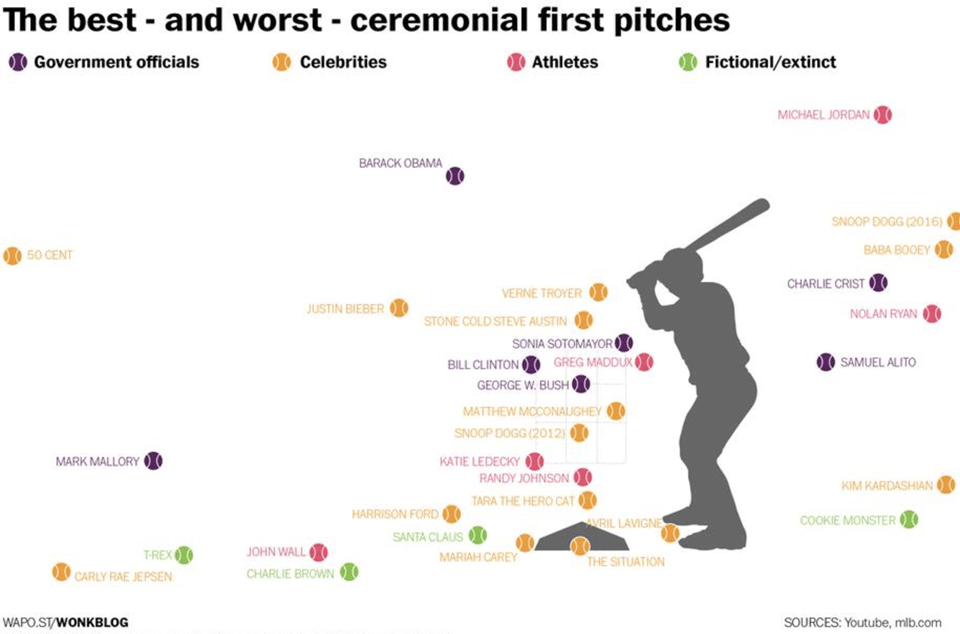
The Washington Post created a fun infographic of celebrity baseball pitches.
I use this graphic in my Data Analytics class. Students are tempted to draw inferences about individuals from this data set. John Wall and Michael Jordan are great athletes, but in this case they are underperforming Avril Lavigne and George W. Bush. Do we conclude that Sonia Sotomayor missed her calling as an MLB player?
The first lesson here is that we should not assume we can predict where Harrison Ford’s next pitch will go based on observing just one pitch. A single pitch should be considered a random draw from a distribution centered around Ford’s average ability. Any single pitch could be an outlier.
Snoop Dog features twice on this graph. In 2012 he got the ball in the strike zone. Had we only seen that, we would want to conclude that he is a great pitcher. However, in 2016 he was way off to the right. In either case, overconfidence that he is predictably near a single pitch would have been a mistake.
Lastly, I use this graph to illustrate the concept of overfitting (investopedia definition). I suggest a model that is obviously inappropriate. What if we conclude from these data that anyone with the last name of Bieber will not be able to throw the ball in the strike zone? That model surely will not generalize. The problem is that if we test that prediction on the same data we used to train the model, the misclassification rate will be zero. If possible, start with a large data set and set aside some portion of the data for validation, before training a model. Having validation data for assessment is a good way to check that you haven’t modeled the noise in your training set.
John Duffy and Daniela Puzzello published a paper in 2014 on adopting fiat money. I think of that paper when I hear the ever-more-frequent discussions of crypto currencies around me. To research the topic, I went to John Duffy’s website. There I found a May 2021 working paper about adopting new currencies in which they directly reference crypto. Before explaining that interesting new paper, first I will summarize the 2014 paper “Gift Exchange versus Monetary Exchange.”
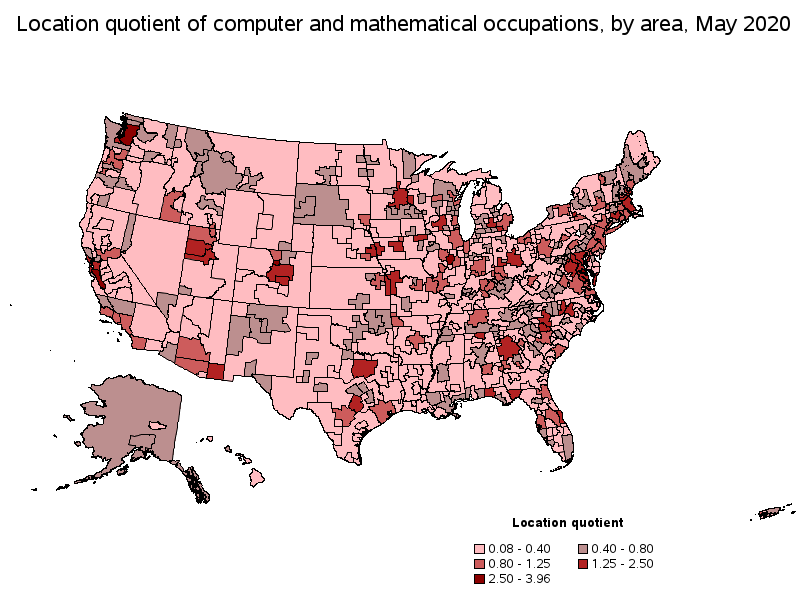
Where are the computer jobs in the United States? When looking just at total numbers of jobs, three major population centers make it into the top 7 areas: NYC, LA, and Chicago. San Francisco is ahead of Chicago, while San Jose is behind Chicago. In terms of the total number of jobs, the D.C. area is ahead of any West Coast city. Is Silicon Valley not as central as we thought?
Here’s a map of the U.S. that isn’t just another iteration of population density.
When metropolitan areas are ranked by employment in computer occupations per thousand jobs, then New York City no longer makes the top-10 list. San Jose, California reigns at the top, which seems suitable for Silicon Valley. The 2nd ranked area will surprise you: Bloomington, IL. A region of Maryland and Washington D.C. shouldn’t surprise anyone. If you aren’t familiar with Alabama, then would you expect Huntsville to rank above San Francisco in this list?
Huntsville, AL is not a large city, but it is a major hub for government-funded high-tech activity. The small number of people who live there overwhelmingly selected in to take a high-tech job. For an example, I quickly checked a job website to sample in Huntsville. Lockheed Martin is hiring a “Computer Systems Architect” based in Huntsville.
Anyone familiar with Silicon Valley already knows that the city of San Francisco was not considered core to “the valley”. Even though computer technology seems antithetical to anything “historical”, there is in fact a Silicon Valley Historical Association. They list the cities of the valley, which does include San Francisco. (corrected an error here)
The last item reported on this Census webpage is annual mean wage. For that contest, San Francisco does seem grouped with the San Jose area, at last. The computer jobs that pay the most are in Silicon Valley or next-door SF. Those middle-of-the-country hotspots like Huntsville do not make the top-10 list for highest paid. However, if cost of living is taken into account, some Huntsville IT workers come out ahead.
I blogged earlier about a new textbook that I am adopting for an analytics course. The first few chapters are primarily an introduction to using the R coding language within RStudio. One of the resources I’m posting for students this week is screen capture videos of me manipulating data in RStudio.
Sometimes I make mistakes, shockingly. I’m a professional, and yet sometimes I still make careless typos in R. I found out that my version of R was outdated, right when I was in the middle of recording a lecture.
I could have deleted the footage of my mistakes. I could have re-recorded a clean smooth video in which I run command after command without saying “ok… I got an error”.
Sarah Ruden is an scholar of ancient literature who has translated classic works such as The Aeneid. Her new book is an English translation of the 4 first books of the Bible’s New Testament, the Gospels.
If you buy a standard Bible, there is usually only a 2-page preface to a 500+ page book. Ruden’s introduction and glossary takes up closer to 50 of the first pages. I would pay just to read the introduction. Ruden describes what it was like, as a professional translator of classics, to approach the Gospels. A reader who is already familiar with the Bible will learn as much from this introduction as from the translation itself. It’s rare to hear the Gospels discussed simply as books instead of as weapons wielded by all sides of the culture wars. I found it interesting to learn about how the Gospels, stylistically, compare to other ancient texts.
Ruben’s enthusiasm for listening to the voices of ancient writers is contagious. She makes it all sound so interesting that anyone, regardless of their previous stance on god (the lowercase g is her idea of what the ancients would write), will want to keep reading. Speaking as someone who has already read the New Testament, I have never been more excited to read the Gospels as I was after finishing Ruden’s introduction. Ruden promises to deliver to modern readers the voices of the ancient writers, with as much accuracy as possible.
Alabama is not a top international tourist destination, and I’m not going to argue that it should be. However, if you are ever in Birmingham, AL…
The restaurant scene if amazing. There are really excellent James Beard award winning restaurants. You can find authentic Southern cooking and BBQ. This is one of the most affordable places to make a foodie weekend. BhamNow curates some good articles on local restaurant news.
Our most famous place is the Birmingham Civil Rights Institute. The struggle for civil rights put Birmingham on the map (I don’t mean in a good way).
Something to understand about the city is that it’s small and easy to get around by car. You can do lots of things in one day. You could quickly go from the Civil Rights Institute over to the Art Museum (free admission).
If you like history or big machines then you will appreciate being able to walk through Sloss Furnaces. This is what remains of a real 20th century blast furnace. Unlike the Art Museum, I would say come see it now before it gets demolished or closed.
Also related to the defunct iron and steel industry is the park around the giant Vulcan statue. The park offers a great view of the city. There is a small museum about digging iron ore out of Red Mountain and how people could die in the steel mills. At this point I will mention, for our international audience, that Birmingham was named after the city in England. We aspired to be the “Birmingham of America”.
If you want to hike Red Mountain, a giant network of hiking trails is just a 15-minute drive from the city. The dirt is red. You can tell this was a rich iron seam. Two other good hiking spots are Ruffner Mountain and Moss Rock Preserve. None of the mountains around here are dramatic, but these are nice places to go when the weather is good. You might want to hike so you can justify eating more.
For kids, I recommend Railroad Park. It’s a nice city park where freight trains go by regularly. Birmingham was not built around a river – it was built around a railroad. Close by is the McWane Science Center that has lots of hands-on exhibits for kids. I would not recommend McWane for adults, although their IMAX movie offerings could be of interest and the Pizitz Food Hall across the street is fun.
If you live in the American South and have not yet visited Birmingham for a weekend, then you are missing out! Of course there are many more things I could say about the city, but just what I listed above will keep you busy.
 Economist Writing Every Day