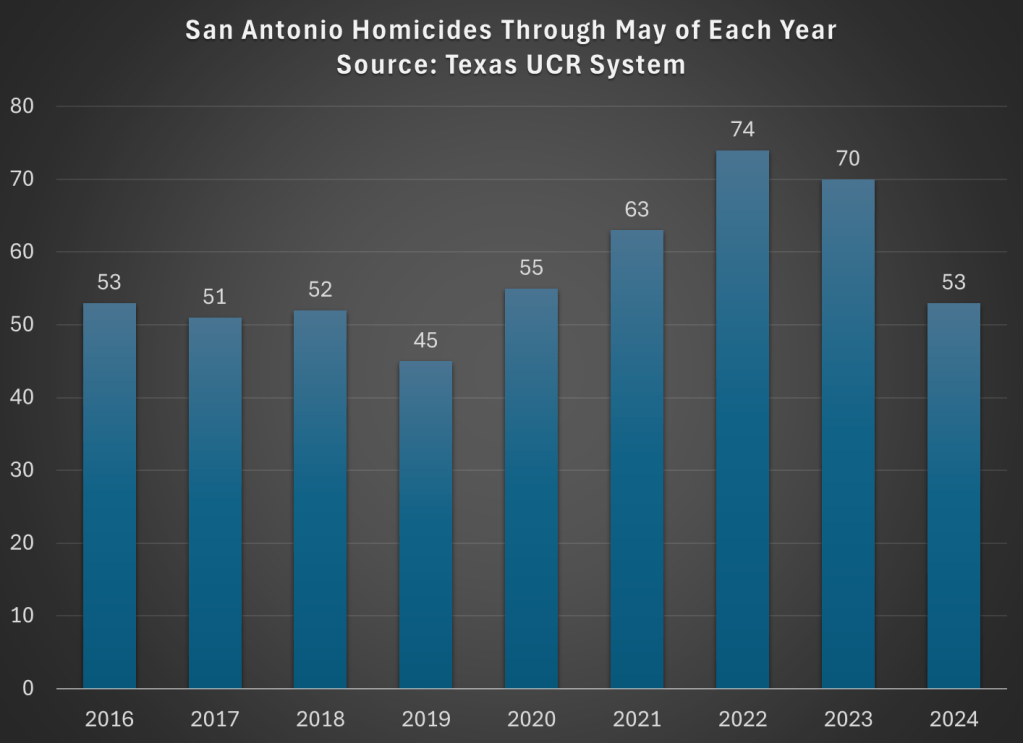
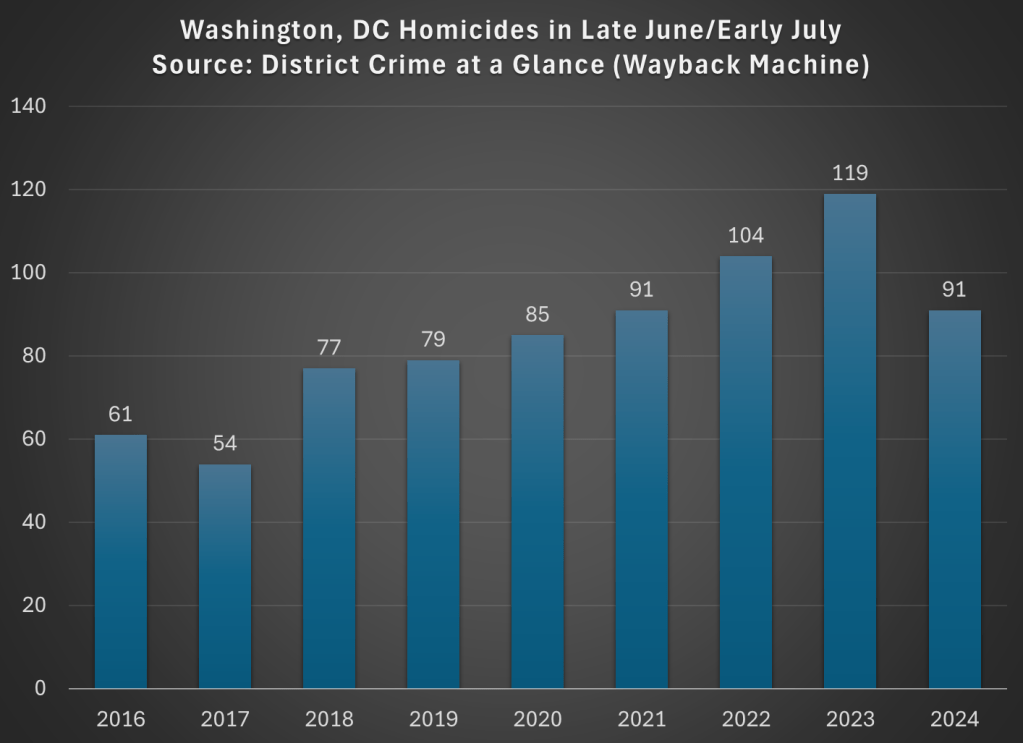
You Read It Here First

The subjects of two of our posts from 2023 are suddenly big stories.

First, here’s how I summed up New Orleans’ recovery from hurricane Katrina then:

Large institutions (university medical centers, the VA, the airport, museums, major hotels) have been driving this phase of the recovery. The neighborhoods are also recovering, but more slowly, particularly small business. Population is still well below 2005 levels. I generally think inequality has been overrated in national discussions of the last 15 years relative to concerns about poverty and overall prosperity, but even to me New Orleans is a strikingly unequal city; there’s so much wealth alongside so many people seeming to get very little benefit from it. The most persistent problems are the ones that remain from before Katrina: the roads, the schools, and the crime; taken together, the dysfunctional public sector.

The New York Times had a similar take yesterday:

Today, New Orleans is smaller, poorer and more unequal than before the storm. It hasn’t rebuilt a durable middle class, and lacks basic services and a major economic engine outside of its storied tourism industry…. New Orleans now ranks as the most income-unequal major city in America…. In areas that attracted investment — the French Quarter, the Bywater and the shiny biomedical corridor — there are few outward signs of the hurricane’s impact. But travel to places like Pontchartrain Park, Milneburg and New Orleans East that were once home to a vibrant Black middle class, and there are abandoned homes and broken streets — entire communities that never regained their pre-Katrina luster…. Meanwhile, basic city functions remain unreliable.

I wrote in 2023 about a then-new Philadelphia Fed working paper claiming that mortgage fraud is widespread:

The fraud is that investors are buying properties to flip or rent out, but claim they are buying them to live there in order to get cheaper mortgages…. One third of all investors is a lot of fraud!… such widespread fraud is concerning, and I hope lenders (especially the subsidized GSEs) find a way to crack down on it…. This mortgage fraud paper seems like a bombshell to me and I’m surprised it seems to have received no media attention; journalists take note. For everyone else, I suppose you read obscure econ blogs precisely to find out about the things that haven’t yet made the papers.

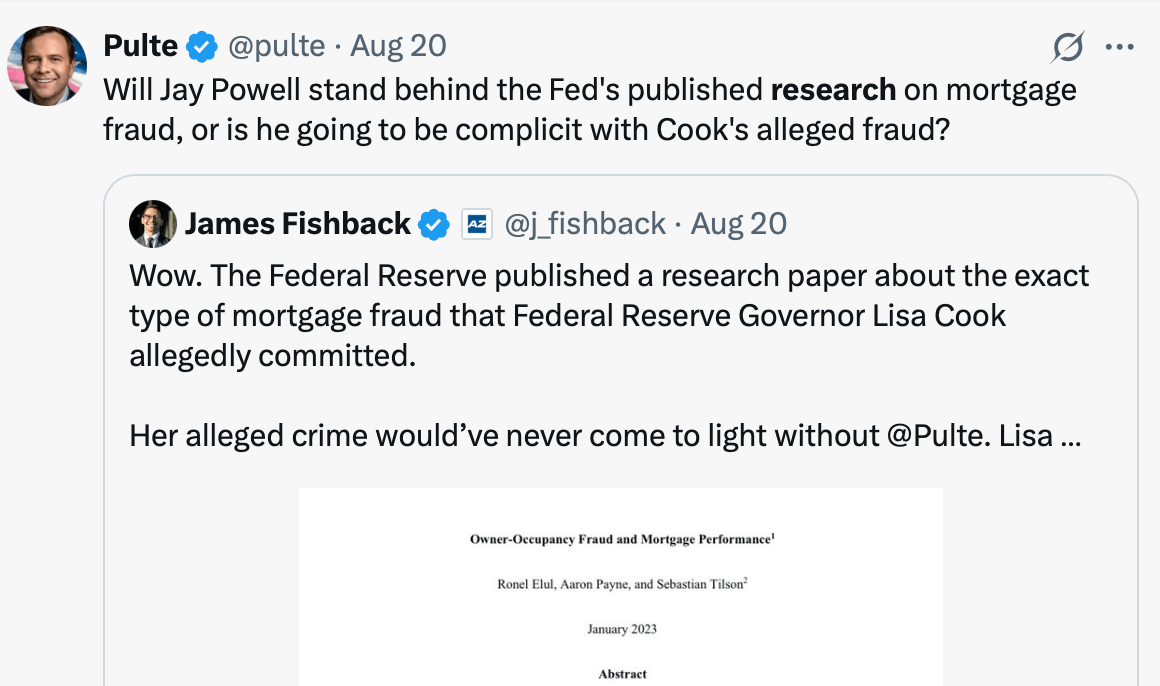
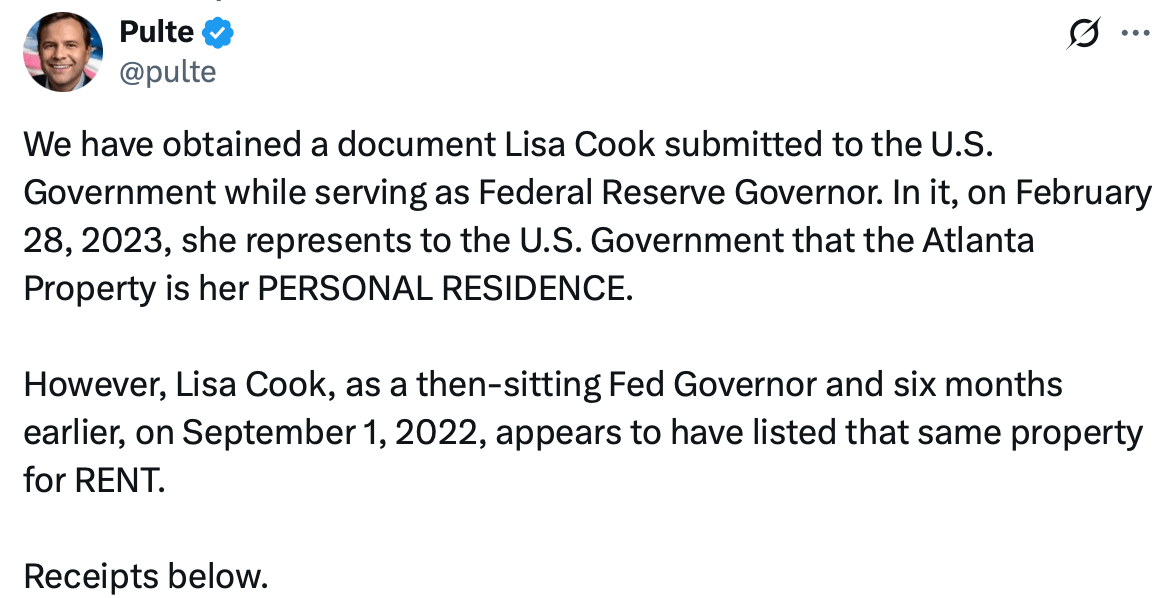
Well, that paper has now got its fair share of attention from the media and the GSEs. Bill Pulte, director of the Federal Housing Finance Agency and chairman of Fannie Mae and Freddie Mac, has been going after Biden-appointed Federal Reserve Governor Lisa Cook over allegations that she mis-stated her primary residence on a mortgage application:

Pulte has written many dozens of tweets about this, at least one of which cited the Philly Fed paper:

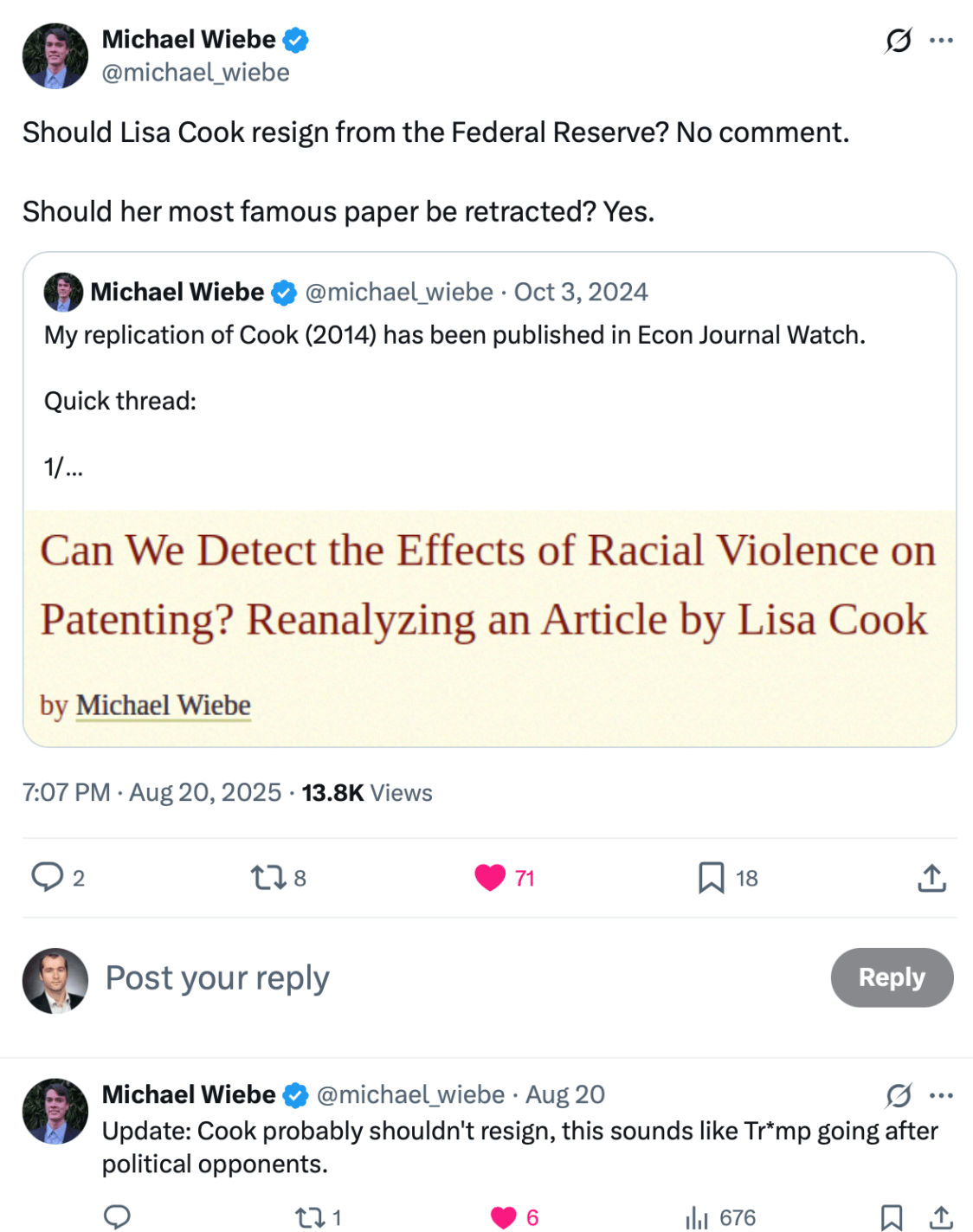
Now President Trump is trying to fire Cook. Federal Reserve Governors can only be fired “for cause” and none ever have been, but Trump is using this alleged mortgage fraud to try to make Cook the first.

The Trump administration seems to have made the same realization as Xi Jinping did back in 2012– that when corruption is sufficiently widespread, some of your political opponents have likely engaged in it and so can be legally targeted in an anti-corruption crackdown (while corruption by your friends is overlooked).

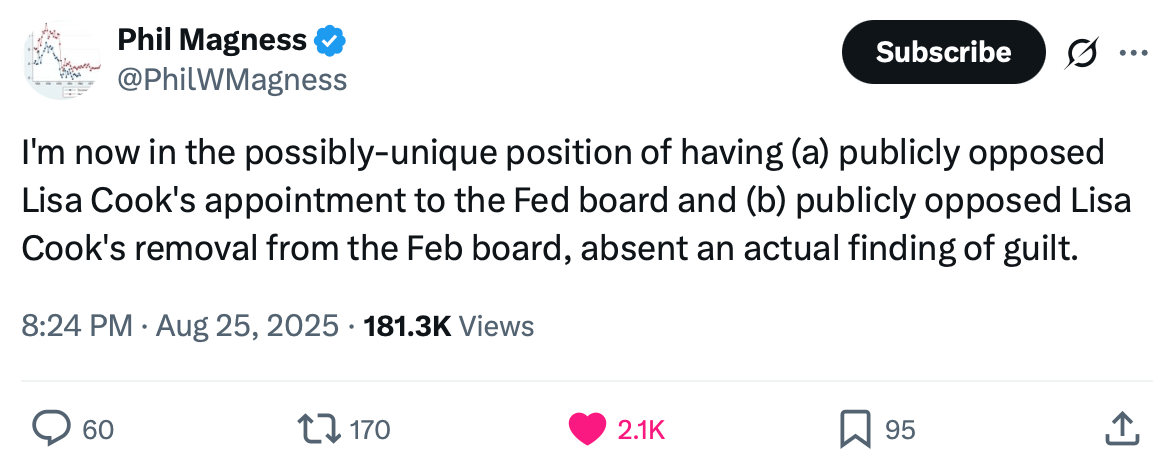
I’m one of a few people hoping for the Fed to be run the most competent technocrats with a minimum of political interference:

But I’m not expecting it.

Remember, you read it here first.

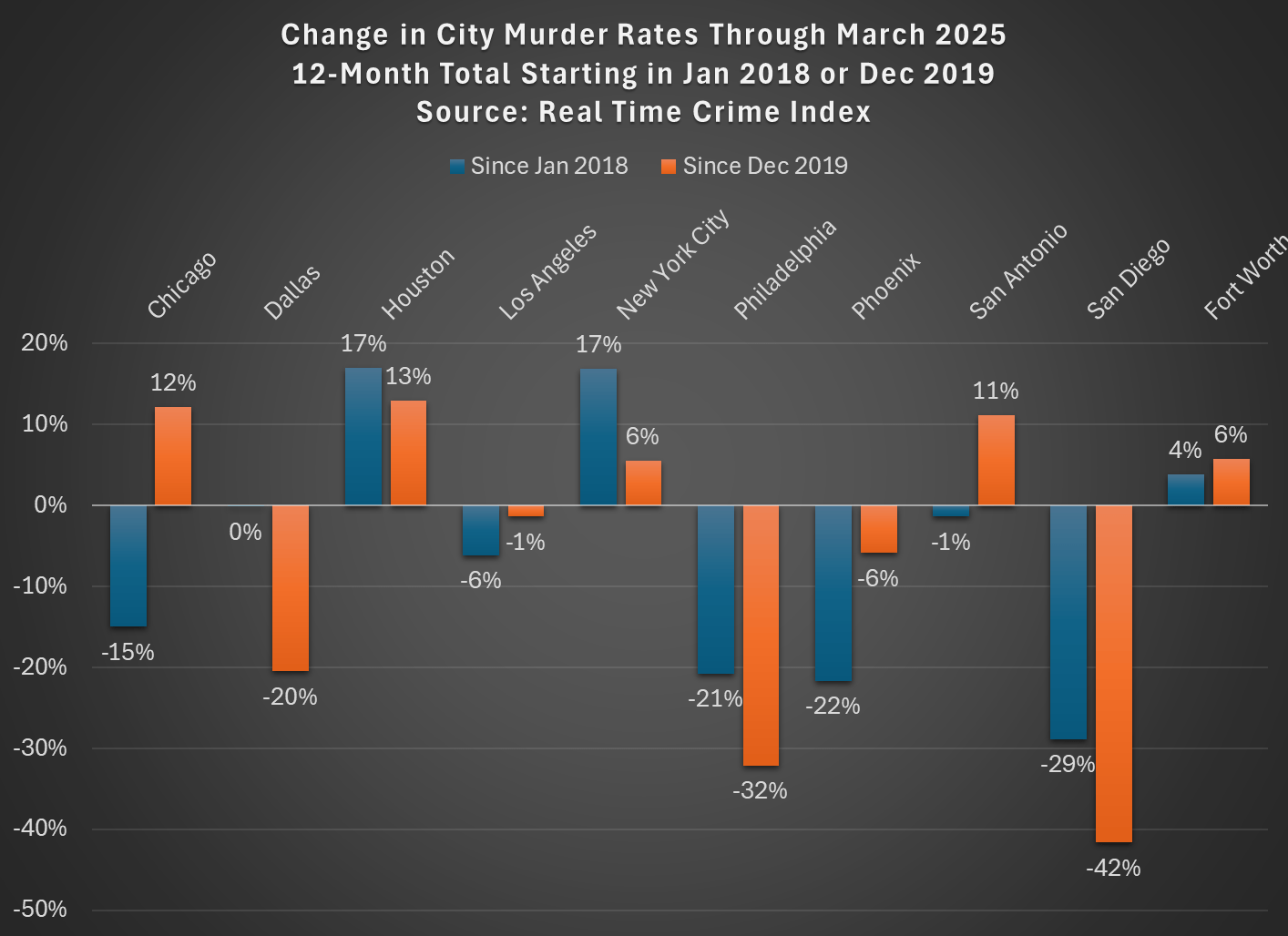
Change in Homicide Rates from Pre-Pandemic in Large US Cities

We all know that homicides spiked in the US in 2020 and we all (hopefully) know that homicides have been falling across most of the country dramatically since the end of 2021. But have homicides started to get back to, or even below, pre-pandemic levels? Or is it merely reversing the 2020 increases?

The answer depends on the city and the pre-pandemic baseline! The chart below shows the 10 largest cities (with Fort Worth instead of Jacksonville, because the Real-Time Crime Index doesn’t include the latter) in the US, using a base of either January 2018 (the first month in the RTCI) or December 2019 (just before the pandemic, and murders had fallen nationally between these two dates):

The murder data comes from the Real-Time Crime Index, and it is a 12-month total so we shouldn’t have to worry about seasonality even though the months are different. I use Census annual city population estimates to calculate the rates (and estimate 2025 based on the growth from 2023-24).

As you can see, depending on the base timeframe used, about half of the cities saw declines, a few were roughly flat, and some definitely saw increases. New York, Houston, and Fort Worth are definitely still elevated. Los Angeles, Philly, Phoenix, and San Diego are definitely down. The others are either close to even or mixed depending on your baseline.

Keep in mind these data are only through March 2025. As both Billy Binion at Reason and Jeff Asher have both recently emphasized, if we use the most recent data for many cities, it’s entirely possible that 2025 will end up having some of the lowest homicide rates ever recorded for many US cities. The declines in early 2025 have definitely been big, but mostly they are just a continuation of the post-2021 decline.

Again, for clarification, all of these cities are down from their 2020-21 peaks: using September 2021 as the base (when the national murder rate roughly peaked), these 10 cities are down between 31% and 58%. Big improvements!

“Final Notice” Traffic Ticket Smishing Scam

Yesterday I got a scary-sounding text message, claiming that I have an outstanding traffic ticket in a certain state, and threatening me with the following if I did not pay within two days:

We will take the following actions:

1. Report to the DMV Breach Database

2. Suspend your vehicle registration starting June 2

3. Suspension of driving privileges for 30 days…

4. You may be sued and your credit score will suffer

Please pay immediately before execution to avoid license suspension and further legal disputes.

Oh, my!

A link (which I did NOT click on) was provided for “payment”.

I also got an almost (not quite) identical text a few days earlier. I was almost sure these were scams, but it was comforting to confirm that by going to the web and reading that, yes, these sorts of texts are the flavor of the month in remote rip-offs; as a rule, states do not send out threatening texts with payment links in them.

These texts are examples of “smishing”, which is phishing (to collect identity or bank/credit card information) via SMS text messaging. It must be a lucrative practice. According to spam blocker Robokiller, Americans received 19.2 billion spam robo texts in May 2025. That’s nearly 63 spam texts for every person in the U.S.

Beside these traffic ticket scams, I often get texts asking me to click to track delivery of some package, or to prevent the misuse of my credit card, etc. I have been spared text messages from the Nigerian prince who needs my help to claim his rightful inheritance; I did get an email from him some years back.

The FTC keeps a database called Sentinel on fraud complaints made to the FTC and to law enforcement agencies. People reported losing a total of $12 billion to fraud in 2024, an increase of $2 billion over the previous year. That is a LOT of money (and a commentary on how wealthy Americans are, if that much can get skimmed off with little net impact on society). The biggest single category for dollar loss was investment; the number of victims was smaller than for other categories, but the loss per victim ($9,200) was quite high. Other areas with high median losses per capita were Business and Job Opportunities ($2,250) and Mortgage Foreclosure Relief and Debt Management ($1,500).

Imposter scams like the texts I have gotten (sender pretending to be from state DMV, post office, bank, credit card company, etc.) were by far the largest category by number reported (845,806 in 2024). Of those imposter reports, 22% involved actual losses ($800 median loss), totaling a hefty $2,952 million. That is a juicy enough haul to keep those robo frauds coming.

How to not get scammed: Be suspicious of every email or text, especially ones that prey on emotions like fear or greed or curiosity and try to engage you to payments or for prying information out of you. If it purports to come from some known entity like Bank of America or your state DMV, contact said entity directly to check it out. If you don’t click on anything (or reply in any way to the text, like responding with Y or N), it can’t hurt you.

I’m not sure how much they can do, considering the bad guys tend to hijack legit phone numbers for their dirty work, but you can mark these texts as spam to help your phone carrier improve their spam detection algorithm. Also, reporting scam texts to the U.S. Federal Trade Commission and/or the FBI’s Internet Crime Complaint Center can help build their data set, and perhaps lead to law enforcement actions.

Later add: According to EZPass, here is how to report text scams:

You can report smishing messages to your cell carrier by following this FCC guidance.  This service is provided by most cell carriers.

  1. Hold down the spam TXT/SMS message with your finger
  2. Select the “Forward” option
  3. Enter 7726 as the recipient and press “Send”

Additionally, to report the message to the FBI, visit the FBI’s Internet Crime Complaint Center (ic3.gov) and select ‘File a Complaint’ to do so.  When completing the complaint, include the phone number where the smishing text originated, and the website link listed within the text.
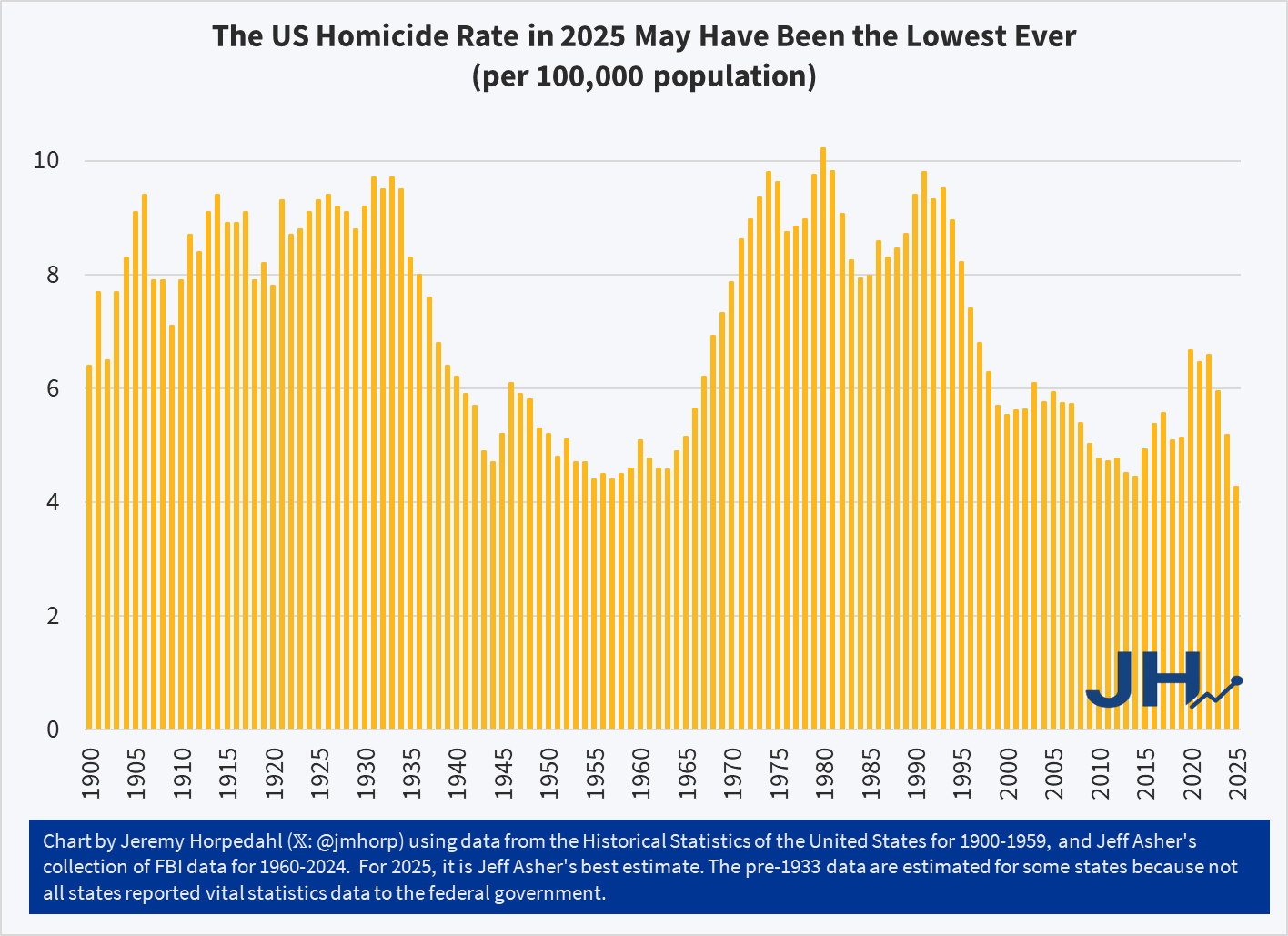
Study Shows AI Can Enable Information-Stealing (Phishing) Campaigns

As a computer user, I make a modest effort to stay informed regarding the latest maneuvers by the bad guys to steal information and money. I am on a mailing list for the Malwarebytes blog, which publishes maybe three or four stories a week in this arena.

Here are three stories from the latest Malwarebytes email:

 ( 1 )   AI-supported spear phishing fools more than 50% of targets A controlled study reveals that 54% of users were tricked by AI-supported spear phishing emails, compared to just 12% who were targeted by traditional, human-crafted ones. ( 2 )  Dental group lied through teeth about data breach, fined $350,000 Westend Dental denied a 2020 ransomware attack and associated data breach, telling its customers that their data was lost due to an “accidentally formatted hard drive”. The company agreed to pay $350,000 to settle HIPAA violations ( 3 ) “Can you try a game I made?” Fake game sites lead to information stealers Victims lured to a fake game website where they were met with an information stealer instead of the promised game.

The first item here fits with our interest in the promise and perils of AI, so I will paste a couple of self-explanatory excerpts in italics:

One of the first things everyone predicted when artificial intelligence (AI) became more commonplace was that it would assist cybercriminals in making their phishing campaigns more effective.

Now, researchers have conducted a scientific study into the effectiveness of AI supported spear phishing, and the results line up with everyone’s expectations: AI is making it easier to do crimes.

The study, titled Evaluating Large Language Models’ Capability to Launch Fully Automated Spear Phishing Campaigns: Validated on Human Subjects, evaluates the capability of large language models (LLMs) to conduct personalized phishing attacks and compares their performance with human experts and AI models from last year.

To this end the researchers developed and tested an AI-powered tool to automate spear phishing campaigns. They used AI agents based on GPT-4o and Claude 3.5 Sonnet to search the web for available information on a target and use this for highly personalized phishing messages.

With these tools, the researchers achieved a click-through rate (CTR) that marketing departments can only dream of, at 54%. The control group received arbitrary phishing emails and achieved a CTR of 12% (roughly 1 in 8 people clicked the link).

Another group was tested against an email generated by human experts which proved to be just as effective as the fully AI automated emails and got a 54% CTR. But the human experts did this at 30 times the cost of the AI automated tools.

…The key to the success of a phishing email is the level of personalization that can be achieved by the AI assisted method and the base for that personalization can be provided by an AI web-browsing agent that crawls publicly available information.

Based on information found online about the target, they are invited to participate in a project that aligns with their interest and presented with a link to a site where they can find more details.

~ ~ ~ ~ ~ ~ ~ ~ ~ ~ ~ ~

But there is good news as well. We can use AI to fight AI: … LLMs are also getting better at recognizing phishing emails. Claude 3.5 Sonnet scored well above 90% with only a few false alarms and detected several emails that passed human detection. Although it struggles with some phishing emails that are clearly suspicious to most humans.

In addition, the blog article cited some hard evidence for year-over-year progress in AI capabilities: a year ago, unassisted AI was unable to match the phishing performance of human-generated phishing messages. But now, AI can match and even slightly exceed the effectiveness of human phishing. This is….progress, I guess.

P.S. I’d feel remiss if I did not remind us all yet again, it’s safest to never click on a link embedded in an email message, if you can avoid it. If the email purports to be from a company, it’s safest to go directly to the company’s website and do your business there.

Homicides in 2024 Were Down Significantly

The tragic act of terrorism in New Orleans early on New Year’s Day might seem like confirmation to many that crime, especially in big cities, is still at elevated levels from before the pandemic. But we have to be very careful with anecdotes, no matter how deadly and visible.

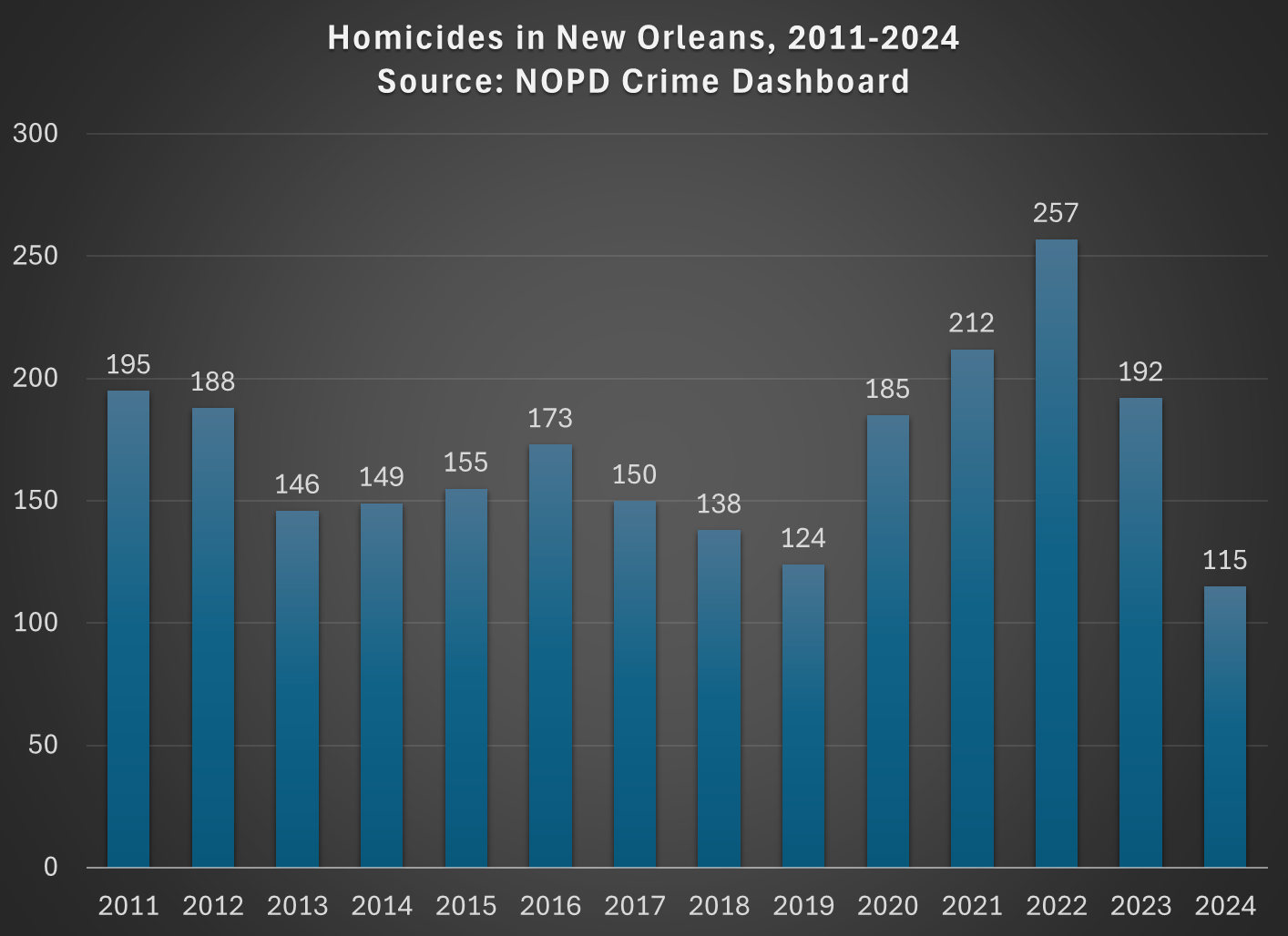
Using data from the New Orleans Police Department dashboard, which has been updated through December 31, 2024, we see that 2024 had the lowest number of homicides going back to 2011, which likely makes it one of the safest years on record in New Orleans:

New Orleans is not alone.

Using data from the Real Time Crime Index, we see that among the 10 largest cities in the US in their index, through the first 10 months of the 2024 (the most recent available for all these cities), homicides are down 16.9% compared to 2023.

Murders in these 10 largest cities are still about 5.6% above the first 10 months of 2019, but three of the 10 cities (Dallas, Philadelphia, and San Diego) are already below the first 10 months of 2019, by fairly significant margins (-13.7%, -26.2%, and -21.6%). Once we have all 12 months of data for these cities, I suspect that a few more will be back to 2019 levels.

Crime is indeed still a major social problem in much of the US, but we are getting back to 2019 levels of social problems — which is still bad, but violent crime is not high and rising, as many seem to believe based on very notable and horrific events.

(The 10 largest cities in the RT Crime Index are Chicago, Dallas, Houston, Las Vegas, Los Angeles, New York, Philadelphia, Phoenix, San Antonio, and San Diego.)

Real Time Crime Index

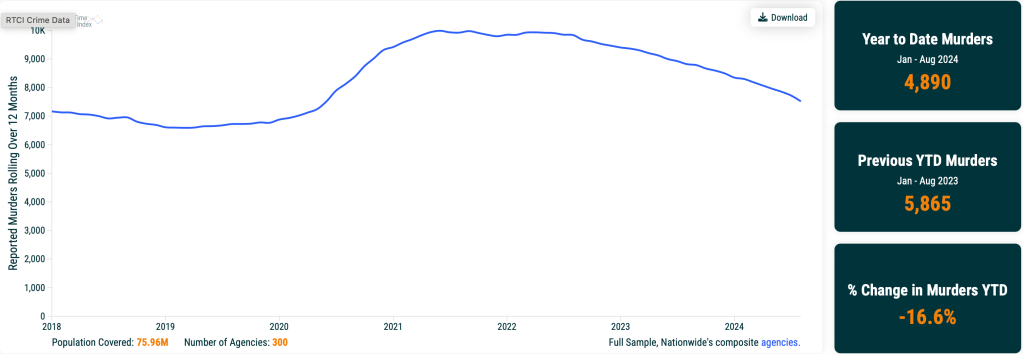
If you want to know how many pigs were killed in the United States yesterday, the USDA has the answer. But if you want to know how many humans were killed in the US this month, the FBI is going to need a year or two to figure it out. The new Real Time Crime Index, though, can tell you much sooner, by putting together the faster local agency reports:

Trends currently look good, though murders still aren’t quite back to pre-2020 levels.

In addition to graphing top-line state and national trends, the Real Time Crime Index also offers the option to download a CSV with city-level data going back to 2018. This seems like a great resource for researchers, worthy of adding to my page of most-improved datasets.

Did Sherlock Holmes Really Wear a Deerstalker Hat?

Quick, who is the guy on the right in the illustration below?

Image: YouTube

Here he is again:

We’d know him anywhere, thanks to that deerstalker cap. This was a practical hat used by hunters and other outdoorsmen in England at the time. It was popular with women as well as men. The front and back brims warded off rain and sun. The ear flaps tied under the chin for cold weather or wind. The flaps were tied at the top when they were not down. Holmes’s hat was apparently in a hounds-tooth tweed pattern of water-shedding wool.

How often did Arthur Conan Doyle feature his detective character wearing this headgear? Actually, he didn’t at all. The stories never once mention Holmes in a deerstalker cap (or an Inverness cape, another Sherlock Holmes trope), although such a hat is not implausible.

When the first sets of Sherlock Holmes stories appeared serialized in the Strand magazine in the early 1890’s, they were illustrated by artist Sidney Paget. Paget is responsible for the deerstalker cap image. Here is the detective and his sidekick on the way to investigate the Boscombe Valley mystery:

Image: Wikipedia The Boscombe Valley  Mystery   

It would seem that Sherlock Holmes lived and died by his deerstalker, as evidenced by Paget’s illustration on the detective’s struggle to the death with the arch-villain Professor Moriarity above Reichenbach Falls, in The Final Problem:

Image: Wikipedia

( Doyle wrote The Final Problem to kill off his detective character, so the author could move on to more dignified pursuits than writing Sherlock Holmes stories. He did not anticipate the public outcry at the demise of the popular character. Men in London wore black armbands, and subscriptions to the Strand magazine were cancelled in protest. Eventually Doyle brought Holmes back in a further series of stories, with the literary device that Holmes had faked his own death in order to hide out from a criminal syndicate. )

Even Paget did not keep Holmes in this hat all the time. When the great detective was not sleuthing in the outdoors, he was properly dressed for English society. It was unthinkable for a gentleman to appear in public without some kind of hat. For instance, here are two illustrations from The Adventure of Silver Blaze. Holmes is depicted below in his deerstalker when confronting a bad guy at the gate of a neighboring farm, after tracking a horse across the moor:

In the same story, however, Holmes is drawn by Paget at a horse race event wearing a formal top hat like the other gentlemen:

Image:  Wikipedia    Holmes with Silver Blaze (forehead dyed), 1892 illustration by Sidney Paget

If all this leaves you itching for your own deerstalker cap, there are several versions available on Amazon, e.g. here and here

Bonus: if you yearn to identify with a more contemporary hero, see here for info on Indiana Jones fedoras.

More Immigrants, More Safety

The headlines often read with the criminal threats that illegal/undocumented immigrants pose to the US native population. The story usually includes a heart wrenching and tragic story about a native minor who was harmed by an immigrant and a politician to help propose a solution. There’s also usually a number cited for how many such crimes happened in the most recent year with data. Stories like this are designed to provoke feelings – not to provoke thinkings.

First, the tragic story is probably not representative. Even if it is, the citation of a raw count of crimes is not communicative in a helpful way.  Sometimes politicians will say something like “one victim of a crime by an illegal immigrant is too many”.  But that seems like a silly argument to make *if* immigrants reduce the probability of being a victim of a crime.

I argue that (1) immigrants who commit crimes at a lower probability than the native population cause the native population to be safer and, counterintuitively, (2) immigrants who commit crimes at a *higher* probability than the native population cause the native population to be safer.

Continue reading

The Crime Wave May Be Over

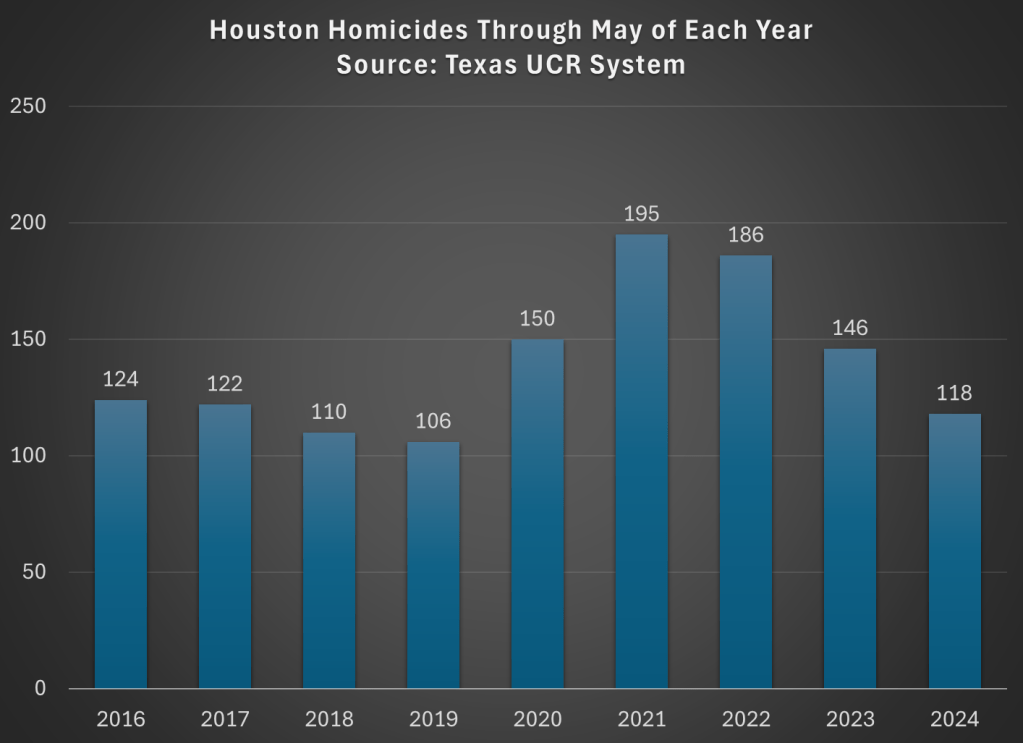
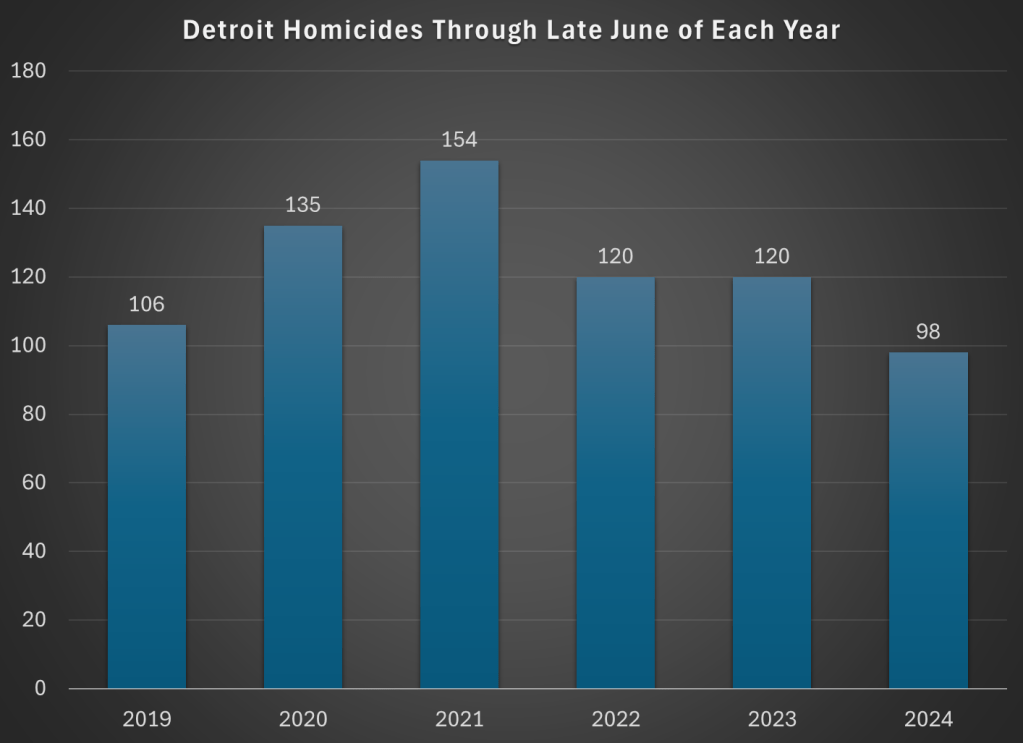
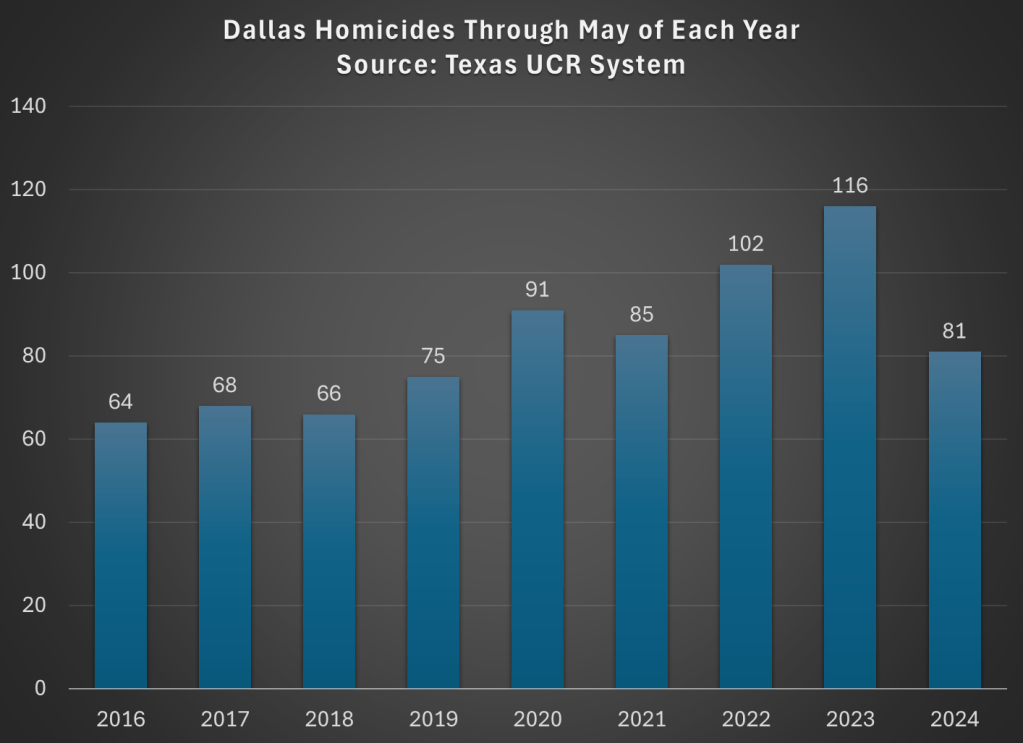
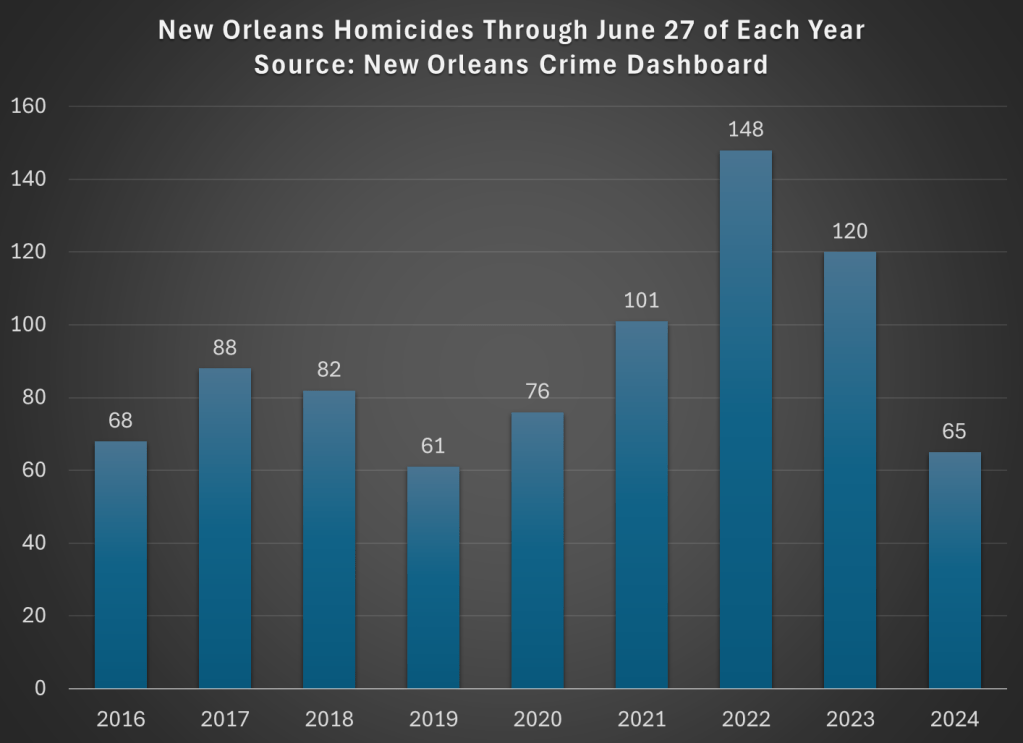
Crime of all forms certainly spiked in 2020 and 2021 in most of the US, and continued to remain high for a time after that. But recent data, especially homicide data compiled by AH Datalytics, suggest that crime is falling. When measured by homicide rates, the worst of crimes and the least likely to be underreported, homicide rates across 272 major cities in the US is down 17.6% in 2024 compared with the same period in 2023. And among the 20 cities with the most homicides in 2023, just one (Birmingham, the 20th on the list) saw an increase from 2023 to 2024.

But is this just coming down from a relative high? Are homicide rates still elevated from pre-pandemic? I went through the cities with the most homicides on the AH Datalytics list, and for those where I could find comparable data pre-pandemic, I created the following charts. As you will see, lots of these cities are down to or below pre-pandemic levels (for the period in 2024 that is comparable to prior years). Not every single city, of course, but most are close to 2019 or prior years.

Was 2022 The “Deadliest Year on Record” For Children in Arkansas?

In my Inbox I read the following sentence, summarizing an article on child health in Arkansas: “The latest Annie E. Casey Foundation KIDS COUNT Data Book shows 2022 was the deadliest year on record for child deaths in Arkansas.”

Deadliest on record! That certainly grabbed my attention. I clicked the link and read the article. Indeed, they emphasize three times that 2022 was the “deadliest year” for kids in Arkansas, including with a chart! And the chart does seem to support the claim: in 2022 there were 44 child and teen deaths per 100,000 in Arkansas, higher than any year on the chart.

But wait a minute, this chart only goes back to 2010. Surely the record goes back further than that? Indeed it does. It took me three minutes (yes, I timed myself, and you have to use 4 different databases) to complete the necessary queries from CDC WONDER to extract the data to replicate their 2010-2022 chart, and to extend the data back a lot further: all the way to 1968 (though in 30 seconds I could have extended it back to 1999).

And what do we find in 1968? The death rate for children and teens in Arkansas was twice as high as it was in 2022. Not just a little higher, but double. With some more digging, I might be able to go back further than 1968, but from the easily accessible CDC data, that’s as far back as “the record” goes. Of course, I knew where to look, but I would hope that a group producing a data book on child health also knows where to look. And you don’t need to extend this very far past the arbitrary 2010 cutoff in the article quoted: 2008 and every year before it was more deadly than 2022 for children in Arkansas. Here’s a chart showing the good long-run trend:

Now there is a notable flattening of the long-run trend in the past 15 years or so, and a big reversal since 2019. What could be causing this? The article I read doesn’t get specific, but here’s what they say: “The state data isn’t broken out into cause of death, but firearm-related deaths have become the leading cause of death among U.S. teens in recent years. Deaths from accidents such as car crashes account for most child deaths.”

But using CDC WONDER, we can easily check on what is causing the increase since 2019. “Firearm-related deaths” is an interesting phrase, since it lumps together three very different kinds of deaths: homicides, suicides, and accidents. And while it is true that “deaths from accidents” are the leading category of deaths for children, this also lumps together many different kinds of deaths: not only car crashes, but also poisonings, drownings, or accidental firearm deaths.

For Arkansas in 2022, here are the leading categories of deaths for children and teens (ages 1-19) if we break down the categories a bit:

  • Homicides: 66
  • Non-transport accidents: 58 (largest subcategories: poisonings/ODs and drowning)
  • Transport accidents: 52 (almost all car crashes)
  • Suicides: 24
  • Birth defects: 16
  • Cancers: 14
  • Cardiovascular diseases: 13

And no other categories are reported, because CDC WONDER won’t show you anything smaller than 10 deaths.

We might also ask what caused the increase since 2019, especially since this a report on child health and possible solutions. The death rate increased by 9 deaths per 100,000, and over 80% of the increase is accounted for by just two categories: homicides and non-transport accidents. Car crashes actually fell slightly (though the rate increased a bit, since the denominator was also smaller). Deaths from suicides, cancer, and heart diseases also declined from 2019 to 2022 among children in Arkansas, and these are the three on the list above that we would probably consider the “health” categories. Things actually got better!

But the really big increase, and very bad social trend, is the category of homicides. Among children and teens in Arkansas, it rose from 35 deaths in 2019 to 66 deaths in 2022. It almost doubled. That’s bad! But homicides are not mentioned anywhere in the article on this topic that I read (“firearm-related deaths” is the closest they get). And while car accidents are definitely a major problem, they didn’t really increase from 2019 to 2022 (among kids in Arkansas).

One more thing we can do with CDC WONDER is break down the homicides by age. The numbers so far are looking at a very broad range of children and teens, from ages 1-19. As I’ve written about before, the is a huge difference between homicide rates for older teens versus all of the kids. Indeed for Arkansas we see the same pattern, such as when I run a CDC WONDER query for single-years of age: only the ages 17, 18, and 19 show up (remember, anything less than 10 deaths won’t register in the query).

Breaking it down by five-year age groups, we see that 53 of the 66 homicides (in Arkansas among kids and teens) were for ages 15-19, that is 80% of the total. And further if we run the query by race, we see that 40 of the 66 homicides were for African Americans age 15-19. This is clearly a social problem, but it’s an extremely concentrated social problem. And the increase for older teen Blacks has been large too: it was just 17 deaths in 2019, more than doubling to 40 homicides in 2022.

Now, small numbers can jump around a bit, so just looking at 2019 and 2022 might be deceptive. What if we had a longer annual series to look at? Again, CDC WONDER allows us to do this. Here is the chart for homicides among older Black teens in Arkansas:

This is a dramatic chart. The steady rise in homicides among this demographic since 2019 is staggering. Not only the dramatic increase, but notice that 2021 and 2022 are much worse than the crime wave of the early 1990s, which also jump out in this chart. The homicide rate for older Black teens in 2022 was almost 50 percent higher than 1995, the prior worst year on record.

So is there a problem with child and teen deaths in Arkansas? Yes! But with just a few minutes of searching on CDC WONDER, I think we can get a much better picture of what is causing it than the article I read summarizing the report. Indeed, if we read the full national report, the word “homicide” is only mentioned once in a laundry list of many causes of death.

The most important part of addressing a social problem, such as “deadliest year on record for child deaths in Arkansas” is to know some basic details about what is causing a bad social indicator to worsen. Hopefully after reading this blog post you know a little bit more. If you want to read my summary of the research on how to reduce deaths from firearms, see this June 2022 post.