Abstract: We extend Akerlof’s (1982) gift-exchange model to the case in which reference wages respond to changes in economic conditions. Our model shows that these changes spur disagreements between workers and employers regarding the reference wage. These disagreements tend to weaken the gift-exchange relationship, thus reducing production levels and wages. We find support for these predictions in a controlled yet realistic workplace environment. Our work also sheds light on several stylized facts regarding employment relationships, such as the increased intensity of labor conflicts when economic conditions are unstable.
Next, I will provide some background on gift-exchange and experiments.
If you want to change how a field works, you have a few options. You can do what you want to see more of, but you are only one person, and perhaps not the one best equipped to make things better. Or you can encourage others to work differently- but why would they listen to you?
Academics often serve as peer reviewers for the work of others. If a reviewer recommends that a paper be rejected, it usually is; if you recommend specific minor changes they usually get made. But you can’t really tell people that they should work on a totally different topic. Journal editors for the most part simply have a scaled-up version of the powers of peer reviewers to steer the field. But unlike reviewers, their positions are public and fairly long-lasting. This means they can credibly say “this is the sort of work I’d like to see more of- if you do this kind of work, there’s a good chance I’ll publish it”.
This is part of why I’ve been hoping to be a journal editor some day, and why I’m excited to be guest-editing for the first time: a special issue on Health Economics and Insurance for the Journal of Risk and Financial Management. The description notes:
Part One of The Theory of Moral Sentiments by Adam Smith is called “Of the Propriety of Action”. Smith argues that we naturally share the emotions and to a certain extent the physical sensations that we witness in others. “Sympathy” is a term Smith used for the feeling of moral sentiments.
In Section One, Chapter Five, Smith writes
In all such cases, that there may be some correspondence of sentiments between the spectator and the person principally concerned, the spectator must, first of all, endeavour … to put himself in the situation of the other, and to bring home to himself every little circumstance of distress which can possibly occur to the sufferer. He must adopt the whole case of his companion with all its minutest incidents; and strive to render as perfect as possible, that imaginary change of situation upon which his sympathy is founded.
After all this, however, the emotions of the spectator will still be very apt to fall short of the violence of what is felt by the sufferer. Mankind, though naturally sympathetic, never conceive, for what has befallen another… That imaginary change of situation, upon which their sympathy is founded, is but momentary. The thought of their own safety… continually intrudes itself upon them…
The modern word “empathy” is the capacity to step into the shoes of another person and feel their pain or joy from within the other person’s frame of reference.
Adam Smith suggests that if we hear a neighbor just experienced the death of a loved one, then we can briefly experience some sadness on their account. The more we put ourselves in their shoes, the more sadness we can experience on their behalf.
We usually think of it as a nice thing to have empathy for others. It can also be instrumental to be able to think through the perspective of another person, in order to predict what they will do next. In practical dealings, it is an economic advantage to make accurate predictions about future behavior.
If I work backward through my 2020 paper “My Reference Point, Not Yours”, then I can start by saying that people can sometimes predict what others will do.
For population to be steady or rising, the average women needs to have at least two kids. In almost every rich country- including the United States, all of Europe, and all of East Asia- this isn’t happening. In the extreme case of South Korea, where total fertility averages about one child per woman, the population will fall by half each generation. If this were to go on for 10 generations, South Korea would go from a country of 50 million people- larger than any US state- to one of 50 thousand people, far smaller than any US state. This sounds crazy and I don’t expect it will actually happen- but I can’t say what exactly will stop it from happening.
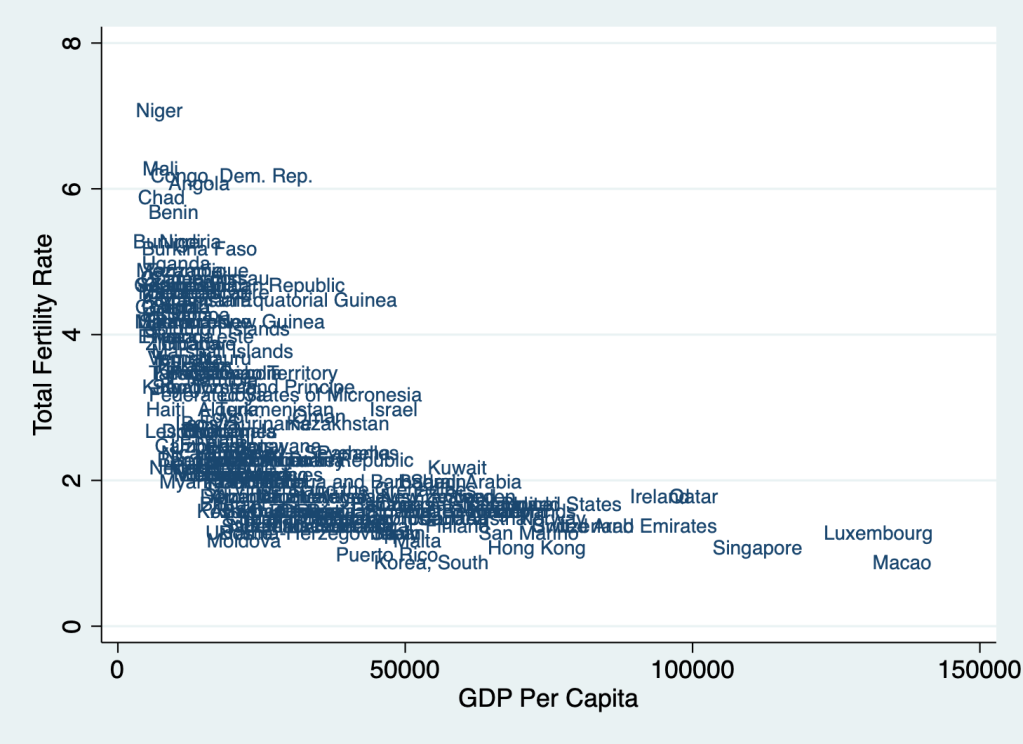
Global population growth has fallen from a peak of 2.1% per year to the current 1%, and is expected to fall to 0 by 2100. The remaining population growth will happen in poor countries, then stop for the same reasons it did in rich countries- the demographic transition from poverty, argicultural work, and high infant mortality to high incomes, high education, and low infant mortality. As the graph below shows, higher income is an incredibly strong predictor of low fertility- and so if economic growth continues, we should expect fertility to continue falling. But where does it stop?
2019 TFR from Population Reference Bureau vs 2019 PPP-adjusted GDP Per Capita fron World Bank
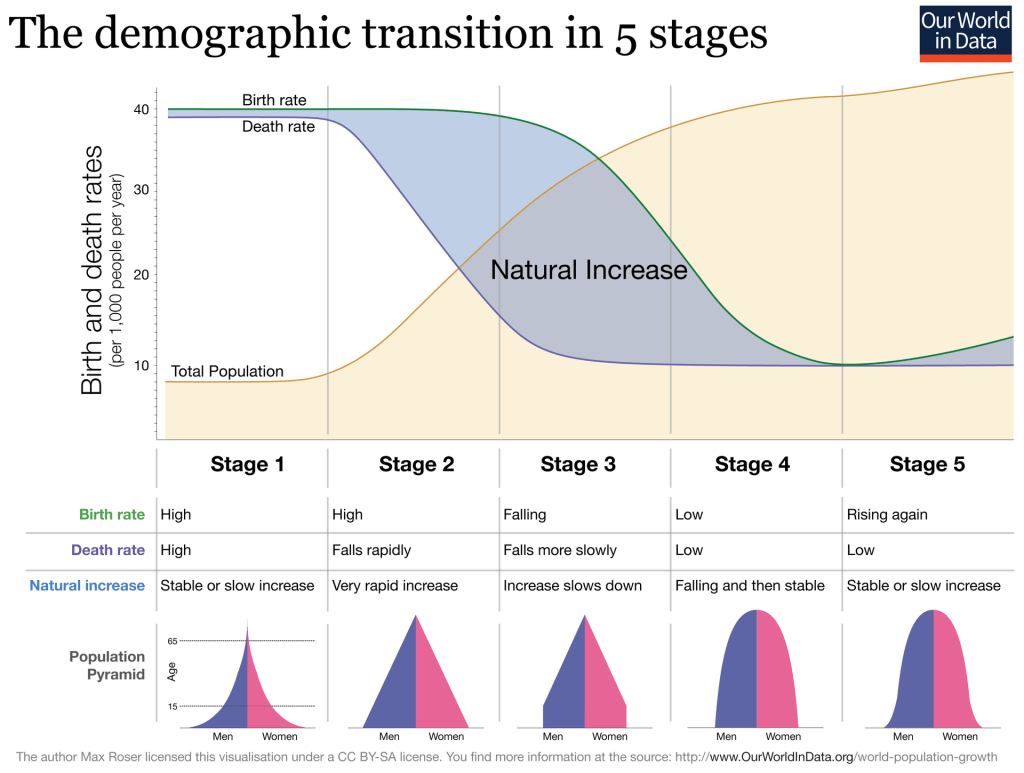
Some have theorized a “J-curve” relationship, where once incomes get high enough, fertility will start rising again. You can see this idea in “Stage 5” of Max Roser’s picture of the demopgraphic transition here:
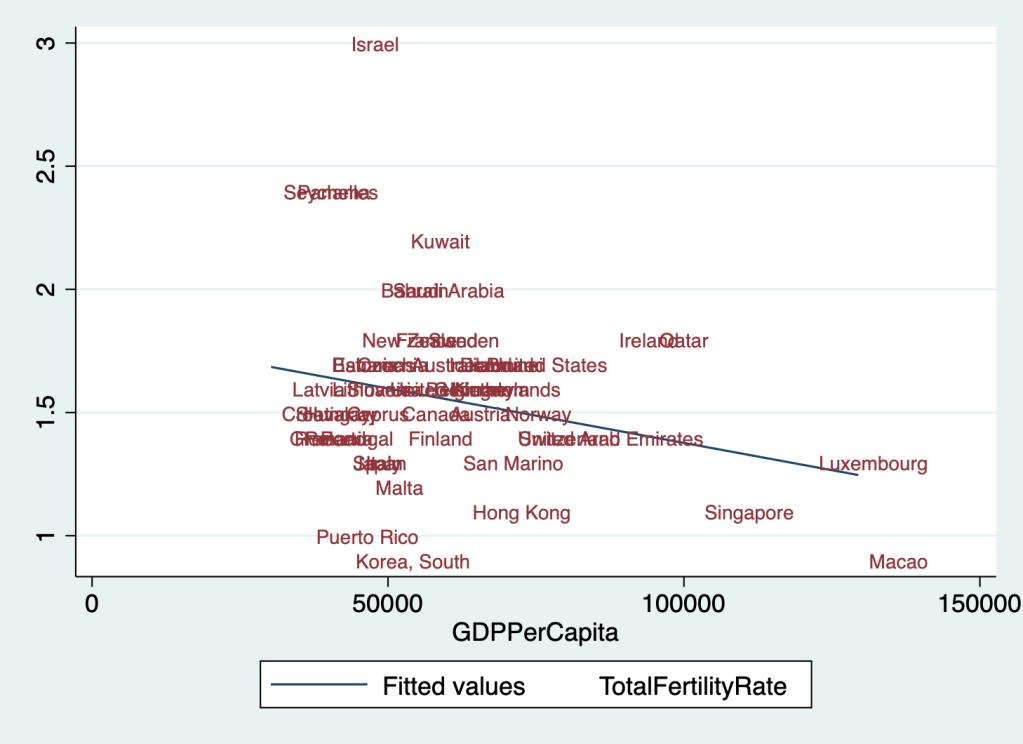
This makes sense to me in theory. As countries get richer, desired fertility (the number of kids each woman wants to have) has fallen, but realized fertility (the number of kids each woman actually has) has fallen faster. In a typical rich country women would like to have 2-2.5 kids, but actually ends up having about 1.5. There are many reasons for this, but some are clearly economic- the high cost of goods and services that are desired by rich-country parents, like child care, education, and spacious housing near high-paying jobs. Perhaps in a rich enough country all these could be obtained with a single income (maybe even from a part-time job). But it seems we aren’t there yet. Even zooming in on higher-income countries, higher incomes still seem to lead to lower fertility.
TFR vs GDP Per Capita in countries with GDP Per Capita over 30k/yr
The only rich countries with fertility above replacement are Panama and the Seychelles (barely meeting my 30k/yr definition of rich), Kuwait (right at replacement with 2.2 kids per woman), and Israel- the biggest outlier, with 3 children per woman at a 42k/yr GDP. This hints that pro-fertility religious culture could be one way to stay at or above replacement. But in most countries, rising wealth seems to drive a decline in religiousity along with fertility. Will this trend eventually come to Israel? Or will it reverse in other countries, as more “pro-fertility” beliefs and cultures (religious or otherwise) get selected for?
To do one more crazy extrapolation like the disappearance of South Korea, the number of Mormons is currently growing by over 50% per generation from a base of 6 million while the rest of the US is shrinking. If these trends continue (and setting aside immigration), in at most 10 generations the US will be majority-Mormon. Again, I don’t actually expect this, but I don’t know whether it will be falling Mormon fertility, non-Mormon fertility somehow rising back above replacement, or somethingelse entirely that changes our path.
What would a secular pro-fertility culture look like? For my generation, I see two big things that make people hold back from having kids: a desire to consume experiences like travel and nightlife that are harder with kids, and demanding careers. I see more potential for change on the career front. Remote work means that more quality jobs will be available outside of expensive city centers. Remote work, along with other technological and cultural changes, could make it easier to work part-time or to re-enter the work force after a break. Improving educational productivity so that getting better-education doesn’t have to mean more years of school would be a game-changer; in the short run I think people will spend even more time in school but I see green shoots on the horizon.
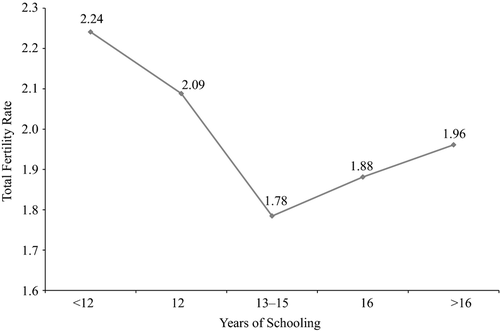
Looking within the US, we are just beginning to see what looks like the “J-curve” happening. Since about the year 2000, women with advanced degrees began to have more children than those with only undergraduate education (though still fewer than those with no college, and still below replacement):
From Hazan and Zoabi 2015, “Do Highly Educated Women Choose Smaller Families?”
We see a similar change with income. In 1980 women from richer households clearly had fewer children, but by 2010 this is no longer true:
Fertility of married white women, from Bar et al. 2018, “Why did rich families increase their fertility? Inequality and marketization of child care”
The authors of the papers that produced the two graphs above argue that this change is due to “marketization”, the increasing ability to spend money to get childcare and other goods and services that make it easier to take care of kids. If this is true, it could bode well for getting back to replacement- markets first figure out how to make more excellent daycare and kid-related gadgets, then figure out how to make them cheap enough for wide adoption.
My article, coauthored with Sarah Kerrigan and published last week, tries to answer the question. In short, the answer seems to be yes- cohabitation before marriage is associated with a 4.6 percentage point increase in the rate of marital dissolution. This is in line with much of the previous literature, which notes one big exception- choosing right (or getting lucky) the first time: “cohabitation had a significant negative association with marital stability, except when the cohabitation was with the eventual marriage partner”.
But we found some even more interesting facts while digging through the National Survey of Family Growth.
John Duffy and Daniela Puzzello published a paper in 2014 on adopting fiat money. I think of that paper when I hear the ever-more-frequent discussions of crypto currencies around me. To research the topic, I went to John Duffy’s website. There I found a May 2021 working paper about adopting new currencies in which they directly reference crypto. Before explaining that interesting new paper, first I will summarize the 2014 paper “Gift Exchange versus Monetary Exchange.”
Texas is one of the most regulated states in the country.
This is one of the surprises that emerged from the State RegData project, which quantifies the number of regulatory restrictions in force in each state. It turns out that a state’s population size, rather than political ideology or any thing else, is the best predictor of its regulations.
This is what I found, with my coauthors James Broughel and Patrick McLaughlin, when we set out to test whether a previous paper (Mulligan and Shliefer 2005) that showed a regulation-population link held up when we used the better data that is now available. We found that across states, a doubling of population size is associated with a 22 to 33 percent increase in regulation.
I’m James Bailey, an economist at Providence College who studies how government policies affect health care and the labor market. Thanks to Joy for the chance to join the blog for a few months!
For my first post, I have to share the brand new book I wrote a chapter of, “Regulation and Economic Opportunity: Blueprints for Reform“. Normally academic volumes like this are sold for hundreds of dollars, so only a few people with access to academic libraries end up reading them. But the publisher of this volume, the Center for Growth and Opportunity, released it as a free Ebook– so I hope you’ll check it out. It covers everything from housing and health care to energy and education to beer and cigarettes.
I wrote chapter 5, on how various regulations affect wages and employment. Here’s an excerpt:
Online platforms are allowing us to trade used goods more easily than before. Similarly, sites like UpWork and Uber are making it easier to trade small blocks of human labor. Since the gig economy is growing (as documented by Dimitri Koustas), it’s important to understand how it is affecting workers.
Liya Palagashvili of Mercatus has a working paper with Paoula Suarez “Women as Independent Workers in the Gig Economy” examining particularly how the growing opportunities to work on a gig basis has affected women in different ways than men. They note, for example, that (in 2014–2015) 87 percent of independent workers on the Etsy platform were female, while 14 percent of workers on Uber’s platform were female.
Abstract: New technologies and digital platforms have ushered in a rise of gig, freelance, contract, and other types of independent work. Although independent workers and the gig economy as a whole have received plenty of attention, little research has examined the heterogeneity of work characteristics among different independent work opportunities, specifically as it relates to the participation of women in this workforce. Existing data indicate that some digital platforms are more male dominated, whereas others are more female dominated. What accounts for these differences? In this paper, we empirically examine the heterogeneity of work within independent work opportunities in relation to female participation by analyzing work characteristics in the United States from the Occupational Information Network (O*Net) database that reflect greater temporal flexibility, which has been shown to vary across occupations and to attract more female workers. Our findings suggest that women in the independent work context do self-select into the types of independent work jobs that reflect greater temporal flexibility, as is the case for women working in traditional employment. However, our findings also reveal that the way in which the existing literature measures temporal flexibility in traditional work settings may not be the same as the way it is measured in the context of independent work. We discuss the implications of our findings for public policy and labor laws. (emphasis mine)
Dmitri Koustas of U. Chicago has a forthcoming paper “Is New Platform Work Different than Other Freelancing?”
Abstract: The rise of freelance work in the online platform economy (OPE) has received considerable media and policy attention in recent years, but freelance work is by no means a new phenomenon. In this paper, we draw on I.R.S. tax records to identify instances when workers begin doing online platform work versus other freelance/independent contractor “gig” work for firms. We find gig work occurs around major reductions in outside income, and document usage over the lifecycle. Our results provide suggestive evidence on motivations for entering into each type of work. (emphasis mine)
people take on this work primarily because they’ve lost a job or some of their income — and particularly for younger workers, app-based services have been significantly more lucrative than more traditional side hustles.
I got to (virtually) talk to Dmitri Koustas, who is now a leading expert on gig work, this week. He became interested in the gig economy when he was thinking through a more traditional econ. question of generally how people modulate their labor supply in response to income shocks.
He also has a working paper “Is Gig Work Replacing Traditional Employment? Evidence from Two Decades of Tax Returns”
First half of the Abstract: We examine the universe of tax returns in order to reconcile seemingly contradictory facts about the rise of alternative work arrangements in the United States. Focusing on workers in the “1099 workforce,” we document the share of the workforce with income from alternative, non-employee work arrangements has grown by 1.9 percentage points of the workforce from 2000 to 2016. More than half of this increase occurred over 2013 to 2016 and can be attributed almost entirely to dramatic growth among gigs mediated through online labor platforms. We find that the rise in online platform work for labor is driven by earnings that are secondary and supplemental sources of income. Many of these jobs do not show up in self-employment tax records… (emphasis mine)

 Economist Writing Every Day