What Should a Businessman Be Willing to Die For?

The late Dallas Willard, a professor at USC, wrote on a variety of subjects touching on moral philosophy. In 2006 he addressed the topic, “The Business of Business”. He noted that the spontaneous, obvious answer today to the question, “What is business (manufacturing, commerce) for?”  would be: “The business of business is to make money for those who are engaged in it.”

But there is a tension here. Willard notes that that is NOT how businessmen/professionals present their raison d’etre : 

“No business or other profession that advertises its ‘services’ announces to the public that it is there for the purpose of enriching itself or those involved in it. With one accord they all say their purpose is service, not serve-us. I have never met “professionals” who would tell their clients that they were there just for their own self-interest.”

This ambiguity in the role of businessmen/women (or “merchants”, as they used to be called) is not new. Willard reaches back to the writings of John Ruskin who remarked in 1860, “The fact is that people never have had clearly explained to them the true functions of a merchant with respect to other people.” Ruskin went on to place what we today call “business” among the  “Five great intellectual professions” necessary to the life of “every civilized nation.” With respect to the nation:

“The Soldier’s profession is to defend it.

The Pastor’s to teach it.

The Physician’s, to keep it in health.

The Lawyer’s to enforce justice in it

The Merchant’s to provide for it.”

Ruskin added: “And the duty of all these men is, on due occasion, to die for it.” The soldier to die “rather than leave his post in battle,” the physician “rather than leave his post in plague,” the pastor “rather than teach falsehood,” the lawyer “rather than countenance injustice.” (Indeed!)

But what of the merchant? What is it that the merchant (businessman) would die for rather than do?

Well, the main function of the merchant or manufacturer in Ruskin’s view is to provide for the community, not simply make money for him/herself:

It is no more his function to get profit for himself out of that provision than it is a clergyman’s function to get his stipend. The stipend is a due and necessary adjunct, but not the object of his life, if he be a true clergyman, any more than his fee (or honorarium) is the object of life to a true physician. Neither is his fee the object of life to a true merchant. All three, if true men, have a work to be done irrespective of fee…. That is to say, he has to understand to their very root the qualities of the thing he deals in, and the means of obtaining or producing it; and he has to apply all his sagacity and energy to the producing or obtaining it in perfect state, and distributing it at the cheapest possible price where it is most needed.

Ruskin also noted that since the merchant has direct control over those who work for him, “…it becomes his duty, not only to be always considering how to produce what he sells in the purest and cheapest forms, but how to make the various employments involved in the production or transference of it most beneficial to the men employed.”

Furthermore, if the enterprise falls on hard times, it is the duty of the CEO (or other top management) to share fully in the hardships suffered by the other employees: “As the captain of a ship is duty-bound to be the last to leave the ship in disaster,…so the manufacturer, in any commercial crisis or distress, is bound to take the suffering of it with his men, and even to take more of it for himself than he allows his men to feel; as a father would in a famine, shipwreck, or battle, sacrifice himself for his son.”

In a similar vein, activist lawyer and later Supreme Court Justice Louis Brandeis in 1912 said at a Brown University commencement address:

The recognized professions…definitely reject the size of financial return as the measure of success. They select as their test, excellence of performance in the broadest sense—and include, among other things, advance in particular occupation and service to the community. These are the basis of all worthy reputations in the recognized professions. In them a large income is the ordinary incident of success; but he who exaggerates the value of the incident is apt to fail of real success…In the field of modern business, so rich in opportunity for the exercise of man’s finest and most varied mental faculties and moral qualities, mere money-making cannot be regarded as the legitimate end.    

Willard drily remarked, “Texts by Ruskin and by Brandeis, along with similar ones, are not popular references in our schools of business today.” My own personal observations are that the nobility of the management and entrepreneurs seems to scale somewhat inversely with the size and age of the enterprise. It gets tricky to start assessing degrees of moral rectitude here, because in classical exchange theory, any voluntary transaction (buying/selling goods, agreement to work for certain wages) brings benefits to both parties, and to society as a whole, quite apart from any conscious intent of altruism.

At large end of the scale, we see CEOs who drive big companies into the ground and then waltz away with multimillion dollar golden parachutes; no sharing of the employees’ hardships at all.

And for many Wall Street dealmakers, it truly is all about the money: float a couple billions in junk bonds, take control of some company, force the company to pay you fees, load the company with your crappy debt, and walk away with a cool billion or so. Or take a short position in a publicly traded company, publish a bogus report (“short attack”) alleging horrible malfeasance at the company, driving share prices down, close out your short position at a huge profit, and move on to the next victim. These seem to be purely predatory actions, taking advantage of the system to make a buck with no clear redeeming social value.

At the other end of the scale, the (often youngish) folks starting a new software firm, the  idealistic couple chucking fast city life to try to make a go of a coffee house or BnB in a small town, the plumber with an associate, all of these I think are very serious about providing the public with a good product/service, and may tend to take care of their employees and also to put a lot of their own personal skin (savings, a lot of extra time) in the game to get these enterprises going. The younger Henry Ford famously fought to pay his employees high wages, over the objections of company shareholders, who wanted more profits to accrue to them. I know personally two men in the greater Trenton, NJ area who (as an expression of their religious values)  intentionally conduct computer-related businesses such that they can provide employment to disadvantaged local young men.

Maybe when an enterprise gets large enough that, to management, its employees and its customers become numbers rather than individual people is the point where the transition to pure greed as the fundamental motive occurs, even if it proves prudent in support of profits to maintain policies and communications which promote the welfare of customers and employees.
Success in starting

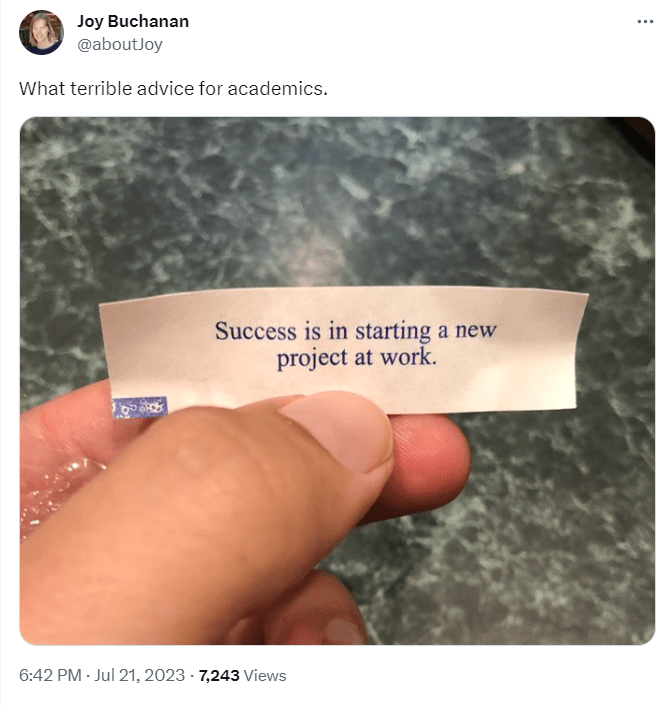
At a Chinese restaurant, I got a fortune that said, “Success is in starting a new project at work.” It struck me as very funny, and it resonates with other people on Twitter.

Starting a new project at work does not translate to success in academia. The danger is usually in starting too many projects and finishing too few.

Starting a new research project, whether alone or with coauthors, is exciting. You fall in love with a new idea.

The hard part is sticking with that idea until the very end of the publication process. This is more comparable to staying married. The project will see you at your worst, and you will discover that the project is not as wonderful as it seemed initially. You might end up re-writing the manuscript several times, years after the initial infatuation has worn off.

Academics do need to start projects. It is important to start the right projects. A reason to not start too many projects is to preserve time for the best work. A downside to being overloaded is that you might have to say no to a new project when an actual good opportunity comes along.

In my post on the Beatles documentary Get Back, I observed the way that the bandmates start new songs together. It reminded me of coauthors convincing each other to start a new project.

Their creative process resembles co-authoring a research paper. When Paul is working out a song and humming through places he hasn’t worked the lyrics out yet, that reminds me of the early drafts of a paper. You don’t have to have the whole Introduction written. The hook of a song is a bit like the main result of a research paper. Persuading yourself and your coauthor that you have a project worth finishing is the first step. Coauthors have unspoken agreements on how the project is going to proceed. The tacit knowledge of the collaborative process is one of the most important things you can learn in graduate school.

Darwyyn Deyo wrote several posts for us on the research process, including: “The Research Process: Identifying the Ideas that Motivate You

Greg Mankiw’s career advice intersects with starting projects:

Advice for new junior faculty (2007)

My Rules of Thumb (1996)

This quote from Rules of Thumb was surprising: “None of this is part of a grand plan. At any moment, I work on whatever then interests me most. Coming up with ideas is the hardest and least controllable part of the research process. It is somewhat easier if you have broad interests.” He goes on to say: “I sometimes fear that because I work in so many different areas, each line of work is more superficial than it otherwise would be. Careful choice of co-authors can solve this problem to some extent, but not completely.”

He really refutes my fortune cookie with this line, “Deciding which research projects to pursue is the most difficult problem I face in allocating my time.” Success is about starting the right projects and no others.

13th Time’s A Charm: Finally Grant Funded

I just found out I’ll be receiving a Course Buyout Grant from the Institute for Humane Studies. It will allow me to teach less next year in order to focus on my research on how Certificate of Need laws affect health care workers.

I’m happy about this because I think this research is valuable and time is my main constraint on doing it (especially doing it quickly enough to inform ongoing policy debates in several states). But I’m also happy because I finally got what I consider to be a “true” grant after many rejections.

I’ve received research funding many times before (e.g. Center for Open Science funding for replications), but it was always relatively small amounts that went directly to me. True grants tend to be larger and to be paid directly to the university. That’s the case with the course buyout grant, which essentially pays the university enough that they can hire someone else to teach my class.

I may have lost count but I’m pretty sure this was the 13th “true grant” I have applied for, and the 1st I will actually receive. Academics have to get used to rejection, since we need to publish and decent journals tend to reject 80%+ of the articles they receive. But for some reason I’ve found grants much harder even than that. From some combination of skill, luck, and targeting lower-tier journals than perhaps I could/should, my acceptance rate for journal articles is probably nearing 50%. I expected this to translate over to grants but it absolutely did not, they seem to be a much different ballgame, one I’m still figuring out.

I’d like to share some of those past misses, both to let junior people see the bumpy road behind success (like a CV of failures), and to try to extract lessons from an admittedly small sample. These proposals were not funded, and probably weren’t even close:

  • Peterson Foundation US 2050
  • MacArthur Foundation 100 & Change
  • RI INBRE (2x)
  • National Institute for Health Care Management (1x, waiting to hear but probably about to be 2x)
  • Kauffman Knowledge Challenge
  • Economic Security Project
  • Emergent Ventures
  • FTX Future Fund (sometimes rejection is a blessing in disguise)
  • Smith Richardson Foundation
  • AHRQ

What did these failures of mine all have in common? Me, of course. This is not just a truism; in most of these cases I was applying for major grants solo as an assistant professor without previous funding. The usual advice is to work your way up with smaller grants or, preferably, as the collaborator of a senior professor with lots of previous funding who knows how things work. I knew that would be smart but I’ve tended to be at institutions without senior people in similar fields; almost all my research has either been solo or coauthored with students or assistant professors. Even my PhD advisor was a brand-new assistant professor when we started working together. I had good reasons for ignoring the usual advice to work with well-known seniors, and it has mostly served me well, but grants seem to be the exception.

Twice, I think I did come close on grant proposals, and both times it involved help from seniors at other institutions who had lots of previous funding. At one foundation that funds a lot of social science, my senior coauthor and I got glowing external reviews, but the internal committee rejected us on the grounds that we could do the project without their funding. They were right in the sense that we did do project anyway with no funding; it got published and even won a best paper award. But with their funding we would have done it faster and better and they would have gotten credit for it.

I do think it is smart for funders to consider whether the research would happen anyway without them, or whether their funding really improves things. But I think it is rare for funders to actually do this, and taking this rejection as advice probably led me to more rejections. I tried to propose bigger, more ambitious projects that needed expensive data so it was clear that I really needed the funding; but for most funders this probably made things worse. I have since heard several times that people who get lots of funding from major funders like NIH tend to submit proposals for research they have essentially already finished; that is why their proposals can look so thorough, credible, and polished. They then use the funding to work on their next project (and next proposal) instead of what they said it was for. That seems sketchy to me, but it’s certainly ethical to turn the proposal dial back somewhat toward “obviously achievable for me” from “ambitious and expensive”, and that’s what I’ve done more recently.

The other time I came close was with an R03 proposal to the Agency for Healthcare Research and Quality. First I got a not-close rejection, as I mentioned in the big list, where my proposal was “not discussed”. But AHRQ allows resubmission. At the prompting of my (excellent) grants office, I got feedback on the proposal from two kind seniors at other schools who get lots of funding. I rewrote the proposal based on their comments plus the rejection comments (which were actually quite detailed despite it being “not discussed”) and resubmitted it. This went way better- the resubmission got discussed with an impact score of 30 and a percentile of 17. Lower scores are better for AHRQ/NIH so this was pretty good, good enough that it might have been funded in a normal year, but 2019 was a bad year for government funding (though through some weird quirk I never actually got rejected; 4 years later their system still says “pending council review”). Again, the key to getting close was getting detailed feedback from people who know what they are talking about.

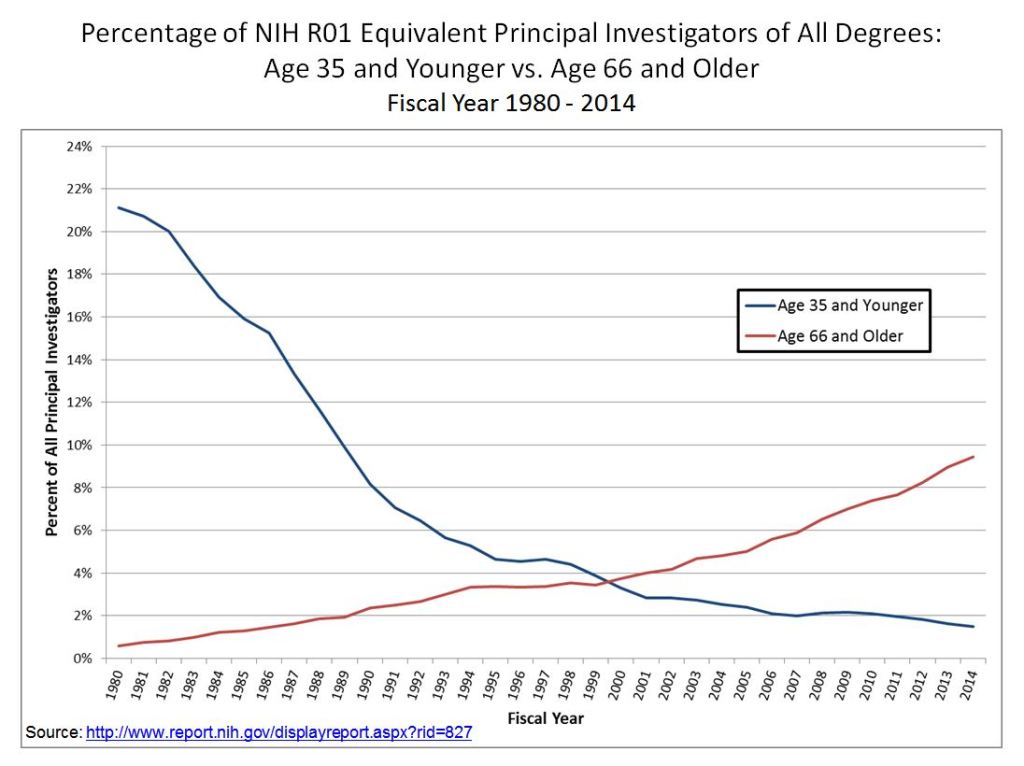
Of course, it also helps to get to know people at the funders and to become more senior yourself. It’s not surprising that my first major grant is coming from IHS given that I’ve been involved with them in all sorts of ways since going to a Liberty & Society seminar way back in 2009. Most funding goes to more senior people who have more connections, knowledge, and proven experience. This is extreme at perhaps the largest funder of research, the National Institutes of Health, where less than 2% of funded principal researchers are under age 36.

This may be the real secret for winning grants- just get older. My 12 rejections all came when I was younger than 36, while my first acceptance came less than a month after my 36th birthday.

In all seriousness, thanks to the Institute for Humane Studies, and I hope that a year from now I’ll be writing here about the great work that came out of this. For everyone with a growing pile of rejections, maybe the 13th time will be the charm for you too.

The Rate of Inflation is Falling, But Prices are Still Rising (And So are Wages)

The latest CPI-U price data shows that the rate of inflation in the US has slowed significantly to just 3% in the past 12 months. That’s a huge improvement from the peak last June, when the annual rate of inflation was over 9%. Still, prices as a whole aren’t falling, and they clearly aren’t anywhere near where they were before the pandemic: using the CPI-U, prices are up over 17% since January 2020.

Lately I’ve heard many people asking a good question: will prices ever get back down to where they were? Usually they mean pre-pandemic prices, though sometimes they refer to a particular point-in-time (such as the start of Biden’s presidency). The only correct answer is “we don’t know,” but I think a likely answer for many goods and services is “no.” For many reasons, the nominal prices of most goods and services rise over time. Though this is not true for everything, of course (newer technologies are one example we often see).

But what about specific goods that we buy frequently? Will we ever see gasoline consistently below $3 per gallon again? Will we ever see milk consistently below $4 per gallon again? What about eggs and bread? And indeed, these prices are well above January 2020 levels: 23% higher for milk, 43% for bread, 45% for gasoline, and a whopping 52% for eggs. For the price data, I am using this convenient data on common food and energy goods from BLS.

For some of these items, I do think you might someday see prices fall back to levels consumers were used to from the recent past, since food and energy prices tend to be volatile. For others, though maybe not. But I think we as consumers can become overly focused on staples that we buy frequently and can easily recall the price in our heads. For example, while eggs, bread, and milk are items that we buy frequently (including being the staples of stocking up before a storm), in total these constitute just 0.6% of average consumer spending.

If instead of those 3 staples, your mind naturally anchors on produce prices, the trends look different: oranges are up 23%, but bananas are only up 10%, and tomatoes are, in fact, down 14% since January 2020. But again, these items are less than 0.5% of total consumer spending. Ideally, we shouldn’t anchor on any one subset of goods when doing a good analysis, even if it is natural for us to do so in our lives as consumers.

This is where the benefit of a price index, like the CPI-U, comes in.

Continue reading

Secondhand by Adam Minter

Secondhand: Travels in the New Global Garage Sale is a great book in my summer stack on fast fashion. I have always been interested in the combination problem-blessing of too much stuff. Adam Minter explains perfectly what many of us have been curious about.

Secondhand is America-centric, but he also travels to Japan to observe a country that is ahead of us both in terms of the demographic crisis and the mechanisms for handling old stuff. The reports from Africa are very interesting.

I have been wondering what is happening with Goodwill and with recycling in general. What hope do we really have of keeping goods out of the landfill? What should I do with a shirt my kid has grown out of? (The lady at work I used to give clothes to now runs away at the sight of me. I gave her too many bags.)

The Goodwill collection center near me looks cluttered and weird. After reading Secondhand, I’m more optimistic about dropping off bags there.

The barrier to sorting the used goods of the rich world is the scarcity of time and attention. This paragraph about a used book seller in Japan is heart-breaking:

It’s a thirty-year-old hardback novel, and the edition is rare. If it were at a traditional bookstore, it’s command a premium price. But Bookoff is about volume, and there’s a problem: not only does it lack a barcode, but it lacks an ISBN… “So there’s no way to price it in Bookoff’s system,” Kominato says. With a grimace, he gently places it on top of the books filling the recycling cage and steps away. (pg 40)

At least the book will get recycled into new paper, and the reality is that it was providing negative value as clutter in someone’s home.

Back in America, Minter describes what happens to donated goods at Goodwill in detail. Sometimes high-quality clothes are identified, but it is hard to get a good price for them. Some customers expect to pay less than $5 for a shirt, no matter what.

Customers are all about price, not quality…They won’t buy a $6.99 shirt that will last.  If that’s the option, they’ll buy a $2.99 shirt from Walmart. (pg 57)

Some consumers are in the habit of treating clothes almost like disposable goods instead of durable assets. They won’t pay for quality. Going out and getting a new replacement shirt costs less than lunch.

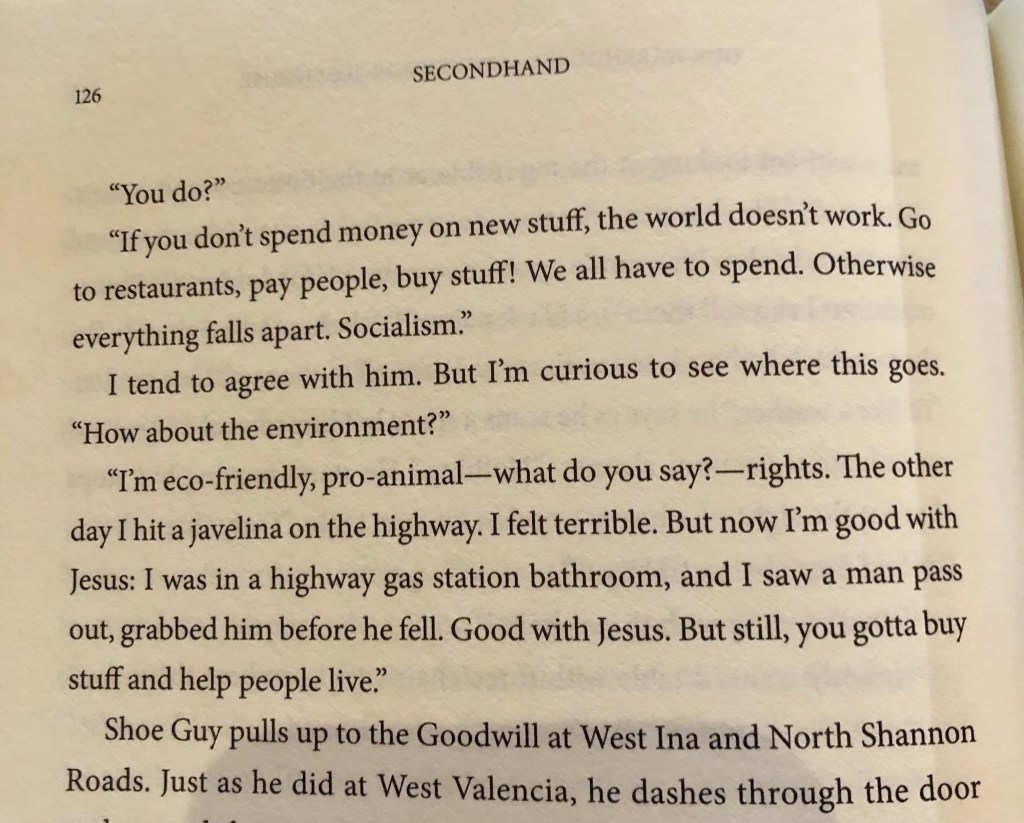
I don’t want to give away too much, since you will want to go get the book yourself. Here’s the funniest page:

Lastly, I’ll share a personal win. I know that I’ll need a school backpack for my youngest in August. I went to a local rummage sale and went to the backpack section. I found one that is good enough (some scuffs but plenty of sparkles). I’m happy about keeping this sparkly pink backpack out of the landfill for a few more years. I walked out of the sale with a load of gear that cost a total of $10. Next, I went to a coffee shop to work where I also spent $10. Used textiles and books are dirt cheap.

Mortgage Fraud Is Surprisingly Common Among Real Estate Investors

That is the conclusion of a recent Philadelphia Fed working paper by Ronel Elul, Aaron Payne, and Sebastian Tilson. The fraud is that investors are buying properties to flip or rent out, but claim they are buying them to live there in order to get cheaper mortgages:

We identify occupancy fraud — borrowers who misrepresent their occupancy status as owner-occupants rather than investors — in residential mortgage originations. Unlike previous work, we show that fraud was prevalent in originations not just during the housing bubble, but also persists through more recent times. We also demonstrate that fraud is broad-based and appears in government-sponsored enterprise and bank portfolio loans, not just in private securitization; these fraudulent borrowers make up one-third of the effective investor population. Occupancy fraud allows riskier borrowers to obtain credit at lower interest rates. 

One third of all investors is a lot of fraud! The flip side of this is that real estate investors are much more prevalent than the official data says:

We argue that the fraudulent purchasers that we identify are very likely to be investors and that accounting for fraud increases the size of the effective investor population by nearly 50 percent.

Many people blame investors for making housing unaffordable for regular people. Economists tend to disagree, and one of our arguments has been to point out that investors are still a small fraction of home buyers. However, official statistics recently showed the investor share over 25% (though dropping fast), and apparently that may still be an understatement. If investors are a problem, there are enough of them to be a big problem.

Of course, there are other reasons economists aren’t so concerned about real estate investors. One is that they can provide the valuable service of renting out homes to people who couldn’t qualify for a mortgage themselves (especially after 2010, when Dodd Frank made it difficult for people without great credit to qualify). Another is that many investors seem to be surprisingly bad at flipping homes for higher prices. The panic over “ibuyers” that would buy houses sight unseen based on algorithms abated when it turned out those those companies lost a ton of money, saw their stock prices plunge, and gave up.

The mortgage fraud paper also provides evidence of investors losing money. In particular, rather than fraudulent investors crowding out the good ones, they are actually more likely to end up defaulting on their purchases:

These fraudulent borrowers perform substantially worse than similar declared investors, defaulting at a 75 percent higher rate.

Still, such widespread fraud is concerning, and I hope lenders (especially the subsidized GSEs) find a way to crack down on it. Based on things I see people bragging about on social media, I’m guessing that tax fraud is also widespread in real estate investing, though I haven’t looked into the literature on it.

This mortgage fraud paper seems like a bombshell to me and I’m surprised it seems to have received no media attention; journalists take note. For everyone else, I suppose you read obscure econ blogs precisely to find out about the things that haven’t yet made the papers.

Updated GDP and Inflation Data for G7 Countries

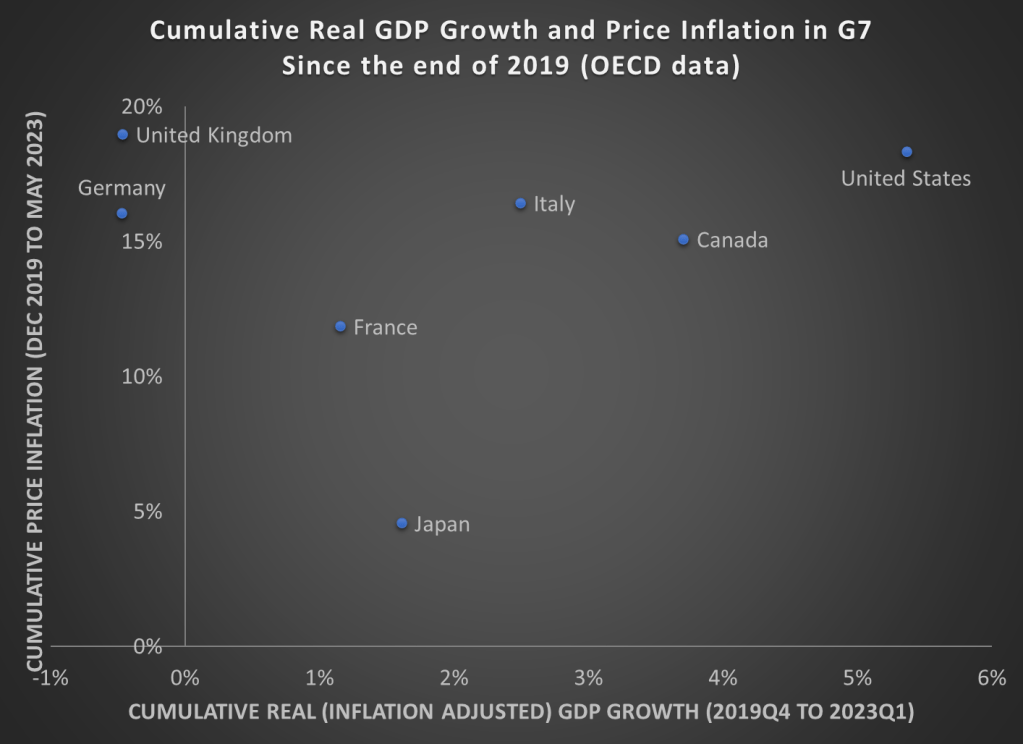
As we prepare for the release of second quarter GDP data over the next few weeks, here is a chart showing cumulative GDP growth (inflation adjusted) and Price inflation for G7 countries. While inflation has been high everywhere (except for Japan), the US comes out looking very well relatively on GDP growth. That’s especially true compared to the UK and Germany, which have also had high price inflation, but have actually had negative economic growth since the end of 2019.

EconTwitter Platforms and Threads

There is a community called #EconTwitter. This agglomeration of not-anonymous accounts links together professional economists, academics, and independent intellectuals. Twitter.com is the home base and origin of #EconTwitter. Mike wrote about turmoil in EconTwitter in December 2022. Find me on Twitter at @aboutJoy

The #EconTwitter group has experimented with leaving Twitter to join new networks. For some people, getting away from the billionaire owner is the explicit goal. Others join the new platform to be where the people are.

Mastodon launched in 2016 but it was not until recently that #EconTwitter made a go at that.

Mastodon is also part of the Fediverse ensemble of computer servers, which use shared protocols allowing users to interact with other users on computers running compatible software packages such as PeerTube and Friendica. Mastodon is crowdfunded and does not contain ads.

https://en.wikipedia.org/wiki/Mastodon_(social_network)

Fediverse? Protocols? The average Twitter user does not want to be bothered with “computer servers”. That’s part of the problem. On Mastodon I am @JoyBuchanan@econtwitter.net

When I joined, I was not confident that it would build on the initial momentum. The reason that the move to Mastodon was large and sudden is that Paul Goldsmith-Pinkham volunteered to set up econtwitter.net It’s paid for out of his research budget and he serves as the monitor. He can ban anyone who violates his speech/civility rules. So there is a moderator but not one paid by Mastodon.

I wrote about “Content Moderation Strategy” back in April 2022 when Elon at Twitter was big news.

Elon Musk buying Twitter is the big news this week. He wants to enhance free speech on the site and, according to him, make it more open and fun. Some fans are hoping that he will make the content moderation and ban policy more transparent. 

me in April 2022

Some people thought Twitter would crash – as in go offline – because of Elon. That has not happened, but users and brands have been irked by his management and personal style.

EconTwitter at Mastodon is still going. As far as I can tell, most people have reverted to Twitter for their main feed because the audience is larger and writers want engagement. The level of engagement at Mastodon probably peaked about a month after Paul started the server for economists. One reason I think it never overtook real EconTwitter is that economists like having a big audience that includes journalists and sociologists. Silo-ing on an EconTwitter-dedicated server was less fun. People say they don’t want to have to deal with weird strangers online, but revealed preference indicates otherwise.

Another notable development was the launch of Bluesky. I’m there as @joybuchanan.bsky.social

Making a good handle at the beginning is easy and there is some upside if it turns out to attract a large community. A few “Twitter famous” people will join these new apps and commit to posting just in an attempt to unseat Twitter. This sort of works in the sense that both networks are still operating, however neither ever got close to the Twitter scale.

Threads, launched this week, might be different.

Mark Zuckerberg opened up Threads for anyone with an Instagram account, which most of us already have. Millions of people joined in just two days. If you already have an Insta, then you can download the free Threads app on your phone and port over your Insta account.

I’m @_Joy_Buchanan_ on Threads. The underscores might look awkward, but there is no “early adopter” phenomenon here, unless you were an early adopter of Instagram.

Brands and celebrities are comfortable on Threads, so it will be able to make money without asking users to pay for a Blue Check. I have no problem with Elon asking Twitter users to pay. Someone who is worried about free speech should want to be able to pay for service.

The Silicon Valley phrase is: “If you’re not paying for the product, you are the product.

That’s going to be true on Threads, since I’m not paying for the product.

Threads will not kill Twitter, but it is going to make a bigger dent than Bluesky and Mastodon did. Nothing is free and nothing is perfect. I know a lot of people are upset about Twitter. However, there are some people who got a voice through it. People stuck inside authoritarian countries had a way to send messages out to a global audience.

Here is my most bullish case for Threads: it might unite the “TikTok generation” that never joined Facebook or Twitter but had Instagram with the older people from Twitter who never joined TikTok. The Twitterers will stay if they get enough attention.

Thus, Threads might put a dent in TikTok, too. Zuckerberg is probably sophisticated enough to make a “TikTok person” feel engaged by sending them more food videos and less BLS update charts.

Continue reading

Basic Immigration Logic

Economists overwhelmingly favor looser immigration controls. Allowing people to immigrate would improve the allocation of scarce labor and capital and it is a far cheaper way to aid poorer families than sending direct payments or trying to develop an entire country. Let’s cover some static analysis basics for migrating workers and their dependents.

Workers, Labor Markets, & Output Markets

There are two markets to consider: The new home country and the old home country. If workers leave the old country in search of the higher wages in the new country, then world employment remains unchanged. Employment obviously rises in the new country and falls in the old country. With identical laborers (a terrible assumption that’s the least charitable to immigration), wages in the new country fall and wages in the old country rise. This logic illustrates the cheap aid of which economists are fond.

Continue reading

A Dangerous Year For Economists

I’m not sure exactly how many notable economists I expect to die in a year, but as of early July I feel like 2023 has already seen a year’s worth:

Robert Lucas, helped re-found macroeconomics with micro-foundations and a focus on growth, influential even as Nobel Prizewinners go

Paul David, economic historian and economics of technology

Stanley Engerman, economic historian, author of the much debated Time on the Cross

Herbert Gintis, game theorist and big picture thinker

Bennet McCallum, macroeconomist and pioneer of nominal GDP targeting and monetary rules

Barkley Rosser, eclectic thinker on chaos, complexity, catastrophe

Luigi Pasinetti, post-Keynesian

Victoria Chick, post-Keynesian

Li Yining, Chinese reformer, helped re-establish the Chinese stock market

Padma Desai, Indian reformer and scholar of planning

Rebecca Blank, labor economist, UW chancellor, acting US Secretary of Commerce

Harry Markowitz, won Nobel for “pioneering work in the theory of financial economics” (finding the risk-return optimal frontier for a portfolio)

Not all the biggest names, but all important enough that I knew of them despite not working in their subfields and, unfortunately, not having met them personally.

Let me know if I’m currently missing anyone, though let’s hope the list doesn’t get much longer by the end of 2023.