Results on stability and gift-exchange

Bejarano, Corgnet, and Gómez-Miñambres have a newly published paper on gift-exchange.

Abstract: We extend Akerlof’s (1982) gift-exchange model to the case in which reference wages respond to changes in economic conditions. Our model shows that these changes spur disagreements between workers and employers regarding the reference wage. These disagreements tend to weaken the gift-exchange relationship, thus reducing production levels and wages. We find support for these predictions in a controlled yet realistic workplace environment. Our work also sheds light on several stylized facts regarding employment relationships, such as the increased intensity of labor conflicts when economic conditions are unstable.

Next, I will provide some background on gift-exchange and experiments.

Continue reading

The Question of When to Act

The collapsed condo building in Florida has been in the headlines for days. Two recent reports come from USA Today and the WSJ.

This is a tragedy that will be associated with many deaths. A steady decay in the concrete structure appears to the be the cause, although there is no professional consensus on the reason for the sudden collapse (see WSJ).

In 2018, an engineering firm recommended repairs in a report. Every 40 years, a building like that needs to be re-certified, and the tower happened to be 40 years old when it collapsed. The recommended repairs had not started.

According to USA Today, a letter circulated in April 2021 (two months before the collapse) warned condo residents that expensive repairs were necessary. Meetings were being held. The condo board was gathering information from engineers and lawyers.

A line from the letter is chilling (see USA Today):

We have discussed, debated, and argued for years now, and will continue to do so for years to come as different items come into play.

Continue reading

Editing: You Figure It Out

If you want to change how a field works, you have a few options. You can do what you want to see more of, but you are only one person, and perhaps not the one best equipped to make things better. Or you can encourage others to work differently- but why would they listen to you?

Academics often serve as peer reviewers for the work of others. If a reviewer recommends that a paper be rejected, it usually is; if you recommend specific minor changes they usually get made. But you can’t really tell people that they should work on a totally different topic. Journal editors for the most part simply have a scaled-up version of the powers of peer reviewers to steer the field. But unlike reviewers, their positions are public and fairly long-lasting. This means they can credibly say “this is the sort of work I’d like to see more of- if you do this kind of work, there’s a good chance I’ll publish it”.

This is part of why I’ve been hoping to be a journal editor some day, and why I’m excited to be guest-editing for the first time: a special issue on Health Economics and Insurance for the Journal of Risk and Financial Management. The description notes:

Continue reading

Steve Horwitz on “The Graduate Student Disease”

On Sunday the world lost a great teacher, economist, and all-around fantastic person in Steve Horwitz. If you don’t know about Steve, I recommend reading the tributes from Pete Boettke and Art Carden.

Pete and Art speak to Steve’s overall legacy and greatness. But I will tell you about a very specific piece of advice that Steve gave me about teaching undergrads.

Steve called it “the graduate student disease.” By this he meant the tendency of newly minted PhD economists to teach undergraduate courses as if they were mini versions of graduate courses. Steve insisted this was the wrong approach.

Continue reading

DIY and The Limits of Comparative Advantage

I’ve been thinking a lot lately about the perils of over fetishizing comparative advantage and outsourcing in our personal lives, which is a long way of saying I bought a Sodastream.

Like many economists, I am wary of self-congratulations for doing something yourself. Don’t get me wrong, hobbies are good, but we shouldn’t suffer the delusion that making a table yourself is a particularly good use of your time. And, so help me god, if I hear you diminish the merits of any restaurant offering because “you could make for yourself for half the price” I will slap the menu out of your hands, hand you a crisp ten dollar bill, and send you home to make your own damn meal.

My loyalty to economics thus declared, I must say there is a case to be made for making exactly the thing you want. Ricardian comparative advantage- I make my low opportunity cost item, you make yours, we trade, everyone wins, it’s important at the micro and macro of our lives, but the bulk of rewards to purchasing private goods in the market instead of producing them yourselves is from the comparative advantage derived from specialization, capital, and scale. It would take me hours to make a batch of homemade Oreo-style cookies, but it’s pretty silly when you consider there are billions of dollars in technology, capital, and expertise dedicated to making just those specific cookies. Unless I were to get some sort of meditative three-steps-of-self-actualization-on-the-path-to-nirvana value out of the process of making those cookies, I’m far better off just grabbing a couple stacks at the grocery store and paying a professional to help me process the shame.

But what if I don’t want exactly the product being offered? Everything comes with a cost, and that includes scale of production. Nabisco sells $550M of just Oreos every year, but they don’t do that by trying to sell them to everyone. It might seem that way, but they really don’t. Yes, I know they have 25 flavors now, so yes, they having expanded into narrower niches since their single-flavor days, but their target remains the 4.29 million Americans consumed 8 or more packages in 2020. If you want to sell a half-billion dollars worth of cookies, you need to sell them cheap, and that means you need to sell a lot of them. You don’t sell a lot of cookies going door to door asking people what they want and then giving it to all of them. You sell a lot of cookies by hunting for the middle of the distribution. Observed used to call the implied bullseye here the lowest common denominator, but now that we are fully-evolved humans who don’t need to sneer at what most people want, we can simply say that sellers are looking for a part of the distribution of preferences with enough mass to support your business.

In soda-land, that means you are definitively not selling to me. Coca-Cola is a literal miracle product, but its also obesity-in-a-can for 43-year-old dudes who count walking somewhere as exercise. I enjoyed the “TEN” calorie product series, but those lasted less than 3 months on the market and probably ended the careers of no fewer than a two dozen career soda executives. At the other end of the sugar spectrum, I don’t like a lot of the Lacroix flavors and they tend to be over-carbonated for my precious bubble-specific sensitivities. Where is the perfect soda for those of us who want 1 to 3 grams of fructose from real fruit juice suspended in a matrix of lightly-bubbled seltzer water?

Where it’s not is the marketplace. That’s fine, the world doesn’t owe me exactly my preferred bundle of product dimensions in everything I consume. I wouldn’t want them to either. Like most people, if the market did ever produce a good just for me, I couldn’t afford it. We need the scale that comes from meeting lots of wants all at once, even when those wants don’t perfectly match my own.

And that’s why we buy Sodastreams. And woodworking tools. And sewing machines. And pizza ovens. Sometimes we go DIY not because we’re denying the merits of comparative advantage, but rather because we’re accepting that there of some products where second-best market solution just won’t cut it.

Which, by the way, is one of the great ironies of modern life in a developed economy. We’re so rich, we can absorb the opportunity cost of our hobbies and weird DIY hyper-niche consumption preferences. We can make our own stupid mole-cherry-lime soda at home because that’s what we want. Because in the modern world, the greatest bourgeois luxury isn’t the stuff you buy, it’s the stuff you make yourself.
Should Andrew Yang Wait to Concede?

Yesterday New York City held their mayoral primary elections. This was an exciting event for election system nerds (political scientists and public choice economists) because NYC is now using a form of ranked choice voting to determine the winner.

While this is not the first place in the US to use RCV (Maine, Alaska, and a handful of cities use it), it is still notable for a few reasons. First, this is America’s largest city. Second, there are a lot of viable candidates, which makes RCV especially interesting and useful.

Specifically, NYC is using a form of voting called instant runoff. There are currently 13 candidates, and voters indicate their top 5 in order. If no one has a majority (>50%) of the votes, then the rankings entered by voters come into play. And indeed that is what happened yesterday.

On the first round, only counting first place votes, Andrew Yang came in 4th with just under 12% of the votes. So last night he conceded.

But should Yang have conceded? Maybe not! Let’s explore how instant runoff works.

Continue reading

Chapman Economic Forecast 2021

I watched the Chapman Economic Forecast Update 2021 live on June 16. Anyone can still watch it for free. (Thank you to to sponsors Edwards Lifesciences and BOA.)

Dr. Jim Doti believes inflation will go up. He didn’t present a forecast of wild double-digit inflation for 2022, however he does believe the data points to higher inflation. He and his team have a good track record of being correct.

They suggest that if inflation is going to increase, we can expect house prices to go down because mortgage rates rise. Housing is an excellent long-term inflation hedge. Yet, in the short term rising inflation leads to a decrease in home prices, historically. House prices have been rising for a long time, and their model suggests that there will be a short term minor correction.

Continue reading

The Research Process: Building and Utilizing a Research Network

This summer I’m writing a series of posts about the curriculum of the research process, from the initial idea to the development of a complete draft. This week, I’m focusing on how to build and utilize a research network to support the development of your project from the initial idea to the data scaffolding of the first draft.

Why do you need a network? Why can’t you just lone wolf this research thing? For starters, going solo necessarily means you’re going to try reinventing the wheel at some point. Beyond that, your network can help you avoid common pitfalls in finding and using specific datasets, alert you to working papers in your general field, expose you to new methods that are being piloted in your discipline, and provide support when the going gets rough (it’s going to at some point). Your network also includes people who could be potential readers for your paper before you submit it to a journal and people who use their platform to boost junior scholars by inviting them to present in conference sessions, seminars, and workshops.

Continue reading

How Will Rich Country Fertility Ever Get Back Above Replacement?

For population to be steady or rising, the average women needs to have at least two kids. In almost every rich country- including the United States, all of Europe, and all of East Asia- this isn’t happening. In the extreme case of South Korea, where total fertility averages about one child per woman, the population will fall by half each generation. If this were to go on for 10 generations, South Korea would go from a country of 50 million people- larger than any US state- to one of 50 thousand people, far smaller than any US state. This sounds crazy and I don’t expect it will actually happen- but I can’t say what exactly will stop it from happening.

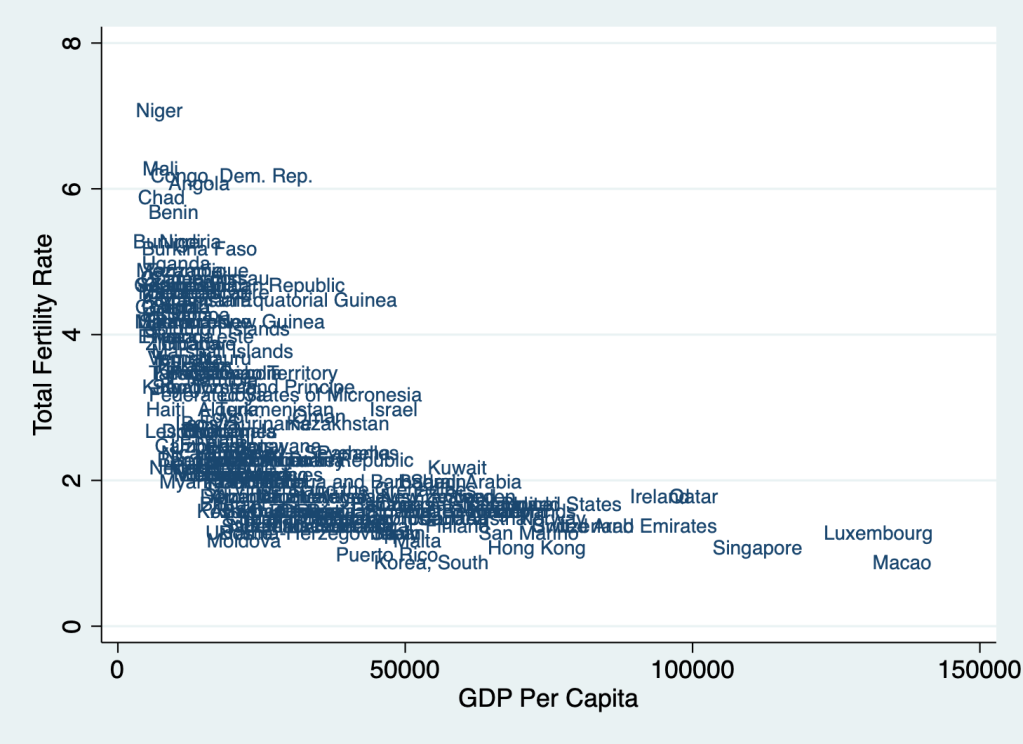
Global population growth has fallen from a peak of 2.1% per year to the current 1%, and is expected to fall to 0 by 2100. The remaining population growth will happen in poor countries, then stop for the same reasons it did in rich countries- the demographic transition from poverty, argicultural work, and high infant mortality to high incomes, high education, and low infant mortality. As the graph below shows, higher income is an incredibly strong predictor of low fertility- and so if economic growth continues, we should expect fertility to continue falling. But where does it stop?

2019 TFR from Population Reference Bureau vs 2019 PPP-adjusted GDP Per Capita fron World Bank

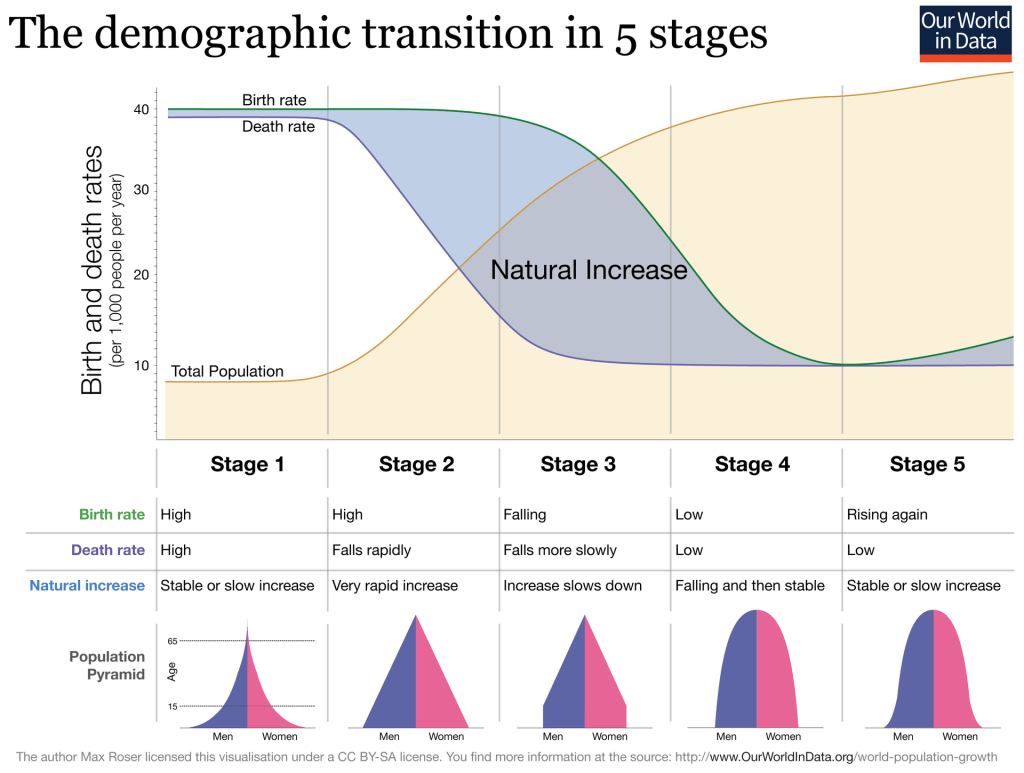
Some have theorized a “J-curve” relationship, where once incomes get high enough, fertility will start rising again. You can see this idea in “Stage 5” of Max Roser’s picture of the demopgraphic transition here:

This makes sense to me in theory. As countries get richer, desired fertility (the number of kids each woman wants to have) has fallen, but realized fertility (the number of kids each woman actually has) has fallen faster. In a typical rich country women would like to have 2-2.5 kids, but actually ends up having about 1.5. There are many reasons for this, but some are clearly economic- the high cost of goods and services that are desired by rich-country parents, like child care, education, and spacious housing near high-paying jobs. Perhaps in a rich enough country all these could be obtained with a single income (maybe even from a part-time job). But it seems we aren’t there yet. Even zooming in on higher-income countries, higher incomes still seem to lead to lower fertility.

TFR vs GDP Per Capita in countries with GDP Per Capita over 30k/yr

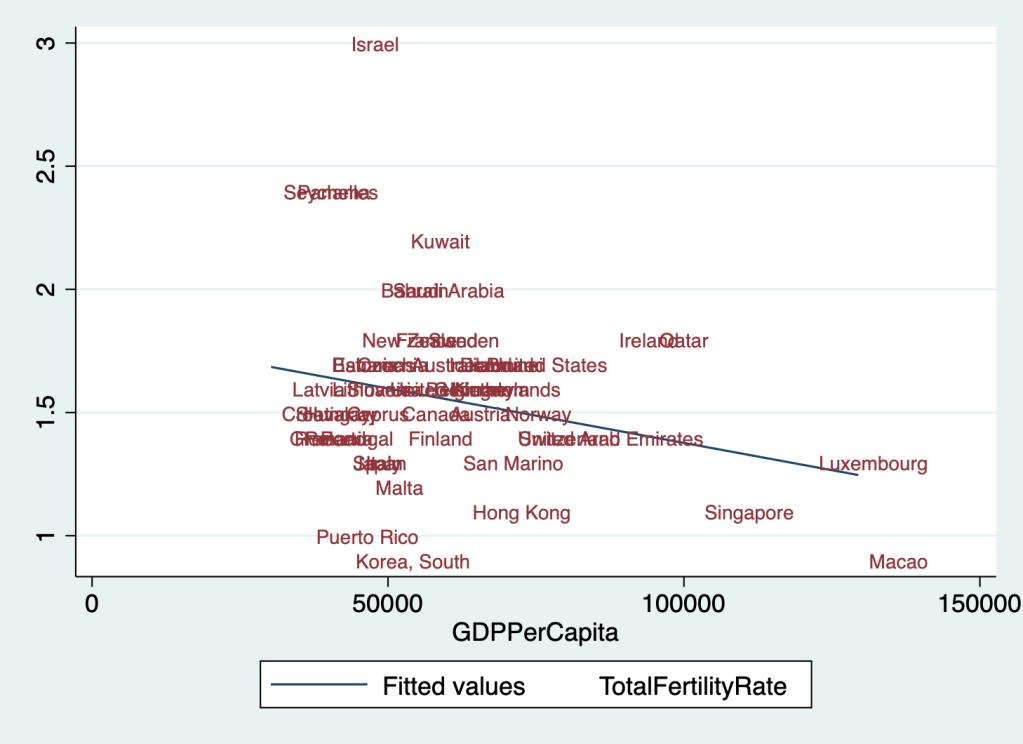
The only rich countries with fertility above replacement are Panama and the Seychelles (barely meeting my 30k/yr definition of rich), Kuwait (right at replacement with 2.2 kids per woman), and Israel- the biggest outlier, with 3 children per woman at a 42k/yr GDP. This hints that pro-fertility religious culture could be one way to stay at or above replacement. But in most countries, rising wealth seems to drive a decline in religiousity along with fertility. Will this trend eventually come to Israel? Or will it reverse in other countries, as more “pro-fertility” beliefs and cultures (religious or otherwise) get selected for?

To do one more crazy extrapolation like the disappearance of South Korea, the number of Mormons is currently growing by over 50% per generation from a base of 6 million while the rest of the US is shrinking. If these trends continue (and setting aside immigration), in at most 10 generations the US will be majority-Mormon. Again, I don’t actually expect this, but I don’t know whether it will be falling Mormon fertility, non-Mormon fertility somehow rising back above replacement, or something else entirely that changes our path.

What would a secular pro-fertility culture look like? For my generation, I see two big things that make people hold back from having kids: a desire to consume experiences like travel and nightlife that are harder with kids, and demanding careers. I see more potential for change on the career front. Remote work means that more quality jobs will be available outside of expensive city centers. Remote work, along with other technological and cultural changes, could make it easier to work part-time or to re-enter the work force after a break. Improving educational productivity so that getting better-education doesn’t have to mean more years of school would be a game-changer; in the short run I think people will spend even more time in school but I see green shoots on the horizon.

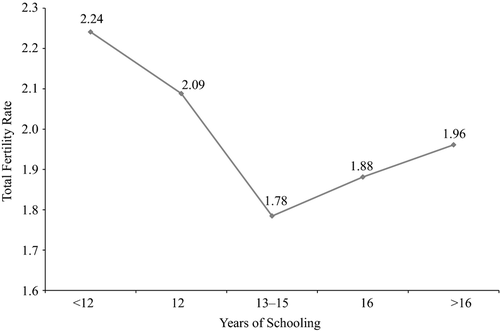
Looking within the US, we are just beginning to see what looks like the “J-curve” happening. Since about the year 2000, women with advanced degrees began to have more children than those with only undergraduate education (though still fewer than those with no college, and still below replacement):

From Hazan and Zoabi 2015, “Do Highly Educated Women Choose Smaller Families?”

We see a similar change with income. In 1980 women from richer households clearly had fewer children, but by 2010 this is no longer true:

Fertility of married white women, from Bar et al. 2018, “Why did rich families increase their fertility? Inequality and marketization of child care”

The authors of the papers that produced the two graphs above argue that this change is due to “marketization”, the increasing ability to spend money to get childcare and other goods and services that make it easier to take care of kids. If this is true, it could bode well for getting back to replacement- markets first figure out how to make more excellent daycare and kid-related gadgets, then figure out how to make them cheap enough for wide adoption.

Temporary Income Shocks

As a graduate student in 2005, I took macroeconomics from Tyler Cowen. It was a fascinating class, covering not just the sweep of business cycle theories, but also just a good dose of “here is what it means to be an economist.” It was the first class in sequence, and for many incoming PhD students with no economics background (yes, this happens a lot!) it was the first economics class they took.

In that class we read a number of papers by Richard Thaler from his Anomalies series in the Journal of Economic Perspectives. We also read The Winner’s Curse in Bryan Caplan’s micro II course at GMU, the book that collected a lot of those JEP papers (for anyone that thinks the GMU PhD program is just straight Chicago school mixed with libertarianism, think again!).

One of the Thaler papers that always stuck with me was his criticism of the life-cycle theory of savings. That paper opens with a story of Thaler winning $300 in a football betting pool. Thaler, of course, used that income shock to splurge on some temporary indulgence, such as a bottle of champagne or a nice dinner. But a strictly rational agent should just use that extra income to increase their annual lifetime income by an even amount, such as about $20. That’s what the famous life-cycle hypothesis says, which is part of what Modigliani won the Econ Nobel for developing. That was in 1985. The joke is that just 5 years later, Thaler (and presumably other economists) were not personally behaving the way that economic theory says that people behave. (The meta-joke is that Thaler later wins the Econ Nobel too.)

This past week, that theory came full circle for me when Tyler Cowen awarded me an Emergent Ventures prize. It really did come as a shock, both in a real sense and an income sense. I was not expecting this prize in any way, but I am very honored and humbled to receive it. (Side note: this very blog that you are reading also received an EV grant, separate from my personal grant. Hooray for us!). The award was largely for my work on social media and this blog trying to convey good information and data during the pandemic, and to fight bad information.

The question that has been gnawing at me since receiving the award is: what should I do with it? It’s a nice problem to have. I am not complaining in any way. But it’s an especially fascinating question for an economist to think about, and to reconsider how we model human behavior.

The award also intersects with my blog post from last week on “what is income?“. The IRS most definitely considers an award like this to be “income,” and not just any income: it is self-employed income, since it doesn’t come from my employer. If I take it as a cash award, the tax bite will be quite large. However, I could also use the award for some academic purpose: purchasing equipment or software; attending a conference (perhaps one that my University would not normally pay for); or running a small workshop or conference (possibly, in the theme of the award, on how to communicate good information effectively on social media?). In those cases, I might legally avoid some taxes.

I don’t yet know what I want to do with the award. But it’s a really interesting intellectual, professional, and personal challenge to think about. Again, nice problem to have. But thank you again to Tyler, Mercatus, and Emergent Ventures for the honor. And thank you to all my readers out there for making the intellectual journey with me over the past year and a half!