Paul Fain Highlights Illiteracy

Paul Fain writes a newsletter called The Job. The newsletter typically presents a few paragraphs one topic and then provides summaries and links to relevant news and current research. I subscribe because I write on and teach labor economics. The title of the letter this week is “Skills and Employability”.

As federal and state governments mull big spending on skills training, some experts say more resources should go toward boosting the literacy and numeracy of Americans without college degrees.

And despite the widespread belief that a quality liberal education in a college degree program is the best way to develop the sort of highly sought skills that pay off in the job market, many college degree holders also lack proficiency in literacy and numeracy.

Fain’s cites a recent essay by Irwin Kirsch calling for more opportunities for illiterate adults to achieve literacy, so that they can take advantage of continuing professional education. Kirsch is calling for more education so that the adults can do yet more education. I’m an educator and find myself sympathetic to Kirsch’s plan.

Continue reading

Endless Frontiers: Old-School Pork or New Cold War Tech Race?

The Endless Frontiers Act passed the Senate Tuesday in a bipartisan 68-32 vote. What was originally a $100 Billion bill to reform and enhance US research in ways lauded by innovation policy experts went through 616 amendments. The bill that emerged has fewer ambitious reforms, more local pork-barrel spending, and some totally unrelated additions like “shark fin sales elimination”. But it does still represent a major increase in US government spending on research and technology- and other than pork, the main theme of this spending is to protect US technological dominance from a rising China. One section of the bill is actually called “Limitation on cooperation with the People’s Republic of China“, and one successful amendment was “To prohibit any Federal funding for the Wuhan Institute of Virology

Continue reading

What Is Income?

The United States, like nearly all countries, has an income tax. What is an income tax? It’s a tax on income. What is income? That’s actually a very hard question.

The question comes up in a recent report by ProPublica on the taxes that very wealthy Americans pay (I’m not going to link to it, because the data was likely illegally obtained, and almost certainly immorally obtained, but you can easily find it). What’s really interesting is that never define income, but they do have an implicit definition which includes changes in net wealth. More on this later, but it does raise an important question under an income tax: what exactly should count as income?

For most wage and salary workers, income is fairly straightforward. It’s the compensation that your employer pays you in exchange for your labor services. Easy enough. There are some wrinkles. For example, most non-cash compensation is not considering income for tax purposes. And even some cash compensation, such as contributions to retirement plans, are not considered income. Still, pretty straightforward.

But what if you own a business? It gets a little more complicated. We could define your income as all of the money you receive when you sell goods and services to your customers. But that has a few problems. Let’s say you run a restaurant. You sell burgers for $5. Should you pay income tax on every $5 burger you sell? Keep in mind that you probably had $4.50 in expenses to sell that burger. You bought the beef, buns, and condiments. You paid your workers. You paid to “keep the lights on” (that’s how small business owners refer to utilities and other overheard). So our income tax system will only tax you on the $0.50 difference, which we usually call profit (in some years, of course, businesses have costs that exceed their sales revenue, in which case they owe no income tax).

Now for the really hard question: what if most of your income is derived from assets that you own? That’s where things get even more complicated, and both legal and philosophical questions come up.

Continue reading

Should student debt be dischargeable in bankruptcy?

I’m not an economist who studies education or bankruptcy, and I’m not 100% confident I spelled dischargeable correctly. I am, however, above average at highlighting the difficulty of a question when dissuading a grad student from attempting an impossible thesis question, so let’s dig into this one, which sounds pretty hard to me.

First of all, it is very difficult to discharge student debt during Chapter 7 or 13 bankruptcy, but I think you still can do it if you convince a judge that continued attempts at repayment would create undue hardship i.e. put you in a state of poverty in the wake of previous good faith efforts.

That said, maybe you shouldn’t have to face literal starvation to discharge student loans. That’s a reasonable idea, but what would the broader consequences be? This is tricky question to untangle because there are both welfare consequences and knock-on effects where we are put down different forking paths of politics and policy.

If debt is dischargable, then lenders will expect lower rates of repayment. This increase in lender risk and decrease in return on capital would likely have immediate consequences in the form of:

  1. Higher interest rates
  2. Lower rates of loan approval
  3. Greater dependence on loan collateral
  4. Greater lender interest in what the loaned funds will be applied towards.

Before we tackle those, we also have to consider the different policy environment paths lenders may have to anticipate:

  1. The government stops subsidizing loans. This would lower tuition, but also lower access for low income students.
  2. A loan forgiveness program. Great for people with outstanding debt, but changes how expectations are formed forever going forward.
  3. The government launches a massive “free college” program that covers tuition at state colleges and universities. This would have all kinds of consequences potentially.

But where this really leaves us is with a billion dollar question: will dischargeable students loans lead to lower costs of higher education? I am confident that the answer is a definitive, unassailable maybe.

Higher interest rates is a pretty straightforward prediction, but the consequences are less clear. Higher interest rates could lead to less college matriculation, greater barriers for lower income individuals, and higher expected rates of bankruptcy, in part because decisions are being made by young people who don’t know the future, their future, or, really, anything. Related to this, lenders will become more discerning regarding who they lend to, giving more money on more favorable terms to matriculants from wealthier backgrounds, in no small part because wealthy parents are filled to the brim with collateral, making for excellent co-signers and providers of high school graduation gifts nicer than any car I ever hope to drive.

That is all boring and moderately obvious. It’s 4) that I’m most curious about. If you get into medical school, there is no shortage of institutions eager to dump several hundred thousand dollars in the foyer of your home. Part of the reason for this is the expected future income of physicians and their high graduation rates from medical school thanks to rigorous admission screening. But what is underappreciated is the 100% rate at which medical school students study medicine.

Not so with undergraduate education. You might study electrical engineering with a minor in computer science. You also might study something a senior tells you is the easiest major at your school. You might major in something that sounds fun or interesting. You might study Miscelleneous Studies, where Miscelleneous is a subject that is likely interesting and possibly extremely important, but within which you can choose classes that facilitate your avoiding learning anything useful or applicable in the labor market.

Herein lies the problem. Lenders treat loans for consumption very differently than loans for investment. Nursing and statistics degrees are investments. Art History classes (for most people) are consumption. What’s going to happen to higher education when the lender tells you you can have $200K at 3% to study any STEM field or $75K at 6% to study anything in the humanities? Will the demand for humanities degrees drop? Will the supply of humanities education recede? Are humanities and STEM education complements or substitutes?1

Let me phrase it a different way? Are wealthy fine arts majors cross-subsidizing STEM majors pursuing the first college degrees in their family? Or are they driving up the price of tuition because heavily subsidized credit is facilitating pre-career retirement lifestyles for 4 years?

All of this leaves me with the suspicion that dischargeable student loans will lower tuition for some while raising it for others. This heterogeneity would likely shift the electoral popularity of free tuition programs while also shifting the nature of those program. Maybe “free college” turns into a means-tested program. Maybe “free college” becomes “free STEM college”. Maybe both.

We could speculate what this means for loan forgiveness or subsidies, but this post is too long already and, as should be already clear, we’re not going to solve anything today. My elegant and succinct point is this:

When you massively subsidize a [knowledge, signal] bundled good for so long that it transforms into a [knowledge, signal, 4-year luxury cruise with your peers] bundle, and to accommodate that subsidy you protect your poorly constructed macro-investment in human capital by exempting it from bankruptcy proceedings, and as a result of this weird landscape a bizarre higher education industry emerges that is both one of the greatest achievements in US history but also a trap that 19-year-olds fall into because, really, is there any trap we don’t fall into when we’re 19, and from which thousands of people never financially recover, but if you just fix one part of it no one knows what will happen, and if you try to fix all of it at once in the back of your mind you’re afraid it could turn into the US healthcare industry part deux, well then what you have is a real and important problem that I don’t know how we will solve but I remain confident that other people will be very confident that they know how to solve it and they will get extremely cross with me for not sharing their confidence.2

So maybe don’t try to solve that in your dissertation.3 Might be safer to just definitively estimate the natural rate of interest that underlines all monetary transactions. That’ll be easier.

1The answer is “Yes”.

2 This is, to be extremely clear, not me picking on Ms. Reisenwitz’s tweet which was good and interesting and left me thinking about student loans for two days when I should have been working on the research topics I have actual expertise in.

3 Of course, if you do find a natural experiment where huge chunks of student debt were accidentally made dischargeable in a state for 2 years because of a legislative SNAFU, you should write that dissertation and put me in the acknowledgements.

The Research Process: Identifying the Ideas that Motivate You

Hello to all the EWED readers! I’m Dr. Darwyyn Deyo, an Assistant Professor of Economics at San José State University and a Visiting Scholar at the Knee Center for the Study of Occupational Regulation. I research law and economics, occupational licensing, and the economics of crime. I would also like to thank Joy for inviting me to write some blog posts this summer! I’ll be writing a series of posts about the curriculum of the research process, from the initial idea to the development of a complete draft. This week, I’m focusing on the mechanics behind choosing that initial idea.

Continue reading

Publications as Positional Goods, and the Division of Labor in Academia

My co-blogger Mike Makowsky has a thoughtful post this week about the academic publishing process. I wanted to offer a slightly different perspective on the same topic. But my perspective comes from someone who is not at a research university, and someone who has recently survived the tenure process.

A little background for those not completely familiar with the academic world: schools are usually considered either teaching or research schools. At first this seems confusing: both Clemson (where Makowksy is) and the University of Central Arkansas (where I am) require that faculty engage in both research and teaching. The difference is subtle, but the big hint is that Clemson is considered an “R1” school (the highest research designation) and has a PhD program with many graduate students. At a school like Clemson, research is valued more than teaching. At UCA, teaching is valued more than research. (Much more could be said about the differences, perhaps in a future post.)

We both engage in both teaching and research (as well as service!), but the emphasis is different. For me at UCA, the expectations of which journals I will publish in and how frequently I will publish are lower than at a school like Clemson. At Clemson, some of your publications should be in the Top 5 (or at least Top 10) journals from time-to-time. At UCA, if you published in one of the top journals, the assumption would be that you are probably leaving soon to go to an R1 school

I’m glad both types of schools exist, and my point here is not to disparage either type of school. But the difference is important for thinking about the academic publishing process.

For someone at an R1 school, publications in top journals are positional goods. Makowsky doesn’t say this exactly, but that’s my takeaway from his post. There are only so many spots available in these journals, and they have value because there is only a fixed number available. And since there has been, over the years, a lot more economists doing a lot more research not all of the great papers will end up being published in one of the top journals.

Upshot: there are a lot of great papers being published in Top 50 or even Top 100 journals! Let me pick on myself. As I said, I recently successfully survived the tenure process. My publication record was good enough. You can inspect my publications over at Google Scholar. I’m proud of these publications. I think some of them are really great. But I’m fairly confident that I would never earn tenure at Clemson with these publications. Instead, you need a publication record like Makowsky.

What’s interesting here is that Mike and I occasionally publish in some of the same journals. Public Choice and Constitutional Political Economy jump out to me. These are, in my view, very fine journals. Lots of interesting research is published in these journals. I’m especially proud of this paper in Public Choice. But if someone published only in these two journals and journals like them, they wouldn’t get tenure at an R1 university.

So what do we do with this information?

Continue reading

Academic Publishing: How I think we got here

Fabio Ghironi, whom you should be following on twitter already, threaded the #econtwitter needle the other day, managing to write about the growing problems within academic economic publishing without falling victim to the sorts of whining and nihilism that discussions of publishing experiences often degenerate into. Below I’ve included a sample. Do go read the whole thing.

I don’t want to adjudicate the merits and flaws of the economic journal system. I have no idea how it would fare in a benefit-cost analysis or how to improve it, and I’m deeply skeptical of anything that has a whiff of “easy fix” for what is a very complex system of scientific incentives, social benefit, and academic sociology.

Instead, I’d like to discuss how I think we got here. A couple stylized facts about how research in economics has changed over the last 50 years, none of which I expect to be controversial

  1. There are a lot more people writing academic journal articles.
  2. There is a lot more well-executed economic research.
  3. The teams of co-authors on papers/projects have become much larger.
  4. The number of journals whose prestige is commensurate with a tenured position at an elite school has grown slower than the total faculty employed by elite schools.
  5. Economics research has become more expensive and labor intensive.

What is immediately obvious from 1-4 is the journal space squeeze, resulting in journals with vanishingly small acceptance rates. The American Economic Journal: Microeconomics (one of the very top journals that isn’t part of the holy Top-5, hallowed be thy names) managed to go an entire year without accepting a paper! Their editorial team, as any Murphy’s Law aficionado would have predicted, interpreted this as evidence they should publish fewer papers.

[Update: 6/2/21 A reader has pointed out that AEJ:Micro has over the past year managed a more than respectable turnaround time on submissions and eventually accepted 33 papers in 2019, 20 in 2020, yielding acceptance rates of 5 to 9%. Editors Report here]

One of the things that economics has become, and maybe always has been, obsessed with is “super stars”, and not just those who get medals. Within every subfield there are a handful of current researchers who are known to everyone else, whose papers are always top of the list in the best working paper series, who tour the country tirelessly promoting their latest papers. And they are often promoting multiple papers. How is it that they find the time to do so much research?

Well, first and foremost, they are incredibly conscientious, with work ethics bordering on obsessive. But a not distant second is the change in the nature of their jobs. They are not just working at a chalkboard by themselves or analyzing the latest batch of data. They are managing research teams. They are applying for grants that support grad students and post-docs. They are meeting for 3 hours each day with different teams of scholars, some at different institutions. They are coming up with their own ideas and refining the ideas of others, they are guiding the research of apprentices while also collaborating with equally experienced peers. They are the CEOs of miniature research empires.

Let’s assume that for a second that the number of super stars in the field has remained constant (it’s grown, but lets keep it simple). In 1950 the top 5 journals probably could have published every single full research paper written by super stars and still had room to spare. Nowadays I’m not sure the top 5 journals could handle the research output in a given year just from MIT. I don’t think the top 10 journals could handle all of the research from the Boston metropolitan area

Let’s visit the other side of the fence now. If you are a co-editor at one of the 5 elite journals in economics, you are allotted roughly 13 acceptances per year. These are fixed. For these slots you review roughly 200 papers. Let’s say 50 of those papers are trash and 50 are good but below the bar. These you desk reject. Of the remaining 100, another 25 are a bad match for the aesthetic or substantive targets laid out by the editor-in-chief(s). Another 25 are good, but the reviewers are, upon closer inspection, able to identify real problems that will undermine the impact of the paper, ruling it out for an elite journal such as yours.

That leaves you with 25 papers for 13 slots. That might not sound like a problem, but think about the process of elimination you just went through. These are really good papers that make important contributions to the field and you need to reject half of them. The discipline will not accept you flipping a coin. You need reasons to reject some of these papers. Well, let’s look at the co-authors. You don’t want to be a jerk, but you’re both desperate and don’t want to be remembered in your hallway at work as the person who rejected that massively influential paper that reinvented the field. You’d feel bad, but 20 of the papers have at least 1 superstar on them. Sorry, but status is a heuristic for a reason. You still need to reject 7 more.

Let’s go through those referee reports again. Was there anything questionable? Any possible source of bias speculatively hypothesized by a person who spent two days thinking about the paper that the people who worked on it for three years never thought of? Are they relying on econometrics that someone has recently posited might sometimes fail to calculate error terms optimally? Is it a theory without an application? Is it an application without a theory? Are the coefficients too small to be interesting or too large to be believable?

Now, let’s remember the single most important thing: everyone knows this is happening. This is not a secret process and academic researchers have responded accordingly. Superstars have responded by managing bigger teams, producing even more research, adding more and more layers of robustness checks, alternative specification designs, even entirely different research designs serving as papers within papers that put Hamlet to shame. At the same time comparably excellent, but perhaps slightly less famous, authors with outstanding research records are thrilled to work with a star, knowing that it will increase their odds at a top journal. When designing the research they know what is in vogue, what is falling out of favor, and how to shape their papers to fit the ambitions of current editors. Research designs are defensive from the start, anticipating as many angles of attack as possible. When the research is completed, it will go on the presentation circuit for a year or two, subject to the slings and arrows from the pool of economists where your future referees will be drawn from. It is from these comments that your appendix will grow. And grow. And grow. You must anticipate every attack, lest your paper’s shortcomings make the editor’s job easier.

Now try to imagine what the research lives of everyone start to look like. For the bulk of good researchers, this means working on 3-6 projects at all time, with each of those projects stretching out over 3 to 5 years. Even if you land a 2 year post-doc, submitting your tenure packet in the fall of your 6th year means you have 7 total years to get multiple papers through a process accepting less than 3-5% of submissions and, more importantly, less than half of all the objectively outstanding research. At the same time, superstars are stretching themselves impossibly thin, expected to meet impossible expectations and get papers accepted at journals with impossible standards knowing full well the careers of their co-authors depend on those acceptances. A faculty appointment should come with a free clonazepam prescription.

To sum up: academic economics has more star researchers, managing larger teams producing more high-quality papers than there is space in the elite journals which have been forced to invent impossible acceptance criteria to produce the singular output that journal editors absolutely cannot shirk: rejections.

And if you think the easy answer is to just increase the size of journals, you are missing the entire function of journals. Journals no longer function as disseminators of economic science.** Rather, they are criteria for tenure and promotion. There are a finite number of faculty slots and schools need reasons to keep/dismiss/promote/retain/recruit. If the number of elite journal articles published were to change, the prinipal effect would be to shift the threshold for success or failure in tenure and promotion.

Of course, increasing the number of publication slots in historically high prestige journals might still be a good thing. Going back to our editor’s dilemma, if they could accept the entire 12.5% of papers that our editor-under-truth-serum genuinely believes are significant contributions, then everyone’s CV would more accurately reflect the subjectively assessed merit of their work, and less their luck and ability to tirelessly play a zero-sum game. Sure, the high-low prestige bar would inflated upwards, but it would nonetheless increase the signal-to-noise ratio on everyone’s CV.

This, of course, would lower the value of every CV that already includes a Top-5 publication, but such is the struggle of every YIMBY vs NIMBY movement. Increasing the supply of elite journal publications won’t be a Pareto improvement (what is?), but it seems likely to me to be welfare improving. So I lied. I do think I know how to improve the system. Big shocker, an academic who thinks they can solve a complex system in one blog post.

** That role has been entirely usurped by the NBER and their working paper series. Now that I have tenure, I would literally rather receive an email permitting me to distribute my future work as NBER working papers than an acceptance at a Top 5 journal. It’s not even close, actually.

John Duffy Experiments and Crypto

John Duffy and Daniela Puzzello published a paper in 2014 on adopting fiat money. I think of that paper when I hear the ever-more-frequent discussions of crypto currencies around me. To research the topic, I went to John Duffy’s website. There I found a May 2021 working paper about adopting new currencies in which they directly reference crypto. Before explaining that interesting new paper, first I will summarize the 2014 paper “Gift Exchange versus Monetary Exchange.”

Continue reading

More computer jobs than San Francisco

The U.S. Bureau of Labor Statistics reports Occupational Employment and Wages from May 2020 for

15-0000 Computer and Mathematical Occupations (Major Group). The website contains a few interesting insights.

Where are the computer jobs in the United States? When looking just at total numbers of jobs, three major population centers make it into the top 7 areas: NYC, LA, and Chicago. San Francisco is ahead of Chicago, while San Jose is behind Chicago. In terms of the total number of jobs, the D.C. area is ahead of any West Coast city. Is Silicon Valley not as central as we thought?

Here’s a map of the U.S. that isn’t just another iteration of population density.

When metropolitan areas are ranked by employment in computer occupations per thousand jobs, then New York City no longer makes the top-10 list. San Jose, California reigns at the top, which seems suitable for Silicon Valley. The 2nd ranked area will surprise you: Bloomington, IL. A region of Maryland and Washington D.C. shouldn’t surprise anyone. If you aren’t familiar with Alabama, then would you expect Huntsville to rank above San Francisco in this list?

Huntsville, AL is not a large city, but it is a major hub for government-funded high-tech activity. The small number of people who live there overwhelmingly selected in to take a high-tech job. For an example, I quickly checked a job website to sample in Huntsville. Lockheed Martin is hiring a “Computer Systems Architect” based in Huntsville.

Anyone familiar with Silicon Valley already knows that the city of San Francisco was not considered core to “the valley”. Even though computer technology seems antithetical to anything “historical”, there is in fact a Silicon Valley Historical Association. They list the cities of the valley, which does include San Francisco. (corrected an error here)

The last item reported on this Census webpage is annual mean wage. For that contest, San Francisco does seem grouped with the San Jose area, at last. The computer jobs that pay the most are in Silicon Valley or next-door SF. Those middle-of-the-country hotspots like Huntsville do not make the top-10 list for highest paid. However, if cost of living is taken into account, some Huntsville IT workers come out ahead.

What Forex says about cheap travel

The 2007-9 Financial Crisis turned Iceland into a major tourist destination, as a newly cheap currency combined with affordable flights and natural beauty. For anyone with plenty of time and a moderate amount of money, chasing the newly-cheap destination seems like a good travel strategy.

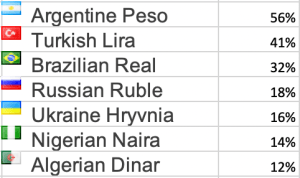
Since January 2020, here are the countries where the US dollar has gained the most vs the local currency:

Calculated using https://fx-rate.net/USD/?date_input=2020-01-01
Continue reading