On Good and (Mostly) Bad Investments

I ran across an article by Lyn Schwartzer on seeking Alpha last week, which I thought was insightful regarding investments. Here is my summary.

The article is Most Investments Are Bad. Here’s Why, And What To Do About It.    The article’s first bullet point is “Historical data shows that the majority of investments, including bonds, stocks, and real estate, perform poorly.” Unpacking this, looking at various investment classes:

Bonds and Stocks

Investment-grade bonds typically pay interest rates just a little above inflation, so it’s not surprising that they have been mediocre investments over the long-term. The prices of long bonds (10 years or more maturity) tended to rise between about 1985 and 2020, as interest rates came steadily down, but that tailwind is pretty much over.

It has been known for years, e.g. from a study by Hendrik Bessembinder, that only a tiny fraction of stocks makes up the vast majority of returns in equity markets. I wrote about this a couple of years ago on this blog.:

The rise of the S&P is entirely due to huge gains by a tiny subset of stocks. The average stock actually loses money over both short and long time periods. … half of the U.S. stock market wealth creation [1926-2015] had come from a mere 0.33% of the listed companies… Out of some 26,000 listed companies, 86 of them (0.33%) provided 50% of the aggregate wealth creation, and the top 983 companies (4%) accounted for the full 100%. That means the other 25,000 companies netted out to zero return. Some gave positive returns, while most were net losers.

As investors, we of course want to know how to lock in on those few stocks that will perform well. I see two approaches here, not mentioned in the article. One is to be very good at analyzing the finances and market environments of companies, to be able to pick individual firms which will be able to grow their profits. Being lucky here probably helps, as well.   An easier and very effective method is to simply invest in the S&P 500 index funds like SPY or VOO. Because these funds are weighted by stock capitalization, they inexorably increase their weighting of the more successful companies and dial down the unsuccessful companies. This dumb, automatic selection process is so effective that it is very difficult for any active stock-picking fund manager to beat the S&P 500 for any length of time.

What the article suggests in this regard is to focus on businesses that have “durable competitive advantages (network effects, powerful brands, intangible property, economies of scale, oligopoly participation, and so forth),” or to try to pick up decent/mediocre companies at a low price.

The big tech companies which are mainly listed on the NASDAQ exchange have these durable advantages, and indeed the QQQ fund which is comprised of the hundred largest stocks on the NASDAQ has far outpaced the broader-based S&P 500 fund over the last 10 or 20 years.

Real Estate

All of us suburbanites know that owning your own home has been one of the best investments you can make, over the past few decades. The article points out, however, that real estate in general has not been such a great performer. If your property is not located close to a thriving metropolitan area, where people want to live, it can be a dog.    The article cites abandoned properties all around Detroit (“large once-expensive homes that are now rotting on parcels of land that nobody wants”), and notes, “In Japan, there are millions of abandoned countryside homes that are nearly free. Many of them are in beautiful and safe rural areas, and yet there is insufficient demand for them.”

And so, “Most real estate falls somewhere between those extremes. It performs decently, especially when considering that it can replace the owner’s rental income or be rented out for cashflows, but after maintenance and taxes are considered, its unlevered total return from price appreciation and cashflow generation net of maintenance leaves something to be desired relative to gold.”

Gold As a Reference

The article uses gold as, well, the gold standard of investing returns. The supply of gold creeps up roughly 1.5% per year, so after say 95 years there is four times as much physical gold as before. We find that an ounce of gold will buy more food or more manufactured goods than it did a century ago, but that is because our efficiency of producing such things has increased faster than the gold supply. On the other hand, “All government bonds have underperformed gold over the long run, and most unlevered real estate has underperformed gold as well.” Stocks in the broad U.S. market (most foreign stock markets did more poorly) greatly outperformed gold, but that is only accomplished by the top 4% of stocks. The other 96% of stocks as group did not generate any excess returns.

Owner-Operators versus Passive Investors

I am looking at these issues from the point of view of a passive investor – I have some extra cash that I want to plow into some investment, and have it return my original capital plus another say 10%/year, without me having to do extra work. It turns out that many companies, especially smaller ones, provide useful products to customers and they make enough profit to pay off the owner/operators and the employees, but not enough to reward outside passive investors, too. These companies serve an important role in society, but are not viable investment vehicles:

Being an owner-operator of a business, or a worker at a business, makes a lot of sense. However, the vast majority of businesses are not strong enough to provide good returns for outside passive investors after all expenses (including salaries) are considered.

Good returns for outside passive investors are reserved for only the best types of companies; companies that are so dominant and high-margin that even after paying all of their executives and workers, they have plenty of excess profits for outside passive investors. Although stocks from any sector can have these characteristics, Bessembinder’s research found that major outperformers were disproportionally concentrated in the technology, telecommunications, energy, and healthcare/pharmaceutical sectors. They are on the right side of an emerging tech trend, they have network effects, they have economies of scale, they have protected intangible property such as patents, or they are part of an oligopoly, and so forth.

Similarly, real estate (especially unlevered), works most easily when it is occupied or used by the owner. After all, you must live somewhere. Now, you can make money buying and renting/flipping properties, but that typically demands work on your part. You add value by fixing the tenant’s toilet or arranging for a plumber, or by scoping the market and identifying a promising property to buy, and by working to upgrade its kitchen. All this effort is not the same as just throwing money at some building as a passive investor, and walking away for five years.

Upping Returns via Leverage

This is a packed sentence: “Historically, a key way to turn mediocre investments into good investments has been to apply leverage. That’s not a recommendation; that’s a historical analysis, and it comes with survivorship bias.”

For example, banks have historically borrowed money (e.g. from their depositors) at lowish, short-term rates, and combined a lot of those funds with the bank corporate equity, to purchase and hold longer-term bonds that pay slightly higher rates. Banks are often levered (assets vs. equity) 10:1. This technique allows them to earn much higher returns on their equity than if they used their equity alone to buy bonds.

It is easy to leverage real estate. If you put 20% down and borrow the rest, bam, you are levered 5:1. Now if the value of your house goes up 6%/year while you are only paying 3% on your mortgage, the return on the actual cash (the 20% down) you put in becomes quite juicy: “After maintenance and recurring taxes, the majority of unlevered real estate, even when rented out for cashflows, doesn’t outperform gold. But unlike gold, 5-to-1 leverage makes real estate actually pretty good in many contexts, and historically allows it to outperform gold.”

Large corporations can leverage up by issuing relatively low-interest bonds: “They can borrow large amounts of money for decades at low interest rates, and use that capital to organically expand their business, buy smaller companies, or buy back their own shares. Either way, they are borrowing abundant fiat currency at low rates and using that capital to build or buy business equity, and they are arbitraging that spread for shareholders.”

Savvy firms like Warren Buffett’s Berkshire Hathaway take it a step further, by having controlling interests in insurance companies, and investing the low-cost “float” funds, as we described here. From the article:

Berkshire has also made a habit out of buying small and medium sized private businesses in full. Many of these smaller companies would have higher borrowing costs if they were independent. But Berkshire can buy a lot of them, and then issue corporate debt at the parent company level at much lower interest rates than any of them could issue on their own. So he can buy a lot of unlevered cashflow-producing small or medium-sized businesses, and turn them into a portfolio of businesses that are levered with Berkshire’s very low cost of capital.

Now other companies like Ares Management and Apollo are jumping onto this arbitrage bandwagon, buying up insurance companies to get access to their captive cash, to be used for investing.

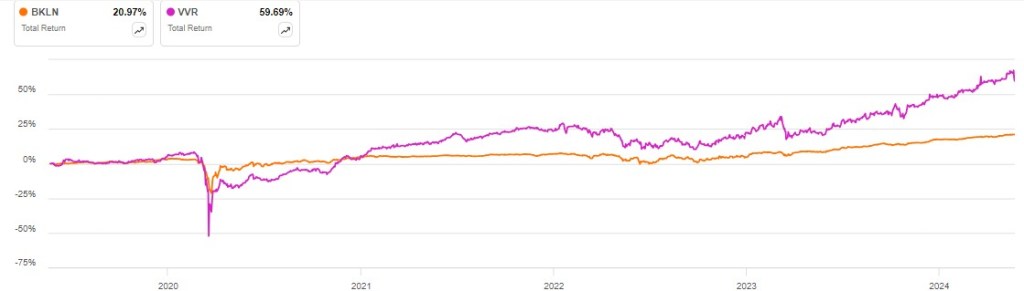
Here is another rough example of the power of leverage. The unleveraged fund BKLN holds bank loans, and so does the closed end fund VVR. But VVR borrows money to add to the shareholders’ equity. There is more complication (discount to net asset value) with VVR which we will not go into, but the following 5-year chart of total returns (share price plus reinvested dividends) shows nearly triple the return for VVR, albeit with higher volatility:
The Changing Global Economic Landscape

The article closes with some summary observations and recommendations. The past 30-40 years have been marked by ever-decreasing interest rates, and by cooperation among nations and generally increasing globalization. It seems that these trends have broken and so what worked for the last four decades (buy stocks, shun gold) may not be as good going forward:

For equity and real estate investors, the key takeaways from this piece are 1) do not extrapolate the prior decades for a given investment and instead assess it with this context in mind, 2) try to emphasize the sectors [such as Big Tech]  that Bessembinder identified as ones that disproportionally generate excess returns, and 3) look for companies that have locked in or are otherwise still able to play this arbitrage game going forward in a more difficult environment for it.

Additionally, hard monies [i.e. gold, silver] become a serious alternative once again in this context, and are worth serious consideration for a portfolio slice, because the hurdle rate for stocks to outperform them is high when there are not a lot of tailwinds at the backs of stocks.

How to Keep Up With Economics

… other than reading our blog, of course.

I was writing up something for my graduating seniors about how to keep learning economics after school, and realized I might as well share it with everyone. This may not be the best way to do things, it is simply what I do, and I think it works reasonably well.

Blogs by Economists: There are many good ones, but besides ours Marginal Revolution is the only one where I aim to read every post

Economic News: WSJ or Bloomberg

Podcasts on the Economy: NPR’s The Indicator (short, makes abstract concepts concrete), Bloomberg’s Odd Lots (deeper dives on subjects that move financial markets)

Podcasts by Economists: Conversations with Tyler and Econtalk (note that both often cover topics well outside of economics). Macro Musings goes the other way and stays super focused on monetary policy.

Twitter/X: This is a double-edged sword, or perhaps even a ring of power that grants the wearer great abilities even as it corrupts them. The fastest way to get informed or misinformed and angry, depending on who you follow and how you process information. Following the people I do gives you a fighting chance, but even this no guarantee; even assuming you totally trust my judgement, sometimes I follow people because they are a great source on one issue, even though I think they are wrong on lots of other things. Still, by revealed preference, I spend more time reading here than other single source.

Finance/Investing: Making this its own category because it isn’t exactly economics. Matt Levine has a column that somehow makes finance consistently interesting and often funny; unlike the rest of Bloomberg, you can subscribe for free. He also now has a podcast. If you’d like to run money yourself some day, try Meb Faber’s podcast. If you’d like things that touch on finance and economics but with more of a grounding in real-world business, try the Invest Like the Best podcast or The Diff newsletter.

Economics Papers: You can get a weekly e-mail of the new papers in each field you like from NBER. But most econ papers these days are tough to read even for someone with an undergrad econ degree (often even for PhDs). The big exception is the Journal of Economic Perspectives, which puts in a big effort to make its papers actually readable.

Books: This would have to be its own post, as there are too many specific ones to recommend, and I don’t know that I have any general principle of how to choose.

This is a lot and it would be crazy to just read all the same things I do, but I hope you will look into the things you haven’t heard of, and perhaps find one or two you think are worth sticking with. Also happy to hear your suggestions of what I’m missing.

“Roaring Kitty” Returns to Social Media, and Reignites Stock Frenzy

Back in early 2021, when we were still locked down, bored and restless, and trillions of pandemic stimulus dollars were pouring into our bank accounts to fund speculative investments, Keith Gill took to social media to argue that the stock of videogame retailer GameStop (GME) was deeply undervalued. He appeared on YouTube as “Roaring Kitty,” and on Reddit under an unsavory moniker.  He rallied an army of retail investors on Reddit to buy up shares of GME, which was heavily shorted by big Wall Street firms. As hoped by the Redditors, this led to a “short squeeze,” where the shorts were forced to buy shares to cover, which drive GME price to the stratosphere.  We discussed this phase of the drama here.

The drama continued as the jubilant retailers sucked so much money from short-selling hedge fund Melvin Capital that it ultimately shut down; the Robin Hood brokerage firm widely used by Redditors suspended trading  in GME for a crucial couple of days, leading to suspicions it caved to pressures from the Wall Street firms and threw the retail investors under the bus; and key parties, including Roaring Kitty himself, were called before a Congressional committee to explain themselves. The story of Roaring Kitty and the meme stock craze was turned into a movie last year called “Dumb Money.”

Keith Gill largely vanished from messaging boards in early 2021. But he came roaring back on Sunday (May 11), posting on X a sketch of a man leaning forward in a chair, a meme among gamers that things are getting serious:

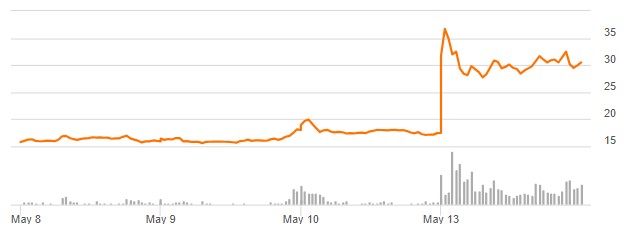
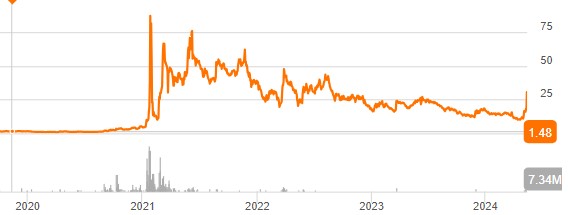
It seems that the Kitty has not lost his magic.  That X post has garnered over 20 million views, and apparently triggered a new surge in GME stock (and in other heavily shorted stocks as well, which is a significant knock-on effect). Here is a five-year chart of GME, showing the craziness in early 2021, which then died down over the next couple of years:

GME stock had finally approached something approximating fundamental fair value, with occasional ups and downs, then Roaring Kitty posted his sketch, and, blam, the next day, the stock nearly doubled:

Keith Gill has followed up with tweets of video clips with a fight theme, including Peaky Blinders, Gangs of New York, Snatch, Tombstone, X-Men Origins: Wolverine, V is for Vendetta and The Good the Bad and the Ugly ; get that testosterone out there roiling (typical meme stock Redditors are youngish males).

As of Tuesday morning, GME had nearly doubled again, up to $57. (I am reasonably sure it will plunge again within the next few months, but I am not into shorting, and the options pricing structure does not make it easy to set up a favorable bearish trade here).

This response is not like the world-shaking short squeeze of 2021, but it still shows an impressive power of social media influencers and memes to move markets.

My Frozen Assets at BlockFi, Part3: I Finally Recovered 27% of My Original Funds.

Well, it’s finally over. As noted in previous blog posts, back when interest rates were essentially zero, I started an account with cryptocurrency investing firm BlockFi. They paid me a hefty 9% per year for lending out my crypto coin to “trusted institutional counterparties”, backed by large collateral. However, when  Sam Bankman-Fried’s FTX exchange went belly up, it took BlockFi with it. (Bankman-Fried, the former rock-star white knight of the crypto world, is now in prison for fraud).  My funds at BlockFi disappeared into the black hole of bankruptcy proceedings for about a year and a half.

Last month, a judge finally allowed a settlement for clients to withdraw their assets from their interest-bearing accounts. There were two wrinkles. First, you get far less than 100% of your funds. Most of my money got chewed up in the corporate bankruptcy itself, and then was eaten by the law firm (Kroll) processing the bankruptcy and the client reimbursement process. So,  I’m only getting about 27% percent of my money back.

As an aside, Kroll got hacked about a year ago, leaking the names and email addresses of us BlockFi clients, and so some scammer sent out a very well-crafted email that a number of people, including me (briefly) were taken in by, as I wrote earlier.  if you responded to that scam email, you ended up connecting your wallet to a scam application, which could then suck everything out of your wallet. Fortunately, I had almost nothing in my wallet for the short time I had it connected, but other victims lost considerable sums. I guess the reason why criminals continue to run crypto scams is because they are profitable, like the legendary bank robber Willie Sutton who robbed banks because “that’s where the money is.”

The other wrinkle In the BlockFi reimbursement is that they will only reimburse you with the actual cryptocurrency coin that you held, not with its dollar value. So, I had to set up a cryptocurrency wallet (I used Trust wallet) to receive my crypto, which was all in the form of the stablecoin USDC.

I had to do considerable background work to make this happen. In order to test that that wallet worked to receive USDC, I had to also set up a cryptocurrency exchange account, which I did with Coinbase (which seemed to be the most solid crypto exchange). I had to connect that account with my bank, put some money into the Coinbase exchange, buy some USDC, and send it to my crypto wallet to make sure that it all worked.


As of a week ago, after some fairly intrusive ID verification, the reimbursement machinery did finally deposit the measly remnants of my USDC into my wallet. OK, I thought, I’ll just transfer that to my Coinbase exchange account, turn the USDC into cash and be done with it all.


But not so fast… Because USDC is transferred over the Ethereum network, I had to have enough ETH coin in my Trust wallet to pay for the transfer. The network transfer cost, called the gas fee, was about eight dollars at midday, going down to about three dollars by 10 o’clock at night.

So, I had to go into my Coinbase account, convert some USDC there into ETH (incurring a $1.49 fee for that), and then send some ETH to my Wallet, incurring yet another a transfer fee there. Then I could use that ETH in my wallet to pay for the transfer of the USDC to my Coinbase exchange. Then at long last I was able to convert my USDC to cash and transfer it to my bank account, to finally put this whole BlockFi drama to rest.

Looking on the bright side of all this uproar, I now have a functioning cryptocurrency exchange account and wallet, and am familiar with elementary crypto operations. This might prove handy if I ever want to dabble more in this area or if some other need arises. For now, however, I have had enough of crypto.

ADDENDUM: Finally got all my BlockFi funds back as of November, 2024. BlockFi was able to claw back its assets from FTX, and fully reimburse its customers. Yay! This post describes the process:

https://economistwritingeveryday.com/2024/11/26/my-frozen-assets-at-blockfi-part-4-full-recovery-of-my-funds/

Recovering My Frozen Assets at BlockFi, Part1. How Sam Bankman-Fried’s Fraud Cost Me.

Back in 2021, interest rates had been so low for so long that that seemed to be the new normal. Yields on stable assets like money market funds were around 0.3% (essentially zero, and well below inflation), as I recall. As a yield addict, I scratched around for a way to earn higher interest, while sticking with an asset where (unlike bonds) the dollar value would stay fairly stable.

It was an era of crypto flourishing, and so I latched onto the notion of decentralized finance (DeFi) lending. I found what seemed to be a reputable, honest company called BlockFi, where I could buy stablecoin (constant dollar value) crypto assets which would sit on their platform. They would lend them out into the crypto world, and pay me something like 9 % interest. That was really, really good money back then, compared to 0.3%.

On this blog, I chronicled some of my steps in this journal. First, in signing up for BlockFi, I had to allow the intermediary company Plaid complete access to my bank account. Seriously, I had to give them my username and password, so they could log in as me, and not only be able to withdraw all my funds, but see all my banking transactions and history. That felt really violating, so I ended up setting up a small auxiliary bank account for Plaid to use and snoop to their heart’s content.

I did get up and running with BlockFi, and put in some funds and enjoyed the income, as I happily proclaimed (12/14/2021) on this blog, “ Earning Steady 9% Interest in My New Crypto Account “.

BlockFi assured me that they only loaned my assets out to “Trusted institutional counterparties” with a generous margin of collateral. What could possibly go wrong?

What went wrong is that BlockFi as a company got into some close relationship with Sam Bankman-Fried’s company, FTX.  Back in 2021-2022, twenty-something billionaire Sam Bankman-Fried (“SBF”) was the whiz kid, the visionary genius, the white knight savior of the crypto universe. In several cases, when some crypto enterprise was tottering, he would step in and invest funds to stabilize things. This reminded some of the role that J. P. Morgan had played in staving off the financial panics of 1893 and 1907. SBF was feted and lauded and quoted endlessly.

For reasons I never understood, BlockFi as a company was having a hard time turning a profit, so I think the plan was for FTX to acquire them. That process was partway along, when the great expose’ of SBF as a self-serving fraudster occurred at the end of 2022. He effectively gambled with his customers’ money. This would have made him even richer if his bets had paid off, but they went sour, which brought everything crashing down.

FTX quickly declared bankruptcy, which forced BlockFi to go BK as well. SBF was eventually locked up, but so were the funds I had put into BlockFi. The amount was not enough to threaten my lifestyle, but it was enough to be quite annoying.

Sam’s parents are both law professors at Stanford who are now resisting returning to FTX’s creditors the  $32 million (!!!) in assets (cash and real estate) that SBF had given them out of FTX’s operations. Some of that $32 million they are hoarding is mine, since BlockFi needs to recover its claims against FTX in order to make BlockFi clients whole. Sam’s mother has denounced the legal judgment against her son as “as “McCarthyite” and a “relentless pursuit of total destruction,” which is enabled by “a credulous public.” One wonders what little Sammy imbibed in the way of practical ethics in that household of idealistic Stanford law professors – the “effective altruism” that the Bankman-Fried family touts is perhaps a gratifying concept, until it actually costs you something you don’t want to part with. But I digress.

BlockFi Assets Begin to Thaw

I got emails from BlockFi every few months, assuring customers that they would do what they could to return our assets. Their bankruptcy proceedings kept things locked, but now they are starting to return some money. A judge ruled in early 2023 that assets held by users in their BlockFi “wallet” belonged to the users and could be withdrawn. However, assets in the interest-bearing account (which is where my stablecoin was) technically still belong to the bankrupt company’s estate, and were not necessarily available for withdrawal. But now, following another legal agreement,  BlockFi is returning funds from the interest accounts. The problem is that you will only get some fraction of what you put in. Some YouTube commenters have complained they only got 10-25% of their assets, and no one seems to know if they will ever get more. Ouch.

I got an email from BlockFi saying that I have assets to claim, but I need to set up an actual independent crypto wallet to receive them. BlockFi will only transfer the actual coin, not the dollar values. So, I am in the middle of this process. It’s one thing to open a wallet, where you can transfer crypto coins in and out. It is another to exchange or monetize your coin; for that you seem to need an exchange.

I have chosen to go with Coinbase. It is not the cheapest alternative, but it seems to be the most solid U.S. based crypto exchange. I have opened a Coinbase account now. As with BlockFi, I had to go through Plaid (ugh) for the connection to my bank account.

Next thing I need to do is to open a Coinbase wallet, and try to connect with BlockFi, and see what I get back. I will post later on what happens there.

Update: I got scammed in this process, see here. My bad for clicking on a link in an email, instead of going to the official website for the link…

Borrowing, Beef, and Break-even

Interest rates communicate the value of resources over time. For example, if you take out a loan, then the interest rate tells you how much you must to pay in order to keep that money over the life of the loan. The interest rate also reflects how much the lender will be compensated in exchange for parting with their funds. On the consumer side, the interest rate reflects the price that the borrower is willing to pay in order to avoid delaying a purchase.

When a business borrows, the interest rate reflects the minimal amount of value that they would need to create in order to make an accounting profit. For example, if a business borrows $100 for one year at an interest rate of 5%, then they need to earn $105 by the time that they repay the loan in order to break even with zero profit. The business would need to earn more than 5% in order to earn a profit on their borrowing and investment venture.

The longer the business takes to repay their loan, the more interest that accrues. And, the higher the interest rate, the more they need to earn in order to repay their loan.

This logic applies to all production because all production takes time. If production takes very little time, then the impact of the interest cost is miniscule. But, if production takes longer, then interest rates become increasingly relevant. These kinds of products include trees, cheese, wine, livestock, etc. Anything that ages, ferments, or has a lengthy production process will be more sensitive to the cost of borrowing.

How?

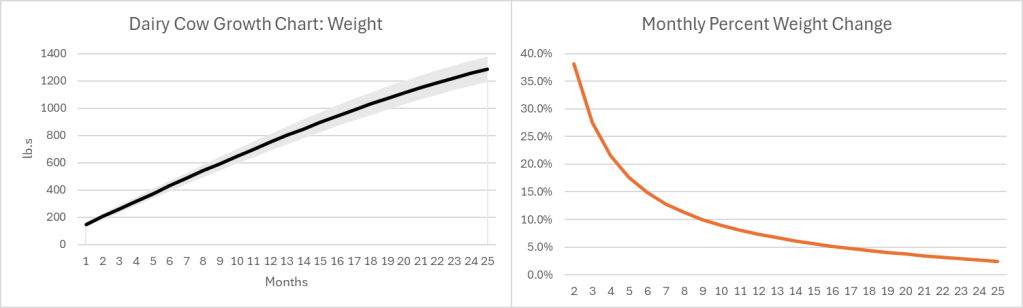
The growth pattern for most (all?) goods looks similar. Below-left is a growth chart for dairy cows . Notice that calves grow quickly at first, and their growth slows over time. For the sake of argument, let’s say that the change in value of a cow mimics the change in weight (Yes, I know that dairy and beef cows are different, but the principle is the same).  Below-right is the monthly percent change. Even at an age of 25 months a cow is still growing in value at 2.4% per month or 33% per year.

Of course, there is a risk that some cows don’t survive to slaughter, lowering the expected growth rate. Since most cattle are slaughtered between 18 and 24 months of age, their growth rate at the time of slaughter is 4.4%-2.7% per month. As the interest rate at which farmers borrow rises, the optimal age at slaughter falls. Otherwise, the spread between the growth rate and the interest rate could go negative. Even so, what an investment! If you can borrow at, say, 8% per year, then you’ll make money hand-over-fist on the spread.

Except… Cows cost money to raise, and most of that cost is feed. According to the production indicators and estimated returns published by the USDA, the cost of feed in February of 2023 was $158.11 per hundred pounds of beef. The selling price of beef was $161.07. That leaves $2.96 or a profit of 1.87% earned over the course of 1.5-1.75 years. That investment is starting to look a lot less good, especially since it doesn’t include the cost of maintaining facilities, insurance, etc. It’s no wonder that farmers and ranchers are serious about their subsidies. Clearly, with such tight margins, farmers and ranchers are going to look good and hard at the interest rates that they pay on their debt. And, they do have debt.

However, the recent increase in beef prices is not caused by higher interest rates.

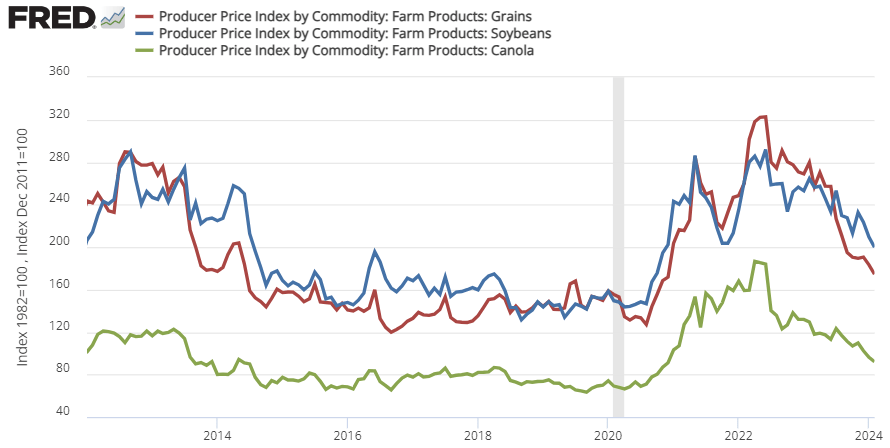
That 1.87% profit margin is at prices and costs from February 2023. Since 2020, the price of cattle feed ingredients (grain, bean, and oil) peaked in the summer of 2022 and are still substantially more expensive than pre-Covid (see below). That means that cows getting slaughtered right now were raised on more expensive feed. This February 2024, the cost of feed per 100lb. of cattle was $191.80. But the cattle selling price was only $180.75. That’s a $11.05 loss for cattle raising. Wholesale prices of cattle might be up recently, but the cost of feed is up by more. It’s not the cattle farmers who are benefiting from the high beef prices. In fact, they’re getting squeezed hard.

There is good news. The cost of feed ingredients has been falling recently, which means that beef farmers should begin to see some relief if the recent trend continues. For Consumers, the price of beef is already down from its 2023 peak.

Business Development Companies: My Favorite Class of High Yield Investments

It is easy to find securities which pay over 10% yield. It is not so easy to find securities which pay over 10% yield AND which maintain their share price over time. Many funds, especially closed-end funds, follow the “melting ice cube model” – they pay high current yields by slowly liquidating the fund assets, since the generous distributions are not matched by actual money-making by the fund’s investments. Oh, and the fund managers charge a nice fee for slowly giving you back your money. The result is that over longish time periods (e.g. five years) the stock price and the dividends decline.

I have been burned numerous times by such “high yield traps” in my longtime exploration of high yielding securities. A glorious exception has been business development companies (BDCs). These companies operate much like banks, lending out money and collecting interest on those loans. They lend to smaller, shakier enterprises that cannot get loans from banks. BDCs get to charge these (desperate?) clients very high interest rates, often around 6-7% over SOFR, which is the replacement for the old LIBOR benchmark, and which is very close to the current Fed funds rate. So back when regular short-term rates were near zero, BDCs were charging around 6%, and now (with Fed funds at 5.3%) they lend out money at around 11%. BDC’s leverage up by about 1:1 by issuing bonds, which boosts net income; this cash inflow is offset by really big management fees. The net result for us equity shareholders is that BDCs are paying out around 10-12% per year in dividends. That varies, of course, from one BDC to the next.

(If you just look at the usual “Forward Yield” value in your brokerage account or Yahoo Finance, it might only show like 9% or so. The reason is that BDCs, in good times like now, often pay out significant “special” dividends, which supplement the regular dividends; but only the regular dividends show up in the standard yield reporting).

One of the largest and oldest BDCs is Ares Capital Corporation, ARCC. If you just look at share price, ARCC does not look too inspiring. In the past five years, its price is up only about 9%, which is way less that the S&P 500 standard fund SPY. (But at least it is not down, like the generic bond fund AGG).

But when you look at total returns, which includes reinvested dividends, ARCC actually beats out SPY (85.7 % vs. 83.9% total returns), which is a noteworthy feat. Another large BDC, HTGC (green line in the plot below) did even better, with roughly 1.8 times the yield of SPY:

The current yield of ARCC 9.3%. This is on the low side for BDCs; ARCC is regarded as very secure, and so its price gets bid up. The yield of HTGC is 10.6%, while relative newcomer TRIN is paying 14%.

Lending to small, sometimes starting-up companies sounds risky, but the risk is mitigated by being at the tip top of the company’s capital stack. The loans are typically secured first-lien, which means in event of bankruptcy, they would get paid off before anything else. If the client company goes totally belly-up, the recovery on these loans is historically about 80%. In practice, a good BDC will often work with the client to come to some arrangement where the recovery is close to 100%. (For unsecured bonds, recoveries in bankruptcy are about 40%, while preferred stockholders get a few crumbs like shares in the reorganized post-bankruptcy enterprise, and common shareholders get zip). If you invest in a small cap stock fund like the Russell 2000, you are owning common stock in some of the companies that BDCs lend to. As such, you are actually in a much riskier position than owning shares in a BDC. Just saying.

Sound interesting? My short list of BDC favorites includes ARCC, HTGC, TRIN, TSLX, and BXSL. For one-stop shopping there are funds which hold a basket of BDCs. BIZD is the venerable big gorilla in this category. It blindly holds the largest BDCs by market cap. A newer, much smaller ETF is PBDC, which uses active, hopefully smart management. Since inception about 18 months ago, PBDC has beat out BIZD by about 12% in total returns, which more than compensates for its higher management fees (0.75% for PBDC versus 0.4% for BIZD).

Disclaimer: As usual, nothing here represents advice to buy or sell any security.

A Contrarian View from Apollo: No Rate Cuts in 2024

The mainstream view for the last 18 months has been that Fed rates cuts are always right around the corner. Markets are acting like the cutting cycle has already begun.

Apollo Global Management is a well-regarded alternative investment firm. (Disclosure: I own some APO stock). Their Chief Economist, Torsten Sløk, recently published his outlook, which differs sharply from the mainstream view. He notes that by various measures, the economy is heating up (or at least staying hot), and inflation has started to creep back up, not down. In his words:

The market came into 2023 expecting a recession.

The market went into 2024 expecting six Fed cuts.

The reality is that the US economy is simply not slowing down, and the Fed pivot has provided a strong tailwind to growth since December.

As a result, the Fed will not cut rates this year, and rates are going to stay higher for longer.

How do we come to this conclusion?

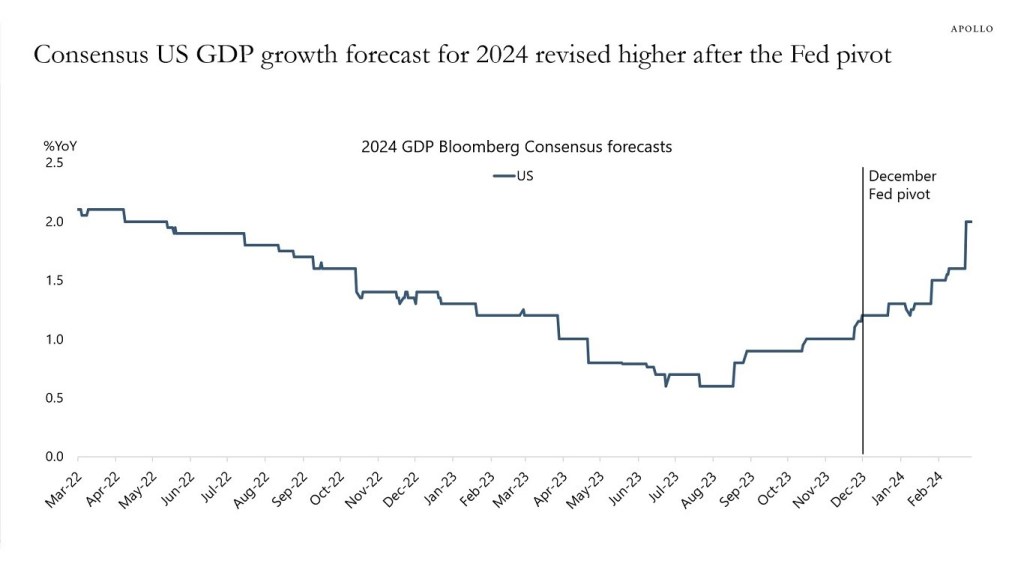
1) The economy is not slowing down, it is reaccelerating. Growth expectations for 2024 saw a big jump following the Fed pivot in December and the associated easing in financial conditions. Growth expectations for the US continue to be revised higher, see the first chart below.

2) Underlying measures of trend inflation are moving higher, see the second chart.

3) Supercore inflation, a measure of inflation preferred by Fed Chair Powell, is trending higher, see the third chart.

4) Following the Fed pivot in December, the labor market remains tight, jobless claims are very low, and wage inflation is sticky between 4% and 5%, see the fourth chart.

5) Surveys of small businesses show that more small businesses are planning to raise selling prices, see the fifth chart.

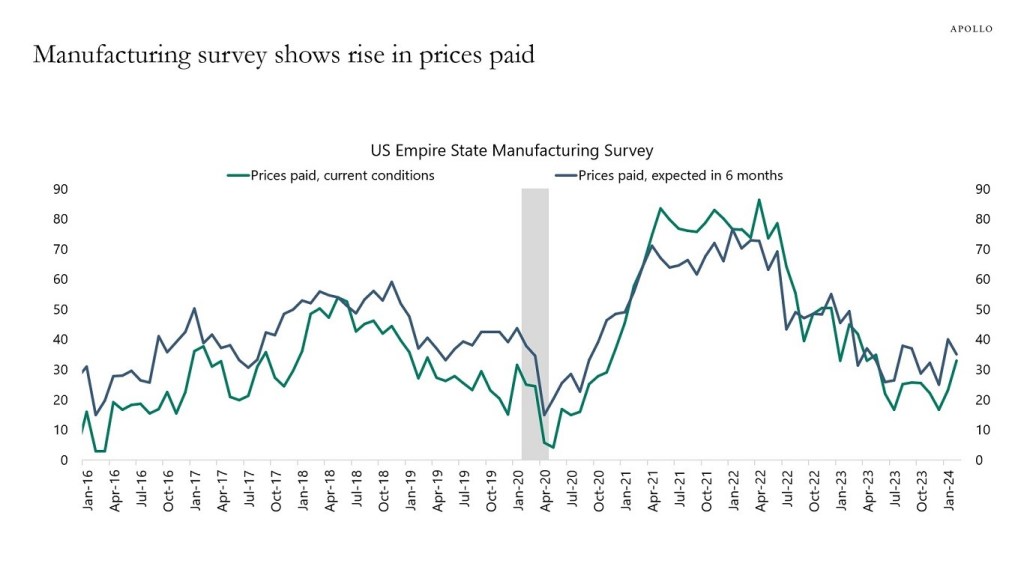
6) Manufacturing surveys show a higher trend in prices paid, another leading indicator of inflation, see the sixth chart.

7) ISM services prices paid is also trending higher, see the seventh chart.

8) Surveys of small businesses show that more small businesses are planning to raise worker compensation, see the eighth chart.

9) Asking rents are rising, and more cities are seeing rising rents, and home prices are rising, see the ninth, tenth, and eleventh charts.

10) Financial conditions continue to ease following the Fed pivot in December with record-high IG issuance, high HY issuance, IPO activity rising, M&A activity rising, and tight credit spreads and the stock market reaching new all-time highs. With financial conditions easing significantly, it is not surprising that we saw strong nonfarm payrolls and inflation in January, and we should expect the strength to continue, see the twelfth chart.

The bottom line is that the Fed will spend most of 2024 fighting inflation. As a result, yield levels in fixed income will stay high.

[END OF EXCERPT]

The big question, of course, is whether these recent signs of increased inflation are just blips of  noise, or the start of a new trend. Time will tell if Sløk’s contrarian view is correct, but I have to respect his intestinal fortitude in putting it right  out there, without any weaselly qualifications. He refers to many charts which are in his original article. I will reproduce four of these charts below:

The Best Personal Finance Books

Last week Scott offered a very negative review of one popular personal finance book, Rich Dad Poor Dad. My own take on the book is less negative, but I still wouldn’t recommend it to most people. That still leaves the question of which personal finance books are worthwhile. I gave my answer back in 2020 in a post on my personal blog. You can read the full reviews there, but I’ll give my short answers here:

I Will Teach You to Be Rich

Despite the title, the book is really about the basics of how to get out of debt, save for retirement, and manage credit. The material is stuff most people will figure out on their own by their 30’s or 40’s, but it’s a nice presentation all in one place and can save people from learning lessons the hard way. Perfect for a college student, someone at their first real job, or someone older who feels like they missed the memo on how all this works. His big idea is that once you set and meet good savings goals, you don’t need to feel guilty about the things you do spend money on.

The Millionaire Next Door

This book is built around surveying millionaires and finding the commonalities in what they did to get wealthy. The core idea is that Americans with millions saved tend to have moderately high incomes but very high savings rates. Even someone with a normal income can become a millionaire- income is different from wealth. The key is to live frugally and let the compound returns on your savings work for you. The original version of the book is inspiring, but has out of date numbers; the author’s daughter recently updated it (The Next Millionaire Next Door) with more current numbers.

There are many more books about how to invest, but for broad takes on personal finance overall these are the best two I have found, and the ones I recommend to students. Still interested to hear your thoughts on more recommendations.

Stock Options Tutorial 3. Selling Options to Generate Extra Income

In the first installment of this series on stock options, I focused on buying options, as a means to economically participate in the movement of a stock price up or down. If you guess correctly that say Apple stock will go up by 10% in the next two months, you can make much more money with less capital at risk by buying a call option than by buying Apple stock itself. Or if you guess correctly that Apple stock will go down by 10% in the next two months, you can make more money, with less risk, by buying a put option on Apple, then by selling the stock short.

In part two of the series, I discussed how options are priced, noting the difference between intrinsic value, and the time-dependent extrinsic value.

Here in part three, I will discuss the merits of selling, rather than buying options. This is the way I usually employ them, and this is what I would suggest to others who want to dip their toes in this pond.

Just to revisit a point made in the first article, I see two distinct approaches to trading options. Professional option traders typically make hundreds of smallish trades a year, with the expectation that most of them will lose some money, but that some will make big money. A key to success here is limiting the size of the losses on your losing trades. It helps to have nerves of steel. Some people have the temperament to enjoy this process, but I do not.

Selling Out of the Money Calls

Instead if spending my days hunched over a screen managing lots of trades, I would rather set up a few trades which may run over the course of 6 to 12 months, where I am fairly OK with any possible outcome from the trades. A typical example is if I bought a stock at say $100 a share, and it has gone up to $110 a share, and I will be OK with getting $120 a share for it; in this case I might sell a six-month call option on it for five dollars, at a strike price of $115. The strike price here is $5 “out of the money”, i.e., $5 above the current market price.

There are basically two possible outcomes here. If the price of the stock goes above $115, the person who bought the call option will likely exercise it and force me to sell him or her the stock for a price of $115. Between that, and the five dollars I got for selling the option period, I will have my total take of $120.

On the other hand, if the stock price languishes below $115, I will get to keep the stock, plus the five dollars I got for selling the option. That is not a ton of money, but it is 4.3% of $115. If at the end of the first six-month period I turned around and sold another, similar six-month call option which had the same outcome, now I have squeezed an 8.6% income out of holding the stock. If the stock itself pays say a 4% dividend, now I am making 12.6% a year. Considering the broader stock market only goes up an average of around 10% a year, this is pretty good money.

At this point, you should be asking yourself, if making money selling options is so easy, I have I heard of this before? What’s the catch?

The big catch is that by selling this call, I have forfeited the chance to participate in any further upside of the stock price, beyond my $120 ($155 + $5). If at the end of six months, the stock has soared to $140 a share, but I must sell it for a net take of $120, I am relatively worse off by selling the call. I have still made some money ($20) versus my original purchase price. However, if I had simply held the stock without selling a call option, I would have been ahead by $40 instead of $20. And now if I want to stay in the game with this stock, I have to turn around and buy it back for $140. This decision can involve irksome soul-searching and regrets.

There are two techniques are used to reduce these potential regrets. One is to only sell calls on say half of my holdings of a particular stock. That way, if the stock rockets up, I have the consolation of making the full profit on half my shares.


The other technique is to try to identify stocks that trade in a range. For instance, the price of oil tends to load up and down between about seven day and $90 a barrel, barring some geopolitical upset. and the price of major oil companies, like Chevron or ExxonMobil, likewise trade up and down within a certain range. If you sell calls on these companies when they are near the top of their range, it is less likely that the share price will exceed the strike price of your option. Or, if it does, and you have to sell your shares, there is a good chance that if you just wait a few months, you will be able to buy them back cheaper. On the other hand, a stock like Microsoft tends to just go up and up and up, so it would not be a good target for selling calls.

Some Personal Examples

From memory, I will recount two cases from my own trading, with the two different outcomes noted above. ExxonMobil stock has been largely priced between $95 and $115 per share, depending mainly on the price of oil. In early 2024, with the price of XOM around 117, I sold a call contract with a strike price of 120 and an expiration date in January, 2024. I think I got around $9 per share for selling this option. The next twelve months went by, and the price of XOM never got above 120, so nobody exercised this call contract against me, and so I simply kept the $9, and kept my XOM shares. Since each contract covers 100 shares, I pocketed $9 x 100= $900 from this exercise, covering 100 shares (approx. $12,000 worth) of XOM stock.

That was the good, here is a not so good: I bought some ARES (Ares Management Corporation) around February 2023 for (I think) around $80/share. For the next few months, the price wobbled between $75 and $90, while the broader S&P 500 stock index (lead by the big tech stocks) was rising smartly. I lost faith in ARES as a growth stock, but decided to at least squeeze some income out of it by selling a call option for about $10 at a strike price of $110 and a distant expiration of Dec 2024.

What then happened is ARES has taken off like a rocket, sitting today at $132/share. If it keeps up like this, it may be well over $150 by December, 2024. I will likely have to sell my 100 shares for $110 (the strike price), so I will get a total of $110 + $10 = $120 for my shares. That is far less than the current market value of these shares. I am not crying, though, since I have some more ARES shares that I did not sell calls on. Also, getting $120 for the shares I bought for $80 is OK with me. There is a saying on Wall Street about being too greedy, “Bulls make money, bears make money, pigs get slaughtered.”

Selling Puts

Briefly, selling out-of-the money puts is like selling calls, on the buy-side instead of the sell-side. It is a way to generate a little income, while garnering an advantageous purchase price, if things go as hoped. In my ARES example above, suppose my 100 shares get called away from me, when the market price is $150. I have various choices at that point. I could simply by a fresh 100 shares at $150, or I could get onto other investments. Or, if I were not happy about paying $150, I might sell a $140 put for say $6 per share. I would have to be OK with either of two outcomes: (1) either the price drops below $140 and the buyer of my put option forces me to buy it at $140 (in which case I need to have $140 x 100= $14,000 in cash available) , though net the stock will only cost me $140 – $6 = $134 ; or (2) the price stays above $140 and I simply pocket the $6 option premium.  And I have to be willing to live with the regret if ARES goes on to $180, in which case it would have been better to have simply bought shares at $150 instead of dinking around with options.

So, there is no one-size-fits-all approach. Again, I prefer to sell puts on companies that more trade in a range. For instance, gold tends to meander up and down – I have thought about it, but never got around to selling puts on gold companies at lows, and calls when they are high.

In Summary

I find judicious selling of calls and puts is a fairly tame way to make a little extra income on stocks. Also, it forces me to set some price targets for buying and selling. I have horrible selling discipline otherwise – I have a hard time making up my mind to buy a stock, but once I do, and once it goes up, I fall in love with it and don’t want to sell it (partly because lazy me doesn’t want to do the work to find a substitute). Selling calls is one way to force myself to set “OK” price targets for letting a stock go.

All that said, selling calls does forfeit participation in the full upside of a stock, and is probably not a good approach in general for growth-oriented tech stocks. Likewise, selling puts, instead of outright buying a stock, may lead to regrets if the stock price goes way up and gets away from you.

As usual, this discussion does not constitute advice to buy or sell any security.