Follow the Money in Politics

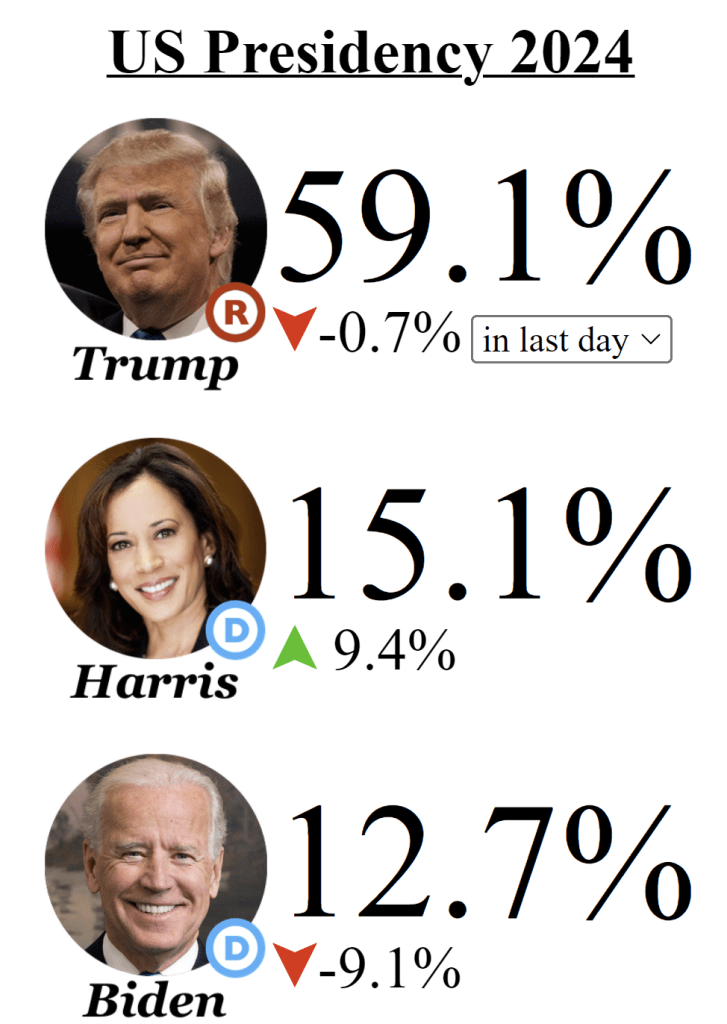
As we enter election season, I can sympathize with those that want to ignore it as much as possible. But if you do want to follow it closely, here is my advice: talk is cheap, so follow the money.

And by money, I am not referring to campaign contributions. I mean prediction markets, where people are putting their money where their mouth is, rather than just making predictions based on their own intuition (or their own “model,” which is just a fancy intuition).

There are a number of betting markets online today, but a good aggregator of them is Election Betting Odds.

For example, here is their current prediction for which party will win the Presidency:

Continue reading

OpenAI, IZA, and The Limits of Formal Power

Companies and non-profit organizations tend to be managed day-to-day by a CEO, but are officially run by a board with the legal power to replace the CEO and make all manner of changes to the company. But last week saw two striking demonstrations that corporate boards’ actual power can be much weaker than it is on paper.

The big headlines, as well as our coverage, focused on the bizarre episode where OpenAI, the one of the hottest companies (technically, non-profits) of the year, fired their CEO Sam Altman. They said it was because he was not “consistently candid with the board”, but refused to elaborate on what they meant by this; they said a few things it was not but still not what really motivated them.

Technically it is their call and they don’t have to convince anyone else, but in practice their workers and other partners can all walk away if they dislike the board’s decisions enough, leaving the board in charge of an empty shell. This was starting to happen, with the vast majority of workers threatening to walk out if the board didn’t reverse their decision, and their partner Microsoft ready to poach Sam Altman and anyone else who left.

After burning through two interim CEOs who lasted two days each, the board brought back ousted CEO Sam Altman. Formally, the big change was board member Ilya Sutskever switching sides, but the blowback was enough to get several board members to resign and agree to being replaced by new members more favored by the workers (including, oddly, economist Larry Summers).

A similar story played out at IZA last week, though it mostly went under the radar outside of economics circles. IZA (aka the Institute for Labor Economics) is a German non-profit that runs the world’s largest organization of labor economists. While they have a few dozen direct employees, what makes them stand out is their network of affiliated researchers around the world, which I had hoped to join someday:

Our global research network ist the largest in labor economics. It consists of more than 2,000 experienced Research Fellows und young Research Affiliates from more than 450 research institutions in the field.

But as with OpenAI, the IZA board decided to get rid of their well-liked CEO. Here at least some of their reasons were clear: they lost their major funding source and so decided to merge IZA with another German research institute, briq. Their big misstep was choosing for the combined entity to be run by the the much-disliked head of the smaller, newer merger partner briq (Armin Falk), instead of the well-liked head of the larger partner IZA (Simon Jaeger). Like with OpenAI, hundreds of members of the organization (though in this case external affiliates not employees, and not a majority) threatened to quit if the board went through with their decision. Like with OpenAI, this informal power won out as Armin Falk backed off of his plan to become IZA CEO.

Each story has many important details I won’t go into, and many potential lessons. But I see three common lessons between them. First is the limits to formal power; the board rules the company, but a company is nothing without its people, and they can leave if they dislike the board enough. Second, and following directly from this, is that having a good board is important. Finally, workers can organize very rapidly in the internet age. At OpenAI nearly all its employees signed onto the resignation threat within two days, because the organizers could simply email everyone a Google Doc with the letter. Organizers of the IZA letter were able to get hundreds of affiliates to sign on the same way despite the affiliates being scattered all across the world. In both cases there was no formal union threatening a strike; it was the simple but powerful use of informal power: the voice and threatened exit of the people, organized and amplified through the internet.

Poland’s Electoral Catalyst

The latest Global Valuation update this week shows that Poland (along with Colombia) has some of the world’s cheapest stocks. Their overall Price to Earnings ratio is 8, compared to 28 for the US:

Does this mean Polish stocks are a good deal, or that investors are rationally discounting them as being risky or slow-growing? After all, they had a low P/E ratio last time I wrote about them too.

Stocks can rise either based on higher investor expectations (higher P/Es) or improved fundamentals (earnings rise, investors see this and bid up the price, but only enough to keep the P/E ratio roughly constant). Over the past year Polish stocks have done the latter; I bought EPOL (the only ETF I know of that focuses Poland) a year ago because its P/E was about 6. Since then its up 70% and the P/E is still… about 6.

Why haven’t investors been excited enough about this earnings growth to bid up the valuation? I think the biggest concern has been political risk, given that the ruling Law and Justice party has been alienating the EU and arguably undermining the rule of law and finding pretexts to arrest businessmen critical of the government.

The recent Polish election promises to change all this. A coalition of ‘centrist’ opposition parties won enough votes to oust the current government, and Washington, the EU, and business seem relieved:

As Europe’s sixth-largest economy, a revitalised pro-EU attitude in Poland would be particularly welcome.

“It will be a positive development for sure because it will unlock the (EU) money that has been withheld and reduce a lot of the tension that has been created with Brussels,” said Daniel Moreno, head of emerging markets debt at investment firm Mirabaud.

Some 110 billion euros ($116 billion) earmarked for Poland from the EU’s long-term budget and the post-pandemic Recovery and Resilience Facility (RRF) remain frozen due to PiS’ record of undercutting liberal democratic rules.

The case for optimism is an influx of EU funds, less risk for business, and an appetite for higher valuations among Western investors who no longer dislike the government.

Being an economist I also have to give you the “other hand”, the case for pessimism: the new government hasn’t actually formed yet, meaning the current one still has the chance for shenanigans; population growth has been strong recently with the influx of Ukrainian refugees, but it is likely to go negative again soon; and EPOL is almost half financial services, which have relatively low P/E even in the US right now.

Nothing is guaranteed but this is my favorite bet right now. I find it amusing that this “risky” emerging market has had a great year while “safe” US Treasury bonds are having a record drawdown (easy to be amused when I don’t own any long bonds and they have done surprisingly little damage in terms of blowing up financial institutions so far). I emphasize the investing angle here but hopefully this signals a bright future for the Polish people.

Disclaimers: Not investment advice, I’m talking my book (long EPOL), I’ve never been to Poland and I’m judging their politics based on Western media reports

The Inner Ring and Barbie and Academia

C.S. Lewis is known as a novelist, but he was an academic familiar with university politics. In 1944, he gave a lectured called “The Inner Ring” about how everyone wants to be accepted into an “inner ring” of friends or colleagues. Being on the fringes of a group can be a source of misery.

My main purpose in this address is simply to convince you that this desire is one of the great permanent mainsprings of human action. It is one of the factors which go to make up the world as we know it—this whole pell-mell of struggle, competition, confusion, graft, disappointment… Unless you take measures to prevent it, this desire is going to be one of the chief motives of your life, from the first day on which you enter your profession…

To a young person, just entering on adult life, the world seems full of “insides,” full of delightful intimacies and confidentialities, and he desires to enter them. But if he follows that desire he will reach no “inside” that is worth reaching.

I’ll list the items that got me thinking about “the inner ring”.

This week, Alex posted on Misandry. Are men starting to feel like it is actually the women who are in the inner ring and men are on the outside?

I’ll share a story in which I felt like I was not in the inner ring. Before I had a job, I was at a professional conference. A colleague invited me to go out with him and some guys to a cigar shop that evening. “Yes!” I said at first, because this sounded both fun and good for my career. Then I remembered that I was three months pregnant. Smoking would damage the baby’s health, so I awkwardly backed out of the event. Of course, this is not a big deal in retrospect, but it’s the kind of thing that can bother you if you obsess over the rings you can’t join.

Women have long felt like they were on the outside of the boy’s club. “Is everyone smoking cigars without me?” The second item in reverse chronological order is the Barbie movie. In the movie, the top-floor meeting room of male executives at the L.A. Mattel office represents the male inner ring. The cul-de-sac of pink dream houses in Barbieland represents the female inner ring. Every character in the movie feels left out of a ring. In the article I was pointed to by Alex, John Tierney writes, “Smug misandry has been box-office gold for Barbie, which delights in writing off men as hapless romantic partners, leering jerks, violent buffoons, and dimwitted tyrants who ought to let women run the world.”

Several posts by my excellent co-bloggers are related to being left out of opportunities for networking or funding. Click through if you want to learn more about the NBER, the dark side, or grants.

The National Bureau of Economic Research (NBER) sent out its membership invitations this week. My twitter timeline quickly filled with explicit congratulations and oblique commentary. My private messages filled with…less than oblique commentary. Academia has always been hierarchical and economics has never been an exception.

Let’s Talk about the NBER, Mike

In my early days, I innocently asked a researcher what the letters N.B.E.R. stood for. He remarked that it was a “money laundering scheme run out of Boston.” I essentially took him literally, because I didn’t know any better, at the time. It is easy to tell that he was never invited to be a member, else he would have described it positively.

The bureaucratic and scholarly gamesmanship that can hold back one paper and elevate another. Every story your paranoid lizard brain can dream up explaining why a node in the tournament decision tree turned against you and in another’s favor.

On EJMR, status competitions, and tapeworms, Mike

I may have lost count but I’m pretty sure this was the 13th “true grant” I have applied for, and the 1st I will actually receive.

13th Time’s A Charm: Finally Grant Funded, James

It’s always nice, rhetorically speaking, to end on a positive note. That’s what Lewis did in his lecture. He said that there is a form of human association that is rewarding and virtuous: true friendship. Have a good weekend, friends.

Everyone Happy? Student Loan Repayment

I like a good lump sum tax. People *must* pay the tax without exception and the advantage over current progressive marginal income taxes is that the marginal wage received doesn’t fall with greater earnings. Employment rises and output rises. To the extent that college students fail to understand their student loans, the indebted graduates essentially pay a lump sum tax each period.

Of course, the exception is income based repayment (IBR) – especially with forgiveness after X years. IBR adjusts the incentives substantially. Under the standard system, your wages are garnished if you fail to make loan payments. Under IBR, lower earnings trigger lower monthly payments. Clearly, in contrast to the standard method, IBR incentivizes more leisure, less income, more black market activity, and higher loan balances. Indeed, all the more so if there is a forgiveness horizon. Someone just has to have low enough income for say 15 years, and their past debt is forgiven (with caveats & conditions).

My principal objection to IBR policy is the resulting malinvestment in human capital. Defaulting on loans is a sign that some investment was inadequately productive to repay the resources consumed by its endeavor. We call that a loss. Real resources of time, attention, and goods and services were consumed in order to produce capital that failed to serve others more than the opportunity cost of those resources.

Continue reading

What Should a Businessman Be Willing to Die For?

The late Dallas Willard, a professor at USC, wrote on a variety of subjects touching on moral philosophy. In 2006 he addressed the topic, “The Business of Business”. He noted that the spontaneous, obvious answer today to the question, “What is business (manufacturing, commerce) for?”  would be: “The business of business is to make money for those who are engaged in it.”

But there is a tension here. Willard notes that that is NOT how businessmen/professionals present their raison d’etre : 

“No business or other profession that advertises its ‘services’ announces to the public that it is there for the purpose of enriching itself or those involved in it. With one accord they all say their purpose is service, not serve-us. I have never met “professionals” who would tell their clients that they were there just for their own self-interest.”

This ambiguity in the role of businessmen/women (or “merchants”, as they used to be called) is not new. Willard reaches back to the writings of John Ruskin who remarked in 1860, “The fact is that people never have had clearly explained to them the true functions of a merchant with respect to other people.” Ruskin went on to place what we today call “business” among the  “Five great intellectual professions” necessary to the life of “every civilized nation.” With respect to the nation:

“The Soldier’s profession is to defend it.

The Pastor’s to teach it.

The Physician’s, to keep it in health.

The Lawyer’s to enforce justice in it

The Merchant’s to provide for it.”

Ruskin added: “And the duty of all these men is, on due occasion, to die for it.” The soldier to die “rather than leave his post in battle,” the physician “rather than leave his post in plague,” the pastor “rather than teach falsehood,” the lawyer “rather than countenance injustice.” (Indeed!)

But what of the merchant? What is it that the merchant (businessman) would die for rather than do?

Well, the main function of the merchant or manufacturer in Ruskin’s view is to provide for the community, not simply make money for him/herself:

It is no more his function to get profit for himself out of that provision than it is a clergyman’s function to get his stipend. The stipend is a due and necessary adjunct, but not the object of his life, if he be a true clergyman, any more than his fee (or honorarium) is the object of life to a true physician. Neither is his fee the object of life to a true merchant. All three, if true men, have a work to be done irrespective of fee…. That is to say, he has to understand to their very root the qualities of the thing he deals in, and the means of obtaining or producing it; and he has to apply all his sagacity and energy to the producing or obtaining it in perfect state, and distributing it at the cheapest possible price where it is most needed.

Ruskin also noted that since the merchant has direct control over those who work for him, “…it becomes his duty, not only to be always considering how to produce what he sells in the purest and cheapest forms, but how to make the various employments involved in the production or transference of it most beneficial to the men employed.”

Furthermore, if the enterprise falls on hard times, it is the duty of the CEO (or other top management) to share fully in the hardships suffered by the other employees: “As the captain of a ship is duty-bound to be the last to leave the ship in disaster,…so the manufacturer, in any commercial crisis or distress, is bound to take the suffering of it with his men, and even to take more of it for himself than he allows his men to feel; as a father would in a famine, shipwreck, or battle, sacrifice himself for his son.”

In a similar vein, activist lawyer and later Supreme Court Justice Louis Brandeis in 1912 said at a Brown University commencement address:

The recognized professions…definitely reject the size of financial return as the measure of success. They select as their test, excellence of performance in the broadest sense—and include, among other things, advance in particular occupation and service to the community. These are the basis of all worthy reputations in the recognized professions. In them a large income is the ordinary incident of success; but he who exaggerates the value of the incident is apt to fail of real success…In the field of modern business, so rich in opportunity for the exercise of man’s finest and most varied mental faculties and moral qualities, mere money-making cannot be regarded as the legitimate end.    

Willard drily remarked, “Texts by Ruskin and by Brandeis, along with similar ones, are not popular references in our schools of business today.” My own personal observations are that the nobility of the management and entrepreneurs seems to scale somewhat inversely with the size and age of the enterprise. It gets tricky to start assessing degrees of moral rectitude here, because in classical exchange theory, any voluntary transaction (buying/selling goods, agreement to work for certain wages) brings benefits to both parties, and to society as a whole, quite apart from any conscious intent of altruism.

At large end of the scale, we see CEOs who drive big companies into the ground and then waltz away with multimillion dollar golden parachutes; no sharing of the employees’ hardships at all.

And for many Wall Street dealmakers, it truly is all about the money: float a couple billions in junk bonds, take control of some company, force the company to pay you fees, load the company with your crappy debt, and walk away with a cool billion or so. Or take a short position in a publicly traded company, publish a bogus report (“short attack”) alleging horrible malfeasance at the company, driving share prices down, close out your short position at a huge profit, and move on to the next victim. These seem to be purely predatory actions, taking advantage of the system to make a buck with no clear redeeming social value.

At the other end of the scale, the (often youngish) folks starting a new software firm, the  idealistic couple chucking fast city life to try to make a go of a coffee house or BnB in a small town, the plumber with an associate, all of these I think are very serious about providing the public with a good product/service, and may tend to take care of their employees and also to put a lot of their own personal skin (savings, a lot of extra time) in the game to get these enterprises going. The younger Henry Ford famously fought to pay his employees high wages, over the objections of company shareholders, who wanted more profits to accrue to them. I know personally two men in the greater Trenton, NJ area who (as an expression of their religious values)  intentionally conduct computer-related businesses such that they can provide employment to disadvantaged local young men.

Maybe when an enterprise gets large enough that, to management, its employees and its customers become numbers rather than individual people is the point where the transition to pure greed as the fundamental motive occurs, even if it proves prudent in support of profits to maintain policies and communications which promote the welfare of customers and employees.

South Carolina Repeals Certificate of Need

Last week South Carolina Governor McMaster signed a bill repealing almost all Certificate of Need (CON) laws in the state. If you want to open or expand a health care facility in South Carolina, you can now do so faster, cheaper, and with more certainty.

This is a bigger deal than West Virginia’s reform earlier this year because it applies to almost all types of facilities, and applies to both new facilities and expansions of existing facilities. Only two parts of the CON system remain: a 3-year sunset where hospitals still need special permission to add beds, and a permanent restriction on nursing homes (why? see my recent post on why states hate nursing homes).

As is often the case, this reform took years to enact. I wrote last year about a repeal bill passing the SC Senate; it didn’t make it through the House then, but did this time. As I said then:

This seems like good news; here at EWED we’ve previously written about some of the costs of CON. I’ve written several academic papers measuring the effects of CON, finding for instance that it leads to higher health care spending. I aimed to summarize the academic literature on CON in an accessible way in this article focused on CON in North Carolina.

CON makes for strange bedfellows. Generally the main supporter of CON is the state hospital association, while the laws are opposed by economistslibertariansFederal antitrust regulatorsdoctors trying to grow their practices, and most normal people who actually know they exist. CON has persisted in most states because the hospitals are especially powerful in state politics and because CON is a bigger issue for them than for most groups that oppose it. But whenever the issue becomes salient, the widespread desire for change has a real chance to overcome one special interest group fighting for the status quo. Covid may have provided that spark, as people saw full hospitals and wondered why state governments were making it harder to add hospital beds.

Why did reform succeed this time in South Carolina? From where I sit in Rhode Island I can only guess, but here are my guesses. First, the reform side really had their stuff together. See this nice page from SC think tank Palmetto Promise on why to repeal CON, and this paper from Matt Mitchell that does a comprehensive review of the literature on CON and explains what it means for South Carolina. Legislative supporters like Senator Wes Climer just kept pushing.

Second, the biggest opponent of CON reform is usually the state hospital association, but in this case they did not formally oppose repeal. Why not? Here I’m really speculating, but in general it has been faster-growing states that repeal CON. Population growth makes it obvious that new facilities are needed, and it means that existing facilities are thinking about how to grow to take advantage of new opportunities, rather than thinking about lobbying to maintain their share of a static or shrinking pie. You can see some hospital CEOs say they don’t mind repeal in this article (where I’m also quoted). South Carolina has been growing at a decent clip, as is Florida, which also almost-entirely repealed CON in 2019. On this theory, the next big CON reform would happen in a fast-growing CON state like Montana, Delaware, North Carolina, Georgia, or Tennessee. If I had to pick one, I’d say North Carolina.

Update: Apparently Montana already repealed all non-nursing home CON in 2021 and I missed it!

The End of Erdogan? Forecasting the Turkish Election

Predicting elections is hard. Poll aggregators and prediction markets can help. Many of the usual suspects like FiveThiryEight and PredictIt aren’t covering Sunday’s election in Turkey, partly due to their own issues, and partly because US organizations often ignore foreign elections. But we do have several good predictors to consider, and they all list opposition candidate Kiliçdaroglu as a slight favorite.

Polymarket is most optimistic for the opposition, giving them a 67% chance. British betting site Smarkets gives them a 61% chance. Play-money site Manifold Markets gives them 56%. Finally, no-money prediction site Metaculus gives a 60% chance that the opposition wins, and a 79% chance that Erdogan leaves office if he loses the election. I’m not sure how the count the Swift Centre, a small closed panel of forecasters, but they are the exception in seeing Erdogan as a slight favorite.

My economist’s instinct is to trust the real-money markets more here, although Manifold and Metaculus outperformed them in the 2022 US midterms. The usual bias is to predict a win for the candidate you like more (which for Westerners on these markets means betting against Erdogan), and have real money on the line can help counteract this. On the other hand, some might use betting markets as a hedge and bet on the outcome they don’t want. In this case the betting markets are slightly more favorable to the opposition, but the gap is small.

Of course, the biggest real-money markets are those that don’t ask directly about the election: the markets for Turkish stocks and bonds. These have generally performed well in the past year as the opposition’s chances have risen, which may indicate that markets think a new Prime Minister with more conventional economic views will get inflation under control.

Highlights from #EconTwitterIRL

Last weekend fellow Temple University economics PhD Adam Ozimek hosted the inaugural #EconTwitterIRL conference. He managed to get 100+ people, including many big names, to come to his bowling alley / arcade in Lancaster, PA.

The overall demographic of Econ Twitter people appears to be youngish professionals, mostly male, surprisingly social and normal-looking (surprising to me because I retain the ’90s-era stereotype that people who write a lot online are nerds who don’t want to talk to anyone IRL).

Adam opened with a history of EconTwitter, which to him is not just about Twitter, but is anywhere where communities of people write about economics online. This starts with the comment sections of the earliest blogs, like Brad DeLong’s, in the early 2000’s. Then in the late 2000’s many commenters start their own blogs, like Karl Smith at Modeled Behavior. In the 2010’s Econ Twitter comes into its own. It may persist or a new forum might take over, but either way the discussion and community will live on.

While it was cool to see a live recording of Odd Lots, and a panel on innovation with MacArthur Genius Heidi Williams, my favorite panel was the one on immigration, because it saw the most serious disagreement. Garett Jones and Daniel Di Martino argued for reforms to the immigration system that would move it away from a focus on family reunification and toward a focus on skills and other indications (like country of origin) that immigrants would benefit the US economy. In contrast, Leah Boustan argued that the current system has worked well, including for assimilation and economic growth, and we should be wary of making big changes to it. Moderator Cardiff Garcia pointed out the oddity of the economists from George Mason and the Manhattan Institute arguing for a “socialist” system where the government determines what the economy needs when it comes to immigration, while the Princeton economist argues against. Garett Jones noted that the rest of his department at Mason disagree with him, but he’s glad to have the freedom to disagree.

While the panel saw intense disagreement about what the ideal system looks like, all panelists shared a frustration with parts of the current system that seem to pointlessly slow or prevent high-skill immigration. Some of this is bureaucracy slowing the process for immigrants who are legally allowed already. Some is politicians refusing to make the smallest, simplest, most common-sense fixes unless they are part of a comprehensive immigration reform that hits their big priority. The big priorities differ by party, but the commitment to holding simple fixes hostage is bipartisan.

Hopefully discussions like this can start to change things. That might sound naive or idealistic, but on an earlier panel Matt Yglesias noted that we should be both impressed and slightly scared of how aware Capitol Hill staffers are about the opinions of Econ Twitter.

Source. Got 2nd at trivia as part of team Acemoglu et al (actual Acemoglu not included).

The magic of all this is that you never know what can come from a post. You might make a friend, make an enemy, get a job, lose a job, influence public policy, get a job in the White House… even make (or lose) a million dollars. So we keep poasting, and once in a while see the results IRL.

China To Squeeze West by Restricting Export of Essential Rare Earths

Rare earths are a set of 17 metals with properties which make them essential to a swathe of high-tech products. These products include lasers, LEDs, catalysts, batteries, medical devices, sensors, and above all, magnets. Rare earth magnets are used in electric motors and generators and vibrators, making them essential to electric cars, wind turbine generators, cell phones/tablets/computers, airplanes, phones, and all sorts of military devices. 

China happens to have large amounts of rare earth oxide ores for mining, relatively lax environmental standards, and a large, compliant workforce. The Chinese government has harnessed these resources to make the nation by far the largest producer of rare earths. Their massive, relatively low-cost production has suppressed production in other countries. This has been a conscious policy, to achieve global control over a vital raw material.

The first time China used this effective monopoly as a political weapon was in a maritime dispute with Japan in 2010. China cut off exports of rare earth metals to Japan for two years, crimping the Japanese electronics industry.  Other nations took note of this threat, and since then have been a number of half-hearted (in my opinion) efforts in various Western nations to develop some domestic capacity and to redesign motors to reduce dependence on rare earth materials.

 China’s share of rare earth ore mined is down to 60%, but they totally dominate processing the ore to metals, and subsequent fabrication of magnets from the metal.  Nearly all of the ore mined in the U.S. is shipped over to China for processing, mainly because of environmental regulations here.  

According to the Asia Times,

The PRC still dominates the entire vertical industry and can flood global markets with cheap material, as it has done before with steel and with solar panels. In 2022, it mined 58% of all rare earths elements, refined 89% of all raw ore, and manufactured 92% of rare earths-based components worldwide.

There is no other global industry so concentrated in the hands of the Chinese Communist Party, nor with such asymmetric downstream impact, as rare earths.

It seems the only way for the West to blunt the Chinese monopoly in rare earths is with large, long-term subsidies (since the Chinese can always undersell the rest of the world on a free market basis) and probably some pushing past environmental objections.

Alarmed by the rapid buildup of Chinese military forces (towards a possible invasion of Taiwan), the U.S. and its allies have begun restricting exports of the highest-power silicon chips to China. In retaliation, China has reportedly made plans to restrict exports of rare earths, starting in 2023. If they follow through, that move would crush fabrication of magnets and of magnet-dependent devices like motors and generators in other countries; the rest of the world would have to come crawling to China for all these items.

This move would in turn cause the rest of the world to accelerate its plans to produce rare earths outside China, but there would be several years of great disruption, and Chinese-made final devices like motors and generators would always have a huge price advantage, due to their cheaper raw material inputs.

I suspect there may be a high-stakes game of brinksmanship going on behind the scenes. The Chinese leadership presumably knows that they can only play this rare earth export ban card once, and the West does not really want to plow a lot of resources into producing large amounts of rare earths much more expensively than they can be bought from China. So maybe we will see some relaxation in chip export controls for China in exchange for them not pulling the final trigger on a rare earth export ban.

We live in interesting times.