Boutique Science

Science keeps getting bigger- more researchers, more funding, and of course more publications. Scientific progress is much harder to measure, but there are good arguments that it’s roughly flat over time. This implies that productivity per researcher is plummeting.

Source

There’s been a lively debate about what drives this falling productivity- is it that the easy discoveries got made first, leaving only harder ones for today’s scientists? Or is something else tanking scientific productivity, like the bureaucratic way we organize scientific research today?

A recent paper, “Slowed canonical progress in large fields of science“, suggests that the growth in the number of researchers and publications could itself be part of the problem. Comparing scientific fields over time, they find that:

When the number of papers published per year in a scientific field grows large, citations flow disproportionately to already well-cited papers; the list of most-cited papers ossifies; new papers are unlikely to ever become highly cited, and when they do, it is not through a gradual, cumulative process of attention gathering; and newly published papers become unlikely to disrupt existing work. These findings suggest that the progress of large scientific fields may be slowed, trapped in existing canon.

What is driving this? They argue:

First, when many papers are published within a short period of time, scholars are forced to resort to heuristics to make continued sense of the field. Rather than encountering and considering intriguing new ideas each on their own merits, cognitively overloaded reviewers and readers process new work only in relationship to existing exemplars. A novel idea that does not fit within extant schemas will be less likely to be published, read, or cited. Faced with this dynamic, authors are pushed to frame their work firmly in relationship to well-known papers, which serve as “intellectual badges” identifying how the new work is to be understood, and discouraged from working on too-novel ideas that cannot be easily related to existing canon. The probabilities of a breakthrough novel idea being produced, published, and widely read all decline, and indeed, the publication of each new paper adds disproportionately to the citations for the already most-cited papers.

Second, if the arrival rate of new ideas is too fast, competition among new ideas may prevent any of the new ideas from becoming known and accepted field wide.

Supposing they are correct, it’s not totally clear what to do. At the biggest level we could fund fewer researchers in large fields, or push more fields to be like economics, where the quality of each researcher’s publications is valued much more than the quantity. But what can an individual researcher do differently? One idea is “boutique science” or “hipster science”, trying to find the smallest or newest field you could reasonably attach yourself to.

Another idea is that the role of generalists and synthesizers is becoming more valuable, as Tyler Cowen often says and David Esptein applies to science in his book Range. When papers are coming out faster than anyone can read, we need more people to sift through them and explain which few are actually important and which are forgettable or wrong. There are lots of ways to do this- review articles, meta-analysis, replication at scale, and of course blogs. But the junk pile is going to keep growing, so we’ll need new and better ways of finding the hidden gems.

Thoughts for the week on podcasts and the Constitution

  1. Jamal Greene was the most recent guest on Conversations with Tyler. This is how Greene describes his work habits as an academic with children:

GREENE: … my most effective work habit is to use the entire day to work. I get a lot of work done late at night. Most of my time during the day is spent teaching classes or meeting with students, and all writing and reading and preparation and everything is much later. That means I don’t watch television shows. It’s a really extended workday.

I work during soccer practices. I work sitting in the car while my kids are doing something or other. I don’t segregate times of the day where I can’t work.

One thing I find personally is that if I’m doing empirical work then I really need to be inside with at least one external monitor. As much as I like the idea of working from the pool (referencing the viral video of the week) being at my office is the best set up.

2. Currently I am teaching an online asynchronous class. Considering that my students are on the move in different places right now, I decided to create a podcast assignment. This seems to have gone over well. One student had a criticism for the episode that she chose: it was not entertaining. Another student complained that his episode had too much fluff about the personal lives of the speakers. This raises the interesting question of how the experts manage to make podcasts informative without being boring. It’s an art. Talking about your personal life to break up the subject matter can work but it can also feel like a waste of time.

3. For a discussion group, I read The Essential Federalist and Anti-Federalist Papers.

Something that stood out to me was the sheer intensity of these guys. Liberty is a serious topic, but I’ll just share something that is funny from the book.

In the middle of a long fiery speech of Patrick Henry, the book inserts a line in brackets:

What will then become of you and your rights? Will not absolute despotism ensue? {Here Mr. Henry strongly and pathetically expatiated on the probability of the President’s enslaving Americans, and the horrible consequences that must result.}

A footnote explains that stenographer had difficulty keeping up with Mr. Henry and was occasionally reduced to recording a mere summary of his words. It’s impressive that a stenographer could have gotten as much as they did.

I came away from the book thinking that people should talk more about this moment in history, and then I started noticing when people do talk about it. In fact, Tyler was interviewing a constitutional scholar this week and explicitly addressed the idea of “federalism.”

4. The debate does rage on 200+ years later.

Continue reading

Human Capital is Socially Contingent

The Deaf community is interesting.

Before I did research, I thought that deaf people simply could not hear. After seeing the Spiderman episodes that featured Daredevil, I believed that it was plausible and likely that deaf people had some sort of cognitive or sensory compensatory skill.

But it wasn’t until recently that I learned of the Deaf Studies field. There is an entire field that’s dedicated to studying deaf people. It’s related to, but not the same as Disability Studies. In fact, there are some sharp divisions between the two fields.

Continue reading

Automation report from 1958

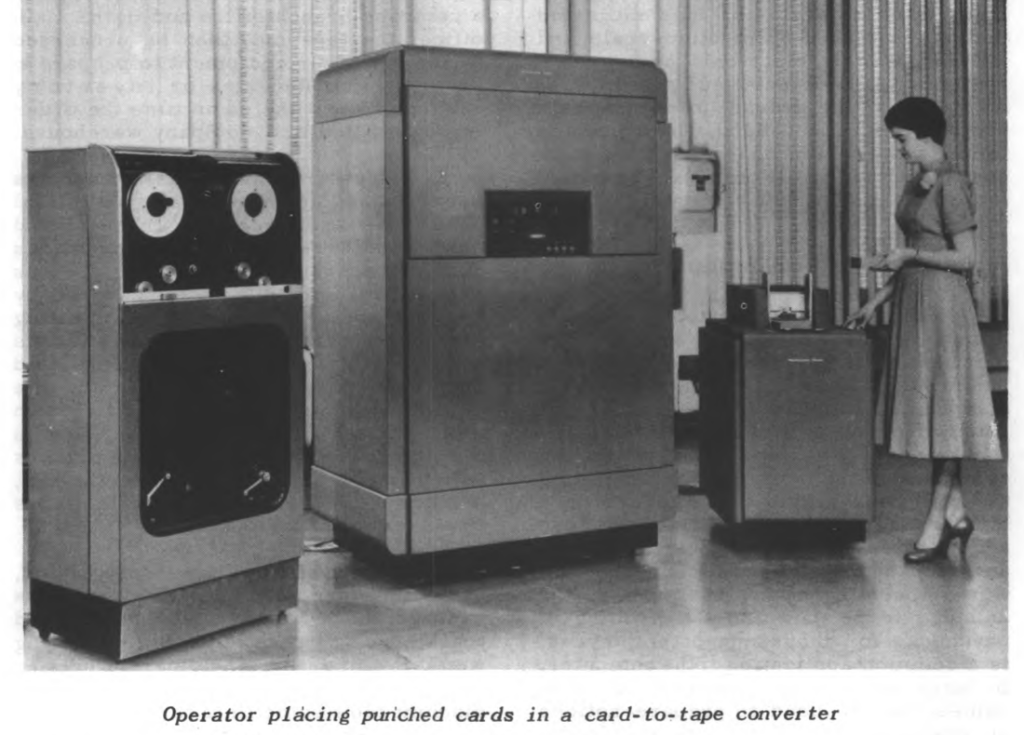
Courtesy of the St. Louis Fed, you can download a report published in 1958 titled “Automation and Employment Opportunities for Office-Workers: A Report on the Effect of Electronic Computers on Employment of Clerical Workers, with a Special Report on Programmers.”

I teach students about data and software to prepare them to enter the hot field of business analytics. It has been a growing field for a few years, especially since the advent of “Big Data”. Something I explain in class is how brand-new technology has changed business.

Reading this report forced me to re-think just how new data analytics is. The authors saw machines in use for data processing and correctly predicted that this would be a dynamic source of new jobs.

The introduction states that millions of “clerical workers” were employed in the United States. That fact would have been obvious at the time, but today we might not realize just how many humans would be needed to store and fetch the files we access regularly on our computers. The creation of clerical jobs was especially important for women.

https://fraser.stlouisfed.org/files/docs/publications/bls/bls_1241_1958.pdf

In view of the volume of work that needed to be done, installing new computers was economical. “A computer system can automatically do such jobs as prepare payrolls for thousands of employees, control inventory on a multitude of items…”

“Although computers are often described as machines that can “think,” that is, of course, not so. Like other machines, they must be operated or controlled by people… The people who prepare the instructions are called programmers.”

“Electronic computers were developed during World War II as an aid in solving intricate scientific and engineering problems such as gunfire control, but their application to the processing of office data is more recent. The Federal Government lead the way in 1951, when an electronic computer was installed by the Bureau of the Census…”

The authors see the primary role of computers in business as a way to automate the routine work that could be performed by clerks. Secondly, they state that computers can by used for solving complex math problems “such as those related to launching and tracking earth satellites.”

The report was created for young people who are considering their own choices for education and careers. The authors describe the programming but also various machine support roles. For example, the Coding Clerk’s job is to convert the programmers’ instructions into “machine language”.

The authors recognize that computers will replace some of the traditional clerk roles. “These developments will not only increase the output of clerical workers and slow down growth in clerical employment, but will also change the character of many jobs… Many of the new jobs … will generally pay better and require higher levels of skill and training than most other clerical jobs.” The next sentence is where the authors fail to predict PCs and the internet: “Moreover, a continued increase is expected in the number of officeworkers in jobs not greatly affected by office automation – for example, secretary, stenographer, messenger, receptionist, and others involving contacts with customers and the public.”

The discussion of women in the workplace is clinical in tone. Turnover is high in the clerical fields because many young women stop working when they get married or have children.

There is a special report on “programmers”, one of the newest occupations in the country. Programmers specialize in either of the following: 1) “processing the great masses of data which have to be handled in large business and government offices” 2) “solving scientific and engineering problems”.

The authors describe typical training and career paths. At the time, a college student could not major in computer science. Companies were filling most positions by selecting employees familiar with the subject matter and giving them training in programming. A few colleges purchased computers and provided some training opportunities.

The culture was different back then. “Although many employers recognize the ability of women to do programming, they are reluctant to pay for their training in view of the large proportion of women who stop working…” The authors tip off their female readers that they are more likely to get training in government than industry, if they aspire to be programmers in the 1950’s. Today, the risk and cost of training has largely shifted from the employer to the worker. If you are interested in the topic of bootcamps and STEM pipelines, read the document for their discussion of education.

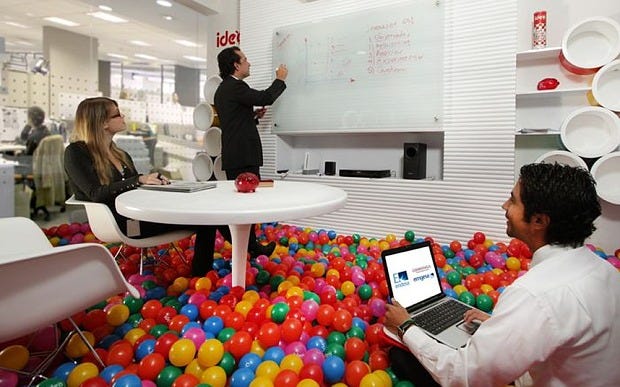
These authors made a good long-term prediction because they anticipated the business analytics boom. “Continued expansion in employment of programmers is expected over the long run… In offices where the volume of recordkeeping is great, there will continue to be need to reduce the cost of processing tremendous amounts of data and to produce more timely reports on which management decision can be based.”   After explaining salary, they talk about perks: “Programmers usually work in well lighted, air-conditioned, modern offices. Employers make special efforts to provide better than average surroundings for programmers, so that they may concentrate to achieve the extreme accuracy necessary for programming.” The nap pods of Silicon Valley have a long history that can be traced back to the Census Bureau.

The New Econ Bloggers

On the Bretton Goods podcast, host Pradyumna Prasad asked student Trevor Chow about blogs. To start the segment, Prasad noted that there has been an increase in what he called “econ blogs” in the past 2-3 years. Will that trend continue? Prasad believes that this is not sustainable because: 1) he thinks the paid subscriber model will not support many writers, which leads to 2) bloggers writing for free will run out of time and energy.

Chow replied that he thinks the recent explosion is partly due to Substack, which makes it easy to start blogging. Chow described the current climate as a “flourishing blogosphere.” He assumes that some people started during a Covid shutdown when the opportunity cost was low. Some of the younger people might shift their focus, as he did when his interests changed, but he believes that many of the blogs started in this phase are here to stay. Both young men think about longevity.

Prasad asked, “What are the qualities of the most successful bloggers across time?”

Chow replied that the only blog that has influenced him “across time” is Marginal Revolution, partly because few writers stick with blogging. Chow thinks a successful blogger over time would find a special niche. I have a similar intuition, even though MR is not about a niche topic. If everyone is checking MR for their “daily links”, then it’s unlikely that inferior new aggregator blogs will attract large numbers of readers. Also, Twitter largely fills that role now.

The fact that duration was discussed more than quality is interesting. To blog is to enter a network and join a community. Part of sticking around for a while is not just writing but also reading and paying attention to the work of others. Good writing is a necessary but not sufficient component of what would be considered a successful blog.

As an economist, I was happy to hear Prasad open this segment by talking about “econ blogs”. Econ blogging occurs when people are interesting online, even if the topic is outside of the traditional domain of economists. I think this is partly due to Tyler Cowen both being prolific and also willing to engage non-standard thinkers.

I enjoyed the podcast. It raised some questions which I posed to Tyler Cowen, the OG econ blogger. We all know that MR generates a high level of engagement, today. My first question was:

1. What was the evolution of reader engagement with MR? How long did you work before a lot of people were reading, commenting? 

Cowen: It took us 3-4 years to have a lot of readers. but I never tracked the numbers very closely. When I started, I was thrilled by the notion of 5,000 readers a day — of course we have done many times more than that.

2. The consensus is that many new people have started since 2020, which I believe is something that you called for. Do you now see the space as, in some sense, saturated, or would you encourage more people to keep joining now? 

Cowen: I don’t think it is saturated now.

 3. For bloggers who started since 2020, should they quit if the opportunity cost increases? 

Cowen: The main thing is simply whether you enjoy it and learn from it!  If so, reason to continue. That sounds trivial, but it is really the bottom line.

Should the new bloggers keep going? Yes, if you enjoy it and learn from it. Is it too late to start? No, if you will enjoy blogging and learn from it.

The blog form is better than a 280-character tweet for capturing nuance. Something I learn from blogging, which might not be obvious from the outside, is that I have some bad ideas. Sometimes trying to write out a piece teaches me that I had an unsupported thought. It would be good if more people would stop scrolling for an hour a week and try to write out an argument.  

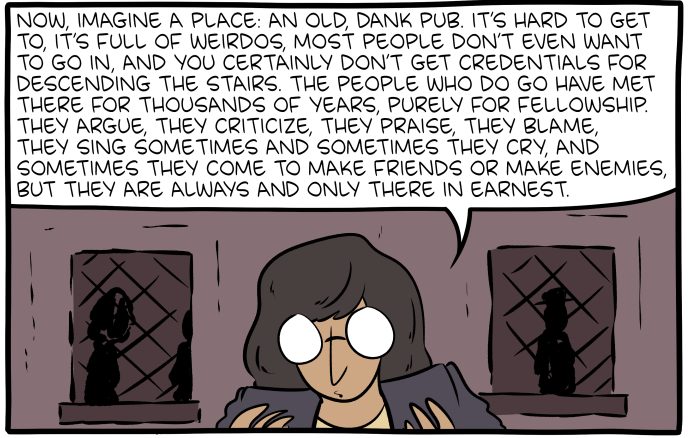
Co-blogger Mike alerted me to this comic:

This is one frame of a long SMBC comic strip https://www.smbc-comics.com/comic/liberal-education

The comic first describes a cynical take on academia, with which I don’t fully agree. Then, the woman paints a picture of an alternative haven for intellectual conversation. Can econ blogs be an old pub where the people are always and only there in earnest? “Most people don’t even want to go in, and you certainly don’t get credentials for descending the stairs.”

In Praise of the FRED Excel Add-in

Sometimes, large entities have enough money to throw at a problem that by sheer magnitude they produce something great (albeit at too high a cost). The iPhone app from the FRED is not that thing. But the Excel add-in is something that every macroeconomics professor should consider adding to their toolkit.

Personally, I include links to FRED content in the lecture notes that I provide to students. But FRED makes it easy to do so much more. They now have an add-in that makes accessing data *much* faster. With it, professors can demonstrate in excel their transformations that students can easily replicate. The advantage is that students can learn to access and transform their own data rather than relying on links that I provide them.

The tool is easy enough to find – FRED wants you to use it. After that, the installation is largely automatic.

Installed in excel you will see the below new ribbon option. It’s very user friendly.

Continue reading

Covid Evidence: Supply Vs Demand Shock

By the time most students exit undergrad, they get acquainted with the Aggregate Supply – Aggregate Demand model. I think that this model is so important that my Principles of Macro class spends twice the amount of time on it as on any other topic. The model is nice because it uses the familiar tools of Supply & Demand and throws a macro twist on them. Below is a graph of the short-run AS-AD model.

Quick primer: The AD curve increases to the right and decreases to the left. The Federal Reserve and Federal government can both affect AD by increasing or decreasing total spending in the economy. Economists differ on the circumstances in which one authority is more relevant than another.

The AS curve reflects inflation expectations, short-run productivity (intercept), and nominal rigidity (slope). If inflation expectations rise, then the AS curve shifts up vertically. If there is transitory decline in productivity, then it shifts up vertically and left horizontally.

Nominal rigidity refers to the total spending elasticity of the quantity produced. In laymen’s terms, nominal rigidity describes how production changes when there is a short-run increase in total spending. The figure above displays 3 possible SR-AS’s. AS0 reflects that firms will simply produce more when there is greater spending and they will not raise their prices. AS2 reflects that producers mostly raise prices and increase output only somewhat. AS1 is an intermediate case. One of the things that determines nominal rigidity is how accurate the inflation expectations are. The more accurate the inflation expectations, the more vertical the SR-AS curve appears.*

The AS-AD model has many of the typical S&D features. The initial equilibrium is the intersection between the original AS and AD curves. There is a price and quantity implication when one of the curves move. An increase in AD results in some combination of higher prices and greater output – depending on nominal rigidities. An increase in the SR-AS curve results in some combination of lower prices and higher output – depending on the slope of aggregate demand.

Of course, the real world is complicated – sometimes multiple shocks occur and multiple curves move simultaneously. If that is the case, then we can simply say which curve ‘moved more’. We should also expect that the long-run productive capacity of the economy increased over the past two years, say due to technological improvements, such that the new equilibrium output is several percentage points to the right. We can’t observe the AD and AS curves directly, but we can observe their results.

The big questions are:

  1. What happened during and after the 2020 recession?
  2. Was there more than one shock?
  3. When did any shocks occur?

Below is a graph of real consumption and consumption prices as a percent of the business cycle peak in February prior to the recession (See this post that I did last week exploring the real side only). What can we tell from this figure?

Continue reading

Post Tenure Agenda

To get anywhere new, you need to step off the treadmill

Before tenure, most academics need to publish their work in peer-reviewed journals if they want to keep their jobs. After tenure, most can publish their work anywhere or nowhere and still keep their jobs. This is a dramatic change in incentives, and you’d think it would lead to dramatic changes in behavior, particularly in a field like economics that studies incentives. In some ways it does- most professors spend less time on research after tenure. But if they do keep doing research, it is generally the same kind they did before- it seems surprisingly rare for economists to change what kind of research they do in response to their changed incentives.

On Monday the President of Providence College told me I’ve been promoted to tenured Associate Professor. I spent much of the last 10 years focused on publishing the 26 academic articles that got me here. So now I’m wondering, what do I change when freed from constraints? I’m planning a pivot toward higher-risk, longer time-horizon, potentially higher-reward research:

Different venues– publish things where people will read them, not where its most prestigious. More white papers, working papers, open access. More blog posts and popular articles, more books– not everything needs to be a peer-reviewed academic paper.

Different topics and methods– focus on work that might have policy impact even if it doesn’t publish well. Do more replications, forecasting and related work that moves us toward being a real science that establishes real truths, even if it doesn’t publish well and might anger some people. Make a point of posting data and code publicly so that its easy for others to use.

New skills– develop generalist skills or a 2nd specialty, ideally in a young/developing field like metascience or superforecasting. Breakthroughs are more likely to come that way, especially for someone not at the top of their 1st field. Create slack so that when big opportunities or needs arise, I’m not “too busy” working on old articles to do anything about it (like I was with Covid in February 2020, Bitcoin mining in 2011, et c). Of course, many of the directions I’m considering (prediction markets, consulting, angel investing, hanging around the state house) might never be “research” even if they do pan out.

The GMU economists are good role models here, though they are such outliers now that people don’t realize they often started their careers focused on publishing journal articles (admittedly some weird ones). For instance, Bryan Caplan’s first book came out 4 years after he got tenure. I’d like to hear more examples of people whose research changed for the better after tenure if you have them. I’d also like to hear about the projects you wish someone not concerned about career risk would take on.

I’m happy to be an Associate Professor at Providence College. While I wouldn’t mind hitting some higher rungs of the academic career/prestige ladder (full professor, endowed chair, NBER invitations, et c), I don’t view these as incentives strong enough to distort my choices the way needing to get a job and get tenure did. Now the goal is simply to do the best work I’m capable of, as I see it. As you can tell I’m pulled in a lot of different directions about what this will look like, but I hope that within 5 years it will be clear I’m doing quality work beyond standard applied microeconomics I’ve been exclusively focused on till now. If not, you’ll have this post to hold over me.

“I consider the “wasting of tenure” to be one of the aesthetic crimes one can commit with a wealthy life, and yet I see it all the time” –Tyler Cowen

Disney World is not Decadent

Last week I went to Disney World for the first time. The decorations live up to the hype. The whole enterprise down to the efficient parking systems was impressive.

Galaxy’s Edge is a new Star Wars themed area in Hollywood Studios

In his book The Decadent Society, Ross Douthat argues that following the Apollo mission, Americans underwent a period of economic stagnation, demographic decline, and intellectual and cultural repetition. I think he makes good points, and every American should grapple with his proposition.

He specifically mentions Disneyland on page 36-37:

But has anything that fits this description happened since the moon mission? … There has been a growth in what [David] Nye calls “the consumer’s sublime” of Disneyland and Las Vegas. … But the hyperloop is a blueprint, Las Vegas is a simulacrum…

Has Douthat been to Orlando recently? Walt Disney was not complacent, and neither are the Disney employees who continue to carry out his vision. Orlando is a place where Americans have built stuff in the past few decades instead of trying to veto all progress.

Perhaps it is a decadent society that overvalues the Disney World pilgrimage. My parents never took me, so I am proof that you can have a good childhood without it. However, to build this zone and enjoy it seems like a perfectly legitimate peacetime activity for a country. People desire to stroll down a safe, beautiful, clean, walkable street with their families. The problem is that so many Americans can only do that for a few days per decade and empty their savings to Disney for the privilege.  

There is a pernicious idea that respectable Americans live in towns that look just like 1950 and they do tourism at sites that look like 1850. Walt Disney obviously did not think that way. On Twitter, @EliDourado and @mnolangray are agitating every day to build more better stuff. We don’t need Donald Duck on every corner, but we could create cities that serve families better.

One surprise I found inside of the Tomorrowland zone of Magic Kingdom is an old ride called The Carousel of Progress.

Continue reading

How to Set Working Directory in R for Replication Packages

The AEA Data Editor kicked it all off with this tweet:

“Please stop using “cd” (in Stata) or “setwd()” (in R) all over the place. Once (maybe, not really), that’s enough.”

Replies proliferated on #EconTwitter this week. In this blog post I am collecting solutions for R.   These days you might share the code used to generate your results for an empirical paper. That code would ideally be easy for other people to run on their own computers. File paths are hard (as I blogged previously).

A project for a single paper might have multiple code files. The code interacts with data stored somewhere. Part of the task of the code is to point the statistical program to the data set. It is frustrating if an outsider is trying to replicate a result and must alter the code in multiple places to point to their own location of the data.

Here is a concise summary of good practice, for any code language: “cd and setwd() specify the directory. When you share code and run on a different computer, they don’t work. Therefore, good practice to only specify once, at the beginning”

Continue reading