In recent years, we have seen growing discontent with the distributional effects of free trade, widespread favor-seeking from businesses, and a recurring sentiment that the economy is rigged.
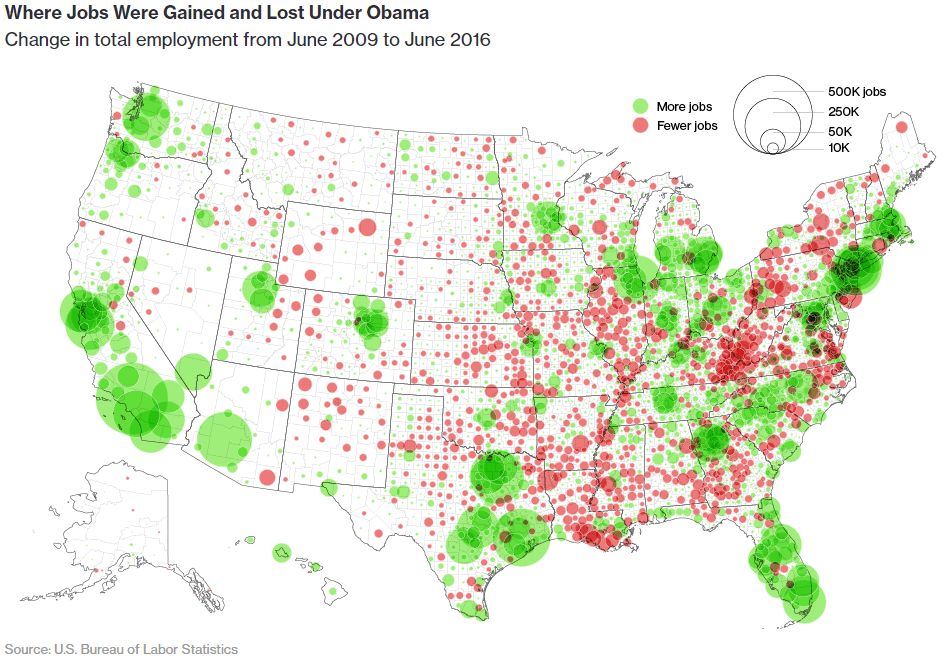
Distributional concerns. The 2016 election of Donald Trump likely stemmed from graphics like those below that demonstrate the geography of job losses and gains. According to this Bloomberg article, the goods-producing sector that includes manufacturing, construction, and mining lost 1.2 percent of their jobs during the Obama administration.
Favor-seeking. The Occupy Wall Street Movement was viewed as an expression of the frustration that government privileged banks above individuals despite their irresponsible business practices.
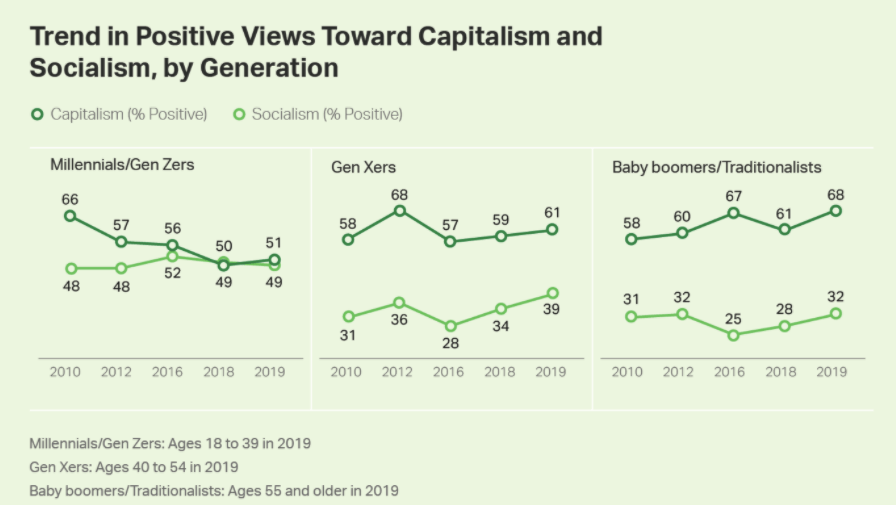
The notion that the economy is harmful to some and the deck is stacked against most is damaging the reputation of capitalism. According to a 2019 Gallup Poll, positive views of capitalism among young adults (ages 18-39) have declined from 66 percent in 2010 to 51 percent in 2019 and positive views of socialism are now at the same level as positive views of capitalism.
While this same group does hold a favorable view toward free enterprise, even that is down to 83 percent in 2019 from 89 percent in 2010. Individuals also view small businesses favorably but many of those local businesses are having difficulty weathering the shock of COVID-19 and that could tilt the composition of the economy toward big business which is viewed less favorably.
This constellation of public opinion is the milieu from which calls for “common-good capitalism” (focuses policies on firm and government obligations to workers) have emerged. Personally, I do not have great confidence in proposals like higher minimum wages, increased tariffs, and more that aim to address the pain that underlies these attitudes about the market economy.
At the same time, I do not have a clear path forward. The favorable views toward free-enterprise suggest individuals want others to exercise their talent and freedom in markets. That is good! At present, we do not want to kill the goose that lays the golden eggs. On the other hand, it is difficult for me to fathom how we can have a government big enough to help workers and one that creates conditions of fairness. It is wishful thinking to assume that the rent-seeking that has undermined the credibility of the market will go away if we turn to “common-good capitalism” or something else.
There is an old Jewish aphorism that, “the clever man can extricate himself from a situation into which the wise man never would have got himself in the first place.” Leadership in the United States lacked the wisdom to adhere to the limited and enumerated powers in the Constitution and Congress has long abandoned being jealous guardians of their authority that undermines checks and balances. Hopefully we are not all out of clever.
A week ago, we described commercial loans in general, and how they differ from bonds. Companies nearly always need money to make money, and thus have to borrow money in addition to selling stock shares. Companies that are new or smaller or doing poorly or have already borrowed a lot can still get loans, but these loans typically come with stringent conditions and require paying relatively high interest. These “leveraged loans” are the loan equivalent of “junk” bonds. When a bank lends money as a “Senior Secured Loan”, this entails agreements (“covenants”) which may specify that in event of default, this loan gets paid off ahead of any other creditor, and also that some specific asset held by the company, such as a building or an oil field, will be given over to the bank.
Financial institutions like insurance companies and pension funds are hungry for “investment grade” securities like bonds rated BBB or higher. Normally, these institutions would not consider buying into the senior loan marketplace, since these instruments are not considered investment grade.
Enter “Collateralized Loan Obligations” (CLOs). With a CLO, 200 or so loans which have been made by banks and then sold off into the market are bundled together, and then the cash flow from the interest paid on these loans plus the principal paid back is repackaged into slices or “tranches”. The highest level tranches get first dibs on being paid from the overall CLO cash flow, then the lower and lower tranches. The majority of bank loans today end up being packaged into CLOs. CLOs are an example of a lucrative operation known as “securitization”: “Securitization is the process of taking an illiquid asset or group of assets and, through financial engineering, transforming it (or them) into a security” (per Investopedia).
The rate of loan defaults in recent years has been only 3-4%, and on average the recovery on a given defaulted senior secured loan has been around 80%. So the actual losses (e.g. 4% x 20%, or 0.8% net) have been quite low. The highest annual default rate in recent memory was about 10%, in the Global Financial Crisis of 2008-2009.
The theory is that, although any particular loan has a nontrivial chance of defaulting, it is unthinkable that more than say 20% of all loans would default; and even if a full 20% of the loans did default, we would expect that the actual losses after liquidating the pledged collateral would be more like 4% of the entire loan portfolio (i.e. 20% defaults x 20% loss per default). This means that the top 95% or so of CLO cash flow should be considered very secure, and the top 60-70% are utterly secure.
Thus, the top 60-65% of the CLO cash flow is packaged as super secure, relatively low-yielding AAA rated debt, and as such is bought up by conservative financial institutions, including banks. This arrangement keeps those institutions happy, and also facilitates the making of loans to the needy companies who are taking out the underlying loans.
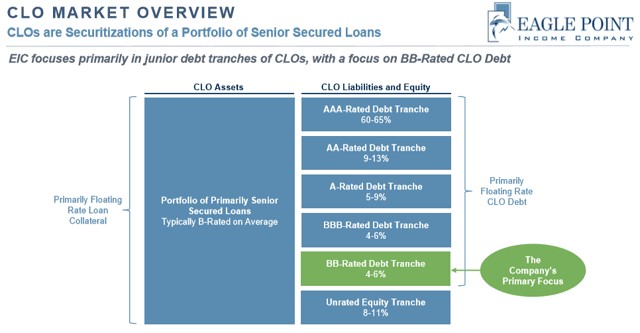
The figure below from an Eagle Point Investment Company presentation depicts typical CLO tranches:
The lower the position in the CLO cash flow “waterfall”, the higher the yield and the higher the risk of non-payment. The AA, A, and BBB debt tranches are all considered investment grade, though with higher risk and higher yields than the AAA tranche. The Eagle Point Investment Company happens to buy into the BB-rated debt tranche, which is just below investment grade. You, the public, can buy shares Eagle Point Investment (stock symbol EIC). These shares pay about 7% yield, after hefty management fees have been subtracted.
The equity tranche lies at the very bottom of the CLO heap. If there were, say, 20% loan defaults with only 50% recovery of the loans, the equity tranche might get completely wiped out. So these are more risky investments. As usual, there is high reward along with the risk. Oxford Lane Capital (OXLC) deals in CLO equity, and it will pay you about 15% per year, which is huge in today’s low-interest world. But….you need to be prepared to have the stock value cut in half every ten years or so, whenever there is a big hiccup in the financial world.
Anyone who was an economics-savvy adult during the GFC should be asking, “But, but, but…aren’t these CLOs essentially the same thing as the collateralized debt obligations (CDOs) that blew up the world in 2008?” The answer is partly yes, in that in both cases a bunch of loans get bundled together and then resliced into tranches. That said, we hope that the underlying loans in today’s CLOs are more robust than the massively shady home mortgage loans of 2003-2008 that fed into those CDOs. Back then, unscrupulous banks and mortgage companies handed out thousands of housing loans to ill-informed private individuals who did not remotely qualify for them, and then the banks dumped these loans out into the broader financial markets via CDOs. The bank loans behind today’s CLOs are more sober, serious, vetted affairs than those ridiculous subprime home mortgages.
This past summer, in the thick of the Covid shutdowns which have stressed small businesses, The Atlantic published a dire assessment of the potential for CLOs to sink the system, with the catchy title The Looming Banks Collapse . The article noted, fairly enough, that there has been a trend in the past few years to weaken the covenants on loans which would normally protect the lender against losses. Most loans these days are considered “covenant-lite”, compared to several years ago. There is genuine concern that the recovery on these loans might be more like 40-50%, instead of the historic 70-80%. On the other hand, the looser requirements on these loans may mean that fewer of them will technically violate these looser covenants and thus fewer companies will actually default. A recent survey estimates that the default rate in the $ 1.2 trillion dollar leveraged loan universe will peak at only 6.6% in 2021.
Also, today’s CLOs seem to be rated by the major ratings agencies more responsibly than the notoriously optimistic ratings given to CDO’s back in 2008. “CLOs are usually rated by two of the three major ratings agencies and impose a series of covenant tests on collateral managers, including minimum rating, industry diversification, and maximum default basket”, according to an article by S&P Global Market Intelligence. That article has a good description of CLOs, including a brief tutorial video on the nuts and bolts of how they work.
A few months back, I received a call for essays from the AEI Initiative on Faith in Public Life. The question was: In the contemporary United States, what would a truly humane economy look like? and it has been rattling around my head for a couple months. Occasionally I’ll write down some thoughts. In this post, I want to share with readers an excerpt from those thoughts.
“… I will situate a humane economy in the literature on fairness and justice and turn to a well-known philosophical device called the “veil of ignorance”. From behind this veil, there is no knowledge of race, sex, abilities, etc. From behind this veil — unencumbered by bias — a person would choose a humane society. John Rawls believed individuals, not knowing where they would be located in the income distribution, would seek to maximize the lowest income. This is what he called the “difference principle”.
In 1987, three political scientists conducted an experimental test of the veil of ignorance (Frolich et al., 1987). Students were presented with distributions of income that reflected different philosophical convictions like utilitarianism, egalitarianism, the difference principle, and utilitarianism with a floor constraint. Then students were asked to vote on their preferred distribution without knowing their ultimate position in the distribution. Students then deliberated with each other for a minimum of five minutes and unanimous vote was required for the adoption of a distribution otherwise one would be chosen randomly.
Rawls was right that individuals come to unanimous agreement behind the veil, however, the difference principle failed. The authors write, “Under all experimental conditions, all groups reached consensus and no group ever selected maximizing the floor as their preferred principle.” From behind a veil of ignorance, what did most people want? Overwhelmingly groups chose utilitarianism subject to a floor constraint. For a majority of people, prosperity is not dirty and undesirable. The economic pie can be large and some people can do very well. However, there is some willingness to limit the ceiling to raise the floor.
The direction of Rawls’ instincts were correct. People do think about the folks on the bottom rung and this experiment, and others like it, reveal something about human nature. We want the opportunity for great prosperity and we want to care for those less fortunate …”
After this discussion of the veil of ignorance, the essay proceeds with a reminder that if we are attempting to secure some material threshold, the poor in the United States are materially doing well by historical and global standards. But, for the remainder of the essay I focus on a different kind of poverty: unmet needs. Specifically the needs for purpose, security, and opportunity. Then I make the argument that to best meet these needs we need a more robust civil society and federalism.
What is justice? It’s a lofty question, up there in the pantheon of “What is the meaning of life?” and “Who let the dogs out?”. There is no great answer for that, but, essentially justice is about doing the right thing. What is right? That’s a good question.
There are three taste buds to justice: merit, need, and equality. When people make an argument for something being right they will draw on one or more of these taste buds. These criteria become especially important when groups decide to allocate goods through non-market institutions.
Here is a favorite example from Peyton Young’s book Equity: In Theory and Practice. At the end of World War II, the United States was demobilizing soldiers in Europe. Some had to be retained to fight Japan while others could come home. Which soldiers should come home first?
After debate, the U.S. Army decided to survey thousands of soldiers in the United States to identify relevant factors. There were four important factors: length of time in the Army, age, amount of overseas service, and number of dependents. Then troops completed a pairwise-comparison of each criteria like in the picture below.
You can see among the transitive rankings (90 percent of those surveyed satisfied transitivity) the two most important features to those surveyed in the United States was overseas service and number of dependents.
But, it turns out there was an important write-in candidate among the soldiers: exposure to combat. A large swath of soldiers mentioned that this should be an important criteria but the Army hadn’t considered it in their survey.
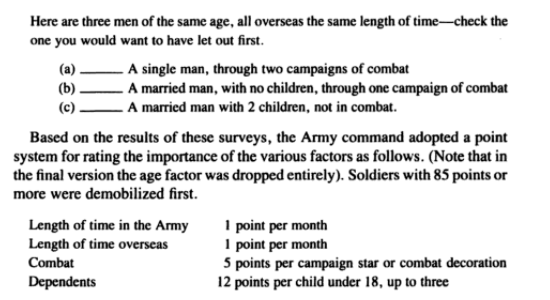
The Army devised another survey that attempted to develop how much different criteria should be weighted. You can see a sample question below and the resulting points system (from a series of questions like the sample question).
What matters most to the troops: exposure to combat and number of dependents. Put another way, what matters most is merit and need. The right thing to do regarding who comes home first involves consideration of whether you merit coming home (exposure to combat elevates you over others) and need (a child needs their parent).
So I do not have a precise definition of justice. But, I have noticed that when people talk about doing the right thing they often rely one one or more of merit, need, and equality.
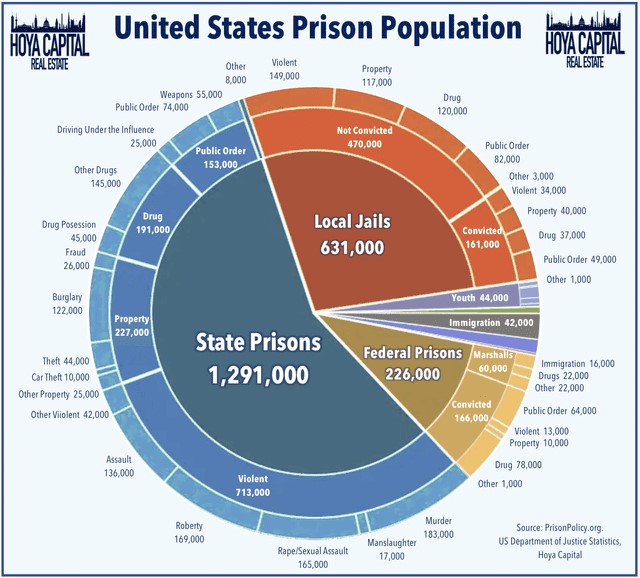
During some general reading on finance, I ran across the following two information-rich graphics from Hoya Capital on the U.S. prison population. On the first graph, the blue areas show the absolute numbers, and the green line shows the percent incarceration rate. A rate of 0.5% comes to 500 prisoners per 100,000 population.
This graph shows a huge rise in the state and federal prison population between 1980 and 2000. There seems general agreement that much of that increase in the prison population is due to mandatory sentencing laws, which require relatively long sentences. In particular, “three strikes and you’re out” laws may demand a life sentence for three felony convictions, if at least one of them is for a serious violent crime. Another factor was the increased criminalization of drug use (possession), in addition to drug dealing.
The graphic below shows the particular classes of crimes of which inmates of the state and federal prison systems have been convicted. The largest single category is violent crimes, but other types are significant, such as drug and property crimes, and “public order” crimes. Public order crimes include activities such as prostitution, gambling, alcohol, child pornography, and some drug charges. This graphic also includes the large number of people in local jails, most of whom are imprisoned awaiting trial or sentencing.
The total number of people under legal supervision in the U.S., including probation and parole, is over 6 million:
The U.S. has by far the largest official prison population in the world, and the highest incarceration rate. The following graph from Wikipedia depicts incarceration rates for several countries or regions as of 2009:
Most developed countries have incarceration rates of around 100-200 per 100,000, which is where the U.S. was in about 1970. The relatively high rate for Russia is attributed in large part to strict “zero tolerance” laws on drugs.
Again, the main driver for the high rates in the U.S. is the long sentences, driven by mandates. Wikipedia notes that there are other countries, including some in Europe, which have higher annual admissions to prison per capita than in the U.S. However, “The typical mandatory sentence for a first-time drug offense in federal court is five or ten years, compared to other developed countries around the world where a first time offense would warrant at most 6 months in jail… The average burglary sentence in the United States is 16 months, compared to 5 months in Canada and 7 months in England.”
Policy debates on this topic continue. Obviously, we want to protect society from dangerous predators, but the direct and indirect costs to society for this level of incarceration are high. It seems like an area which is ripe for reform of some kind, though I do not claim to have a novel proposal.
One of the more interesting results from last night’s election comes out of Florida: voters appear to have narrowly approved an increase of the minimum wage in stages to $15/hour in 2026 (Florida has a 60% requirement for ballot measures to pass, and the current vote total is just above that threshold).
Florida is not the first state to approve such an increase to $15/hour: 7 states have already done so, though no state is yet at that level. California will hit $15 first in 2022. Several US cities, such as New York and Seattle, as well as the “city-state” of Washington, DC are already at $15, but these are generally very high wage cities.
What makes Florida the most interesting of the states to try very high minimum wages is that Florida is not a high wage state. Once the minimum wage is fully phased in (in 2026), the minimum wage will be about 75% of Florida’s median wage (it was $17.23 in 2019). That’s much higher than other states: California will be the next highest at about 66%, with Oregon next around 64%. Oregon will be close to $15, but perhaps a little below, as they index their minimum wage for inflation.
(To make these estimates I am using 2019 median wage data from the BLS OES wage data and assuming 2% annual wage growth. This may not be exactly right, but it’s probably close enough.)
Also important to note in Florida: the median wage is not $17.23/hour all over the state. Several MSAs in Florida currently have a median wage at or even below $15 (Sebring, Florida is the lowest at around $14/hour). There will be some wage growth over the next 6 years in those areas, but still this means that the minimum wage will be applicable to roughly half the labor force.
That brings up another interesting legal question: will the minimum wage apply to salaried workers making less than $30,000 per year? The way the law is written, probably not, but logic would seem to dictate that it should. Otherwise, what’s to stop an employer from hiring an employee on a $2,000/month contract, equivalent to $12/hour for a full time worker?
The minimum wage debate among economists consumes a vast literature, and I am no expert on it, and will make no attempt to summarize it here. But Florida seems to be breaking new territory. My little state of Arkansas currently holds the “record” for a US state starting in 2021, with a minimum wage of $11/hour which will be about 67% of the median wage (and about 78% of the median wage in Hot Springs, Arkansas). Florida’s experiment will certainly give economists a new experiment to study.
Arin Dube, one of the leading researchers of the minimum wage and a strong advocate of raising the wage, suggested in a recent policy paper that a good minimum wage for Florida would be around $9/hour, given their wage distribution. That was in 2014 dollars, so we can roughly adjust that up to $11-$12 in 2026 dollars. Florida voters have chosen to go well beyond that recommendation.
There is a YUGE election happening tomorrow. I don’t know if there will be an apparent winner before bedtime tomorrow night. In 2016, I stayed up watching the news until (to everyone’s great surprise) Trump gave an acceptance speech at 3am.
I don’t play video games. Whether you do or not, you’ll want to keep an eye on this important cultural and financial trend. Regardless of who wins the 2020 US election, people around the world will be playing a lot of video games. The following report is the work of Samford undergraduate student Erica Eades.
Esports is a competitive level of gaming that involves players winning money. Professional esports players are typically sponsored by companies affiliated with video games. Students are becoming more and more involved in esports. League of Legends World Championship was 2019’s biggest tournament by live viewership hours on Twitch and YouTube, with 105.5 million hours.
When the pandemic reached the U.S. the sports industry shifted their focus. Many leagues were able to quickly restart their competitions in a different format as esports, which quickly transitioned its in-person events to online-only games. For many months following the pandemic esports was the only option if you wanted to watch a live competitive event.
I had an interview with Noah Hankinson, a professional eSports gamer and consultant that has conducted extensive work with the NCAA, Learfield Sports, and multiple eSports properties. Noah shared perspectives on the state of eSports and demographics.
According to Noah, the most popular game is constantly changing. Although a game may be incredibly popular one week, it could be obsolete the next. To learn what game is most popular during a given time frame, simply observe the games famous Twitch players are using. Many Twitch streamers focus on only one game, but others will focus on what is most popular at the time so that they can maximize revenue from viewership. Noah informed me that the ‘traditional’ games such as Call of Duty, League of Legends, or Rocket League are growing. These games are the most popular and have the widest reach across all eSports demographics.
Depending on the game being played, there are different rules and formats each team (or individual) must adhere to. Popular games include football and soccer, where player roles or team game plans are more well known. Many eSports are based on individual talent, much like wrestling or track-and-field. Over the years, as eSports has become more of an emerging community, college organizations have started to help push the next generation of eSports competitors.
From a social standpoint, esports are more inclusive than other sports. Men and women are able to play on the same teams and teams are made up of individuals from various demographics and ages. Esports is not just a young demographic, eSports gamers ages in America range from 12 to 60 with the average age being 33 years old.
Many predictions have been made about the growth of the industry. As teams of eSports members populate across the country, the unprecedented growth of the competitive gaming industry continues to rise. Newzoo is the leading provider of market intelligence covering the global games, esports, and mobile markets. The data from newzoo allows them to project the esports industry esports revenue stream worldwide based on sponsorship. In 2018, the global market esports revenue was $776.4 million. The global esports revenue will probably hit $973.9 million in 2020, and $1.194 billion in 2021.
This projected growth has made it important to maintain positive relationships with current and future partners in the industry. With increased interest in esports there is a momentum for new partners to enter the industry and increase revenue. Using the data that projected the revenue and growth can be beneficial for many esports executives and the industry as whole. It will be interesting to follow and see how the industry continues once live sports are able to resume normally. After the “at home” year that brought so much to esports, observers agree that the industry’s upward trajectory is continuing.
Friday afternoon has come and gone, we’re now into the evening, and I am just now writing a product review. I nearly cast dispersions on our blog name, “Economists Writing Everyday”! It won’t be a lengthy product review and my wit-producing engine is bereft of gas. It’s been that kind of week. I am torn between reviews of booze and theology …
There is something wonderful about the charm of making classic cocktails and also putting a twist on them. My favorite drink is an Old Fashioned and I like the weight of a quality glass, the large ice cube (I’ll have to check out Jeremy’s recommendation!), the quality of these cherries, and I enjoy experimenting with different bitters that put a twist on the classic cocktail. For example, my recent favorite combination involves black walnut bitters and chocolate bitters. Your mileage may vary.
One wonderful treasure that I discovered this summer was the series of books, “The Ancient Christian Commentaries on Scripture“. The 29 volume set is a whopping $1,499 on Amazon. But, you can start small and buy the different books piecemeal. These books provide a wealth of insights from the Church Fathers. The commentary on the book of Acts added a new dimension to my summer Bible study (maybe the subject of a future blog post).
Do not let the brevity and unremarkable quality of this product review undermine the wonderful products I’ve linked to. They are great and if you have someone in your life that loves theology and an Old Fashioned perhaps they might like some of these products too.
According to a recent CDC Report on the mental health effects of COVID-19 lockdowns, 1 in 4 young adults (ages 18-24) have had suicidal ideation. Even before COVID-19, many of you may also know about the so-called “deaths of despair” that refers to the rise in mortality among middle-aged white men starting in the late 1990s from suicide, overdose, chronic liver disease or cirrhosis.
With so much existential anguish, my book review is on a slim little book called The Sabbath by Abraham Joshua Heschel. The book is packed with zeal for a day Heschel calls, “a palace in time”,
“The seventh day is a mine where spirit’s precious metal can be found with which to construct a palace in time, a dimension in which the human is at home with the divine; a dimension in which man aspires to approach the likeness of the divine. For where shall the likeness of God be found? There is no quality that space has in common with the essence of God. There is not enough freedom at the top of the mountain; there is not enough glory in the silence of the sea. Yet the likeness of God can be found in time, which is eternity in disguise.”
Heschel divides the world into two categories: space and time. Both are means to understand God. The toil that we experience happens in space and allows us to better understand God as Creator. But, Heschel spends more pages writing about time.
In thinking about time, there is a tension because Genesis 2:2 reads, “On the seventh day God finished his work,” Exodus 20:11 reads, “In six days the Lord made the heaven and earth.” How is it possible to finish making heaven and earth in six days but not to be finished until the 7th day? The rabbi’s resolved this tension by stating that menuha was created on the Sabbath. Menuha is not an object that we create that can be grasped in our hands. Heschel states menuha means something akin to “tranquility, serenity, peace, and repose”. God created an architecture in time and menuha is the special attribute of the seventh day.
The fact that God blessed the seventh day, and not the other days, should hint that the seventh day is special. What this means is that time is not homogeneous —some time is different than other time. So it seems there is time for creating and time for remembering that we were created. On the seventh day we remember our relationship with God, that remembrance is a refuge from a fury of sound and distraction. What is more, this remembrance carries us through the rest of the week.
This was a great joy for me to think about The Sabbath today. It was also a reminder. If you are like me and still trying to find your groove amidst Coronavirus, consider setting apart one day from the others. Create a palace in time, a time that is different from all the other time. Remember, time is not homogenous. Your palace will look different depending on your position in life but it should be restorative and help you to remember and be grateful.
At one point, Heschel asks, “. . . is there any institution which holds out greater hope for man’s progress than the Sabbath?” I do not know. But, genuine rest — not diversion — seems necessary in the tensions of our present moment.






 Economist Writing Every Day