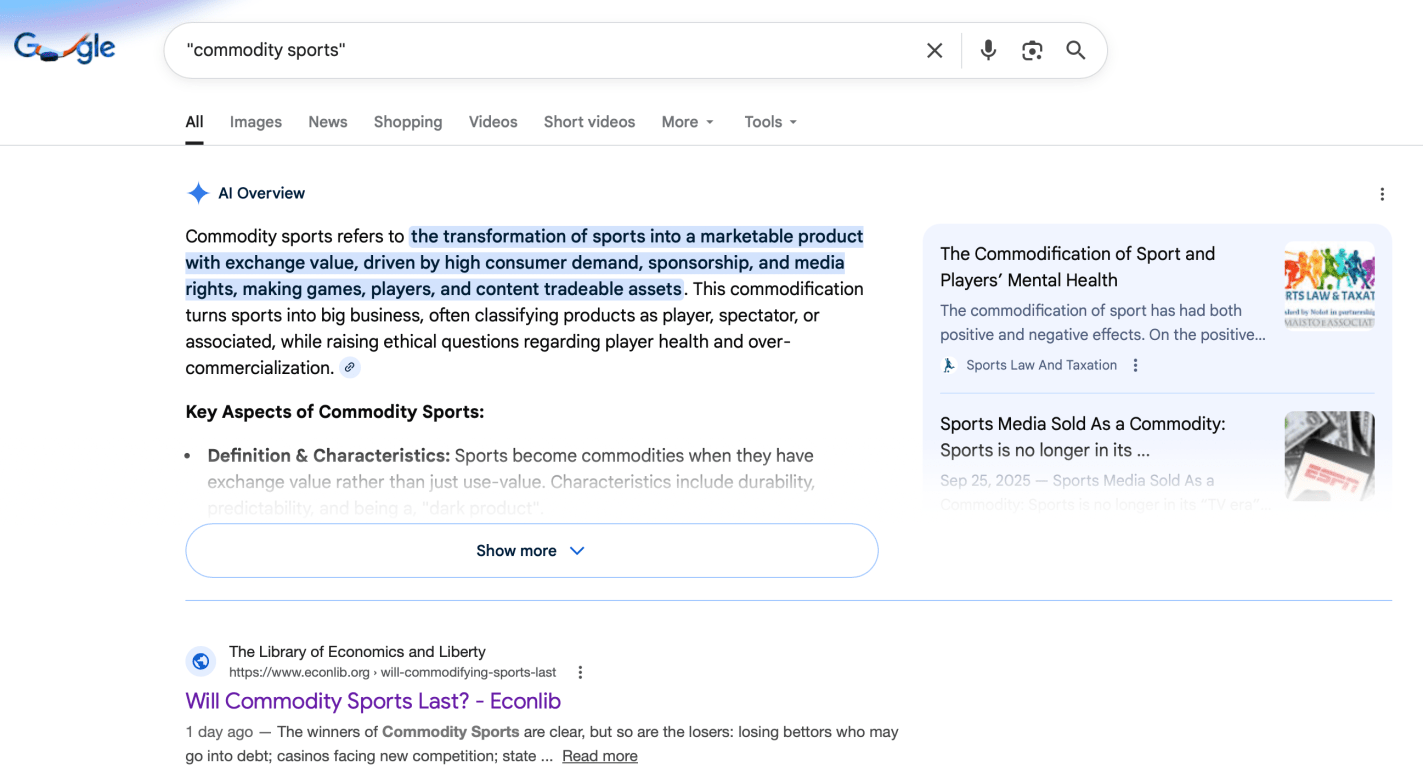
I’m trying to coin “Commodity Sports” as the term to refer to sports betting that takes place on exchanges regulated by the US Commodity Futures Trading Commission, as opposed to sports betting that takes place through casinos regulated by state gaming commissions. So far it seems to be working alright, I haven’t convinced Gemini but have got the top spot in traditional Google search:
That article- Will Commodity Sports Last?– is my first at EconLog. I’m happy to get a piece onto one of the oldest economics blogs, one where I was reading Arnold Kling’s takes on the Great Recession in real time, where I was introduced to Bryan Caplan’s writing before I read his books, and where Scott Sumner wrote for many years (though I started reading him at The Money Illusion before that).
The key idea of the piece, other than the legal oddity of sports betting sharing a legal category with corn futures, is that the Commodity Sports category is being pioneered by prediction markets like Kalshi. As readers here will know, I like prediction markets:
I love that CFTC-regulated exchanges like Kalshi and Polymarket are bringing prediction markets to the mainstream. The true value of prediction markets is to aggregate information dispersed across the world into a single number that represents the most accurate forecast of the future.
But I’m not so excited to see them expanding into sports:
Although I see huge value in prediction markets when they are offering more accurate forecasts on important issues that help policymakers, businesses, and individuals make more informed plans for our future (e.g., Which world leaders will leave office this year?, or Which countries will have a recession?)… I see much less value in having a more accurate forecast of how many receptions Jaxon Smith-Njigba will have.
Like Robin Hanson, I worry that the legal battles against Commodity Sports and the brewing cultural backlash against sports betting risk taking the most informative prediction markets down along with it.
This post is just some thoughts about perspective. I apologize for any lack of organization.
My academic influences include North, Weingast, Coase, Hayek, the field of Public Choice, and others. I’m not an ‘adherent’ to any school of thought. Those guys just provided some insights that I find myself often using.
What lessons did they teach? Plenty. When I see the world of firms, governments, and other institutions, I maintain a sharp distinction between intention and outcome. Any given policy that’s enacted is probably not the welfare maximizing one, but rather must keep special interests relatively happy. So, the presence of special interests is a given and doesn’t get me riled up. When I see an imperfect policy outcome, I think about who had to be enticed to vote for it. We live in a world where ‘first bests’ aren’t usually on the table.
Historically, or in lower income countries, I think about violence. Their rules and laws are not operating in a vacuum of peaceful consent. There is always the threat of violence. Laws are enforced (or not) conditional on whether and what type of violence that may result. All of the ideal legislation is irrelevant if theft and fraud are the lay of the land.
I think about institutional evolution with both internal and external pressures. I’m a bit worried about the persistence of the US republic, or at least worried for its pro-growth policies. I’m not worried about China in the long run. I don’t think they have the institutions that get them to ‘high income’ status. I do think that they are a tactical concern in the short run and that the government does/will have access to great volumes of resources in the medium run. That’s a bit of a concern. But like I said, I’m not super worried in the long run.
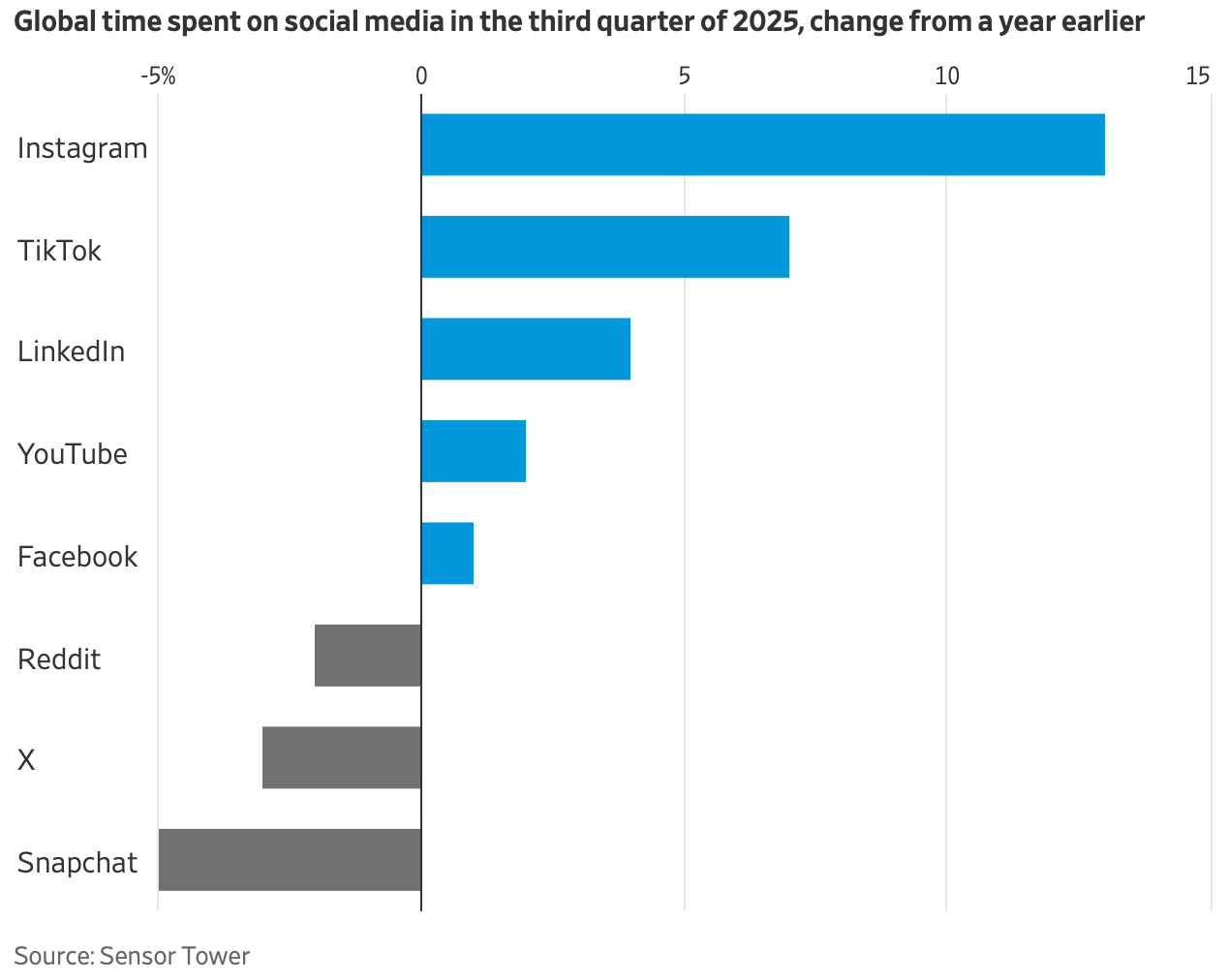
Even before Elon Musk gutted X’s content moderation, James Bailey was tired of the shouting. “It’s like a cursed artifact that gives you great power to keep up with what’s going on, but at the cost of subtly corrupting your soul,” said the 38-year-old Providence College economics professor.
He retreated. This year, he realized he was spending five to 10 minutes a day on a site he used to ignore.
The WSJ reporter contacted me after seeing my previous post about LinkedIn here, explaining how I think LinkedIn has improved as a way to share and read articles, and was always good as a way to keep up with former students. Just in the short time since the WSJ article came out, I finally used LinkedIn for one of its official purposes, hiring, where it worked wonders helping to fill a last-minute vacancy.
If you don’t trust me or the WSJ to identify the hot social network, lets see what the actual cool kids are up to
In August, I listed the Top EWED Posts of 2025. Here are a few more highlights. This list is roughly based on web traffic, starting with the highest number of views for 2025, since the August list.
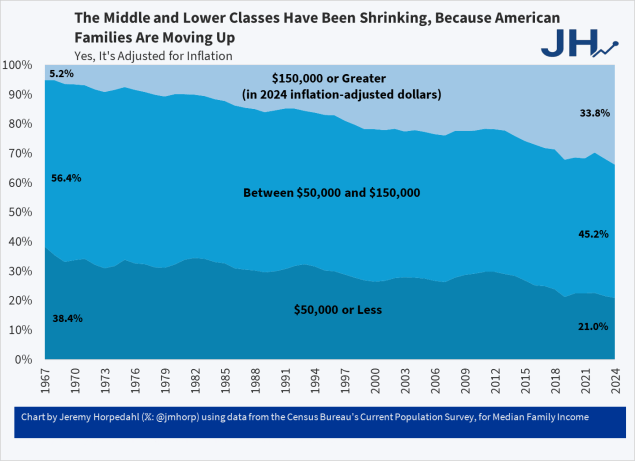
Our breakout post for the entire year is Jeremy Horpedahl with:
It has been cited in the Washington Post and the Financial Times, and shared many times.
Mr. Green has understated typical family income by something like 70 percent. Knowing this fact alone would, I think, cause him to reconsider his entire essay. But it’s worse than that: he also overstates the amount of spending required to support a family!
On Twitter I joked that if it is true, you should just run all of GDP through SNAP and we could be 80% richer. But my joke isn’t quite fair, because it could be true at the margin, but the effects might dissipate at some point. At what point? Well, a key assumption by USDA’s model is that the recipients of SNAP benefits have a higher marginal propensity to consume than the average household…
6. I rarely do this in top post roundups, but I’ll mention that Mike Makowsky’s post from 2022 generated a lot of interest this year, possibly because of the rise of interest in “agents”: Why Agent-Based Modeling Never Happened in Economics
I, myself, am embarking on a research project about AI agents. More to come on that.
Though don’t worry: not everyone went to Europe this summer, despite what social media might have you believe.
Just wait for my posts from Europe, people. I’ll get back there soon.
This cuts against the idea that all progress is just more people staring into their screens. Although, arguably, people travel for the social media engagement it generates. Sometimes I feel like my Facebook friends document their trips so thoroughly that I don’t even need to go.
16. This post hasn’t had weeks to pick up a high views score, but Mike was one of the first to this paper, and I subsequently saw big accounts talking about it: Obviously baseline economic security matters, but…
If you asked me five years ago where a new UBI might, at the margin, have a zero effect, I would have picked a Nordic country, but still…
Our biggest source of web traffic is Google search. We get readers who click through links shared by our friends (thank you). And, something that’s way up in percentage terms is referral traffic from a certain “chatgpt.com” – 8 times more than in 2024.
I said years ago on my Ideas Page that we need data and research on Benefit Cliffs:
Benefits Cliffs: Implicit marginal tax rates sometimes go over 100% when you consider lost subsidies as well as higher taxes. This could be trapping many people in poverty, but we don’t have a good idea of how many, because so many of the relevant subsidies operate at the state and local level. Descriptive work cataloging where all these “benefits cliffs” are and how many people they effect would be hugely valuable. You could also study how people react to benefits cliffs using the data we do have.
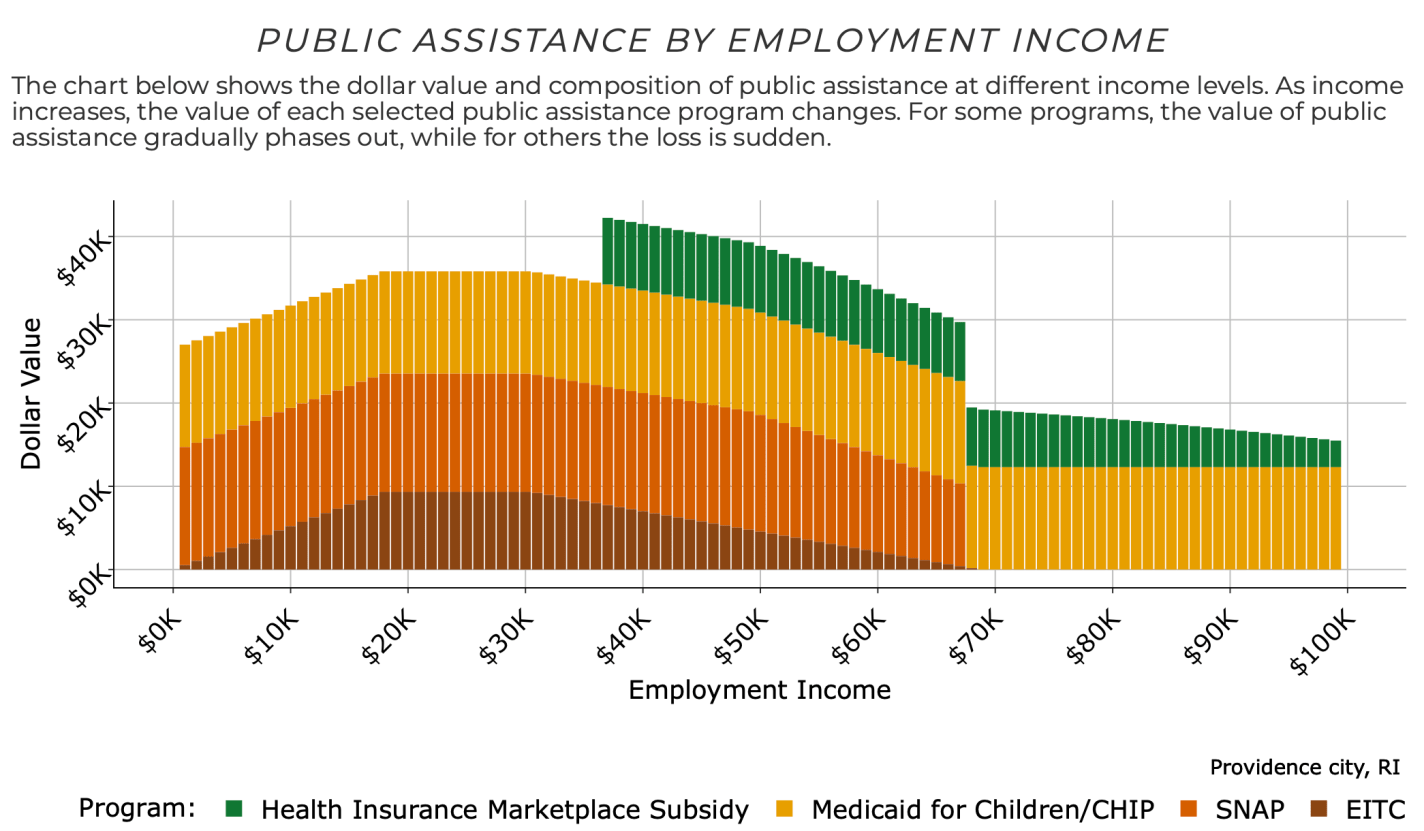
But it turns out* that the Atlanta Fed has now done the big project I’d hoped some big institution would take on and put together the data on benefits cliffs. They even share it with an easy-to-use tool that lets you see how this applies to your own family. Based on your family’s location, size, ages, assets, and expenses, you can see how the amount of public assistance you are eligible for varies with your income:
Then see how your labor income plus public assistance changes how well off you are in terms of real resources as your labor income rises:
For a family like mine with 3 kids and 2 married adults in Providence, Rhode Island, it shows a benefit cliff at $67,000 per year. The family suddenly loses access to SNAP benefits as their labor income goes over $67k, making them worse off than before their raise unless their labor income goes up to at least $83,000 per year.
I’ve long been concerned that cliffs like this in poorly designed welfare programs will trap people in (or near) poverty, where they avoid taking a job, or working more hours, or going for a promotion, or getting married, in order to protect their benefits. This makes economic sense for them over a 1-year horizon but could keep them from climbing to independence and the middle-class in the longer run. You can certainly find anecdotes to this effect, but it has been hard to measure how important the problem is overall given the complex interconnections between federal, state, and local programs and family circumstances.
I look forward to seeing the research that will be enabled by the full database that the Atlanta Fed has put together, and I’m updating my ideas page to reflect this.
*I found out about this database from Jeremy’s post yesterday. Mentioning it again today might seem redundant, but I didn’t want this amazing tool to get overlooked for being shared toward the bottom of a long post that is mainly about why another blogger is wrong. I do love Jeremy’s original post, it takes me back to the 2010-era glory days of the blogosphere that often featured long back-and-forth debates. Jeremy is obviously right on the numbers, but if there is value in Green’s post, it is highlighting the importance of what he calls the “Valley of Death” and what we call benefit cliffs. The valley may not be as wide as Green says it is and it may be old news to professional tax economists, but I still think it is a major problem, and one that could be fixed with smarter benefit designs if it became recognized as such.
Bryan Caplan explains why blogging is his favorite way to write, even as someone who has published many articles and books. It’s because of the readers:
The blog posts, finally, are the most fun. Why? Because I can quickly make an original point. When I blog, I assume that readers already understand the basics of economics, philosophy, political science, and history. Or to be more precise, I assume either that (a) readers already understand the basics, or (b) are motivated enough to self-remediate any critical gaps in their knowledge. I also assume that readers already know the basics of my outlook, so I don’t have to constantly repeat repeat repeat myself. Finally, I assume that readers already appreciate me, at least to the extent of, “You’re often wrong, but reliably interesting.” So rather than spend precious time convincing readers that I’m worth reading, I can immediately try to convince them that the thesis of my latest post is important and correct….
In the spirit of Thanksgiving, I’d like to say that I owe almost all of this to you, my dear readers. You’re the people I wake up thinking about. You’re the people I hope to excite on a daily basis. You’re my sounding board, and my confidants. I owe you, big time.
I couldn’t say it better myself, so I’ll just leave it to Bryan.
For the last few years the blog Astral Codex Ten has run contests for the best reader-submitted book reviews. This year Scott mixed things up and asked people to review anything except books.
You can review a movie, song, or video game. You can review a product, restaurant, or tourist attraction. But don’t let the usual categories limit you. Review comic books or blog posts. Review political parties – no, whole societies! Review animals or trees! Review an oddly-shaped pebble, or a passing cloud! Review abstract concepts! Mathematical proofs! Review love, death, or God Himself!
“This is not like Iraq” the Ukrainian recruiting officer soberly told me with a thick accent. “You have 50% chance of dying.” That wasn’t actually true, but it was a lot closer to being true than almost anything you can voluntarily sign up for in an organized way. I decided it was worth it.
Recommended, I thought several of the essays were excellent, voting goes through October 13th.
These are notable posts from 2025, roughly presented in descending order, starting with the post that got the most views.
Is there a competitive threat to the NBA? Mike Makowsky wrote, “… let’s put it this way. Why *wouldn’t* the Saudi Arabian PIF invest $5 billion in creating a rival basketball league?”
2. Perspective: This Stock Correction Fear, Too, Will Pass In March, Scott Buchanan presented “an optimistic take on the current stock market pullback.” Indeed, the market came back, despite the tariff doomerism of 2025 Spring.
7. Was the US at Our Richest in the 1890s? If you don’t believe Jeremy, consider one of the American Girl Doll historical books I was just reading to my kid. In our book, a little girl sends a letter to Samantha (the 1904 doll) reporting that bothof her parents just died from the flu.
8. The Wild Market of July 8th, 2025 James Bailey on the topic that we are all trying to keep up with this year: “Yesterday the S&P 500 shot up 9% on the news that most of Trump’s new tariffs were paused.”
9. No Tech Workers or No Tech Jobs? I (Joy) wish I had more time to write about the market for tech jobs this year. There is some indication that hiring is slowing. Some people still call it a correction from the Covid tech over-hiring spree. Other people take this as a sign that AI reduces the need for human programmers and otherwise “high-skill” humans, while some refute that claim.
10. Other “I, Pencils” It was fun for several dozen of us economists when everyone else in the world suddenly re-discovered the value of international exchange.
11. The Best Investments of the 1970s James considers “what were the best investments of the 1970’s?” Interesting to consider the performance of gold in retrospect considering stagflation.
15. Salty SALT in the OBBB Zachary explains. “Economically, the SALT makes it cheaper for individuals to live in high-tax jurisdictions. That’s distortionary.”
Reflections: We’ve been doing this for 5 years now, as of August 2025. From the analytics I can see, our posts have been the answer to a stranger’s Google query hundreds of thousands of times. Having been the beneficiary of so many other posts from strangers online, I’m happy about that.
Reminder: You can subscribe to our WordPress site to get posts sent to your email. The widget for putting your email in should be on the right side of your screen on a computer, or you can find it by scrolling to the bottom of the home page on a mobile device. WordPress will let you customize your preferences so that you get emails batched once a week if you prefer that to Every Day.
Based on my crude analytics from WordPress, “traffic” to our site from LLMs is low but increasing. It appears that readers occasionally click over from chatgpt.com or perplexity.ai What we can’t see is if and when our writing is re-molded as part of an LLM answer without attribution. In one sense, writing online is more important than ever, to feed the beast and help get good quality answers to LLM users. On the other hand, old systems in place like upvotes and view counts that used to motivate people to write for free might crumble in the new world.
From me in 2024: “AI companies have money. Could we be headed toward a world where OpenAI has some paid writers on staff? Replenishing the commons is relatively cheap if done strategically, in relation to the money being raised for AI companies.”
If anyone knows Mark Zuckerberg, please tell him that I’ll write for a fraction of what he’s paying these new engineers. What if he gave out a writing fellowship on the understanding the person never publishes (else the other bots would scrape it) and just exclusively lets Llama train off of original work?
In our case, anyway, we enjoy writing and learn from the process, so we are looking forward to being here every day.
If you like to read and discuss with smart people, then you can make a free account in the Liberty Fund Portal. If you listen to this podcast over the weekend: Eliezer Yudkowsky on the Dangers of AI (2023) you will be up to speed for our asynchronous virtual debate room on Monday May 5.
Russ Roberts sums up the doomer argument using the following metaphor:
The metaphor is primitive. Zinjanthropus man or some primitive form of pre-Homo sapiens sitting around a campfire and human being shows up and says, ‘Hey, I got a lot of stuff I can teach you.’ ‘Oh, yeah. Come on in,’ and pointing out that it’s probable that we are either destroyed directly by murder or maybe just by out-competing all the previous hominids that came before us, and that in general, you wouldn’t want to invite something smarter than you into the campfire.
What do you think of this metaphor? By incorporating AI agents into society, are we inviting a smarter being to our campfire? Is it likely to eventually kill us out of contempt or neglect? That will be what we are discussing over in the Portal this week.
Is your P(Doom) < 0.05? Great – that means you believe that the probability of AI turning us into paperclips is less than 5%. Come one come all. You can argue against doomers during the May 5-9 week of Doom and then you will love Week Two. On May 12-16, we will make the optimistic case for AI!
See more details on all readings and the final Zoom meeting in my previous post.
Don’t worry, EWED is in the same place as always, but my personal website is moving.
Temple University has generously hosted my site long after my 2014 graduation. But next week they are moving to a more typical policy where alumni lose access to online university resources like web-hosting, email, and library datasets starting one year after graduation.





 Economist Writing Every Day