Wild Pigs Are a Big Problem; You, Too, Can Thin the Herds from a Chopper with a Machine Gun

Wild pigs kill more people worldwide than sharks do (I didn’t know that a week ago). They do much damage to agriculture and the environment, and transmit diseases:

According to the U.S. Department of Agriculture, feral hogs cause approximately $2.5 billion in agricultural damages each year…Nearly 300 native plant and animal species in the U.S. are in rapid decline because of feral swine, and many of the species are already at risk, according to Animal and Plant Health Inspection Service. The swine also carry at least 40 parasites, 30 bacterial and viral illnesses, and can infect humans, livestock and other animals with diseases like brucellosis and tuberculosis

Besides eating and injuring crops and livestock, hogs damage the environment:

…They will also feed on tree seeds and seedlings, causing significant damage in forests, groves and plantations… Rooting — digging for foods below the surface of the ground — destabilizes the soil surface, uprooting or weakening native vegetation, damaging lawns and causing erosion. Their wallowing behavior destroys small ponds and stream banks, which may affect water quality. They also prey upon ground-nesting wildlife, including sea turtles. Wild hogs compete for food with other game animals such as deer, turkeys and squirrels, and they may consume the nests and young of many reptiles, ground-nesting birds and mammals.

Pigs are smart (ahead of dogs and horses), tough, and adaptable, and they breed very quickly. The protected, overfed, calm hogs you see on farms quickly  turn lean and mean if they have to fend for themselves in the wild. You pretty much only see female pigs or castrated males on the farm, since whole males (boars) are intrinsically aggressive and destructive. But vigorous 200-pound boars, with their 3 inch-long, razor-sharp tusks, are well-represented in feral swine.

This is a growing problem. The population of wild pigs in the southern third of the U.S. has increased significantly in the past few decades. There have historically been some wild pigs in spots like Florida and Texas, escapees from Spanish settlers long ago. But they seem to be spreading northward, largely because hunters transplant them:

From 1982 to 2016, the wild pig population in the United States increased from 2.4 million to an estimated 6.9 million, with 2.6 million estimated to be residing in Texas alone. The population in the United States continues to grow rapidly due to their high reproduction rate, generalist diet, and lack of natural predators. Wild pigs have expanded their range in the United States from 18 States in 1982 to 35 States in 2016. It was recently estimated that the rate of northward range expansion by wild pigs accelerated from approximately 4 miles to 7.8 miles per year from 1982 to 2012 (12). This rapid range expansion can be attributed to an estimated 18-21% annual population growth and an ability to thrive across various environments, however, one of the leading causes is the human-mediated transportation of wild pigs for hunting purposes.

As for pigs attacking and killing humans, a definitive study was recently made in 2023 by Mayer, et al., covering 2000-2019. This report includes informative tables and charts, such as:

and

Comparison of mean annual number of human fatalities from attacks by various wild animals for time periods ranging between 2000 and 2019. From Mayer, et al.

About half of these fatalities occurred in rural regions of India. Government policies there prohibit farmers from killing marauding pigs, so farmers try to chase them away from their fields with rakes and stones. Sometimes that provokes the pig to attack, slashing at thigh level and often lacerating the femoral artery. But a disturbing 39% of deadly attacks were unprovoked, including a horrific case with an elderly woman in Texas. So danger to humans is an issue, though for perspective, far more people are killed each year by snakes (100,000), rabid dogs (30,000), and crocodiles (1000). In the U.S., over 100 people are killed a year, and 30,000 injured, by collisions with deer (see here for a market-based solution for this problem).

What to do? Hunters in many states are free to blast away at feral pigs year-round, since they are considered a harmful, invasive (non-native) species. Paradoxically, however, allowing hunting of pigs can be counterproductive: amateur hunting does not eliminate enough pigs to stop their spread, and it incentivizes hunters to transport pigs to new regions to make for more targets. For instance, Arkansas allows hunting and even transport of pigs, and has seen swine populations skyrocket. The state of Missouri, next door, took the enlightened approach of banning hunting and transport, leaving population control to wildlife professionals. By removing the sport-hunting incentive, Missouri removed the incentive to transport them, which stymied their spread.

To control pig populations, the pros mainly set up baited large corrals, and monitor them remotely with webcams. After several weeks, the local pigs get comfortable coming there to feed. When the cameras show that every single pig in the herd is in the corral, the gate is sprung shut remotely. Then the pros drive out to, er, euthanize the pigs. The goal is to wipe out the entire herd, and leave no sadder-but-wiser survivors who will be harder to catch next time. Once a hog population has become established in an area, it typically takes ongoing eradication efforts to keep the numbers down.

If you want to do your own part to reduce the surplus swine population, the following notable opportunity came to my attention: for a largish fee the Helibacon company will train you in firing automatic weapons and take you up in a chopper where you can mow down a marauding herd in the low Texas scrubland. It sounds like a guy thing, but Helibacon reminds us that full auto is for ladies, too.  See also PorkChoppersAviation for similar service.

This is actually a fine example of a free market solution to a problem: wild hogs were such a problem for landowners that they were paying expensive professional helo hunters to take out herds, but in Texas, “All that changed in 2011, when the state legislature passed the so-called pork chopper law, which allowed hunters to pay to shoot feral hogs out of helicopters – and a new business model was born.” Hunters are happy to pay to hunt, helo companies are happy to take their money, and landowners are happy to have pigs reduced for free. Voila, voluntary exchange creates value…

EconTalk Extra on Daisy Christodoulou

I wrote an Extra for the How Better Feedback Can Revolutionize Education (with Daisy Christodoulou) episode.

Can Students Get Better Feedback? is the title of my Extra.

Read the whole thing at the link (ungated), but here are two quotes:

For now, the question is still what kind of feedback teachers can give that really benefits students. Daisy Christodoulou, the guest on this episode, offers a sobering critique of how educators tend to give feedback in education. One of her points is that much of the written feedback teachers give is vague and doesn’t actually help students improve. She shares an example from Dylan William: a middle school student was told he needed to “make their scientific inquiries more systematic.” When asked what he would do differently next time, the student replied, “I don’t know. If I’d known how to be more systematic, I would have been so the first time.” 

Christodoulou also turns to the question many of us are now grappling with: can AI help scale meaningful feedback?

Not a Ranked-Choice Failure

I have a good friend who is a professor in philosophy at another university. He was telling me about the struggle among his colleagues to determine the recipient of their annual department award. Every year the department chooses from among the graduating philosophy major students one to recognize for excellence. This year, they faced the challenge of incommensurables.

One student had a high GPA in the major, but had a severe case of senioritis and had phoned-in her senior courses. A second had a slightly worse GPA, but had face-planted the senior thesis. Still a 3rd student had merely a good GPA, but wrote an excellent publishable thesis.

The philosophy faculty could not agree. They each shared stories and arguments about the relative weights of the performance indicators and the relative value of the performances. I don’t know if you know any academics, but suffice it to say that they both A) tend not to be good administrators and B) tend not to be invited to productive meetings. I’m glad that I wasn’t in the room.

In fact, the faculty met twice! They were at an impasse. The department award winner is usually no contest. The person who excels in one area tends to also excel in the others. This year, the decision was so unclear and the faculty were so divided that they even seriously considered withholding the award entirely. None of the candidates was excellent on all counts.

Finally, trying to come to a decision – if not an agreement – they decided to adopt something that they’d heard good things about: Ranked Choice Voting. I was thrilled to hear this. What an opportunity to exhibit the nuance and beauty of this collective choice method! They agreed to adopt whatever the outcome would be. As my friend told me this, I was giddy with anticipation. What an exciting story! More good experiences with ranked choice voting may improve its popularity and make widespread its adoption.

If you don’t know, Ranked Choice Voting involves everyone ranking the candidates in order of preference. In this case 1 is most preferred and 3 is least preferred. Then, the candidate with the fewest first-ranked votes is eliminated from the running. The voters whose first preference was nixed now have their votes reallocated to their 2nd preferred candidates. Since only two candidates remain, one of them has won the majority and the election ends with an outcome that is usually considered better than the simple ‘just choose your favorite’ version that most of us use at our local polls.

How did the philosophers fare?

Continue reading

Corporate Debt by Industry Sector

A reporter recently told me she thought there is a national trend toward hospitals issuing more bonds. I tried to verify this and found it surprising hard to do with publicly available data. But once I had to spend an hour digging through private Compustat data to find the answer, I figured I should share some results. Here’s the average debt in millions of companies by sector:

Source: My graph made from Compustat North American Fundamentals Annual data collapsed by Standard Industrial Classification code into the Fama-French 10 sectors

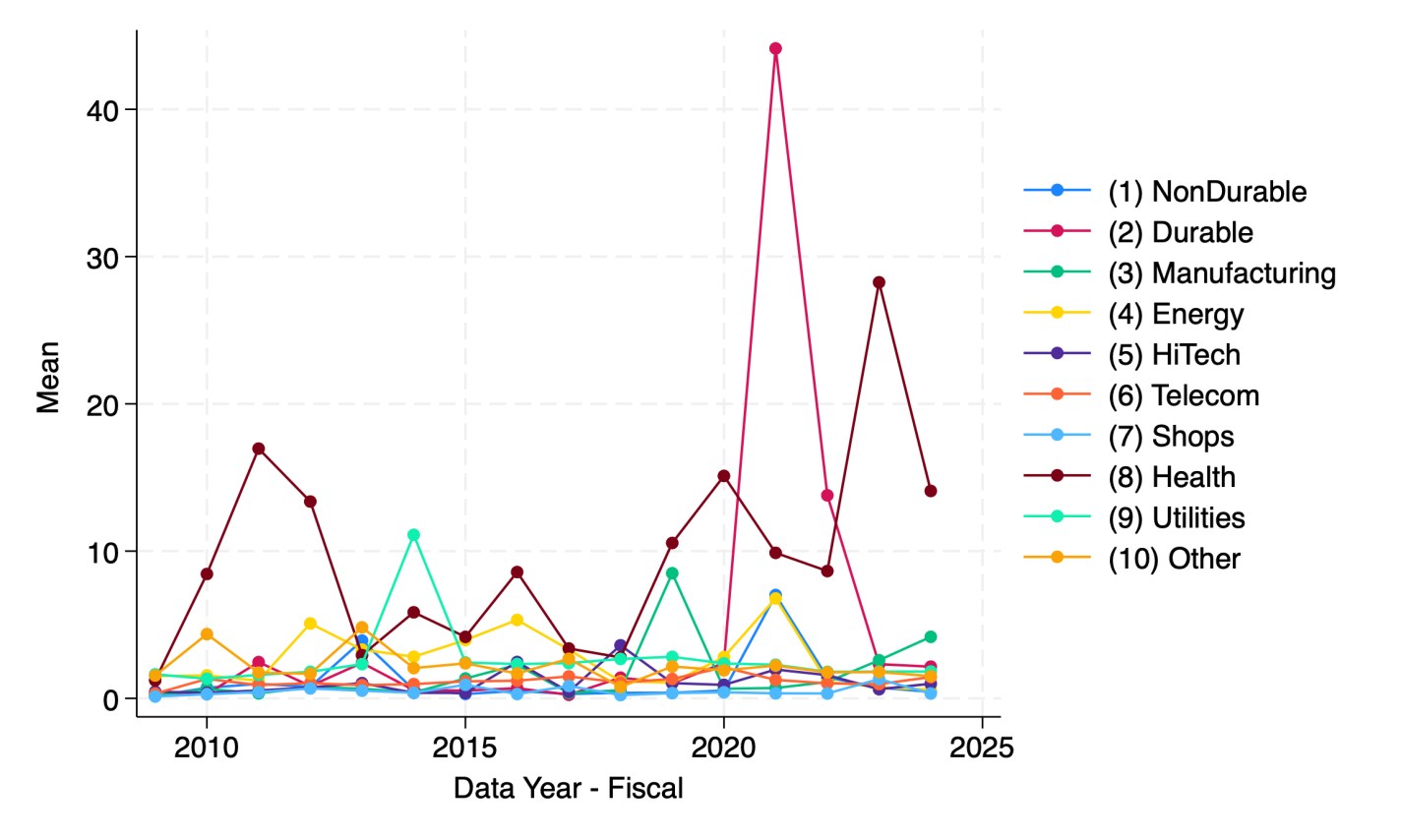
This shows that health care is actually the least-indebted sector, and telecommunications the most indebted, followed by utilities and “other” (a broad category that actually covers most firms in the Fama-French 10). But are health care firms really more conservative about debt, or are they just smaller? Let’s scale the debt by showing it as a share of revenue:

My graph made from Compustat North American Fundamentals Annual data collapsed by SIC code into the Fama-French 10 sectors (dltt/revt).

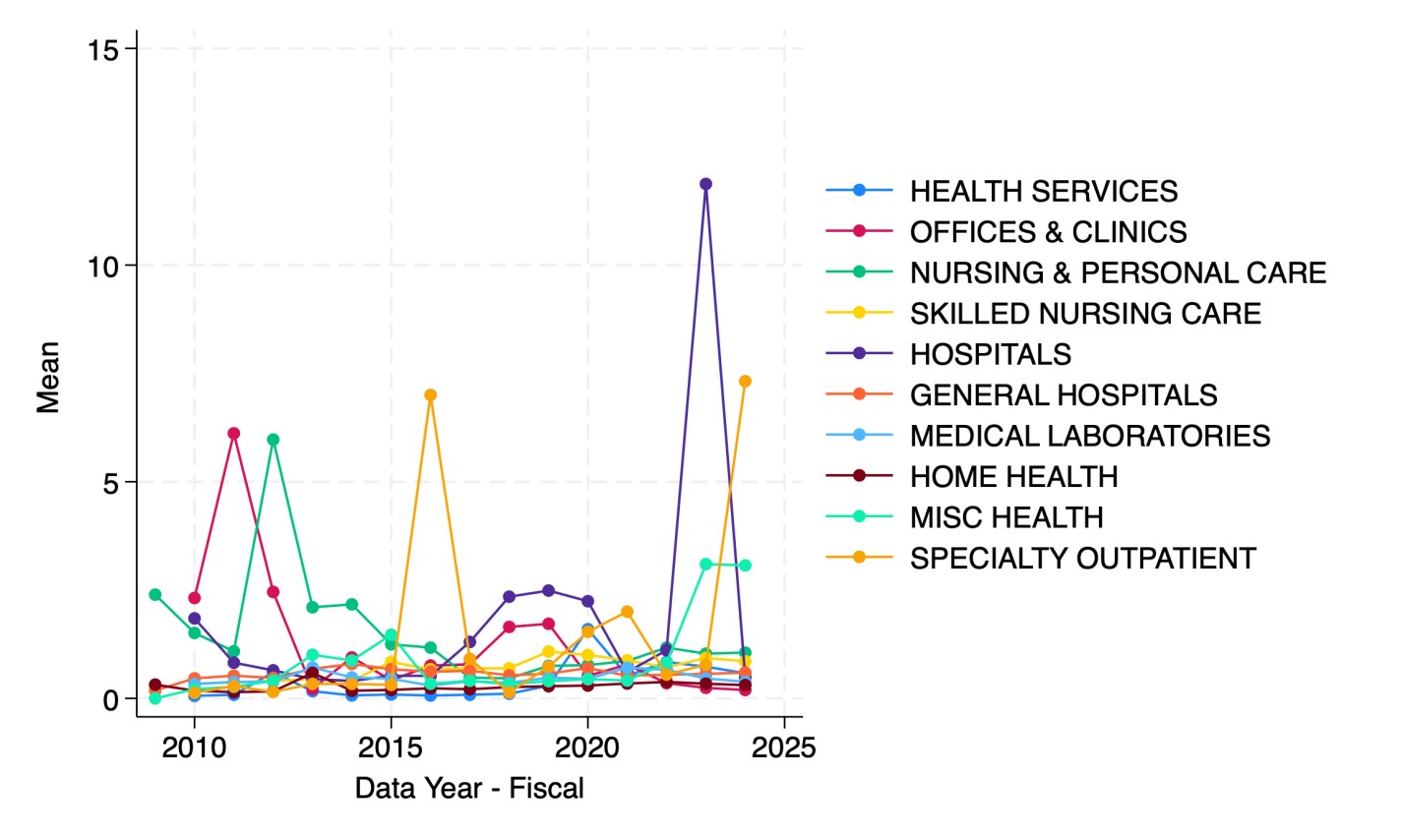
It appears that health care firms are the most indebted relative to revenue since 2023. But which parts of health care are driving this?

Hospitals in 2023 followed by specialty outpatient in 2024. However, seeing how much the numbers bounce around from year to year, I suspect they are driven by small numbers of outlier firms. This could be because Compustat North America data only covers publicly traded firms, but many sectors of health care are dominated by private corporations or non-profits.

I welcome suggestions for datasets on the bond-market side of things that are able to do industry splits including private companies, or suggestions for other breakdowns you’d like to see me do with Compustat.

Montana’s New Property Tax System

SPOILER ALERT if you are watching the TV Series Yellowstone: at the start of Season 5, John Dutton (played by Kevin Costner) is sworn in as Governor of Montana. One of his first proposals in his inaugural address is that the state legislature “double property taxes for non-residents” who have been buying up vacation homes in the state, and contributing to the increase in property values in the state (a fact which drives many plotlines throughout the series). This episode aired in November 2022.

This week, the real governor of Montana signed a pair of bills which effectively did what the fictional governor John Dutton proposed: significantly increasing property taxes on non-residents. Starting in tax year 2026, the property taxes for non-primary residences (which will include non-Montana residents and Montanans who own vacation homes) will be based on 1.9% of market value, while Montana residents will pay a graduated rate structure for their primary residence: 0.76% for property up to the state median (currently about $340,000), 0.9% up to two times the state median, 1.1% for the value between 2 and 4 times the state median, and 1.9% (the same as non-residents) for the value of homes above 4 times the state median ($1.36 million currently). Currently residential property is taxed at 1.35% of market value, meaning that while the rate hasn’t fully doubled for non-residents, most non-residents will be paying twice or more in property taxes than Montana residents.

I was a non-resident member of the Montana Property Tax Task Force, and served on the “Tax Fairness” subcommittee where the plan for HB 231 originated, so I have somewhat of a unique perspective on these changes to property tax rates. I will offer a few thoughts, some of which are critical, but let me first say that it was a great honor to be asked to serve on the Task Force by Montana’s Governor. Also, everyone on the Task Force was very friendly and receptive to ideas from outsiders (I was one of three non-Montanans on the Task Force), and so my comments here are not critical of the Task Force process nor anyone on it. As I did when I served on the Task Force, my goal in this post is to try, as best as I can, to objectively analyze how this proposal (now law) will impact Montana.

Continue reading

United Health Care Stock Implodes After Withdrawing Guidance, CEO Suddenly Resigns, and WSJ Alleges DOJ Fraud Probe

The United Healthcare Group (UNH) is a gigantic ($260 B market cap, even after recent dip) health plan provider, which until recently seemed to be the bluest of blue-chip companies. It is a purveyor of essential medical services with a wide moat, largely unaffected by tariff posturing, and considered too big to fail. The ten-year stock price chart shows it steadily grinding up and up, shrugging off market tantrums like 2020 and 2022, and even the tragic gunning down of one of its division presidents in December.

But things really unraveled in the past month. Let’s look at the charts, and then get into the underlying causes.

The year-to-date chart above shows the price hanging around $500, then rising to nearly $600 as the April 17 quarterly earnings report approached. Presumably the market was licking its chops in anticipation of the usual UNH earnings beat. The actual report was OK by most corporate standards, but it failed to match expectations. Revenue growth was a hearty +9.8% Y/Y, but this was $2.02B “miss”. Earnings were up 4% over year-ago Q1, but they missed expectation (by a mere 1%). What was probably much more disturbing was guidance on 2025 total adjusted earnings down to $26 to $26.50 per share, compared to $29.74 consensus.

That took the stock down from $600 to around $450 immediately, and then it drifted below $400 in the following month as investors looked for and failed to find better news on the company. But then two things happened last week. The effects are seen in the 1-month chart below:

On May 13 (blue arrow) the company came out with a stunning dual announcement. It noted that the recently-appointed CEO, Andrew Witty, had suddenly resigned “for personal reasons.” The blogosphere speculated (perhaps unfairly) that you don’t suddenly resign from a $25 million/year job unless your “personal reasons” involve things like not going to prison for corporate fraud. The other stunner was that the company completely yanked 2025 financial guidance, due to an unexpected rise in health care costs (i.e., what they must pay out to their participants). Over the next day or two, the stock fell to about 50% of its value in early April.

Then on May 14 the Wall Street Journal came out with an article claiming that the U.S. Department of Justice is carrying out a criminal investigation into UNH for possible Medicare fraud, focusing on the company’s Medicare Advantage business practices. The WSJ said that while the exact nature of the allegations is unclear, it has been an active probe since at least last summer.

UNH promptly fired back a curt response to the “deeply irresponsible” reporting of the WSJ:

We have not been notified by the Department of Justice of the supposed criminal investigation reported, without official attribution, in the Wall Street Journal today.

The WSJ’s reporting is deeply irresponsible, as even it admits that the “exact nature of the potential criminal allegations is unclear.”   We stand by the integrity of our Medicare Advantage program.

The stock nose-dived again (red arrow, above), touching 251, as investors completely panicked over “Medicare fraud.”  Cooler heads promptly started buying back in, leading to substantial recovery. That includes the new CEO, Steven Hemsley, who was the highly-paid CEO from 2009 to 2017, and since then has been the highly-compensated “executive chairman of the board”, a role created just for him. Pundits were impressed that he stepped in to buy some $25 million of UNH stock near its lows, saying wow, he is really putting some skin in the game. Well, not really: the dude is worth over $1 billion (did I mention high compensation of health care execs?), so $25 mill is hardly heroic. He is already up some 12% or a cool $3 million on this purchase, a tidy little example of how the rich become richer.

We’re harder on the ones that are listening

“We hurt the ones we love because we can” is a cliche, though perhaps I should be attributing it to a specific writer. Its truth is something that I find extends beyond our close familial, platonic, and romantic relationships. The mechanism behind misdirected aggression is simple: we are exposed to a source of stress that we are unable to affect, and the innocent bystanders most proximate to us become collateral damage specifically because we can affect them. The anger inside us needs to go somewhere and, in a parable of true irony, your mutual affection becomes the channel through which you express anger and frustration that has nothing to do with them.

There are a lot economists, writers, pundits, public intellectuals whose work I consume. Often I agree, sometimes I don’t, but I keep reading them because I consistently learn from them. Lately I’ve found myself becoming more frustrated with a greater share of their writing, often because they’re not being hard enough on the Trump administration, attempts to dismantle core insitutions, or the indiscriminate cruelty behind the rampant incompetence. I want them to be meaner and angrier and more direct. I want them to have an affect that I can’t. To be clear, I’ve attributed more power and influence to them than they actually have, but I think that’s not the real problem.

The real problem is that I know that no one in the Trump administration cares that they are cruel or incompetent. You can, at best, embarrass these people briefly, but you can’t shame them. They only internalize consequences and they’ve yet to experience any. They have coalesced around the singular belief that has served as the North Star for Trump’s entire life: there are no rules. Rules are fake. An illusion. A mass delusion. There are no rules and you can do whatever you want in the moment that serves your ambitions and ego and then move on to the next thing.

What do you do when your entire mechanism for affecting and contributing to world is the written word, criticism, the speaking of evidence-based truth to power and that power doesn’t care? What I find myself tempted to do, and what a lot commentators our there (especially on bluesky) are doing, is attacking the people who might and do actually listen with an undeserved fury. The criticism is often valid, but it’s just 30% meaner than it needs to be. More personal. More cruel.

I care about AI. I care about energy subsidies. I care about crime and education and health. But, if I’m being honest, there are times every day when I don’t. I’m a professor, I care about and contribute to bleeding edge research, but the moment we are living through isn’t about PhD level questions. These are 5th grade social studies times. Democracy. Rule of law. Citizenship. All men are created equal. Basic human dignity. That’s the reality and it’s not hyperbole.

I hope everyone will keep doing their research and commentary about the nitty gritty of day to day science. I also hope that everyone will take the time to grant just a bit more space emphasizing the basics, to leave no doubt about where they stand. Becaue no matter how someone might identify politically, in this moment it’s mostly irrelevant. Liberal, conservative, libertarian, classical liberal, neoliberal, new liberal, social democrat. The differences are trivialities. There are only two groups that matter: those who want to keep the basic institutions intact and those that want to burn it to ground. That’s it.

So just keep that in mind when you’re mad about someone online, about what they wrote, what you think they believe. Are they trying to hold the world together while bandits are stripping the walls for copper and carving out chunks of marble from every load-bearing pillar? If the answer is yes then they deserve grace. I’m trying and I hope you’ll do the same for me.

Tariff Tilly (Satire)

Satire news shows are, in my opinion, one of the higher forms of art that my country has produced (and an example of our exports). “Meet Tariff Tilly, the perfect replacement for the 37 dolls your kid does not need” from The Daily Show

“Tariff Tilly” builds. There is even a comment on interest rates (addressed in my previous post).

In this house, we believe in economists writing about dolls. You can find more at https://economistwritingeveryday.com/?s=barbie or https://economistwritingeveryday.com/?s=dolls

Manufacturing Jobs of the Past

This post is co-written with John Olis, History major at Ave Maria University.

There is a popular myth that manufacturing jobs of the past provided a leg-up to young people. The myth goes like this. Manufacturing jobs had low barriers to entry so anyone could join. Once there, the job paid well and provided opportunities for fostering skills and a path toward long-term economic success. There is more to the myth, but let’s stop there for the moment. Is the myth true?

One of my students, John Olis, did a case study on Connecticut in 1920-1930 using cross sectional IPUMS data of white working age individuals to evaluate the ‘Manufacturing Myth’. We are not talking causal inference here, but the weight of the evidence is non-zero. The story above has some predictions if not outright theoretical assertions.

  1. Manufacturing jobs paid better than non-manufacturing jobs for people with less human capital.
  2. Manufacturing jobs yielded faster income growth than non-manufacturing jobs.
  3. Implicitly, manufacturing jobs provided faster income growth for people with less human capital.

Using only one state and two decades of data obviously makes the analysis highly specific. Expanding the breadth or the timescale could confirm or falsify the results. But historical Connecticut is a particularly useful population because 1) it had a large manufacturing sector, 2) existed prior to the post WWII boom in manufacturing that resulted from the destruction of European capacity, and 3) had large identifiable populations with different levels of human capital.

Who had less human capital on average? There are two groups who are easy to identify: 1) immigrants and 2) illiterate people. Immigrants at the time often couldn’t speak English with native proficiency or lacked the social norms that eased commercial transactions in their new country (on average, not always). Illiterate people couldn’t read or write. Therefore, having a comparative advantage in manual labor, we’d expect these two groups to be well served by manufacturing employment vs the alternative.

Being cross-sectional, the individuals are not linked over time, so we can’t say what happened to particular people. But we can say how people differed by their time and characteristics. Interaction variables help to drill-down to the relevant comparisons. There are two specifications for explaining income*, one that interacts manufacturing employment with immigrant status and one that interacts the status of illiteracy. The baseline case is a 1920 non-operative native or literate person. Let’s start with the below snapshot of 1920. The term used in the data is ‘operative’ rather than ‘manufacturer’, referring to people who operate machines of one sort or another. So, it’s often the same as manufacturing, but can also be manufacturing-adjacent. The below charts illustrate the effect of lower human capital in pink and the additional subpopulation impacts of manufacturing in blue.

In the left-hand specification, native operatives made 2.2% less than the baseline population. That is, being an operative was slightly harmful to individual earnings. Being an immigrant lowered earnings a substantial 16.8%, but being an operative recovered most of the gap so that immigrant operatives made only 6.1pp less than the baseline population and only 3.9pp less than native operatives. In the right-hand specification, unsurprisingly, being illiterate was terrible for one’s earnings to the tune of 23.4pp. And while being an operative resulted in a 1.2% earnings boost among natives, being an operative entirely eliminated the harm that illiteracy imposed on earnings.

Both graphs show that manufacturing had tiny effects for a typical native or literate individual. But manufacturing mattered hugely for people who had less human capital. So, prediction 1) above is borne out by the data: Manufacturing is great for people with less-than-average human capital.

But what about earnings *growth*? See below.

Continue reading

The Most Regulated States

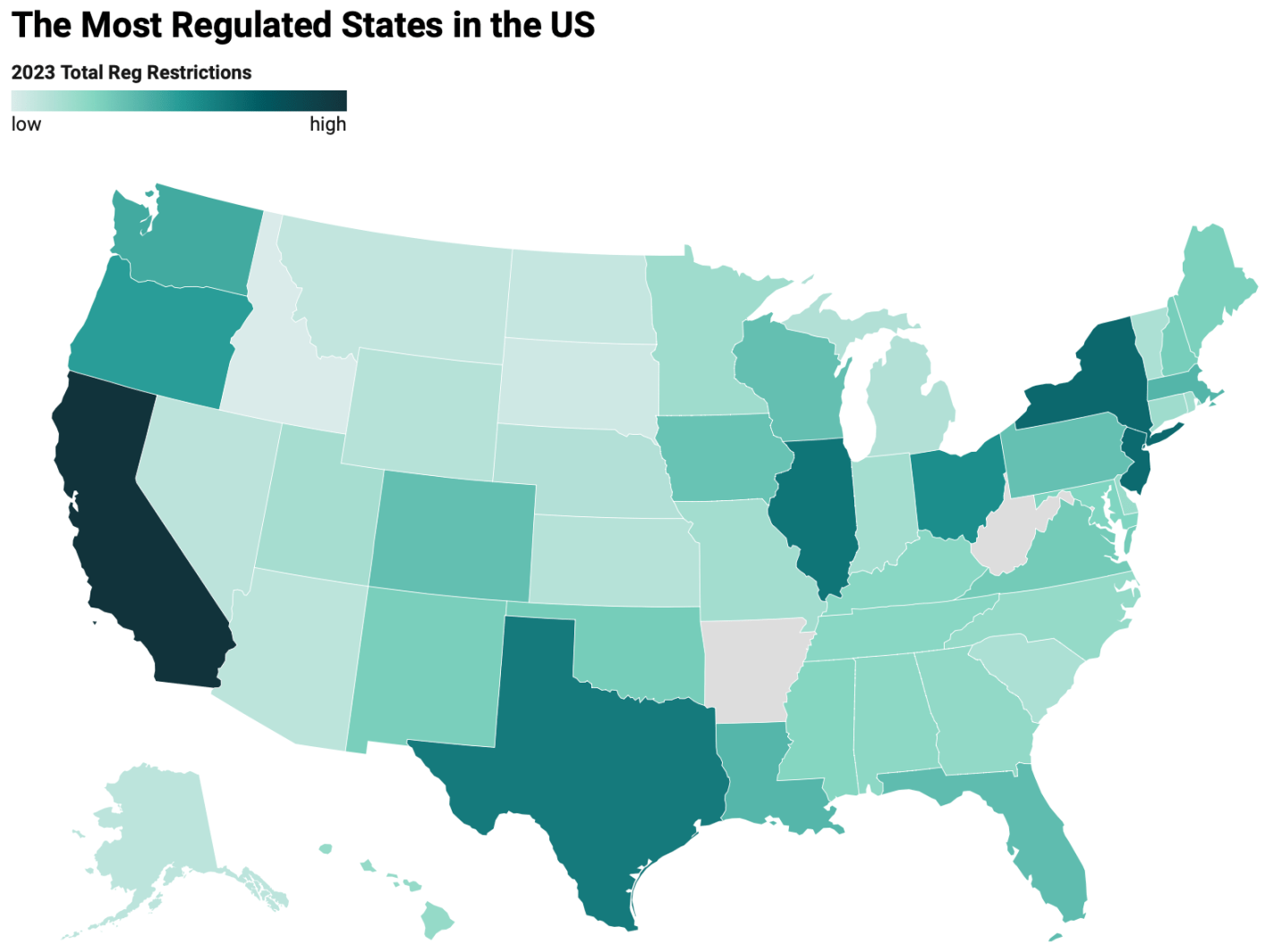
The Mercatus Center has put together a page of “Snapshots of State Regulation” using data from their State RegData project. Their latest data suggests that population is still a big predictor of state-level regulation, on top of the red/blue dynamics people expect:

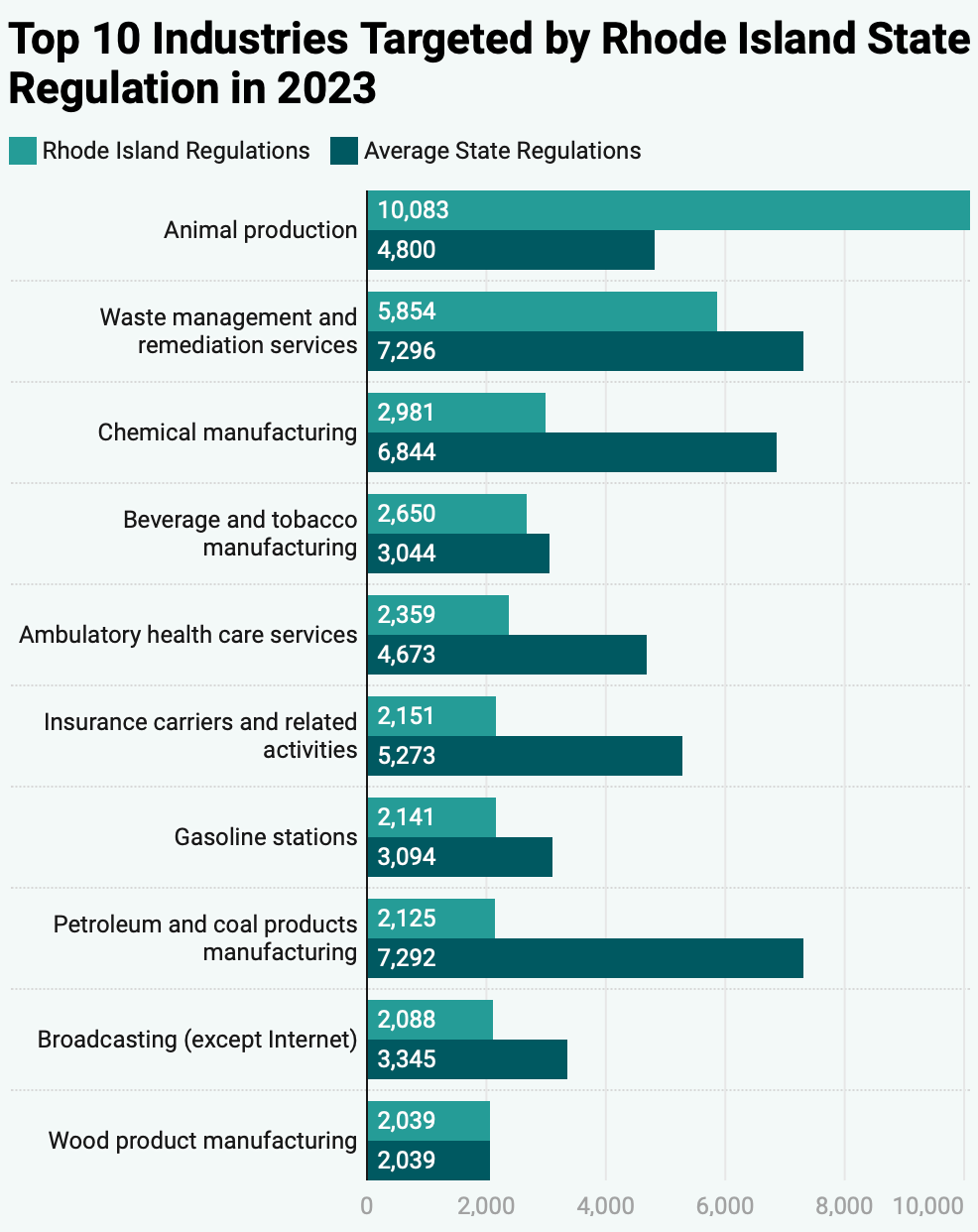
They also made pages with much more detail on each state, like what the most regulated industries in each state are and how each one compares to the national average:

You can find your state here.