Understanding Inflation and Interest Rates

Anyone who teaches Macroeconomics knows that these concepts are hard for people to understand at first.

A clip about inflation has been making the rounds.

Transcripts provided by CNN show the following

CNN NewsNight with Abby Phillip
Aired April 17, 2025 – 22:00 ET

ABBY PHILLIP, CNN ANCHOR

BATYA UNGAR-SARGON, AUTHOR, HOW THE ELITES BETRAYED AMERICA’S WORKING MEN AND WOMEN

CHARLOTTE HOWARD, EXECUTIVE EDITOR, THE ECONOMIST

PHILLIP: Jerome Powell is the head of the Fed and has a mandate to keep inflation low and employment high. So if there are, you know, macroeconomic things that are happening in the economy that make it very difficult for him to do that, you don’t think he’s going to comment?

UNGAR-SARGON: Do you know what would have really helped? What would be a really good idea right now to help bring down inflation and make sure that things keep running smoothly? It’s dropping interest rates. Why doesn’t he do that?

PHILLIP: Why doesn’t he do that?

HOWARD: So interest rates, if you were to drop interest rates, you would stoke inflation.

GPT expands on Howard’s point: “Dropping interest rates would not lower inflation—in fact, it typically makes inflation worse.

Interest rates are a key tool the Federal Reserve uses to manage inflation. When rates are lowered, it becomes cheaper to borrow money. This encourages people and businesses to take out loans, spend more, and invest more, which increases demand for goods and services.

But when demand rises faster than supply can keep up, prices go up—that’s inflation.

So, in a time of high inflation, cutting interest rates would likely make the problem worse, not better. The Fed raises interest rates to make borrowing more expensive, which slows down spending and cools demand, helping to bring inflation under control.”

Recall that the United States achieved disinflation starting in 2022, largely due to the Federal Reserve’s aggressive interest rate hikes. Tyler calls the disinflation America’s triumph.

As for the commentariat, a diverse array of economists ranging from the Keynesian Paul Krugman to many conservative economists recognized that rate increases and disinflation were necessary and had to be done with promptness and fortitude. And so credibility reigned.
It’s the Humidity

Recently, I learned what humidity is. That might sound stupid, so let me clarify. I knew that humidity is the water content of the air. I also knew that the higher the number, the more humid. Finally, I also knew that the dew point is the temperature at which the water falls out of the air. But, now I understand all of this in a way that I hadn’t previously.

First, what does it mean for there to be 70% humidity? As it turns out, it’s a moving target. There are two types of humidity: specific and relative. Specific humidity is the mass of water in, say, a kilogram of air. So, more humidity means more water. This is obvious. There’s a related concept called absolute humidity, which is more like mass of water per volume of air (sometimes used in place of specific humidity). Again, more humidity means more water. Neither of these is the way that humidity is reported on the weather channel.

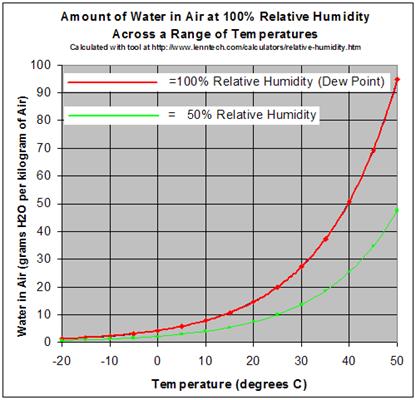
Relative humidity is the number that you see in your weather app. What’s that? Relative to what? First, we need to know that warm air can hold more water than cool air. Pressure also matters, but atmospheric pressure doesn’t change enough to make its effect on humidity significant on relevant margins. So, all of this discussion, and the number in your phone, is at atmospheric pressure. Below is a graph that illustrates the maximum amount of water that can be in the air at different temperatures (red line). So, at 30 degrees Celsius (86 degrees Fahrenheit), there can be as much as 27 grams (0.95 oz or ~2 tablespoons) of water in the air.

More after the jump.

Continue reading

The Best Investments of the 1970s

The tariffs still have me thinking about buying VIX calls and stock puts (especially when policy changes loom on certain dates like July 8th), and on the bigger question of finding the sort of investments that did well in the 1970’s, another decade of stagflation that was kicked off by a President who broke America’s commitment to an international monetary system that he thought no longer served us.

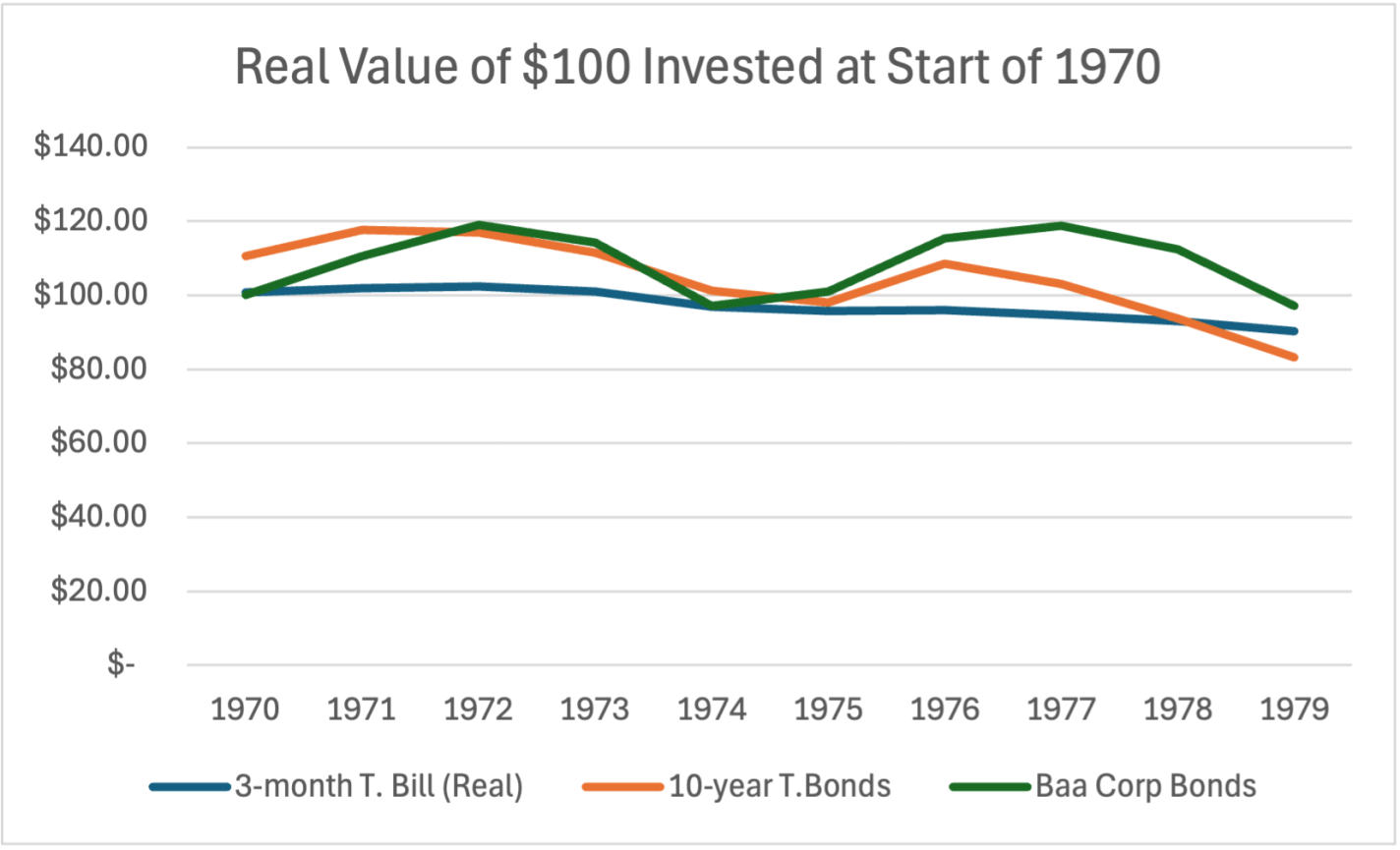
That’s how I concluded last week. So this week I’ll answer the question- what were the best investments of the 1970’s? When the dollar is losing value both at home and abroad, holding dollars or bonds that pay off in dollars does poorly:

Source: My calculations using Aswath Damodaran’s data

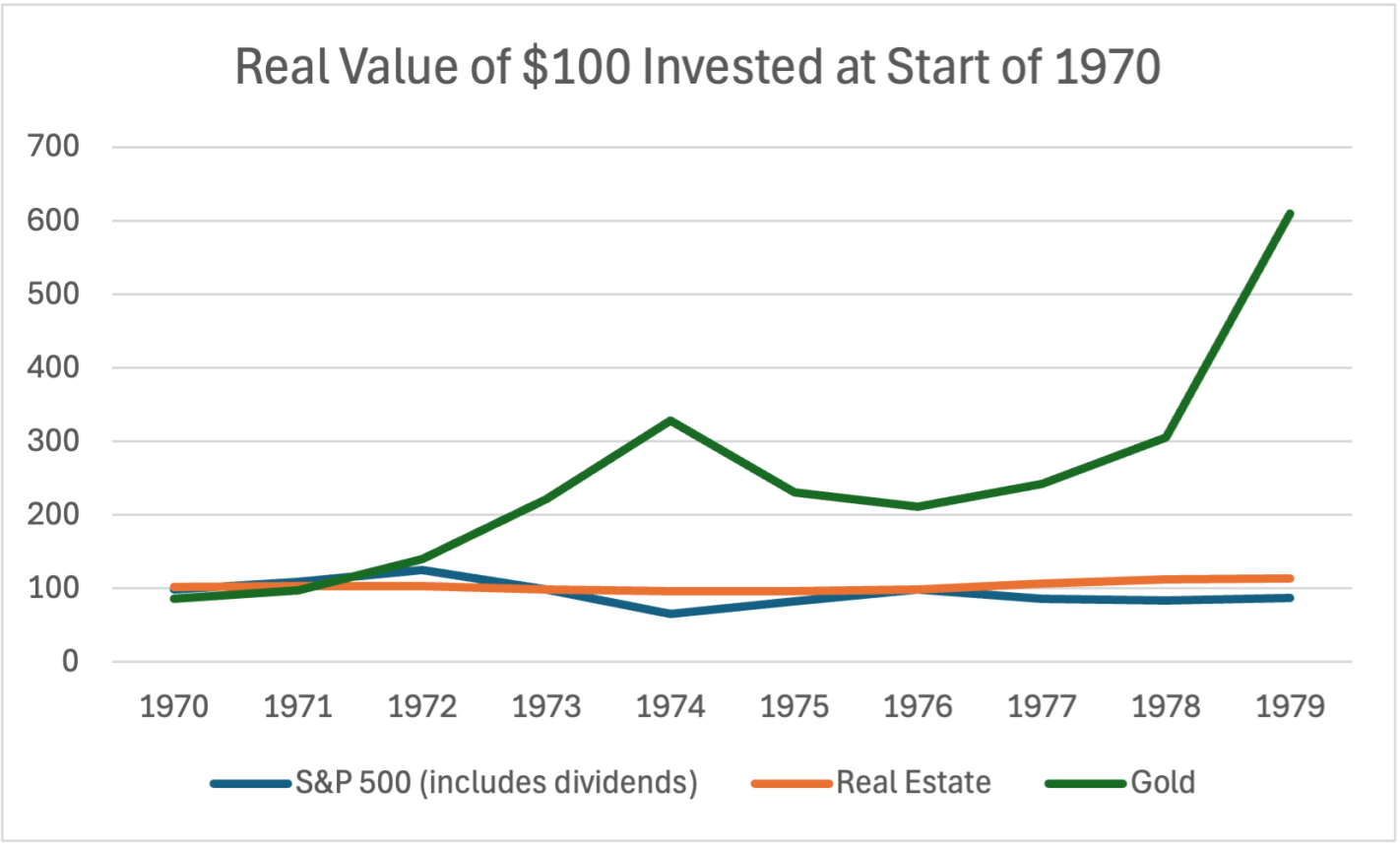
Stocks can do alright with moderate inflation, but US stocks lost value in the stagflation of the 1970’s. Foreign stocks and commodities generally performed better. Real estate held its value but didn’t produce significant returns; gold shone as the star of the decade:

Source: My calculations using Aswath Damodaran’s data

Gold is easy to invest in now compared to the 1970s; you don’t have to mess with futures or physical bullion, there are low-fee ETFs like IAUM available at standard brokerages.

Of course, while history rhymes, it doesn’t repeat exactly; this time can and will be different. I doubt oil will spike the same way, since we have more alternatives now, and if it did spike it wouldn’t hurt the US in the same way now that we are net exporters. Inflation won’t be so bad if we keep an independent Federal Reserve, though that is now in doubt. At any time the President or Congress could reverse course and drop tariffs, sending markets soaring, especially if they pivot to tax cuts and deregulation in place of tariffs ahead of the midterms.

Things could always get dramatically better (AI-driven productivity boom) or worse (world war). But for now, “1970s lite” is my base case for the next few years.

GDPNow: Still Negative on Q1, But Less So

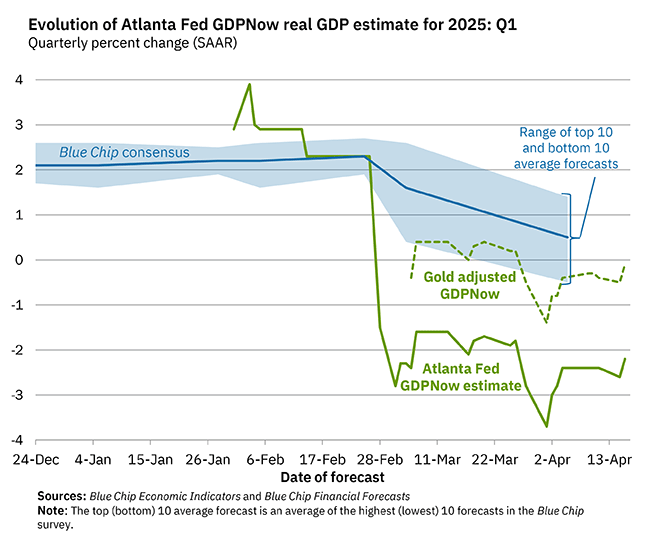
Last month I wrote about the projected decline in GDP from the Atlanta Fed’s GDPNow model. Since then, they have released an alternative version of the model, which includes a “gold adjustment” to account for non-monetary gold inflows, which may be impacting the model to overstate the negative impact of imports (and it looks like this may be a permanent change to the model).

With those changes, and some more recent data, the GDPNow model is still pointing to a negative reading for Q1 of 2025, though only very slightly now: -0.1%.

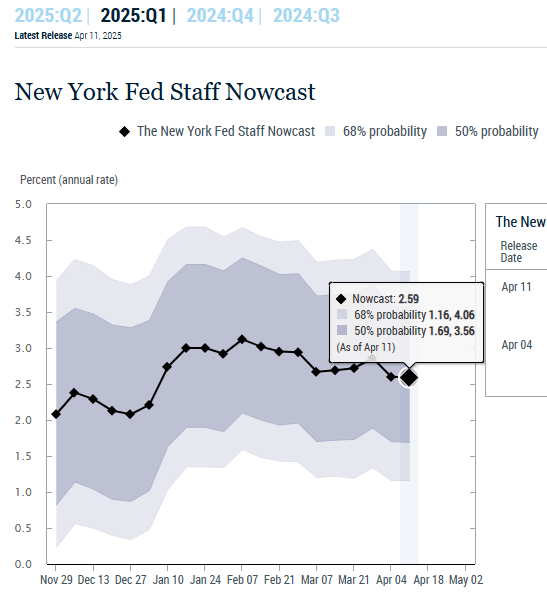
It’s also worth noting that the New York Fed has a similar model, but one with very different estimates right now: about 2.6% for Q1.

We’ll still have to wait until April 30th to get the preliminary estimates from BEA.

Long-Short Funds Can Mitigate Your Portfolio Gyrations

Here we discuss some stock funds that go down less than stocks in general; the flip-side is that they go up less than plain stocks, as well. Some investors may appreciate the reduction in gyrations, especially after a week like the previous one.

Long-short funds come in two main flavors. When you buy a stock, that is considered being “long”. If you short-sell a stock (borrow shares from some broker, that you plan to pay market price for later, such that you make roughly one dollar for every dollar the stock goes down), that is being short.

 “Equity-neutral” funds are short as much value of stocks as they are long. So, they are net 0% long. Obviously, you would expect the value of such a fund to not decline much in a market crash. But conversely, it would not go up much in a bull market, either. So how is this better than just holding cash in your account? The magic is if the active fund managers can manage to be long a set of stocks which go up more than the stocks that they short. They often try to pair longs and shorts in the same sector. For instance, in 2024 if a fund was long Nvidia and short Intel (another stock in the semiconductor sector), that would have been a big net win. Sometimes this works, and sometimes it doesn’t.

The actual performance of such a fund is very dependent on the active managers’ skill and luck. For instance, here is a ten-year total return plot of two market-neutral funds, one from AQR and the other from Vanguard. The Vanguard fund (VMNIX) muddled along pretty flat from 2015 through 2021, then had a slow rise 2021-2023, then went flat again. The performance of the AQR fund (QMNNX) has been more erratic. It went up 2015-2017, then down a lot (this would have been hard to bear at the time, when the S&P was roaring upward) for 2018-2020. It then roughly matched the Vanguard fund for a couple of years, then pulled way ahead 2023-2025, as it made some great long/short choices:

However, the ten-year performance of these funds fell far short of a simple S&P500 holding (blue line above). Since stocks go up the vast majority of the time, a long-short fund which is net long seems to make more sense.

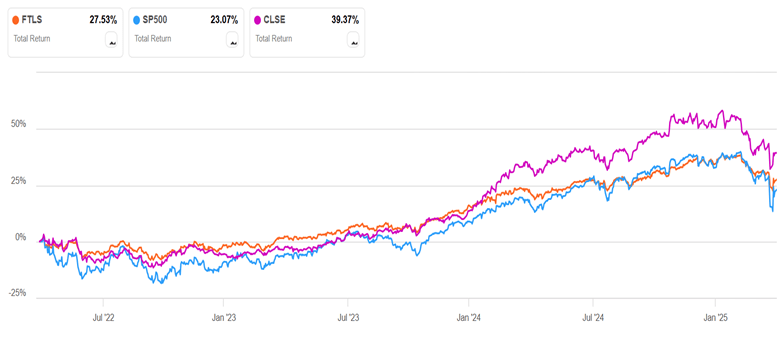
A plain vanilla net-long long-short fund is FTLS. It seems to be among the best of the long-short ETFs. It is usually about 60% net long. I modeled its performance against a portfolio of 60% S&P 500 stocks and 40% cash (rebalanced periodically), and it performed about the same. That is, FTLS went up and down with moves about 60% of what the S&P did. That is OK, but one might wonder why one would hold such a fund instead of just holding a 60/40 stocks/cash allocation for the same amount of investment. If we look at time periods with appreciable down periods, such as the past three years (see chart below), FTLS does look comforting; its muted dips in 2022 and 2025 compensate for its slower rise in 2023-2024, so it presents as a slow, fairly steady rise with a 3-year total return slightly higher than S&P. It is certainly easier psychologically to hold such a fund, and it might help small investors avoid the deadly mistake of panic-selling during a market downturn.

CLSE is a long-short fund that is often about 70% long. Management there takes a more swashbuckling, risk-taking approach. It went down less than S&P in the bear market of 2022 (as expected), and then it soared high above S&P in the first half of 2024, as it made skillful/lucky picks to go very long tech growth stocks like NVDA. That tech-heavy approach has backfired so far in 2025, since CLSE has fallen as much as S&P in the past several months (NOT what one hopes for a long-short fund). Despite that glitch, however, CLSE still weighs in with a 3-year return far ahead of the broader S&P (39% vs. 23%):

Another strategy to mitigate market ups and downs is for a stock fund to buy and sell put and call options, to create a “collar” effect. Buying puts limits the downward movements; the puts are financed by selling calls, which limits the upward swings. The fund ACIO, for instance, seeks to capture 65% of the S&P’s upside, while limiting loss to 50% of the downside.  In my stock charting, I found it ended up performing about like FTLS.  As of a week ago (Tue, Apr 8), the S&P was down 15% year to date (i.e., since Jan 1), while FTLS and ACIO were only down 8.3 % and 9.6%, respectively.

Standard Disclaimer: This is for information only. Nothing here is advice to buy or sell any security.

What I’ve been reading

In no particular order:

Caetano, Gregorio, and Vikram Maheshri. “Identifying dynamic spillovers of crime with a causal approach to model selection.” Quantitative Economics 9.1 (2018): 343-394.

The “broken windows” theory of crime (i.e small crimes lead to bigger crimes) continues continues to find very little support.

Cabral, Marika, and Marcus Dillender. Air pollution, wildfire smoke, and worker health. No. w32232. National Bureau of Economic Research, 2024.

Air quality remains an underrated public good.

McBride, Michael, and Garret Ridinger. “Beliefs also make social-norm preferences social.” Journal of Economic Behavior & Organization 191 (2021): 765-784.

It’s conditional cooperation all the way down.

Literature on Recent Advances in Applied Micro Methods

Your one-stop-shop for an updating list of the papers currently advancing causal identification in social science

Research on Big Questions April 2025

I’m working on a new paper with Bart Wilson. We might have a draft to release soon.

  1. https://economistwritingeveryday.com/2023/03/25/discrepancy-in-views-about-music-pirating/  In that post, I pointed out that the estimates reported in journals for the effect of pirating on music revenues range from almost 0% to almost 100%. There is room for new empirical work. Not often is the range of the estimates that big.
  2. My coauthor Bart Wilson did an interesting podcast episode for the Curious Task in 2020.

https://thecurioustask.podbean.com/e/ep-64-bart-wilson-%e2%80%94-is-the-idea-of-property-universal/

Episode: Bart Wilson — Is The Idea of Property Universal? 

I’m providing a rough transcription of the part that stood out to me, because he identified a prime big unanswered question. This is around minute 7 of the episode.

Host: Why is [the Property Species] an interesting topic deserving of a book?

Bart Wilson: “So, I work with primatologists… and I would talk to them about what I’m working on with my laboratory experiments on property. They would say, ‘Oh yeah. Dolphins do that, too, or baboons. … scrub jays re-cache their food if another scrub jay is watching them so they are protecting themselves against theft… so property is all over the animal kingdom. And then I’m also working with my colleague in the English department. In the humanities, property is a very narrow thing, something Western European. It’s very modern. And, so, in one part of the academy property is this broadly natural phenomenon and in another part of the academy it’s very local: only some humans have it. And so, as a social scientist…”

Bart identified a gap in understanding. Property cannot be both common to all animals and rare among humans. In his book The Property Species he spans that gap by claiming (spoiler alert) that property is common to all humans and only humans. Human language is an important piece of that story. No other animal can wield complex symbolic language.

In our new paper (manuscript forthcoming) we’ll be investigating how humans use symbolic language to describe nonrivalrous digital resources.

Old Fashioned Function Keys

Your Function Keys Are Cooler Than You Think
by someone who used to press F1 by mistake

Ever notice the F keys on your keyboard? F1 through F12. Sitting at the top like unused shelf space. If you’re at a computer now, take a glance. I used to think they did nothing, or at least nothing for me. Maybe experts used them. Experts who know what BIOS and DOS are.  But for me, just little space fillers with no purpose. I frequently pressed F1 by accident rather than escape. A help window would pop up, wasting half a second of my life until I closed it.

But the Fn keys (function keys) are sneaky useful. They can save you serious time. No clicking. No dragging. No fumbling with touchpad mis-clicks.

When using a web browser, F5 refreshes the web page. Windows has added the same functionality for folders too, updating recently edited files. Fast and easy. F11 changes your web browser view to full screen. Great for long reads or historical documents. F12 shows the guts of a webpage. That’s perfect if you web scrape or need to know what things are called behind the scenes. Ctrl + F4 closes a tab. Alt + F4 shuts the whole application instance down. That last one works for almost all applications.

Excel? F4 saves so much of your life. It toggles absolute cell, row, and column references. Have you ever watched someone try to click on the right spot with their touchpad and manually press the ‘$’ sign… twice? I can feel myself slowly creeping toward death as my life wastes away. Whereas pressing F4 lets you get on with your life. F12 in most Microsoft applications is ‘Save As’. No need to find the floppy disk image on that small laptop screen. PowerPoint has its own tricks—F5 begins the presentation. Shift + F5 starts it from the current slide. Not bad. And don’t forget F7! That’s the spellcheck hotkey. But now it’s been expanded to include grammar, clarity, concision, and inclusivity.

Continue reading

The Wild Market of July 8th, 2025

April 2nd drove the point home- when someone in a position to know tells you something big is coming on a precise date, it is a smart time to act. As opposed to doing what I have done, which is think about acting but ultimately do nothing.

Ahead of April 2nd this year, the White House made a big deal of how they had a big announcement on trade coming April 2nd and I thought “this could go better or worse than markets expect, but some big move is coming, this seems like a great time to invest in volatility through something like VIX options expiring shortly after April 2nd”, but then I didn’t buy VIX options. I didn’t totally understand how they worked, didn’t want to buy without finding out, and didn’t make time to find out. My instinct was right though- the VIX more than doubled last week, so the right options on it much more than doubled. 

Ahead of the war in Ukraine in February 2022, US intelligence warned that Russia was planning to invade imminently, and I thought “they don’t have a great recent track record but it is very unusual for them to announce something so big will happen so soon, this is probably happening, this would be a good time to buy puts” but then didn’t buy puts, which of course did great as markets crashed following the invasion.

Yesterday the S&P 500 shot up 9% on the news that most of Trump’s new tariffs were paused. I thought this reaction was excessive given that the tariffs weren’t canceled, merely paused 90 days. Note that an exact date is being offered- July 8th! I sold some stocks last night and put in orders for S&P puts and VIX calls, but the limit options orders didn’t fill today as it seems the market caught up to my take from last night. The S&P is down 4% as I write this. This morning I was was researching which puts to buy, leaning toward SPY or XSP at-the-money puts for July 19 (first options date available after the 90-day tariff delay expires), then markets opened and their prices jumped 20+% in seconds as I watched. They are up over 50% now.

It is possible that the administration will fully clarify their stance on tariffs one way or another before July 8th, or even that Congress takes back their tariff power before then and makes their own deal. But I think it is more likely than not that we get a big announcement from the White House on July 8th about which tariffs will be implemented. In which case July 8th will be another wild market day.

This may already be priced in, but so far this April the situation has been changing so rapidly and touching so many parts of the markets and the real economy that even some of the most efficient markets (like US stock and bond markets) seem to be struggling to process what is happening. My ill-timed post from November praising the S&P has some lines that hold up well:

I’m now back up to 90% belief in efficient markets, at least for stocks.

This efficiency seems to change a lot over time. Probably fewer than 10% of US stocks have obvious mis-pricings right now; really none stand out as super mispriced to a casual observer like me. Instead, it seems like every 10 years or so a broad swathe of the market is driven crazy by a bubble or a crash, and you get lots of mispricing- like tech in 2000, forced/panic selling at the bottom in 2009, or meme stocks in 2021. The rest of the time, the stock market is quite efficient. So, in typical times, just be boring and buy and hold a broad index fund.

Ever since April 2nd, we have not been in typical times. At some point they will return and most people are probably best served by just holding through this (selling at the bottom and never getting back in is a big failure mode in investing). But for now the tariffs still have me thinking about buying VIX calls and stock puts (especially when policy changes loom on certain dates like July 8th), and on the bigger question of finding the sort of investments that did well in the 1970’s, another decade of stagflation that was kicked off by a President who broke America’s commitment to an international monetary system that he thought no longer served us.

Other “I, Pencils”

When the owner of X.com, also the wealthiest man in the world, posted a video of Milton Friedman explaining how a pencil is made, many economists knew exactly where that reference came from: Leonard Read’s classic essay “I, Pencil.”

If you have never read “I, Pencil,” or if it has been a while since you last did, I encourage you to read it right now. It’s quite short and easy to read, as well as easy to understand. That’s what makes it a classic. But let me also summarize what I think are the two main points:

  1. No one can make a pencil on their own — it takes thousands of people to produce all of the inputs and assemble them into a simple pencil
  2. The activities of all those thousands of people are coordinated through subtle but miraculous social institutions, such as the price system, international trade, and property rights — rather than by force through government dictate, and even mostly outside of private firms (though firms are often part of the story)

Leonard Read communicated those ideas beautifully in an essay that is, somewhat humorously, written from the perspective of the pencil itself. But many other economists and economic communicators used other examples of goods to discuss similar themes. I’ll list a few of my favorites, but please comment with yours as well. Some of these essays and videos focus more on the production of the good, some focus more on the institutions, and not all are necessarily about international trade. But these “Other I, Pencils” are great introductory readings to remind us of the power of voluntary human cooperation.

Adam Smith’s “woolen coat” — this is a short discussion early in the Wealth of Nations, describing all of the people and trade needed to produce a woolen coat for a day laborer (at the link you’ll also see a comic version of the tale).

Harriet Martineau’s “plum pudding” — Martineau was a 19th century writer that popularized many of the ideas in Adam Smith. Less well known today, her discussion of international trade needed to bring many simple foods to our table, including plum pudding, is many ways superior to Smith’s discussion (start reading at the line “You mean machines”).

Thomas Thwaites “Toaster Project” — a book and Ted Talk explaining how to make a toaster from scratch — and fail miserably despite spending over $1,000 and spending hundreds of hours, all for something you can buy for a few dollars at the store.

Russ Roberts’ “It’s a Wonderful Loaf” — a poem set to video, explaining how a simple loaf of bread is always ready for you at the bakery when you want it in the morning.

T-Shirts — many examples!

Continue reading