America has withdrawn aid from Ukraine. Contra the Vice-President, we could easily afford to reverse this, and I hope we will. I know we could afford it because even the much poorer Europeans can, and I think they might finally be ready to try.
Until now, Europe has been fighting with both hands tied behind their back- letting their economic growth fall far behind America’s due to poor policy, and committing only a tiny share of that economy to defense. Here’s how Polish Prime Minister Donald Tusk put it:
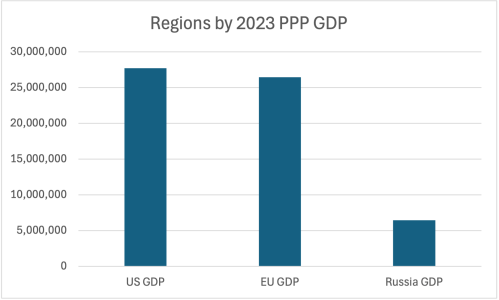
Europe may be significantly poorer than the US on a per-capita basis, but it has significantly more people, so the total size of their economy is almost as large as the US and over 4 times larger than Russia:
But Europe has put only a small fraction of their economy toward defense for a long time. Russia alone spends more on their military than the rest of Europe combined despite their much smaller economy, by putting a much larger fraction of their GDP toward the military:
When European countries spend so little on their own defense, they have little to share with Ukraine. Many leaders complaining about the end of US support have contributed much less themselves, even as a share of their smaller economies:
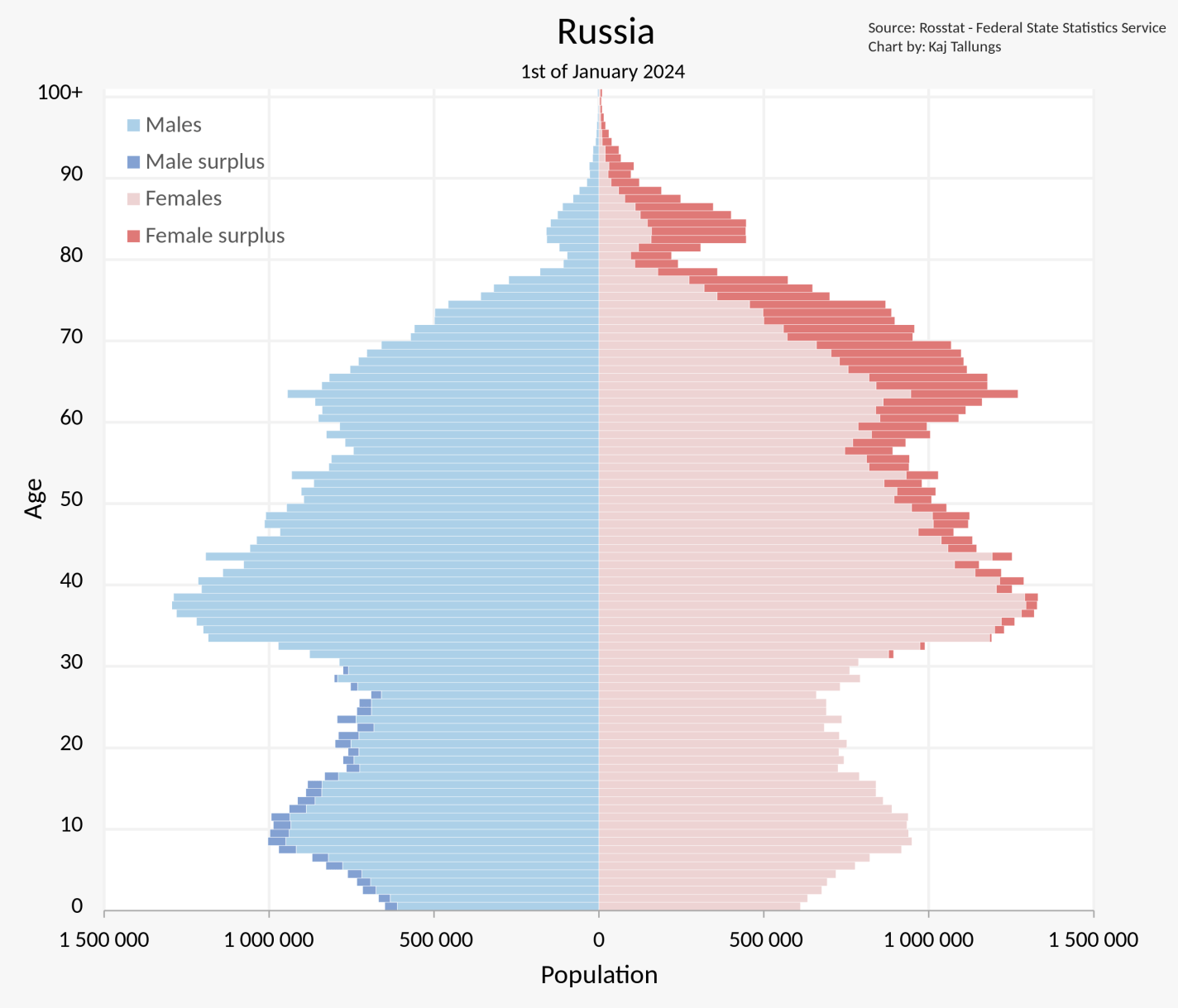
Europe can be much stronger than Russia, but only if they start trying at least half as hard as Russia. Yes, Europe has poor demographics, but Russia’s are worse; Europe has many more military-age men:
Yes, Russia has nukes, but so do Britain and France, and France might actually take advantage of this.
Economically speaking, is this a good time for Europe to rearm? To me it looks fine. The best time would have been the late 2000s to early 2010s, both because it could have been in time to dissuade Russia from starting this war, and because their economic problems then were much more about a lack of aggregate demand. But right now inflation is fine at 2.4%, NGDP growth is fine at 4.3%, and 10-year bond yields the major countries are around 3-4%. Overall this looks like AD is currently about right, but markets expected that economic growth could turn negative this year, and a burst of defense spending could head that off:
This would be especially valuable if it can be paired with the supply-side reforms that European leaders know they should to do anyway, and that would allow for more growth without pushing up inflation. Europe has fallen far behind the US in productivity, to the point that it is now a bigger issue than their higher unemployment and lower hours worked in explaining why the US is much richer:
The silver lining here is that the further behind the US they fall, the faster they could potentially grow- catchup growth is easier than frontier growth, you just need to copy the technologies and implement the strategies already figured out by the frontier economies. Europe easily has the human capital to do this, they just haven’t had the will- have preferred to regulate new technologies like fracking and AI into oblivion, along with older technologies like nuclear power. They won’t drill for oil and gas themselves in the name of decarbonization but have spent hundreds of billions on Russian oil and gas just since the war began. But if they ever decided to change their policy, their economy could rapidly improve- like letting go of the rubber band you’ve been pulling back.
European leaders appear to finally be realizing this. The European Commission just proposed a 150 billion Euro joint defense fund. This week Germany proposed spending half a trillion on infrastructure and defense, sending European stocks above their previous all-time high set in the year 2000 (!).
The EU always used to be able to excuse their economic failings by saying “at least we brought peace to a continent formerly full of war.” But this is no longer the case. If they cannot settle the war on good terms, they have no excuse. The good news is that European decline has been a choice, and it is a choice they could decide to change at any moment. Victory awaits those who will it.
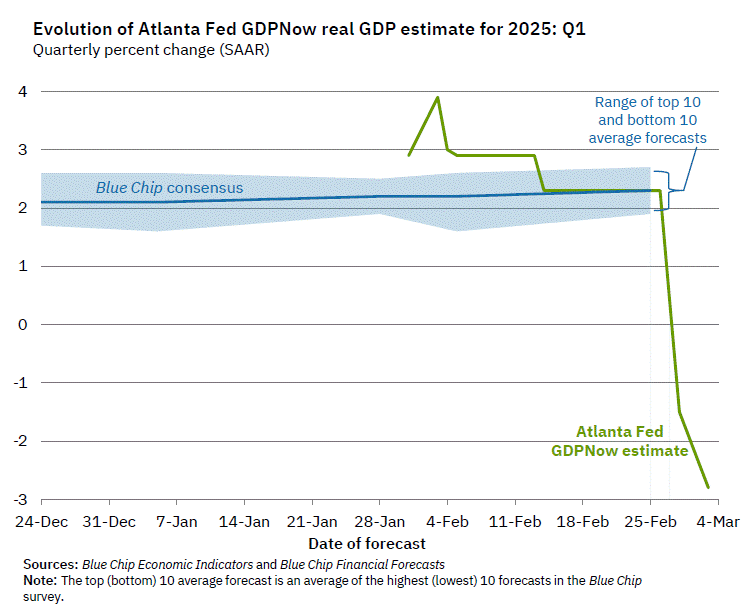
The chart comes from the Atlanta Fed’s GDPNow model, which tries to estimate GDP growth each quarter as data becomes available. The sharp drops in their Q1 forecast for 2025, based on the last two data updates, look pretty shocking. Should we be worried?
First, it’s useful to ask: has this model been accurate recently? Yes, it has. For Q4 of 2025, the model forecast 2.27% growth — it was 2.25%. For Q3 of 2024, the model forecast 2.79% growth — it was 2.82%. Those are very accurate estimates. Of course, it’s not always right. It overestimated growth by 1 percentage point in Q1 of 2024, and it underestimated growth by 1 percentage point the quarter before that. So pretty good, but not perfect. Notable: during the massive decline in Q2 2020 at the start of the pandemic, it got pretty close even given the strange, uncertain data and times, predicting -32.08% when it was -32.90% (that’s off by almost 1 percentage point again, but given the highly unusual times, I would say “pretty good”).
OK, so what can we say about the current forecast of -2.8% for Q1 of 2025? First, almost all of the data in the model right now are for January 2025 only. We still have 2 full months in the quarter to go (in terms of data collection). Second, the biggest contributor to the negative reading is a massive increase in imports in January 2025.
To understand that part of the equation, you have to think about what GDP is measuring. It is trying to measure the total amount of production (or income) in the United States. One method of calculation is to add up total consumption in the US, including by final consumers, business investments, and government purchases and investments. But this method of calculation undercounts some US production (because exports don’t show up — they are consumed elsewhere) and overcounts some US production (because imports are consumed here, but not produced here). So to make GDP an accurate measure of domestic production, you need to add in exports, and subtract imports.
Keep in mind what we’re doing in this calculation: we aren’t saying “exports good, imports bad.” We are trying to accurately measure production, but in a roundabout way: by adding up consumption. So we need to take out the goods imported — not because they are bad, but because they aren’t produced in the US.
The Atlanta Fed GDPNow model is doing exactly that, subtracting imports. However, it’s likely they are doing it incorrectly. Those imports have to show up elsewhere in the GDP equation. They will either be current consumption, or added to business inventories (to be consumed in the future). My guess, without knowing the details of their model, is that it’s not picking up the change in either inventories or consumption that must result from the increased imports. It’s also just one month of data on imports.
As always, we’ll have to wait for more data and then, of course, the actual data from BEA (which won’t come until April 30th). More worrying in the current data, to me, is not the massive surge in imports — instead, it’s that real personal consumption expenditures and real private fixed investment are currently projected to be flat in Q1. If consumption growth is 0% in Q1, it will be a bad GDP report, regardless of everything else in the data.
Since I have posted on the recreational drugs/painkillers kava and kratom for the past two weeks (here and here), I figured I would round it out with a look at the various active compounds that can be derived from the cannabis plant. I knew of THC (the main psychoactive ingredient in weed) and CBD (very tame), but there are many others. When I visited that head shop/kava bar in Florida last month, I noted that they sold a lot of products containing THC-A, THC-P, and HHC, since THC sale is illegal there:
“Super Looper” Vapes, Containing Cannabinoids
The stork clerk showed me the following road-map (with its color-coded “Measure Your Mellow” legend) of various cannabinoids, taking you from innocuous CBD (“Non-psychoactive, soothes anxiety, anti-inflammatory; calming, relaxing”) to THC-P (“Very psychoactive, best entourage effect; energizing, euphoric, total head and body high”) and HHC-P (“Strongest and longest-lasting psychoactive effect; energizing, sativa-like effect”):
Road-Map of Cannabinoids, with putative effects.
On this roadmap, the main “THC” ingredient in weed is shown as Delta-9 or trans-delta-9-Tetrahydrocannabinol (rated as “Very Psychoactive”).
I don’t want to go too far down this rabbit-hole, but out of curiosity I looked up a few articles to try to understand this zoo of mind-altering compounds. Out of sheer laziness, I’ll start with Wikipedia’s take on the pharmacology, focusing on THC itself:
When THC enters the blood stream and reaches the brain, it binds to cannabinoid receptors. The endogenous ligand of these receptors is anandamide, the effects of which THC emulates. This agonism of the cannabinoid receptors results in changes in the levels of various neurotransmitters, especially dopamine and norepinephrine, which are closely associated with the acute effects of cannabis ingestion, such as euphoria and anxiety. Some effects may include a general altered state of consciousness, euphoria, relaxation or stress reduction, increased appreciation of the arts, including humor and music, joviality, metacognition and introspection, enhanced recollection (episodic memory), and increased sensuality, sensory awareness, libido, and creativity. Abstract or philosophical thinking, disruption of linear memory and paranoia or anxiety are also typical. Anxiety is cannabis’s most commonly reported adverse side effect. Up to 30 percent of recreational users experience intense anxiety and/or panic attacks after smoking cannabis….Cannabidiol (CBD), another cannabinoid found in cannabis, has been shown to mitigate THC’s adverse effects, including anxiety.
Cannabis produces many other subjective effects, including increased enjoyment of food taste and aroma, and marked distortions in the perception of time. At higher doses, effects can include altered body image, auditory or visual illusions, pseudohallucinations, and ataxia from selective impairment of polysynaptic reflexes. In some cases, cannabis can lead to acute psychosis and dissociative states such as depersonalization and derealization.
Regarding some other cannabinoids:
There are similar compounds in cannabis that do not exhibit psychoactive response but are obligatory for functionality: cannabidiol (CBD), an isomer of THC; cannabivarin (CBV), an analog of cannabinol (CBN) with a different side chain, cannabidivarin (CBDV), an analog of CBD with a different side chain, and cannabinolic acid. CBD is believed to regulate the metabolism of THC by inactivating cytochrome P450 enzymes that metabolize drugs; one such mechanism is via generation of carbon monoxide (a pharmacologically active neurotransmitter) by upon metabolism of CBD.[14] THC is converted rapidly to 11-hydroxy-THC, which is also pharmacologically active, so the euphoria outlasts measurable THC levels in blood.
Almost none of these psychoactive compounds are present in the raw cannabis plant. The raw plant contains THC-A, which is then converted to THC and CBD, etc., by heating (e.g. by the heat of burning the dried leaves in a joint, or by baking in brownies). THC-A itself seems to have some attractive anti-inflammatory properties. This NIH article has a listing of the major classes of cannabinoids along with a description of their chemistries. Various synthetic cannabinoids have also been created, with some them now included in pharmaceutical preparations. I have not dug into all the research, but it seems likely to me that some combination of these other cannabinoids might have more favorable effects than plain old THC.
Although CBD is not itself psychoactive, it appears to helpfully modulate the effects of THC, and to have its own useful properties. It is used to treat seizures, and possibly anxiety and chronic pain. It can be eaten (think: gummy bears) or applied in skin patches (for longest-lasting, controlled exposure) or oils or lotions. Some varieties (e.g. “Full-Spectrum”) of CBD contain traces of THC, and so act more strongly.
Taking cannabinoids via a tincture under the tongue (where it can cross a mucous membrane, into the bloodstream) takes longer than smoking to show effects, but they last longer. It also gives a more precise dosage, and avoids smoke inhalation, so this seems like a preferable route if it is available. I recall reading some months back that a mixture of THC and CBD taken sublingually was effective in controlling pain. Eating cannabis, as in “Colorado” brownies, can be problematic: it often takes several hours to take effect (via liver metabolism), so users get impatient and start eating more brownies, and then end up way higher than intended.
Long-term adverse effects of cannabis are controversial. Some researchers claim there are none, but:
There is evidence that long-term use of cannabis increases the risk of psychosis, regardless of confounding factors, and particularly for people who have genetic risk factors. A 2019 meta-analysis found that 34% of people with cannabis-induced psychosis transitioned to schizophrenia. This was found to be comparatively higher than hallucinogens (26%) and amphetamines (22%).
Long-term cannabis users are at risk for developing cannabinoid hyperemesis syndrome (CHS), characterized by recurrent bouts of intense vomiting and abdominal cramping during or within 48 hours of heavy cannabis use.
Also, a very recent large study found that 63% of long-term heavy cannabis users had significantly reduced brain function for working memory tasks. (I’ll add that I know someone whose trajectory very strongly suggests that exposure to weed in early teens put a permanent crimp in her mental and emotional functioning).
It seems that habitual use of cannabis can result in general “chill” lassitude, which lowers productivity. As one counselor told a friend of mine, “It is true that with weed ‘nothing happens.’ That is just the problem.”
Weed has long been touted as an alternative pain-killer. I know of people who claim benefits here. Most states allow “medical marijuana” for conditions such as chronic pain or nausea. However, its use is still unlawful at the federal level, so weed must be grown in-state and not transported across state lines.
This NIH site summarizes many studies on cannabis for pain. The evidence is very mixed. Often a significant fraction of subjects report improvements, but so do those on placebos.
My totally amateur takeaway from this flyover: THC and related cannabinoids have a variety of effects on the mind, mostly pleasant but sometimes bad or very bad. There seems little evidence for adverse effects of weed on the body (outside of the brain), but real dangers of messing up your brain with heavy or extended use. As usual with these recreational drugs, harmful interactions are very likely if other substances are used at the same time.
As for pain treatment, it’s effectiveness seems to vary a lot among individuals. Weed may be worth a try as an alternative to opioids, but it still carries significant dangers
If I had to pick a poison for myself as alternative painkiller, at this point it would be a tie between weed (which messes with your brain, not so much your body), and kava (whose side effects mainly show in body parts like the liver and the skin, plus brief nausea). I would experiment to see what worked for me. But first I would make every effort to treat pain through some other means. There are many possible treatments for pain which may be safer than cannabis, and new treatments keep coming. For instance, a friend with neuropathy told me that he experienced relief with a new medicine called Neuropaway.
Huge Disclaimer: I have no expert knowledge here. Don’t act on anything here. All I have done is summarize a few articles. Consult your doctor before doing anything.
P.S.
I could not resist taking a look at the side-effects of drinking alcohol. After all, we all do it, and we have all seen headlines claiming health benefits of drinking a glass of red wine a day. Well, the medical community is pretty down on drinking, saying the proven harms far outweigh the few, slight proven benefits. Even “moderate” consumption can overtax the liver, which really damages it, per this.
The future is always uncertain, but the short term returns on Luka Doncic to the Los Angeles Lakers already look better than some would have forecast. While he isn’t up to his highest previous standard of play yet, the reduced burden and additional space being enjoyed by Lebron James is already evident in his play. You’ll find no predictions regarding the rest of the season here, but it is a healthy reminder that complementarities are harder to anticipate than substitutes. The possibility of substitution between inputs is more than anything else revealed by their sameness, an attribute that alllows revelation by comparions. Complementarity, on the other hand, is far more complex and often obfuscated by the near infinite ways two or more inputs can be different. Substitutes can be predicted with information and attention to detail, and is therefore more easily reduced to a repeatably applied formula. Predicting complementarities demands more bespoke creativity, an art that is far harder to differentiate from luck.
Hoel’s main argument is that if AI becomes more intelligent than humans, it could pose a serious threat. What if the AI agents start to treat humans the way we currently treat wild deer, not necessarily with malice but without much regard for the welfare of every human individual?
Things that are vastly more intelligent than you are really hard to understand and predict; and the wildlife next door, as much as we might like it, we will also build a parking lot over it at a heartbeat and they’ll never know why.
If you follow libertarian media such as Reason Magazine or its ancillaries, then you are well acquainted with the humdrum of “it goes without saying that most US programs should be ended“. They kind of just say this and then continue with their news. One of the favorites is to say that we should get rid of the Department of Education (ED). After all, 90% of K-12 education is paid for by states and localities. Here I was thinking “what does the Department of Education even do”?
Agreement is different from trust. I trust the Brookings Institute. They have a nice explainer on what ED does. It’s a quick overview and has plenty of the appropriate citations. I learned that most of what ED does concerns K-12 and is achieved through grants that have strings attached. Funding primarily goes to serving “educationally disadvantaged” communities (that have a high poverty rate). Funding also goes to programs for disabled children, minority education programs (like Howard University), and Indian tribes. They also administer Pell Grants and fund & regulate college loans (which are privately administered).
ED’s appropriated budget is online for anyone to see and includes pretty good detail about costs. The total discretionary cost of FY 2024 was $79 billion. The “mandatory” spending, which does not need to be voted on by congress every year, was $45 billion. For context, the entire federal FY 2024 expenditure was $6.75 trillion. So, eliminating the department of education *and* it’s responsibilities (an unpopular position) would reduce federal expenditures by 1.8%. For even more context, the budget deficit is $1.83 trillion or 27.1% of total federal expenditures. Eliminating ED and consolidating its responsibilities to other departments would save $0.6 billion. That assumes eliminating program administration, the ED office of civil rights, and the ED office of the inspector general.
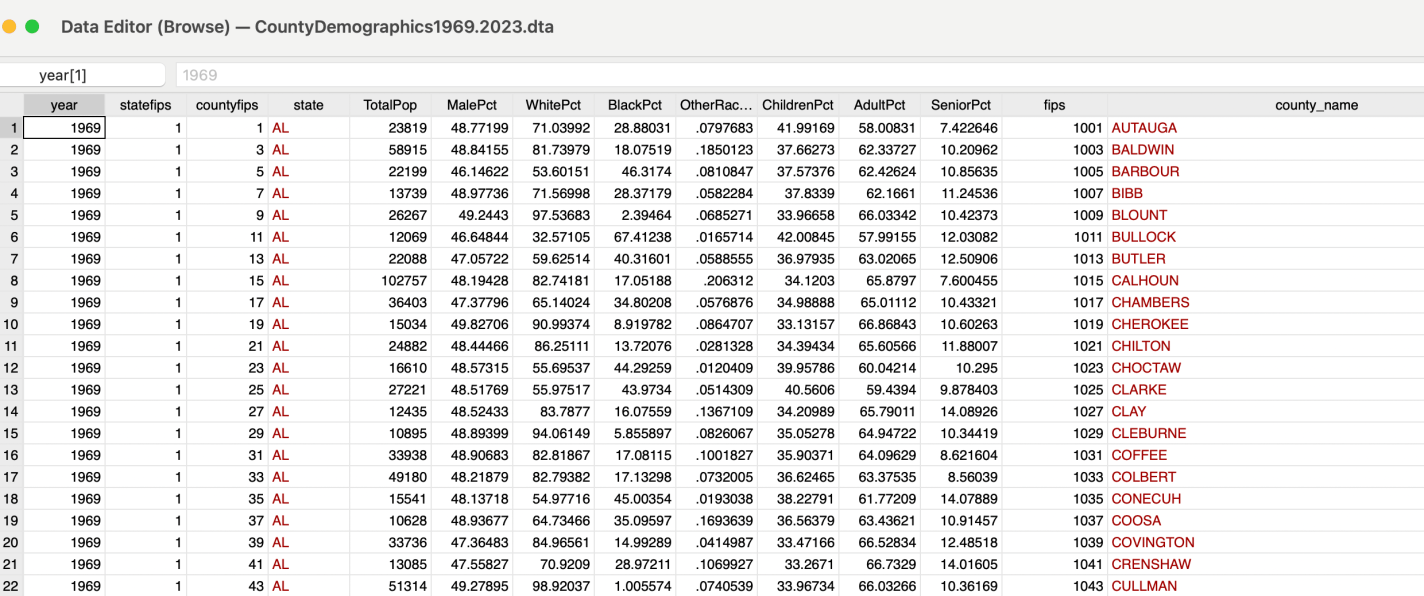
Whenever researchers are conducting studies using state- or county-level data, we usually want some standard demographic variables to serve as controls; things like the total population, average age, and gender and race breakdowns. If the dataset for our main variables of interest doesn’t already have this, we go looking for a new dataset of demographic controls to merge in; but it has always been surprisingly hard to find a clean, easy-to-use dataset for this. For states, I’ve found the University of Kentucky’s National Welfare Database to be the best bet. But what about counties?
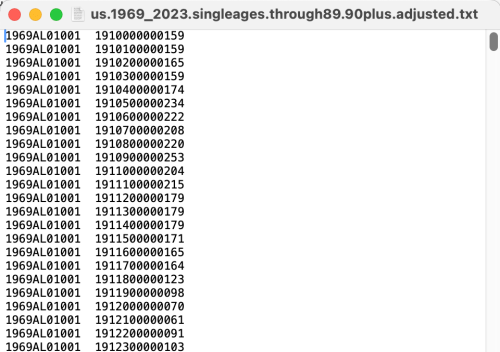
I had no good answer, and the best suggestion I got from others was the CDC SEER data. As so often, the government collected this impressively comprehensive dataset, but only releases it in an unusable format- in this case only as txt files that look like this:
I cleaned and reformatted the CDC SEER data into a neat panel of county demographics that look like this:
I posted my code and data files (CSV, XLSX, and DTA) on OSF and my data page as usual. I also posted the data files on Kaggle, which seems to be more user-friendly and turns up better on searches; I welcome suggestions for any other data repositories or file formats you would like to see me post.
This chart shows the average number of hours worked in the US, by gender, for those in their prime working ages (25-54), from 1900 to 2023. It includes both paid market work and household production (which includes activities like cooking, cleaning, shopping, and taking care of children):
A few things to notice. First, there is no data for 2020, as the ATUS didn’t publish any tables due to incomplete data from the pandemic. And even if we had data, it would have been a huge outlier year.
More importantly, there is an obvious long-term trend of declining market work and rising household production for men, and the opposite for women. In 1900 women worked over 6 times as many hours in the household as they did in the market, but by 2023 they worked almost the exact same number of hours in each sector.
Male hours in market work declined by about 16 hours per week (using 10-year averages, as there is a slight business-cycle effect on hours), but the total number of hours they worked declined much more modestly, by about 3 hours per week (note: these numbers include all men, whether they are working or not). Women saw similar changes, but in the opposite direction, with total hours worked only falling by about 4 hours per week, even though hours working at home fell by almost 22 hours.
Americans do have more leisure time than in 1900, but not dramatically so: perhaps 3-4 hours per week. This is an improvement, but less of an improvement than you might suspect by looking at hours of market work alone.
Ramey and Francis do try to carefully distinguish between household production and leisure. For example, yardwork and changing diapers are household production, while gardening and playing with your children are leisure. For some respondents to surveys, they may feel differently about whether gardening is “really” work or not, and some may enjoy changing baby’s diapers, but in general their distinctions seem reasonable to me.
Finally, we can say pretty confidently with this data that women have almost always worked more hours than men — the one exception in the 20th century being WW2 — and the gender gap was about 4 hours per week in both the early 1900s and the most recent decade (though it did fluctuate in between).
This article was updated on March 1 with additional information on kava side effects.
This is a follow-up to my post last week, describing my visit to a shop purveying beverages laced with kava and with kratom, two substances I had not heard of previously. As a service to readers who may deal with someone who is using these materials, here is what I have found out about what they do to people.
Upfront disclaimer: I have no expertise in this area, these are just the observations of an amateur who has read a few articles. Do not make any decisions based on this article.
Primary Effects of Kava
Kava is made from the roots of a plant in the pepper family, which is native to the Pacific Islands. There are two main classes of kava plants. The “noble” cultivars are what has traditionally been used for human consumption, via water extraction of the roots to make a beverage. The non-noble (two-day or “tudei”) cultivars grow faster (so they are cheaper for production), but are more likely to have adverse side effects. Also, the above-ground parts of the plants are known to contain toxic alkaloids.
The Wikipedia summary of effects is, “Systematic reviews and meta-analyses conducted in the last decade have typically indicated a modest positive effect of kava on anxiety and generalized anxiety disorder, though the evidence is mixed and further research is frequently recommended.”
I found a 2020 memo by a FDA toxicologist, titled “Review of the published literature pertaining to the safety of Kava for use in conventional foods”, which covers both the positive effects and the extensive side-effects. The memo notes: “The major physiological action in humans is consistently reported as a pleasant, mild, centrally acting relaxant property which induces a generalized muscle relaxation and, ultimately, a deep natural sleep. A minor property of kava is its local anesthetic properties which are experienced as numbing of the mucous membranes of the mouth and tongue when the beverage is consumed.” That all sounds pretty nice.
The main active compounds in cava are called kavalactones. Known effects of the six major kavalactones are:
For the biochemists among us: “The psychotropic effects of kava are achieved by the modulation of gamma‐amino‐butyric acid (GABA) receptors. Although the exact mechanisms are not known, studies suggest that the effects are mediated via different mechanisms such as upregulation of GABA‐A receptor function, blockade of voltage‐gated sodium ion channels, enhanced ligand binding across GABA‐A receptor subtypes, and reduced excitatory neurotransmitter release.” GABA is the primary inhibitory neurotransmitter in the central nervous system, so it is commonly targeted by tranquilizers such as benzodiazepines (e.g. Valium). Hence, the calming effect. Research suggests that kava components also inhibit the re-uptake of norepinephrine (a chemical that makes you feel alert) and of dopamine (a feel-good hormone).
Side Effects of Kava
The most controversial issue is liver damage. There were a number of very severe cases (complete liver failure) in the late 1990s/early 2000s in Europe, which led to a ban of kava in a number of countries there starting around 2002. It was not banned in the U.S., but the FDA issued an advisory letter expressing concern about liver damage.
Kava advocates were unconvinced, and further research seems to indicate that nearly all of those liver damage cases were due to use of the non-noble cultivars and/or the use of stems instead of just the roots and/or the extraction being done with some alcoholic solvent rather than water (probably due to greedy/ignorant kava suppliers). Most European countries have relaxed their outright bans, although in many cases kava sales are still restricted or regulated. Because their main market got shut off due to the liver problems, Pacific island nations scrambled to rebuild kava credibility. They now try to ensure that only proper kava is exported to the West.
Kava advocates claim that if kava is extracted the traditional way from traditional cultivars, there are no appreciable severe bad side-effects. On the other hand, the 2020 FDA memo document claimed there was a wide range of serious adverse effects of kava use among traditional kava users in the eastern Pacific, especially liver damage, among heavy kava drinkers: “Several studies show a clear association of increased level of liver enzymes GGT, ALP, and moderate to heavy kava beverage consumption as shown in Table 2…..Hepatic injury due to traditional aqueous extracts of kava root was reported in a study of 27 heavy kava drinkers in New Caledonia (Russmann et al. 2003).”
On closer examination, however, it seems that the FDA document gave an overly negative view of kava liver effects. The Russman 2003 study did not actually show “heptatic injury” among the 27 heavy kava drinkers. All it showed was elevated levels of the liver-related enzymes. It is true that there were pretty consistent observations of elevated levels of enzymes such as GGT (gamma-glutamyl transpeptidase) and ALP (alanine aminotransferase) in blood samples. Most of the studies of Polynesian subjects cited in the FDA memo lacked controls, but Brown (2007) included kava users and nonusers in its survey of Tongans living in Hawaii. This study showed high levels of GGT and ALP among the kava users, yet without any clinical indications of liver malfunction. Also, other liver-related markers in the blood such as AST, ALT, bilirubin, and ferritin were normal in the kava users. The significance of the partial abnormalities in enzymes is not clear. My guess is that the liver is somewhat stressed but not to the point of malfunction.
So it seems true that moderate consumption of kava prepared the traditional way (water extraction from roots of noble cultivars) shows no general tendency for observable liver damage. That said, the elevated liver-related enzymes are grounds for at least a little caution, and there have been a (very) few cases of genuine liver damage from traditionally extracted kava. Russman (2003) reported two women in New Caledonia who developed symptoms of liver distress from kava; these symptoms resolved after cessation of kava use. And Becker (2019) documented the case of an otherwise healthy woman in Brazil who experienced complete liver failure following 52 days of using an approved kava pill at approved dosage; her life was saved by a liver transplant. However, people die every year from eating peanuts, so I don’t know how much to read into these isolated cases of liver damage from kava.
A common effect of kava use is dermatitis, presenting as dry skin, rashes, and eruptions. (This strikes me as an allergic-type reaction). Other common side-effects can be nausea and headaches. These effects typically resolve quickly if kava use is discontinued. In the plus column, there is some sketchy evidence for anti-cancer activity by kava. In general, cognition is not impaired.
I read about sixty reviews on Amazon from purchasers of kava root powders, and more discussions on Reddit. Most were quite happy with the kava products, but emphasized that preparing the drink from the root takes some time and effort to squeeze and then filter; the brew tastes terrible, like dirt (you have to gulp it down, not sip it), and some temporary nausea is common. However, there were a nontrivial minority that reported very ugly experiences, and one man who with his first dose went comatose and nearly died. The general opinion is that kava beverage made fresh (by you or at a kava bar) from the ground root is better than capsules or packaged drinks made from kava extracts.
The exact effects may depend on your genome – some folks may get whacked, while others escape unscathed. And there may be systemic differences between how Caucasians and Polynesians react to kava. Apparently you must chug it down on an empty stomach to get the full effects. It is best to drink it in multiple small increments, rather than one giant glass. Some users chase each “shell” with a swish of some other beverage to clear the taste out, and/or eat a tiny snack like a few chips to calm the queasy stomach.
Side effects seem to be greatly amplified when kava is consumed with other substances, especially alcohol. That makes chemical sense, since kava acts on many of the same metabolic pathways as alcohol and antianxiety meds like benzodiazepines and barbiturates. This is significant, since in the West kava is often consumed in a social context which includes alcohol.
For further reading on kava effects: see an objective 2022 review by Soarez, and many pro-kava articles such as this on the kava promotion site kavacoalition.org. That site includes testimonials of people using kava instead of opioids for coping with chronic pain from injuries. Although its main function is to reduce anxiety, that in turn may mitigate the sensations of pain. A number of participants in a Reddit thread stated that kava has helped them overcome alcoholism.
One source estimated that there are about 200 kava bars in the U.S., with about half of them in Florida. After a court battle with the state, a kava bar opened in Virginia in 2024. The state has so far has not approved serving of kratom.
My takeaway on kava: It seems to me to be somewhat similar to cannabis or alcohol – light, occasional use can give a good feeling, especially pleasant as a shared experience with friends. For some, it might be helpful in coping with pain. Unlike alcohol, there seems to be no obvious tendency towards addiction. However, as with alcohol and cannabis, there is some possibility of serious adverse effects, especially with heavy use and if it is consumed with other substances. Therefore, it would seem wise to start slow with kava and monitor your body’s reactions.
Also, it is essential to make sure you are getting kava made the right way, as discussed above. At a kava bar, you can talk with the server. If you are taking capsules, I’d suggest contacting the manufacturer. Or you can buy plain kava root, and steep your own brew.
Effects of Kratom
I will spend less time on kratom effects, since it acts largely like an opioid. Need we say more.
Kratom is extracted from the leaves of an evergreen plant native to southeast Asia. We discussed some of the varieties of kratom earlier. Quotations here are all from the Wikipedia article; they mesh with what I have read elsewhere.
The active compounds are a mix of dozens of alkaloid compounds. The key ones seem to interact with opioid receptors in the brain. But the interactions are complex and poorly-understood. On the plus side, “These compounds display functional selectivity and do not activate the β-arrestin pathway partly responsible for the respiratory depression, constipation, and sedation associated with traditional opioids.”
For recreational use, “At low doses, kratom produces euphoric effects comparable to those of coca. At higher doses, kratom produces opioid-like effects.” Much of kratom use is for more serious issues, such as managing chronic pain or helping with opioid withdrawal.
There are many documented adverse side effects, resulting in many visits to hospitals:
Common side-effects include appetite loss, erectile dysfunction, nausea and constipation. More severe side-effects may include respiratory depression (decreased breathing), seizure, psychosis, elevated heart rate and blood pressure, trouble sleeping, and, rarely, liver toxicity. Addiction is a possible risk with regular use: when use is stopped, withdrawal symptoms may occur. A number of deaths have been attributed to the use of kratom, both by itself and mixed with other substances.
…Long-term use of high doses of kratom may lead to development of tolerance, dependence, and withdrawal symptoms, including loss of appetite, weight loss, decreased libido, insomnia, muscle spasms, muscle and bone pain, increased yawning and/or sneezing, myoclonus, watery eyes, hot flashes, fever, diarrhea, restlessness, anger, and sadness. This may lead to resumption of use. Frequent use of high doses of kratom may cause tremors, anorexia, weight loss, seizures, psychosis and other mental health conditions.
Perhaps the biggest concern with kratom is the high propensity for addiction and the need to increase dosage to obtain the desired effects:
Kratom is a botanical with a known addiction liability and, in vulnerable individuals, dependence may develop rather quickly with tolerance noted at three months and four- to ten-fold dose escalations required within the first few weeks…Kratom addiction carries a relapse risk as high as 78% to 89% at three months post-cessation.
In 2017 the FDA stated that “There is no reliable evidence to support the use of kratom as a treatment for opioid use disorder; there are currently no FDA-approved therapeutic uses of kratom… and the FDA has evidence to show that there are significant safety issues associated with its use.”
Some advice here on Reddit on how with kratom “less is more” — due to complex biochemical interactions, upping your dose or making it more frequent can actually diminish the desired effects, and start down the road of diminishing returns and then using higher and higher doses. And this Reddit where users describe their problems with kratom addiction:
i suggest you stop while you are still able to walk away relatively unscathed. addiction is a very disgusting thing that can happen to a person. you will absolutely feel worse than you ever thought you could feel, save for losing a child or something insane happening IRL.
some drugs will actually cause a physical addiction, like kratom. this means your body adjusts to it & stops doing its job in order to let the drug do it. now when you stop using, your body & mind are without their own processes & they are also without the drug. this leaves you empty, sick, wide awake but exhausted, sweaty but cold, aching pain. for alcohol, withdrawal can actually lead to seizures, extreme hallucinations & delusions, & even will just straight up kill you bc you need a drink so bad.
My takeaway on kratom: This one seems like playing with fire, due to its addictive properties. Also, street doses of kratom are sometimes spiked with horrible drugs like fentanyl. Thus, I see little case for promoting it for recreational use, given that there are safer alternatives such as weed, booze, and kava. (And in general, there are more fruitful ways to rise above anxiety than drinking or smoking something – – change your thinking patterns, or even use flashing lights to put your brain into alpha waves. )
It is possible that kratom could be useful to someone dealing with chronic pain, as an alternative to opioids with their known addition danger. I have deep sympathy for anyone in that position. I would hope that they would work with a medical professional or at least a trustworthy friend to monitor their usage (keeping it low, no matter what), since in these matters it is easy to deceive oneself as to what is really going on.
ADDENDUM
In case someone is tempted to try kratom out of curiosity, I will share the cautionary observation an acquaintance emailed me after reading the original version of this article:
You know, I met some heroin addicts who said that they always told themselves they wouldn’t do it, they had seen it destroy people. But they ended up one day just caving to curiosity. One day, they just shrugged and said “screw it, I wanna see what this is about.” And their life was ruined by the immediate addiction. It’s a very sad story.
Institutional vandalism is neither privatization nor creative destruction. It’s just cruelty masquerading as genius that plans to simply plead the necessary risk of endeavor when exposed as gratuitous incompetence. We may, within 10 years, see a newer, better NIH (or, preferably, cluster of baby NIHs) rise from the ashes. We may see a revitalized NSF and a whole slew of new institutions funding educaton research domestically and supporting the broader world through American aid programs. Maybe, maybe not.
But make no mistake: this is not a controlled burn. There is no plan, other than perhaps the wholly articulated belief that destruction wrought from chaos is a plan. This is a series of forest fires set by gleefull children with matches, wholly unable to even comprehend the risks they are taking on behalf of everyone else. We’ll probably get through to the other side, but for those of us who have been thinking about tail risk for a decade of Trump, the number of standard deviations between us and the unthinkable keeps getting smaller.









 Economist Writing Every Day