After the Crash: Silver Clawing Back Up After Epic Bust Last Week

A month ago (red arrow in 5-year chart below), I noticed that the price of silver was starting into a parabolic rise pattern. That is typical of speculative bubbles. Those bubbles usually end in a bust. Also, the rise in silver price seemed to be mainly driven by retail speculators, fueled by half-baked narratives rather than physical reality.
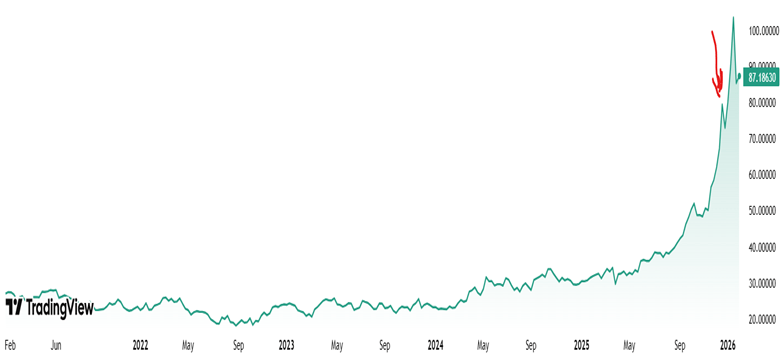
Five-year chart of silver prices $/oz, per Trading View

So I wrote a blog post here last month warning of a bubble, and sold about a quarter of my silver holdings. (I also initiated some protective options but that’s another story for another time.) I then felt pretty foolish for the next four weeks, as silver prices went up and up and up, a good 40% percent over the point I initially thought it was a bubble. Maybe I was wrong, or maybe the market can stay irrational longer than you can stay solvent, per J. M. Keynes.

When the crash finally came, it was truly epic. Below is a one-month chart of silver price. The two red lines show silver price at the close of regular trading on Thursday, January 29 (115.5 $/oz), and at the close of trading on Friday, January 30 (84.6 $/oz):
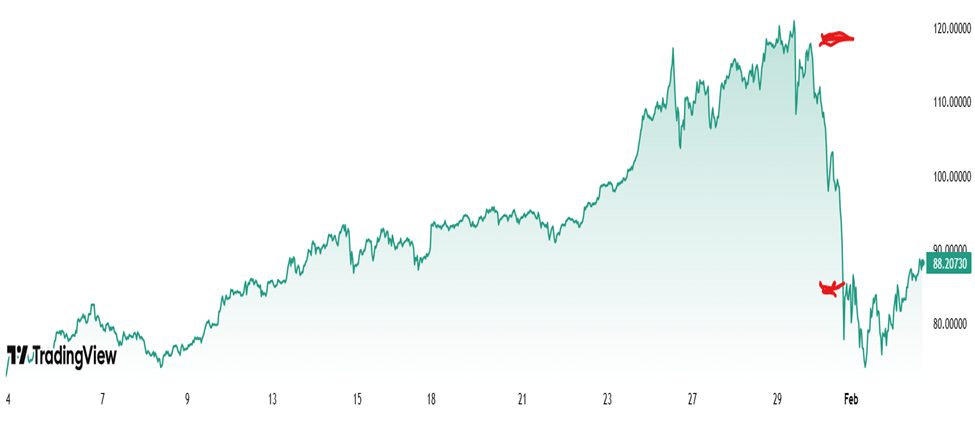
This is a drop of nearly 30% in one day, which is a mind-boggling move for a major commodity. Gold got dragged down, too:

These aren’t normal moves. Over roughly the past 25+ years (through 2025), gold’s price has changed by about 0.8% per day on average (in absolute percentage terms). Silver, being more volatile, has averaged around 1.4–1.5% per day. If you’re scoring at home, that’s about a 13 Sigma move for Gold and 22 Sigma move for Silver! You’re witnessing something that shouldn’t happen more than once in several lifetimes…statistically speaking. Yet here we are.

After the fact, a number of causes for the crash were proposed:

  • The nomination of Kevin Warsh as the next Federal Reserve Chair.  Warsh is perceived as a hawkish policymaker, leading investors to expect tighter monetary policy, higher interest rates, and a stronger U.S. dollar—all of which reduce the appeal of non-yielding assets like silver. 
  • Aggressive profit-taking after silver surged over 40% year-to-date and hit record highs near $121 per ounce. 
  • Leveraged positions in silver futures were rapidly unwound as prices broke key technical levels, triggering stop-loss orders and margin calls. 
  • CME margin hikes (up to 36% for silver futures) increased trading costs, forcing traders to cut exposure and accelerating the sell-off. 
  • Extreme speculation among Chinese investors, leading the Chinese government to clamp down on speculative trading. (And presumably Chinese solar panel manufacturers have been complaining to the government about high costs for silver components).

What happens next?

Silver kept falling to a low of 72.9 $/oz in the wee hours of February 2, a drop of 40% percent from the high of 120.8 on Jan 26. However, it looks to my amateur eyes like the silver bubble is not really tamed yet. For all the drama of a 22-sigma crash one day crash, about all that did was erase one months’ worth of speculative gains. The charts above are showing that silver is clawing its way right back up again.  It is very roughly on the trend line of the past six months, if one excludes the monster surge in the month of January.

There is a saying among commodities traders, that the cure for high prices is high prices. This means that over time, there will be adjustments that will bring down prices. In the case of silver, that will include figuring out ways to use less of it, including recycling and substitution of other metals like copper and aluminum. However, my guess is that the silver bulls feel vindicated by the price action so far, and will keep on buying at least for now.

Disclaimer: As usual, nothing here should be regarded as advice to buy or sell any security.

Michael Burry’s New Venture Is Substack “Cassandra Unchained”: Set Free to Prophesy All-Out Doom on AI Investing

This is a quick follow-up to last week’s post on “Big Short” Michael Burry closing down his Scion Asset Management hedge fund. Burry had teased on X that he would announce his next big thing on Nov 25. It seems he is now a day or two early: Sunday night he launched a paid-subscription “Cassandra Unchained” Substack. There he claims that:

Cassandra Unchained is now Dr. Michael Burry’s sole focus as he gives you a front row seat to his analytical efforts and projections for stocks, markets, and bubbles, often with an eye to history and its remarkably timeless patterns.

Reportedly the subscription cost is $39 a month, or $379 annually, and there are 26,000 subscribers already. Click the abacus and…that comes to a cool $ 9.9 million a year in subscription fees. Not bad compensation for sharing your musings on line.

Michael Burry was dubbed “Cassandra” by Warren Buffett in recognition of his prescient warnings about the 2008 housing market collapse, a prophecy that was initially ignored, much like the mythological Cassandra who was fated to deliver true prophecies that were never believed. Burry embraced this nickname, adopting “Cassandra” as his online moniker on social media platforms, symbolizing his role as a lone voice warning of impending financial disaster. On the About page of his new Substack, he wrote that managing clients’ money in a hedge fund like Scion came with restrictions that “muzzled” him, such that he could only share “cryptic fragments” publicly, whereas now he is “unchained.”

Of his first two posts on the new Substack, one was a retrospective on his days as a practicing doctor (resident in neurology at Stanford Hospital) in 1999-2000. He had done a lot of on-line posting on investing topics, focusing on valuations, and finally left medicine to start a hedge fund. As he tells it, he called the dot.com bubble before it popped.

The Business Insider summarizes Burry’s second post, which attacks the central premise of those who claim the current AI boom is fundamentally different from the 1990s dot.com boom:

The second post aims straight at the heart of the AI boom, which he calls a “glorious folly” that will require investigation over several posts to break down.

Burry goes on to address a common argument about the difference between the dot-com bubble and AI boom — that the tech companies leading the charge 25 years ago were largely unprofitable, while the current crop are money-printing machines.

At the turn of this century, Burry writes, the Nasdaq was driven by “highly profitable large caps, among which were the so-called ‘Four Horsemen’ of the era — Microsoft, Intel, Dell, and Cisco.”

He writes that a key issue with the dot-com bubble was “catastrophically overbuilt supply and nowhere near enough demand,” before adding that it’s “just not so different this time, try as so many might do to make it so.”

Burry calls out the “five public horsemen of today’s AI boom — Microsoft, Google, Meta, Amazon and Oracle” along with “several adolescent startups” including Sam Altman’s OpenAI.

Those companies have pledged to invest well over $1 trillion into microchips, data centers, and other infrastructure over the next few years to power an AI revolution. They’ve forecasted enormous growth, exciting investors and igniting their stock prices.

Shares of Nvidia, a key supplier of AI microchips, have surged 12-fold since the start of 2023, making it the world’s most valuable public company with a $4.4 trillion market capitalization.

“And once again there is a Cisco at the center of it all, with the picks and shovels for all and the expansive vision to go with it,” Burry writes, after noting the internet-networking giant’s stock plunged by over 75% during the dot-com crash. “Its name is Nvidia.”

Tell us how you really feel, Michael. Cassandra, indeed.

My amateur opinion here: I think there is a modest but significant chance that the hyperscalers will not all be able to make enough fresh money to cover their ginormous investments in AI capabilities 2024-2028. What happens then? For Google and Meta and Amazon, they may need to write down hundreds of millions of dollars on their balance sheets, which would show as ginormous hits to GAAP earnings for a number of quarters. But then life would go on just fine for these cash machines, and the market may soon forgive and forget this massive misallocation of old cash, as long as operating cash keeps rolling in as usual. Stocks are, after all, priced on forward earnings. If the AI boom busts, all tech stock prices would sag, but I think the biggest operating impact would be on suppliers of chips (like Nvidia) and of data centers (like Oracle). So, Burry’s comparison of 2025 Nvidia to 1999 Cisco seems apt.