Health Insurance and Wages: Compensating Differentials in Reverse?

One of the oldest theories in economics is the idea of compensating differentials. A job represents not just a certain amount of money per hour, but a whole package of positive and negative things. Jobs have more or less stability, flexibility, fun, room to grow, danger… and non-cash benefits like health insurance. The idea of compensating differentials is that, all else equal, jobs that are good on these other margins can pay lower cash wages and still attract workers (thus, the danger of doing what you love). On the other hand, jobs that are bad on these other margins need high wages if they want to hire anyone (thus, the deadliest catch)

I think this theory makes perfect sense, and we see evidence for it in many places. But when it comes to health insurance, everything looks backwards. A job that offers employer-provided health insurance is better to most employees than one that doesn’t, so by compensating differentials it should be able to offer lower wages. There’s just one problem: US data shows that jobs offering health insurance also offer significantly higher wages. The 2018 Current Population Survey shows that workers with employer-provided health insurance had average wages of $33/hr, compared to $24/hr for those without employer insurance.

All the economists are thinking now: that’s not a problem, compensating differentials is an “all else equal” claim, but not all else is equal here. The jobs with health insurance pay higher wages because they are trying to attract higher-skilled workers than the jobs that don’t offer insurance.

That’s what I thought too. It is true that jobs with insurance hire quite different workers on average:

Source: 2017 CPS analyzed here

The problem is, once we control for all the observable ways that insured workers differ, we still find that their wages are significantly higher than workers who don’t get employer-provided insurance. Like, 10-20% higher. That’s after controlling for: year, sex, education, age, race, marital status, state of residence, health, union membership, firm size, whether the firm offers a pension, whether the employee is paid hourly, and usual hours worked. I’ve thrown in every possibly-relevant control variable I can think of and employer-provided health insurance always still predicts significantly higher wages. Of course, there are limits to what we get to observe about people using surveys; I don’t get any direct measures of worker productivity. Possibly the workers who get insurance are more skilled in ways I don’t observe.

We can try to account for these unobserved differences by following the same person from one job to another. When someone switches jobs, they could have health insurance in both jobs, neither, only the new, or only the old. What happens to the wages of people in each of these situations? It turns out that gaining health insurance in a new job on average brings the biggest increase in wages:

What could be going on here? One possibility is that health insurance makes people healthier, which improves their productivity, which improves their wages. But we control for health status and still find this effect. The real mystery is that papers that study mandatory expansions of health insurance (like the ACA employer mandate and prior state-level mandates) tend to find that they lower wages. Why would employer-provided health insurance lower wages when it is broadly mandated, but raise wages for individuals who choose to switch to a job that offers it?

My current theory is that “efficiency benefits” are offered alongside “efficiency wages”. The idea of efficiency wages is that some firms pay above-market wages as a way of reducing turnover. Workers won’t want to leave if they know their current job pays above-market, and so the company saves money on hiring and training. But this only works if other firms aren’t doing it. The positive correlation of wages and insurance could be because the same firms that pay “efficiency wages” are more likely to pay “efficiency benefits”- offering unusually good benefits as a way to hold on to employees.

I still feel like these results are puzzling and that I haven’t fully solved the puzzle. This post summarizes a currently-unpublished paper that Anna Chorniy and I have been working on for a long time and that I’ll be presenting at WVU tomorrow. We welcome comments that could help solve this puzzle either on the empirical side (“just control for X”) or the theoretical side (“compensating differentials are being overwhelmed here by X”).

Why Many Substance Use Treatment Facilities Don’t Take Insurance

According to the latest data, about one in four facilities doesn’t accept private insurance or Medicaid, and more than half don’t accept Medicare. This makes substance use treatment something of an outlier, since 91% of all US health spending is paid for through insurance. Still, there are many reasons to prefer being paid in cash: insurance might reimburse at low rates, impose administrative hassles, and generally try to tell you how to run things.

Providers generally put up with the hassles of insurance because they see the alternative as not getting paid. But if demand for their services gets high enough that they can stay busy with patients paying cash, they will often try going cash-only. Some try to generate high demand by providing excellent service. Sometimes high demand comes from a growing health crisis, as with opioids.

Demand can also be high relative to supply because supply is restricted. US health care is full of supply restrictions, but in this case I wondered if Certificate of Need laws were playing a role. As we’ve written about previously, CON laws require health care providers in 34 states to get the permission of a government board to certify their “economic necessity” before they can open or expand. But there’s a lot of variation from state to state in what types of services are covered by this requirement; acute hospital beds and long-term care beds are most common. 23 states require substance use treatment facilities to obtain a CON before opening or expanding.

States with Substance Use–Treatment CON Laws in 2020. Created using data from Mitchell, Philpot, and McBirney

How do these laws affect substance use treatment? We didn’t really know- only one academic article had studied substance use CON, finding it led to fewer facilities in CON states. But I’ve studied other types of CON, so I joined forces with Cornell substance use researcher Thanh Lu and my student Patrick Vogt to investigate. The resulting article, “Certificate-of-need laws and substance use treatment“, was just published at Substance Abuse Treatment, Prevention, and Policy. Here’s the quick summary:

We find that CON laws have no statistically significant effect on the number of facilities, beds, or clients and no significant effect on the acceptance of Medicare. However, they reduce the acceptance of private insurance by a statistically significant 6.0%.

Overall I was surprised that CON didn’t significantly affect most of the outcomes we looked at, and appears to be far from the main reason that treatment facilities don’t take insurance. Still, repealing substance use CON would be a simple way to improve access to substance use treatment, particularly since CON doesn’t appear to bring much in the way of offsetting benefits.

Going forward I aim to investigate how these laws affect health outcomes like overdose rates, and to dig more into the text of state laws and regulations to determine exactly what is covered by substance use CON in different states. As the article explains, we identified several errors in the official data sources we were using. This makes me worry there are more errors we didn’t catch, and there are certainly things the sources just don’t specify, like in which states the laws apply to outpatient facilities. So I hope we (or someone else) will have even better work to share in the future, but for now this article is as good as it gets, and we share our data here.

Health Insurance Benefit Mandates and Health Care Affordability

My article on benefit mandates was published today at the Journal of Risk and Financial Management. It begins:

Every US state requires private health insurers to cover certain conditions, treatments, and providers. These benefit mandates were rare as recently as the 1960s, but the average state now has more than forty. These mandates are intended to promote the affordability of necessary health care. This study aims to determine the extent to which benefit mandates succeed at this goal

I began my research career by writing about these mandates, and my goal with this article was to tie up that whole chapter. I realized that all my articles on benefit mandates, as well as most of what other economists write about them, simply try to measure their costs- how much they raise health insurance premiums, raise employee contributions to premiums, lower wages, lower employment, or harm smaller businesses. Its good to know their costs, but to really evaluate a policy we should learn about its benefits too so that we can compare costs and benefits.

One key benefit that had yet to be measured was how much a typical mandate lowers out-of-pocket health care costs. In this article, I estimate that the average benefit mandate lowers costs by 0.8%-1%. I argue that combining this with a measure of how mandates affect total health spending by households could provide a sufficient statistic for the net benefits of mandates for households. I’m not totally confident this works in theory though, and it has a big challenge in practice- one of my empirical strategies finds that mandates reduce total spending, but the other finds they don’t. So I think the main contribution of the article ends up being the first estimate of how the average state health insurance benefit mandate affects out-of-pocket costs.

I’m currently planning to move on from writing about mandates- other topics are catching my eye, state policymakers don’t seem to particularly care what the research says about mandates, and changes in how economists use difference-in-difference methods are making it harder to publish articles like this that study continuous treatments. But I think there are still big opportunities here for anyone who wants to take up the torch. First, the ACA Essential Health Benefits provision changed the game for state mandates in a way that I have yet to see the empirical literature grapple with. Second, there are more than a hundred separate types of state benefit mandates; in most of my articles I aggregate them but they should really be studied separately. A handful have been, such as mandates for autism treatments, infertility treatments, and telemedicine. But the vast majority appear to be completely unstudied.

P.S. Writing this article gave me two wildly varying opinions of our federal bureaucracy. I tried to get both data and funding from the Agency for Healthcare Research and Quality for this article. The data side worked well- they were surprisingly fast, efficient and reasonable about the process of accessing restricted data. On the other hand, I applied for funding from AHRQ in March 2019 and still have yet to officially hear back about it (it is “pending council review” in NIH Commons). This sort of thing is why nimble organizations like Fast Grants can do so much good despite having much smaller budgets.

P.P.S. This article is part of a special issue on Health Economics and Insurance that is still accepting submissions. I’m the guest editor and would handle your submission, though my own got handled by other editors and put though multiple rounds of revisions.

Generous Health Insurance Makes Employees Stay

The idea of “job lock” is well established in the academic literature- employees leave firms that don’t offer health insurance more often than they leave firms that do. But this literature has always measured employer-provided health insurance as a simple binary: either they offer it or they don’t. In fact employers vary widely in the generosity of their plans, both in the quality of the insurance and in how much of the cost is paid by the employer. Some employers pay all of the premiums, some pay none, and most pay part:

Data are from the Current Population Survey, which uses top-coding to protect privacy (values greater than 9997 are reported as 9997)

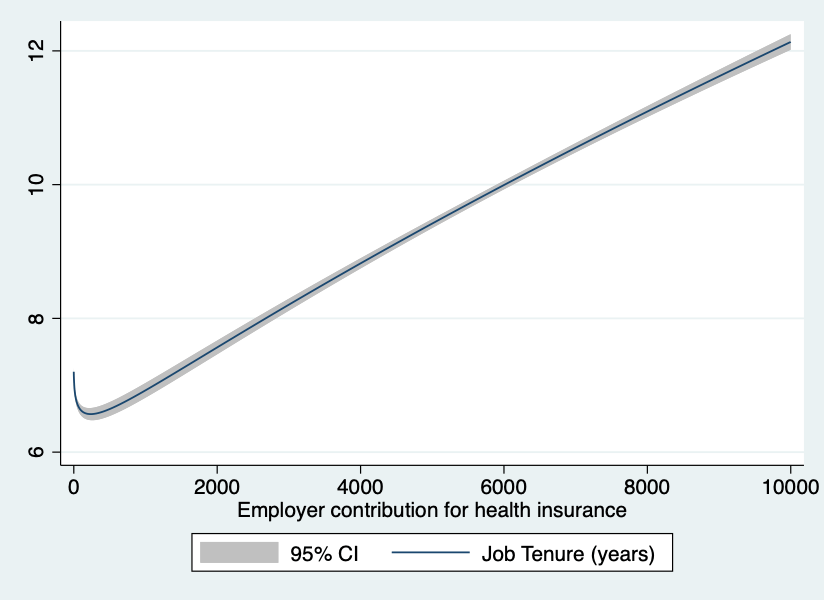
In an article published last week in Applied Economics Letters, my colleague Michael Mathes and I combine two supplements of the Current Population Survey to test whether employers who contribute more towards health insurance see their employees stay longer. Perhaps not surprisingly, we find that they do. We run lots of regressions to establish this, but this simple fit plot tells the story best:

What we found more surprising was the magnitude of this effect: a thousand dollar increase in employer contributions to health insurance is associated with at least 83 additional days of job tenure, compared to less than 10 additional days for a thousand dollar increase in wages. We conclude that:

For employers trying to increase retention, increasing contributions to health insurance appears to lengthen employee tenure far more than increasing wages by a similar amount.

Why the difference? Probably employees rationally valuing $1000 in untaxed contributions to health insurance above $1000 in taxable wages. Why don’t employers shift more compensation away from wages and toward health insurance, given that employees seem to prefer it? Here I’m less sure, and they could simply be making a mistake, but one possibility is that they worry about increasing their costs as couples whose employers both offer insurance choose the more generous one for a family plan. Another is that while generous health insurance plans are better for retention, higher wages could be better for attracting new employees, who tend to be younger and for whom the salary number could be more salient.