Health Insurance Benefit Mandates and Premiums

The Center for Modern Health just released a report “Paring Down Coverage Mandates To Reduce Health Insurance Premiums“. It builds on one of my papers to estimate how much states could drive down insurance premiums by reducing the number of things health insurers are required to cover:
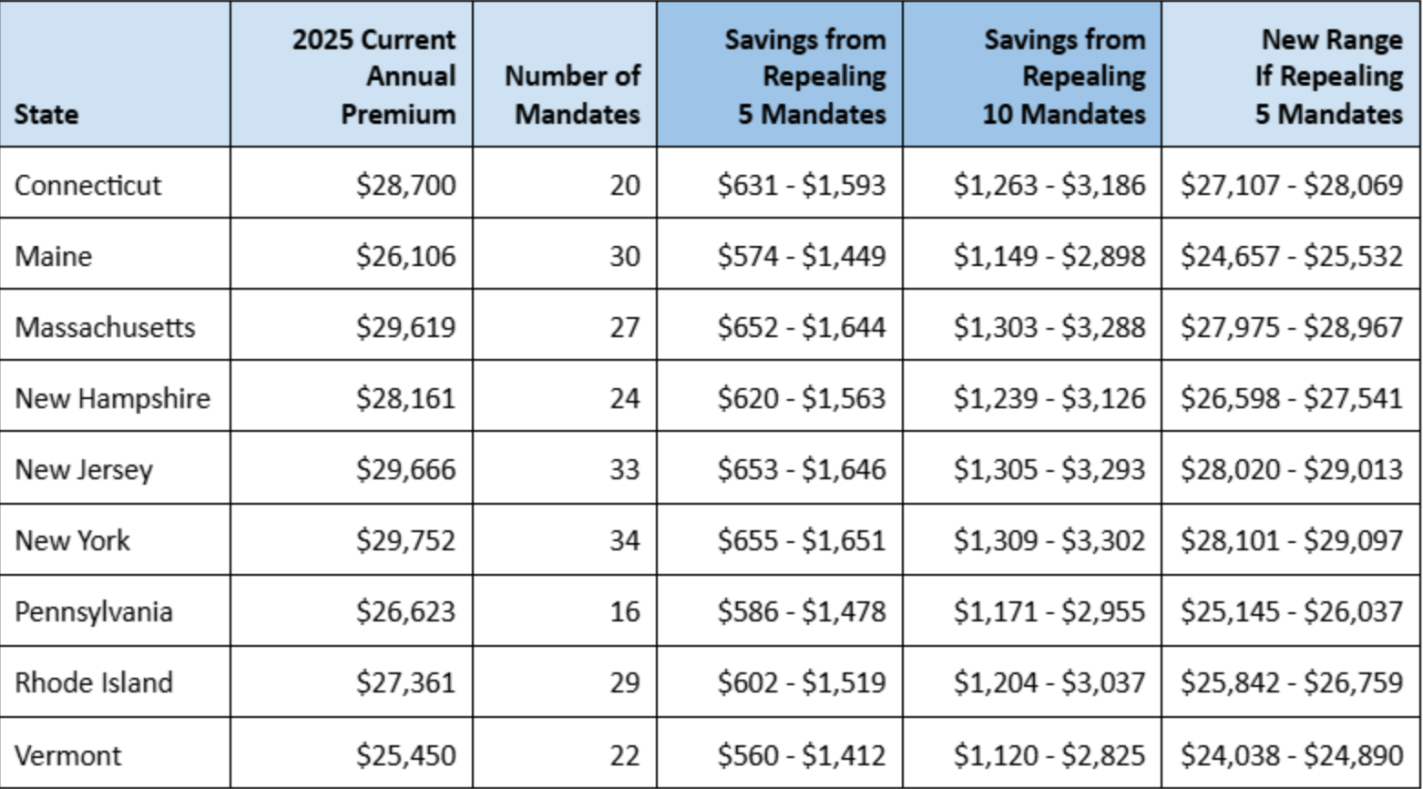
Estimated savings for Family Plans (Table 2 of CMH Report)

It’s nice to see that someone in the health policy world remembers that health insurance benefit mandates exist and can be a significant cost driver. I’m also glad to see that someone still cares about my 2014 paper (the first one I ever got accepted at a journal), though I wish there were more up to date estimates available for them to cite.

Why has no one developed more recent estimates? Partly for data reasons- the organizations that had been putting out counts of mandates by state each year (the Council for Affordable Health Insurance & Blue Cross Blue Shield Association) stopped doing so. Partly because of the ACA, which changed how mandates worked in complex ways.

That said, there there seems to be some more recent data from 2017 that could be used for a slight update, and this post and my ideas page detail the many things we still don’t know about how mandates operated prior to 2014:

State Health Insurance Mandates: Most of my early work was on these laws, but many questions remain unanswered. States have passed over a hundred different types of mandated benefits, but the vast majority have zero papers focused on them. Many likely effects of the laws have also never been studied for any mandate or combination of mandates. Do they actually reduce uncompensated hospital care, as Summers (1989) predicts? Do mandates cause higher deductibles and copays, less coverage of non-mandated care, or narrower networks? How do mandates affect the income and employment of relevant providers? Can mandates be used as an instrument to determine the effectiveness of a treatment? How does all this change in light of the ACA? On the identification side, redoing older papers using a dataset like MEPS-IC where self-insured firms can be used as a control would be a major advance.

Health Insurance Benefit Mandates and Health Care Affordability

My article on benefit mandates was published today at the Journal of Risk and Financial Management. It begins:

Every US state requires private health insurers to cover certain conditions, treatments, and providers. These benefit mandates were rare as recently as the 1960s, but the average state now has more than forty. These mandates are intended to promote the affordability of necessary health care. This study aims to determine the extent to which benefit mandates succeed at this goal

I began my research career by writing about these mandates, and my goal with this article was to tie up that whole chapter. I realized that all my articles on benefit mandates, as well as most of what other economists write about them, simply try to measure their costs- how much they raise health insurance premiums, raise employee contributions to premiums, lower wages, lower employment, or harm smaller businesses. Its good to know their costs, but to really evaluate a policy we should learn about its benefits too so that we can compare costs and benefits.

One key benefit that had yet to be measured was how much a typical mandate lowers out-of-pocket health care costs. In this article, I estimate that the average benefit mandate lowers costs by 0.8%-1%. I argue that combining this with a measure of how mandates affect total health spending by households could provide a sufficient statistic for the net benefits of mandates for households. I’m not totally confident this works in theory though, and it has a big challenge in practice- one of my empirical strategies finds that mandates reduce total spending, but the other finds they don’t. So I think the main contribution of the article ends up being the first estimate of how the average state health insurance benefit mandate affects out-of-pocket costs.

I’m currently planning to move on from writing about mandates- other topics are catching my eye, state policymakers don’t seem to particularly care what the research says about mandates, and changes in how economists use difference-in-difference methods are making it harder to publish articles like this that study continuous treatments. But I think there are still big opportunities here for anyone who wants to take up the torch. First, the ACA Essential Health Benefits provision changed the game for state mandates in a way that I have yet to see the empirical literature grapple with. Second, there are more than a hundred separate types of state benefit mandates; in most of my articles I aggregate them but they should really be studied separately. A handful have been, such as mandates for autism treatments, infertility treatments, and telemedicine. But the vast majority appear to be completely unstudied.

P.S. Writing this article gave me two wildly varying opinions of our federal bureaucracy. I tried to get both data and funding from the Agency for Healthcare Research and Quality for this article. The data side worked well- they were surprisingly fast, efficient and reasonable about the process of accessing restricted data. On the other hand, I applied for funding from AHRQ in March 2019 and still have yet to officially hear back about it (it is “pending council review” in NIH Commons). This sort of thing is why nimble organizations like Fast Grants can do so much good despite having much smaller budgets.

P.P.S. This article is part of a special issue on Health Economics and Insurance that is still accepting submissions. I’m the guest editor and would handle your submission, though my own got handled by other editors and put though multiple rounds of revisions.