We Don’t Have Mass Starvations Like We Used To

Two ideas coalesced to contribute to this post. First, for years in my Principles of Macroeconomics course I’ve taught that we no longer have mass starvation events due to A) Flexible prices & B) Access to international trade. Second, my thinking and taxonomy here has been refined by the work of Michael Munger on capitalism as a distinct concept from other pre-requisite social institutions.

Munger distinguishes between trade, markets, and capitalism. Trade could be barter or include other narrow sets of familiar trading partners, such as neighbors and bloodlines.  Markets additionally include impersonal trade. That is, a set of norms and even legal institutions emerge concerning commercial transactions that permit dependably buying and selling with strangers. Finally, capitalism includes both of these prerequisites in addition to the ability to raise funds by selling partial stakes in firms – or shares.

This last feature’s importance is due to the fact that debt or bond financing can’t fund very large and innovative endeavors because the upside to lenders is too small. That is, bonds are best for capital intensive projects that have a dependable rates of return that, hopefully, exceed the cost of borrowing. Selling shares of ownership in a company lets a diverse set of smaller stakeholders enjoy the upside of a speculative project. Importantly, speculative projects are innovative. They’re not always successful, but they are innovative in a way that bond and debt financing can’t satisfy. Selling equity shares open untapped capital markets.

With this refined taxonomy, I can better specify that it’s not access to international trade that is necessary to consistently prevent mass starvation. It’s access to international markets. For clarity, below is a 2×2 matrix that identifies which features characterize the presence of either flexible prices or access to international markets.

Continue reading
The 2018 Tariffs in Many Graphs

Did president Trump’s first term tariffs, enacted in 2018, increase manufacturing employment or even just manufacturing output? Let’s set the stage.

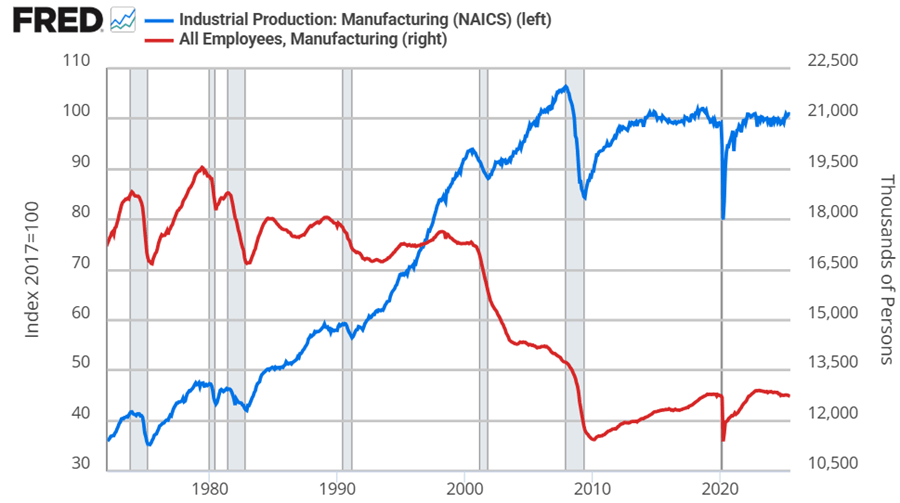
Manufacturing employment was at its peak in 1979 at 19.6 million. That number declined to 18m by the 1980s, 17.3m in the 1990s. By 2010, the statistics bottom out at 11.4m. Since then, there has been a rise and plateau to about 12.8m if we omit the pandemic.

Historically, economists weren’t too worried about the transition to services for a while. After all, despite falling employment in manufacturing, output continued to rise through 2007. But, after the financial crisis, output has been flat since 2014, again, if we omit the pandemic. Since manufacturing employment has since risen by 5% through 2025, that reflects falling productivity per worker. That’s not comforting to either economists or to people who want more things “Made in the USA”.

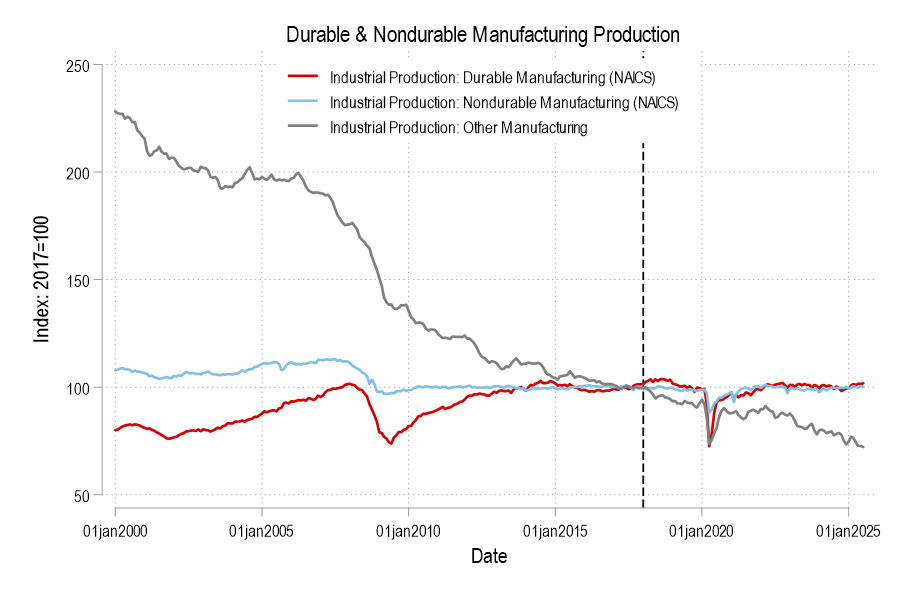
Looking at the graphs, there’s no long term bump from the 2018 tariffs in either employment or output. If you squint, then maybe you can argue that there was a year-long bump in both – but that’s really charitable. But let’s not commit the fallacy of composition. What about the categories of manufacturing? After all, the 2018 tariffs were targeted at solar panels, washing machines, and steel. Smaller or less exciting tariffs followed.

Breaking it down into the major manufacturing categories of durables, nondurables, and ‘other’ (which includes printed material and minimally processed wood products),  only durable manufacturing output briefly got a bump in 2018. But we can break it down further.

Continue reading

The Price of Eggs: Long-Run Perspective

Everyone is talking about the price of eggs. Even the President. That’s despite the fact eggs, on average, constitute about 0.1% of consumer spending (according to the Consumer Expenditure Survey for 2023). Even so, economists always get excited when people talk about prices.

On prices at the current moment, I wrote a blog post for the Cato Institute looking at the relevant supply and demand factors, and trying to explain why wholesale egg prices are falling so quickly. When will these falling wholesale prices translate into lower retail prices? The NY Times asked this question, and I tried to answer it for them (answer: perhaps in a few weeks).

But let’s step back from the current moment and take a longer-term perspective on egg prices. This chart shows the long-run real price of eggs, measured in terms of how much time an average worker would need to work to afford 1 dozen eggs:

Continue reading

Forecasting the Fed: Description Vs Prescription

After raising rates in 2022 to belatedly combat inflation, the FOMC was feeling successful in 2024. They were holding the line and remaining steadfast while many people were getting all in a tizzy about pushing us into a recession. People had been predicting a recession since 2022, and the Fed kept the federal funds rate steady at 5.33% for an entire year. Repeatedly, in the first half of 2024, betting markets were upset that the Fed wasn’t budging. I had friends saying that the time to cut was in 2023 once they saw that Silicon Valley Bank failed. I remained sanguine that rates should not be cut.

I thought that rates should have been higher still given that the labor market was strong. But, I also didn’t think that was going to happen. My forecasts were that the Fed would continue to keep rates unchanged. At 5.33%, inflation would slowly fall and there was plenty of wiggle room for unemployment.

Then, we had a few months of lower inflation. It even went slightly negative in June 2024. Some people were starting to talk about overshooting and the impending recession. I documented my position in August of 2024. Two weeks later, Jerome Powell gave a victory lap of a speech. He said that “The time has come for policy to adjust”.  Instead of discerning whether the FOMC would cut rates, the betting markets switched to specifying whether the cut would be 0.25% or 0.5%. The Fed chose the latter, followed by two more cuts by the end of the year.

I was wrong about the Fed’s policy response function. But why? Was the FOMC worried about the downward employment revisions? That was big news. Did they think that they had inflation whipped? I’m not sure. There was a lot of buzz about having stuck the soft landing. In late 2024, I leaned toward the theory that the Fed was concerned about employment. Like, they thought that we had been doing better until then.

Continue reading

Nintendo vs Nintendo: Time Prices of Video Games in 1986 and 2024

For decades one of the most popular Christmas gifts for kids (and often adults) has been video game systems. And Nintendo has long been a dominant player in this market: the original NES arguably launched the modern gaming market in 1986 (even though it wasn’t the first, it was the first blockbuster) and Nintendo’s latest offering, the Switch, is now the best-selling console ever in the US.

As we often ask on this blog: has it become more or less affordable for an average worker to buy this iconic Christmas gift (or even buy one for yourself)?

When it comes to the consoles themselves, the Switch and NES are, perhaps surprisingly, equally affordable. The original NES cost $90 in 1986, while the Switch costs $300 today. Average wages in late 1986 were $9/hour and they are about $30/hour today. So in both years, it took about 10 hours of work to buy the console (alternatively, it’s about 25% of median weekly earnings in both years).

But as any serious gamer will tell you, the individual game cartridges can cost as much or more than the console if you want to play a lot of games. For example, the games available in the 1986 Sears catalog ranged from $25-$30. To buy just the 10 games in that catalog would cost $275 — over 30 hours of labor at the average wage, or about 3 hours of labor per game.

Today there is a wider range of prices for games, but the most expensive Switch games are around $60, or just 2 hours of labor at the average wage. There are also plenty of games around $30, or just 1 hour of labor.

The challenge with the comparison is that video games today are much higher quality, challenging, and advanced in so many ways. Is there any way to make a more direct comparison?

Yes. Nintendo offers an annual subscription for $20 to Nintendo Switch Online. Included in the subscription is access to nearly every NES game, plus Super Nintendo and Gameboy games. Not only do you get the 10 games from the 1986 Sears catalog, but many dozens more. All for less than $1 hour of labor at the average wage.

In other words, for 30 hours of labor today (the time to purchase those 10 original NES games), you could buy about 46 years worth of subscriptions to Nintendo online. That’s almost a lifetime of video game play, with many more advanced games.

On Average, American Wage Earners are Better Off Than They Were Four Years Ago

As I wrote last November, the question “are you better off than you were four years ago?” is a common benchmark for evaluating Presidential reelection prospects. And even though Biden is no longer running for reelection, voters will no doubt be considering the economic performance of his first term when thinking about their vote in November.

The good news for American wage earners (and possibly Harris’ election prospects) is that average wages have now outpaced average price inflation since January 2021. Despite some of that time period containing the worst price inflation in a generation, wages have continued to grow even as price growth has moderated. Key chart:

For most of Biden’s term, it was true that prices had outpaced wages. But no longer.

The real growth in wages, admittedly, is not very robust, despite being slightly positive. How does this compare to past performance under recent Presidents? Surprisingly, pretty well! (Lots of caveats here, but this is what the raw data shows.)

Not Just Consumer Prices

We all know about inflation. One popular measure is the Consumer Price Index (CPI), which measures the change in price of a fixed basket of goods. The other popular measure used for inflation is the Personal Consumption Expenditures (PCE) price index. This index measures the price of what consumers actually purchase and captures the effects of consumers changing their consumption bundles over time. While the latter is a better measure for the prices at which consumers make purchases, it takes longer to calculate. In practice, the earlier CPI release gives a pretty accurate preview to the PCE price index.

While consumption is a substantial two-thirds of total expenditures in the US economy, other prices definitely matter. On average, a third of our income is spent on other things. Below is a stacked bar chart of quarterly GDP components – the classic Y=C+I+G+NX.* Investment spending composes a relatively stable 16.7% and Government spending composes about 16.5% of GDP. We almost never hear much about the price of these other things.

Continue reading

Real and Nominal Rigidities Research

This week, I’m doing some review for a macro-related project. In economics, the concepts of real and nominal rigidities help explain why prices and wages do not always adjust quickly in response to shocks. These rigidities create frictions that affect how markets function. A well-known rigidity is downward nominal wage rigidity (I have an experimental paper on that).

“Nominal rigidities” refer to the stickiness of prices and wages in their nominal (monetary) terms. These rigidities prevent immediate adjustment of prices and wages to changes in the overall economic environment.

Examples of Nominal Rigidities

  • Menu Costs: The costs associated with changing prices, such as reprinting menus or reprogramming point-of-sale systems. For instance, a restaurant might avoid changing its menu prices frequently because of the costs involved in printing new menus and the risk of confusing or losing customers.
  • Nominal Wage Contracts: Many workers are employed under contracts that fix their wages for a certain period, such as a year. This means that even if the demand for labor changes, wages cannot adjust immediately. For example, a factory might have a one-year wage contract with its workers, preventing it from lowering wages even during a downturn.
  • Price Stickiness Due to Psychological Factors: Prices may remain rigid because businesses fear that frequent changes might upset customers or erode their trust. A classic example is a retail store keeping prices stable to maintain a reputation for reliability, even when costs fluctuate.

Side note: Lars Christensen predicts less nominal rigidity in our future. Menu costs are getting smaller and customers could become accustomed to, for example, watching the price of milk fluctuate in real time in response to statements by the Fed. Click here for related Twitter joke.

Continue reading

Future Consumption Has Never Been Cheaper

Economics as a discipline really likes to boil things down to their essentials. There are plenty of examples. How many goods can one consume? Just two, bread and not bread. How can you spend your time? You can labor or leisure. How do you spend your money? Consume or save. It’s this last one that I want to emphasize here.

First, all income ultimately ends up being spent on consumption. Saving today is just the decision to consume in the future. And if not by you, then by your heirs. One determinant of inter-temporal consumption decisions is the real rate of return. That is, how many apples can you eat in the future by forgoing an apple eaten today? The bigger that number is, the more attractive the decision to save.

Further, since most saving is not in the form of cash and is instead invested in productive assets, we can also characterize the intertemporal consumption problem as the current budget allocation decision to consume or invest. The more attractive capital becomes, the more one is willing to invest rather than consume. The relative attractiveness between consumption and investment informs the consumption decision.

How attractive is investment? I’ll illustrate in two graphs. First, if the price of investment goods falls relative to consumption goods, then individuals will invest more. The graph below charts the price ratio of investment goods to consumption goods. Relative to consumption, the price of investment has fallen since 1980. Saving for the future has never been cheaper!

Of course, as in a price taker story, I am assuming that individuals don’t affect this price ratio. Truly, prices are endogenous to consumption/investment decisions. For all we know, it may be that the prices of investment goods are falling because demand for investment goods has fallen. But that doesn’t appear to be the case.

Continue reading

Where’s the Deflation?

Inflation continues to remain stubbornly high in the US. While Core CPI is down to 3.6%, the lowest it has been in 3 years, this is still well above the Fed’s 2% target (the Fed’s preferred Core PCE is a bit lower at 2.8%). But consumers are tired of the cumulative inflation, which, depending on your preferred gauge of inflation, is somewhere around 20% in the past 4 years. Consumers want to know: will prices ever go down again?

The answer is: Yes, and some prices already have declined!

For example, you can look at broad categories of consumer purchases, such as durable goods, which are down almost 5 percent since the peak in August 2022. Durable goods include items such as used cars (down 17.3 percent since February 2022), furniture (down 6 percent since August 2022), and appliances (down 7.2 percent since March 2023).

We can even jump into the nondurables category and look at specific items, such as groceries which seem to be on everyone’s mind. Here’s a list of items and the price decrease since their peak (I ignore a few items where it is only a purely seasonal cycle that made them cheaper in April 2024):

  • Spaghetti and macaroni: -4.3% (Feb 2023)
  • Bacon: -12.8% (Oct 2022)
  • Chicken legs: -10.6% (Aug 2023)
  • Chicken breasts: -14.4% (Sept 2022)
  • Eggs: -40.6% (Jan 2023)
  • Milk: -8.3% (Nov 2022)
  • Cheddar cheese: -9.4% (Sep 2022)
  • Bananas: -2.6% (Sept 2022)
  • Oranges: -14.7% (Sept 2022)
  • Lemons: -12.3% (May 2022)
  • Strawberries: -12.9% in the past year (and down 34.6% since seasonal peak in Dec 2022)
  • Ground coffee: -6.2% (Dec 2022)

It’s true that this is a cherry-picked list: lots of items are at all-time highs! My goal here is to show that, Yes!, some prices will fall. Others may too in the near future. And while it’s also true that most prices are still well above 2019 levels, that’s not universally true. The April 2024 prices of lemons, strawberries, and tomatoes are roughly equal to their April 2019 prices.

And it’s not just food. Natural gas this January was 20% cheaper than January 2023. Regular unleaded gasoline is down 11.6% from 2 years ago (and down 25% from the peak in Summer 2022, but we’ll wait to see what this summer looks like). Even some services, such as airline fares, are down 6.7% from 2 years ago (and down 16% from June 2022).

Some of these price decreases could be due to factors specific to the production and supply of those goods, but another factor is monetary policy. Broad measures of the money supply such as M2 show a decline of about 4 percent in the past 2 years. That hasn’t yet produced overall deflation, but it has probably contributed to the decline in the goods and services mentioned.

Looking at price changes can only tell us so much though, especially focusing on individual item prices. The big picture is that over the past 4 years, wages have increased more than prices overall across most of the income distribution (only the highest quintile lost out on the race between wages and prices). Falling prices would certainly help this trend continue, but most consumers have more buying power than they did in 2019, even if they don’t feel like they do.