Meta Is Poaching AI Talent With $100 Million Pay Packages; Will This Finally Create AGI?

This month I have run across articles noting that Meta’s Mark Zuckerberg has been making mind-boggling pay offers (like $100 million/year for 3-4 years) to top AI researchers at other companies, plus the promise of huge resources and even (gasp) personal access to Zuck, himself. Reports indicate that he is succeeding in hiring around 50 brains from OpenAI (home of ChatGPT), Anthropic, Google, and Apple. Maybe this concentration of human intelligence will result in the long-craved artificial general intelligence (AGI) being realized; there seems to be some recognition that the current Large Language Models will not get us there.

There are, of course, other interpretations being put on this maneuver. Some talking heads on a Bloomberg podcast speculated that Zuckerberg was using Meta’s mighty cash flow deliberately to starve competitors of top AI talent. They also speculated that (since there is a limit to how much money you can possibly, pleasurably spend) – – if you pay some guy $100 million in a year, a rational outcome would be he would quit and spend the rest of his life hanging out at the beach. (That, of course, is what Bloomberg finance types might think, who measure worth mainly in terms of money, not in the fun of doing cutting edge R&D).

I found a thread on reddit to be insightful and amusing, and so I post chunks of it below. Here is the earnest, optimist OP:

andsi2asi

Zuckerberg’s ‘Pay Them Nine-Figure Salaries’ Stroke of Genius for Building the Most Powerful AI in the World

Frustrated by Yann LeCun’s inability to advance Llama to where it is seriously competing with top AI models, Zuckerberg has decided to employ a strategy that makes consummate sense.

To appreciate the strategy in context, keep in mind that OpenAI expects to generate $10 billion in revenue this year, but will also spend about $28 billion, leaving it in the red by about $18 billion. My main point here is that we’re talking big numbers.

Zuckerberg has decided to bring together 50 ultra-top AI engineers by enticing them with nine-figure salaries. Whether they will be paid $100 million or $300 million per year has not been disclosed, but it seems like they will be making a lot more in salary than they did at their last gig with Google, OpenAI, Anthropic, etc.

If he pays each of them $100 million in salary, that will cost him $5 billion a year. Considering OpenAI’s expenses, suddenly that doesn’t sound so unreasonable.

I’m guessing he will succeed at bringing this AI dream team together. It’s not just the allure of $100 million salaries. It’s the opportunity to build the most powerful AI with the most brilliant minds in AI. Big win for AI. Big win for open source

And here are some wry responses:

kayakdawg

counterpoint 

a. $5B is just for those 50 researchers, loootttaaa other costs to consider

b. zuck has a history of burning big money on r&d with theoretical revenue that doesnt materialize

c. brooks law: creating agi isn’t an easily divisible job – in fact, it seems reasonable to assume that the more high-level experts enter the project the slower it’ll progress given the communication overhead

7FootElvis

Exactly. Also, money alone doesn’t make leadership effective. OpenAI has a relatively single focus. Meta is more diversified, which can lead to a lack of necessary vision in this one department. Passion, if present at the top, is also critical for bleeding edge advancement. Is Zuckerberg more passionate than Altman about AI? Which is more effective at infusing that passion throughout the organization?

….

dbenc

and not a single AI researcher is going to tell Zuck “well, no matter how much you pay us we won’t be able to make AGI”

meltbox

I will make the AI by one year from now if I am paid $100m

I just need total blackout so I can focus. Two years from now I will make it run on a 50w chip.

I promise
You’ll Never Walk Alone…to the Moon🚀?

As a dedicated supporter of Tottenham Hotspur Football Club, it is with much shame that I have referenced the anthem of Liverpool FC, but the sentiment implied by their club slogan is a powerful one.* To promise someone they will never have to suffer the torments of loneliness is to promise them a lifetime of riches. When we soft, vulnerable human beings find a source of community and support, we are loathe to give it up. Which is to say the promise of membership and threat of banishment are powerful means of solving collective action problems.

The promise of forever walking within columns of lockstep compatriots is a big part of why Gamestop (GME) went to the moon 🚀🚀🚀, but also why it came back down to earth. As Scott noted in his post, the story of the last, and most meteoric, stage of the Gamestop saga was the “short-squeeze”– short-sellers suddenly desperate to cover their positions found themselves needing more shares than existed, while the “unsophisticated” gamblers of r/wallstreetbets refused to sell their shares. Specifically, the large, but uncoordinated institutional short-position holders all pursued their independent self-interest, while the seemingly disaggregated redditors managed to solve their collective action problem. Which raises what, to me, is the most interesting question of the whole saga: if coordinating a short-squeeze is so lucrative, why doesn’t it happen more often? Put another way, why were a large number of strangers able to coordinate a complex financial gambit rarely pulled off by sophisticated institutional investors?


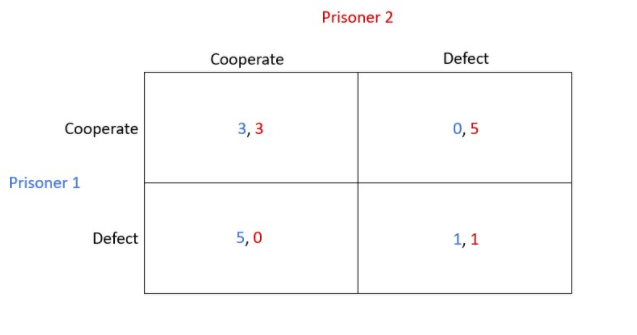
The answer, in part, is that they weren’t strangers. They may be anonymous to one another, absent recognition or connection in real life (IRL aka meatspace), but that doesn’t make them strangers. These men and women had built a community so deep they had their own (often incredibly offensive) language. Their own jokes. They had a culture and sources of status, going so far as to create their own within-group celebrities. And, absent any visible coordination, that culture had evolved in this moment toward a single idea: hold the stock. They were playing a massive prisoner’s dilemma game with each other. Can you form a group for the express purpose of creating a short-squeeze? Probably not – the very action of creating an identity around profit from financial speculation belies the prospect of building an identity valued more than pure profit by its members. That’s the rub – if you want to pull off a massive collective financial action, you’re going to have to build a group of people interested in financial collective action that nonetheless values the identity of the group above the profits of collective financial action. That’s what makes this Planet Money podcast about Gamestop so special– more than anyone anyone else, they seemed to understand that the absurdist emoji usage and language, the elaborate memes, the actual freaking sea-shanties, those weren’t just color for the story, they were the story. Hedge funds weren’t losing tens (hundreds?) of millions of dollars in a zero sum game to a bunch of idiots obsessed with chicken tender-centric memes and sea shanties. They were losing a millions of dollars in a zero sum game because of the memes and sea shanties.

https://blog.methodsconsultants.com/posts/the-prisoners-dilemma/

Put succinctly, at every stage leading up to and during the short-squeeze, each and every holder of Gamestock shares would have been better “defecting” on their r\wallstreetbets comrades-in-arms. Yes, the group is better off if everyone holds, but everyone knows the incentives faced by everyone else, which creates a seemingly irresistible economic gravity of self-interest (defect, defect). So how do we solve these collective action problems? Well, first and foremost, we change the payoffs. That’s what we do in successful families, mafias, and religious groups. It’s what we fail to do in our misfiring coups, cooperatives, and communes.

Yes, your bank account balance will increment upwards if you defect and sell your stock. But that also means you’re no longer a true Son of Gondor. Sure, no one else on the subreddit knows it, but you’ll know it. You’ll know it in your cold, lonely, traitorous heart. Sure, you can use the words and participate in the jokes, but will you ever know the same sense of fellow-feeling within the community as you knew before. That’s a real cost. Is it worth cashing in $5000 in profit a week early, especially knowing it might be worth more next week? Remember – the benefit of group identity doesn’t have to be greater than the profit at hand, it only has to be greater than the risk holding the stock bears for your future profit. Combined with a little motivated reasoning, and it quickly becomes clear how a community, formed independent of profit-via-collective-action, now suddenly becomes an engine of pro-social decision-making sufficient to create an existential threat to any institution over-leveraged on a short position.

The same payoff matrix, however, also demonstrates that a short-squeeze built around a group identity is living on borrowed time. With every short position that gets closed out, the price climbs both higher and closer to its (actually) inevitable peak. There are a finite number of short positions, and there is a finite number of days their share lenders will allow them to hold out, all of which mean a peak will be reached, after that point the price will begin to rapidly decline. Which all means that as the price rises the risk to holding also rises, both of which are increasing the opportunity costs of holding the stock, shifting the payoffs back to a classic Prisoner’s Dilemma. Sure, your group identity might be worth $5K, or even $50K, but there’s a point at which anonymous community is dominated by the prospect of material wealth. I’m not saying you can buy true friends, but eventually you can buy something that offers a close substitute for anonymous friends. Or an island.


*I mean, I personally believe “To Dare is to Do” is a far smarter and sexier slogan.

The GameStop Short Squeeze: Swarm of Small Investors Stings Wall Street Hedge Funds

If you think the price of a stock is going to go up, you can buy shares and wait for the price to go up, then sell the shares to someone else. This is called being “long” a stock. If it turns out that the stock price goes down and stays down, the most money you can lose is the amount you put in, since the stock price cannot go below zero.

But what if you think the stock price is going to go down instead of up? You may believe the price has run up irrationally high, or your analysis uncovers poor earnings prospects. A favorite tactic of Wall Street pros, including hedge funds, in this case is to “short” a stock.

Continue reading