New EG.5  Variant Spreading: Start of New Covid Surge?

The spread of highly-contagious and sometimes fatal Covid-19, and the responses to it (lockdowns and then trillions of dollars of federal giveaway money to mitigate the effects of the lockdowns and now huge interest rate hikes to counter the inflation caused by that giveaway money) have been arguably the most economically momentous events of this decade so far. Thus, it behooves us to keep an ongoing eye on this beast, since it seems to keep coming back in waves.

We all know that Covid is spread by little “aerosol”  droplets coming out the infected people’s mouths and noses. Those aerosols are mainly generated by speaking and singing. So being in a room full of talking or singing people (e.g., a happy convention or bar, or a hymn-singing church) can be a super-spreader situation.

I have reasons to try to avoid respiratory diseases, and so I attended church on-line or outdoors for most of the past three years. The Covid numbers finally got low enough this spring that I started attending inside, and even going unmasked the past two months.

Alas, Covid cases and hospitalizations are back on the rise, it seems due to the new Eris or EG.5 subvariant. Like the infamous omicron variant of a year ago, it is very transmissible and resistant to existing vaccines, but is not as deadly as the original strain. Much of the population has some immunity due to vaccines and/or prior exposure. Also, antivirals like Paxlovid are widely available to help mitigate symptoms. Still, a case of Covid often makes for an uncomfortable and disruptive  week or two, and can still be fatal or debilitating.

So, I have done a quick amateur scan of the internet, trying to get a fix on what to expect. One thing that stands out is that actual case numbers are far higher than officially reported, for a couple of reasons. One is that the rigorous, systematic reporting of cases has fallen off, since Covid was deemed no longer an emergency. Also, with the end of free test kits and the generally more lax public attitude (we just want to be done with this), there is far less testing done than in 2022. (In communities with systematic testing, it turns out that the best way to track Covid is by analyzing wastewater).

Will the Latest Vaccines Save Us?

The vaccine story seems somewhat mixed. The latest booster vaccine, to be available around October, will target the XBB.1.5 subvariant, which is what was mainly circulating earlier this year. However, it is expected that since EB.5 is closely related to XBB.1.5 (both of these are of the general omicron family), the booster will confer some immunity to EB.5. That is the good news.

The bad news is that the public’s uptake of boosters in general is well under 50%, so we may expect EB.5 or whatever the next subvariant is to continue to circulate, and probably surge during the colder months when respiratory diseases tend to spread. Also, vaccines do not really stop you from getting Covid, they mainly act to mitigate the symptoms by helping your body’s defenses to react faster.

Starting next week, I will resume wearing an effective KN-95 or my preferred KF-94 mask at church and other venues where a lot of people are talking or singing.

On the Spreading of Monkeypox

New York City has become the second major U.S. city after San  Francisco to declare a state of emergency due to the rise of monkeypox cases: “New York City is currently the epicenter of the outbreak, and we estimate that approximately 150,000 New Yorkers may currently be at risk for monkeypox exposure.”

With the country and the world still feeling the economic/social/personal effects of one pandemic, is there another one on the way? I don’t know, having no special training in epidemiology, but have tried to peruse some reliable sources to find out what I could, and share this information for your examination. I will paste in a general page from a UC Davis article, then conclude with a CDC snip on transmission details.

It seems that monkeypox typically takes pretty close physical contact (especially with skin, body fluids, or e.g. towels/clothing)  to spread, with having multiple romantic partners being a high risk factor. This is the opposite of COVID transmission, where just being in the same room puts you at high risk. However, as with COVID, someone can be contagious in the early stages before they show obvious symptoms. Based on all this, my guess is that monkeypox will not spread in the general population very much, but it will spread significantly in some groups and locales. But that is just my guess.

~~~~~~~~~~~~~~~~~~~~~~~~~~~~~~

From UC Davis “Monkeypox: What you need to know about this rare virus:

What are the signs and symptoms of monkeypox? At what point is it infectious?

Monkeypox starts with fever, then general body aches, malaise, and muscle aches. with the first symptoms are similar to influenza. Those usually precede the development of a rash. You have probably seen photos of the rash. It’s really hard to miss. It starts as macules, which are flat lesions. Then it forms a firm nodule. From there, it becomes a blister, then a pustule (a blister containing pus) and then it scabs over.

According to the Centers for Disease Control and Prevention (CDC), the incubation period (The time from infection to symptoms) for monkeypox is usually 7 to 14 days, but it can range from 5 to 21 days.

People may be contagious at the early signs of fever and stay infectious through the rash until the skin scabs and heals over.

How is it transmitted?

Monkeypox is transmitted through close person-to-person contact with lesions, body fluids and respiratory droplets, and through contaminated materials such as clothing or bedding.  [[ see more on transmission below]]

Can you die from monkeypox? 

Most people with monkeypox will recover on their own. But 5% of people with monkeypox die. It appears that the current strain causes less severe disease. The mortality rate is about 1% with the current strain….

What are the treatments for monkeypox? Is there a vaccine for monkeypox?

The smallpox vaccine has some cross protection against monkeypox. The vaccine is being made available through public health for people who have had contact with confirmed or suspected cases of monkeypox. If the vaccine is given within four days of exposure, it protects about 85% of the time. Even if the vaccine is given up to two weeks after exposure, it may modify the disease, making it less severe. 

In addition, there are some antivirals and immunoglobulins that are available to treat monkeypox.

Is there a way to test for monkeypox?

If a health care provider suspects that a patient has been exposed to monkeypox, they can get a sample of a lesion and send it to the state for testing. If it turns out positive, the result will be confirmed at the CDC.

~~~~~~~~~~~~~~~~~~~~~~~~~

From CDC “How It Spreads”:

Monkeypox spreads in a few ways.

  • Monkeypox can spread to anyone through close, personal, often skin-to-skin contact, including:
    • Direct contact with monkeypox rash, scabs, or body fluids from a person with monkeypox.
    • Touching objects, fabrics (clothing, bedding, or towels), and surfaces that have been used by someone with monkeypox.
    • Contact with respiratory secretions.
  • This direct contact can happen during intimate contact, including:
    • Oral, anal, and vaginal sex or touching the genitals  or anus of a person with monkeypox.
    • Hugging, massage, and kissing.
    • Prolonged face-to-face contact.
    • Touching fabrics and objects during sex that were used by a person with monkeypox and that have not been disinfected, such as bedding, towels, fetish gear, and sex toys.
  • A pregnant person can spread the virus to their fetus through the placenta.

A person with monkeypox can spread it to others from the time symptoms start until the rash has fully healed and a fresh layer of skin has formed. The illness typically lasts 2-4 weeks.

Vaccine Lotteries: They Work!

To try and encourage vaccination during the on-going COVID pandemic, there have been many public and private incentives offered. For example, free doughnuts. Or offering $200 to state employees in Arkansas (taxable income, of course!).

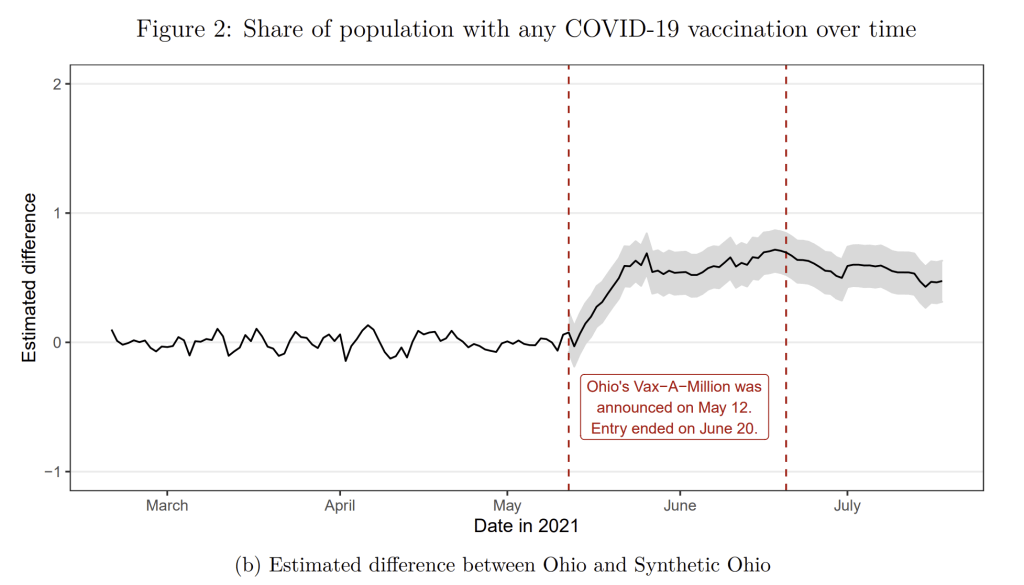
But when the governor of Ohio announced on May 12, 2021 that they would be offering a $1 million lottery prize, with 5 winners, it took the incentive game to a new level (college scholarships were also a prize for 5 winners under 18).

So do the lotteries “work”? Do they get more people vaccinated? And even if they do “work,” does it pass a cost benefit test? Many expressed concern that, even if more people get vaccinated, that this is a lot of money to spend in uncertain budget times.

A new working paper by Andrew Barber and Jeremy West attempts to answer these questions. And they do so using synthetic control, one of the better methods social scientists have for attempting to identify causal relationships (which can be tricky).

What do they find? First, vaccine lotteries do work! They estimate that vaccination rates increased by 1.5% in Ohio because of the lottery. This amount is above and beyond the increase that would have been expected without the lottery (by comparing Ohio to other states that didn’t use a lottery — this is what the synthetic control method does).

But does it pass a cost-benefit test?

Continue reading