I really don’t like the time and effort wasted in cleaning crudded-up frying pans, so I appreciate non-stick coatings. I have a small diameter Gotham ceramic pan that works well, and I was thinking of getting a larger one for cooking bigger loads. As usual, I went to the internet for wisdom on preferred ceramic pans to buy.
However, in the course of trying to get a fix on how they work, I fell down a rabbit hole. It turns out that this subject is complex and controversial. I will try to summarize my understanding in a brief post, with the caveat that I am not sure of everything here.
First of all, the “ceramic” coating is not really ceramic. Typical ceramics are made from firing powders of inorganic materials like silicon/aluminum oxides (including clays) at extremely high temperatures to where the particles fuse together. For the ceramic coatings on pans, this is not the case. I looked pretty hard on line without success to pin down the actual process or composition of the pan coating. It seems to involve some sort of silicone or silica polymer, applied using a sol-gel process. (Silica is just silicon and oxygen – quartz and white sand are pure silica – while silicone is typically a Si-O-Si-O-Si polymer with two extra hydrocarbon side groups attached to each Si).
100% silicone, in the form of rubbery sheets or cupcake papers for cooking on or in, is known to give a non-stick cooking surface. The “ceramic” coating in pans appears to be a solid equivalent of silicone cookware. A key factor mentioned in why it is slick and why it loses its slickness is that (supposedly) a thin layer of silica or silicone comes off with each cooking episode, and that thin layer is what gives the non-stick effect. (I would not mind ingesting a little adventitious silica, but eating random silicone worries me a little – but I don’t know if all this is actually true).
See this link for further discussion of the safety of ceramic versus teflon coatings. Be aware that makers of teflon coatings often choose names for their coatings that include the words “stone” or “granite”, perhaps to make the unwary consumer believe that these are ceramic coatings. My teflon pans have usually started to flake (into my food!) after a couple years’ use. A happy exception is a newer electric skillet which has temperature control so it never gets above about 425 F (high temperature destroys teflon). We do keep it oiled in use. Its teflon coating is still good as new after two years.
There seems to be general agreement that ceramic pans start off super slick, that fried eggs slide right out, but that after some months of use, food starts sticking noticeably. It helps to use a little oil every time you cook, and to avoid using metal utensils or abrasive cleaning pads, and to avoid very high temperatures or the use of cooking sprays (which deposit something harmful to the ceramic coating) or olive oil (which can burn on). Some users say it is important to clean the pan well between uses, e.g., using salt as a mild abrasive.
Why Do Ceramic Pans Lose Their Non-Stickiness?
There seem to be two main schools of thought as to the deterioration of performance. One school points to the (alleged) continual loss of silica particles or (presumably oily) silicone from the surface; perhaps once this surface layer is depleted, it’s game over. Another camp points to the buildup of burned-on deposits, even very thin, nearly invisible deposits, that then become a locus of food sticking.
What Can Be Done to Restore a Ceramic Pan Coating?
It is common to read that you just have to be prepared throw the pan away every 1-2 years. However, this does not seem economical. Can these pans be salvaged? One author claims that slickness can be restored by “seasoning” a ceramic pan, similar to how cast-iron pans are treated: after cleaning the pan, rub a very thin layer of a recommended oil (e.g. soybean oil, not olive oil) on the pan and then heat it to the smoke point. This should bond a polymerized oil layer to the surface. I have not tried this, but it might be worth a try.
A diametrically opposite approach is recommended by the maker of GreenPan ceramic pans. Here the theory is that if an offending film of cooked-on crud is removed, the native, clean ceramic layer beneath will once again be non-stick. A wet Magic Eraser type cleaning pad is recommended.
A similar remedy touted on the internet (e.g. here and here) is to rub with coarse salt (for long time, but not too hard) to get down to a pristine ceramic surface. Good results are claimed.
As a (retired) experimental scientist, I was itching to try something like this. At a family member’s house, I found an older ceramic pan that was not in really bad shape, but had lost its primal non-stick.
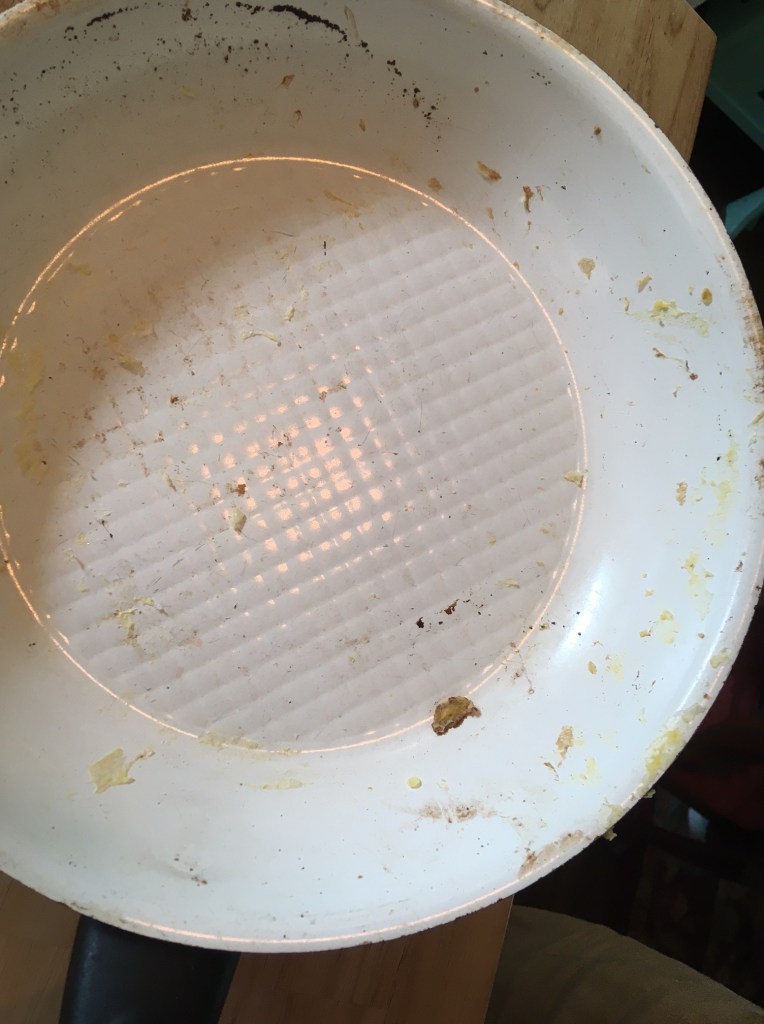
The BEFORE picture is above. There was a persistent brown film in parts of the pan, and cooked omelets (my test vehicle) did not simply slide out. I cleaned the pan with soap and water and a sponge, then went at it with a wetted Magic Eraser. I got the brown film off, though you could still see some pitting in the coating due to the use of metal utensils.
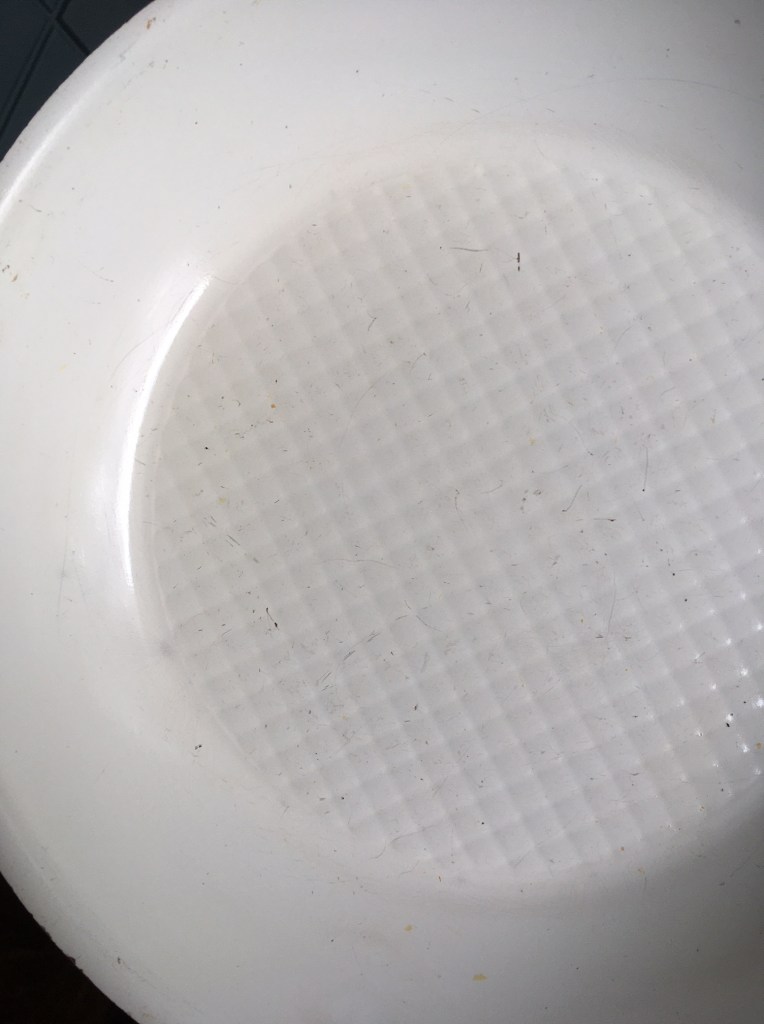
The AFTER picture is below. This is after cooking yet another omelet (with oil), and just wiping the pan with paper towel afterward. I can’t say that it was a night and day difference, but the Magic Eraser treatment definitely seemed to improve the performance. Score one for sustainability.
APPENDIX: Finally Understanding What Make Ceramic Pan Coatings Non-Stick
As noted in the original article above, I was puzzled over how the ceramic coatings worked. The descriptions in articles I could find on-line talked of forming these coatings from sol-gel solutions, using ingredients such as tetraethoxysilane. Without going into details, my chemical intuition led me to believe that, yes, you could form a dense silica pan coating from that, but the final outer surface would have Si-OH groups, like quartz or glass or ordinary “enamel” ceramic pan coatings. This would not give the oily, silicone-like surface that is evident with the nonstick ceramic pan coatings.
My “Aha” moment came when examining a patent application ( United States Patent Application No. 20180170815) for making a GreenPan ceramic pan coating. Among the ingredients for making the coating is methyltrimethoxysilane (MTMS). And THAT should give Si-CH3 groups on the outer surface, which is exactly the type of oil-like outer surface that silicone has. (The -CH3 methyl group is a fairly nonpolar, “oily” hydrocarbon type group).
A restless itch has now been scratched. I think I now understand why fresh ceramic pan coating can have such fine non-stick properties, and perhaps why they might be vulnerable to losing their non-stick properties. With Teflon type pan coatings, it is plasticky, oily Teflon all the way down, so if you abrade off a hundred molecular layers, it should make no difference. But with the ceramic coatings, it is not clear to me whether the oily Si-CH3 groups are only in the topmost atomic layer; maybe if that gets abraded off, there is only the quartz-like Si-OH groups to be found; or maybe there is a substantial (in atomic terms) topmost layer rich in Si-CH3 groups. Anyway, it makes sense to keep using oil when cooking on ceramic pans, to keep a hydrocarbon-type surface coating going there, and to avoid using metal utensils that can scrape and scratch the coating.
Sep 2026 Update:
For readers here, I figured I should harness the power of AI, so I asked Claude about restoring ceramic pan coatings. Some takeaways, which basically agree with the above:
For cleaning deposits off the pan, as an alternative or supplement to Magic Eraser, try : Simmer a mix of water + a few tablespoons of baking soda in the pan for 8–10 minutes, then let cool and wipe out. For stubborn buildup, a paste of baking soda + a little water…left on for 15–20 minutes, then scrubbed gently with a soft sponge (never steel wool or abrasive scrubbers — that’s what actually damages ceramic).
After cleaning, re-season lightly: wipe a thin layer of a high-smoke-point oil (avocado, grapeseed) over the warm, dry pan and heat it for a few minutes, then wipe off the excess. This won’t rebuild the ceramic, but it restores some slickness by filling in micro-pores.
Prevention going forward: avoid metal utensils, avoid high heat above medium (ceramic coatings degrade faster than PTFE at high temps), hand-wash rather than dishwasher, and avoid cooking sprays with lecithin (like Pam), which leave a residue that’s notoriously hard to remove and accelerates the buildup that looks like “degradation.”


Hi
Great post
I found a high alkali oven cleaner (a gel based one you brush or ‘paint’ onto your oven and then rinse off like the one made by Lakeland uk) worked on my old ceramic pan and restored the non stick 100% but it would still rapidly degrade again. Above process would again work
No sure why- assume removed any surface burnt on food and re-exposed the non stick area.
LikeLiked by 1 person
Yes, I would think that an oven cleaner would remove any food film. I don’t know what it would do to the underlying coating. I recently saw a spray can of oven cleaner that did not use alkali, but instead an ethanolamine solvent.
But the Magic Eraser method was fairly easy and did not involve hazardous chemicals, so I would suggest that as a first approach.
LikeLike
Wow! This article about whether to use a pan without its non-stick coating is really helpful!
It’s like a friend giving me advice in the kitchen,
making it easier to know what to do. Thanks for sharing this useful information! 🍳🌟
I feel more confident now about handling my pans,
thanks to the clear explanations in this article!
It’s like having a kitchen coach right at my fingertips. 🥘👩🍳
LikeLike
This makes total sense, $400 for a cookware set that lasts a year or so at best. Not a good choice and I am regretting it now. Marketers got me again…..
LikeLike
Great article – glad to hear I am not alone.
I am slowly coming to the conclusion there is no ideal solution to the problem of pans losing their non-stick and low adhesion properties with age, regardless how much money you throw at the problem. Enamel becomes problematic as the surface becomes etched over time. Burning the bottom really doesn’t help here where concentrated bleach or abrasive is required to remove the charred bottom. I agree, better care needs to be taken in cleaning the bottom to preserve the surface properties.
Then you have PTFE coatings that invariably end up peeling off with usage. This gets worse with electromagnetic induction hobs I fear where at higher temperatures, these coatings may begin to break down more quickly. In this case, replacing pans every few years becomes an accepted practice.
I guess there are a few approaches to consider if you don’t want to replace your pans every few years.
There is the art of seasoning which takes some skill and practice building up and maintaining a natural non-stick layer over time.
Alternatively, you become adept at using a stainless pan providing it has good heat conductivity and low adhesion properties (a more expensive pan actually helps here). While they won’t be non-stick, they’re a durable alternative.
And then there is the elusive PTFE re-surfacing service I have been chasing recently, now that I have six 3-ply pans that have completely deteriorated PTFE coatings.
I am getting closer to (3) after tracking down several suppliers, most of which only supply to commercial businesses and not setup to deal with the domestic consumer. Hopefully I can avoid purchasing another set of pans as someone else in the household will not consider (2), the low adhesion route.
My journey continues…
LikeLiked by 1 person
Yes, grandma’s cast iron pan is looking pretty good in some ways. I think the trick is to get one of those chain mail pot scrubbers to help clean off crud. After much use, I boil a little water (no soap) in cast iron pan, then scrub, and re-oil.
But actually, my cheapo Gotham Steel ceramic pan is still non stick after some four years. I think the key with any of these is to not overheat. My electric stovetop heating coils have some some sort of heat sensor, I think, so if we set heat at like 6/10, it does not burn. We do keep it lightly oiled, and avoid using metal on it. I would imagine on a gas stove, there is more possibility to scorch the coating.
Something else that has worked well is a teflon coated electric skillet. It never goes above say 425 F, and with its fairly modern coating (it’s maybe 2 years old), it has no deterioration .
Good luck!
LikeLike
I know this article is old but do you have any recommendations for the ceramic coating of rice cookers? I bought a nice one but the inner bowl is trash. They don’t sell replacement parts anymore
LikeLike
Hello, I don’t have any special insights on a ceramic coating if it is really trashed. I have found that if I treat it gently (not overheat) and keep it oiled, it can last well for years.
In your case, I would first try the Magic Eraser as a “do not harm” approach. Maybe try first loosen deposits by heat water with baking soda. Then oil it. This might get the coating working again. Of course, if the ceramic coating is scratched down to metal, you are donw.
Ah, I decided to confirm this with my buddy Claude — turns out he agrees with me, so I will paste this advice up in the main article.
LikeLike