Leading Indicators Show Incoming Recession; Lagging Indicators Not So Much

Here I will draw on a recent article Leads And Lags: Timing A Recession by Seeking Alpha author Eric Basmajian. His overall points are (1) that some indicators are associated with leading segments of the economy (which have historically turned down well before the rest), while others are more lagging, and (2) the leading indicators are strongly flashing recession. Direct quotes from his article are in italics.

Leading Economy, Cyclical Economy & Total Economy

When economic data is released, the information should be contextualized based on where the data point falls in the economic cycle sequence.

We can separate the economy into three buckets: the Leading Economy, the Cyclical Economy, and the Total Economy.

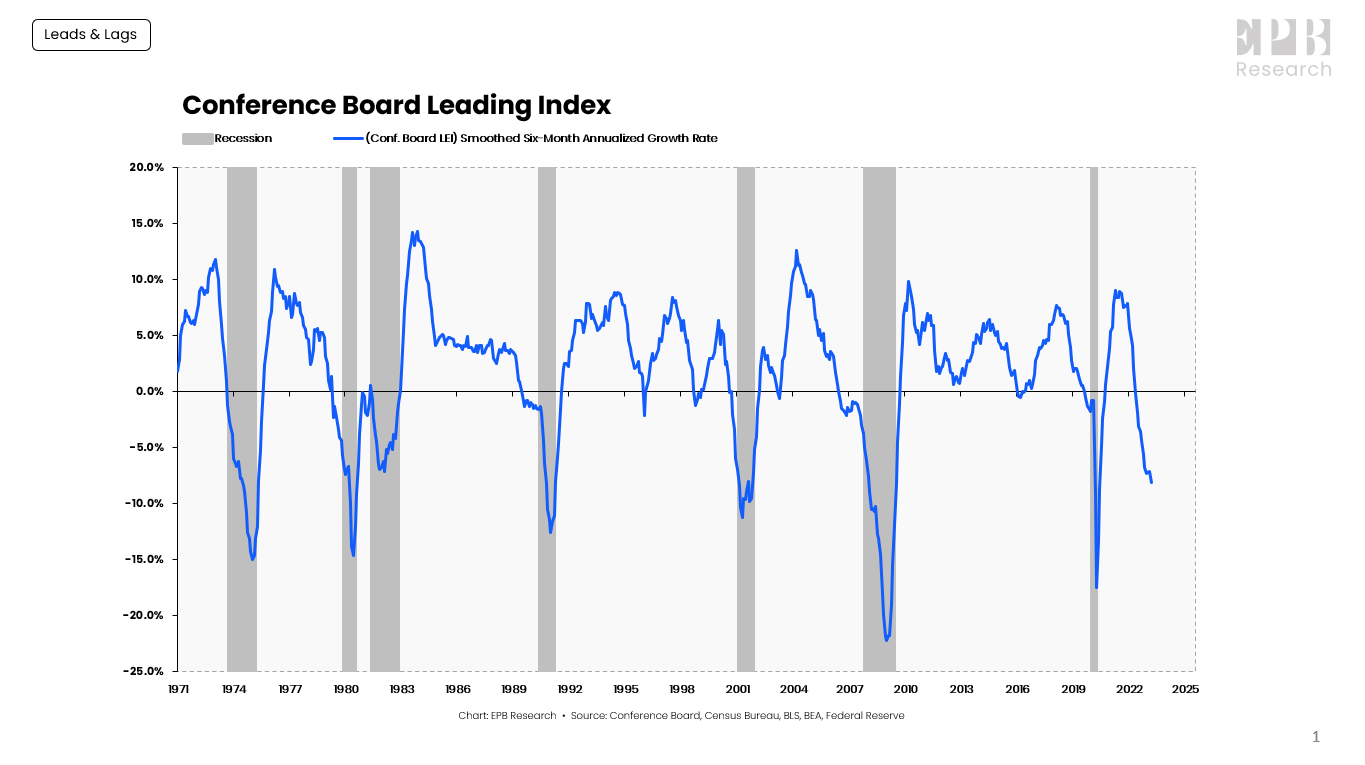
The Leading Economy is defined by the Conference Board Leading Index, which is a basket of ten leading economic variables such as building permits, new orders, and stock prices.

The Leading Index has turned negative before every recession, without exception.

Conference Board, Census Bureau, BLS, BEA, Federal Reserve

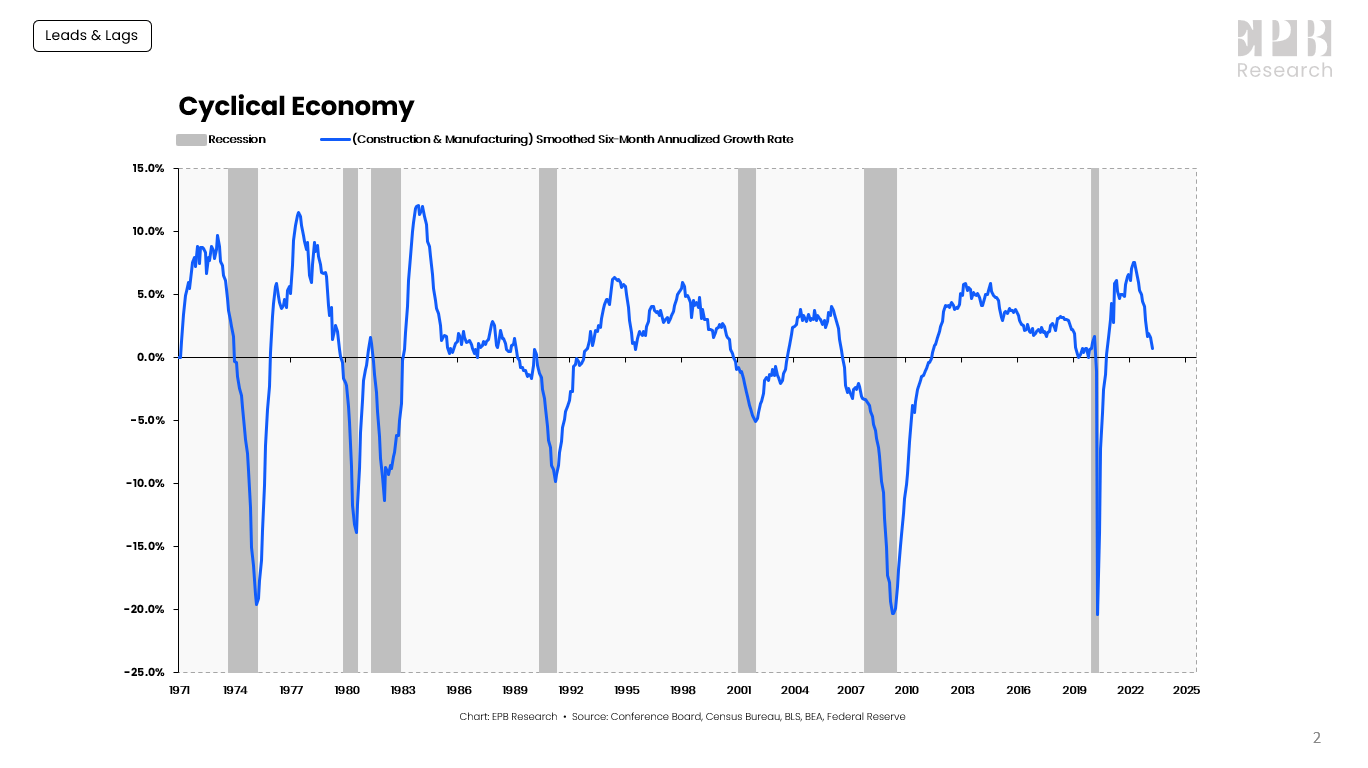
The Cyclical Economy represents the construction and manufacturing sectors. The Cyclical Economy is the driving force behind recessions, always turning negative before the Total Economy, and never giving a false signal; when the Cyclical Economy turns negative, the Total Economy turns negative several months later.

Conference Board, Census Bureau, BLS, BEA, Federal Reserve

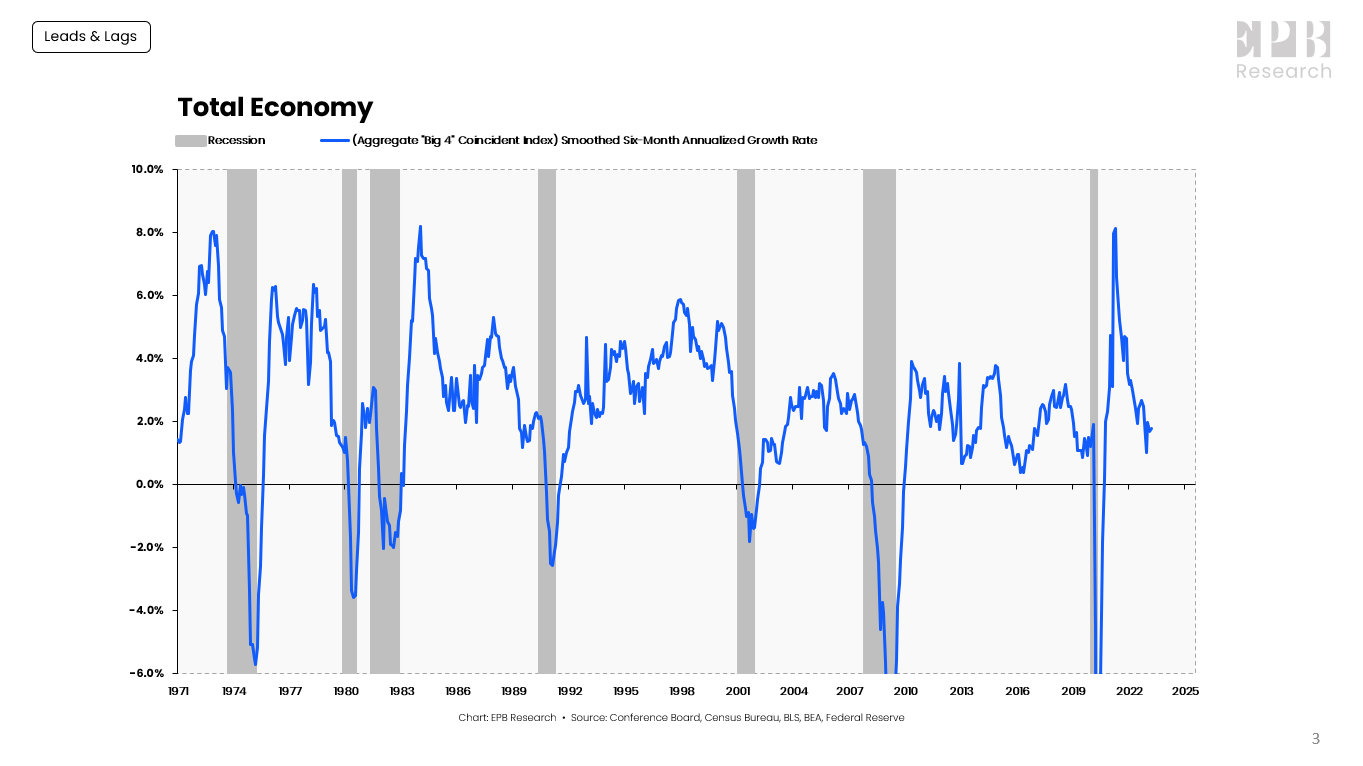
The Total Economy is defined by the “Big-4” Coincident Indicators of economic activity. Nonfarm payrolls, real personal income less transfer payments, real personal consumption, and industrial production are four major economic indicators that the NBER uses as the core of their recession dating procedure.

Conference Board, Census Bureau, BLS, BEA, Federal Reserve

A sustained contraction in the “Big-4” Coincident Indicators is the definition of a recession.

The Total Economy starts showing contracting growth rates about four months into the recession.

Could This Time Be Different?

If we do finally get a recession, it will be probably the most long-expected recession ever. Pundits have been warning for over a year that the Fed’s well-telegraphed program of rate hikes will crater the economy, as the only way to tame inflation.

According to Basmajian, When the Leading Economy and Cyclical Economy are both lower than -1%, a recession, as dated by the NBER, occurred an average of 5 months later, with a range of a 4-month lag to a 14-month lead.

His Leading indicator went negative about 11 months ago (June, 2022). However, it looks like the economy is still humming along and employment remains robust. His Cyclic Economy is on track to go negative right about now, but that has an unusually long lag between Leading and Cyclical:

The Cyclical Economy will likely turn negative with April data and potentially below -1% by May data should the current downward slope remain.

That would push the lag between the Leading Economy and the Cyclical Economy to 11 months, the longest on record.

And the lag before we finally get a bona fide recession in the Total Economy may keep dragging out longer yet. There is even a possible Soft Landing scenario where the rate hikes manage to cool the economy down without causing a severe recession at all.

It seems to me that we collectively are still spending down our excess pandemic benefits, and no recession will come till we finish running through those monies.

PTO can buy school supplies in bulk

My kids go to public school, and I love our Parent Teacher Organization (PTO). I’m going to keep this focused on one wonderful bit of collective action.

Students need to show up on the first day of school in August with certain school supplies. For example, first graders must have a 24-count crayon box. The school posts a list of supplies that parents must pay for. One option is to go to the store yourself to get all these items.

Or the PTO will do it for you if you pay a fee online. So, you don’t go shopping at all, and your kid just walks into school and the supplies are on their desk.

The savings from going through the PTO, in both time and money, are massive. The savings in the time of parents are more important than the bulk discount factor. (If you’d like to consider what that monetary bulk discount is, see this form from a similar program in Pennsylvania https://www.ht-sd.org/uploaded/District/Schools/Central/2013-2014_SY/PTO_-_School_Supplies_5th_Grade_2014.pdf)

One reason for sharing this is just to spread this particular idea, although many PTOs around the country already do it. It requires some volunteers to coordinate activity.

In my experience, collecting money and handling new office supplies is something American volunteers will do. There are certain jobs that seemingly always have to be paid positions in any organization, because no one wants to do it no matter how warm the fuzzies are.

Another reason for mentioning it is as just one of thousands of examples of how my life is improved by the networks of volunteers and local leaders that I live near. These kinds of benefits do not automatically follow from people living in proximity to each other, but they are one of the potential benefits of clustering together geographically.

The UN estimates this milestone event – when the number of people in urban areas overtook the number in rural settings – occurred in 2007.

https://ourworldindata.org/urbanization#number-of-people-living-in-urban-areas

Animated AS AD Model

Gifs are really cool. They’re like the animated photos on loop from Harry Potter. They’re also great for teaching. You can show students exactly what you want them to see over, and over, and over. They don’t need to navigate to the right part of the video, wait for ads, or worry about whether the particular grammar of a book is opaque. They can just look and think.

For example: Why are prices higher than 3 years ago? We can use the Aggregate Supply- Aggregate Demand model (AS-AD) to help us think about it. Prices have increased because demand has grown faster than long-run aggregate supply (LRAS).

At first, the SRAS, which does the work of finding the long run equilibrium, increased rightward. This is because we’ve had a decade of low, stable inflation and inflation expectations were anchored at a low level. Greater demand was met with greater output. But, as AD continued to grow and people began to confront the unavoidable reality of scarcity, SRAS began moving upward, increasing the price to ration the quantity demanded.*

See the below gif. I made it in Stata and ezgif.com. It’s pretty cool.

Continue reading

Highlights from #EconTwitterIRL

Last weekend fellow Temple University economics PhD Adam Ozimek hosted the inaugural #EconTwitterIRL conference. He managed to get 100+ people, including many big names, to come to his bowling alley / arcade in Lancaster, PA.

The overall demographic of Econ Twitter people appears to be youngish professionals, mostly male, surprisingly social and normal-looking (surprising to me because I retain the ’90s-era stereotype that people who write a lot online are nerds who don’t want to talk to anyone IRL).

Adam opened with a history of EconTwitter, which to him is not just about Twitter, but is anywhere where communities of people write about economics online. This starts with the comment sections of the earliest blogs, like Brad DeLong’s, in the early 2000’s. Then in the late 2000’s many commenters start their own blogs, like Karl Smith at Modeled Behavior. In the 2010’s Econ Twitter comes into its own. It may persist or a new forum might take over, but either way the discussion and community will live on.

While it was cool to see a live recording of Odd Lots, and a panel on innovation with MacArthur Genius Heidi Williams, my favorite panel was the one on immigration, because it saw the most serious disagreement. Garett Jones and Daniel Di Martino argued for reforms to the immigration system that would move it away from a focus on family reunification and toward a focus on skills and other indications (like country of origin) that immigrants would benefit the US economy. In contrast, Leah Boustan argued that the current system has worked well, including for assimilation and economic growth, and we should be wary of making big changes to it. Moderator Cardiff Garcia pointed out the oddity of the economists from George Mason and the Manhattan Institute arguing for a “socialist” system where the government determines what the economy needs when it comes to immigration, while the Princeton economist argues against. Garett Jones noted that the rest of his department at Mason disagree with him, but he’s glad to have the freedom to disagree.

While the panel saw intense disagreement about what the ideal system looks like, all panelists shared a frustration with parts of the current system that seem to pointlessly slow or prevent high-skill immigration. Some of this is bureaucracy slowing the process for immigrants who are legally allowed already. Some is politicians refusing to make the smallest, simplest, most common-sense fixes unless they are part of a comprehensive immigration reform that hits their big priority. The big priorities differ by party, but the commitment to holding simple fixes hostage is bipartisan.

Hopefully discussions like this can start to change things. That might sound naive or idealistic, but on an earlier panel Matt Yglesias noted that we should be both impressed and slightly scared of how aware Capitol Hill staffers are about the opinions of Econ Twitter.

Source. Got 2nd at trivia as part of team Acemoglu et al (actual Acemoglu not included).

The magic of all this is that you never know what can come from a post. You might make a friend, make an enemy, get a job, lose a job, influence public policy, get a job in the White House… even make (or lose) a million dollars. So we keep poasting, and once in a while see the results IRL.

Housing Costs Revisited: What About Renters?

Kevin Erdmann has written a detailed and thoughtful response to my post from last week on housing spending as a percent of income. My goal in that post was to look at consumer spending as a percent of income for a variety of different sub-groups (my primary interest was by age group, but I tried to get into more detail for other sub-groups).

As Erdmann emphasizes in his post, I left out one set of sub-groups that the CEX data allows us to use: renters vs. homeowners. And these are very important groups to look at, since for homeowners (as he points out) many of the costs are implicit (such as the opportunity cost of those that don’t have a mortgage). Lumping all of these households together may obscure some of the different trends.

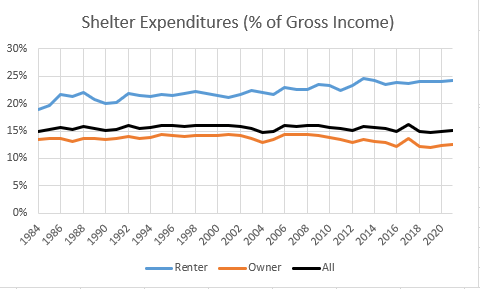
Be sure to read Erdmann’s post in full (he says many smart and correct things), but the key result is in his Figure 2 (reproduced here). Renters have seen the share of their income spent on shelter rise from 19% in 1984 to 24% in 2021. This is not a trivial increase. Owners, by contrast, have seen their share of spending fall, which is how it all gets washed out in the average.

I will concede that Erdmann is probably right on many of his many points. Still, I wanted to see this at a much finer level of detail, since national aggregates might be giving us confusing results. The micro-data in the CEX is probably not detailed enough to give us good breakdowns by MSA.

Continue reading

Regulation and Delayed Updates: Why Services Inflation Will Likely Stay High

Apart from some possible geopolitical upset (and theater with the debt ceiling), the Big Issue for the larger economy, and for investing decisions, remains how fast inflation will decline – since that governs how soon the Fed can relent on keeping interest rates high. Those high interest rates are having all kinds of knock-on effects, including bank failures and suppressed home sales.

The investing market seems to be pricing in expectations of significant Fed rate cuts before the end of 2023, which in turn presupposes that inflation will have ratcheted downwards far enough by then to allow the Fed to declare victory. Goods inflation (= mainly stuff made in China) has declined nicely, but services (which comprise the majority of household spending) remains high. It is coming down, but too slowly to realistically hit the Fed’s 2% target this year.

In an article in the Seeking Alpha site title Services Inflation Is Stuck, the investment firm Blackrock notes some technical factors that will likely keep services inflation high for at least the remainder of this year. I will paste in their text in italics:

Core Services ex-Shelter inflation is a bit of a hodgepodge that includes things like medical care services, video and audio services, tuition, and insurance. It comprises roughly a quarter of the CPI basket and, importantly for the Fed, is very domestically oriented.

A key insight from this article is that nearly two-thirds of this key “Core Services ex-Shelter” component consists of:

(1) Service prices that are regulated (especially insurance), and

(2) Services with infrequent price resets (such as tuition and especially medical services):

There are technical factors that make it likely that these particular items will see ongoing, sticky inflation:

Impact of Regulated Prices

Regulated prices tend to be more discrete and more lagged in their changes due to bureaucratic delays and their negotiated nature. Some types of regulated prices, like postage or water and sewage fees, are easily recognizable as subject to government regulation. Somewhat less intuitive is the degree to which insurance in the United States is a regulated price. Insurance comprises the largest share of Core Services ex-Shelter basket and state-level insurance commissioners play important roles in negotiating auto, property, and casualty insurance price changes.

The underwriting costs of insurance have been surging globally – a combination of higher reinsurance premiums, inflated asset values, and more natural disasters. These rising costs have only just begun to flow through into consumer prices; auto insurance costs were an upside surprise within March’s CPI report.

Jumps in Medical and Education Prices Will Appear Later

Though the market has been fixated on the painstaking details of the month-over-month inflation prints, many of the sub-components of the CPI do not update monthly. Two of the more important items within the core services basket – medical care services and tuition – only update their prices annually. Coincidentally, updates for both of these categories take place in the autumn, and both are set to rise strongly.

Medical care services are the largest component (28%) of Core Services ex-Shelter, but have a complex and lagged computation and update only once a year in October. Medical services inflation has been negative since last October as a consequence of excess consumer demand for post-pandemic doctors’ visits, however, we expect this mechanical effect will abate later this year and thereafter lift core services inflation.

Tuition is another example of a service with intermittent price resets, given prices are set on the basis of the academic year. We expect the broad-based upward wage pressure in education to be passed through to higher education consumer prices later this year when students return to school.

And so…I expect “higher for longer” inflation and interest rates.

Why Tenure

Joy got tenure! Texas took away tenure? North Carolina is trying to take away tenure. It’s become, at least to some, an open question as to why we grant faculty lifetime contracts after a certain benchmark of their career. So I’m going to answer it.

But first a point of clarification. I think we sometimes confuse benefits with reasons. Intellectual freedom is a benefit of tenure, a byproduct possibly, but I don’t think that is a reason. There is no shortage of industries and fields that would benefit from creative, intellectual, and artistic freedom, but we don’t tenure them. Just ask any of the major film directors of the last 50 years how much job security they’ve enjoyed and they’ll laugh out loud. I think it is pretty safe to say we’d probably observe greater artistic integrity in a variety of fields if people could fall back on a lifetime contract, albeit integrity coupled with some dropoff in productivity. Tenure remains a rare commodity across labor contracts.

So why tenure in academia?

To become an academic researcher is to make an enormous upfront investment in human capital, often remaining in school until someone’s late 20s, even early 30s. These are people who often have a relatively high opportunity cost of time, even early in their careers, and they do this while also staring down the possibility of technical obsolescence within a decade of graduation. An academic, if they make a major contribution, often knows it will happen before they turn 40 (30 if they’re a mathematician). This is not a trivial endeavor or decision.

Building a critical mass of high quality employees when such high opportunity costs underlie the requisite labor pool presents a financial challenge. In the face of these costs, as much as half of academic compensation takes the form of non-pencuniary benefits (lifestyle, freedom, flexibility, status, etc). And there’s one more problem, and it might be the biggest. For those in more technical fields, the full career’s worth of (discounted) wages would have to be collected in their first 8 years on the job. To put it another way, for the academic labor market to clear absent these non-pecuniary benefits, salaries would have to double or more.

There should be little doubt in your mind that all but a tiny fraction of universities would much prefer to pay in non-pecuniaries, clinging to solving their fiscal puzzle simply by letting their gaggle of weirdo nerds hang out in their clubhouses. Here’s the rub, though: you can’t front-load non-pecuniaries. If you know you’re going to peak at 34, you’re going to want to get paid now because nobody trusts an employer to keep paying them out of “loyalty”. Just ask every professional athlete who’s ever blown out their knee how well the franchise took care of them after their elite attributes were taken from them by the dark forces of randomness and age.

So how have universities solved this quandary? By paying their very best employees a lifetime contract, an annuity bundled with all those precious non-pecuniary benefits that blessedly never show up as an expenditure in a budget.

Sure, this story applies a bit more directly to departments whose faculty enjoy outside options in the private sector and government. But still, ten years studying literature and rhetoric remains an investment in human capital with a significant opportunity cost that most universities would be loathe to compensate for in pure wages. Better again to bundle a lifetime annuity with all those non-pecuniaries, especially since the kind of people who want to study esoteric subjects with little outside market value are exactly the kind of people who are willing to even less of their total compensation in wages.

Tenure exists to balance the books in a peculiar labor market. So what happens if tenure goes away?

Well, first off universities will have to start paying more money if they want to hold their incoming labor pool historically consistent. More of those wages will have to be frontloaded as well. I have a hard time imagining the state legislature is going to increase the line item for universities to accomodate a massive increase in the wage bill. More likely the quality of talent coming in will drop, especially for technical fields.

Second, university faculty employment will become more vulnerable to the preferences of their peers, students, and to a lesser degree the state legislature. Sure, once a year some poor soul will find themselves in the crosshairs of guileless politician desperate to sacrifice an academic for media attention, but the reality is most academics will gallop unnoticed within the herd. No, the real problem will be when students decide they don’t like you. Or your colleagues decide they don’t like you. Woe unto the professor who finds themselves outside of the political zeitgeist. It’s funny to me to that politicians in Texas and North Carolina seem to think that tenure is what’s protecting liberal professors. Liberal professors are the median voter in these little quasi-democracies. It’s the conservatives who are vulnerable. Or, more accurately, the most conservative faculty member in each department.

When you imagine departments purging colleagues, what sort of department do you imagine? Chemistry? Mechanical Engineering? Marketing?

Of course not. It’s obviously a humanities-adjacent department. Which brings us to perhaps the greatest irony of eliminating tenure: it will take the biggest hotbeds of godless communist socialist conspirators and make them even more liberal.

Now, I have little doubt that universities will strategically respond with contract designs that offer quasi-tenure. They will do everything they can to reconstitute the lifetime annuity compensation structure that keeps them competitive and fiscally afloat. But you can only do so much and there seems little doubt that job security absent tenure will decline, which means wages will have to increase some, particularly for fields without the kinds of large grants for which universities are desperate.

There’s no real workaround, no panacea for losing job security that protects you from political and intellectual isolation. Perhaps the biggest effect of eliminating tenure will be to make faculties more homogenous, more paranoid, more boring, and yes, I’m talking to you state legislatures, more liberal. Eliminating tenure will, at the margin push the most valuable, most talented, and most conservative faculty away, from red states to blue states. Those left behind will, at the margin, focus more on teaching than research, activism than grants, politics than science. When red states eliminate tenure, they are taking a significant step towards conjuring exactly the bogeyman that has thus far only existed in their imagination: an institution dedicated towards indocrinating students into a monolithic political worldview contrary to their own.

When your grandchildren come home from college, they’ll explain that is what we call “ironic“.

Tenure Reflections from Joy

Samford has voted to keep me around with promotion to Associate Professor. I am also pleased to have won a faculty Research award this year. You can see a list of my papers here. Tenure gives one an ability to plan for the future and be less focused on short-term publication success. I’m excited to keep at it with empirical research.

Five thoughts:

  1. It is a privilege to live when and where I do. Since we started this blog in August of 2020, several major events have changed the world. Through it all, I sometimes try to stay informed and offer thoughts here, and sometimes I block it out to focus on my research papers. I think about the young women in Kabul or Mariupol who started projects of their own in August of 2020. They don’t get to block it out.

https://www.wired.com/story/mariupol-ukraine-war/

2. James wrote a great inspiring tenure reflection post last year and pointed me to this quote: “I consider the “wasting of tenure” to be one of the aesthetic crimes one can commit with a wealthy life, and yet I see it all the time” –Tyler Cowen No aesthetic criminals here at EWED.

Continue reading

Buying Your New Home: Process and Strategy

I’m currently purchasing a new house and I want to share some insights. Baseline knowledge: Houses are unique goods on multiple margins that are imperfect substitutes. Let’s assume that both a buyer and a seller have real estate agents in the USA. The opportunity cost to the buyer is selecting another house that is not quite as desirable or finding a comparably desirable house after a wait (due to time searching and the appearance of new listings). Legally, the seller is not allowed to lie about the property details (though they can claim ignorance). The lending process makes it difficult for the buyer to lie.

Step 1: List and Bid

The seller chooses a price low enough that will permit a sale within their preferred timeframe, and high enough so that they earn a commensurate return. There is a tradeoff.

The buyer makes an offer. Before buying, I thought that the offer was, more or less, just bidding a price. That would make the problem nice and 1-dimensional. It would fit nicely into the auction theory that I learned in grad school. But that’s not the whole story. As it turns out, an offer specifies other details too. It specifies:

  1. The price.
  2. Earnest money. This is the amount that the buyers pays immediately in order to signal legitimate interest in the property. It’s often held in escrow by a 3rd party in order to improve credibility.
  3. The number of days until closing (signing the final contract).
  4. The number of days for ‘due diligence’. This is the period during which inspections must/can be done. The seller or their agent must make the house reasonably available for inspection during this period.
  5. The appraisal period. This is the length of time during which an appraisal of the property determines the value of the home insofar as a lending institution is concerned. Without a loan, this number can be zero is irrelevant.
  6. A lender’s pre-approval letter specifying the permitted size of the loan and the down payment. This is a signal of credibility that the buyer is able to pay. The buyer can request to be approved for a smaller loan in order to signal unwillingness to pay more.
  7. Any contingencies, such as whether another property must sell first, or a delay is requested. Really, this can be almost anything that the buyer wants. Some people get creative in their offers, like paying a higher price in exchange for a later closing date or rent-to-own contracts.

Given the above details, a potential buyer would like to craft the offer to meet the seller’s preferences while also acknowledging the scarcity of the buyer’s resources. As it turns out, not all resources are instantly convertible. One may be willing to move quickly but have a lower budget. Or, be willing to pay a higher price, contingent on the sale of another property.

Continue reading

Health Insurance and Wages: Compensating Differentials in Reverse?

One of the oldest theories in economics is the idea of compensating differentials. A job represents not just a certain amount of money per hour, but a whole package of positive and negative things. Jobs have more or less stability, flexibility, fun, room to grow, danger… and non-cash benefits like health insurance. The idea of compensating differentials is that, all else equal, jobs that are good on these other margins can pay lower cash wages and still attract workers (thus, the danger of doing what you love). On the other hand, jobs that are bad on these other margins need high wages if they want to hire anyone (thus, the deadliest catch)

I think this theory makes perfect sense, and we see evidence for it in many places. But when it comes to health insurance, everything looks backwards. A job that offers employer-provided health insurance is better to most employees than one that doesn’t, so by compensating differentials it should be able to offer lower wages. There’s just one problem: US data shows that jobs offering health insurance also offer significantly higher wages. The 2018 Current Population Survey shows that workers with employer-provided health insurance had average wages of $33/hr, compared to $24/hr for those without employer insurance.

All the economists are thinking now: that’s not a problem, compensating differentials is an “all else equal” claim, but not all else is equal here. The jobs with health insurance pay higher wages because they are trying to attract higher-skilled workers than the jobs that don’t offer insurance.

That’s what I thought too. It is true that jobs with insurance hire quite different workers on average:

Source: 2017 CPS analyzed here

The problem is, once we control for all the observable ways that insured workers differ, we still find that their wages are significantly higher than workers who don’t get employer-provided insurance. Like, 10-20% higher. That’s after controlling for: year, sex, education, age, race, marital status, state of residence, health, union membership, firm size, whether the firm offers a pension, whether the employee is paid hourly, and usual hours worked. I’ve thrown in every possibly-relevant control variable I can think of and employer-provided health insurance always still predicts significantly higher wages. Of course, there are limits to what we get to observe about people using surveys; I don’t get any direct measures of worker productivity. Possibly the workers who get insurance are more skilled in ways I don’t observe.

We can try to account for these unobserved differences by following the same person from one job to another. When someone switches jobs, they could have health insurance in both jobs, neither, only the new, or only the old. What happens to the wages of people in each of these situations? It turns out that gaining health insurance in a new job on average brings the biggest increase in wages:

What could be going on here? One possibility is that health insurance makes people healthier, which improves their productivity, which improves their wages. But we control for health status and still find this effect. The real mystery is that papers that study mandatory expansions of health insurance (like the ACA employer mandate and prior state-level mandates) tend to find that they lower wages. Why would employer-provided health insurance lower wages when it is broadly mandated, but raise wages for individuals who choose to switch to a job that offers it?

My current theory is that “efficiency benefits” are offered alongside “efficiency wages”. The idea of efficiency wages is that some firms pay above-market wages as a way of reducing turnover. Workers won’t want to leave if they know their current job pays above-market, and so the company saves money on hiring and training. But this only works if other firms aren’t doing it. The positive correlation of wages and insurance could be because the same firms that pay “efficiency wages” are more likely to pay “efficiency benefits”- offering unusually good benefits as a way to hold on to employees.

I still feel like these results are puzzling and that I haven’t fully solved the puzzle. This post summarizes a currently-unpublished paper that Anna Chorniy and I have been working on for a long time and that I’ll be presenting at WVU tomorrow. We welcome comments that could help solve this puzzle either on the empirical side (“just control for X”) or the theoretical side (“compensating differentials are being overwhelmed here by X”).