Hayek on The Volatility Pie

In the Road to Serfdom, Friedrich Hayek uses some basic quantitative logic to make an important point about employment and political economy.

Hayek starts by assuming that government jobs are stable relative to those in the private sector. This might seem obvious, but let’s just start by checking the premises. Below are the percent change in total compensation and total employment for government employees and for the private sector. From year to year, private employment and total compensation is more volatile. So, Hayek’s initial premise is correct.

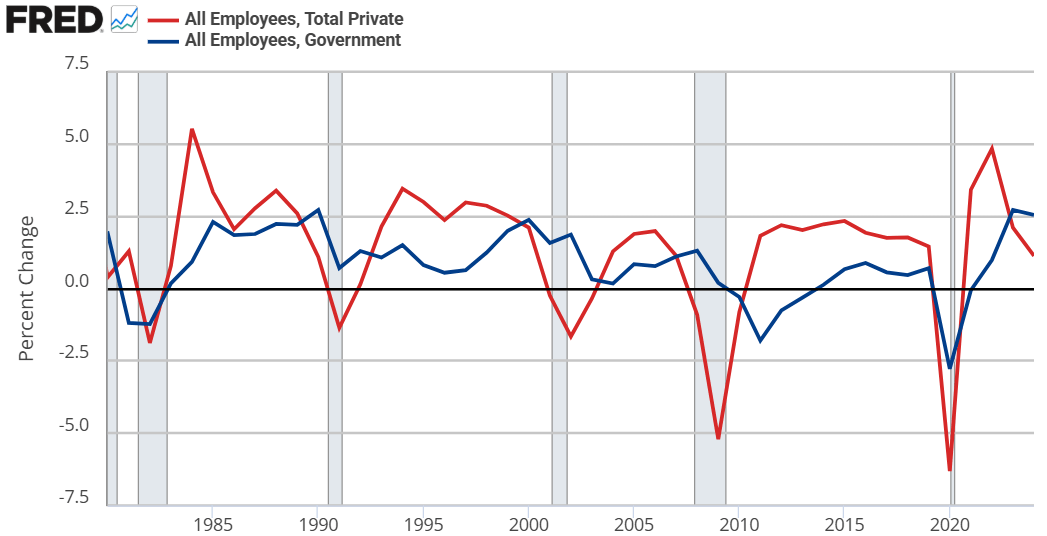
From there, he proceeds to say that if any part of income or employment is guaranteed or stabilized by the government, then the result must be that the risk and volatility is borne elsewhere in the economy. He reasons that if there is a decline in total spending, then stable government pay and employment implies that the private sector must have a deeper recession than the overall economy. Looking at the above graphs, both government employment and the total compensation are much less volatile.

But can’t governments intervene in macroeconomic stabilization policies effectively? Yes! They can and do stabilize the economy, especially with monetary policy. But Hayek is referring to individual stabilizations. For any individual to be guaranteed an income, all others must necessarily experience greater income volatility. How’s that?

Consider two individuals. Person #1 has an average income of $100. In any given year, his income might be $10 – or 10% – higher or lower than average. For the moment, person #2 is not employed and has income volatility of zero. If the government provides a job with a constant pay rate to person #2, then they still have zero income volatility. But instead of earning a consistent $0, person #2 earns a consistent $50. Nice.

Of course, person #2 gets his pay from somewhere. By one means or another, it comes from person #1. Let’s be generous and assume the tax on person #1 has no resulting behavioral effect. His new average income is $50, being $10 higher or lower in any given year. But now, that $10 deviation is over a base of $50 rather than $100. Person #1’s income varies by 20% relative to his new average!

Reasoning through this, we can consider that a person has a stable portion of their income and a volatile portion. If someone takes a part of your stable portion and leaves you with all of your volatile portion, then your remaining income is now more volatile on average. I think that this point is interesting enough all by itself.

IRL, many of our taxes are not lump sum. Rather, progressive taxation causes a negative incentive for production & earnings. The downside is that we produce less. The upside is that the government takes a higher proportion of our volatile income than of our stable income (because income changes are always on the margin and those marginal dollars are taxed at a higher rate). So, the government shares the income volatility of the private sector. By continuing to pay government employees a stable salary, the government is effectively absorbing some of that year-to-year income volatility on behalf of its employees.* The government is, in a sense, providing income insurance to a subgroup.

What does this have to do with The Road to Serfdom? Hayek argues that, as the government employs an increasing proportion of the population, the remaining private sector experiences increasing income and employment volatility. Such volatility increases private risk exposure so much that people begin to fawn over and increasingly compete for the stability found in government work. He gets anthropological and argues that the economic attraction to government jobs will introduce greater competition for those jobs and subsequently greater esteem and respect for those who are able to get them. This process makes the government jobs even more attractive.

My own two cents is that there is nothing internally unstable about this process. Total real income would fall compared to the alternative. However, such a state of affairs might be externally unstable as other governments/economies compete with the increasingly socialist one.


*An important analogue is that firms behave in a similar way. An individual may receive a relatively constant salary so long as they are employed. But the result must be that the firm bears more of the net-profit volatility. So, as more people want stable private sector jobs, the profit volatility of firms would increase and result in greater [seemingly windfall] profits and losses.
Parental Job Lock

The Affordable Care Act was supposed to make it easier for American workers to switch jobs by making it easier to get health insurance from sources other than their current employer. Mostly it didn’t work out that way. But a new paper finds that one piece of the ACA actually made people less likely to switch jobs.

The ACA Dependent Coverage Mandate required family health insurance plans to cover young adults though age 26, when prior to the 2010 passage of the ACA many had to leave the family plan at age 18 or 19. I thought these newly covered young adults would be more likely to switch jobs or start businesses, but there turned out to be absolutely no effect on job switching, and no overall increase in businesses (though it did seem to increase the number of disabled young adults starting businesses, and other parts of the ACA increased business formation among older adults).

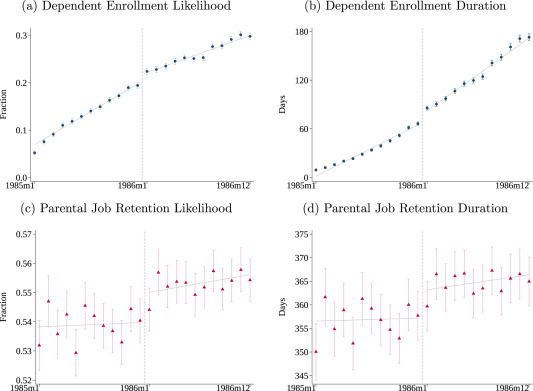
But while the Dependent Coverage mandate seems not to have reduced job lock for young adults, it increased job lock among their parents. That is the finding of a new paper in the Journal of Public Economics by Hannah Bae, Katherine Mackel, and Maggie Shi. Using a large dataset with exact months of age and coverage, MarketScan, allows them to estimate precise effects:

We find that dependents just to the right of the December 1985/January 1986 cutoff—those eligible for longer coverage—are more likely to enroll and remain covered for longer once the mandate is in effect. Dependent enrollment increases by 1.8 percentage points at the cutoff, an increase of 9.2 % over the enrollment rate for dependents born in December 1985. In addition, the enrollment duration increases by 9.7 days (14.6 %). Turning to their parents, we find that parental job retention likelihood increases by 1.0 percentage point (1.8 %) and job duration increases by 5.8 days (1.6 %) to the right of the cutoff. When scaled by the estimated share of dependents on end of year plans, our findings imply that 12 additional months of dependent coverage correspond to a 7.7 % increase in job retention likelihood and a 7.0 % increase in retention duration.

Source: Figure 2 of Bae, Mackel and Shi 2025

I believe in this parental job lock effect partly because of their data and econometric analysis, and partly through introspection. I plan to work for years after I have the money to retire myself in order to keep benefits for my kids, though personally I’m more interested in tuition remission than health insurance.

On top of working longer though, benefits like these enable employers to pay parents lower money wages. A 2022 Labour Economics paper from Seonghoon Kim and Kanghyock Koh found that the Dependent Coverage Mandate “reduced parents’ annual wages by about $2600 without significant reductions in the probability of employment and working hours.” But at least their kids are better off for it.

Is Everyone Going to Europe This Summer?

I had planned to write about the Trump-BLS fight today. But considering that two of my co-bloggers have already written about this (Mike on Monday and Scott on Tuesday) and that I have written about supposedly “fake” jobs numbers before several times (see January 2024 and August 2024), I will hold off on that topic until all of the dust settles. But this is a very important topic, and I believe Trump is clearly in the wrong (as is Kevin Hassett, see my tweets from this week), so please do continue to follow this topic and sane voices on it (see a Tweet from Ernie Tedeschi and from me for a long-run perspective on data accuracy).

But now, on to something a little more light-hearted: is everyone traveling to Europe these days?

Judging by my Facebook feed, it seems that Yes, lots of people are traveling to Europe. But this could be a result of selection bias in at least two ways: the people I am friends with on Facebook, and what people choose to post about on Facebook.

So what does the hard data say? We actually have pretty good long-run data on this question. In short: yes, lots more Americans are traveling to Europe (and overseas generally). Though don’t worry: not everyone went to Europe this summer, despite what social media might have you believe.

For starters, here’s a chart showing three decades of US overseas travel:

Continue reading

Bureau of Labor Statistics Under Siege

Thousands of keyboards were likely drenched four days ago as coffee spewed from thousands of nostrils upon reading the headlines that President Trump fired the head of the Bureau of Labor Statistics because he (the prez) didn’t like the July 2025 job numbers that were reported. Apparently, the job stats were not as great as we had been led to expect for the new regime of tariffs and deportations. (Someone should inform the politicians that businessmen need predictability for making any expansionary plans). So, shoot the messenger, that will fix it.

The First Ire was apparently kindled especially by the truly massive downward revisions to the May (-125,000) and June (-133,000) job figures, which reduced the combined employment gain for those months by 258,000. That made for three anemic employment months in a row, which is a different picture that had been earlier portrayed. For those unfamiliar with past BLS reports, that could seem like manipulation or gross incompetence. For instance, whitehouse.gov published an article titled, “BLS Has Lengthy History of Inaccuracies, Incompetence”, excoriating the “Biden-appointed”, now-fired Erika McEntarfer who “consistently published overly optimistic jobs numbers — only for those numbers to be quietly revised later.”

But massive overestimations of jobs creation, followed a month or two or three later by massive downward revisions are pretty standard procedure for the BLS in recent years. Fellow blogger Jeremy Horpedahl has noted prior occurrences of this, e.g. here and here. There is no reason to suspect nefarious motives, though. The understaffed and overworked folks at BLS seem to be doing the best they can. It is just a fact that some key data simply is not available as early as other data. There are also rational adjustments, e.g. seasonal trends, that must first be estimated, and only later get revised.

Bloomberg explains some of the fine points of the recent revisions:

The downward revision to the prior two months was largely a result of seasonal adjustment for state and local government education, BLS said in earlier comments to Bloomberg. Those sectors substantially boosted June employment only to be largely revised away a month later.

But economists say the revisions also point to a more concerning, underlying issue of low response rates.

BLS surveys firms in the payrolls survey over the course of three months, gaining a more complete picture as more businesses respond. But a smaller share of firms are responding to the first poll. Initial collection rates have repeatedly slid below 60% in recent months — down from the roughly 70% or more that was the norm before the pandemic.

In addition to the rolling revisions to payrolls that BLS does, there’s also a larger annual revision that comes out each February to benchmark the figures to a more accurate, but less timely data source. BLS puts out a preliminary estimate of what that revision will be a few months in advance, and last year [2024], that projection was the largest since 2009.

Perhaps it would be wise for the BLS to hang a big “preliminary” label on any of the earlier results they publish, to minimize the howls when the big revisions hit later. Or perhaps some improvements could be made in pre-adjusting the adjustments, since revisions there do seem to swing things around outrageously. I expect forthcoming BLS reports to be the subject of derision from all sides. We all know which parties will scoff if the job report looks great or if it looks not great. Presumably the interim head of the Bureau, William Wiatrowski, is busy polishing his resume.

And POTUS should be careful what he wishes for – “great” job growth numbers would, ironically, strengthen the case for the Fed to delay the interest rate cuts he so desires.

The (attempted) return of Soviet economic statistics

From Warren Nutter’s “The structure and growth of Soviet industry: A comparison with the United States.” The Journal of Law and Economics 2 (1959): 147-174.:

“Let us acknowledge at once that all statistics contain faults and errors. Let us also acknowledge that no government or other agency resists the temptation to stretch figures to its own account if it feels it can get away with it. Representative government, competitive scholarship, and free public discourse are the Western institutions that have counteracted error and misrepresentation in statistics, imperfectly to be sure, but at least to some degree.

The peculiar difficulties with Soviet statistics stem, in the first instance, from the system of authoritarian, centralized planning-from what has been called a “command economy.” Published statistics come from only one source: the state. There are no independent sources to restrain each other or used as checks against each other, except to the extent that related figures published by different state agencies might not be fully coordinated before publication. At the same time, the suppliers of data to the central authorities -the economic and administrative units- have a stake in the figures they report, since their performance is judged on the basis of them. The Soviet statistical authorities do not hide their concern over the misreporting that results from this feature of the economic system. A second set of difficulties stems from the crusading nature of Soviet communism. Statistics are grist for the propaganda mill. Knowing the ideological views of Soviet leaders, one cannot expect them to dispense facts in a passive and detached manner.”

As many of you likely know, the President fired the director of the Bureau of Labor Statistics because he didn’t like that the newest employment numbers painted an unflattering portrait of the US labor market. Fortunately, the US continues to benefit from alternative to government statistics, but make no mistake, the BLS produces the absolute best labor market measurements the world has ever known.

It’s telling that while Soviet data seemed to often fool outsiders at the time (despite the occasionally raising of doubts), there was no such delusion within the Soviet Union, where provincial leaders would consistently look to outside sources for accurate economic reports.

Nutters is credited with co-founding the “Virginia School of Political Economy” at the University of Virginia with future Nobel Laureate James Buchanan. The Virginia school is most associated with public choice economics, something which by the 70s was often construed as an intellectual counterbalance to the modeling of government as infallible corrective to market failures that was particularly enticing to those favoring a socialist planned economy. That an administration and political coalition that loves to rail against omnipresent socialist threats is demanding that the US embrace a Soviet-style data apparatus is a reminder that history is never without irony.

See New York City for Full Price

I posted See New York City for Free in 2022 and See New York City for Cheap in 2024. In summer 2025, we spent 4 nights in Midtown. I will post general reflections about kids and New York here. Last week, l posted a short itinerary for our half-week in Manhattan with elementary-aged kids, as suggestions for other parents: NYC Family Summer Trip Itinerary

1. Assuming a middle-income family with 1-3 kids, when it comes to travel, I propose Do Less for Preschool. Save money by staying close to home when the kids are under the age of 6. I know people who do international trips with babies, usually because they are visiting family. I have not.

2. A mentor encouraged me to have kids early. One of my objections in 2014 was that I hadn’t traveled the world yet. Everyone I knew was posting selfies in Thailand. How could I have kids if I haven’t even posted from Thailand yet? He told me that you can travel with your kids when they are older. Now it’s 2025. Did that time go by fast? It’s a blur at this point. I remember the time when I read in a book that your kids will potty train themselves if you let them walk around with no diaper. When I tried that, my folks just went on the floor. That’s the stage of life when you might want to put unnecessary travel on hold.

3. Someone had told us that the NYC Subway is not safe and we should not take our kids on it. We used the Subway every day and it was fine. I saw one young man jump the turnstile. The elevator smelled bad. One night when I was checking routes, I noticed a warning on the map reading, “trains are delayed while we request NYPD for someone being disruptive on train…” So, people who rely on the Subway at all times might still have some complaints.

We enjoyed peace and safety in touristy areas between the hours of 8am and 9pm. Were we the beneficiaries of the crime decrease? I saw a bus ad celebrating the decrease in murders in NYC. Before I left Birmingham, Mayor Woodfin announce a big decrease in murders. The trend seems to be real.

4. The Observation Deck of the Empire State Building trip is almost more meta than the MOMA. You are inside the building looking at pictures of the outside of the building. You are posting pictures of yourself next to 50-year-old pictures of the outside of the building. People appear to go to the real thing in order to poast.

You can just do things, as they say, or at least you could in 1930.

Both kids voted that the Empire State Building was more “wow” than the MOMA. Maybe they like constructing more than deconstructing.

5. I vote the Museum of Modern Art (MOMA) as more “wow” because the permanent installations include many famous pieces including Starry Night by Van Gogh.

I had booked a day at MOMA without knowing exactly what was inside. My kids got to see me going around saying things like, “Wow. They have a real Picasso!” Instead of acting as a docent through a world I’ve already explored, my kids get to discover a lot along with me. We discussed what counts as “art” and “how did that get on the wall of a museum?”

6. If you are going to Lower Manhattan to see the New York Stock Exchange and the World Trade Center, don’t miss a free tour of Trinity Church. (Hamilton’s tomb is in the churchyard.) It is an example of progress to see the cathedral dwarfed by the surrounding skyscrapers considering that: “With its 281-foot steeple, the third Trinity Church became the tallest building in the United States.”

Here at EWED, Jeremy has often pointed out that people are richer today than in the past. The maligned Boomers would have seen a shorter New York skyline as children. Many of the supertall glass structures you see today were built after 2001, meaning it’s Gen Z who gets to live with them. (I learned that on our harbor boat tour.)

7. The 7-year-old got Lion King and the M&M store in Times Square. The tour of the United Nations headquarters was for the older people. The 10yo and I learned a lot from an excellent tour guide.

The 7yo had to be carried. She did not understand why they were calling “an emergency meeting on Syria.” The next day I asked her what she remembered from touring the UN. She sincerely replied, “What United Nations?” If you are wondering if she remembers anything from the trip, the answer is yes. The Empire State Building and the Chrysler building, among many other things, are newly part of the family vocabulary.

After the UN tour, I took the family back across 1st Avenue to see the Isaiah Wall. Scaffolding blocked our view, which is not encouraging for the hope of peace. The idea is that: “They shall beat their swords into plowshares, and their spears into pruning hooks; nation shall not lift up sword against nation, neither shall they learn war any more.”

Imagine a child named Johnny trying to form a model of the universe from the journey I set up for my kids this summer. In New York, Johnny embarked on a cultural safari that began at the MoMA, where he stood wide-eyed before melted clocks and soup cans, absorbing the idea that the world might be an absurd, fragmented collage. Then came The Lion King as a dazzling counterpoint, suggesting that the world is imbued with cosmic purpose. Every giraffe, ghost-dad, and blade of savannah grass existed in service of a divine, eternal monarchy. Finally, at the United Nations, he was led past flags and translation booths, where no one bowed to anyone and the world’s contradictions were negotiated over coffee. By the end of the day, Johnny wondered: is meaning a myth, a fact taught by the Spirit, or a matter of committee?

I noticed that they serve Starbucks coffee in the basement of the UN and in the Empire State Building. As long as we can get coffee before and dinner after, no one seems to care if the message is coherent.

Organization of the Federal Reserve – OR, Why The President is Impotent against the Fed

In my recent post that included Federal Reserve political independence, I dared to use the word ‘trust’, and commenters let me know that they were not pleased about it. In strict economic terms, there is no such thing as trust. Either that, or it’s the same thing as expectations or maybe low-information expectations. Since it wasn’t the main thrust of my post, I didn’t lay-out the informed reasoning behind my confidence in President Trump’s inability to cause Argentina or Turkey or even 1970’s US levels of political influence on the Fed.

In short, I’m not worried about it because the operational structure of the Fed and the means by which individuals join the Fed are determined by congress and are pretty robust. Below is a diagram that I made. I know that it’s a lot, but I’ll explain below.

Continue reading