Should Practicing Economists Read Tyler’s New Marginalism Book

Tyler Cowen’s new (free online) book entitled The Marginal Revolution: Rise and Decline, and the Pending AI Revolution is going to be “interesting,” but should you read it?

Mike Makowsky explained that Academic economists are overcommitted

If you are already struggling to meet your deadlines for referee reports you owe to editors, should you take the time? If you don’t have time to indulge your curiosity about the 18th century and dead thinkers, right in the middle of the semester, should you look at it now or maybe browse it over the summer?

I think it’s worth going straight to the last chapter right now.

“Chapter 4: Why Marginalism Will Dwindle, and What Will Replace It?

It was written for you and released quickly for this moment. Tyler does not personally have to worry about his job, but you might.

This link will take you straight to an in-browser e-reader https://tylercowen.com/marginal-revolution-generative-book/app/

Or you can download the PDF at https://tylercowen.com/wp-content/uploads/2026/03/TheMarginalRevolution-Tyler_Cowen.pdf

You might face mental resistance to reading this chapter, because you don’t want to hear the message. If that’s you, then it’s especially useful to read this chapter. He’s not correct about everything. Develop your counter argument, to go forth and save marginalism. You can only do that if you understand and name the threats. This is more about methods/professions and less about ideology than you might think from the title.

Here are some quotes that stood out to me

The ties of empirical work in economics to economic theory are evolving, and in particular the explicit ties to intuitive microeconomic reasoning, and marginalist thinking, are being cut. In much of traditional econometrics, the emphasis is on testing pre-existing models…

in machine learning, we let the algorithm build the “theory” for us, noting it may have tens of millions of variables and thus not count as a theory…

So much for prediction, what about hypothesis generation? Well, there is a new approach to that too, using machine learning.

A lot of economists do not regularly describe what they actually do for work. Yes, we are saving the world by writing papers, but what exactly do you do? Do you generate hypotheses? Is that what you are teaching your students to do?

It’s not fun to think of how the econ profession might need to reposition, but we owe it to students. Who better to work on this than tenured professors? 

I think the case for undergraduates students to major in economics is strong. I also think the case for doing 4 years of college is strong for students who want to learn.

Last summer I wrote: Students still need to learn principles

If economics is “more interesting” than hard science, then it might serve to scoop up good thinkers at the undergraduate level and get them doing something more technical than what they would end up doing in a humanities program. When I graduated from college, the fact that most econ student had accidentally learned to code was a benefit to them.

College graduate humans ought to be able to read and pass the Turing Test if they are going to be effective complements to AI.

Economists championing marginalism for students, today, write: For Gen Z, Economics May Be the Key to Success in the New AI World

Let me plug Mike as well for thinking about what research econs do in 2026: The actual AI problem in academic economics “Oh, what shall all the candlemakers do now that the sun has risen?” made me laugh.

An Expensive Easter

Americans like their food. Holidays are often known by the dishes that we serve. Thanksgiving is a bit unique in that most of us converge on turkey, though diversity obviously exists. What about Easter? There’s not really the same focus on a single food like there is for Thanksgiving. My impression is that people eat daytime or lunch foods that include ham, lamb, or just about anything. My family tends to make tacos.

What am I saying?! We eat candy! Solid or hollow chocolate bunnies, jellybeans, peeps, and on and on. We fill Easter eggs and keep candy around the office. We literally have baskets full of candy.

A Chocolate Bunny? In this economy?

Have you seen the price of chocolate? Yeesh! The latest figures are from February and the prices for chocolate and cocoa bean products are down 11.7%  year-over-year. That’s nice, you may think, our budgets can fit a bit more chocolate into our consumer – I mean Easter – baskets. Great news. The news seems a little less great when you realize that February’s price of chocolate was 90% higher than it was four years earlier in 2022. 90% higher is a lot like 100%, and 100% is double! In fact, the price had peaked at 142% higher by September of 2025, and now prices are quickly falling. See the chocolate-colored line in the graph below.

Continue reading

How Much To Trust Research Papers? My Rules Of Thumb

  1. Trust literatures over single papers
  2. Common sense and Bayes’ Rule agree: extraordinary claims require extraordinary evidence
  3. Trust more when papers publicly share their data and code
  4. Trust higher-ranked journals more up to the level of top subfields (e.g. Journal of Health Economics, Journal of Labor Economics), but top general-interest journals can be prone to relaxing standards for sensationalist or ideologically favored claims (e.g. The Lancet, PNAS, Science/Nature when covering social science)
  5. More recent is better for empirical papers, data and methods have tended to improve with time
  6. Overall effects are more trustworthy than interaction or subgroup effects, the latter two are easier to p-hack and necessarily have lower statistical power
  7. Trust large experiments most, then quasi-experiments, then small experiments, then traditional regression (add some controls and hope for the best)
  8. The real effect size is half what the paper claims

That last is inspired by a special issue of Nature out today on the replicability of social science research. An exception to rule #4, this is an excellent project I will write more about soon.

Real Wages Today are Much Higher Than 1894, But Are Workers Still Getting Squeezed by Rent?

A recent viral Tweet shares a political cartoon from 1894, which shows a worker being squeezed by high rents and low wages. The Tweet claims “the problem has only gotten worse.”

Can this be true? Are workers today actually worse off than they were in 1894? At first blush, this seems obviously wrong. Here is a chart I created showing real (inflation-adjusted) wages since 1894. They are eight times higher today (I have combined two wage series and two price indices, so don’t take this as being perfect, but roughly accurate).

Figure 1

Whatever concerns we might have about high rents today, there must have been some other major improvements in the cost of living relative to wage increases since 1894, given that one hour of work can purchase about 8 times as many real goods and services today.

But is there a narrower case for the cartoon? What if we only focus on wages? We can do this by using a great new resource from the Philadelphia Fed, which provides some long-run data on housing prices in the US, for both purchasing a home and renters. The data series conveniently goes all the way back to 1890, so we can make the comparison with 1894 using the nominal rent index (it ends in 2006, but we can merge it with the modern CPI for rental housing). What if we compare this rental price series to the same wage series I used in the chart above?

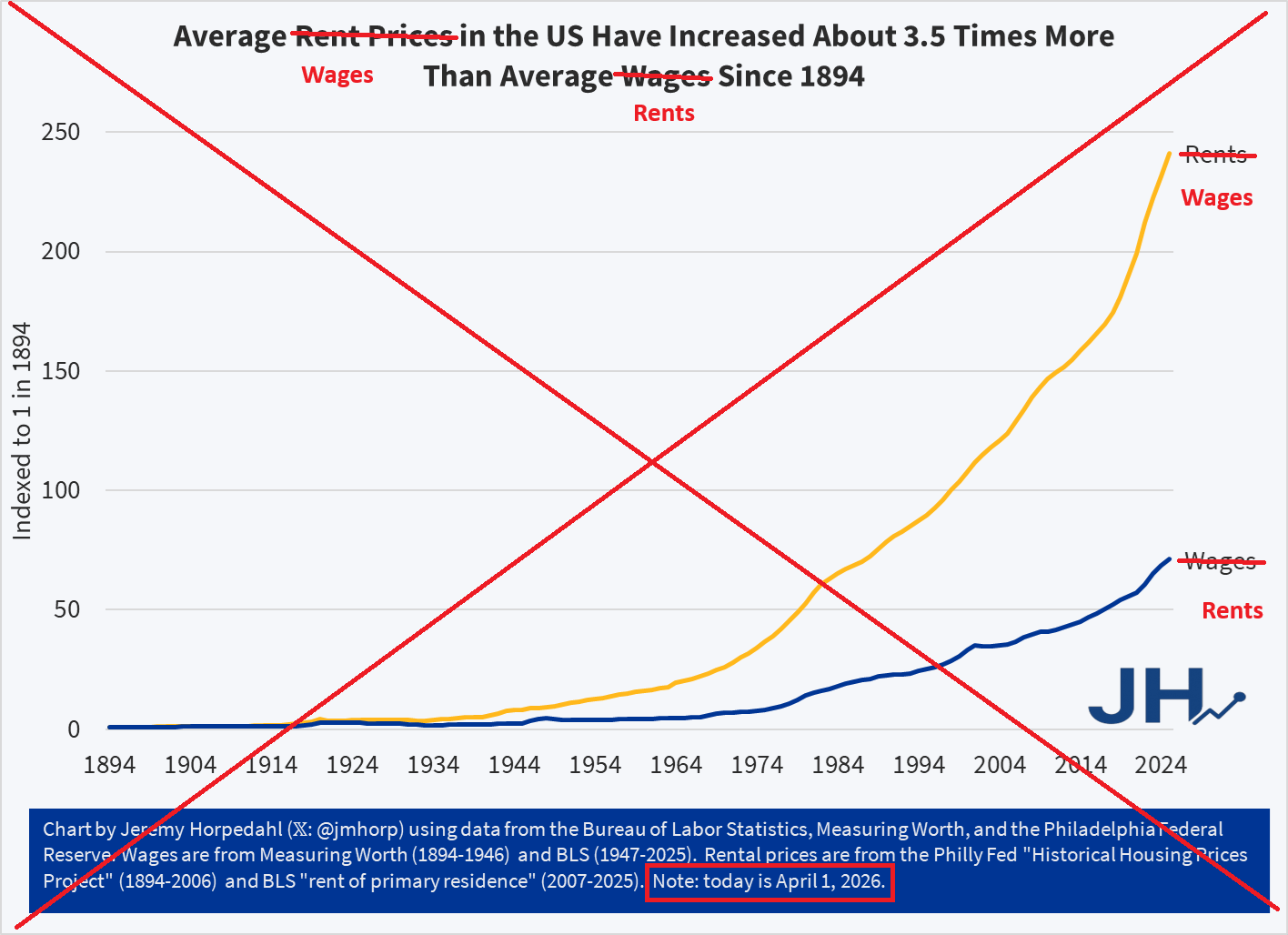
Figure 2

The trend in this second chart is very troubling. Rents have increased much faster than nominal wages. While other goods and services may be more affordable, rents — which consume around 24 percent of household income for renters — are rising relative to wages. Sure, we can talk all day about how the quality has improved — larger apartments, indoor plumbing, modern safety features that didn’t exist in 1894 — yet still, renters can only rent what is available. And today rental housing is much more expensive than on April 1, 1894.

APRIL FOOLS!

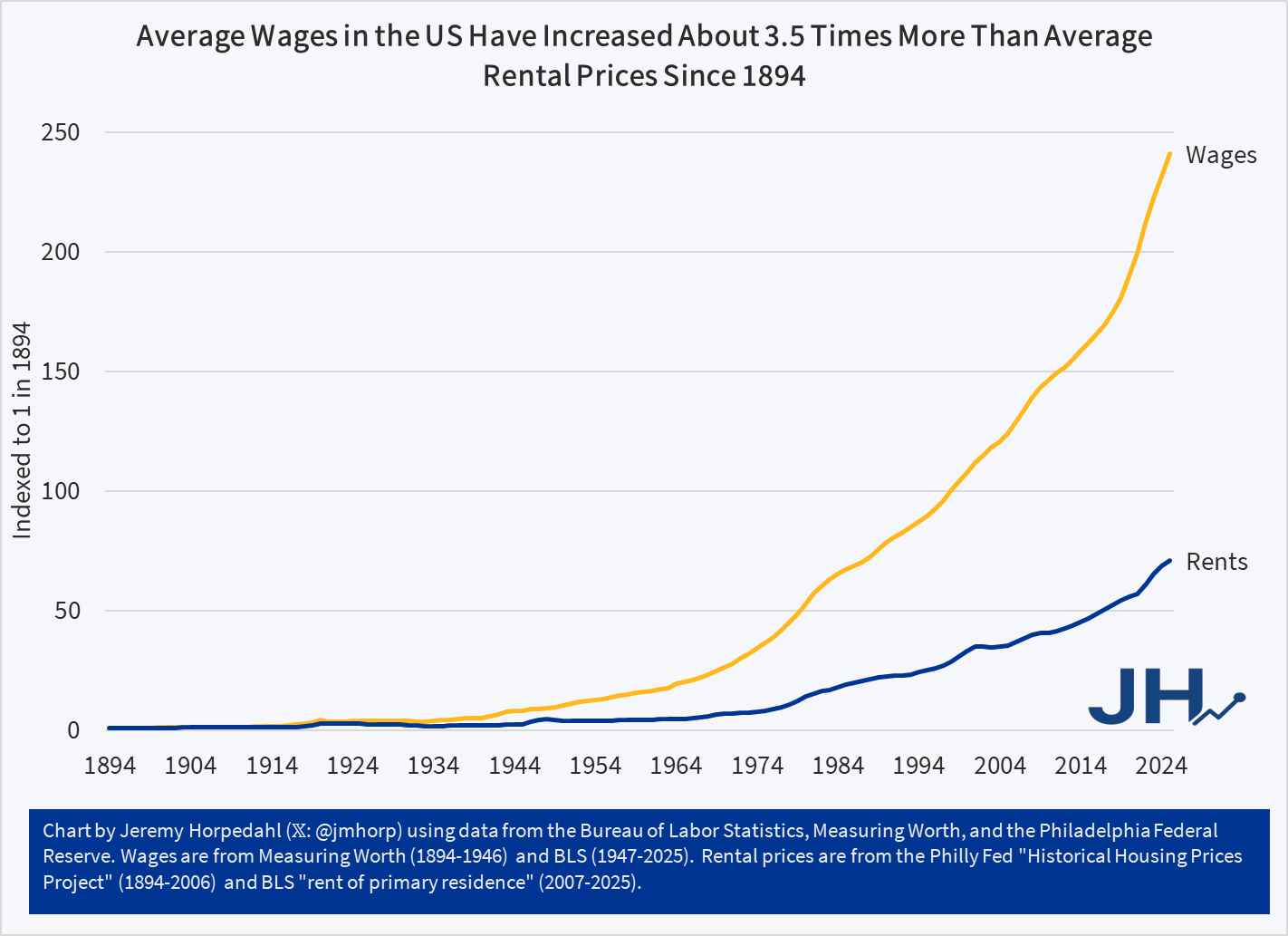
The data was all correct, other than the fact that I tricked you by swapping the wage and rent lines. Wages have actually increased much faster than rents since 1894 (though they have increased roughly equal rates in recent decades). Sorry for that little trick, I’m a little surprised no one noticed. Perhaps I am just too well-known for being a straight shooter with data. Here is the real chart: